


 |
市場調查報告書
商品編碼
2124463
全球一次性塑膠包裝:市場佔有率分析、產業趨勢與統計及成長預測(2026-2031年)Global Single Use Plastic Packaging - Market Share Analysis, Industry Trends & Statistics, Growth Forecasts (2026 - 2031) |
||||||

※ 本網頁內容可能與最新版本有所差異。詳細情況請與我們聯繫。
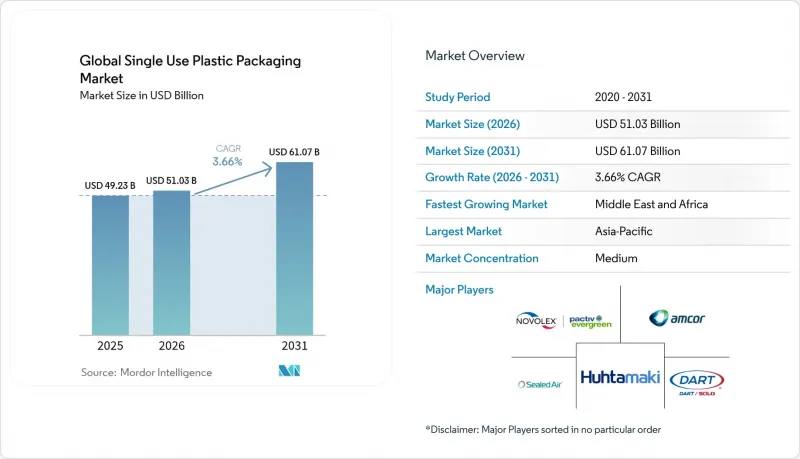
根據 Mordor Intelligence 預測,一次性塑膠包裝市場規模將從 2025 年的 492.3 億美元成長到 2026 年的 510.3 億美元,然後在 2031 年達到 610.7 億美元,2026 年至 2031 年的複合年成長率為 3.6%。
本報告按材料(聚對苯二甲酸乙二醇酯 (PET)、聚乙烯 (PE) 等)、產品類型(瓶裝、軟包裝袋/小袋等)、終端用戶行業(快餐店 (QSR)、正餐餐廳 (FSR)、食品飲料等)、配銷通路(直銷、間接銷售)和地區進行細分。市場預測以美元 (USD) 為單位。
全球一次性塑膠包裝市場趨勢及洞察
亞洲特大城市基於應用程式的食品配送蓬勃發展
在印尼、泰國和越南,數位食品配送交易持續保持兩位數成長,推動了對能夠承受摩托車運輸的防漏隔熱包裝的需求成長。雅加達的企業目前將訂單金額的15%至20%用於包裝,促使供應商開發可堆疊設計,以防止洩漏並提升品牌知名度。隨著單身家庭的增多,小容量包裝越來越受歡迎,迷你容器和雙隔層包裝也隨之普及。配送平台的標準化簡化了產品種類,促進了規模經濟,而地方政府則大力推廣使用後回收計劃,以支持新興的回收基礎設施。這些因素共同推動了需求成長,並加速了單一材料複合材料的轉變,以方便下游工序的分類。
歐盟關於「封頂」的規定正在加速單一材料PET的採用。
歐洲強制使用繫繩式瓶蓋的規定於2024年7月生效,正在推動瓶裝生產線的快速轉型。光是可口可樂一家就已在40個地點投資1.5億歐元,並且95%的消費者都接受了這個改變。供應商們積極回應,提供可與原生PET、再生PET和生物基PET瓶完美匹配的繫繩式瓶蓋,從而提高了PET的回收率,並增強了PET回收的優勢。加州預計將在2027年效仿,從而建立一個事實上的全球標準,這將有利於那些能夠進行大規模設備升級的生產商。 Origin Materials公司的可互通瓶蓋展示了法規如何推動產品特性的差異化發展,例如符合人體工學的改進和防篡改功能。
易於取得替代品
在對阻隔性能要求較不嚴格的領域,纖維基蓋、模塑紙漿托盤和生物基薄膜的需求正在不斷成長。台灣麥當勞計畫在2025年前從菜單中淘汰塑膠複合材料,每年可節省86噸樹脂,並保護1萬棵樹木。歐盟法規要求在2030年實現可回收利用,促使各品牌加速試行推廣含有54%木質纖維素的可堆肥肉類托盤。北美Dart Containers公司推出的乾式模塑纖維技術已將能耗降低了80%,並且在成本上比傳統的EPS更具競爭力。隨著模塑技術的普及,一次性塑膠包裝市場的競爭日益激烈,尤其是在低溫和短壽命應用領域。
細分市場分析
預計到2025年,PET將佔據一次性塑膠包裝市場34.68%的佔有率,隨著瓶到瓶循環利用的成熟,其領先優勢將以6.95%的複合年成長率進一步擴大。歐洲要求飲料瓶中必須含有30%的再生材料,這推動了對rPET薄片的高階需求,並促使相關投資,例如Ganesha EcoPET公司每年新增4.2萬噸產能,以滿足當地品牌的配額要求。 PET的可回收性、阻隔性、透明度和與繫繩蓋的兼容性,共同鞏固了其在飲料和個人保健產品領域的地位。
聚乙烯和聚丙烯因其用途廣泛且成本效益高,仍然是薄膜、包裝袋和瓶蓋的關鍵材料,但隨著監管機構將目標轉向難以回收的多層複合材料,它們的成長速度正在放緩。聚苯乙烯由於監管禁令,在餐飲服務業的市場佔有率正在下降,而生物基聚合物在性能和可堆肥性要求相符的細分市場中正獲得發展動力。儘管大型科技公司正在推動化學回收試點項目,但在實現規模經濟之前,PET在一次性塑膠包裝市場仍可能保持實際優勢。
由於瓶蓋的廣泛應用以及隨時隨地補充水分的趨勢,瓶裝產品預計將保持其最大的市場佔有率,到2025年將佔銷售額的30.12%。然而,袋裝和小袋表現優異,複合年成長率達到4.98%,這主要得益於機能飲料、調味品和個人保健產品填充用的強勁成長。憑藉FDA批准的超薄阻隔膜,品牌可以在保持保存期限的同時,將包裝重量減輕30%,因此袋裝產品已成為控制份量和電子商務的首選。
對於翻蓋式包裝盒、托盤和杯子,人們的意見不一。雖然零售生鮮食品區更傾向於使用rPET熱成型容器,但快餐店正在試用纖維碗以符合當地法規。薄膜和包裝紙受益於線上食品銷售的成長,但面臨可回收性方面的挑戰,這促使一個聯盟致力於標準化單一材料PE結構。在所有產品形式中,「可回收設計」都是關鍵的選擇標準,推動了對支援重點區域路邊回收解決方案的投資。
區域分析
亞太地區佔一次性塑膠包裝市場39.85%的佔有率,反映了該地區製造業的規模、都市區的成長以及不斷壯大的中產階級。預計到2024年,中國包裝產業的產值將達到2.3兆元人民幣,這主要得益於線上生鮮銷售和冷鏈領域的投資熱潮,這些領域對EPS和rPET解決方案的需求日益成長。印度正受惠於吸塑包裝出口和食品配送市場的成長而蓬勃發展,而東南亞的電子商務交易量增加了35%,從而推動了對防護性郵寄包裝材料的需求。
北美市場呈現出成熟而又充滿活力的格局,各州對再生材料含量的禁令和配額制度對其產生了影響。加州的《生產者延伸責任法案》影響了全美各地的品牌規範,其目標30%為PCR PET含量,領先聯邦指導方針。機械和化學回收領域的投資正在不斷成長,安姆科已簽訂多年期機械回收聚乙烯契約,以確保原料的穩定供應。
歐洲在監管方面仍處於領先地位,其《一次性塑膠指令》、《PPWR》和《繫繩瓶蓋法案》引領全球設計範本。合規成本雖然推動了產業重組,但也刺激了單一材料軟性結構和模塑纖維紀念瓶蓋的創新。
中東和非洲地區正引領經濟成長,預計到2031年年複合成長率(CAGR)將達到5.45%。沙烏地阿拉伯的「2030願景」旅遊策略促使其遊客數量在2024年成長了56%,從而推動了瓶裝水包裝需求的激增。 Masafi公司已投資1.2億迪拉姆擴大產能,以滿足與旅館業的合約需求。諸如NEOM等大型基礎設施項目也推動了對能夠承受沙漠物流環境惡劣條件的防護和阻隔材料的需求成長,供應商正在加快在各地區建立回收中心。
在拉丁美洲,包裝產業正在局部擴張,尤其是在巴西,預計到 2024 年,巴西的包裝產量將增加 8%。儘管外匯波動和監管不一致限制了外國投資,但當地加工商正在升級設備,以抓住跨境電子商務中一次性塑膠包裝市場的機會。
其他好處:
- Excel格式的市場預測(ME)表
- 3個月的分析師支持
目錄
第1章:引言
- 研究假設和市場定義
- 調查範圍
第2章:調查方法
第3章執行摘要
第4章 市場狀況
- 市場概覽
- 市場促進因素
- 亞洲特大城市基於應用程式的食品配送蓬勃發展
- 歐盟的「捆綁式封頂」法規正在加速單一材料PET的採用。
- 在北美,即飲機能飲料正在推動對輕質阻隔包裝袋的需求。
- 在印度,藥品泡殼包裝生產的外包業務正在快速成長。
- 海灣主導激增
- 中國都市區冷鏈的擴展正在推動對EPS托盤的需求。
- 市場限制因素
- 易於取得替代品
- 歐盟的永續塑膠指令迫使品牌商過渡到紡織基替代材料。
- 樹脂價格波動與原油價格相關
- 美國多個州禁止使用刀叉餐具吸管
- 供應鏈分析
- 監理展望
- 技術展望
- 波特五力分析
- 投資分析
第5章 市場規模與成長預測
- 材料
- 聚對苯二甲酸乙二醇酯(PET)
- 聚乙烯(PE)
- 聚丙烯(PP)
- 聚苯乙烯(PS)
- 其他材料
- 依產品類型
- 瓶子
- 小袋
- 蛤殼
- 托盤、杯子、蓋子
- 薄膜包裝
- 其他產品類型
- 按最終用途行業分類
- 速食店(QSR)
- 全方位服務餐廳 (FSR)
- 食品/飲料
- 醫療和藥品
- 個人護理化妝品
- 其他終端用戶產業
- 透過分銷管道
- 直銷
- 間接銷售
- 按地區
- 北美洲
- 美國
- 加拿大
- 墨西哥
- 歐洲
- 德國
- 英國
- 法國
- 義大利
- 西班牙
- 俄羅斯
- 其他歐洲國家
- 亞太地區
- 中國
- 印度
- 日本
- 韓國
- 澳洲和紐西蘭
- 其他亞太國家
- 中東和非洲
- 中東
- 阿拉伯聯合大公國
- 沙烏地阿拉伯
- 土耳其
- 其他中東國家
- 非洲
- 南非
- 奈及利亞
- 埃及
- 其他非洲國家
- 中東
- 南美洲
- 巴西
- 阿根廷
- 其他南美國家
- 北美洲
第6章 競爭情勢
- 市場集中度
- 策略趨勢
- 市佔率分析
- 公司簡介
- Amcor plc
- Novolex
- Huhtamaki Oyj
- Sealed Air Corp.
- Dart Container Corp.
- Graphic Packaging International LLC
- Winpak Ltd.
- Sonoco Products Co.
- Reynolds Consumer Products
- Sabert Corp.
- Genpak LLC
- Coveris Holdings
- Fabri-Kal
- Inteplast Group
- Hotpack Packaging Industries LLC
- Alpla Werke Alwin Lehner GmbH
- Plastipak Holdings
第7章 市場機會與未來展望
According to Mordor Intelligence, the single-use plastic packaging market size is expected to grow from USD 49.23 billion in 2025 to USD 51.03 billion in 2026 and is forecast to reach USD 61.07 billion by 2031 at 3.66% CAGR over 2026-2031.
This report is Segmented by Material (Polyethylene Terephthalate (PET), Polyethylene (PE), and More), Product Type (Bottles, Pouches and Sachets, and More), End-Use Industry (Quick-Service Restaurants (QSR), Full-Service Restaurants (FSR), Food and Beverages, and More), Distribution Channel (Direct Sales, Indirect Sales), and Geography. The Market Forecasts are Provided in Terms of Value (USD).
Global Single Use Plastic Packaging Market Trends and Insights
App-based Food-Delivery Boom in Asian Megacities
Indonesia, Thailand and Vietnam continue to report double-digit growth in digital food-delivery transactions, elevating demand for leak-proof, temperature-retentive packs that survive motorcycle logistics. Jakarta operators now allocate 15-20% of order value to packaging, prompting suppliers to engineer stackable designs that cut spillage and enhance brand visibility. A widening base of single-person households favors smaller portions, spurring mini-tub and two-compartment formats. Delivery-platform standardization simplifies SKUs and aids scale economies, while local governments encourage post-use collection schemes that feed emerging recycling infrastructure. These converging forces lift volume yet accelerate the switch to mono-material laminates to ease downstream sorting.
EU Tethered-Cap Rule Accelerating Mono-Material PET Adoption
Europe's July 2024 tethered-cap mandate has driven rapid conversion of bottling lines; Coca-Cola alone invested EUR 150 million across 40 sites and achieved 95% consumer acceptance. Suppliers respond with tethered closures that mate seamlessly to virgin, recycled and bio-PET bottles, boosting capture rates and reinforcing PET's recycling advantage. California will follow by 2027, creating a de-facto global standard that favors producers able to retrofit at scale. Origin Materials' cross-compatible caps showcase how regulation spurs differentiated product features such as enhanced ergonomics and tamper evidence.
Easy Availability of Substitutes
Fiber-based lids, molded-pulp trays and bio-derived films erode demand where barrier rigor is moderate. McDonald's Taiwan removed plastic lamination from menus in 2025, saving 86 t of resin annually and preserving 10,000 trees. EU rules requiring recyclability by 2030 accelerate brand pilots of compostable meat trays containing 54% wood cellulose. Dry-molded fiber technology introduced by Dart Container in North America cuts energy use by 80%, improving cost competitiveness against legacy EPS. As tooling migrates, the single-use plastic packaging market faces intensified competition in low-temperature or short-life applications.
Other drivers and restraints analyzed in the detailed report include:
- RTD Functional Beverages Spurring Lightweight Barrier Pouches
- India's Pharma Blister Outsourcing Surge
- Crude-Linked Resin Price Volatility
For complete list of drivers and restraints, kindly check the Table Of Contents.
Segment Analysis
PET captured 34.68% of the single-use plastic packaging market share in 2025 and is expected to widen its lead at a 6.95% CAGR as bottle-to-bottle loops mature. Europe's 30% recycled-content order for beverage bottles underpins premium demand for rPET flake, prompting investments like Ganesha Ecopet's 42,000 t pa expansion to meet local brand quotas. Recyclability, barrier clarity and tethered-cap compatibility combine to cement PET's role in beverage and personal-care aisles.
Polyethylene and polypropylene remain workhorses in films, bags and closures thanks to versatility and cost, yet growth lags as regulators target harder-to-recycle multi-layer laminates. Polystyrene loses share in food service due to bans, while bio-based polymers gain niche traction where performance demands align with compostability mandates. Tech giants push chemical recycling pilots, but until scale and economics converge, PET retains its pragmatic superiority in the single-use plastic packaging market.
Bottles retain the largest revenue slice at 30.12% in 2025, benefiting from tethered-cap rollouts and on-the-go hydration trends. Even so, pouches and sachets outpace at 4.98% CAGR, driven by functional drinks, condiments and personal-wash refills. FDA-approved ultra-thin barrier films help brands shed 30% of pack weight while preserving shelf stability, making pouches the go-to for portion control and e-commerce.
Clamshells, trays and cups navigate mixed signals: retail produce favors rPET thermoforms, while quick-service eateries trial fiber bowls to satisfy local ordinances. Films and wraps enjoy e-grocery tailwinds but confront recyclability gaps, prompting consortium efforts to standardize mono-material PE structures. Across formats, design-for-recycling becomes a core selection criterion, steering capital toward solutions compatible with curbside collection in leading regions.
Complete Report Scope:
- By Material
- Polyethylene Terephthalate (PET)
- Polyethylene (PE)
- Polypropylene (PP)
- Polystyrene (PS)
- Other Materials
- By Product Type
- Bottles
- Pouches and Sachets
- Clamshells
- Trays, Cups and Lids
- Films and Wraps
- Other Product Types
- By End-Use Industfy
- Quick-Service Restaurants (QSR)
- Full-Service Restaurants (FSR)
- Food and Beverages
- Healthcare and Pharmaceutical
- Personal Care and Cosmetics
- Other End-Use Industry
- By Distribution Channel
- Direct Sales
- Indirect Sales
- By Geography
- North America
- United States
- Canada
- Mexico
- Europe
- Germany
- United Kingdom
- France
- Italy
- Spain
- Russia
- Rest of Europe
- Asia-Pacific
- China
- India
- Japan
- South Korea
- Australia and New Zealand
- Rest of Asia-Pacific
- Middle East and Africa
- Middle East
- United Arab Emirates
- Saudi Arabia
- Turkey
- Rest of Middle East
- Africa
- South Africa
- Nigeria
- Egypt
- Rest of Africa
- Middle East
- South America
- Brazil
- Argentina
- Rest of South America
- North America
Geography Analysis
Asia-Pacific's 39.85% slice of the single-use plastic packaging market reflects the region's manufacturing heft, urban population growth and expanding middle class. China's packaging sector generated RMB 2.3 trillion in output during 2024, supported by e-grocery and cold-chain investment waves that demand EPS and rPET solutions. India adds momentum through blister exports and food-delivery growth, while Southeast Asia posts 35% e-commerce transaction expansion that lifts protective mailer demand.
North America exhibits mature but dynamic conditions shaped by state-level bans and recycled-content quotas. California's extended producer responsibility law influences brand specifications nationwide, pushing 30% PCR PET targets ahead of federal guidelines. Investments in mechanical and chemical recycling proliferate; Amcor entered a multiyear mechanically-recycled PE deal to secure feedstock continuity.
Europe remains the regulatory vanguard, with the Single-Use Plastics Directive, PPWR and tethered-cap law steering global design templates. Compliance costs drive consolidation yet also catalyze innovation in mono-material flexible structures and molded-fiber keepsake lids.
The Middle East & Africa lead growth at 5.45% CAGR through 2031. Saudi Arabia's Vision 2030 tourism strategy lifted visitor arrivals 56% in 2024, fueling bottled-water packaging spikes; Masafi invested AED 120 million in capacity enhancements to serve hospitality contracts. Infrastructure mega-projects such as NEOM expand demand for protective and barrier materials able to withstand desert logistics stresses, incentivizing suppliers to site recycling hubs regionally.
Latin America delivers pockets of expansion, notably Brazil where packaging production rose 8% in 2024. Currency fluctuations and uneven regulation temper foreign investment, but local processors upgrade equipment to tap the single-use plastic packaging market opportunity in cross-border e-commerce.
- Amcor plc
- Novolex
- Huhtamaki Oyj
- Sealed Air Corp.
- Dart Container Corp.
- Graphic Packaging International LLC
- Winpak Ltd.
- Sonoco Products Co.
- Reynolds Consumer Products
- Sabert Corp.
- Genpak LLC
- Coveris Holdings
- Fabri-Kal
- Inteplast Group
- Hotpack Packaging Industries LLC
- Alpla Werke Alwin Lehner GmbH
- Plastipak Holdings
Additional Benefits:
- The market estimate (ME) sheet in Excel format
- 3 months of analyst support
TABLE OF CONTENTS
1 INTRODUCTION
- 1.1 Study Assumptions and Market Definition
- 1.2 Scope of the Study
2 RESEARCH METHODOLOGY
3 EXECUTIVE SUMMARY
4 MARKET LANDSCAPE
- 4.1 Market Overview
- 4.2 Market Drivers
- 4.2.1 App-based Food-Delivery Boom in Asian Megacities
- 4.2.2 EU Tethered-Cap Rule Accelerating Mono-Material PET Adoption
- 4.2.3 RTD Functional Beverages Spurring Lightweight Barrier Pouches in North America
- 4.2.4 India's Pharma Blister Outsourcing Surge
- 4.2.5 Tourism-Led Bottled-Water Demand Spike in GCC
- 4.2.6 Urban China Cold-Chain Expansion Driving EPS Trays
- 4.3 Market Restraints
- 4.3.1 Easy Availability of Substitutes
- 4.3.2 EU SUP Directive Pushing Brands to Fiber Substitutes
- 4.3.3 Crude-Linked Resin Price Volatility
- 4.3.4 US State-Level Bans on Cutlery and Straws
- 4.4 Supply-Chain Analysis
- 4.5 Regulatory Outlook
- 4.6 Technological Outlook
- 4.7 Porter's Five Forces Analysis
- 4.7.1 Bargaining Power of Suppliers
- 4.7.2 Bargaining Power of Buyers
- 4.7.3 Threat of New Entrants
- 4.7.4 Threat of Substitutes
- 4.7.5 Intensity of Competitive Rivalry
- 4.8 Investment Analysis
5 MARKET SIZE AND GROWTH FORECASTS
- 5.1 By Material
- 5.1.1 Polyethylene Terephthalate (PET)
- 5.1.2 Polyethylene (PE)
- 5.1.3 Polypropylene (PP)
- 5.1.4 Polystyrene (PS)
- 5.1.5 Other Materials
- 5.2 By Product Type
- 5.2.1 Bottles
- 5.2.2 Pouches and Sachets
- 5.2.3 Clamshells
- 5.2.4 Trays, Cups and Lids
- 5.2.5 Films and Wraps
- 5.2.6 Other Product Types
- 5.3 By End-Use Industfy
- 5.3.1 Quick-Service Restaurants (QSR)
- 5.3.2 Full-Service Restaurants (FSR)
- 5.3.3 Food and Beverages
- 5.3.4 Healthcare and Pharmaceutical
- 5.3.5 Personal Care and Cosmetics
- 5.3.6 Other End-Use Industry
- 5.4 By Distribution Channel
- 5.4.1 Direct Sales
- 5.4.2 Indirect Sales
- 5.5 By Geography
- 5.5.1 North America
- 5.5.1.1 United States
- 5.5.1.2 Canada
- 5.5.1.3 Mexico
- 5.5.2 Europe
- 5.5.2.1 Germany
- 5.5.2.2 United Kingdom
- 5.5.2.3 France
- 5.5.2.4 Italy
- 5.5.2.5 Spain
- 5.5.2.6 Russia
- 5.5.2.7 Rest of Europe
- 5.5.3 Asia-Pacific
- 5.5.3.1 China
- 5.5.3.2 India
- 5.5.3.3 Japan
- 5.5.3.4 South Korea
- 5.5.3.5 Australia and New Zealand
- 5.5.3.6 Rest of Asia-Pacific
- 5.5.4 Middle East and Africa
- 5.5.4.1 Middle East
- 5.5.4.1.1 United Arab Emirates
- 5.5.4.1.2 Saudi Arabia
- 5.5.4.1.3 Turkey
- 5.5.4.1.4 Rest of Middle East
- 5.5.4.2 Africa
- 5.5.4.2.1 South Africa
- 5.5.4.2.2 Nigeria
- 5.5.4.2.3 Egypt
- 5.5.4.2.4 Rest of Africa
- 5.5.4.1 Middle East
- 5.5.5 South America
- 5.5.5.1 Brazil
- 5.5.5.2 Argentina
- 5.5.5.3 Rest of South America
- 5.5.1 North America
6 COMPETITIVE LANDSCAPE
- 6.1 Market Concentration
- 6.2 Strategic Moves
- 6.3 Market Share Analysis
- 6.4 Company Profiles (includes Global level Overview, Market level overview, Core Segments, Financials as available, Strategic Information, Market Rank/Share for key companies, Products and Services, and Recent Developments)
- 6.4.1 Amcor plc
- 6.4.2 Novolex
- 6.4.3 Huhtamaki Oyj
- 6.4.4 Sealed Air Corp.
- 6.4.5 Dart Container Corp.
- 6.4.6 Graphic Packaging International LLC
- 6.4.7 Winpak Ltd.
- 6.4.8 Sonoco Products Co.
- 6.4.9 Reynolds Consumer Products
- 6.4.10 Sabert Corp.
- 6.4.11 Genpak LLC
- 6.4.12 Coveris Holdings
- 6.4.13 Fabri-Kal
- 6.4.14 Inteplast Group
- 6.4.15 Hotpack Packaging Industries LLC
- 6.4.16 Alpla Werke Alwin Lehner GmbH
- 6.4.17 Plastipak Holdings
7 MARKET OPPORTUNITIES AND FUTURE OUTLOOK
- 7.1 White-Space and Unmet-Need Assessment

 2026年全球聚苯乙烯包裝市場報告
 2035 年前食品飲料塑膠包裝市場分析與預測:類型、產品類型、技術、應用、材料類型、製造流程、最終用戶、功能
 中東和非洲塑膠包裝市場:市場佔有率分析、行業趨勢和統計數據以及成長預測(2026-2031 年)亞太地區塑膠包裝:市場佔有率分析、產業趨勢與統計及成長預測(2026-2031)全球塑膠包裝:市場佔有率分析、產業趨勢與統計及成長預測(2026-2031年)印度塑膠包裝:市場佔有率分析、產業趨勢與統計及成長預測(2026-2031)日本塑膠包裝市場:市場佔有率分析、產業趨勢與統計及成長預測(2026-2031)美國塑膠包裝:市場佔有率分析、產業趨勢與統計及成長預測(2026-2031)英國塑膠包裝:市場佔有率分析、產業趨勢與統計、成長預測(2026-2031)印尼塑膠包裝市場:市場佔有率分析、產業趨勢與統計及成長預測(2026-2031)