


 |
市場調查報告書
商品編碼
2121743
美國塑膠包裝:市場佔有率分析、產業趨勢與統計及成長預測(2026-2031)US Plastic Packaging - Market Share Analysis, Industry Trends & Statistics, Growth Forecasts (2026 - 2031) |
||||||

※ 本網頁內容可能與最新版本有所差異。詳細情況請與我們聯繫。
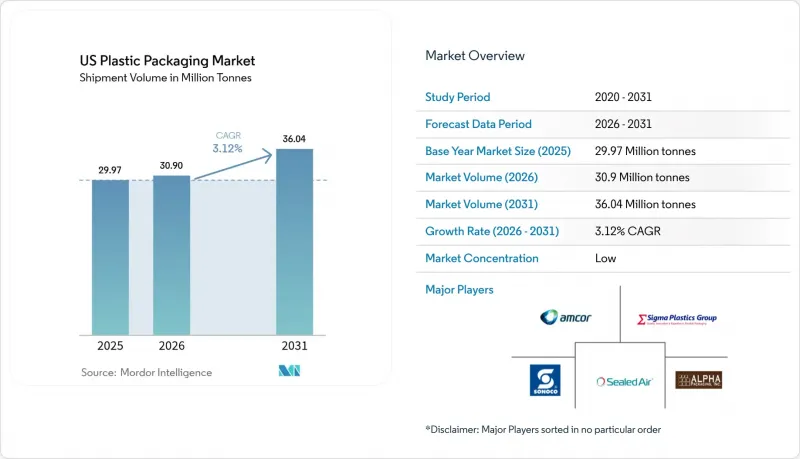
據 Mordor Intelligence 稱,美國塑膠包裝市場預計到 2026 年將達到 3,090 萬噸,高於 2025 年的 2,997 萬噸,預計到 2031 年將達到 3,604 萬噸。
預計從 2026 年到 2031 年,其複合年成長率將達到 3.12%。
本報告材料類型(硬質塑膠(聚乙烯(PE)、聚丙烯(PP)、其他)、軟質塑膠(聚乙烯(PE)、雙軸延伸聚丙烯(BOPP)、其他))、包裝類型(硬質塑膠包裝、軟質塑膠包裝)、最終用途行業(食品、飲料、藥品、其他)和包裝技術(擠出、熱成型、其他)分類。
美國塑膠包裝市場的趨勢和洞察
受《2025 年塑膠協定》目標的推動,美國消費品品牌迅速採用可回收的單一材料包裝袋。
單一材質的聚乙烯和聚丙烯複合材料正日益普及,取代了曾經阻礙回收流程的混合材質薄膜。加工商現在提供符合美國《2025年塑膠公約》設計目標的耐熱阻隔性包裝袋,使品牌商更容易將其產品標註為「可回收」。 DNP印尼公司在零食和寵物食品包裝領域的商業化推廣表明,在保持阻隔性能的同時,還能簡化使用後的處理流程。零售商要求其規格與傳統鋁箔結構相當,測試數據也證實了其氧氣透過率與傳統鋁箔結構相當,這使得各種SKU都能順利過渡到這種新包裝。美國塑膠包裝市場的包裝團隊正透過減薄材料厚度和最佳化捲材寬度來降低單位產品的薄膜消耗量。
美國小包裹遞送網路中,電子商務對輕便防護郵寄袋的需求激增。
小包裹運輸商正逐步淘汰不必要的緩衝材料,人們對薄壁可回收郵寄袋的興趣日益濃厚,這種郵寄袋既能降低體積重量費用,又能保證產品完整性。亞馬遜已將其美國小包裹的三分之一替換為紙質包裝,自該項目啟動以來,已減少了150億個塑膠空氣枕的使用。其先導工廠的生產線速度已超過每分鐘250個,為自動化樹立了新的標竿。競爭對手也使用含有30% PCR(再生塑膠)的單一材料LDPE氣泡信封實現了類似的性能,這符合華盛頓州再生材料含量法的要求。美國塑膠包裝市場的加工商正在投資高產能吹膜生產設備和自動化導流板連接系統,以應對每日小包裹量的激增。
各州擴大一次性塑膠禁令的範圍,將導致某些類型包裝的使用量減少。
加州SB 54法案規定,到2032年,加州境內銷售的原生塑膠包裝必須減少25%,製造商必須在2025年前加入生產者責任組織(PRO)。新澤西州、科羅拉多和緬因州的類似法規造成了合規的區域差異,增加了全國性品牌面臨的複雜性。儘管成本不斷上漲,加工商仍在積極地從產品目錄中逐步淘汰PS吸塑包裝和PVC泡殼包裝,轉而使用PET G和塗層紙板等替代品。監管的不確定性導致長期供應合約中加入了風險溢價,而美國塑膠包裝市場的可自由支配資本支出也受到限制,因為各公司都在等待統一的聯邦指導方針。
細分市場分析
到2025年,軟包裝將占美國塑膠包裝市場佔有率的53.86%,並以4.82%的複合年成長率持續成長。與硬質包裝相比,每個新型軟包裝袋所需的聚合物用量減少60-70%,從而減少運輸浪費和倉儲面積。電商巨頭們更青睞扁平包裝袋,這種包裝袋折疊後體積僅為瓦楞紙箱的十分之一,顯著降低了儲存成本。品牌商現在使用近紅外線(NIR)可讀油墨,以確保柔軟性在資源回收設施中高效分揀,從而提高實際回收率。同時,「智慧型」包裝袋嵌入了RFID或NFC標籤,實現了從填充到消費者掃描的全程可視性。
硬質塑膠在飲料、藥品和家用化學品領域仍扮演重要角色,但其年複合成長率僅2.03%。與2023年的設計相比,輕質高密度聚乙烯(HDPE)瓶可減少高達12%的樹脂用量,但進一步減薄受到衝擊強度和口感影響等性能標準的限制。華盛頓州的再生材料含量法要求瓶子製造商確保穩定的再生高密度聚乙烯(rHDPE)供應,這促使他們增加對內部清洗生產線的投資。目前,美國塑膠包裝市場的競爭主要集中在符合即將訂定的瓶蓋固定要求的繫繩式瓶蓋上,這種瓶蓋既方便又能減少浪費。
2025年,聚乙烯在軟包裝市場仍將佔據45.12%的佔有率,這得益於其廣泛的加工能力和完善的家庭垃圾收集基礎設施。美國食品藥物管理局(FDA)批准在零嘴零食包裝中使用100%回收的線性低密度聚乙烯(LLDPE),為符合食品安全標準開闢了途徑,使全國零售商能夠推出「循環」自有品牌產品。研發團隊採用茂金屬催化劑,即使在較薄的薄膜上也能達到高抗污強度,從而減少了8-10%的樹脂用量。共擠出技術能夠適應不同回收顆粒的特性,同時又不影響薄膜的透明度,這表明美國聚乙烯基軟包裝市場將持續成長。
「其他材料」類別正以6.09%的複合年成長率快速成長,主要得益於可堆肥PLA共混物、纖維素薄膜和二氧化矽塗層紙的成長。消費品牌正在嘗試使用甘蔗衍生的生物基聚乙烯(bio-PE),這種材料在提供類似機械性能的同時,碳足跡也更低。雙向拉伸聚丙烯(BOPP)仍然是光澤零食和糖果甜點重疊包裝的關鍵材料,但新型清漆系統能夠實現無需金屬化的阻隔性能,並符合單一材料回收指南。樹脂供應商和薄膜加工商之間的合作正在加速認證流程,並縮短新配方上市時間。
其他好處
- Excel格式的市場預測(ME)表
- 3個月的分析師支持
目錄
第1章:引言
- 研究假設和市場定義
- 調查範圍
第2章:調查方法
第3章執行摘要
第4章 市場狀況
- 市場概覽
- 市場促進因素
- 美國小包裹遞送網路中,電子商務對輕便防護郵寄袋的需求激增。
- 受《2025 年塑膠協定》目標的推動,美國消費品品牌迅速採用可回收的單一材料包裝袋。
- 即食和便攜食品的成長需要阻隔性軟性薄膜
- 醫藥冷鏈的擴展帶動了對專用硬質容器和泡殼包裝膜的需求增加。
- 由於各公司努力達到 25% 的 PCR 含量,對 rPET 和 rHDPE 瓶的需求增加。
- 投資先進的數位印刷技術,為中小企業品牌實現小批量客製化生產。
- 市場限制因素
- 各州擴大一次性塑膠禁令的範圍,將導致某些類型包裝的使用量減少。
- 聚烯樹脂價格的波動與頁岩氣原料價格的波動有關。
- 消費者轉向以永續性為優先考慮的紙張和鋁製品替代品。
- 化學回收基礎設施的資本密集特性限制了再生塑膠的供應。
- 供應鏈分析
- 貿易情境分析(依相關HS編碼)
- 美國當前的回收趨勢
- 監理展望
- 技術展望
- 波特五力分析
第5章 市場規模與成長預測
- 依材料類型
- 硬質塑膠
- 聚乙烯(PE)
- 聚丙烯(PP)
- 聚對苯二甲酸乙二醇酯(PET)
- 聚氯乙烯(PVC)
- 聚苯乙烯(PS)和發泡聚苯乙烯(EPS)
- 其他材料類型
- 軟質塑膠
- 聚乙烯(PE)
- 雙軸延伸聚丙烯(BOPP)
- 流延聚丙烯(CPP)
- 其他材料類型
- 硬質塑膠
- 按包裝類型
- 硬質塑膠包裝
- 瓶子罐
- 蓋子與封口裝置
- 托盤翻蓋
- 其他
- 軟質塑膠包裝
- 小袋
- 包包
- 薄膜包裝
- 其他
- 硬質塑膠包裝
- 按最終用途行業分類
- 食物
- 飲料
- 製藥
- 化妝品和個人護理
- 家用和工業化學品
- 寵物食品和動物護理
- 其他
- 透過包裝技術
- 射出成型
- 吹塑成型
- 擠出成型
- 熱成型
第6章 競爭情勢
- 市場集中度
- 策略趨勢
- 市佔率分析
- 公司簡介
- Amcor plc
- Sealed Air Corp.
- Sonoco Products Co.
- Sigma Plastics Group Inc.
- ProAmpac LLC
- Constantia Flexibles
- Alpha Packaging Inc.
- Centor Inc.(Gerresheimer)
- Silgan Holdings Inc.
- Bericap Holdings
- Plastipak Holdings Inc.
- Coveris Holdings SA
- Printpack Inc.
- AptarGroup Inc.
- Pactiv Evergreen Inc.
- Novolex Holdings LLC
- Sabert Corp.
- Genpak LLC
- Mondi plc
第7章 市場機會與未來展望
According to Mordor Intelligence, the United States plastic packaging market size in 2026 is estimated at 30.9 million tonnes, growing from 2025 value of 29.97 million tonnes with 2031 projections showing 36.04 million tonnes, growing at 3.12% CAGR over 2026-2031.
This report is Segmented by Material Type ((Rigid Plastic(Polyethylene (PE), Polypropylene (PP) and More)), Flexible Plastic (Polyethylene (PE), Biaxially Oriented Polypropylene (BOPP) and More)), Packaging Type (Rigid Plastic Packaging, Flexible Plastic Packaging), End-Use Industry (Food, Beverage, Pharmaceutical, and More) and Packaging Technology (Extrusion, Thermoforming, and More)
US Plastic Packaging Market Trends and Insights
Rapid Adoption of Recyclable Mono-Material Pouches by US CPG Brands
Mono-material polyethylene and polypropylene laminates are replacing mixed-substrate films that once obstructed recycling streams. Converters now deliver heat-resistant, high-barrier pouches that comply with the U.S. Plastics Pact 2025 design targets, giving brand owners a straightforward route to "recycle-ready" claims. DNP Indonesia's commercial roll-out of mono-material snack and pet-food packs demonstrates how barrier performance can be maintained while simplifying end-of-life processing. Retailers request specification parity with legacy foil structures, and test data confirm comparable oxygen-transmission rates, enabling broad SKU conversion. Packaging teams within the United States plastic packaging market are synchronizing material down-gauging with roll-stock width optimization to shrink film consumption per unit.
Surging E-Commerce Demand for Lightweight Protective Mailers in the US Parcel Network
Parcel shippers continue to eliminate unnecessary void fill, driving interest in thin-gauge, curbside-recyclable mailers that cut dimensional-weight fees while preserving product integrity. Amazon has shifted one-third of its U.S. outbound parcels to paper-based alternatives, eliminating 15 billion plastic air pillows since program inception. The company's pilot plants validate line speeds exceeding 250 parcels per minute, setting new benchmarks for automation. Competitors are matching performance with mono-material LDPE bubble mailers containing 30% PCR, as mandated by Washington's recycled-content law. Converters positioned within the United States plastic packaging market are investing in high-output blown-film towers and automated wicketing to address the spike in daily parcel volumes.
Escalating State-Level Single-Use Plastics Bans Reducing Certain Packaging Formats
California SB 54 mandates a 25% reduction in virgin plastic packaging sold within state borders by 2032, and producers must join a Producer Responsibility Organization by 2025. Similar mandates in New Jersey, Colorado, and Maine create a fragmented compliance map that raises complexity for nationwide brands. Converters are pre-emptively retiring PS clamshells and PVC blisters from their catalogs, turning to PET G and coated paperboard alternatives even when cost of goods rises. The regulatory uncertainty embeds risk premiums into long-term supply contracts, curbing discretionary capital spend within the United States plastic packaging market as firms await harmonized federal guidelines.
Other drivers and restraints analyzed in the detailed report include:
- Growth of Ready-to-Eat and On-the-Go Foods Requiring High-Barrier Flexible Films
- Corporate Commitments to 25% PCR Content Boosting Demand for rPET and rHDPE Bottles
- Consumer Shift Toward Paper and Aluminum Alternatives for Sustainability
For complete list of drivers and restraints, kindly check the Table Of Contents.
Segment Analysis
Flexible formats delivered 53.86% of United States plastic packaging market share in 2025 and are marching ahead at a 4.82% CAGR. Each new pouch replaces rigid counterparts with 60-70% less polymer, reducing freight emissions and warehouse footprints. E-commerce giants favor flat mailers because they collapse to one-tenth the inbound cube of corrugated boxes, slashing storage overhead. Brands now employ near-infrared (NIR) readable inks so flexibles sort efficiently at material-recovery facilities, improving real recycling rates. Meanwhile, "smart" pouches embed RFID or NFC tags, providing end-to-end visibility from filler to consumer scanning events.
Rigid plastics still account for essential roles in beverages, pharmaceuticals, and household chemicals, yet growth lags at 2.03% CAGR. Lightweight HDPE bottles use up to 12% less resin than 2023 designs, but performance thresholds on drop strength and taste neutrality limit further down-gauging. Washington State's recycled-content law compels bottle makers to secure stable rHDPE streams, prompting co-investment in in-house wash lines. Competition within the United States plastic packaging market now revolves around tethered caps that comply with forthcoming closure-retention mandates, merging convenience and litter reduction.
Polyethylene retained a 45.12% share of flexible volumes in 2025, supported by its broad processing window and robust curbside collection infrastructure. FDA approval for 100% rLLDPE content in snack wrappers confirms food-safety compliance pathways, allowing national retailers to launch "circular" private labels. Development teams adopt metallocene catalysts that provide higher dart impact at reduced gauge, contributing to resin savings of 8-10%. The United States plastic packaging market size for PE-based flexibles will continue scaling as co-extrusion technology accommodates recycled pellet variability without compromising film clarity.
The "other materials" category advances 6.09% CAGR, propelled by compostable PLA blends, cellulose-based films, and silicium-oxide coated papers. Consumer brands experiment with bio-PE derived from sugarcane that offers equivalent mechanical properties and a lower carbon footprint. BOPP remains indispensable for glossy snack and confectionery overwraps, yet new varnish systems deliver metallization-free barrier performance aligned with mono-material recycling guidelines. Partnerships between resin suppliers and film converters accelerate qualification cycles, shortening time-to-market for emerging formulations.
Complete Report Scope:
- By Material Type
- Rigid Plastic
- Polyethylene (PE)
- Polypropylene (PP)
- Polyethylene Terephthalate (PET)
- Polyvinyl Chloride (PVC)
- Polystyrene (PS) and Expanded Polystyrene (EPS)
- Other Material Types
- Flexible Plastic
- Polyethylene (PE)
- Biaxially Oriented Polypropylene (BOPP)
- Cast Polypropylene (CPP)
- Other Material Types
- Rigid Plastic
- By Packaging Type
- Rigid Plastic Packaging
- Bottles and Jars
- Caps and Closures
- Trays and Clamshells
- Other Product Types
- Flexible Plastic Packaging
- Pouches
- Bags
- Films and Wraps
- Other Product Types
- Rigid Plastic Packaging
- By End-use Industry
- Food
- Beverage
- Pharmaceutical
- Cosmetics and Personal Care
- Home and Industrial Chemicals
- Pet Food and Animal Care
- Other End-use Industry
- By Packaging Technology
- Injection Molding
- Blow Molding
- Extrusion
- Thermoforming
List of Companies Covered in this Report:
- Amcor plc
- Sealed Air Corp.
- Sonoco Products Co.
- Sigma Plastics Group Inc.
- ProAmpac LLC
- Constantia Flexibles
- Alpha Packaging Inc.
- Centor Inc. (Gerresheimer)
- Silgan Holdings Inc.
- Bericap Holdings
- Plastipak Holdings Inc.
- Coveris Holdings SA
- Printpack Inc.
- AptarGroup Inc.
- Pactiv Evergreen Inc.
- Novolex Holdings LLC
- Sabert Corp.
- Genpak LLC
- Mondi plc
Additional Benefits:
- The market estimate (ME) sheet in Excel format
- 3 months of analyst support
TABLE OF CONTENTS
1 INTRODUCTION
- 1.1 Study Assumptions and Market Definition
- 1.2 Scope of the Study
2 RESEARCH METHODOLOGY
3 EXECUTIVE SUMMARY
4 MARKET LANDSCAPE
- 4.1 Market Overview
- 4.2 Market Drivers
- 4.2.1 Surging E-commerce Demand for Lightweight Protective Mailers in US Parcel Network
- 4.2.2 Rapid Adoption of Recyclable Mono-Material Pouches by US CPG Brands Post-2025 Plastics Pact Targets
- 4.2.3 Growth of Ready-to-Eat and On-the-Go Foods Requiring High-Barrier Flexible Films
- 4.2.4 Pharmaceutical Cold-Chain Expansion Driving Specialty Rigid Containers and Blister Films
- 4.2.5 Corporate Commitments to 25 % PCR Content Boosting Demand for rPET and rHDPE Bottles
- 4.2.6 Investments in Advanced Digital Printing Enabling Short-Run Customization for SME Brands
- 4.3 Market Restraints
- 4.3.1 Escalating State-Level Single-Use Plastics Bans Reducing Certain Packaging Formats
- 4.3.2 Volatility in Polyolefin Resin Prices Linked to Shale Gas Feedstock Swings
- 4.3.3 Consumer Shift Toward Paper and Aluminum Alternatives for Sustainability
- 4.3.4 Capital Intensity of Chemical Recycling Infrastructure Limiting rPlastics Supply
- 4.4 Supply-Chain Analysis
- 4.5 Trade Scenario Analysis (under relevant HS codes)
- 4.6 Current Recycling Trends in United States
- 4.7 Regulatory Outlook
- 4.8 Technological Outlook
- 4.9 Porter's Five Forces Analysis
- 4.9.1 Threat of New Entrants
- 4.9.2 Bargaining Power of Buyers
- 4.9.3 Bargaining Power of Suppliers
- 4.9.4 Threat of Substitute Products
- 4.9.5 Intensity of Competitive Rivalry
5 Market Size and Growth Forecasts (Volume)
- 5.1 By Material Type
- 5.1.1 Rigid Plastic
- 5.1.1.1 Polyethylene (PE)
- 5.1.1.2 Polypropylene (PP)
- 5.1.1.3 Polyethylene Terephthalate (PET)
- 5.1.1.4 Polyvinyl Chloride (PVC)
- 5.1.1.5 Polystyrene (PS) and Expanded Polystyrene (EPS)
- 5.1.1.6 Other Material Types
- 5.1.2 Flexible Plastic
- 5.1.2.1 Polyethylene (PE)
- 5.1.2.2 Biaxially Oriented Polypropylene (BOPP)
- 5.1.2.3 Cast Polypropylene (CPP)
- 5.1.2.4 Other Material Types
- 5.1.1 Rigid Plastic
- 5.2 By Packaging Type
- 5.2.1 Rigid Plastic Packaging
- 5.2.1.1 Bottles and Jars
- 5.2.1.2 Caps and Closures
- 5.2.1.3 Trays and Clamshells
- 5.2.1.4 Other Product Types
- 5.2.2 Flexible Plastic Packaging
- 5.2.2.1 Pouches
- 5.2.2.2 Bags
- 5.2.2.3 Films and Wraps
- 5.2.2.4 Other Product Types
- 5.2.1 Rigid Plastic Packaging
- 5.3 By End-use Industry
- 5.3.1 Food
- 5.3.2 Beverage
- 5.3.3 Pharmaceutical
- 5.3.4 Cosmetics and Personal Care
- 5.3.5 Home and Industrial Chemicals
- 5.3.6 Pet Food and Animal Care
- 5.3.7 Other End-use Industry
- 5.4 By Packaging Technology
- 5.4.1 Injection Molding
- 5.4.2 Blow Molding
- 5.4.3 Extrusion
- 5.4.4 Thermoforming
6 COMPETITIVE LANDSCAPE
- 6.1 Market Concentration
- 6.2 Strategic Moves
- 6.3 Market Share Analysis
- 6.4 Company Profiles {(includes Global level Overview, Market level overview, Core Segments, Financials as available, Strategic Information, Market Rank/Share for key companies, Products and Services, and Recent Developments)}
- 6.4.1 Amcor plc
- 6.4.2 Sealed Air Corp.
- 6.4.3 Sonoco Products Co.
- 6.4.4 Sigma Plastics Group Inc.
- 6.4.5 ProAmpac LLC
- 6.4.6 Constantia Flexibles
- 6.4.7 Alpha Packaging Inc.
- 6.4.8 Centor Inc. (Gerresheimer)
- 6.4.9 Silgan Holdings Inc.
- 6.4.10 Bericap Holdings
- 6.4.11 Plastipak Holdings Inc.
- 6.4.12 Coveris Holdings SA
- 6.4.13 Printpack Inc.
- 6.4.14 AptarGroup Inc.
- 6.4.15 Pactiv Evergreen Inc.
- 6.4.16 Novolex Holdings LLC
- 6.4.17 Sabert Corp.
- 6.4.18 Genpak LLC
- 6.4.19 Mondi plc
7 MARKET OPPORTUNITIES AND FUTURE OUTLOOK
- 7.1 White-space and Unmet-Need Assessment

 2026年全球聚苯乙烯包裝市場報告
 全球一次性塑膠包裝:市場佔有率分析、產業趨勢與統計及成長預測(2026-2031年)
 2035 年前食品飲料塑膠包裝市場分析與預測:類型、產品類型、技術、應用、材料類型、製造流程、最終用戶、功能中東和非洲塑膠包裝市場:市場佔有率分析、行業趨勢和統計數據以及成長預測(2026-2031 年)亞太地區塑膠包裝:市場佔有率分析、產業趨勢與統計及成長預測(2026-2031)全球塑膠包裝:市場佔有率分析、產業趨勢與統計及成長預測(2026-2031年)印度塑膠包裝:市場佔有率分析、產業趨勢與統計及成長預測(2026-2031)日本塑膠包裝市場:市場佔有率分析、產業趨勢與統計及成長預測(2026-2031)英國塑膠包裝:市場佔有率分析、產業趨勢與統計、成長預測(2026-2031)印尼塑膠包裝市場:市場佔有率分析、產業趨勢與統計及成長預測(2026-2031)