


 |
市場調查報告書
商品編碼
2121505
亞太地區塑膠包裝:市場佔有率分析、產業趨勢與統計及成長預測(2026-2031)Asia Pacific Plastic Packaging - Market Share Analysis, Industry Trends & Statistics, Growth Forecasts (2026 - 2031) |
||||||

※ 本網頁內容可能與最新版本有所差異。詳細情況請與我們聯繫。
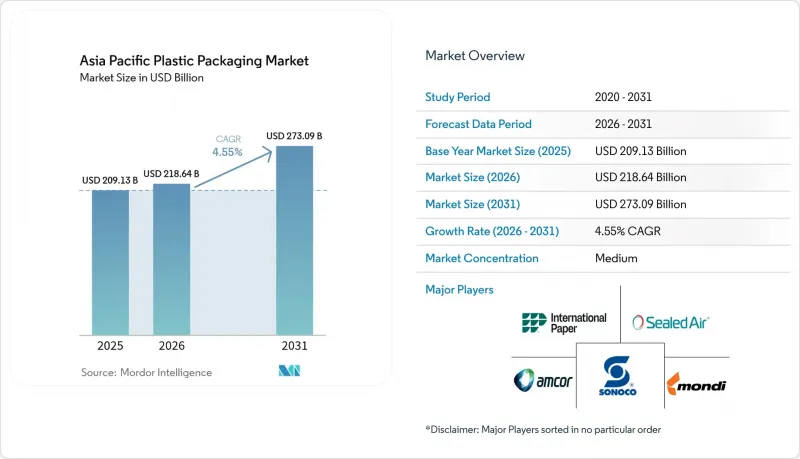
根據 Mordor Intelligence 預測,亞太地區塑膠包裝市場規模預計將從 2025 年的 2091.3 億美元成長到 2026 年的 2186.4 億美元,到 2031 年將達到 2730.9 億美元,2026 年至 2031 年的複合年成長率為 4.5%。
本報告按材料類型(聚乙烯、聚丙烯等)、包裝類型(軟包裝、硬包裝)、產品形態(瓶/罐、托盤/容器等)、終端用戶行業(食品、飲料、醫藥/保健等)、製造程序(擠出成型等)和國家/地區進行細分。市場預測以美元計價。
亞太地區塑膠包裝市場趨勢及洞察。
電子商務的快速發展對輕巧、抗損包裝提出了更高的要求。
隨著小包裹的激增,包裝加工商需要設計能夠承受多次搬運且不增加運輸成本的包裝。一家泰國飲料製造商於2024年在履約中心採用無標籤寶特瓶,以簡化自動化分類流程。添加奈米黏土的阻隔薄膜比傳統複合材料輕30-50%,在維持材料品質的同時降低了材料成本。具有優異抗衝擊性的特殊PE和PP等級材料目前在電子設備運輸領域佔據主導地位,而平台營運商也發布了嚴格的跌落測試標準,優先考慮能夠提供經證實具有抗壓強度的供應商。
有組織的零售和簡便食品。
印度、越南和印尼現代零售業的擴張推動了對美觀、保存期限長且適應螢光照明的包裝的需求。 SK集團和Samir製藥在越南醫藥行業的投資表明,普通零售商正在推動包裝標準化。高阻隔阻隔性拉伸聚丙烯(BOPP)和鍍鋁雙向拉伸聚酯薄膜(BOPET)正在取代鋁箔,在確保產品隔絕氧氣和水分的同時,提高了可回收性。份量已調整的乳製品和調理食品受益於冷鏈相容的複合薄膜,而大型零售商的崛起則使加工商能夠將固定成本分攤到更大的訂單量上。
加強一次性塑膠製品的禁令以及生產者責任延伸制度(EPR)費用
新加坡的飲料容器押金計畫將於2026年實施,屆時每個容器將加收0.10美元的附加稅,這將增加包裝成本,並促使消費者轉向可重複填充產品。東南亞國協不同的生產者責任延伸制度(EPR)收費系統使得包裝設計難以標準化,迫使遵守規定的公司承擔樹脂替代和測試方面的額外成本,與不受監管的競爭對手相比,這將對其利潤率造成壓力。
細分市場分析
聚乙烯因其經濟高效且用途廣泛,可用於薄膜、瓶子和瓶蓋等多種應用,預計到2025年將佔據亞太塑膠包裝市場38.20%的佔有率。 PET持續維持5.24%的複合年成長率,這主要得益於萬凱與Carbios等公司合作開展的酶水解項目,該項目旨在每年在中國生產5萬噸rPET。熱填充PET瓶正在調味品產業取代玻璃瓶,有助於提高物流安全性並減少碳排放。聚丙烯在需要高耐熱性的細分市場中保持著一定的地位,而可生物分解聚合物和紙質複合材料則通過獲得ISO 17088認證,在監管支持下佔據了高階市場佔有率。
儘管聚乙烯(PE)價格競爭力持續強勁,傳統生產線仍在繼續運作,但生產者延伸責任制(EPR)推動的設計轉變,以及瓶到瓶回收基礎設施的完善,正使聚對苯二甲酸乙二醇酯(PET)單一材料回收系統脫穎而出。吸氧添加劑可改善PET的阻隔性,而品牌商對使用再生材料的承諾也促使了「招標」採購,導致瓶片供應緊張。 PE生產商正在開發高密度等級的聚乙烯,並採用金屬沉澱沉積層來保護對香氣敏感的產品,從而在確保可回收性的同時,避免與PET競爭,並追求價格競爭力。
預計到2025年,軟包裝將佔亞太地區塑膠包裝市場54.30%的佔有率,複合年成長率達6.65%。這主要歸功於製造商根據Huhtamaki India的「回收設計指南」轉向更輕的單一材料複合材料。去除鋁箔和PVC添加劑有助於機械回收。對於碳酸飲料和個人保健產品的泵式分配器而言,硬質容器仍然必不可少,因為其尺寸精度和抗衝擊性優於其他材料。
隨著消費者對「便攜零食」和「宅配餐點」的需求日益成長,立式袋的銷售量也不斷攀升。同時,由高密度聚苯乙烯(HDPE)製成的硬質瓶在支援循環回收的填充站越來越受歡迎。品牌商正在試行使用帶有QR碼的包裝袋,引導消費者前往回收點,以解決使用後材料流向資料匱乏的問題。同時,對脫模技術的投資旨在回收高價值的隔離層,使軟包裝材料的回收率與瓶子相媲美。
其他好處:
- Excel格式的市場預測(ME)表
- 3個月的分析師支持
目錄
第1章:引言
- 研究假設和市場定義
- 調查範圍
第2章:調查方法
第3章執行摘要
第4章 市場狀況
- 市場概覽
- 市場促進因素
- 電子商務的快速發展催生了對輕便耐用包裝材料的需求。
- 有組織的零售業擴張和已調理食品。
- 先進的阻隔薄膜延長了保存期限
- 東協從小小袋向可重複填充包裝過渡計劃
- 人工智慧驅動的加工生產線正在促進小批量訂單的客製化。
- 企業綠色債券資金籌措與再生材料含量的關鍵績效指標掛鉤
- 市場限制因素
- 擴大一次性塑膠製品和生產者責任延伸(EPR)費用的禁令
- 樹脂價格波動與原油價格相關
- PE和PP的結構性供應過剩正在給加工商的利潤率帶來壓力。
- 缺乏可追溯性阻礙了rPET在食品領域的廣泛應用。
- 產業價值鏈分析
- 監理情勢
- 技術展望
- 波特五力分析
- 宏觀經濟因素對市場的影響
第5章 市場規模與成長預測
- 材料類型
- 聚乙烯(PE)
- 聚丙烯(PP)
- 聚對苯二甲酸乙二醇酯(PET)
- 聚苯乙烯和EPS
- 其他材料類型
- 按包裝類型
- 軟塑膠包裝
- 硬質塑膠包裝
- 按產品形式
- 瓶子和罐子
- 托盤和容器
- 小袋和小袋
- 包包
- 薄膜和包裝
- 其他產品形式
- 按最終用戶行業分類
- 食物
- 飲料
- 藥品和醫療保健
- 化妝品和個人護理
- 產業
- 其他終端用戶產業
- 透過製造程序
- 擠壓
- 射出成型
- 吹塑成型
- 熱成型
- 國家
- 中國
- 印度
- 日本
- 韓國
- 澳洲
- 其他亞太國家
第6章 競爭情勢
- 市場集中度
- 戰略措施和投資
- 市佔率分析
- 公司簡介
- Amcor plc
- Mondi plc
- Sonoco Products Company
- International Paper Company
- Sealed Air Corporation
- Huhtamaki Oyj
- ALPLA-Werke Alwin Lehner GmbH and Co KG
- Uflex Ltd.
- Plastipak Holdings Inc.
- Pactiv Evergreen Inc.
- Winpak Ltd.
- Toyo Seikan Group Holdings Ltd.
- Nihon Yamamura Glass Co., Ltd.
- Manjushree Technopack Ltd.
- Time Technoplast Ltd.
- Greif Inc.
- IFCO Systems GmbH
- Dynapack Asia Sdn Bhd
- Cheng Loong Corp.
第7章 市場機會與未來展望
According to Mordor Intelligence, the Asia-Pacific plastic packaging market size is expected to grow from USD 209.13 billion in 2025 to USD 218.64 billion in 2026 and is forecast to reach USD 273.09 billion by 2031 at 4.55% CAGR over 2026-2031.
This report is Segmented by Material Type (Polyethylene, Polypropylene, and More), Packaging Type (Flexible, and Rigid), Product Form (Bottles and Jars, Trays and Containers, and More), End-User Industry (Food, Beverage, Pharmaceuticals and Healthcare, and More), Manufacturing Process (Extrusion, and More), and Country. The Market Forecasts are Provided in Terms of Value (USD).
Asia Pacific Plastic Packaging Market Trends and Insights
E-commerce boom demanding lightweight, damage-resistant packs
Rapid parcel growth obliges converters to engineer packaging that survives multiple handling points without inflating freight costs. Beverage producers in Thailand adopted label-free PET bottles during 2024 to facilitate automated sortation in fulfillment centers. Nanoclay-enhanced barrier films enable 30-50% weight reduction versus conventionally laminated formats, lowering material outlay while retaining integrity. Specialized PE and PP grades with superior impact resistance now dominate electronics shipments, whereas platform operators publish stringent drop-test standards that favor suppliers offering proven compression strength.
Growing organised retail and convenience-food penetration
Expansion of modern trade in India, Vietnam, and Indonesia lifts demand for shelf-stable, aesthetic packs calibrated for fluorescent store lighting. Vietnam's pharmaceutical investments by SK Group and Samil Pharmaceutical illustrate how formal retail elevates packaging standardization. High-barrier BOPP and metallized BOPET films replace foil, ensuring oxygen and moisture defense while improving recyclability. Portion-controlled dairy and ready meals benefit from cold-chain compatible laminates, and consolidated retailers enable converters to spread fixed costs across larger order volumes.
Escalating single-use-plastic bans and EPR fees
Singapore's beverage-container deposit scheme launching in 2026 imposes a USD 0.10 levy per unit, inflating pack costs and re-routing consumer demand toward refill options. Differing EPR fee structures across ASEAN complicate harmonized pack designs and spur compliant firms to absorb higher resin substitution and testing expenses, squeezing margins versus unregulated competitors.
Other drivers and restraints analyzed in the detailed report include:
- Shelf-life extension via advanced barrier films
- Sachet-to-refill transition programs in ASEAN
- Volatile crude-linked resin prices
For complete list of drivers and restraints, kindly check the Table Of Contents.
Segment Analysis
Polyethylene held 38.20% Asia-Pacific plastic packaging market share in 2025 through cost-effective versatility across films, bottles, and closures. PET is marching at 5.24% CAGR, buoyed by enzymatic depolymerization partnerships such as Wankai-Carbios targeting 50,000 t/y rPET output in China. PET's hot-fill capable bottles displace glass in condiments, improving logistics safety and carbon footprints. Polypropylene sustains niches demanding high-heat tolerance, while biodegradable polymers and paper laminates secure premium, regulation-driven slots armed with ISO 17088 certifications.
Continued PE price competitiveness keeps legacy lines running, yet EPR-driven design shifts favor PET mono-material loops thanks to bottle-to-bottle infrastructure. Oxygen-scavenging additives enhance PET's barrier, and bottle flake supply closes as brand recycled-content pledges trigger Tender-based purchasing. PE producers explore high-density grades blended with metallized strip layers to protect aroma-sensitive goods, seeking parity with PET while safeguarding recyclability.
Flexible formats commanded 54.30% Asia-Pacific plastic packaging market size in 2025, scaling at 6.65% CAGR as converters strip weight and move toward mono-material laminates per Huhtamaki India's Design for Recycling Guidance. Eliminating aluminum foil and PVC additives unlocks mechanical recycling streams. Rigid containers remain essential for carbonated beverages and personal-care pumps where dimensional accuracy and impact resistance outweigh material-use advantage.
Consumer gravitation to on-the-go snacks and home-delivery meals boosts stand-up pouch volumes, while rigid HDPE bottles gain traction in refill stations supporting controlled reuse cycles. Brand owners pilot QR-enabled pouches that direct consumers to collection points, closing data gaps on post-use material flow. Parallel investment in delamination tech aims to salvage high-value barrier layers, offering flexible packs a path toward parity with bottle recycling rates.
Complete Report Scope:
- By Material Type
- Polyethylene (PE)
- Polypropylene (PP)
- Polyethylene Terephthalate (PET)
- Polystyrene and EPS
- Other Material Types
- By Packaging Type
- Flexible Plastic Packaging
- Rigid Plastic Packaging
- By Product Form
- Bottles and Jars
- Trays and Containers
- Pouches and Sachets
- Bags and Sacks
- Films and Wraps
- Other Product Forms
- By End-User Industry
- Food
- Beverage
- Pharmaceuticals and Healthcare
- Cosmetics and Personal Care
- Industrial
- Other End-user Industries
- By Manufacturing Process
- Extrusion
- Injection Molding
- Blow Molding
- Thermoforming
- By Country
- China
- India
- Japan
- South Korea
- Australia
- Rest of Asia Pacific
List of Companies Covered in this Report:
- Amcor plc
- Mondi plc
- Sonoco Products Company
- International Paper Company
- Sealed Air Corporation
- Huhtamaki Oyj
- ALPLA-Werke Alwin Lehner GmbH and Co KG
- Uflex Ltd.
- Plastipak Holdings Inc.
- Pactiv Evergreen Inc.
- Winpak Ltd.
- Toyo Seikan Group Holdings Ltd.
- Nihon Yamamura Glass Co., Ltd.
- Manjushree Technopack Ltd.
- Time Technoplast Ltd.
- Greif Inc.
- IFCO Systems GmbH
- Dynapack Asia Sdn Bhd
- Cheng Loong Corp.
Additional Benefits:
- The market estimate (ME) sheet in Excel format
- 3 months of analyst support
TABLE OF CONTENTS
1 INTRODUCTION
- 1.1 Study Assumptions and Market Definition
- 1.2 Scope of the Study
2 RESEARCH METHODOLOGY
3 EXECUTIVE SUMMARY
4 MARKET LANDSCAPE
- 4.1 Market Overview
- 4.2 Market Drivers
- 4.2.1 E-commerce boom demanding lightweight, damage-resistant packs
- 4.2.2 Growing organised retail and convenience-food penetration
- 4.2.3 Shelf-life extension via advanced barrier films
- 4.2.4 Sachet-to-Refill" transition programmes in ASEAN
- 4.2.5 AI-enabled converting lines boosting small-lot customisation
- 4.2.6 Corporate green-bond funding tied to recycled-content KPIs
- 4.3 Market Restraints
- 4.3.1 Escalating single-use-plastic bans and EPR fees
- 4.3.2 Volatile crude-linked resin prices
- 4.3.3 PE and PP structural oversupply depressing converter margins
- 4.3.4 Traceability gaps limiting rPET food-grade uptake
- 4.4 Industry Value Chain Analysis
- 4.5 Regulatory Landscape
- 4.6 Technological Outlook
- 4.7 Porter's Five Forces Analysis
- 4.7.1 Bargaining Power of Suppliers
- 4.7.2 Bargaining Power of Buyers
- 4.7.3 Threat of New Entrants
- 4.7.4 Threat of Substitute Products
- 4.7.5 Intensity of Competitive Rivalry
- 4.8 Impact of Macroeconomic Factors on the Market
5 MARKET SIZE AND GROWTH FORECASTS(VALUE)
- 5.1 By Material Type
- 5.1.1 Polyethylene (PE)
- 5.1.2 Polypropylene (PP)
- 5.1.3 Polyethylene Terephthalate (PET)
- 5.1.4 Polystyrene and EPS
- 5.1.5 Other Material Types
- 5.2 By Packaging Type
- 5.2.1 Flexible Plastic Packaging
- 5.2.2 Rigid Plastic Packaging
- 5.3 By Product Form
- 5.3.1 Bottles and Jars
- 5.3.2 Trays and Containers
- 5.3.3 Pouches and Sachets
- 5.3.4 Bags and Sacks
- 5.3.5 Films and Wraps
- 5.3.6 Other Product Forms
- 5.4 By End-User Industry
- 5.4.1 Food
- 5.4.2 Beverage
- 5.4.3 Pharmaceuticals and Healthcare
- 5.4.4 Cosmetics and Personal Care
- 5.4.5 Industrial
- 5.4.6 Other End-user Industries
- 5.5 By Manufacturing Process
- 5.5.1 Extrusion
- 5.5.2 Injection Molding
- 5.5.3 Blow Molding
- 5.5.4 Thermoforming
- 5.6 By Country
- 5.6.1 China
- 5.6.2 India
- 5.6.3 Japan
- 5.6.4 South Korea
- 5.6.5 Australia
- 5.6.6 Rest of Asia Pacific
6 COMPETITIVE LANDSCAPE
- 6.1 Market Concentration
- 6.2 Strategic Moves and Investments
- 6.3 Market Share Analysis
- 6.4 Company Profiles (includes Global level Overview, Market level overview, Core Segments, Financials as available, Strategic Information, Market Rank/Share for key companies, Products and Services, and Recent Developments)
- 6.4.1 Amcor plc
- 6.4.2 Mondi plc
- 6.4.3 Sonoco Products Company
- 6.4.4 International Paper Company
- 6.4.5 Sealed Air Corporation
- 6.4.6 Huhtamaki Oyj
- 6.4.7 ALPLA-Werke Alwin Lehner GmbH and Co KG
- 6.4.8 Uflex Ltd.
- 6.4.9 Plastipak Holdings Inc.
- 6.4.10 Pactiv Evergreen Inc.
- 6.4.11 Winpak Ltd.
- 6.4.12 Toyo Seikan Group Holdings Ltd.
- 6.4.13 Nihon Yamamura Glass Co., Ltd.
- 6.4.14 Manjushree Technopack Ltd.
- 6.4.15 Time Technoplast Ltd.
- 6.4.16 Greif Inc.
- 6.4.17 IFCO Systems GmbH
- 6.4.18 Dynapack Asia Sdn Bhd
- 6.4.19 Cheng Loong Corp.
7 MARKET OPPORTUNITIES AND FUTURE OUTLOOK
- 7.1 White-Space and Unmet-Need Assessment

 2026年全球聚苯乙烯包裝市場報告
 全球一次性塑膠包裝:市場佔有率分析、產業趨勢與統計及成長預測(2026-2031年)
 2035 年前食品飲料塑膠包裝市場分析與預測:類型、產品類型、技術、應用、材料類型、製造流程、最終用戶、功能中東和非洲塑膠包裝市場:市場佔有率分析、行業趨勢和統計數據以及成長預測(2026-2031 年)全球塑膠包裝:市場佔有率分析、產業趨勢與統計及成長預測(2026-2031年)印度塑膠包裝:市場佔有率分析、產業趨勢與統計及成長預測(2026-2031)日本塑膠包裝市場:市場佔有率分析、產業趨勢與統計及成長預測(2026-2031)美國塑膠包裝:市場佔有率分析、產業趨勢與統計及成長預測(2026-2031)英國塑膠包裝:市場佔有率分析、產業趨勢與統計、成長預測(2026-2031)印尼塑膠包裝市場:市場佔有率分析、產業趨勢與統計及成長預測(2026-2031)