


 |
市場調查報告書
商品編碼
2122006
中東和非洲塑膠包裝市場:市場佔有率分析、行業趨勢和統計數據以及成長預測(2026-2031 年)Middle East And Africa Plastic Packaging - Market Share Analysis, Industry Trends & Statistics, Growth Forecasts (2026 - 2031) |
||||||

※ 本網頁內容可能與最新版本有所差異。詳細情況請與我們聯繫。
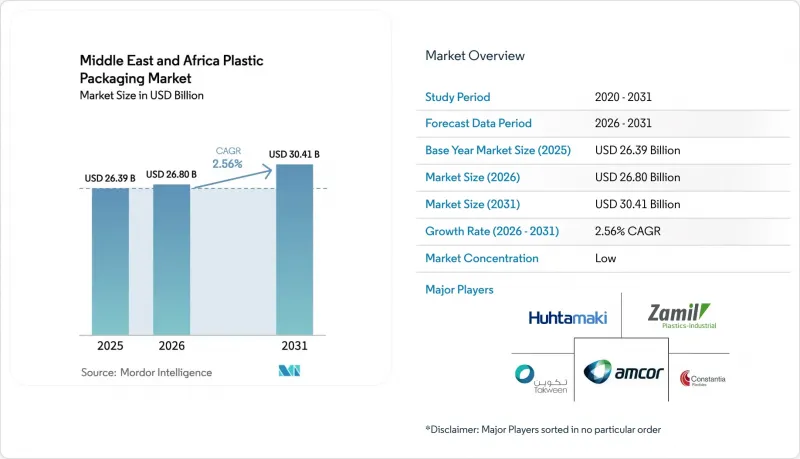
根據 Mordor Intelligence 預測,中東和非洲的塑膠包裝市場規模將從 2025 年的 263.9 億美元和 2026 年的 268 億美元成長到 2031 年的 304.1 億美元,2026 年至 2031 年的年複合成長率(CAGR)為 2.56%。
本報告按材料類型(聚乙烯、聚丙烯等)、包裝類型(軟包裝、硬包裝等)、產品形式(托盤、容器等)、終端用戶行業(食品、飲料、醫藥保健等)、製造程序(擠出成型、射出成型等)和國家/地區進行細分。市場預測以美元計價。
中東和非洲塑膠包裝市場趨勢與洞察
加工食品需求的持續成長
人口向都市區遷移、雙薪家庭增加以及氣候變遷引發的食品安全問題,正在推動全部區域對密封、分裝食品的需求。超級市場連鎖店正將貨架空間從散裝主食轉向預包裝肉類、乳製品和零食,這帶動了對多層阻隔薄膜的需求,這種薄膜能夠在低於40 度C的環境溫度下延長保存期限。沙烏地阿拉伯的包裝食品消費水準已接近西方水平,而奈及利亞的市場滲透率低於15%,這意味著新增產能仍有巨大的成長空間。加工商正透過提供調氣包裝袋和真空貼皮托盤來滿足這一需求,這些產品可以防止食品變質並減少商店的廢棄物。隨著分銷網路擴展到農村城市,小包裝袋使零售商能夠在價格和衛生之間取得平衡,從而進一步推動中東和非洲塑膠包裝市場對軟性塑膠解決方案的採用。
電子商務履約包裝的成長正在加速。
2024年,線上零售實現了30%的成長率,超過了其他銷售管道,這主要得益於沿岸地區勞動力的很大一部分。不穩定的供應鏈,例如崎嶇不平的道路和多次交接,增加了破損的風險,迫使物流供應商增加包裝層數。輕質枕式包裝、空氣枕和拉伸膜能夠在不大幅增加運費的情況下保護訂單,進一步加速了塑膠產品在最後一公里配送中的應用。光是奈及利亞的電子商務預計在2023年至2028年間就將成長57.1億美元,這意味著將有數百萬個小包裹需要保護膜和氣泡信封。杜拜和利雅德的快時尚平台正在引入溫控配送的新趨勢,推動了發泡聚苯乙烯內襯和真空包裝板的使用。這些趨勢共同推動了中東和非洲塑膠包裝市場出貨量高於平均水準的成長。
海灣國家禁止使用一次性塑膠製品的趨勢
阿拉伯聯合大公國(阿拉伯聯合大公國)將於2026年1月起實施2024年第36號聯邦法規,禁止使用一次性塑膠袋、刀叉餐具和吸管,罰款金額將在2028年之前逐步提高。沙烏地阿拉伯在其「綠色舉措」下也表達了類似的意願,但實施日期尚未確定,這給加工商帶來了投資的不確定性。可堆肥樹脂的供應尚處於起步階段,其價格比傳統聚乙烯高出40%,這對中小企業構成了成本障礙。為生產一次性產品而專門設計的擠出和射出成型線等資產可能遭受損失,這將威脅到利潤率。儘管如此,這些禁令將促使產品系列轉向可重複使用或經認證可回收的形式,最終推動中東和非洲整個塑膠包裝市場建立更高的規範標準。
細分市場分析
預計到2025年,聚乙烯將在中東和非洲塑膠包裝市場佔據39.32%的市場。這主要歸功於其成本優勢以及在各種製造流程中的多功能性,包括吹塑成型、射出成型和旋轉成型。線性低密度聚乙烯(LLDPE)在拉伸膜和收縮膜領域佔據主導地位,用於固定行駛在多塵高速公路上的托盤;而高密度聚苯乙烯(HDPE)則在清潔劑和潤滑油瓶領域佔據領先地位,因為這些產品需要耐化學腐蝕性。聚丙烯仍然是瓶蓋和編織袋的理想材料,尤其是在對繫繩瓶蓋的監管日益普及的情況下,但其回收利用途徑落後於PET。預計PET的複合年成長率將達到3.56%,超過中東和非洲塑膠包裝市場的整體成長率。 2024年,Indorama Ventures推出了一款輕質寶特瓶,在保持瓶坯強度的同時,減少了15%的瓶坯重量,從而降低了樹脂用量和運輸排放。在高溫灌裝飲料生產線上,PET是更優的選擇,因為與聚乙烯不同,即使在85 度C高溫下滅菌也不會變形。此外,由於南非和肯亞的延伸生產者責任制(EPR)計劃對不可回收容器徵收更高的費用,品牌商也開始轉向使用PET。
聚乙烯的韌性得益於沙烏地阿拉伯石化巨頭提供的本地原料供應,確保了及時供貨和價格優勢。聚丙烯則受益於乳製品和咖啡產業對射出成型可重複密封蓋日益成長的需求。聚苯乙烯的細分市場涵蓋保溫食品容器和保護性緩衝材料,儘管監管機構正密切關注其小型化趨勢。同時,單層PET蓋膜開始應用於調理食品餐盒,以提高其可回收性。隨著再生材料含量標準的日益嚴格,加工商正謹慎地平衡自身供應鏈中聚乙烯的穩定供應與終端市場對PET循環利用的偏好。儘管PET市場穩步成長,但聚乙烯和聚苯乙烯在中東和非洲的塑膠包裝市場仍佔據核心地位。
預計到2025年,軟包裝將佔55.62%的市場佔有率,複合年成長率(CAGR)為3.87%,這反映了其重量效率高且運輸過程中對環境影響小的優勢。與玻璃瓶相比,立式袋可減少廢棄物掩埋量,並將運輸排放量減半,這項特性在零售商的環保行銷中被廣泛應用。 2024年,Hootamaki對其阿拉伯聯合大公國工廠進行了重組,整合了一條五層共擠出生產線。這表明產能將有所提升,並加劇了對更薄包裝的競爭。硬質容器在醬料、抹醬和家用清潔劑等領域仍然佔據重要地位,因為容量控制和觸感品牌標識會影響消費者的購買決策。然而,隨著快遞配送的化妝品包裝袋、營養補充劑粉末和食材自煮包的宅配,對枕式包裝和郵寄薄膜的需求也隨之增加。因此,與硬質容器相比,中東和非洲的軟包裝市場規模預計將繼續保持成長動能。
在飲料、優格和維生素等對展示效果和防篡改性能要求極高的行業,硬質容器仍佔據主導地位。 PET寶特瓶採用吹塑成型拉伸吹塑成型,確保了瓶身的透明度和抗裂性,這對於沿岸地區旅遊零售通路銷售的高階果汁尤為重要。高密度聚苯乙烯吹塑桶可安全儲存需要聯合國認證的危險物品-農藥和機油。混合型設計打破了傳統界限。將薄聚乙烯內襯層壓到紙管套上的結構,使品牌商能夠在不影響可回收性的前提下,提高容器的剛性和印刷適性。這種雙重策略使加工商能夠在滿足監管合規和消費者便利性之間取得平衡的同時,維持利潤率。
其他好處:
- Excel格式的市場預測(ME)表
- 3個月的分析師支持
目錄
第1章:引言
- 研究假設和市場定義
- 調查範圍
第2章:調查方法
第3章執行摘要
第4章 市場狀況
- 市場概覽
- 市場促進因素
- 對Oxo可分解塑膠的需求
- 對加工食品的需求正在穩步成長。
- 電子商務履約包裝材料市場正在加速成長。
- 區域醫療基礎設施擴建
- 政府支持的資金用於提升回收能力
- 採用高阻隔薄膜包裝高溫灌裝飲料
- 市場限制因素
- 關於回收和安全處置的環境問題
- 原料成本上漲及回收基礎設施不足
- 海灣國家禁止一次性塑膠製品的趨勢
- 外匯波動影響聚合物樹脂進口
- 產業價值鏈分析
- 宏觀經濟因素對市場的影響
- 當前回收和永續性狀況
- 技術展望
- 監理情勢
- 波特五力分析
第5章 市場規模與成長預測
- 材料類型
- 聚乙烯(PE)
- 聚丙烯(PP)
- 聚對苯二甲酸乙二醇酯(PET)
- 聚苯乙烯和EPS
- 其他材料類型
- 按包裝類型
- 軟塑膠包裝
- 硬質塑膠包裝
- 按產品形式
- 瓶子和罐子
- 托盤和容器
- 小袋和小袋
- 包包
- 薄膜和包裝
- 其他產品形式
- 按最終用戶行業分類
- 食物
- 飲料
- 藥品和醫療保健
- 化妝品和個人護理
- 產業
- 其他終端用戶產業
- 透過製造程序
- 擠壓
- 射出成型
- 吹塑成型
- 熱成型
- 其他製造程序
- 按地區
- 中東
- 沙烏地阿拉伯
- 阿拉伯聯合大公國
- 其他中東國家
- 非洲
- 南非
- 埃及
- 奈及利亞
- 其他非洲國家
- 中東
第6章 競爭情勢
- 市場集中度
- 策略趨勢
- 市佔率分析
- 公司簡介
- Zamil Plastic Industries Co.
- Huhtamaki South Africa(Pty)Ltd
- Takween Advanced Industries
- Napco National
- Constantia Flexibles Afripack
- Packaging Products Company(PPC)
- PrimePak Industries Nigeria Ltd(Enpee Group)
- Al Bayader International(H and H Group of Companies)
- Falcon Pack
- Arabian Flexible Packaging LLC
- Hotpack Packaging Industries LLC
- ENPI Group
- Gulf East Paper and Plastic Industries LLC
- Obeikan Investment Group(OIG Packaging)
- Sealed Air Corporation
- Taghleef Industries
- Alpla Group
- Greif Inc.
- RPC M&H Plastics
第7章 市場機會與未來展望
According to Mordor Intelligence, the Middle East and Africa plastic packaging market size is projected to expand from USD 26.39 billion in 2025 and USD 26.80 billion in 2026 to USD 30.41 billion by 2031, registering a CAGR of 2.56% between 2026 to 2031.
This report is Segmented by Material Type (Polyethylene, Polypropylene, and More), Packaging Type (Flexible, and Rigid), Product Form (Trays and Containers, and More), End-User Industry (Food, Beverage, Pharmaceuticals and Healthcare, and More), Manufacturing Process (Extrusion, Injection Molding, and More), and Country. The Market Forecasts are Provided in Terms of Value (USD).
Middle East And Africa Plastic Packaging Market Trends and Insights
Steady Rise in Demand for Processed Food
Urban migration, rising dual-income households, and climate-driven food-safety concerns lift demand for hermetically sealed, portion-controlled grocery lines across the region. Supermarket chains shift shelf space from loose staples to pre-packed meats, dairy, and snacks, pulling through multilayer barrier films that extend shelf life under 40 °C ambient temperatures. Saudi Arabia already approaches Western European packaged-food consumption benchmarks, while Nigeria's penetration lags below 15%, indicating significant headroom for new capacity. Converters respond with modified-atmosphere sachets and vacuum-skin trays that curb spoilage and shrink in-store waste. As distribution networks reach second-tier cities, small-format pouches allow retailers to balance affordability with hygiene, reinforcing adoption of flexible plastic solutions within the Middle East and Africa plastic packaging market.
Accelerating Growth of E-Commerce Fulfilment Packaging
Online retail expanded at 30% in 2024 and continues to outpace other channels, driven by consumers under 35 who dominate the Gulf workforce. Fragile supply routes that involve bumpy roads or multiple hand-offs increase breakage risk, pushing logistics operators to over-specify cushioning layers. Lightweight flow-wraps, air pillows, and stretch films safeguard orders without unduly raising freight costs, deepening penetration of plastics in last-mile distribution. Nigerian e-commerce alone is expected to add USD 5.71 billion in sales between 2023 and 2028, translating into millions of additional parcels that demand protective films and bubble mailers. Quick-commerce platforms in Dubai and Riyadh introduce a parallel stream for temperature-controlled shipments, spurring uptake of expanded polystyrene liners and vacuum panels. These dynamics collectively underpin above-average volume growth for the Middle East and Africa plastic packaging market.
Emerging Gulf Single-Use Plastic Bans
The United Arab Emirates enforces Federal Decree-Law 36 of 2024, prohibiting single-use bags, cutlery, and straws from January 2026, with escalating fines through 2028. Saudi Arabia signals similar intent under its Green Initiative, though timelines remain fluid, generating investment uncertainty for converters. Compostable resin supply is nascent and priced 40% above conventional polyethylene, raising cost barriers for smaller firms. The possibility of asset write-offs on extrusion and injection lines tuned for single-use products threatens margins. Nonetheless, bans catalyze portfolio pivots toward reusable or certified-recyclable formats, ultimately embedding higher specification standards across the Middle East and Africa plastic packaging market.
Other drivers and restraints analyzed in the detailed report include:
- Sovereign Wealth-Fund Backing for Recycling Capacity
- Expanding Regional Healthcare Infrastructure
- High Raw-Material Costs and Limited Recycling Infrastructure
For complete list of drivers and restraints, kindly check the Table Of Contents.
Segment Analysis
Polyethylene holds a 39.32% market share in the Middle East and Africa plastic packaging market in 2025, driven by its cost advantages and versatility across blown-film, injection, and rotational molding operations. Linear low-density polyethylene dominates the stretch-wrap and shrink-film segments that secure pallets traveling on dusty highways, while high-density polyethylene leads the way in detergent and lubricant bottles, which require chemical resistance. Polypropylene remains attractive for closures and woven sacks, particularly as tethered-cap regulations gain traction, although its recycling pathways lag behind those of PET. PET is forecast to expand at a 3.56% CAGR, surpassing the overall Middle East and Africa plastic packaging market. Indorama Ventures launched a lightweight PET bottle in 2024 that reduces preform mass by 15% while maintaining top-load strength, thereby lowering resin use and freight emissions. Hot-fill beverage lines prefer PET because it withstands 85 °C pasteurization without warping, unlike polyethylene. Extended producer responsibility schemes in South Africa and Kenya impose steeper fees on non-recyclable formats, prompting brand owners to shift toward PET.
Polyethylene's resilience rests on local feedstock from Saudi petrochemical giants, ensuring timely supply and price leverage. Polypropylene benefits from growing demand for injection-molded reclosable lids in dairy and coffee. Polystyrene's niche covers insulated food containers and protective cushioning, yet regulators scrutinize its micro-fragmentation tendencies. Meanwhile, mono-material PET lidding films enter ready-meal trays to improve recyclability. As recycled-content quotas tighten, converters weigh the security of captive polyethylene supply against end-market preference for PET circularity. This competitive interplay keeps both polymers central to the Middle East and Africa plastic packaging market, even as PET captures incremental growth.
Flexible packaging commanded 55.62% share in 2025 and is projected to record a 3.87% CAGR, reflecting its weight efficiency and low shipping footprint. Stand-up pouches reduce landfill volumes and cut transportation emissions in half compared to glass jars, an attribute that retailers' marketing eco-scores leverage heavily. Huhtamaki rationalized its United Arab Emirates sites in 2024 to pool five-layer coextrusion assets, signaling a race toward higher throughput and thinner gauges. Rigid containers maintain relevance in sauces, spreads, and household cleansers where controlled dispensing and tactile branding influence purchase decisions. Nonetheless, the rising demand for courier shipments of cosmetics sachets, nutraceutical powders, and meal kits amplifies the need for flow-wraps and mailer films. The Middle East and Africa plastic packaging market size for flexible formats will, therefore, remain on an expansion path relative to rigid counterparts.
Rigid solutions still dominate beverages, yogurts, and vitamins, where shelf impact and tamper evidence are critical. Injection stretch blow moulding of PET bottles ensures clarity and crack resistance, particularly important for premium juices sold across the Gulf's travel retail channel. Blow-molded high-density polyethylene jerrycans secure agrochemicals and motor oils that require UN-certification for hazardous goods. Hybrid designs blur boundaries; paperboard sleeves bonded to thin polyethylene liners give brand owners improved stiffness and printability without compromising recyclability. The dual strategy allows converters to safeguard margins while meeting opposing pressures of regulatory compliance and consumer convenience.
Complete Report Scope:
- By Material Type
- Polyethylene (PE)
- Polypropylene (PP)
- Polyethylene Terephthalate (PET)
- Polystyrene and EPS
- Other Material Types
- By Packaging Type
- Flexible Plastic Packaging
- Rigid Plastic Packaging
- By Product Form
- Bottles and Jars
- Trays and Containers
- Pouches and Sachets
- Bags and Sacks
- Films and Wraps
- Other Product Forms
- By End-User Industry
- Food
- Beverage
- Pharmaceuticals and Healthcare
- Cosmetics and Personal Care
- Industrial
- Other End-user Industries
- By Manufacturing Process
- Extrusion
- Injection Molding
- Blow Molding
- Thermoforming
- Other Manufacturing Processes
- By Region
- Middle East
- Saudi Arabia
- United Arab Emirates
- Rest of Middle East
- Africa
- South Africa
- Egypt
- Nigeria
- Rest of Africa
- Middle East
List of Companies Covered in this Report:
- Zamil Plastic Industries Co.
- Huhtamaki South Africa (Pty) Ltd
- Takween Advanced Industries
- Napco National
- Constantia Flexibles Afripack
- Packaging Products Company (PPC)
- PrimePak Industries Nigeria Ltd (Enpee Group)
- Al Bayader International (H and H Group of Companies)
- Falcon Pack
- Arabian Flexible Packaging LLC
- Hotpack Packaging Industries LLC
- ENPI Group
- Gulf East Paper and Plastic Industries LLC
- Obeikan Investment Group (OIG Packaging)
- Sealed Air Corporation
- Taghleef Industries
- Alpla Group
- Greif Inc.
- RPC M&H Plastics
Additional Benefits:
- The market estimate (ME) sheet in Excel format
- 3 months of analyst support
TABLE OF CONTENTS
1 INTRODUCTION
- 1.1 Study Assumptions and Market Definition
- 1.2 Scope of the Study
2 RESEARCH METHODOLOGY
3 EXECUTIVE SUMMARY
4 MARKET LANDSCAPE
- 4.1 Market Overview
- 4.2 Market Drivers
- 4.2.1 Demand for Oxo-Degradable Plastics
- 4.2.2 Steady Rise in Demand for Processed Food
- 4.2.3 Accelerating Growth of E-Commerce Fulfilment Packaging
- 4.2.4 Expanding Regional Healthcare Infrastructure
- 4.2.5 Sovereign Wealth-Fund Backing for Recycling Capacity
- 4.2.6 Adoption of High-Barrier Films for Hot-Fill Beverages
- 4.3 Market Restraints
- 4.3.1 Environmental Concerns Over Recycling and Safe Disposal
- 4.3.2 High Raw-Material Costs and Limited Recycling Infrastructure
- 4.3.3 Emerging Gulf Single-Use Plastic Bans
- 4.3.4 Currency Volatility Impacting Polymer Resin Imports
- 4.4 Industry Value Chain Analysis
- 4.5 Impact of Macroeconomic Factors on the Market
- 4.6 Recycling and Sustainability Landscape
- 4.7 Technological Outlook
- 4.8 Regulatory Landscape
- 4.9 Porter's Five Forces Analysis
- 4.9.1 Bargaining Power of Suppliers
- 4.9.2 Bargaining Power of Consumers
- 4.9.3 Threat of New Entrants
- 4.9.4 Threat of Substitute Products
- 4.9.5 Intensity of Competitive Rivalry
5 MARKET SIZE AND GROWTH FORECASTS (VALUE)
- 5.1 By Material Type
- 5.1.1 Polyethylene (PE)
- 5.1.2 Polypropylene (PP)
- 5.1.3 Polyethylene Terephthalate (PET)
- 5.1.4 Polystyrene and EPS
- 5.1.5 Other Material Types
- 5.2 By Packaging Type
- 5.2.1 Flexible Plastic Packaging
- 5.2.2 Rigid Plastic Packaging
- 5.3 By Product Form
- 5.3.1 Bottles and Jars
- 5.3.2 Trays and Containers
- 5.3.3 Pouches and Sachets
- 5.3.4 Bags and Sacks
- 5.3.5 Films and Wraps
- 5.3.6 Other Product Forms
- 5.4 By End-User Industry
- 5.4.1 Food
- 5.4.2 Beverage
- 5.4.3 Pharmaceuticals and Healthcare
- 5.4.4 Cosmetics and Personal Care
- 5.4.5 Industrial
- 5.4.6 Other End-user Industries
- 5.5 By Manufacturing Process
- 5.5.1 Extrusion
- 5.5.2 Injection Molding
- 5.5.3 Blow Molding
- 5.5.4 Thermoforming
- 5.5.5 Other Manufacturing Processes
- 5.6 By Region
- 5.6.1 Middle East
- 5.6.1.1 Saudi Arabia
- 5.6.1.2 United Arab Emirates
- 5.6.1.3 Rest of Middle East
- 5.6.2 Africa
- 5.6.2.1 South Africa
- 5.6.2.2 Egypt
- 5.6.2.3 Nigeria
- 5.6.2.4 Rest of Africa
- 5.6.1 Middle East
6 COMPETITIVE LANDSCAPE
- 6.1 Market Concentration
- 6.2 Strategic Moves
- 6.3 Market Share Analysis
- 6.4 Company Profiles (Includes Global Level Overview, Market Level Overview, Core Segments, Financials as Available, Strategic Information, Market Rank/Share, Products and Services, and Recent Developments)
- 6.4.1 Zamil Plastic Industries Co.
- 6.4.2 Huhtamaki South Africa (Pty) Ltd
- 6.4.3 Takween Advanced Industries
- 6.4.4 Napco National
- 6.4.5 Constantia Flexibles Afripack
- 6.4.6 Packaging Products Company (PPC)
- 6.4.7 PrimePak Industries Nigeria Ltd (Enpee Group)
- 6.4.8 Al Bayader International (H and H Group of Companies)
- 6.4.9 Falcon Pack
- 6.4.10 Arabian Flexible Packaging LLC
- 6.4.11 Hotpack Packaging Industries LLC
- 6.4.12 ENPI Group
- 6.4.13 Gulf East Paper and Plastic Industries LLC
- 6.4.14 Obeikan Investment Group (OIG Packaging)
- 6.4.15 Sealed Air Corporation
- 6.4.16 Taghleef Industries
- 6.4.17 Alpla Group
- 6.4.18 Greif Inc.
- 6.4.19 RPC M&H Plastics
7 MARKET OPPORTUNITIES AND FUTURE OUTLOOK
- 7.1 White-Space and Unmet-Need Assessment

 2026年全球聚苯乙烯包裝市場報告
 全球一次性塑膠包裝:市場佔有率分析、產業趨勢與統計及成長預測(2026-2031年)
 2035 年前食品飲料塑膠包裝市場分析與預測:類型、產品類型、技術、應用、材料類型、製造流程、最終用戶、功能亞太地區塑膠包裝:市場佔有率分析、產業趨勢與統計及成長預測(2026-2031)全球塑膠包裝:市場佔有率分析、產業趨勢與統計及成長預測(2026-2031年)印度塑膠包裝:市場佔有率分析、產業趨勢與統計及成長預測(2026-2031)日本塑膠包裝市場:市場佔有率分析、產業趨勢與統計及成長預測(2026-2031)美國塑膠包裝:市場佔有率分析、產業趨勢與統計及成長預測(2026-2031)英國塑膠包裝:市場佔有率分析、產業趨勢與統計、成長預測(2026-2031)印尼塑膠包裝市場:市場佔有率分析、產業趨勢與統計及成長預測(2026-2031)