


 |
市場調查報告書
商品編碼
2121645
美國工廠自動化和工業控制:市場佔有率分析、行業趨勢和統計數據以及成長預測(2026-2031 年)United States Factory Automation And Industrial Controls - Market Share Analysis, Industry Trends & Statistics, Growth Forecasts (2026 - 2031) |
||||||

※ 本網頁內容可能與最新版本有所差異。詳細情況請與我們聯繫。
根據 Mordor Intelligence 預測,美國工廠自動化和工業控制市場規模將從 2025 年的 492.2 億美元成長到 2026 年的 542.3 億美元,到 2031 年將達到 880.5 億美元,2026 年至 2031 年的複合成長率為 10.18%。
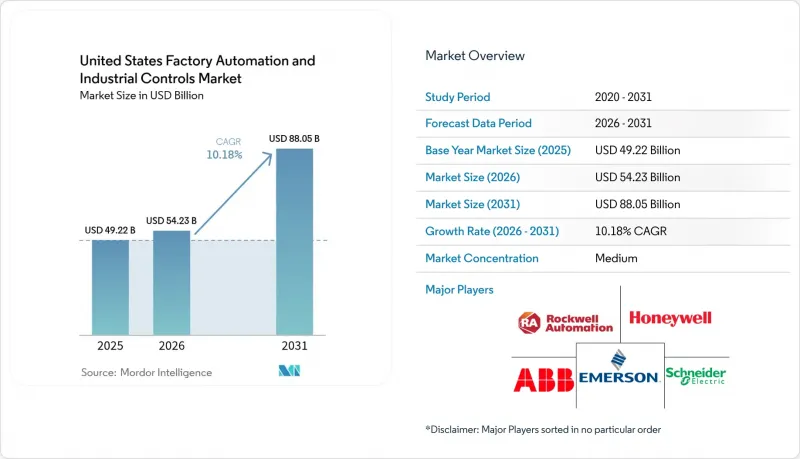
本報告按組件(硬體、軟體等)、類型(工業控制系統和現場設備)以及最終用戶產業(石油天然氣、金屬和採礦等)進行細分。市場預測以價值(美元)表示。
美國工廠自動化和工業控制市場的趨勢和洞察
回流工廠的激勵措施和《晶片製造法案》正在加速半導體工廠的自動化進程。
《晶片與科學法案》正在引發美國史上規模最大的半導體投資浪潮,亞利桑那州、德克薩斯州和俄亥俄州正在興建數十億美元的晶圓廠,這些晶圓廠採用超潔淨機器人、奈米級精度運動系統和自動化物料輸送,以最大限度地減少顆粒污染。每投資10億美元用於半導體製造,通常會伴隨2億至3億美元的自動化相關支出,從而推動了對高速晶圓搬運機器人、機器學習驅動的製程控制系統以及整合安全功能的PLC平台的需求。各州的稅收優惠政策正促使大型計畫進一步南下,並向西部山區轉移,在這些地區,可以在新建的待開發區廠址上從一運作就部署完全數位化、無人值守的製造單元。隨著晶圓廠業主尋求能夠縮短認證週期並保護敏感資訊的承包解決方案,提供硬體、MES軟體和全生命週期服務的供應商正在獲得競爭優勢。
人手不足正在推動協作機器人的應用。
目前製造業面臨75萬工人的缺口,預計2030年缺口將達210萬人。為了應對這項挑戰,經營團隊被迫將單調重複性的工作委託給協作機器人(cobot),並將員工的職位提升到品管、維護和數據分析等領域。一項調查顯示,57%的工廠表示機器人是輔助而非取代人類工作,即使在工會化的工廠中,也鼓勵採用機器人。汽車組裝是先行者,但隨著即插即用型協作機器人價格的下降和無程式碼介面的普及,中小型契約製造製造商也紛紛效仿。聯邦和州政府的培訓津貼支持了這一趨勢,用於支付機器人操作和安全認證計畫的費用,從而加速了勞動力與技術的融合。
美國不同類型棕地設施中傳統OT互通性面臨的挑戰
歷經數次工業革命而建成的工廠往往充斥著各種專有協議,導致資料流難以無縫銜接。系統整合商經常會遇到千禧年之前安裝的PLC,這些PLC缺乏原生乙太網路介面,迫使他們使用客製化驅動程序,從而增加專案成本和風險。儘管諸如基於TSN的OPC UA等開放架構旨在實現連接標準化,但由於嚴格的停機時間和有限的資金預算,進展速度遠低於供應商的預期。自動化巨頭和組件供應商的聯合舉措已開始提供預先認證的互通性軟體包,但許多中小企業仍在推遲項目,直到投資回報更加明朗。
細分市場分析
到2025年,硬體支出將佔總支出的71.25%,製造商將採購機器人、驅動器、感測器和人機介面(HMI)來實現生產線的數位化。儘管美國工廠自動化和工業控制市場的硬體市場預計將以中等個位數的速度成長,但服務領域的擴張速度更快,這表明市場正朝著基於訂閱的支援、遠端狀態監測和效能保證的方向發展。領先的供應商正在將軟體許可、網路安全管理和員工培訓整合到多年期合約中,以穩定收入並將獎勵與客戶的生產績效掛鉤。軟體平台將現場數據與製造執行系統(MES)和雲端分析連接起來,實現閉合迴路最佳化,從而降低缺陷率和能耗。因此,儘管硬體層仍然至關重要,但價值創造正在向整合商和原始設備製造商(OEM)轉移,他們整合設備、數據和專業知識,從而產生可衡量的成果。
服務業12.42%的複合年成長率反映出製造商更傾向於可預測的營運成本而非初始資本支出。服務導向的機器人焊接單元、視覺即服務檢測以及安全即服務解決方案等組合方案,正受到尋求規避技術過時風險的大型汽車製造商和消費品製造商的青睞。供應商透過共同建立遠端營運中心,提供全天候支援和即時洞察,在不增加員工的情況下縮短平均維修時間並推動持續改進。此類模式正在開闢新的收入來源,並在競爭激烈的硬體市場中使供應商脫穎而出。
其他好處:
- Excel格式的市場預測(ME)表
- 3個月的分析師支持
目錄
第1章:引言
- 研究假設和市場定義
- 調查範圍
第2章:調查方法
第3章執行摘要
第4章 市場狀況
- 市場概覽
- 市場促進因素
- 回流生產激勵措施和《晶片製造和生產法案》(CHIPS Act) 正在加速美國半導體工廠的自動化進程。
- 美國人手不足正在推動製造業採用協作機器人。
- 《通貨膨脹控制法》正在促進清潔能源生產產業的發展,而清潔能源生產產業反過來又推動了對先進自動化技術的投資。
- 美國職業安全與健康管理局 (OSHA) 對機械安全法規的嚴格執行,增加了對整合安全功能的控制系統的需求。
- 將工業物聯網 (IIoT) 整合到美國 OEM 供應商網路中的現有設備中,以實現即時 OEE 最佳化
- 隨著電動車產量的擴大,靈活高速的組裝組裝線變得至關重要。
- 市場限制因素
- 美國不同類型棕地設施中傳統OT互通性面臨的挑戰
- 儘管有稅額扣抵,但高昂的初始投資成本阻礙了美國中型製造商採用這項技術。
- 互聯控制系統的網路安全風險阻礙了其普及應用。
- 貿易政策的變化正在影響關鍵自動化組件的供應。
- 價值供應鏈分析
- 行業政策和法規
- 監管和技術展望
- 波特五力分析
- 投資分析
- 主要案例研究和實施場景
第5章 市場規模與成長預測
- 按組件
- 硬體
- 軟體
- 服務
- 按類型
- 工業控制系統
- 分散式控制系統(DCS)
- 可程式邏輯控制器(PLC)
- 監控與資料採集系統(SCADA)
- 產品生命週期管理(PLM)
- 製造執行系統(MES)
- 人機介面(HMI)
- 其他工業控制系統
- 現場設備
- 機器視覺
- 工業機器人
- 馬達和驅動器
- 安全系統
- 感測器和發射器
- 其他現場設備
- 工業控制系統
- 按最終用戶行業分類
- 石油和天然氣
- 化工/石油化工
- 電力/公共產業
- 食品/飲料
- 汽車和運輸業
- 製藥
- 半導體和電子學
- 金屬和採礦
- 紙漿和造紙
- 其他終端用戶產業
- 按地區(美國)
- 美國東北部
- 美國中西部
- 美國南部
- 美國西部
第6章 競爭情勢
- 市場集中度
- 策略趨勢
- 市佔率分析
- 公司簡介
- Rockwell Automation Inc.
- Siemens AG
- Schneider Electric SE
- Emerson Electric Co.
- ABB Ltd
- Mitsubishi Electric Corporation
- Honeywell International Inc.
- Omron Corporation
- Yokogawa Electric Corporation
- Fanuc Corporation
- Bosch Rexroth AG
- KUKA AG
- Kawasaki Heavy Industries Ltd.
- Beckhoff Automation GmbH and Co. KG
- GE Vernova(GE Automation and Controls)
- Keyence Corporation
- Danfoss Drives A/S
- Parker Hannifin Corporation
- Yaskawa Electric Corporation
- Banner Engineering Corp.
- Advantech Co.
- Cognex Corporation
- Delta Electronics
- Hitachi Industrial Equipment Systems Co.
- BandR Industrial Automation GmbH
第7章 市場機會與未來展望
According to Mordor Intelligence, the United States factory automation and industrial controls market size is expected to grow from USD 49.22 billion in 2025 to USD 54.23 billion in 2026 and is forecast to reach USD 88.05 billion by 2031 at 10.18% CAGR over 2026-2031.
This report is Segmented by Component (Hardware, Software, and More), Type (Industrial Control Systems and Field Devices), and End-User Industry (Oil and Gas, Metals and Mining, and More). The Market Forecasts are Provided in Terms of Value (USD).
United States Factory Automation And Industrial Controls Market Trends and Insights
Reshoring incentives & CHIPS Act accelerate semiconductor factory automation
The CHIPS and Science Act has triggered the largest wave of domestic semiconductor investment on record, with multibillion-dollar fabs in Arizona, Texas, and Ohio specifying ultra-clean robotics, nanometer-precision motion systems, and automated material handling that minimize particle contamination. Every USD 1 billion allocated to chip fabrication typically pulls USD 200-300 million of automation spend, magnifying demand for high-speed wafer transfer robots, machine-learning-driven process control, and safety-integrated PLC platforms. State-level abatements further shift large projects toward the South and Mountain West, where purpose-built greenfield sites can adopt fully digital, lights-out manufacturing cells from day one. Suppliers that bundle hardware, MES software, and lifecycle services gain a competitive edge as fab owners seek turnkey solutions that shorten qualification cycles and protect sensitive.
Labor shortage drives collaborative robotics adoption
Manufacturing payrolls face a 750,000-person gap today and risk 2.1 million unfilled roles by 2030, pressing management teams to deploy collaborative robots (cobots) that assume monotonous, high-repetition tasks while up-skilling employees into quality, maintenance, and data-analytics positions. Surveys show 57% of plants report that robots augment rather than eliminate human jobs, reinforcing adoption even in unionized facilities. Automotive assemblers are first movers, but small and midsize job shops follow suit as plug-and-play cobots drop in price and gain no-code programming interfaces. Federal and state training grants amplify the trend by covering tuition for certificate programs in robot operation and safety, accelerating labor-technology convergence.
Legacy OT interoperability challenges in diverse U.S. brownfield facilities
Plants built across several industrial revolutions run a patchwork of proprietary protocols, making seamless data flow difficult. Integrators often confront PLCs installed before Y2K with no native Ethernet interface, forcing custom drivers that inflate project cost and risk. Open-architecture movements such as OPC UA over TSN aim to standardize connectivity, but progress is slower than software vendors predict because downtime windows remain narrow and capital budgets are stretched. Collaborative initiatives involving automation majors and component suppliers have begun to release pre-certified interoperability bundles, yet many small firms still delay projects until clearer return on investment emerges
Other drivers and restraints analyzed in the detailed report include:
- Clean-energy manufacturing boost from Inflation Reduction Act
- OSHA-enforced machine-safety compliance raises demand for safety-integrated control systems
- Cyber-security risks in connected control systems hinder deployment
For complete list of drivers and restraints, kindly check the Table Of Contents.
Segment Analysis
Hardware accounted for 71.25% spending in 2025 as manufacturers purchased robots, drives, sensors, and HMIs to digitalize production lines. The United States factory automation and industrial controls market size for hardware is projected to post mid-single-digit growth while services expand faster, signaling a transition toward subscription-based support, remote condition monitoring, and performance guarantees. Leading suppliers bundle software licenses, cybersecurity management, and workforce training into multi-year agreements that stabilize revenue and align incentives with customer output. Software platforms bridge field data to MES and cloud analytics, enabling closed-loop optimization that lowers scrap and energy intensity. The hardware layer thus remains indispensable, yet value capture is migrating to integrators and OEMs that orchestrate devices, data, and domain expertise into measurable outcomes.
The services segment's 12.42% CAGR reflects manufacturer preference for predictable operating expenditure over upfront capital outlay. As-a-service robotic welding cells, vision-as-a-service inspection, and security-as-a-service packages resonate with tier-one automotive and consumer packaged goods firms seeking to hedge technology obsolescence. Vendors that co-locate remote operations centers provide 24/7 support and real-time insight, shortening mean time to repair and driving continuous improvement cycles without inflating headcount. Such models unlock new margin pools and differentiate suppliers in a crowded hardware market.
Complete Report Scope:
- By Component
- Hardware
- Software
- Services
- By Type
- Industrial Control Systems
- Distributed Control System (DCS)
- Programmable Logic Controller (PLC)
- Supervisory Control and Data Acquisition (SCADA)
- Product Lifecycle Management (PLM)
- Manufacturing Execution System (MES)
- Human Machine Interface (HMI)
- Other Industrial Control Systems
- Field Devices
- Machine Vision
- Industrial Robotics
- Motors and Drives
- Safety Systems
- Sensors and Transmitters
- Other Field Devices
- Industrial Control Systems
- By End-user Industry
- Oil and Gas
- Chemical and Petrochemical
- Power and Utilities
- Food and Beverage
- Automotive and Transportation
- Pharmaceutical
- Semiconductor and Electronics
- Metals and Mining
- Pulp and Paper
- Other End-user Industries
- By Region (United States)
- Northeast U.S.
- Midwest U.S.
- South U.S.
- West U.S.
List of Companies Covered in this Report:
- Rockwell Automation Inc.
- Siemens AG
- Schneider Electric SE
- Emerson Electric Co.
- ABB Ltd
- Mitsubishi Electric Corporation
- Honeywell International Inc.
- Omron Corporation
- Yokogawa Electric Corporation
- Fanuc Corporation
- Bosch Rexroth AG
- KUKA AG
- Kawasaki Heavy Industries Ltd.
- Beckhoff Automation GmbH and Co. KG
- GE Vernova (GE Automation and Controls)
- Keyence Corporation
- Danfoss Drives A/S
- Parker Hannifin Corporation
- Yaskawa Electric Corporation
- Banner Engineering Corp.
- Advantech Co.
- Cognex Corporation
- Delta Electronics
- Hitachi Industrial Equipment Systems Co.
- BandR Industrial Automation GmbH
Additional Benefits:
- The market estimate (ME) sheet in Excel format
- 3 months of analyst support
TABLE OF CONTENTS
1 INTRODUCTION
- 1.1 Study Assumptions and Market Definition
- 1.2 Scope of the Study
2 RESEARCH METHODOLOGY
3 EXECUTIVE SUMMARY
4 MARKET LANDSCAPE
- 4.1 Market Overview
- 4.2 Market Drivers
- 4.2.1 Reshoring Incentives and CHIPS Act Accelerating Semiconductor Factory Automation in the U.S.
- 4.2.2 Labor Shortage Driving Collaborative Robotics Adoption Across U.S. Manufacturing
- 4.2.3 Clean-Energy Manufacturing Boost from Inflation Reduction Act Stimulating Advanced Automation Investments
- 4.2.4 OSHA-Enforced Machine-Safety Compliance Elevating Demand for Safety-Integrated Control Systems
- 4.2.5 Brownfield IIoT Retrofits for Real-Time OEE Optimization Among U.S. OEM Supplier Network
- 4.2.6 EV Production Expansion Necessitating Flexible High-Speed Assembly Automation Lines
- 4.3 Market Restraints
- 4.3.1 Legacy OT Interoperability Challenges in Diverse U.S. Brownfield Facilities
- 4.3.2 High Initial CapEx Limiting Adoption by Mid-Sized U.S. Manufacturers Despite Tax Credits
- 4.3.3 Cyber-Security Risks in Connected Control Systems Hindering Deployment
- 4.3.4 Trade Policy Volatility Impacting Supply of Critical Automation Components
- 4.4 Value / Supply-Chain Analysis
- 4.5 Industry Policies and Regulations
- 4.6 Regulatory or Technological Outlook
- 4.7 Porter's Five Forces Analysis
- 4.7.1 Bargaining Power of Suppliers
- 4.7.2 Bargaining Power of Consumers
- 4.7.3 Threat of New Entrants
- 4.7.4 Threat of Substitutes
- 4.7.5 Intensity of Competitive Rivalry
- 4.8 Investment Analysis
- 4.9 Key Case Studies and Implementation Scenarios
5 MARKET SIZE AND GROWTH FORECASTS (VALUE)
- 5.1 By Component
- 5.1.1 Hardware
- 5.1.2 Software
- 5.1.3 Services
- 5.2 By Type
- 5.2.1 Industrial Control Systems
- 5.2.1.1 Distributed Control System (DCS)
- 5.2.1.2 Programmable Logic Controller (PLC)
- 5.2.1.3 Supervisory Control and Data Acquisition (SCADA)
- 5.2.1.4 Product Lifecycle Management (PLM)
- 5.2.1.5 Manufacturing Execution System (MES)
- 5.2.1.6 Human Machine Interface (HMI)
- 5.2.1.7 Other Industrial Control Systems
- 5.2.2 Field Devices
- 5.2.2.1 Machine Vision
- 5.2.2.2 Industrial Robotics
- 5.2.2.3 Motors and Drives
- 5.2.2.4 Safety Systems
- 5.2.2.5 Sensors and Transmitters
- 5.2.2.6 Other Field Devices
- 5.2.1 Industrial Control Systems
- 5.3 By End-user Industry
- 5.3.1 Oil and Gas
- 5.3.2 Chemical and Petrochemical
- 5.3.3 Power and Utilities
- 5.3.4 Food and Beverage
- 5.3.5 Automotive and Transportation
- 5.3.6 Pharmaceutical
- 5.3.7 Semiconductor and Electronics
- 5.3.8 Metals and Mining
- 5.3.9 Pulp and Paper
- 5.3.10 Other End-user Industries
- 5.4 By Region (United States)
- 5.4.1 Northeast U.S.
- 5.4.2 Midwest U.S.
- 5.4.3 South U.S.
- 5.4.4 West U.S.
6 COMPETITIVE LANDSCAPE
- 6.1 Market Concentration
- 6.2 Strategic Moves
- 6.3 Market Share Analysis
- 6.4 Company Profiles (includes Global level Overview, Market level overview, Core Segments, Financials as available, Strategic Information, Market Rank/Share for key companies, Products and Services, and Recent Developments)
- 6.4.1 Rockwell Automation Inc.
- 6.4.2 Siemens AG
- 6.4.3 Schneider Electric SE
- 6.4.4 Emerson Electric Co.
- 6.4.5 ABB Ltd
- 6.4.6 Mitsubishi Electric Corporation
- 6.4.7 Honeywell International Inc.
- 6.4.8 Omron Corporation
- 6.4.9 Yokogawa Electric Corporation
- 6.4.10 Fanuc Corporation
- 6.4.11 Bosch Rexroth AG
- 6.4.12 KUKA AG
- 6.4.13 Kawasaki Heavy Industries Ltd.
- 6.4.14 Beckhoff Automation GmbH and Co. KG
- 6.4.15 GE Vernova (GE Automation and Controls)
- 6.4.16 Keyence Corporation
- 6.4.17 Danfoss Drives A/S
- 6.4.18 Parker Hannifin Corporation
- 6.4.19 Yaskawa Electric Corporation
- 6.4.20 Banner Engineering Corp.
- 6.4.21 Advantech Co.
- 6.4.22 Cognex Corporation
- 6.4.23 Delta Electronics
- 6.4.24 Hitachi Industrial Equipment Systems Co.
- 6.4.25 BandR Industrial Automation GmbH
7 MARKET OPPORTUNITIES AND FUTURE OUTLOOK
- 7.1 White-Space and Unmet-Need Assessment

 4U工業電腦市場-2026年至2032年全球市場預測
 2034 年工業自動化網路安全市場預測—按部署類型、安全類型、組件、服務類型、技術、應用、最終用戶和地區分類的全球分析
 北美工廠自動化和工業控制:市場佔有率分析、行業趨勢和統計數據以及成長預測(2026-2031 年)工廠自動化與工業控制:市場佔有率分析、產業趨勢與統計、成長預測(2026-2031)德國工廠自動化和工業控制:市場佔有率分析、行業趨勢和統計數據以及成長預測(2026-2031 年)日本工廠自動化和工業控制:市場佔有率分析、行業趨勢和統計數據以及成長預測(2026-2031 年)歐洲工廠自動化和工業控制:市場佔有率分析、行業趨勢和統計數據以及成長預測(2026-2031 年)義大利工廠自動化和工業控制:市場佔有率分析、行業趨勢和統計數據以及成長預測(2026-2031 年)法國工廠自動化和工業控制:市場佔有率分析、行業趨勢和統計數據以及成長預測(2026-2031 年)中國工廠自動化與工業控制:市場佔有率分析、產業趨勢與統計及成長預測(2026-2031年)