


 |
市場調查報告書
商品編碼
2113582
工廠自動化與工業控制:市場佔有率分析、產業趨勢與統計、成長預測(2026-2031)Factory Automation And Industrial Controls - Market Share Analysis, Industry Trends & Statistics, Growth Forecasts (2026 - 2031) |
||||||

※ 本網頁內容可能與最新版本有所差異。詳細情況請與我們聯繫。
根據 Mordor Intelligence 預測,工廠自動化和工業控制市場預計將從 2025 年的 3,123.3 億美元成長到 2026 年的 3,384.6 億美元,到 2031 年達到 5,058.8 億美元,2026 年至 2031 年的複合成長率為 8.37%。
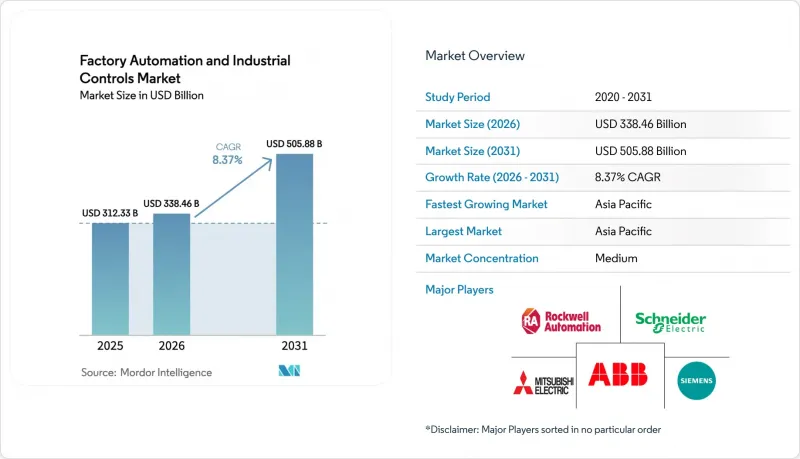
本報告按產品(工業控制系統、現場設備)、組件(硬體、軟體、服務)、最終用戶產業(汽車、化學、公共產業等)、控制系統結構(專有、開放式、混合式)和地區(北美、南美等)進行細分。市場預測以美元計價。
全球工廠自動化與工業控制市場趨勢及洞察
加速採用工業4.0
製造商正在將傳統的「自動化孤島」轉變為同步的網實整合系統,將機器、物流和品管迴路即時連接起來,從而縮短換線時間並提高整體設備效率 (OEE)。預計到 2025 年,德國受訪工廠中採用數位孿生技術的比例將躍升至 68%,高於兩年前的 41%。典型的投資回收期不到 18 個月。在日本,政府已撥款津貼,以幫助中小企業採用協作機器人和物聯網感測器,從而將自動化擴展到大型工廠之外。對改裝專案的關注刺激了對模組化邊緣閘道器、時間敏感網路和可與 20 年前設備相容的協定無關控制器的需求。因此,資本投資正擴展到數千家中型工廠,從而鞏固了工廠自動化和工業控制市場廣泛且永續的成長路徑。
能源效率法規和成本壓力
歐盟的《生態設計條例2024/1781》和修訂後的美國馬達標準正迫使製造商採用IE4-IE5級馬達、變頻器和先進的功率分析技術,這將降低15-25%的電力消耗。 2024年,歐洲工業用電平均價格將達到每度電0.28歐元(每度0.30美元),是2022年之前的兩倍多。這使得能源最佳化成為董事會層級討論的核心議題。自動化供應商正將這些法規轉化為商業性驅動力。Schneider Electric報告稱,隨著客戶競相通過ISO 50001認證,其搭載EcoStruxure技術的變頻器銷量在2025年成長了22%。這波升級浪潮在化學和金屬等能源密集型行業尤為強勁,推動了與能源儀錶板和基於人工智慧的負載平衡相關的軟體收入持續成長。這些因素正為工廠自動化和工業控制市場帶來持續的利多。
自動化專案初始資本支出(CAPEX)較高
實施一套整合式MES-SCADA系統通常需要每個工廠投入200萬至800萬美元,而在食品加工等低利潤產業,投資回報期可能超過三年。不同地區的低成本資金籌措管道不盡相同,南美洲和東南亞部分地區的利率仍超過12%。儘管租賃和「自動化即服務」(Automation-as-a-Service)模式有望降低准入門檻,但客戶仍然對資料所有權和生命週期依賴性持謹慎態度。 ABB透露,到2025年,基於訂閱的機器人銷售僅佔其機器人業務銷售的9%,顯示替代資金籌措機制仍處於起步階段。因此,資金限制可能會減緩中小型製造商短期內採用該系統的速度,從而可能抑制工廠自動化和工業控制市場的成長。
細分市場分析
預計在預測期內,現場設備將成為成長最快的產品類型,到2031年,其年均成長率預計將達到9.71%。這一成長速度將超過工業控制系統,後者在2025年佔據了工廠自動化和工業控制市場佔有率的54.31%。到2024年,機器人部署量將達到55.3萬台,其中汽車和電子產業佔出貨量的62%。受人工智慧驅動的缺陷偵測業務的強勁表現推動,康耐視(Cognex)的機器視覺部門在2024年的營收成長了18%。這些投資標誌著產業正在從可程式邏輯控制器(PLC)轉向具備本地分析能力以及5G和IO-Link無線連接的智慧終端。
這種轉變正在重塑價值提案。控制器差異化優勢正從掃描時間基準轉向生態系統相容性和軟體工具鏈。擴增實境(AR) 疊加功能正被添加到人機介面 (HMI) 中,使中型生產線的批次切換時間縮短高達 30%。混合控制架構將確定性 PLC 迴路與雲端分析相結合,從而避免了徹底更換現有系統(即「拆裝式」系統)的成本。隨著傳統 SCADA 系統逐漸過時,關於升級的討論越來越側重於無縫遷移路徑,而不僅僅是硬體更新,而這正是工廠自動化和工業控制市場實現多周期收入的基礎。
到2025年,硬體仍將佔總收入的68.17%,而軟體預計將成長10.93%,是所有組成部分中成長率最高的。目前,訂閱模式在部署中佔據主導地位,西門子就是一個典型的例子。該公司旗下的MindSphere和Xcelerator產品組合預計將在2025年推動軟體銷售額成長16%,而硬體銷售額僅成長4%。艾默生2024年的軟體經常性銷售額佔自動化銷售額的22%以上,毛利率超過70%。相比之下,硬體的毛利率則維持在30%左右。
低程式碼設定工具(例如 EcoStruxure Automation Expert 2.0)可將工程工作時間縮短一半,並將使用者群體擴展至製程工程師和營運經理。業務收益長期以來主要依賴現場試運行,如今正轉向遠端診斷和人工智慧故障排除,從而降低差旅成本和碳排放。這些趨勢共同推動了控制器和驅動器軟體的發展,並強化了工廠自動化和工業控制市場的混合平台策略。
區域分析
預計到2025年,亞太地區將佔全球工廠自動化和工業控制市場37.68%的佔有率,並在2031年之前保持9.56%的複合年成長率,凸顯了其作為製造地和政策驅動者的雙重角色。在中國「雙循環」政策的推動下,隨著製造商供應鏈的本地化,2024年中國國內PLC和驅動器的出貨量增加了28%。印度向電子、製藥和汽車零件產業提供了1,200億印度盧比(約14.4億美元)的生產連結獎勵計畫,前提是這些企業必須達到最低自動化標準。日本向中小企業提供了1,200億日圓(約8億美元)的資金,以支援機器人應用,進一步將自動化應用擴展到其核心汽車產業之外。韓國在2024年支援了3200個智慧工廠項目,涵蓋半導體、顯示器和電池製造等領域。
儘管北美地區的成長速度正在放緩,但它仍然是一個至關重要的地區,這得益於聯邦政府將資金與工業4.0實踐掛鉤的獎勵。 《晶片與工業安全法案》(CHIPS Act)下的390億美元津貼框架要求在新晶圓廠中實施即時監控和預測性維護。墨西哥和加拿大正透過近岸外包受益,從而推動了對運動控制供應商的訂單。在歐洲,儘管數位孿生技術的應用日趨成熟,但它在數位孿生和節能維修仍然處於主導。在受調查的德國工廠中,68%的工廠預計到2025年至少會應用一項數位孿生技術。不斷上漲的電價正在加速向IE5標準馬達和驅動器的升級改造。
儘管南美洲、中東和非洲在整體投資方面落後於其他地區,但它們擁有眾多與採礦業相關的極具前景的項目。巴西石油公司(Petrobras)已撥款21億美元,計劃於2024年投入數位化油田平台,其中包括自主鑽井和SCADA系統升級。沿岸地區的煉油廠正在實施先進的製程控制技術,以滿足能源強度目標;而南非的礦業公司則正在部署無線感測器網路,以提高資產運轉率。由於部署規模較小且已安裝設備的平均運作較短,開放標準架構和雲端原生分析技術可望顯著超越傳統解決方案。總體而言,區域多元化正在推動工廠自動化和工業控制市場保持強勁成長勢頭。
其他好處:
- Excel格式的市場預測(ME)表
- 3個月的分析師支持
目錄
第1章:引言
- 研究假設和市場定義
- 調查範圍
第2章:調查方法
第3章執行摘要
第4章 市場狀況
- 市場概覽
- 市場促進因素
- 加速採用工業4.0
- 強制性節能改造和成本壓力
- 製造業勞動力短缺問題日益嚴重
- 政府對數位化工廠的支持措施
- 低程式碼/無程式碼自動化平台
- 利用人工智慧加強預測性品管
- 市場限制因素
- 自動化專案初始資本支出(CAPEX)較高
- OT網路中的網路安全漏洞
- 互通性標準碎片化
- 控制器用半導體的供應波動
- 產業價值鏈分析
- 監理情勢
- 技術展望
- 宏觀經濟因素對市場的影響
- 波特五力分析
第5章 市場規模與成長預測
- 依產品
- 工業控制系統
- 分散式控制系統(DCS)
- 可程式邏輯控制器(PLC)
- 監控與數據採集(SCADA)
- 產品生命週期管理(PLM)
- 人機介面(HMI)
- 製造執行系統(MES)
- 企業資源規劃(ERP)
- 其他工業控制系統
- 現場設備
- 機器視覺系統
- 工業機器人
- 感測器和發射器
- 馬達和驅動器
- 其他現場設備
- 工業控制系統
- 按組件
- 硬體
- 軟體
- 服務
- 按最終用戶行業分類
- 車
- 化工/石油化工
- 公用事業
- 製藥
- 食品/飲料
- 石油和天然氣
- 電子和半導體
- 航太/國防
- 其他終端用戶產業
- 控制系統結構
- 專有規格/廠商特定規格
- 開放/互通
- 混合架構
- 按地區
- 北美洲
- 美國
- 加拿大
- 墨西哥
- 南美洲
- 巴西
- 其他南美國家
- 歐洲
- 德國
- 英國
- 法國
- 義大利
- 西班牙
- 北歐的
- 其他歐洲國家
- 中東
- 沙烏地阿拉伯
- 阿拉伯聯合大公國
- 其他中東國家
- 非洲
- 南非
- 奈及利亞
- 其他非洲國家
- 亞太地區
- 中國
- 日本
- 韓國
- 印度
- 新加坡
- 澳洲
- 其他亞太國家
- 北美洲
第6章 競爭情勢
- 市場集中度
- 策略趨勢
- 市佔率分析
- 公司簡介
- ABB Ltd
- Siemens AG
- Rockwell Automation Inc.
- Schneider Electric SE
- Mitsubishi Electric Corporation
- Honeywell International Inc.
- Emerson Electric Co.
- Omron Corporation
- Yokogawa Electric Corporation
- GE Vernova Inc.
- Texas Instruments Inc.
- Bosch Rexroth AG
- Fanuc Corporation
- Keyence Corporation
- Advantech Co. Ltd.
- Beckhoff Automation GmbH
- Delta Electronics Inc.
- Lenze SE
- WAGO Kontakttechnik GmbH
- Hollysys Automation Technologies
第7章 市場機會與未來展望
According to Mordor Intelligence, the factory automation and industrial controls market size is expected to increase from USD 312.33 billion in 2025 to USD 338.46 billion in 2026 and reach USD 505.88 billion by 2031, growing at a CAGR of 8.37% over 2026-2031.
This report is Segmented by Product (Industrial Control Systems, Field Devices), Component (Hardware, Software, and Services), End-User Industry (Automotive, Chemical, Utility, and More), Control System Architecture (Proprietary, Open, and Hybrid), and Geography (North America, South America, and More). The Market Forecasts are Provided in Terms of Value (USD).
Global Factory Automation And Industrial Controls Market Trends and Insights
Industry 4.0 Adoption Acceleration
Manufacturers are converting legacy "automation islands" into synchronized cyber-physical ecosystems that link machines, logistics, and quality loops in real time, yielding shorter changeovers and higher overall equipment effectiveness. Digital-twin deployments jumped to 68% of surveyed German plants in 2025, up from 41% two years earlier, with typical payback falling below 18 months. Japan budgeted JPY 120 billion (USD 800 million) in grants for small and midsized enterprises to install collaborative robots and IoT sensors, expanding automation beyond mega-plants. The emphasis on retrofit projects is stimulating demand for modular edge gateways, time-sensitive networking, and protocol-agnostic controllers capable of coexisting with 20-year-old equipment. As a result, capital spending is spreading across thousands of mid-tier facilities, cementing a broad, sustainable growth path for the factory automation and industrial controls market.
Energy-Efficiency Mandates and Cost Pressure
The European Union's Ecodesign Regulation 2024/1781 and updated United States motor standards are pressing manufacturers to adopt IE4-IE5 motors, variable-frequency drives, and advanced power analytics, reducing electricity use by 15-25%. Average industrial power prices in Europe reached EUR 0.28 per kWh (USD 0.30 per kWh) in 2024, more than double pre-2022 levels, putting energy optimization at the center of board-level discussions. Automation vendors are translating the regulations into commercial traction; Schneider Electric reported a 22% rise in EcoStruxure-enabled drives in 2025 as customers raced to certify plants under ISO 50001. The replacement wave is especially strong in energy-intensive segments such as chemicals and metals, lifting recurring software revenue tied to energy dashboards and AI-based load balancing. These factors add durable lift to the factory automation and industrial controls market.
High Upfront CAPEX of Automation Projects
Integrated MES-SCADA deployments often require USD 2-8 million per site, with paybacks exceeding three years in thin-margin sectors such as food processing. Access to low-cost financing is uneven, particularly in South America and parts of Southeast Asia where interest rates remain above 12%. Although leasing and automation-as-a-service models promise lower entry hurdles, customers remain wary of data ownership and long lifecycle dependencies. ABB disclosed that subscription-based robotics accounted for only 9% of its 2025 robotics revenue, underscoring the early stage of alternative financing. Consequently, capital constraints could dampen near-term adoption across smaller manufacturers, trimming growth of the factory automation and industrial controls market.
Other drivers and restraints analyzed in the detailed report include:
- Rising Labor Shortages in Manufacturing
- Government Stimulus for Digital Factories
- Cyber-Security Vulnerabilities in OT Networks
For complete list of drivers and restraints, kindly check the Table Of Contents.
Segment Analysis
Field devices are expected to be the fastest-growing product category over the forecast period and are set to expand at 9.71% through 2031, outpacing industrial control systems that held 54.31% of the factory automation and industrial controls market share in 2025. Robot installations reached 553,000 units in 2024, with automotive and electronics buyers taking 62% of shipments. Machine-vision revenue climbed 18% at Cognex during 2024 on the strength of AI-powered defect detection. These investments illustrate an industry pivot from programmable logic controllers toward intelligent endpoints that carry local analytics and 5G or IO-Link Wireless connectivity.
This transition reshapes value propositions. Controller differentiation now turns on ecosystem compatibility and software toolchains rather than scan-time benchmarks. Human-machine interfaces add augmented-reality overlays that cut batch changeovers by up to 30% in mid-volume lines. Hybrid control architectures mix deterministic PLC loops with cloud analytics, sidestepping full rip-and-replace costs. As older SCADA systems approach obsolescence, upgrade discussions increasingly center on seamless migration paths instead of pure hardware refresh, anchoring multi-cycle revenue for the factory automation and industrial controls market.
Hardware still represented 68.17% of revenue in 2025, yet software is projected to rise at a 10.93% clip, the highest among components. Subscription models now dominate rollouts, illustrated by Siemens, whose MindSphere and Xcelerator portfolios drove 16% software growth in 2025 while hardware rose only 4%. Emerson's recurring software topped 22% of automation sales in 2024, delivering gross margins above 70%, versus the mid-30% range for hardware.
Low-code configuration tools such as EcoStruxure Automation Expert 2.0 reduce engineering hours by up to half, broadening user bases to process engineers and operations managers. Services revenue, long dominated by on-site commissioning, is shifting toward remote diagnostics and AI-assisted troubleshooting, which lowers travel costs and carbon footprints. Collectively, these dynamics deepen software's pull-through effect on controllers and drives, reinforcing hybrid platform strategies across the factory automation and industrial controls market.
Complete Report Scope:
- By Product
- Industrial Control Systems
- Distributed Control System (DCS)
- Programmable Logic Controller (PLC)
- Supervisory Control and Data Acquisition (SCADA)
- Product Lifecycle Management (PLM)
- Human-Machine Interface (HMI)
- Manufacturing Execution System (MES)
- Enterprise Resource Planning (ERP)
- Other Industrial Control Systems
- Field Devices
- Machine Vision Systems
- Industrial Robotics
- Sensors and Transmitters
- Motors and Drives
- Other Field Devices
- Industrial Control Systems
- By Component
- Hardware
- Software
- Services
- By End-User Industry
- Automotive
- Chemical and Petrochemical
- Utility
- Pharmaceutical
- Food and Beverage
- Oil and Gas
- Electronics and Semiconductor
- Aerospace and Defense
- Other End-User Industries
- By Control System Architecture
- Proprietary / Vendor-Specific
- Open / Interoperable
- Hybrid Architecture
- By Geography
- North America
- United States
- Canada
- Mexico
- South America
- Brazil
- Rest of South America
- Europe
- Germany
- United Kingdom
- France
- Italy
- Spain
- Nordics
- Rest of Europe
- Middle East
- Saudi Arabia
- United Arab Emirates
- Rest of Middle East
- Africa
- South Africa
- Nigeria
- Rest of Africa
- Asia-Pacific
- China
- Japan
- South Korea
- India
- Singapore
- Australia
- Rest of Asia-Pacific
- North America
Geography Analysis
Asia Pacific accounted for 37.68% of the factory automation and industrial controls market in 2025 and is projected to post a 9.56% CAGR through 2031, underscoring its dual role as a manufacturing hub and policy engine. China's dual-circulation push triggered a 28% rise in domestic PLC and drive shipments in 2024 as producers localized supply chains. India disbursed INR 120 billion (USD 1.44 billion) in production-linked incentives for electronics, pharmaceuticals, and auto components, subject to minimum automation thresholds. Japan granted JPY 120 billion (USD 800 million) to small and mid-sized enterprises to support robot adoption, extending automation beyond the automotive nucleus. South Korea sponsored 3,200 smart-factory projects in 2024, spanning semiconductor, display, and battery facilities.
North America remains pivotal despite slower growth, powered by federal incentives that tether funding to Industry 4.0 practices. The CHIPS Act's USD 39 billion grant pool obliges real-time monitoring and predictive maintenance in new fabs. Mexico and Canada are benefiting via near-shoring, funneling orders to motion-control suppliers. Europe commands mature penetration yet maintains leadership in digital twins and energy-efficient retrofits; 68% of surveyed German plants had adopted at least one digital-twin application by 2025. High power prices propel upgrades to IE5 motors and drives, reinforcing refresh velocity.
South America, the Middle East, and Africa collectively trail in spending but register strong point projects tied to extractive industries. Brazil's Petrobras earmarked USD 2.1 billion for digital oilfield platforms in 2024, including autonomous drilling and SCADA upgrades. Gulf refineries adopt advanced process control to meet energy-intensity targets, while South African miners deploy wireless sensor networks to improve asset uptime. Although volumes are smaller, the installed base is younger, providing an opening for open-standard architectures and cloud-native analytics to leapfrog legacy solutions. Collectively, geographic diversification underpins a resilient trajectory for the factory automation and industrial controls market.
- ABB Ltd
- Siemens AG
- Rockwell Automation Inc.
- Schneider Electric SE
- Mitsubishi Electric Corporation
- Honeywell International Inc.
- Emerson Electric Co.
- Omron Corporation
- Yokogawa Electric Corporation
- GE Vernova Inc.
- Texas Instruments Inc.
- Bosch Rexroth AG
- Fanuc Corporation
- Keyence Corporation
- Advantech Co. Ltd.
- Beckhoff Automation GmbH
- Delta Electronics Inc.
- Lenze SE
- WAGO Kontakttechnik GmbH
- Hollysys Automation Technologies
Additional Benefits:
- The market estimate (ME) sheet in Excel format
- 3 months of analyst support
TABLE OF CONTENTS
1 INTRODUCTION
- 1.1 Study Assumptions and Market Definition
- 1.2 Scope of the Study
2 RESEARCH METHODOLOGY
3 EXECUTIVE SUMMARY
4 MARKET LANDSCAPE
- 4.1 Market Overview
- 4.2 Market Drivers
- 4.2.1 Industry 4.0 Adoption Acceleration
- 4.2.2 Energy-Efficiency Mandates and Cost Pressure
- 4.2.3 Rising Labor Shortages in Manufacturing
- 4.2.4 Government Stimulus for Digital Factories
- 4.2.5 Low-Code / No-Code Automation Platforms
- 4.2.6 AI-Driven Predictive Quality Control Upgrades
- 4.3 Market Restraints
- 4.3.1 High Upfront CAPEX of Automation Projects
- 4.3.2 Cyber-Security Vulnerabilities in OT Networks
- 4.3.3 Fragmented Interoperability Standards
- 4.3.4 Semiconductor Supply Volatility for Controllers
- 4.4 Industry Value Chain Analysis
- 4.5 Regulatory Landscape
- 4.6 Technological Outlook
- 4.7 Impact of Macroeconomic Factors on the Market
- 4.8 Porter's Five Forces Analysis
- 4.8.1 Bargaining Power of Suppliers
- 4.8.2 Bargaining Power of Buyers
- 4.8.3 Threat of New Entrants
- 4.8.4 Threat of Substitutes
- 4.8.5 Intensity of Competitive Rivalry
5 MARKET SIZE AND GROWTH FORECASTS (VALUE)
- 5.1 By Product
- 5.1.1 Industrial Control Systems
- 5.1.1.1 Distributed Control System (DCS)
- 5.1.1.2 Programmable Logic Controller (PLC)
- 5.1.1.3 Supervisory Control and Data Acquisition (SCADA)
- 5.1.1.4 Product Lifecycle Management (PLM)
- 5.1.1.5 Human-Machine Interface (HMI)
- 5.1.1.6 Manufacturing Execution System (MES)
- 5.1.1.7 Enterprise Resource Planning (ERP)
- 5.1.1.8 Other Industrial Control Systems
- 5.1.2 Field Devices
- 5.1.2.1 Machine Vision Systems
- 5.1.2.2 Industrial Robotics
- 5.1.2.3 Sensors and Transmitters
- 5.1.2.4 Motors and Drives
- 5.1.2.5 Other Field Devices
- 5.1.1 Industrial Control Systems
- 5.2 By Component
- 5.2.1 Hardware
- 5.2.2 Software
- 5.2.3 Services
- 5.3 By End-User Industry
- 5.3.1 Automotive
- 5.3.2 Chemical and Petrochemical
- 5.3.3 Utility
- 5.3.4 Pharmaceutical
- 5.3.5 Food and Beverage
- 5.3.6 Oil and Gas
- 5.3.7 Electronics and Semiconductor
- 5.3.8 Aerospace and Defense
- 5.3.9 Other End-User Industries
- 5.4 By Control System Architecture
- 5.4.1 Proprietary / Vendor-Specific
- 5.4.2 Open / Interoperable
- 5.4.3 Hybrid Architecture
- 5.5 By Geography
- 5.5.1 North America
- 5.5.1.1 United States
- 5.5.1.2 Canada
- 5.5.1.3 Mexico
- 5.5.2 South America
- 5.5.2.1 Brazil
- 5.5.2.2 Rest of South America
- 5.5.3 Europe
- 5.5.3.1 Germany
- 5.5.3.2 United Kingdom
- 5.5.3.3 France
- 5.5.3.4 Italy
- 5.5.3.5 Spain
- 5.5.3.6 Nordics
- 5.5.3.7 Rest of Europe
- 5.5.4 Middle East
- 5.5.4.1 Saudi Arabia
- 5.5.4.2 United Arab Emirates
- 5.5.4.3 Rest of Middle East
- 5.5.5 Africa
- 5.5.5.1 South Africa
- 5.5.5.2 Nigeria
- 5.5.5.3 Rest of Africa
- 5.5.6 Asia-Pacific
- 5.5.6.1 China
- 5.5.6.2 Japan
- 5.5.6.3 South Korea
- 5.5.6.4 India
- 5.5.6.5 Singapore
- 5.5.6.6 Australia
- 5.5.6.7 Rest of Asia-Pacific
- 5.5.1 North America
6 COMPETITIVE LANDSCAPE
- 6.1 Market Concentration
- 6.2 Strategic Moves
- 6.3 Market Share Analysis
- 6.4 Company Profiles (includes Global Level Overview, Market Level Overview, Core Segments, Financials as Available, Strategic Information, Market Rank/Share for Key Companies, Products and Services, and Recent Developments)
- 6.4.1 ABB Ltd
- 6.4.2 Siemens AG
- 6.4.3 Rockwell Automation Inc.
- 6.4.4 Schneider Electric SE
- 6.4.5 Mitsubishi Electric Corporation
- 6.4.6 Honeywell International Inc.
- 6.4.7 Emerson Electric Co.
- 6.4.8 Omron Corporation
- 6.4.9 Yokogawa Electric Corporation
- 6.4.10 GE Vernova Inc.
- 6.4.11 Texas Instruments Inc.
- 6.4.12 Bosch Rexroth AG
- 6.4.13 Fanuc Corporation
- 6.4.14 Keyence Corporation
- 6.4.15 Advantech Co. Ltd.
- 6.4.16 Beckhoff Automation GmbH
- 6.4.17 Delta Electronics Inc.
- 6.4.18 Lenze SE
- 6.4.19 WAGO Kontakttechnik GmbH
- 6.4.20 Hollysys Automation Technologies
7 MARKET OPPORTUNITIES AND FUTURE OUTLOOK
- 7.1 White-Space and Unmet-Need Assessment

 4U工業電腦市場-2026年至2032年全球市場預測
 2034 年工業自動化網路安全市場預測—按部署類型、安全類型、組件、服務類型、技術、應用、最終用戶和地區分類的全球分析
 北美工廠自動化和工業控制:市場佔有率分析、行業趨勢和統計數據以及成長預測(2026-2031 年)德國工廠自動化和工業控制:市場佔有率分析、行業趨勢和統計數據以及成長預測(2026-2031 年)美國工廠自動化和工業控制:市場佔有率分析、行業趨勢和統計數據以及成長預測(2026-2031 年)日本工廠自動化和工業控制:市場佔有率分析、行業趨勢和統計數據以及成長預測(2026-2031 年)歐洲工廠自動化和工業控制:市場佔有率分析、行業趨勢和統計數據以及成長預測(2026-2031 年)義大利工廠自動化和工業控制:市場佔有率分析、行業趨勢和統計數據以及成長預測(2026-2031 年)法國工廠自動化和工業控制:市場佔有率分析、行業趨勢和統計數據以及成長預測(2026-2031 年)中國工廠自動化與工業控制:市場佔有率分析、產業趨勢與統計及成長預測(2026-2031年)