

 |
市場調查報告書
商品編碼
2120517
日本工廠自動化和工業控制:市場佔有率分析、行業趨勢和統計數據以及成長預測(2026-2031 年)Japan Factory Automation And Industrial Controls - Market Share Analysis, Industry Trends & Statistics, Growth Forecasts (2026 - 2031) |
||||||

※ 本網頁內容可能與最新版本有所差異。詳細情況請與我們聯繫。
據 Mordor Intelligence 稱,2025 年日本工廠自動化和工業控制市場價值為 168.4 億美元,預計到 2031 年將達到 285.7 億美元,而 2026 年為 183.9 億美元,預測期(2026-2031 年)的複合成長率為 9.21%。
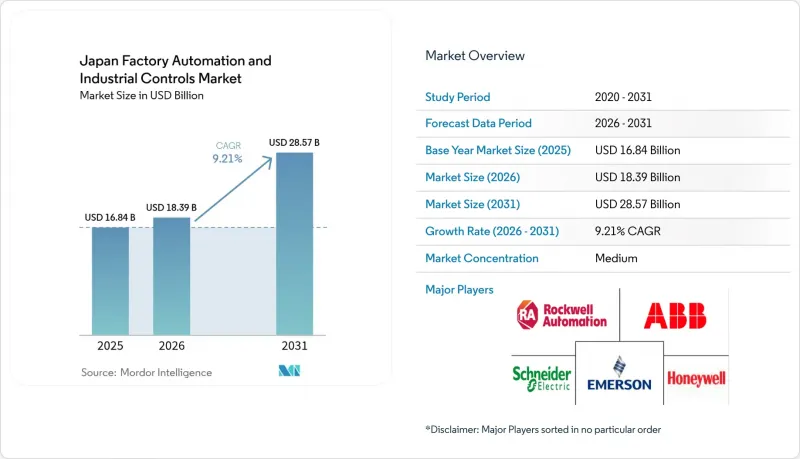
本報告按系統類型(DCS、PLC、SCADA、PLM、MES、HMI 及其他)、組件(硬體、軟體、服務)、工廠規模(中小企業、大型企業)和最終用戶行業(石油天然氣、化學和石化、電力和公共產業、食品飲料及其他)進行細分。市場預測以美元計價。
日本工廠自動化和工業控制市場的趨勢和洞察。
強制性碳中及及能源效率法規
2023年修訂的日本《能源節約法》規定,年耗油量超過1500千公升原油當量的工廠必須設定能源強度基準,違規者將被處以罰款。這促使施耐德電氣和西門子等公司增加了對變頻驅動器、再生輸送機和即時能源管理解決方案的預算撥款。 2024年的修訂將範圍擴大到範圍3排放,迫使一級汽車零件供應商對其分包商的碳足跡進行審核,導致愛知縣和靜岡縣的二級金屬加工廠的PLC維修數量激增。橫河電機的OpreX能源管理套件在2024年的日本國內安裝量增加了340%,顯示企業支出正從合規支出轉向營運成本最佳化。
勞動力老化和嚴重的人手不足
預計到2024年,日本的勞動年齡人口將減少58萬人,有些人預測2030年製造業勞動力將下降12%。協作機器人正在填補這一勞動力缺口。發那科(FANUC)於2024年3月發布的「CRX-5iA」機器人實現了無圍欄組裝;OMRON)的移動機器人和視覺系統相結合,使Panasonic)電池生產線的設置時間縮短了40%。 2024年春季勞資談判中,基本薪資上漲了3.6%,使得包裝和物流領域部署機器人的投資回收期縮短至不到24個月。在該領域,安川電機(Yaskawa Electric)的「Motoman」機器人已在60%的新倉庫中取代了人工員工。
中小企業的大額初始資本支出(CAPEX)
佔製造業99.7%的中小企業面臨著負債收入比低於地方銀行設定的標準,需要6到9個月的利潤才能實施一項價值800萬日元的PLC(產品生命週期管理)和願景驅動型單元。儘管「製造業補貼」在2024會計年度支持了1,240個項目,但核准通過率下降至32%,迫使許多中小企業推遲計畫或選擇成本高昂的租賃協議。
細分市場分析
預計到 2025 年,PLC 解決方案將佔據日本工廠自動化和工業控制市場 36.35% 的佔有率,而 MES(製造執行系統)預計將在 2031 年前以 9.95% 的複合年成長率加速成長。分散式控制系統在製程工業中佔據主導地位,橫河電機佔據了國內市場 42% 的佔有率,而三菱電機和OMRON合計佔了 60% 的離散 PLC 部署佔有率。
向軟PLC和雲端歷史資料庫的轉變正在擴大日本工廠自動化和工業控制市場對虛擬化邊緣伺服器和數位孿生平台的需求。監控、控制和數據採集(SCADA)平台正在工廠中部署,以滿足即時碳排放報告的需求,而MES和PLM的融合在電池和半導體生產線中進展最為迅速。
預計到2025年,硬體收入將佔總收入的58.12%,而服務收入的年均成長率為10.41%,是所有業務板塊中成長最快的。 2024年,機器人和機器視覺產品的出貨量年增26%,整合商因OPC UA TSN、雲端歷史資料庫和預測性維護工作負載的普及而處於領先地位。
這一轉變正在擴大日本工廠自動化和工業控制市場的規模,其目標客戶是結合邊緣人工智慧和網路安全監控的年度服務合約。儘管驅動和馬達領域的兩大硬體壟斷企業仍保持著定價權,但僅提供組件的供應商卻面臨著利潤率下降的風險,因為買家往往更傾向於整合能源管理解決方案。
其他福利
- Excel格式的市場預測(ME)表
- 3個月的分析師支持
目錄
第1章:引言
- 研究假設和市場定義
- 調查範圍
第2章:調查方法
第3章執行摘要
第4章 市場狀況
- 市場概覽
- 市場促進因素
- 強制性碳中及及能源效率法規
- 勞動力老化和嚴重的人手不足
- 政府的「工業5.0」互聯產業計劃
- 來自汽車和電子行業的強勁需求。
- 透過綠色數位轉型補貼計畫(GX基金)加速自動化
- 為了實現製造現場的互通性,需要在TSN上對OPC UA進行快速概念驗證測試。
- 市場限制因素
- 中小企業的大額初始資本支出(CAPEX)
- 半導體供應鏈中斷
- OT和IT整合背景下,網路安全人員短缺問題日益凸顯。
- 保守的文化正在延緩雲端原生控制技術的採用。
- 產業價值鏈分析
- 宏觀經濟因素對市場的影響
- 監理情勢
- 技術展望
- 波特五力分析
第5章 市場規模與成長預測
- 依系統類型
- 分散式控制系統(DCS)
- 可程式邏輯控制器(PLC)
- 監控與數據採集(SCADA)
- 產品生命週期管理 (PLM) 軟體
- 製造執行系統(MES)
- 人機介面(HMI)
- 其他系統類型
- 按組件
- 硬體
- 機器視覺
- 工業機器人
- 感測器和發送器
- 馬達驅動
- 安全系統
- 其他
- 軟體
- 服務(整合、諮詢、維護)
- 硬體
- 按工廠尺寸
- 小型企業
- 大公司
- 按最終用戶行業分類
- 石油和天然氣
- 化工/石油化工
- 電力/公共產業
- 飲食
- 汽車和運輸業
- 電子和半導體
- 製藥
- 金屬和採礦
- 其他
第6章 競爭情勢
- 市場集中度
- 策略趨勢
- 市佔率分析
- 公司簡介
- Mitsubishi Electric Corporation
- Omron Corporation
- Fanuc Corporation
- Yokogawa Electric Corporation
- Siemens AG
- ABB Ltd.
- Schneider Electric SE
- Rockwell Automation, Inc.
- Honeywell International Inc.
- Emerson Electric Co.
- Yaskawa Electric Corporation
- Nidec Corporation
- Fuji Electric Co., Ltd.
- Seiko Epson Corporation
- Shibaura Machine Co., Ltd.
- Keyence Corporation
- Panasonic Holdings Corporation(Factory Solutions)
- SMC Corporation
- Hitachi Ltd.(Industrial Equipment Systems)
- Denso Corporation(Factory Automation)
- Advantech Co., Ltd.
- IAI Corporation
- Azbil Corporation
- Nachi-Fujikoshi Corp.
- Kawasaki Heavy Industries, Ltd.(Robotics)
第7章 市場機會與未來展望
According to Mordor Intelligence, the Japan factory automation and industrial controls market size was valued at USD 16.84 billion in 2025 and estimated to grow from USD 18.39 billion in 2026 to reach USD 28.57 billion by 2031, at a CAGR of 9.21% during the forecast period (2026-2031).
This report is Segmented by System Type (DCS, PLC, SCADA, PLM, MES, HMI, and Other), Component (Hardware, Software, and Services), Factory Size (SME and Large Enterprises), and End-User Industry (Oil and Gas, Chemical, Power, Food and Beverage, and More). Market Forecasts are Provided in Terms of Value (USD).
Japan Factory Automation And Industrial Controls Market Trends and Insights
Carbon-Neutrality Mandates And Energy-Efficiency Regulations
Japan's 2023 Energy Conservation Act revision obliges factories that consume at least 1,500 kiloliters of crude oil equivalent annually to benchmark energy intensity or face fines, which is channeling budgets into variable-frequency drives, regenerative conveyors, and real-time energy-management suites from Schneider Electric and Siemens. The 2024 amendment broadened the scope to Scope 3 emissions, forcing tier-1 automotive suppliers to audit subcontractor footprints and sparking PLC retrofits across second-tier metal shops in Aichi and Shizuoka. Yokogawa's OpreX Energy Management suite experienced a 340% increase in domestic installations during fiscal 2024, marking a shift from compliance spending to operational cost arbitrage.
Aging Workforce And Acute Labor Shortages
Japan's working-age population is expected to shrink by 580,000 in 2024, with projections indicating a 12% decline in manufacturing labor by 2030. Collaborative robots are plugging gaps: Fanuc's CRX-5iA, launched March 2024, enables fence-free assembly, while Omron's mobile-robot-plus-vision combo cut changeover time 40% on a Panasonic battery line. Rising base wages, up 3.6% in spring 2024 bargaining, have shortened payback on robotics to under 24 months in packaging and logistics, where Yaskawa's Motoman robots now outnumber humans in 60% of new warehouses.
High Upfront CAPEX For SMEs
SMEs account for 99.7% of manufacturers yet face debt-service ratios below thresholds required by regional banks, making a JPY 8 million PLC-plus-vision cell equal to 6-9 months of profit. While the Monozukuri subsidy covered 1,240 projects in fiscal 2024, approval rates slipped to 32%, forcing many SMEs to defer plans or seek costly lease options.
Other drivers and restraints analyzed in the detailed report include:
- Government's Society 5.0 / Connected Industries Program
- Robust Demand From Automotive And Electronics Verticals
- Semiconductor Supply-Chain Disruptions
For complete list of drivers and restraints, kindly check the Table Of Contents.
Segment Analysis
PLC solutions captured a 36.35% share of the Japan factory automation and industrial controls market in 2025 and MES is projected to accelerate at a 9.95% CAGR through 2031. Distributed control systems dominate process industries, where Yokogawa holds a 42% domestic share, while Mitsubishi Electric and Omron together control 60% of discrete PLC deployments.
The shift to soft PLCs and cloud historians is expanding the Japan factory automation and industrial controls market size for virtualized edge servers and digital twin platforms. Supervisory control and data acquisition platforms are moving into factories to satisfy real-time carbon reporting, and MES-PLM convergence is rising fastest in battery and semiconductor lines.
Hardware accounted for 58.12% of 2025 revenue; however, services revenue is growing at a rate of 10.41% per year, the fastest of any component segment. Robotics and machine vision shipped 26% more units in 2024, but OPC UA TSN rollouts, cloud historians, and predictive maintenance workloads are pushing integrators to the forefront.
This pivot is expanding the Japan factory automation and industrial controls market size for annual service contracts that bundle edge AI and cybersecurity monitoring. Hardware duopolies in drives and motors maintain pricing power, yet component-only suppliers risk margin erosion as buyers favor integrated energy-management packages.
Complete Report Scope:
- By System Type
- Distributed Control System (DCS)
- Programmable Logic Controller (PLC)
- Supervisory Control and Data Acquisition (SCADA)
- Product Lifecycle Management (PLM) Software
- Manufacturing Execution System (MES)
- Human-Machine Interface (HMI)
- Other System Types
- By Component
- Hardware
- Machine Vision
- Industrial Robotics
- Sensors and Transmitters
- Motors and Drives
- Safety Systems
- Other Hardwares
- Software
- Services (Integration, Consulting, Maintenance)
- Hardware
- By Factory Size
- Small and Medium Enterprises
- Large Enterprises
- By End-user Industry
- Oil and Gas
- Chemical and Petrochemical
- Power and Utilities
- Food and Beverage
- Automotive and Transportation
- Electronics and Semiconductor
- Pharmaceuticals
- Metals and Mining
- Other End-user Industries
List of Companies Covered in this Report:
- Mitsubishi Electric Corporation
- Omron Corporation
- Fanuc Corporation
- Yokogawa Electric Corporation
- Siemens AG
- ABB Ltd.
- Schneider Electric SE
- Rockwell Automation, Inc.
- Honeywell International Inc.
- Emerson Electric Co.
- Yaskawa Electric Corporation
- Nidec Corporation
- Fuji Electric Co., Ltd.
- Seiko Epson Corporation
- Shibaura Machine Co., Ltd.
- Keyence Corporation
- Panasonic Holdings Corporation (Factory Solutions)
- SMC Corporation
- Hitachi Ltd. (Industrial Equipment Systems)
- Denso Corporation (Factory Automation)
- Advantech Co., Ltd.
- IAI Corporation
- Azbil Corporation
- Nachi-Fujikoshi Corp.
- Kawasaki Heavy Industries, Ltd. (Robotics)
Additional Benefits:
- The market estimate (ME) sheet in Excel format
- 3 months of analyst support
TABLE OF CONTENTS
1 INTRODUCTION
- 1.1 Study Assumptions and Market Definition
- 1.2 Scope of the Study
2 RESEARCH METHODOLOGY
3 EXECUTIVE SUMMARY
4 MARKET LANDSCAPE
- 4.1 Market Overview
- 4.2 Market Drivers
- 4.2.1 Carbon-Neutrality Mandates And Energy-Efficiency Regulations
- 4.2.2 Aging Workforce And Acute Labor Shortages
- 4.2.3 Government's Society 5.0 / Connected Industries Program
- 4.2.4 Robust Demand From Automotive And Electronics Verticals
- 4.2.5 Green-DX Subsidy Programme (GX Fund) Accelerates Automation
- 4.2.6 Rapid Piloting Of OPC UA Over TSN For Shop-Floor Interoperability
- 4.3 Market Restraints
- 4.3.1 High Upfront CAPEX For SMEs
- 4.3.2 Semiconductor Supply-Chain Disruptions
- 4.3.3 Cyber-Security Skill Gap For OT/IT Convergence
- 4.3.4 Conservative Culture Slowing Cloud-Native Control Adoption
- 4.4 Industry Value Chain Analysis
- 4.5 Impact of Macroeconomic Factors on the Market
- 4.6 Regulatory Landscape
- 4.7 Technological Outlook
- 4.8 Porter's Five Forces Analysis
- 4.8.1 Bargaining Power of Suppliers
- 4.8.2 Bargaining Power of Buyers
- 4.8.3 Threat of New Entrants
- 4.8.4 Threat of Substitutes
- 4.8.5 Intensity of Competitive Rivalry
5 MARKET SIZE AND GROWTH FORECASTS (VALUE)
- 5.1 By System Type
- 5.1.1 Distributed Control System (DCS)
- 5.1.2 Programmable Logic Controller (PLC)
- 5.1.3 Supervisory Control and Data Acquisition (SCADA)
- 5.1.4 Product Lifecycle Management (PLM) Software
- 5.1.5 Manufacturing Execution System (MES)
- 5.1.6 Human-Machine Interface (HMI)
- 5.1.7 Other System Types
- 5.2 By Component
- 5.2.1 Hardware
- 5.2.1.1 Machine Vision
- 5.2.1.2 Industrial Robotics
- 5.2.1.3 Sensors and Transmitters
- 5.2.1.4 Motors and Drives
- 5.2.1.5 Safety Systems
- 5.2.1.6 Other Hardwares
- 5.2.2 Software
- 5.2.3 Services (Integration, Consulting, Maintenance)
- 5.2.1 Hardware
- 5.3 By Factory Size
- 5.3.1 Small and Medium Enterprises
- 5.3.2 Large Enterprises
- 5.4 By End-user Industry
- 5.4.1 Oil and Gas
- 5.4.2 Chemical and Petrochemical
- 5.4.3 Power and Utilities
- 5.4.4 Food and Beverage
- 5.4.5 Automotive and Transportation
- 5.4.6 Electronics and Semiconductor
- 5.4.7 Pharmaceuticals
- 5.4.8 Metals and Mining
- 5.4.9 Other End-user Industries
6 COMPETITIVE LANDSCAPE
- 6.1 Market Concentration
- 6.2 Strategic Moves
- 6.3 Market Share Analysis
- 6.4 Company Profiles (includes Global level Overview, Market level overview, Core Segments, Financials as available, Strategic Information, Market Rank/Share for key companies, Products and Services, and Recent Developments)
- 6.4.1 Mitsubishi Electric Corporation
- 6.4.2 Omron Corporation
- 6.4.3 Fanuc Corporation
- 6.4.4 Yokogawa Electric Corporation
- 6.4.5 Siemens AG
- 6.4.6 ABB Ltd.
- 6.4.7 Schneider Electric SE
- 6.4.8 Rockwell Automation, Inc.
- 6.4.9 Honeywell International Inc.
- 6.4.10 Emerson Electric Co.
- 6.4.11 Yaskawa Electric Corporation
- 6.4.12 Nidec Corporation
- 6.4.13 Fuji Electric Co., Ltd.
- 6.4.14 Seiko Epson Corporation
- 6.4.15 Shibaura Machine Co., Ltd.
- 6.4.16 Keyence Corporation
- 6.4.17 Panasonic Holdings Corporation (Factory Solutions)
- 6.4.18 SMC Corporation
- 6.4.19 Hitachi Ltd. (Industrial Equipment Systems)
- 6.4.20 Denso Corporation (Factory Automation)
- 6.4.21 Advantech Co., Ltd.
- 6.4.22 IAI Corporation
- 6.4.23 Azbil Corporation
- 6.4.24 Nachi-Fujikoshi Corp.
- 6.4.25 Kawasaki Heavy Industries, Ltd. (Robotics)
7 MARKET OPPORTUNITIES AND FUTURE OUTLOOK
- 7.1 White-space and Unmet-need Assessment

 4U工業電腦市場-2026年至2032年全球市場預測
 2034 年工業自動化網路安全市場預測—按部署類型、安全類型、組件、服務類型、技術、應用、最終用戶和地區分類的全球分析
 北美工廠自動化和工業控制:市場佔有率分析、行業趨勢和統計數據以及成長預測(2026-2031 年)工廠自動化與工業控制:市場佔有率分析、產業趨勢與統計、成長預測(2026-2031)德國工廠自動化和工業控制:市場佔有率分析、行業趨勢和統計數據以及成長預測(2026-2031 年)美國工廠自動化和工業控制:市場佔有率分析、行業趨勢和統計數據以及成長預測(2026-2031 年)歐洲工廠自動化和工業控制:市場佔有率分析、行業趨勢和統計數據以及成長預測(2026-2031 年)義大利工廠自動化和工業控制:市場佔有率分析、行業趨勢和統計數據以及成長預測(2026-2031 年)法國工廠自動化和工業控制:市場佔有率分析、行業趨勢和統計數據以及成長預測(2026-2031 年)中國工廠自動化與工業控制:市場佔有率分析、產業趨勢與統計及成長預測(2026-2031年)