


 |
市場調查報告書
商品編碼
2121602
德國工廠自動化和工業控制:市場佔有率分析、行業趨勢和統計數據以及成長預測(2026-2031 年)Germany Factory Automation And Industrial Controls - Market Share Analysis, Industry Trends & Statistics, Growth Forecasts (2026 - 2031) |
||||||

※ 本網頁內容可能與最新版本有所差異。詳細情況請與我們聯繫。
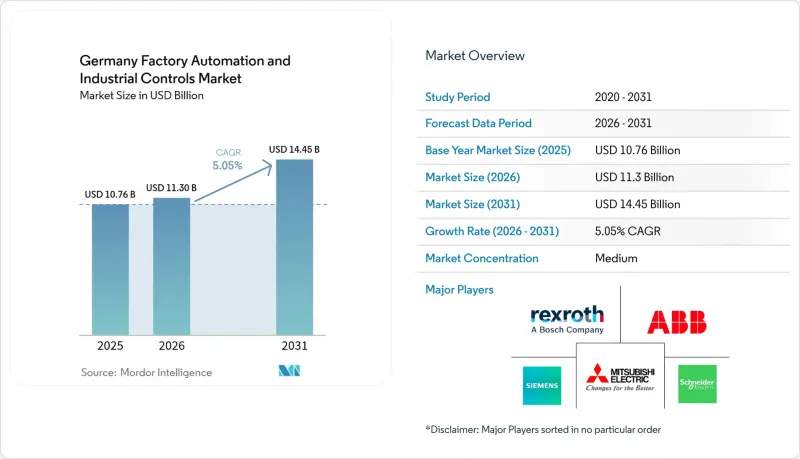
根據 Mordor Intelligence 預測,德國工廠自動化和工業控制市場規模預計將從 2025 年的 107.6 億美元成長到 2026 年的 113 億美元,然後從 2026 年到 2031 年以 5.05% 的複合年成長率成長,到 2031 億美元達到 144.44.5 億美元。
本報告按組件(控制器、驅動裝置)、控制系統類型(離散控制系統、製程控制系統等)、最終用戶產業(汽車、機械設備等)、部署模式(本地部署控制系統、混合架構等)和地區進行細分。市場預測以美元計價。
德國工廠自動化和工業控制市場的趨勢和見解。
德國製造業工業4.0實施現狀
根據《工業4.0平台報告》,2024年底,78%的大型工廠和54%的中小型企業將至少實施一項數位化應用,高於2020年的41%。目前,資產管理外殼(AAS)和OPC UA標準構成了機器間資料交換的基礎,實現了異質設備間的互通性,且避免了廠商鎖定。一級汽車零件供應商透過將數位孿生嵌入可程式邏輯控制器(PLC)的程式碼中,並進行虛擬切換操作測試,將停機時間從數天縮短至數小時。機器製造商正在標準化「即插即用」模組,這些模組可減少高達40%的工程工作量,並支援在單一班次內完成生產線重新配置。隨著製造商在邊緣進行機器學習推理,避免延遲並保護本地智慧財產權,對配備多核心處理器和FPGA的工業用電腦的需求正在不斷成長。
人事費用上升和技術純熟勞工短缺正在推動自動化。
2024年,德國製造業的平均時薪達到47.30歐元(53.45美元),為歐盟最高水準。預計到2030年,德國將面臨120萬名技術工人的缺口。 2024年,不含安全籠的協作機器人出貨量年增22%,這主要得益於食品飲料包裝商對不同尺寸產品的需求成長。製藥承包商將自動導引車(AGV)與倉庫管理軟體整合,使處理能力提高了18%,工傷事故減少了35%。自動化正在抵銷不斷上漲的訓練成本,自2020年以來,學徒完成率下降了9%,操作員的年平均離職率為14%。
中小企業的高初始資本投入
中小企業僱用了德國60%的製造業勞動力,但每家工廠的初始設備升級成本高達80萬至150萬歐元(約90.4萬至170萬美元),在低利潤行業,投資回收期可能長達五年。 「數位轉型」補貼可以涵蓋其中一半的成本,但申請者需要提交能源審計報告和網路安全計劃,而中小企業通常會將這些工作外包,因此補貼發放可能會延遲6至9個月。租賃和「自動化即服務(AaaS)」模式可以將成本分攤到月費中,但由於擔心資料所有權和供應商鎖定問題,德國機械設備製造業聯合會(VDMA)的推廣速度緩慢。
細分市場分析
預計到2025年,控制器將在德國工廠自動化和工業控制設備市場佔據66.31%的最大市場佔有率,並在2031年之前以5.55%的複合年成長率成長。可程式邏輯控制器(PLC)對於離散任務仍然至關重要,而分散式控制系統(DCS)在需要檢驗稽核追蹤的製程環境中正主導。由於高速視覺和人工智慧工作負載的需求,工業用電腦的需求正在成長,預計到2024年其出貨量將成長19%,尤其是在電子組裝領域。
驅動器、馬達、感測器和機器人佔據了剩餘的支出,推動了控制器市場的成長。在包裝產業,整合式編碼器的伺服電機正在取代步進電機,精度可達0.01毫米。 IO-Link感測器可將試運行時間縮短25%,而嵌入式深度學習攝影機在汽車最終檢測中可實現99.5%的缺陷檢測率。具備清洗功能的協作機器人正在飲料碼垛生產線上不斷擴大市場佔有率。
隨著汽車和機械行業的客戶優先考慮高速邏輯,離散控制系統在 2025 年的銷售額佔比達到 39.46%。製程控制(用於調節溫度、壓力和流量)正在推動化學和製藥業的發展。
SCADA系統提供歷史資料管理和視覺化功能,但其複合年成長率僅4.05%。整合PLC、PC和閘道器的物聯網邊緣平台正以5.9%的成長率快速擴張,建構了一個響應迅速的預測性維護層,且無需將專有資料暴露於公共雲端。對能夠保證亞毫秒延遲的時效性網路交換器的需求正在推動架構轉型。
其他好處:
- Excel格式的市場預測(ME)表
- 3個月的分析師支持
目錄
第1章:引言
- 研究假設和市場定義
- 調查範圍
第2章:調查方法
第3章執行摘要
第4章 市場狀況
- 市場概覽
- 市場促進因素
- 德國製造業工業4.0實施現狀
- 人事費用上升和技術純熟勞工短缺正在推動自動化。
- 政府對節能智慧工廠的支持措施
- 對大規模客製化和靈活生產的需求日益成長。
- 對網實整合安全標準的重視正在推動控制系統的升級。
- 關鍵供應鏈回流正在推動國內對自動化設備的投資。
- 市場限制因素
- 對中小企業的大額初始資本投資
- 與遺留棕地設施相關的整合複雜性
- 由於半導體供應鏈波動,控制器交付延遲。
- 嚴格的資料主權法規阻礙了基於雲端的控制平台的廣泛應用。
- 宏觀經濟因素的影響
- 產業價值鏈分析
- 監理情勢
- 技術展望
- 波特五力分析
第5章 市場規模與成長預測
- 按組件
- 控制器
- 可程式邏輯控制器(PLC)
- 分散式控制系統(DCS)
- 工業用電腦(IPC)
- 驅動裝置
- 引擎
- 感應器
- 機器視覺
- 機器人技術
- 其他驅動裝置
- 控制器
- 按控制系統類型
- 離散控制系統
- 過程控制系統
- 監控與數據採集(SCADA)
- 物聯網邊緣控制平台
- 按最終用戶行業分類
- 車
- 機械/設備
- 電子和半導體
- 食品/飲料
- 藥品和化學產品
- 金屬和採礦
- 其他終端用戶產業
- 按部署模式
- 本地控制系統
- 基於雲端的控制平台
- 混合(邊緣+雲)架構
第6章 競爭情勢
- 市場集中度
- 策略趨勢
- 市佔率分析
- 公司簡介
- Siemens AG
- Bosch Rexroth AG
- ABB Ltd
- Schneider Electric SE
- Mitsubishi Electric Corporation
- Rockwell Automation Inc.
- Honeywell International Inc.
- Emerson Electric Co.
- Omron Corporation
- Fanuc Corporation
- Yaskawa Electric Corporation
- KUKA AG
- Beckhoff Automation GmbH and Co. KG
- B and R Industrial Automation GmbH
- Festo SE and Co. KG
- Phoenix Contact GmbH and Co. KG
- WAGO Kontakttechnik GmbH and Co. KG
- Lenze SE
- SEW-Eurodrive GmbH and Co. KG
- Danfoss A/S
第7章 市場機會與未來展望
According to Mordor Intelligence, the Germany factory automation and industrial controls market size is expected to grow from USD 10.76 billion in 2025 to USD 11.3 billion in 2026 and is forecast to reach USD 14.45 billion by 2031 at 5.05% CAGR over 2026-2031.
This report is Segmented by Component (Controllers, and Drives), Control System Type (Discrete Control Systems, Process Control Systems, and More), End-User Industry (Automotive, Machinery and Equipment, and More), Deployment Model (On-Premises Control Systems, Hybrid Architectures, and More), and Geography. The Market Forecasts are Provided in Terms of Value (USD).
Germany Factory Automation And Industrial Controls Market Trends and Insights
Industry 4.0 Adoption Across German Manufacturing
Plattform Industrie 4.0 reported that by end-2024, 78% of large plants and 54% of SMEs had implemented at least one digital use case, up from 41% in 2020. Asset Administration Shell and OPC UA standards now underpin machine-to-machine data exchange, letting heterogeneous fleets interoperate without vendor lock-in. Tier-one automotive suppliers embed digital twins inside programmable logic controller code to test changeovers virtually, shrinking downtime from days to hours. Machinery builders have standardized on plug-and-produce modules that reduce engineering effort by up to 40%, enabling line re-configuration within a single shift. Demand for industrial PCs with multi-core processors and FPGAs is rising as manufacturers run machine-learning inference at the edge, bypassing latency and safeguarding intellectual property on-premises.
Rising Labor Costs and Skilled Labor Shortage Driving Automation
Median hourly manufacturing wages climbed to EUR 47.30 (USD 53.45) in 2024, the highest in the European Union. Germany faces a projected 1.2 million technical-worker shortfall by 2030. Collaborative robots without safety cages shipped 22% more units in 2024, especially to food and beverage packagers that handle variable-size products. Pharmaceutical contractors integrated automated guided vehicles with warehouse-management software, boosting throughput 18% and cutting injuries 35%. Automation offsets spiraling onboarding costs as apprenticeship completion rates declined 9% since 2020 and operator turnover averages 14% annually.
High Initial Capital Expenditure for SMEs
SMEs employ 60% of Germany's manufacturing workforce yet face upfront retrofit costs of EUR 800,000 to 1.5 million (USD 904,000 to 1.70 million) per plant, extending payback to five years in low-margin segments. The Digital Now subsidy covers half the spend, but applicants must supply energy audits and cybersecurity plans that small firms often outsource, delaying disbursements six to nine months. Leasing and automation-as-a-service models spread expenses over monthly fees, though concerns about data ownership and vendor lock-in temper adoption VDMA.
Other drivers and restraints analyzed in the detailed report include:
- Government Incentives for Energy-Efficient Smart Factories
- Increasing Demand for Mass Customization and Flexible Production
- Integration Complexity With Legacy Brownfield Equipment
For complete list of drivers and restraints, kindly check the Table Of Contents.
Segment Analysis
Controllers held the largest slice of the Germany factory automation and industrial controls market size at 66.31% in 2025 and will grow at a 5.55% CAGR to 2031. Programmable logic controllers remain indispensable for discrete tasks, while distributed control systems lead in process environments that demand validated audit trails. Industrial PCs are seizing high-speed vision and AI workloads, particularly in electronics assembly, where shipments jumped 19% in 2024.
Drives, motors, sensors and robotics comprise the balance of spending and track controller growth. Servo motors with integrated encoders replace steppers in packaging, offering 0.01 millimeter precision. IO-Link sensors reduce commissioning by 25%, and embedded deep-learning cameras deliver 99.5% defect detection in automotive final inspection. Collaborative robots with wash-down ratings are gaining share in beverage palletizing lines.
Discrete control systems secured 39.46% of 2025 revenue as automotive and machinery customers prioritize high-speed logic. Process control dominates chemicals and pharmaceuticals by regulating temperature, pressure and flow.
SCADA provides historian and visualization functions but lags at 4.05% CAGR. IoT-enabled edge platforms, integrating PLCs, PCs and gateways, advance at 5.9%, establishing a responsive layer for predictive maintenance without exposing proprietary data to public clouds. Demand for time-sensitive networking switches that guarantee sub-1 millisecond latency underscores the architectural transition.
Complete Report Scope:
- By Component
- Controllers
- Programmable Logic Controllers (PLCs)
- Distributed Control Systems (DCS)
- Industrial PCs (IPCs)
- Drives
- Motors
- Sensors
- Machine Vision
- Robotics
- Other Drives
- Controllers
- By Control System Type
- Discrete Control Systems
- Process Control Systems
- Supervisory Control and Data Acquisition (SCADA)
- IoT-Enabled Edge Control Platforms
- By End-User Industry
- Automotive
- Machinery and Equipment
- Electronics and Semiconductors
- Food and Beverage
- Pharmaceuticals and Chemicals
- Metals and Mining
- Other End-User Industries
- By Deployment Model
- On-Premises Control Systems
- Cloud-Based Control Platforms
- Hybrid (Edge + Cloud) Architectures
List of Companies Covered in this Report:
- Siemens AG
- Bosch Rexroth AG
- ABB Ltd
- Schneider Electric SE
- Mitsubishi Electric Corporation
- Rockwell Automation Inc.
- Honeywell International Inc.
- Emerson Electric Co.
- Omron Corporation
- Fanuc Corporation
- Yaskawa Electric Corporation
- KUKA AG
- Beckhoff Automation GmbH and Co. KG
- B and R Industrial Automation GmbH
- Festo SE and Co. KG
- Phoenix Contact GmbH and Co. KG
- WAGO Kontakttechnik GmbH and Co. KG
- Lenze SE
- SEW-Eurodrive GmbH and Co. KG
- Danfoss A/S
Additional Benefits:
- The market estimate (ME) sheet in Excel format
- 3 months of analyst support
TABLE OF CONTENTS
1 INTRODUCTION
- 1.1 Study Assumptions and Market Definition
- 1.2 Scope of the Study
2 RESEARCH METHODOLOGY
3 EXECUTIVE SUMMARY
4 MARKET LANDSCAPE
- 4.1 Market Overview
- 4.2 Market Drivers
- 4.2.1 Industry 4.0 Adoption Across German Manufacturing
- 4.2.2 Rising Labor Costs and Skilled Labor Shortage Driving Automation
- 4.2.3 Government Incentives for Energy-Efficient Smart Factories
- 4.2.4 Increasing Demand for Mass Customization and Flexible Production
- 4.2.5 Emphasis on Cyber-Physical Security Standards Boosting Control System Upgrades
- 4.2.6 Reshoring of Critical Supply Chains Stimulating Domestic Automation Capex
- 4.3 Market Restraints
- 4.3.1 High Initial Capital Expenditure for SMEs
- 4.3.2 Integration Complexity with Legacy Brownfield Equipment
- 4.3.3 Semiconductor Supply Chain Volatility Delaying Controller Deliveries
- 4.3.4 Stringent Data Sovereignty Regulations Hindering Cloud-Based Control Platforms
- 4.4 Impact of Macroeconomic Factors
- 4.5 Industry Value Chain Analysis
- 4.6 Regulatory Landscape
- 4.7 Technological Outlook
- 4.8 Porter's Five Forces Analysis
- 4.8.1 Threat of New Entrants
- 4.8.2 Threat of Substitutes
- 4.8.3 Bargaining Power of Buyers
- 4.8.4 Bargaining Power of Suppliers
- 4.8.5 Competitive Rivalry
5 MARKET SIZE AND GROWTH FORECASTS (VALUE)
- 5.1 By Component
- 5.1.1 Controllers
- 5.1.1.1 Programmable Logic Controllers (PLCs)
- 5.1.1.2 Distributed Control Systems (DCS)
- 5.1.1.3 Industrial PCs (IPCs)
- 5.1.2 Drives
- 5.1.2.1 Motors
- 5.1.2.2 Sensors
- 5.1.2.3 Machine Vision
- 5.1.2.4 Robotics
- 5.1.2.5 Other Drives
- 5.1.1 Controllers
- 5.2 By Control System Type
- 5.2.1 Discrete Control Systems
- 5.2.2 Process Control Systems
- 5.2.3 Supervisory Control and Data Acquisition (SCADA)
- 5.2.4 IoT-Enabled Edge Control Platforms
- 5.3 By End-User Industry
- 5.3.1 Automotive
- 5.3.2 Machinery and Equipment
- 5.3.3 Electronics and Semiconductors
- 5.3.4 Food and Beverage
- 5.3.5 Pharmaceuticals and Chemicals
- 5.3.6 Metals and Mining
- 5.3.7 Other End-User Industries
- 5.4 By Deployment Model
- 5.4.1 On-Premises Control Systems
- 5.4.2 Cloud-Based Control Platforms
- 5.4.3 Hybrid (Edge + Cloud) Architectures
6 COMPETITIVE LANDSCAPE
- 6.1 Market Concentration
- 6.2 Strategic Moves
- 6.3 Market Share Analysis
- 6.4 Company Profiles (includes Global Level Overview, Market Level Overview, Core Segments, Financials as available, Strategic Information, Market Rank/Share for Key Companies, Products and Services, and Recent Developments)
- 6.4.1 Siemens AG
- 6.4.2 Bosch Rexroth AG
- 6.4.3 ABB Ltd
- 6.4.4 Schneider Electric SE
- 6.4.5 Mitsubishi Electric Corporation
- 6.4.6 Rockwell Automation Inc.
- 6.4.7 Honeywell International Inc.
- 6.4.8 Emerson Electric Co.
- 6.4.9 Omron Corporation
- 6.4.10 Fanuc Corporation
- 6.4.11 Yaskawa Electric Corporation
- 6.4.12 KUKA AG
- 6.4.13 Beckhoff Automation GmbH and Co. KG
- 6.4.14 B and R Industrial Automation GmbH
- 6.4.15 Festo SE and Co. KG
- 6.4.16 Phoenix Contact GmbH and Co. KG
- 6.4.17 WAGO Kontakttechnik GmbH and Co. KG
- 6.4.18 Lenze SE
- 6.4.19 SEW-Eurodrive GmbH and Co. KG
- 6.4.20 Danfoss A/S
7 MARKET OPPORTUNITIES AND FUTURE OUTLOOK
- 7.1 White-Space and Unmet-Need Assessment

 4U工業電腦市場-2026年至2032年全球市場預測
 2034 年工業自動化網路安全市場預測—按部署類型、安全類型、組件、服務類型、技術、應用、最終用戶和地區分類的全球分析
 北美工廠自動化和工業控制:市場佔有率分析、行業趨勢和統計數據以及成長預測(2026-2031 年)工廠自動化與工業控制:市場佔有率分析、產業趨勢與統計、成長預測(2026-2031)美國工廠自動化和工業控制:市場佔有率分析、行業趨勢和統計數據以及成長預測(2026-2031 年)日本工廠自動化和工業控制:市場佔有率分析、行業趨勢和統計數據以及成長預測(2026-2031 年)歐洲工廠自動化和工業控制:市場佔有率分析、行業趨勢和統計數據以及成長預測(2026-2031 年)義大利工廠自動化和工業控制:市場佔有率分析、行業趨勢和統計數據以及成長預測(2026-2031 年)法國工廠自動化和工業控制:市場佔有率分析、行業趨勢和統計數據以及成長預測(2026-2031 年)中國工廠自動化與工業控制:市場佔有率分析、產業趨勢與統計及成長預測(2026-2031年)