


 |
市場調查報告書
商品編碼
2121308
義大利工廠自動化和工業控制:市場佔有率分析、行業趨勢和統計數據以及成長預測(2026-2031 年)Italy Factory Automation And Industrial Controls - Market Share Analysis, Industry Trends & Statistics, Growth Forecasts (2026 - 2031) |
||||||

※ 本網頁內容可能與最新版本有所差異。詳細情況請與我們聯繫。
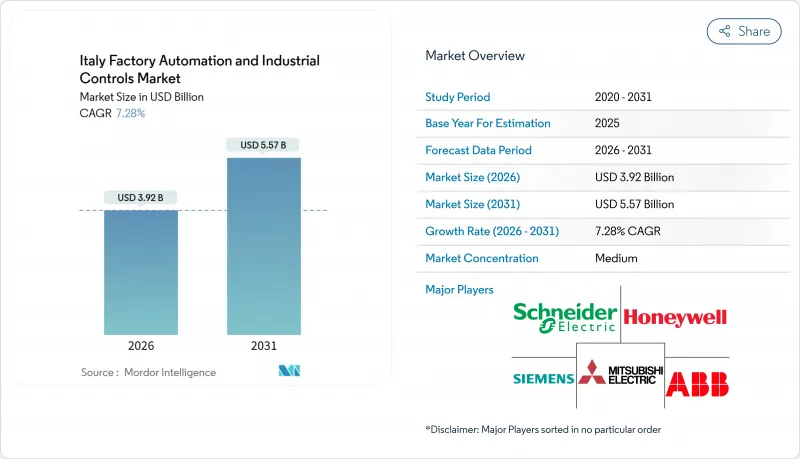
根據 Mordor Intelligence 預測,義大利工廠自動化和工業控制市場規模預計將在 2026 年達到 39.2 億美元,到 2031 年達到 55.7 億美元,在預測期內複合年成長率為 7.28%。
本報告按產品(工業控制系統、現場設備、工業軟體和服務)、組件(硬體、軟體、服務)、部署模式(本地部署、雲端部署、邊緣部署)和最終用戶產業(電力和公共產業、汽車和運輸、紡織、食品和飲料等)進行細分。市場預測以美元計價。
義大利工廠自動化和工業控制市場的趨勢和見解。
繼續為「轉型4.0」和「轉型5.0」提供稅收優惠
「轉型5.0」計畫於2025年推出,該計畫對工廠層級節能3%、流程層面節能5%的企業提供35%至45%的補貼,使自動化成為脫碳的驅動力。能夠持續追蹤節能效果的封閉回路型迴路邊緣閘道目前已成為採購首選。根據Comau的報告顯示,2025年63%的機器人訂單都配備了能源監控模組。 2026年的預算將補貼資格期限延長至2027年,促使企業加快採購步伐,導致訂單週期性激增。因此,供應商在硬體產品中附上符合審計要求的文檔,以確保獲得補貼。儘管頻繁的審核導致需求波動,但這項獎勵計畫仍然是義大利工廠自動化和工業控制市場最大的成長動力。
技術製造業崗位勞動力短缺問題日益嚴重
到2025年,55歲及以上的勞工將佔義大利製造業勞動力的31%,這一比例在七國集團(G7)中最高。在義大利北部地區,機械師和技術人員的職缺超過1.8萬個,這導致協作機器人的出貨量年增27%。安川電機位於博洛尼亞的培訓中心已將協作機器人單元的部署時間縮短了一半,使企業能夠彌補因標準化數位化工作流程而流失的隱性知識。隨著退休潮的加速,製造商正在將隱性知識系統化地整合到機器視覺和數位孿生系統中,以便即使是專業技能較低的員工也能進行監控。因此,勞動力短缺正在從根本上推動向自主系統和預測分析的轉型。
政策頻繁變動導致投資前景不明朗
2020年至2025年間基準值的修訂(包括2024年能源效率標準從0%大幅提高至3%)迫使企業縮短規劃週期,48%的受訪企業表示,他們已將專案推遲至相關法規最終確定後再啟動。在信貸資格可能被取消的情況下,多年期軟體訂閱合約被視為高風險,因此買家更傾向於投資回報期較短的獨立硬體。化工等能源密集產業尤其受到監管快速變化的影響,因為流程變更檢驗需要18至24個月的時間。施耐德電機指出,由於客戶等待關於雲端託管分析的明確指南,訂單預測下降了19%。因此,這些措施缺乏可預測性仍然是義大利工廠自動化和工業控制市場發展的一大阻力。
細分市場分析
2025年,工業控制系統業務將佔總銷售額的45.78%,為化學、電力、石油和天然氣設施的傳統分散式控制和SCADA系統奠定基礎。儘管目前規模仍較小,但工業軟體和服務正以7.81%的複合年成長率成長,是義大利工廠自動化和工業控制市場中成長最快的領域。 CINECA將Leonardo超級電腦20%的處理能力分配給製造業工作負載,使中小企業無需資本投資即可進行計算流體力學(CFD)模擬。西門子的MindSphere和AVEVA PI System訂閱式分析系統已於2025年獲得ISO 27001認證,從而緩解了人們對《一般資料保護規則》(GDPR)的擔憂。
軟體的成長也反映了虛擬感測器和數位孿生技術的低邊際成本,這意味著一旦平台建置完成,其增量成本幾乎為零。羅克韋爾自動化公司的FactoryTalk Design Studio可將工程時間縮短30%,並協助整合商從永久授權模式轉向經常性收入模式。儘管由於強制性能源監控推動每條生產線感測器密度增加,現場設備的需求仍然強勁,但其成長速度並未超過義大利工廠自動化和工業控制市場的整體成長速度,而是與整體市場趨勢一致。這種轉變表明,價值正從硬體轉向能夠提高運作和合規性的資料豐富型平台。
2025年,硬體仍佔總收入的56.19%,但軟體成長速度最快,複合年成長率達7.93%,這主要得益於邊緣分析、網路安全增強和數位孿生引擎在NIS2框架下變得至關重要。 ABB Ability的訂閱量在2025年成長了41%,其中預測性維護模組佔新契約的三分之二。業務收益現在與軟體捆綁銷售。艾默生的DeltaV平台包含一項為期五年的管理服務契約,涵蓋修補程式和操作員培訓。
硬體市場呈現兩極化趨勢。傳統的基於繼電器的控制器正逐步被淘汰,而用於機器人和半導體製造設備的高性能運動控制仍然至關重要。倍福的EtherCAT控制器憑藉其以軟體為中心的架構,市佔率已擴展至12%。因此,軟體驅動的服務擴展已成為支撐供應商在義大利工廠自動化和工業控制市場長期獲利能力的基礎。
其他好處
- Excel格式的市場預測(ME)表
- 3個月的分析師支持
目錄
第1章:引言
- 研究假設和市場定義
- 調查範圍
第2章:調查方法
第3章執行摘要
第4章 市場狀況
- 市場概覽
- 產業價值鏈分析
- 市場促進因素
- 繼續為「轉型4.0」和「轉型5.0」提供稅收優惠
- 技術製造業崗位勞動力短缺問題日益嚴重
- 加速汽車電氣化的投資
- 透過5G和光纖擴展工業IoT連接
- 模組化直流配電系統維修激增。
- 將 Leonardo超級電腦整合到中小企業的模擬系統中。
- 市場限制因素
- 政策頻繁變動導致投資前景不明朗
- 自動化和網路安全工程師長期短缺
- 高昂的初始成本阻礙了中小企業的採用。
- 歐盟資料位置法規限制非歐盟ICS SaaS(軟體即服務)
- 宏觀經濟因素對市場的影響
- 監理情勢
- 技術概述
- 波特五力分析
- 新冠疫情對各產業的影響
第5章 市場規模與成長預測
- 依產品
- 工業控制系統
- 現場設備
- 工業軟體服務
- 按組件
- 硬體
- 軟體
- 服務
- 部署模式
- 現場
- 雲
- 邊緣
- 按最終用戶行業分類
- 石油和天然氣
- 化工/石油化工
- 電力/公共產業
- 汽車和運輸業
- 紡織品
- 飲食
- 電子和半導體
- 其他
第6章 競爭情勢
- 市場集中度
- 策略趨勢
- 市佔率分析
- 公司簡介
- ABB Ltd
- Siemens AG
- Schneider Electric SE
- Rockwell Automation Inc.
- Mitsubishi Electric Corp.
- Honeywell International Inc.
- Emerson Electric Co.
- Omron Corp.
- Yokogawa Electric Corp.
- Fanuc Corp.
- Yaskawa Electric Corp.
- Nidec Corp.
- Fuji Electric Co. Ltd
- Bosch Rexroth AG
- Comau SpA
- Danfoss A/S
- Delta Electronics Inc.
- Renishaw plc
- AVEVA Group plc
- Beckhoff Automation GmbH
- Lenze SE
第7章 市場機會與未來展望
According to Mordor Intelligence, the Italy factory automation and Industrial Controls Market size was USD 3.92 billion in 2026 and is projected to reach USD 5.57 billion by 2031, growing at a 7.28% CAGR over the forecast period.
This report is Segmented by Product (Industrial Control Systems, Field Devices, Industrial Software and Services), Component (Hardware, Software, Services), Deployment Mode (On-Premises, Cloud, Edge), End-User Industry (Power and Utilities, Automotive and Transportation, Textile, Food and Beverage, and More). The Market Forecasts are Provided in Terms of Value (USD).
Italy Factory Automation And Industrial Controls Market Trends and Insights
Continuation of Transition 4.0 and 5.0 Tax Incentives
Transition 5.0, introduced in 2025, ties a 35% to 45% rebate to a 3% facility-level or 5% process-level energy reduction, turning automation into a lever for decarbonization. Closed-loop edge gateways that document continuous savings now dominate purchasing shortlists, and Comau reported that energy-monitoring modules accompanied 63% of 2025 robot orders. The 2026 budget extended eligibility to 2027, prompting firms to front-load purchases and creating cyclical order spikes. Vendors, therefore, bundle audit-ready documentation with hardware to assure credit approval. Although frequent revisions create demand lumpiness, the incentive framework remains the single largest growth catalyst for the Italy factory automation and industrial controls market.
Rising Labor Shortages in Skilled Manufacturing Roles
Workers aged 55 and older accounted for 31% of Italy's manufacturing headcount in 2025, the highest ratio among G7 economies. Unfilled machinist and technician vacancies exceeded 18,000 in northern districts, driving a 27% year-over-year increase in collaborative-robot shipments. Yaskawa's Bologna training center compresses cobot-cell deployment time by half, allowing firms to offset lost tribal knowledge with standardized digital workflows. As retirements accelerate, manufacturers codify tacit knowledge into machine-vision and digital-twin systems that less specialized staff can supervise. Labor scarcity, therefore, structurally supports a shift toward autonomous systems and predictive analytics.
Frequent Policy Changes Reduce Investment Visibility
Threshold revisions in 2020-2025, including a sudden energy-saving jump from 0% to 3% in 2024, shortened planning horizons and caused 48% of surveyed firms to defer projects until regulations were finalized. Multi-year software subscriptions appear risky when credit eligibility can be revoked, so buyers prefer discrete hardware with near-term payback. Energy-intensive sectors such as chemicals need 18-24 months to validate process changes, making abrupt rule shifts especially burdensome. Schneider Electric noted a 19% contraction in its pipeline in early 2025, as clients waited for clarity on cloud-hosted analytics. Policy predictability, therefore, remains a drag on the Italy factory automation and industrial controls market.
Other drivers and restraints analyzed in the detailed report include:
- Accelerating Automotive Electrification Investments
- Expansion of 5G and Fiber Industrial IoT Connectivity
- Persistent Shortage of Automation-Cybersecurity Engineers
For complete list of drivers and restraints, kindly check the Table Of Contents.
Segment Analysis
The industrial control systems segment generated 45.78% of the 2025 revenue, underpinning legacy distributed-control and SCADA footprints across chemicals, power, and oil and gas sites. Industrial software and services, although smaller, are growing at a 7.81% CAGR, the swiftest pace within the Italy factory automation and industrial controls market. CINECA's allocation of 20% of the Leonardo supercomputer's capacity to manufacturing workloads enabled small and medium-sized enterprises to perform computational fluid dynamics simulations without incurring capital outlay. Subscription-based analytics from Siemens MindSphere and AVEVA PI System achieved ISO 27001 certification in 2025, alleviating concerns under the General Data Protection Regulation.
Software growth also reflects the marginal economics of virtual sensors and digital twins, whose incremental cost approaches zero once the platform exists. Rockwell Automation's FactoryTalk Design Studio reduces engineering time by 30%, encouraging integrators to transition from perpetual licenses to recurring revenue. Field devices retain steady demand because energy-monitoring mandates lift sensor density per line, yet their growth tracks the overall Italy factory automation and industrial controls market rather than outpacing it. The evolving mix shows value migrating from hardware toward data-rich platforms that improve uptime and regulatory compliance.
Hardware still contributed 56.19% of 2025 sales, but software is rising fastest at a 7.93% CAGR as edge analytics, cybersecurity overlays, and digital twin engines become mandatory under NIS2. ABB Ability subscriptions grew 41% in 2025, with predictive-maintenance modules comprising two-thirds of new contracts. Service revenues are now bundled with software; Emerson's DeltaV platform includes five-year managed-service contracts covering patching and operator training.
The hardware market is bifurcating. Legacy relay-based controllers face retirement, while high-performance motion controls for robotics and semiconductor tools remain indispensable. Beckhoff EtherCAT controllers have expanded their share to 12% by leveraging a software-centric architecture. Consequently, software pull-through boosts services, anchoring long-term vendor margins within the Italy factory automation and industrial controls market industry.
Complete Report Scope:
- By Product
- Industrial Control Systems
- Field Devices
- Industrial Software and Services
- By Component
- Hardware
- Software
- Services
- By Deployment Mode
- On-premises
- Cloud
- Edge
- By End-user Industry
- Oil and Gas
- Chemical and Petrochemical
- Power and Utilities
- Automotive and Transportation
- Textile
- Food and Beverage
- Electronics and Semiconductor
- Other End-user Industries
List of Companies Covered in this Report:
- ABB Ltd
- Siemens AG
- Schneider Electric SE
- Rockwell Automation Inc.
- Mitsubishi Electric Corp.
- Honeywell International Inc.
- Emerson Electric Co.
- Omron Corp.
- Yokogawa Electric Corp.
- Fanuc Corp.
- Yaskawa Electric Corp.
- Nidec Corp.
- Fuji Electric Co. Ltd
- Bosch Rexroth AG
- Comau SpA
- Danfoss A/S
- Delta Electronics Inc.
- Renishaw plc
- AVEVA Group plc
- Beckhoff Automation GmbH
- Lenze SE
Additional Benefits:
- The market estimate (ME) sheet in Excel format
- 3 months of analyst support
TABLE OF CONTENTS
1 INTRODUCTION
- 1.1 Study Assumptions and Market Definition
- 1.2 Scope of the Study
2 RESEARCH METHODOLOGY
3 EXECUTIVE SUMMARY
4 MARKET LANDSCAPE
- 4.1 Market Overview
- 4.2 Industry Value Chain Analysis
- 4.3 Market Drivers
- 4.3.1 Continuation of Transition 4.0 and 5.0 Tax Incentives
- 4.3.2 Rising Labor Shortages in Skilled Manufacturing Roles
- 4.3.3 Accelerating Automotive Electrification Investments
- 4.3.4 Expansion of 5G and Fiber Industrial IoT Connectivity
- 4.3.5 Surge in Modular DC Power Distribution Retrofits
- 4.3.6 Integration of Leonardo Supercomputer for SME Simulation
- 4.4 Market Restraints
- 4.4.1 Frequent Policy Changes Reducing Investment Visibility
- 4.4.2 Persistent Shortage of Automation-Cybersecurity Engineers
- 4.4.3 High Up-Front Costs Limiting SME Adoption
- 4.4.4 EU Data-Residency Rules Restricting Non-EU ICS SaaS
- 4.5 Impact of Macroeconomic Factors on the Market
- 4.6 Regulatory Landscape
- 4.7 Technology Snapshot
- 4.8 Porter's Five Forces Analysis
- 4.8.1 Bargaining Power of Suppliers
- 4.8.2 Bargaining Power of Consumers
- 4.8.3 Threat of New Entrants
- 4.8.4 Intensity of Competitive Rivalry
- 4.8.5 Threat of Substitutes
- 4.9 Impact of Covid-19 on the Industry
5 MARKET SIZE AND GROWTH FORECASTS (VALUE)
- 5.1 By Product
- 5.1.1 Industrial Control Systems
- 5.1.2 Field Devices
- 5.1.3 Industrial Software and Services
- 5.2 By Component
- 5.2.1 Hardware
- 5.2.2 Software
- 5.2.3 Services
- 5.3 By Deployment Mode
- 5.3.1 On-premises
- 5.3.2 Cloud
- 5.3.3 Edge
- 5.4 By End-user Industry
- 5.4.1 Oil and Gas
- 5.4.2 Chemical and Petrochemical
- 5.4.3 Power and Utilities
- 5.4.4 Automotive and Transportation
- 5.4.5 Textile
- 5.4.6 Food and Beverage
- 5.4.7 Electronics and Semiconductor
- 5.4.8 Other End-user Industries
6 COMPETITIVE LANDSCAPE
- 6.1 Market Concentration
- 6.2 Strategic Moves
- 6.3 Market Share Analysis
- 6.4 Company Profiles (includes Global Level Overview, Market Level Overview, Core Segments, Financials as available, Strategic Information, Market Rank/Share for key companies, Products and Services, and Recent Developments)
- 6.4.1 ABB Ltd
- 6.4.2 Siemens AG
- 6.4.3 Schneider Electric SE
- 6.4.4 Rockwell Automation Inc.
- 6.4.5 Mitsubishi Electric Corp.
- 6.4.6 Honeywell International Inc.
- 6.4.7 Emerson Electric Co.
- 6.4.8 Omron Corp.
- 6.4.9 Yokogawa Electric Corp.
- 6.4.10 Fanuc Corp.
- 6.4.11 Yaskawa Electric Corp.
- 6.4.12 Nidec Corp.
- 6.4.13 Fuji Electric Co. Ltd
- 6.4.14 Bosch Rexroth AG
- 6.4.15 Comau SpA
- 6.4.16 Danfoss A/S
- 6.4.17 Delta Electronics Inc.
- 6.4.18 Renishaw plc
- 6.4.19 AVEVA Group plc
- 6.4.20 Beckhoff Automation GmbH
- 6.4.21 Lenze SE
7 MARKET OPPORTUNITIES AND FUTURE OUTLOOK
- 7.1 White-space and Unmet-need Assessment

 4U工業電腦市場-2026年至2032年全球市場預測
 2034 年工業自動化網路安全市場預測—按部署類型、安全類型、組件、服務類型、技術、應用、最終用戶和地區分類的全球分析
 北美工廠自動化和工業控制:市場佔有率分析、行業趨勢和統計數據以及成長預測(2026-2031 年)工廠自動化與工業控制:市場佔有率分析、產業趨勢與統計、成長預測(2026-2031)德國工廠自動化和工業控制:市場佔有率分析、行業趨勢和統計數據以及成長預測(2026-2031 年)美國工廠自動化和工業控制:市場佔有率分析、行業趨勢和統計數據以及成長預測(2026-2031 年)日本工廠自動化和工業控制:市場佔有率分析、行業趨勢和統計數據以及成長預測(2026-2031 年)歐洲工廠自動化和工業控制:市場佔有率分析、行業趨勢和統計數據以及成長預測(2026-2031 年)法國工廠自動化和工業控制:市場佔有率分析、行業趨勢和統計數據以及成長預測(2026-2031 年)中國工廠自動化與工業控制:市場佔有率分析、產業趨勢與統計及成長預測(2026-2031年)