


 |
市場調查報告書
商品編碼
2066438
中國工廠自動化與工業控制:市場佔有率分析、產業趨勢與統計及成長預測(2026-2031年)China Factory Automation And Industrial Controls - Market Share Analysis, Industry Trends & Statistics, Growth Forecasts (2026 - 2031) |
||||||

※ 本網頁內容可能與最新版本有所差異。詳細情況請與我們聯繫。
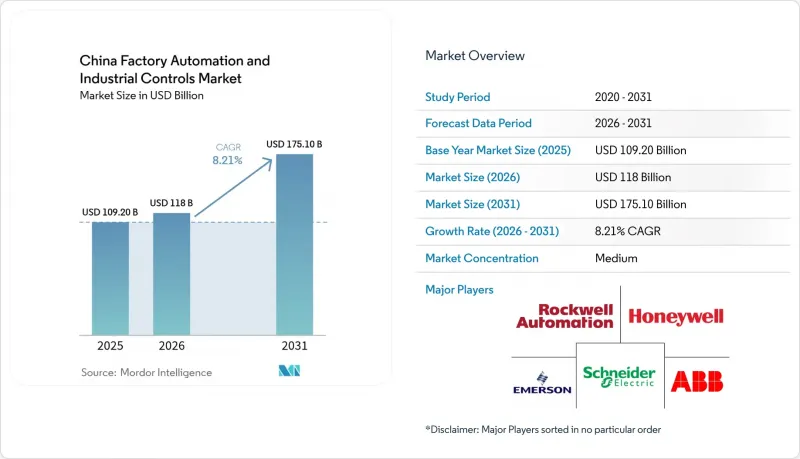
根據 Mordor Intelligence 預測,中國工廠自動化和工業控制市場規模預計到 2025 年將達到 1,092 億美元,到 2026 年將達到 1,180 億美元,到 2031 年將達到 1,751 億美元,2026 年至 2031 年的複合成長率為 8.21%。
本報告按組件(硬體、軟體等)、控制系統類型(分散式控制系統 (DCS)、可程式邏輯控制器 (PLC) 等)、終端用戶產業(汽車/電動車、電子/半導體等)和自動化解決方案類型(離散式自動化等)進行分類。市場預測以美元計價。
中國工廠自動化和工業控制市場的趨勢和洞察。
政府在「中國製造2025」框架下鼓勵智慧製造升級的獎勵
中國政府正在推行全球規模最大的產業政策項目之一,該項目結合了規模達1兆元人民幣的政府支持創投基金和工信部製定的指導方針,要求到2025年實現70%的核心自動化組件國產化。省級政府已撥款97億美元用於中小企業的自動化維修,使資源有限的工廠也能採用協作機器人和邊緣運算中心。採購獎勵、稅收減免和快速核准流程共同建構了在地化供應鏈、更具競爭力的價格和技術快速普及的良性循環。自動化供應商受益於穩定的需求,而製造商則可以透過互聯互通的生產線實現更快的投資回報,這些生產線能夠提供高產量、穩定的品質和低能耗。這些政策也包含資料主權要求,旨在促進採用國產工業物聯網平台,確保敏感的現場資料留在中國境內。
透過電動車和電池超級工廠加速對軟性製造的需求
電動車 (EV) 整車製造商和電池生產商正以前所未有的速度擴大生產規模,推動了對模組化、人工智慧驅動的自動化系統需求的激增。寧德時代 (CATL)、比亞迪 (BYD) 和國騰 (Gotion) 計劃在 2024 年部署超過 2 萬台機器人,以支援鋰離子電池的全天候生產,並實現 99.5% 的品質檢測準確率。小鵬汽車 (XPeng) 斥資 138 億美元打造的人形機器人專案凸顯了對能夠在單一工廠內生產多種車型的敏捷生產線的需求。特斯拉上海超級工廠已將年產量提升至 75 萬輛,中國競爭對手正致力於透過數位雙胞胎和 PLC 與機器人同步架構來複製這一水平。這些努力鞏固了國內供應商生產的運動控制器、驅動器和機器視覺系統的長期訂單,進一步推動了中國工廠自動化和工業控制市場的發展。
傳統OT系統中的網路安全漏洞
INCONTROLLER惡意軟體事件暴露了數十年前設計的PLC和SCADA節點中存在的重大漏洞,這些設備並非為網路連線而設計。隨著工廠接入工業物聯網(IIoT)雲端進行分析,這些漏洞正成為勒索軟體攻擊、智慧財產權竊盜和潛在安全事件的風險因素。營運商現在需要在其生產網路中實施多層零信任架構、本地資料中心和持續修補程式,這增加了資本支出(CAPEX)並延長了專案週期。日益緊張的地緣政治局勢加劇了對外國製造的韌體和晶片組的審查,促使買家即使性能相當也傾向於選擇值得信賴的國內供應商。這種直接的資本支出負擔略微抑制了中國工廠自動化和工業控制市場的複合年成長率(CAGR),否則該市場原本將保持強勁成長。
細分市場分析
2025年,硬體銷售額佔比將達到59.98%,這主要得益於機器人和伺服驅動器部署量創歷史新高;而隨著工廠尋求人工智慧驅動的最佳化,軟體預計將以12.54%的複合年成長率成長。國內機器人廠商在承重能力、重複性和平均故障間隔時間(MTBF)等指標方面正迅速追趕,其市場佔有率將從2015年的17.5%成長到2024年的32%。
服務業目前市場佔有率最小,但透過確保對系統整合、操作人員技能發展和全生命週期支援的穩定需求,正創造著類似退休金的現金流。隨著技術的普及,製造商正將重心從機器安裝轉向數據驅動的性能提升,並將預算分配給製造執行系統 (MES)、高級生產系統 (APS)數位雙胞胎,以提高固定資產的回報率。這形成了一個良性循環:先進的軟體能夠進一步提升現有機器的產能,從而刺激更多投資,並維持中國工廠自動化和工業控制市場的發展動能。
預計到2025年,可程式邏輯控制器(PLC)將佔據32.24%的市場佔有率,並將以11.62%的複合年成長率持續成長至2031年,鞏固其在離散製造和流程工廠的核心地位。像Inovance Technology和STEP Electric這樣的國內企業,憑藉本地化支持、具有競爭力的價格以及符合中國標準的韌體,正穩步蠶食歐美主要企業的領先地位。
隨著中小企業實現單一用途工作站的自動化,小型PLC的銷售量成長了5.6%,但跨國公司仍主導著石油化工和電力產業關鍵任務應用的中大型PLC市場。在連續製造業,互補的SCADA和DCS系統正在積極部署,而隨著每個新機器人單元的引入,人機介面(HMI)面板也在不斷擴展。運動控制器的需求反映了機器人技術的快速發展,並支撐著中國工廠自動化產業各個領域的成長。
其他好處:
- Excel格式的市場預測(ME)表
- 3個月的分析師支持
目錄
第1章:引言
- 研究假設和市場定義
- 調查範圍
第2章:調查方法
第3章執行摘要
第4章 市場狀況
- 市場概覽
- 市場促進因素
- 工業IoT(IIoT)平台的快速普及
- 政府為支持「中國製造2025」框架下的智慧製造轉型所採取的支持措施
- 電動車和電池超級工廠推動了對軟性製造的快速需求
- 利用邊緣人工智慧進行預測性維護,減少意外停機時間。
- 可實現超高可靠性和低延遲控制的本地 5G 專用網路
- 人事費用上升正在推動中小企業轉型為機器人。
- 市場限制因素
- 傳統OT系統中的網路安全漏洞
- 工業通訊標準碎片化阻礙了互通性
- 缺乏具備特定領域專業知識的自動化工程師
- 由於地緣經濟風險,出口導向工廠的資本投資被凍結。
- 監理情勢
- 技術展望
- 波特五力分析
第5章 市場規模與成長預測
- 按組件
- 硬體
- 軟體
- 服務
- 按控制系統類型
- 分散式控制系統(DCS)
- 可程式邏輯控制器(PLC)
- 監控與數據採集(SCADA)
- 人機介面(HMI)
- 運動控制器和驅動器
- 按最終用戶行業分類
- 汽車和電動車
- 電子和半導體
- 食品/飲料
- 化工/石油化工
- 金屬和採礦
- 其他終端用戶產業
- 按自動化解決方案類型
- 離散自動化
- 流程自動化
- 混合自動化
第6章 競爭情勢
- 市場集中度
- 策略趨勢
- 市佔率分析
- 公司簡介
- ABB Ltd.
- Siemens AG
- Schneider Electric SE
- Rockwell Automation, Inc.
- Mitsubishi Electric Corporation
- Omron Corporation
- Yokogawa Electric Corporation
- Honeywell International Inc.
- Emerson Electric Company
- Bosch Rexroth AG
- Fanuc Corporation
- Yaskawa Electric Corporation
- Delta Electronics, Inc.
- Advantech Co., Ltd.
- Panasonic Holdings Corporation
- Beckhoff Automation GmbH and Co. KG
- Keyence Corporation
- Fuji Electric Co., Ltd.
- Nidec Corporation
- Inovance Technology Co., Ltd.
- Shanghai STEP Electric Corporation
- Hollysys Automation Technologies Ltd.
- Zhejiang Supcon Technology Co., Ltd.
- Zhejiang Chint Electrics Co., Ltd.
第7章 市場機會與未來展望
According to Mordor Intelligence, the china factory automation and industrial controls market size is projected to be USD 109.20 billion in 2025, USD 118 billion in 2026, and reach USD 175.10 billion by 2031, growing at a CAGR of 8.21% from 2026 to 2031.
This report is Segmented by Component (Hardware, Software, and More), Control System Type (Distributed Control Systems (DCS), Programmable Logic Controllers (PLC), and More), End-User Industry (Automotive and EV, Electronics and Semiconductor, and More), Automation Solution (Discrete Automation, and More). The Market Forecasts are Provided in Terms of Value (USD).
China Factory Automation And Industrial Controls Market Trends and Insights
Government Incentives for Made-in-China 2025 Smart Manufacturing Upgrades
Beijing orchestrates one of the world's largest industrial-policy programs, coupling a CNY 1 trillion state-backed venture fund with MIIT guidelines that require 70% domestic content in core automation parts by 2025. Provincial subsidies worth USD 9.7 billion are earmarked for SME automation retrofits, allowing even resource-constrained factories to deploy collaborative robots and edge-computing hubs. Together, procurement preferences, tax rebates, and fast-track approvals create a self-reinforcing cycle of localized supply chains, more competitive pricing, and quick technology adoption. Automation vendors benefit from guaranteed demand, while manufacturers gain faster ROI from interconnected production lines that deliver higher throughput, consistent quality, and lower energy consumption. The policy suite also embeds data-sovereignty requirements, driving uptake of domestic IIoT platforms that keep sensitive shop-floor data within China's borders.
Accelerated Demand for Flexible Manufacturing from EV and Battery Gigafactories
Electric-vehicle OEMs and cell makers are scaling production at unprecedented speed, driving a surge in demand for modular, AI-driven automation. CATL, BYD, and Gotion deployed more than 20,000 robots in 2024 to support 24/7 lithium-ion cell output while achieving 99.5% quality-inspection accuracy. XPeng's USD 13.8 billion humanoid-robotics initiative underscores the need for agile lines capable of multivehicle production in a single facility. Tesla's Shanghai Gigafactory has set a 750,000-unit annual benchmark that Chinese rivals aim to replicate through digital twins and synchronized PLC-robot architectures. These programs anchor long-term orders for motion controllers, drives, and machine-vision systems made by domestic suppliers, further lifting the China Factory Automation and Industrial Controls Market.
Cyber-Security Vulnerabilities in Legacy OT Systems
The INCONTROLLER malware episode exposed gaping holes in decades-old PLCs and SCADA nodes that were never designed for Internet connectivity. As factories connect to IIoT clouds for analytics, these soft spots invite ransomware, intellectual-property theft, and potential safety incidents. Operators must now layer zero-trust architectures, local data centers, and continuous patching routines onto production networks, inflating capex and project timelines. Heightened geopolitical tensions intensify scrutiny of foreign firmware and chipsets, nudging buyers toward trusted domestic vendors even when performance is on par. The immediate capex burden slightly tempers the otherwise robust CAGR of the China Factory Automation and Industrial Controls Market.
Other drivers and restraints analyzed in the detailed report include:
- Rapid Adoption of Industrial Internet-of-Things (IIoT) Platforms
- Edge-AI-Based Predictive Maintenance Reducing Unplanned Downtime
- Fragmented Industrial Communication Standards Hindering Interoperability
For complete list of drivers and restraints, kindly check the Table Of Contents.
Segment Analysis
Hardware contributed 59.98% of 2025 revenue, anchored by record robot and servo-drive installations, yet software is poised to grow at a 12.54% CAGR as factories chase AI-enabled optimization. Domestic robot vendors lifted their local share from 17.5% in 2015 to 32% in 2024, signaling rapid catch-up on payload, repeatability, and mean-time-between-failure metrics.
Services, though currently the smallest slice, secure consistent demand for systems integration, operator upskilling, and lifecycle support, forming annuity-style cash flows. As adoption deepens, manufacturers shift focus from mechanical installation to data-driven performance gains, rerouting budgets toward MES, APS, and digital twins that amplify return on fixed assets. The result is a virtuous cycle: advanced software squeezes extra throughput from existing machines, encouraging further investment and sustaining momentum in the China Factory Automation and Industrial Controls Market.
Programmable Logic Controllers held a commanding 32.24% share in 2025 and are on track to log an 11.62% CAGR to 2031, affirming their centrality in both discrete and process plants. Domestic firms such as Inovance Technology and STEP Electric steadily erode Western incumbents' leads by bundling local support with competitive pricing and firmware tuned for Chinese standards.
Small PLCs post 5.6% growth as SMEs automate single-purpose stations, while mid-to-large models still favor multinationals for mission-critical applications in petrochemicals and power. Complementary SCADA and DCS layers flourish in continuous industries, whereas HMI panels expand with each new robot cell. Motion-controller demand mirrors the robotics surge, underpinning growth across all nodes of the china factory automation industry.
List of Companies Covered in this Report:
- ABB Ltd.
- Siemens AG
- Schneider Electric SE
- Rockwell Automation, Inc.
- Mitsubishi Electric Corporation
- Omron Corporation
- Yokogawa Electric Corporation
- Honeywell International Inc.
- Emerson Electric Company
- Bosch Rexroth AG
- Fanuc Corporation
- Yaskawa Electric Corporation
- Delta Electronics, Inc.
- Advantech Co., Ltd.
- Panasonic Holdings Corporation
- Beckhoff Automation GmbH and Co. KG
- Keyence Corporation
- Fuji Electric Co., Ltd.
- Nidec Corporation
- Inovance Technology Co., Ltd.
- Shanghai STEP Electric Corporation
- Hollysys Automation Technologies Ltd.
- Zhejiang Supcon Technology Co., Ltd.
- Zhejiang Chint Electrics Co., Ltd.
Additional Benefits:
- The market estimate (ME) sheet in Excel format
- 3 months of analyst support
TABLE OF CONTENTS
1 INTRODUCTION
- 1.1 Study Assumptions and Market Definition
- 1.2 Scope of the Study
2 RESEARCH METHODOLOGY
3 EXECUTIVE SUMMARY
4 MARKET LANDSCAPE
- 4.1 Market Overview
- 4.2 Market Drivers
- 4.2.1 Rapid adoption of Industrial Internet-of-Things (IIoT) platforms
- 4.2.2 Government incentives for "Made-in-China 2025" smart-manufacturing upgrades
- 4.2.3 Accelerated demand for flexible manufacturing from EV and battery gigafactories
- 4.2.4 Edge-AI based predictive-maintenance reducing unplanned downtime
- 4.2.5 On-premise 5G private networks enabling ultra-reliable low-latency control
- 4.2.6 Rising labor-cost inflation driving robotic substitution in SMEs
- 4.3 Market Restraints
- 4.3.1 Cyber-security vulnerabilities in legacy OT systems
- 4.3.2 Fragmented industrial communication standards hindering interoperability
- 4.3.3 Shortage of domain-skilled automation engineers
- 4.3.4 Capital-expenditure freezes in export-oriented factories amid geo-economic risk
- 4.4 Regulatory Landscape
- 4.5 Technological Outlook
- 4.6 Porter's Five Forces Analysis
- 4.6.1 Threat of New Entrants
- 4.6.2 Bargaining Power of Buyers
- 4.6.3 Bargaining Power of Suppliers
- 4.6.4 Threat of Substitutes
- 4.6.5 Competitive Rivalry
5 MARKET SIZE AND GROWTH FORECASTS (VALUE)
- 5.1 By Component
- 5.1.1 Hardware
- 5.1.2 Software
- 5.1.3 Services
- 5.2 By Control System Type
- 5.2.1 Distributed Control Systems (DCS)
- 5.2.2 Programmable Logic Controllers (PLC)
- 5.2.3 Supervisory Control and Data Acquisition (SCADA)
- 5.2.4 Human-Machine Interface (HMI)
- 5.2.5 Motion Controllers and Drives
- 5.3 By End-User Industry
- 5.3.1 Automotive and EV
- 5.3.2 Electronics and Semiconductor
- 5.3.3 Food and Beverage
- 5.3.4 Chemicals and Petrochemicals
- 5.3.5 Metals and Mining
- 5.3.6 Other End-User Industries
- 5.4 By Automation Solution
- 5.4.1 Discrete Automation
- 5.4.2 Process Automation
- 5.4.3 Hybrid Automation
6 COMPETITIVE LANDSCAPE
- 6.1 Market Concentration
- 6.2 Strategic Moves
- 6.3 Market Share Analysis
- 6.4 Company Profiles (includes Global level Overview, Market level overview, Core Segments, Financials as available, Strategic Information, Market Rank/Share for key companies, Products and Services, and Recent Developments)
- 6.4.1 ABB Ltd.
- 6.4.2 Siemens AG
- 6.4.3 Schneider Electric SE
- 6.4.4 Rockwell Automation, Inc.
- 6.4.5 Mitsubishi Electric Corporation
- 6.4.6 Omron Corporation
- 6.4.7 Yokogawa Electric Corporation
- 6.4.8 Honeywell International Inc.
- 6.4.9 Emerson Electric Company
- 6.4.10 Bosch Rexroth AG
- 6.4.11 Fanuc Corporation
- 6.4.12 Yaskawa Electric Corporation
- 6.4.13 Delta Electronics, Inc.
- 6.4.14 Advantech Co., Ltd.
- 6.4.15 Panasonic Holdings Corporation
- 6.4.16 Beckhoff Automation GmbH and Co. KG
- 6.4.17 Keyence Corporation
- 6.4.18 Fuji Electric Co., Ltd.
- 6.4.19 Nidec Corporation
- 6.4.20 Inovance Technology Co., Ltd.
- 6.4.21 Shanghai STEP Electric Corporation
- 6.4.22 Hollysys Automation Technologies Ltd.
- 6.4.23 Zhejiang Supcon Technology Co., Ltd.
- 6.4.24 Zhejiang Chint Electrics Co., Ltd.
7 MARKET OPPORTUNITIES AND FUTURE OUTLOOK
- 7.1 White-space and Unmet-Need Assessment

 4U工業電腦市場-2026年至2032年全球市場預測
 2034 年工業自動化網路安全市場預測—按部署類型、安全類型、組件、服務類型、技術、應用、最終用戶和地區分類的全球分析
 北美工廠自動化和工業控制:市場佔有率分析、行業趨勢和統計數據以及成長預測(2026-2031 年)工廠自動化與工業控制:市場佔有率分析、產業趨勢與統計、成長預測(2026-2031)德國工廠自動化和工業控制:市場佔有率分析、行業趨勢和統計數據以及成長預測(2026-2031 年)美國工廠自動化和工業控制:市場佔有率分析、行業趨勢和統計數據以及成長預測(2026-2031 年)日本工廠自動化和工業控制:市場佔有率分析、行業趨勢和統計數據以及成長預測(2026-2031 年)歐洲工廠自動化和工業控制:市場佔有率分析、行業趨勢和統計數據以及成長預測(2026-2031 年)義大利工廠自動化和工業控制:市場佔有率分析、行業趨勢和統計數據以及成長預測(2026-2031 年)法國工廠自動化和工業控制:市場佔有率分析、行業趨勢和統計數據以及成長預測(2026-2031 年)