


 |
市場調查報告書
商品編碼
2120397
法國工廠自動化和工業控制:市場佔有率分析、行業趨勢和統計數據以及成長預測(2026-2031 年)France Factory Automation And Industrial Controls - Market Share Analysis, Industry Trends & Statistics, Growth Forecasts (2026 - 2031) |
||||||

※ 本網頁內容可能與最新版本有所差異。詳細情況請與我們聯繫。
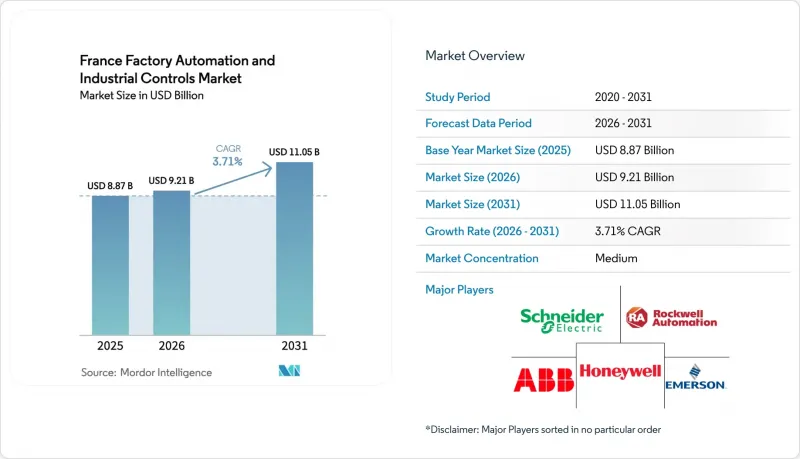
根據 Mordor Intelligence 預測,法國工廠自動化和工業控制市場規模預計將從 2025 年的 88.7 億美元成長到 2026 年的 92.1 億美元,到 2031 年將達到 110.5 億美元,2026 年至 2031 年的複合年成長率為 3.71%。
本報告按類型(工業控制系統、現場設備)、組件(硬體、軟體、服務)、最終用戶產業(石油天然氣、食品飲料等)、部署模式(本地部署、雲端部署、混合部署)和銷售管道(直接銷售給最終用戶、系統整合商等)分類。市場預測以美元計價。
法國工廠自動化和工業控制市場的趨勢和洞察。
加速汽車和航太產業。
汽車和航太製造商正在採用即時分析、協作機器人和擴增實境(AR) 的工作指導來縮短週期時間並減少缺陷。空中巴士公司已在其位於圖盧茲的 A321組裝線上驗證了這種方法。雷諾公司在 22 家工廠實施的預測性維護平台每年可節省 8,000 萬歐元(9,000 萬美元)的成本,並證明了數位孿生技術在現有棕地環境中的有效性。電動車 (EV) 平台需要高精度扭力控制和熱監控,而傳統的可程式邏輯控制器 (PLC) 無法提供這些功能,因此推動了對具備高速視覺功能的模組化 PLC 的需求。儘管 2024 年工業機器人的部署數量下降了 24%,至 4,900 台,但預計 2026 年資本投資的復甦將再次增加訂單積壓。 ISO 9001 等法規結構現在要求提供數位化審計追蹤,這正在鞏固向整合製造執行軟體的轉變。
製造業人事費用上升和熟練工人短缺
到2024年,81%的法國製造商將面臨勞動力短缺。這主要是由於關鍵地區的薪資超過每小時25歐元(28美元),以及即將到來的退休潮將導致經驗豐富的技術人員流失。在法國法蘭西島大區,協作機器人五年內成本低於人事費用的臨界點已經到來,加速了機器人的應用。特別是航太和國防工業叢集,正在技術純熟勞工退休前,透過人工智慧驅動的故障排除將隱性知識數位化。預計2019年至2025年,生產力成長將放緩至每年0.8%,這將增加對重複性、危險性或精密作業自動化的需求。 ISO 45001職業健康與安全標準進一步推動了化學品處理和高溫焊接的自動化,以降低雇主的法律責任。
全面自動化需要大量的初始投資。
即使有補貼,中型工廠全面維修到工業4.0也需要花費50萬至200萬歐元(約56.3萬至225萬美元),超過了60%法國中小企業的年度資本預算。像食品加工這樣的低利潤產業,儘管面臨人手不足,也常常延後投資。歐洲央行升息導致借貸成本上升,使得「租賃所有權」和「自動化即服務」等模式更具吸引力,但這些模式仍僅限於大型供應商。許多中小企業將自動化視為非此即彼的選擇,忽略了分階段維修,例如在現有PLC中引入物聯網模組。然而,隨著ISO 9001和ISO 14001審核越來越強調自動化資料收集,即使是那些原本猶豫不決的企業也開始轉向分階段實施。
細分市場分析
2025年,工業控制系統將佔據法國工廠自動化和工業控制市場37.40%的佔有率。化學工業的分散式控制架構和汽車工廠的可程式控制器支撐了這一地位。同時,現場設備成長更為迅速,儘管2024年工業機器人的裝置量下降了24%,但預計到2031年,其複合年成長率仍將達到4.36%。在必須符合AGEC可追溯性法規的食品和飲料生產線中,機器視覺的銷售額正以每年18%的速度成長。馬達和驅動器受益於C3IV稅額扣抵,使水泥窯的能耗降低了15-20%。
感測器,尤其是支援無線 LoRaWAN 的產品,正在推動現有設施(棕地)的維修,這些設施的佈線難度較高,但關鍵基礎設施中加密不足仍然是一大障礙。符合 ISO 13849 標準的安全系統部署時間與機器人部署時間有約九個月的延遲。監控系統正在遷移到雲端,AVEVA 於 2025 年通過 AWS檢驗後,本地伺服器的支出減少了 30%。在人機互動方面,基於平板電腦的擴增實境(AR) 疊加技術的應用日益廣泛,從而縮短了操作員的訓練時間。
預計到2025年,硬體將維持法國工廠自動化和工業控制市場46.20%的佔有率,而軟體預計將以4.38%的複合年成長率快速成長。雷諾的工業元宇宙正是這一轉變的例證,它每天從15,000個資產中收集超過30億資料點,並累積節省了7億歐元(7.88億美元)的成本。雲端原生MES平台正在推動這項轉型,與本地部署解決方案相比,其整體擁有成本(TCO)降低了30%。同時,Eclipse 4diac等開放原始碼框架正在使底層控制邏輯更加通用。
服務正朝著基於績效的合約模式發展,以確保運作,從而使供應商的獎勵與製造商的營運目標保持一致。然而,在缺乏認證整合商的地區,服務成長受到阻礙,但像 EcoSpare 這樣的市場平台正透過標準化的部署指南來彌補這一差距。氫能和電池超級工廠對硬體的需求仍然強勁,它們需要強大的閘道器和冗餘電源。
其他好處:
- Excel格式的市場預測(ME)表
- 3個月的分析師支持
目錄
第1章:引言
- 研究假設和市場定義
- 調查範圍
第2章:調查方法
第3章執行摘要
第4章 市場狀況
- 市場概覽
- 產業價值鏈分析
- 監理情勢
- 技術展望
- 宏觀經濟因素對市場的影響
- 波特五力分析
- 市場促進因素
- 加速汽車和航太產業。
- 政府對中小企業節能維修的支持措施
- 人事費用上升和製造業技術工人短缺。
- 可再生氫能專案的擴展需要先進的控制技術
- 國家人工智慧策略推動智慧邊緣控制系統
- 循環經濟的監管要求催生了對自動化追溯的需求。
- 市場限制因素
- 全面自動化需要大量的設備前期投資。
- 遺留棕地設施整合的複雜性
- 中型企業IT/OT融合帶來的網路安全問題
- 工業中心以外的認證系統整合商數量有限。
第5章 市場規模與成長預測
- 按類型
- 工業控制系統
- 分散式控制系統(DCS)
- 可程式邏輯控制器(PLC)
- 監控與數據採集(SCADA)
- 產品生命週期管理(PLM)
- 製造執行系統(MES)
- 人機介面(HMI)
- 其他工業控制系統
- 現場設備
- 機器視覺
- 工業機器人
- 馬達和驅動器
- 安全系統
- 感測器和發射器
- 其他現場設備
- 工業控制系統
- 按組件
- 硬體
- 軟體
- 服務
- 按最終用戶行業分類
- 石油和天然氣
- 化工/石油化工
- 電力/公共產業
- 食品/飲料
- 汽車和運輸業
- 製藥
- 其他終端用戶產業
- 部署模式
- 現場
- 基於雲端的
- 混合
- 按銷售管道
- 直接銷售給最終用戶
- 系統整合商
- 分銷商/經銷商
- 線上工業市場
第6章 競爭情勢
- 市場集中度
- 策略趨勢
- 市佔率分析
- 公司簡介
- Schneider Electric SE
- Siemens AG
- ABB Ltd.
- Rockwell Automation Inc.
- Honeywell International Inc.
- Emerson Electric Co.
- Mitsubishi Electric Corporation
- Omron Corporation
- Yokogawa Electric Corporation
- FANUC Corporation
- Bosch Rexroth AG
- Beckhoff Automation GmbH
- Phoenix Contact GmbH
- Festo SE and Co. KG
- SEW-EURODRIVE GmbH
- WAGO Kontakttechnik GmbH
- Parker Hannifin Corp.
- B&R Industrial Automation GmbH
- Yaskawa Electric Corp.
- Fuji Electric Co., Ltd.
第7章 市場機會與未來展望
According to Mordor Intelligence, the France factory automation and industrial controls market size is expected to grow from USD 8.87 billion in 2025 to USD 9.21 billion in 2026 and is forecast to reach USD 11.05 billion by 2031 at 3.71% CAGR over 2026-2031.
This report is Segmented by Type (Industrial Control Systems, and Field Devices), Component (Hardware, Software, and Services), End-User Industry (Oil and Gas, Food and Beverage, and More), Deployment Mode (On-Premise, Cloud-Based, and Hybrid), and Sales Channel (Direct To End-User, System Integrators, and More). The Market Forecasts are Provided in Terms of Value (USD).
France Factory Automation And Industrial Controls Market Trends and Insights
Accelerating Industry 4.0 Adoption in Automotive and Aerospace
Automotive and aerospace producers are embedding real-time analytics, collaborative robots, and augmented-reality work instructions to compress cycle times and reduce defects, an approach demonstrated by Airbus at its Toulouse A321 final assembly line. Predictive-maintenance platforms deployed by Renault across 22 plants save EUR 80 million (USD 90 million) annually and validate digital twins in brownfield settings. Electric-vehicle platforms require precision torque control and thermal monitoring that legacy programmable-logic controllers cannot natively support, spurring demand for modular PLCs with high-speed vision add-ons. Although industrial-robot installations fell 24% to 4,900 units in 2024, renewed capital spending in 2026 is reviving backlogs. Regulatory frameworks such as ISO 9001 now insist on digital audit trails, anchoring the migration toward integrated manufacturing-execution software.
Rising Labor Cost and Skill Shortages in Manufacturing
Eighty-one percent of French manufacturers faced hiring difficulties in 2024, with wage levels above EUR 25 (USD 28) per hour in key regions and a looming retirement wave that removes experienced technicians. The cost crossover that makes collaborative robots less expensive than manual labour over five years has already arrived in Ile-de-France, accelerating robot uptake. Companies are digitizing tacit knowledge through AI-assisted troubleshooting before skilled workers exit, particularly in aerospace and defense clusters. Productivity growth slowed to 0.8% a year between 2019 and 2025, intensifying pressure to automate repetitive, hazardous, or precision tasks. ISO 45001 occupational-health standards further incentivize automated handling of chemicals and high-temperature welding to reduce employer liability.
High Initial Capital Expenditure for Full-Scale Automation
Even after subsidies, a comprehensive Industry 4.0 retrofit can cost EUR 500,000 - 2 million (USD 563,000 - 2.25 million) for a mid-size plant, exceeding annual capital budgets for 60% of French SMEs. Thin-margin sectors like food processing often defer investments despite labour shortages. European Central Bank rate hikes have raised borrowing costs, making lease-to-own and automation-as-a-service models attractive yet still limited to large suppliers. Many small firms still view automation as an all-or-nothing commitment, overlooking phased retrofits such as IoT modules on existing PLCs. ISO 9001 and ISO 14001 audits nonetheless increasingly favour automated data capture, pushing reluctant firms toward gradual adoption.
Other drivers and restraints analyzed in the detailed report include:
- Government Incentives for Energy-Efficient Upgrades in SMEs
- Expansion of Renewable-Hydrogen Projects Requiring Advanced Controls
- Integration Complexity with Legacy Brownfield Facilities
For complete list of drivers and restraints, kindly check the Table Of Contents.
Segment Analysis
Industrial Control Systems commanded 37.40% of the France factory automation and industrial controls market share in 2025, a position anchored in distributed control architectures across chemicals and programmable controllers in automotive plants. Field Devices, however, are growing faster, with Industrial Robotics slated for a 4.36% CAGR through 2031 despite a 24% installation dip in 2024. Machine-vision sales are rising 18% annually in food and beverage lines that must meet AGEC traceability rules. Motors and drives benefit from C3IV tax credits, enabling 15-20% electricity savings in cement kilns.
Sensors, especially wireless LoRaWAN variants, facilitate brownfield retrofits where cabling is prohibitive, though encryption gaps remain a hurdle in critical infrastructure. Safety systems tied to ISO 13849 regulations track robot adoption with a lag of about nine months. Supervisory systems are shifting to cloud hosting, cutting on-premises server spend by 30% following AVEVA's 2025 AWS validation. Human-machine interfaces increasingly use tablet-based augmented-reality overlays that shorten operator training cycles.
Hardware retained 46.20% of the France factory automation and industrial controls market size in 2025, yet the fastest expansion is in Software at a 4.38% CAGR. Renault's industrial metaverse exemplifies the shift, ingesting more than 3 billion data points daily from 15,000 assets and delivering EUR 700 million (USD 788 million) cumulative savings. Cloud-native MES platforms lower total cost of ownership by 30% against on-premises alternatives, spurring conversions, while open-source frameworks such as Eclipse 4diac commoditize base control logic.
Services evolve toward outcome-based contracts that guarantee uptime, aligning vendor incentives with manufacturer operating goals. Still, services growth is curbed in regions lacking certified integrators, a gap that marketplaces like EcoSpare address through standardized installation guides. Hardware demand remains resilient in hydrogen and battery gigafactories that require ruggedized gateways and redundant power supplies.
Complete Report Scope:
- By Type
- Industrial Control Systems
- Distributed Control System (DCS)
- Programmable Logic Controller (PLC)
- Supervisory Control and Data Acquisition (SCADA)
- Product Lifecycle Management (PLM)
- Manufacturing Execution System (MES)
- Human Machine Interface (HMI)
- Other Industrial Control Systems
- Field Devices
- Machine Vision
- Industrial Robotics
- Motors and Drives
- Safety Systems
- Sensors and Transmitters
- Other Field Devices
- Industrial Control Systems
- By Component
- Hardware
- Software
- Services
- By End-user Industry
- Oil and Gas
- Chemical and Petrochemical
- Power and Utilities
- Food and Beverage
- Automotive and Transportation
- Pharmaceutical
- Other End-user Industries
- By Deployment Mode
- On-premise
- Cloud-based
- Hybrid
- By Sales Channel
- Direct to End-user
- System Integrators
- Distributor / Reseller
- Online Industrial Marketplace
List of Companies Covered in this Report:
- Schneider Electric SE
- Siemens AG
- ABB Ltd.
- Rockwell Automation Inc.
- Honeywell International Inc.
- Emerson Electric Co.
- Mitsubishi Electric Corporation
- Omron Corporation
- Yokogawa Electric Corporation
- FANUC Corporation
- Bosch Rexroth AG
- Beckhoff Automation GmbH
- Phoenix Contact GmbH
- Festo SE and Co. KG
- SEW-EURODRIVE GmbH
- WAGO Kontakttechnik GmbH
- Parker Hannifin Corp.
- B&R Industrial Automation GmbH
- Yaskawa Electric Corp.
- Fuji Electric Co., Ltd.
Additional Benefits:
- The market estimate (ME) sheet in Excel format
- 3 months of analyst support
TABLE OF CONTENTS
1 INTRODUCTION
- 1.1 Study Assumptions and Market Definition
- 1.2 Scope of the Study
2 RESEARCH METHODOLOGY
3 EXECUTIVE SUMMARY
4 MARKET LANDSCAPE
- 4.1 Market Overview
- 4.2 Industry Value-Chain Analysis
- 4.3 Regulatory Landscape
- 4.4 Technological Outlook
- 4.5 Impact of Macroeconomic Factors on the Market
- 4.6 Porter's Five Forces Analysis
- 4.6.1 Threat of New Entrants
- 4.6.2 Bargaining Power of Suppliers
- 4.6.3 Bargaining Power of Buyers
- 4.6.4 Threat of Substitutes
- 4.6.5 Intensity of Competitive Rivalry
- 4.7 Market Drivers
- 4.7.1 Accelerating Industry 4.0 Adoption Across Automotive and Aerospace
- 4.7.2 Government Incentives for Energy-Efficient Upgrades in SMEs
- 4.7.3 Rising Labor Cost and Skill Shortages in Manufacturing
- 4.7.4 Expansion of Renewable-Hydrogen Projects Requiring Advanced Controls
- 4.7.5 National AI Strategy Driving Intelligent Edge Control Systems
- 4.7.6 Circular Economy Compliance Creating Need for Traceability Automation
- 4.8 Market Restraints
- 4.8.1 High Initial Capital Expenditure for Full-Scale Automation
- 4.8.2 Integration Complexity with Legacy Brownfield Facilities
- 4.8.3 Cybersecurity Concerns Around IT/OT Convergence in Mid-Cap Firms
- 4.8.4 Limited Availability of Certified System Integrators Outside Industrial Hubs
5 MARKET SIZE AND GROWTH FORECASTS (VALUE)
- 5.1 By Type
- 5.1.1 Industrial Control Systems
- 5.1.1.1 Distributed Control System (DCS)
- 5.1.1.2 Programmable Logic Controller (PLC)
- 5.1.1.3 Supervisory Control and Data Acquisition (SCADA)
- 5.1.1.4 Product Lifecycle Management (PLM)
- 5.1.1.5 Manufacturing Execution System (MES)
- 5.1.1.6 Human Machine Interface (HMI)
- 5.1.1.7 Other Industrial Control Systems
- 5.1.2 Field Devices
- 5.1.2.1 Machine Vision
- 5.1.2.2 Industrial Robotics
- 5.1.2.3 Motors and Drives
- 5.1.2.4 Safety Systems
- 5.1.2.5 Sensors and Transmitters
- 5.1.2.6 Other Field Devices
- 5.1.1 Industrial Control Systems
- 5.2 By Component
- 5.2.1 Hardware
- 5.2.2 Software
- 5.2.3 Services
- 5.3 By End-user Industry
- 5.3.1 Oil and Gas
- 5.3.2 Chemical and Petrochemical
- 5.3.3 Power and Utilities
- 5.3.4 Food and Beverage
- 5.3.5 Automotive and Transportation
- 5.3.6 Pharmaceutical
- 5.3.7 Other End-user Industries
- 5.4 By Deployment Mode
- 5.4.1 On-premise
- 5.4.2 Cloud-based
- 5.4.3 Hybrid
- 5.5 By Sales Channel
- 5.5.1 Direct to End-user
- 5.5.2 System Integrators
- 5.5.3 Distributor / Reseller
- 5.5.4 Online Industrial Marketplace
6 COMPETITIVE LANDSCAPE
- 6.1 Market Concentration
- 6.2 Strategic Moves
- 6.3 Market Share Analysis
- 6.4 Company Profiles (includes Global Level Overview, Market Level Overview, Core Segments, Financials as Available, Strategic Information, Market Rank/Share for Key Companies, Products and Services, and Recent Developments)
- 6.4.1 Schneider Electric SE
- 6.4.2 Siemens AG
- 6.4.3 ABB Ltd.
- 6.4.4 Rockwell Automation Inc.
- 6.4.5 Honeywell International Inc.
- 6.4.6 Emerson Electric Co.
- 6.4.7 Mitsubishi Electric Corporation
- 6.4.8 Omron Corporation
- 6.4.9 Yokogawa Electric Corporation
- 6.4.10 FANUC Corporation
- 6.4.11 Bosch Rexroth AG
- 6.4.12 Beckhoff Automation GmbH
- 6.4.13 Phoenix Contact GmbH
- 6.4.14 Festo SE and Co. KG
- 6.4.15 SEW-EURODRIVE GmbH
- 6.4.16 WAGO Kontakttechnik GmbH
- 6.4.17 Parker Hannifin Corp.
- 6.4.18 B&R Industrial Automation GmbH
- 6.4.19 Yaskawa Electric Corp.
- 6.4.20 Fuji Electric Co., Ltd.
7 MARKET OPPORTUNITIES AND FUTURE OUTLOOK
- 7.1 White-Space and Unmet-Need Assessment

 4U工業電腦市場-2026年至2032年全球市場預測
 2034 年工業自動化網路安全市場預測—按部署類型、安全類型、組件、服務類型、技術、應用、最終用戶和地區分類的全球分析
 北美工廠自動化和工業控制:市場佔有率分析、行業趨勢和統計數據以及成長預測(2026-2031 年)工廠自動化與工業控制:市場佔有率分析、產業趨勢與統計、成長預測(2026-2031)德國工廠自動化和工業控制:市場佔有率分析、行業趨勢和統計數據以及成長預測(2026-2031 年)美國工廠自動化和工業控制:市場佔有率分析、行業趨勢和統計數據以及成長預測(2026-2031 年)日本工廠自動化和工業控制:市場佔有率分析、行業趨勢和統計數據以及成長預測(2026-2031 年)歐洲工廠自動化和工業控制:市場佔有率分析、行業趨勢和統計數據以及成長預測(2026-2031 年)義大利工廠自動化和工業控制:市場佔有率分析、行業趨勢和統計數據以及成長預測(2026-2031 年)中國工廠自動化與工業控制:市場佔有率分析、產業趨勢與統計及成長預測(2026-2031年)