


 |
市場調查報告書
商品編碼
2120649
歐洲工廠自動化和工業控制:市場佔有率分析、行業趨勢和統計數據以及成長預測(2026-2031 年)Europe Factory Automation And Industrial Controls - Market Share Analysis, Industry Trends & Statistics, Growth Forecasts (2026 - 2031) |
||||||

※ 本網頁內容可能與最新版本有所差異。詳細情況請與我們聯繫。
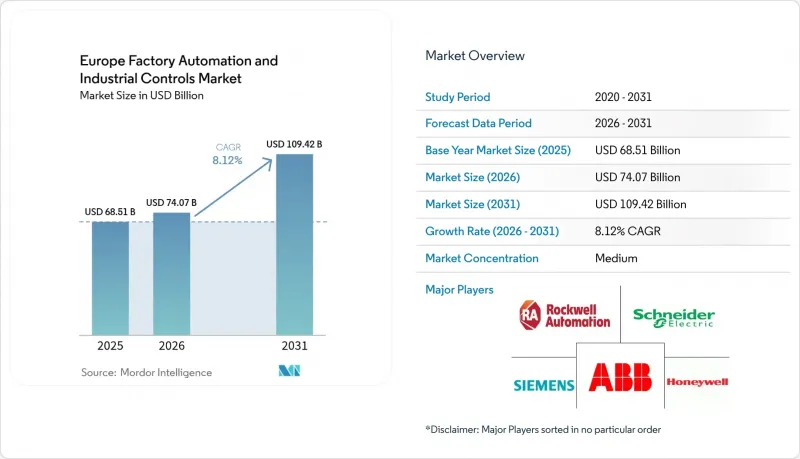
2025年歐洲工廠自動化和工業控制市場價值為685.1億美元,預計到2031年將達到1094.2億美元,而2026年為740.7億美元,預測期(2026-2031年)複合年成長率為8.12%。
本報告按產品類型(包括具有DCS的工業控制系統)、現場設備類型(工業機器人、機器視覺系統等)、最終用戶行業(汽車、食品飲料等)、部署模式(本地部署、雲端部署、混合邊緣/雲端部署)和地區進行細分。市場預測以美元(USD)為單位。
歐洲工廠自動化和工業控制市場的趨勢和洞察
人們越來越關注節能型智慧工廠
歐盟製造商正優先考慮節能自動化,以減少碳排放並保護利潤率免受電價波動的影響。 「歐洲製造夥伴關係」於2025年4月啟動,旨在透過結合人工智慧和即時數據分析,實現零缺陷、零停機生產。同時,瑞典98%的電力供應來自非石化燃料,為大規模機器人部署提供了支援。參與丹麥「數位化工廠加速計畫」的中小型企業報告稱,在過渡到無紙化工作流程並採用即時性能儀表板後,效率提高了10%至20%。 ABB收購Sensorfact凸顯了歐洲工廠自動化和工業控制市場對符合ISO 50001標準的精細化能源監控平台的強勁需求,這些平台能夠推動持續改善。
汽車電氣化加速所帶來的需求
隨著歐洲汽車製造商對工廠進行現代化改造以滿足電動車生產的需求,電池生產線正成為新計畫的重點。用於電極疊層、電解填充和最終檢測的機器人解決方案正在取代傳統的焊接電池。能夠偵測低於10ppm缺陷的機器視覺系統正成為電池組件的標準配備。柔軟性的可程式邏輯控制器(PLC)和自適應製造執行系統(MES)使工廠能夠在不長時間運作的情況下切換鋰離子電池的化學成分,從而推動了對模組化和麵向未來的控制系統的需求。
舊有系統中持續存在的網路安全漏洞
近五分之四的歐洲工廠仍在運作至少一台在現代安全框架出現之前安裝的可程式邏輯控制器 (PLC),這使得生產資產極易受到勒索軟體的威脅。雖然臨時網路分段和工業防火牆在一定程度上緩解了威脅,但要完全符合 IEC 62443 標準,則需要對控制器維修,這給資本預算帶來了沉重負擔。對於使用過時控制系統的製造商而言,保險費不斷上漲,促使企業董事會批准分階段升級,但專案工期卻越來越長。
細分市場分析
到2025年,可程式邏輯控制器(PLC)將佔據歐洲工廠自動化和工業控制市場27.98%的佔有率,這反映出PLC在需要確定性控制的離散製造生產線中的廣泛應用。隨著棕地升級改造,老舊硬體被標配安全功能的節能設備所取代,該細分市場保持穩定。受ISO 9001強制性即時生產可視性以及汽車和製藥行業標準中可追溯性條款的推動,預計到2031年,製造執行系統(MES)將以9.78%的複合年成長率成長。雲端訂閱降低了中型供應商的進入門檻,從而推動了歐洲工廠自動化和工業控制市場的擴張。此外,更緊密的ERP整合也帶來了其他益處,例如同步需求預測和生產線調度,並最大限度地減少在製品庫存。
儘管分散式控制系統在優先考慮高可用性架構的製程工業中仍被廣泛應用,但與支援預測分析功能的軟體層相比,其發展速度仍然較為緩慢。監控、控制和資料採集 (SCADA) 平台正轉向基於瀏覽器的用戶端,從而實現對多個地點運作情況的遠端監控。人機介面 (HMI) 整合了行動警報和上下文影片串流,以支援遠端專家快速進行故障排除。在歐盟資助的數位孿生先導計畫下,產品生命週期管理 (PLM) 正在實施,使設計人員能夠在設施建設之前透過模擬檢驗永續性指標。
預計2025年,工業機器人將佔據歐洲工廠自動化和工業控制市場31.05%的佔有率。德國每萬名工人安裝429台機器人的數據印證了這項預測。儘管汽車電氣化和消費品包裝產業對六軸機器人和Delta機器人的需求依然旺盛,但由於防護要求的放寬,協作機器人的銷售量正經歷兩位數的成長。機器視覺系統以9.05%的複合年成長率快速發展,透過人工智慧演算法降低電池單元檢測和無菌藥品填充的不合格率,從而迅速擴大歐洲工廠自動化和工業控制市場的規模。內建智慧相機的邊緣處理器可在本地進行推理,避免了雲端延遲,並保護了敏感的生產資料。
隨著基於振動和溫度資料流的預測性維護技術的引入,感測器和變送器的出貨量也在不斷成長。馬達和驅動器正朝著高效節能的方向發展,IE5馬達正逐漸成為變頻驅動器的標準配置,以實現淨零排放目標。智慧型執行器整合了自診斷功能,能夠偵測扭力異常,並支援分散式架構,從而在中央控制器離線時增強容錯能力。
其他好處:
- Excel格式的市場預測(ME)表
- 3個月的分析師支持
目錄
第1章:引言
- 研究假設和市場定義
- 調查範圍
第2章:調查方法
第3章執行摘要
第4章 市場狀況
- 市場概覽
- 市場促進因素
- 人們對節能型智慧工廠的興趣日益濃厚。
- 車輛電氣化加速所帶來的需求
- 推動旨在實現工業部門淨零排放的法規
- 引入人工智慧預測性維護(報告不足)
- 戰略產業回歸歐洲(媒體通報不足)
- 歐盟為製造業提供的數位孿生資金(缺乏媒體報導)
- 市場限制因素
- 舊有系統中仍存在網路安全漏洞。
- 半導體供應鏈貿易摩擦
- 中小企業自動化資金籌措分散(缺乏報告)
- 工人對過度自動化的抗拒(這一點尚未得到充分報告)
- 產業價值鏈分析
- 監理情勢
- 宏觀經濟因素的影響
- 技術展望
- 波特五力分析
第5章 市場規模與成長預測
- 依產品類型
- 分散式控制系統(DCS)
- 可程式邏輯控制器(PLC)
- 監控與數據採集(SCADA)
- 製造執行系統(MES)
- 產品生命週期管理(PLM)
- 人機介面(HMI)
- 企業資源規劃(ERP)
- 依現場設備類型
- 工業機器人
- 機器視覺系統
- 感測器和發射器
- 馬達和驅動器
- 智慧型執行器
- 按最終用戶行業分類
- 車
- 食品/飲料
- 製藥和生物技術
- 化工/石油化工
- 能源公用事業
- 金屬和採礦
- 其他終端用戶產業(紡織、紙漿和造紙等)
- 按部署模式
- 現場
- 雲端相容
- 混合邊緣雲
- 國家
- 德國
- 英國
- 法國
- 義大利
- 西班牙
- 荷蘭
- 波蘭
- 其他歐洲國家
第6章 競爭情勢
- 市場集中度
- 策略趨勢
- 市佔率分析
- 公司簡介
- Siemens AG
- Schneider Electric SE
- ABB Ltd.
- Rockwell Automation, Inc.
- Mitsubishi Electric Corporation
- Honeywell International Inc.
- Emerson Electric Co.
- Omron Corporation
- Robert Bosch GmbH
- Yokogawa Electric Corporation
- Beckhoff Automation GmbH and Co. KG
- Phoenix Contact GmbH and Co. KG
- B and R Industrial Automation GmbH
- FANUC Europe Corporation SA
- Pepperl+Fuchs SE
- Balluff GmbH
- Endress+Hauser Group Services AG
- GE Vernova
- Danfoss A/S
- WAGO Kontakttechnik GmbH and Co. KG
第7章 市場機會與未來展望
According to Mordor Intelligence, the Europe factory automation and industrial controls market size was valued at USD 68.51 billion in 2025 and estimated to grow from USD 74.07 billion in 2026 to reach USD 109.42 billion by 2031, at a CAGR of 8.12% during the forecast period (2026-2031).
This report is Segmented by Product Type (Industrial Control Systems Including DCS, and More), Field Device Type (Industrial Robots, Machine Vision Systems, and More), End-User Industry (Automotive, Food and Beverage, and More), Deployment Model (On-Premise, Cloud-Enabled, and Hybrid Edge-Cloud), and Geography. The Market Forecasts are Provided in Terms of Value (USD).
Europe Factory Automation And Industrial Controls Market Trends and Insights
Growing Emphasis on Energy-Efficient Smart Factories
EU manufacturers are prioritizing energy-efficient automation to reduce carbon footprints and shield margins from volatile power prices. The Made in Europe Partnership, launched in April 2025, targets zero-defect and zero-downtime production by combining AI with real-time data analytics, while Sweden's 98% fossil-free electricity underpins large-scale robotics rollouts. Danish SMEs in the Digital Factory Acceleration program report 10-20% efficiency gains after migrating to paperless workflows with live performance dashboards. ABB's purchase of Sensorfact highlights the surge in demand for granular energy-monitoring platforms that comply with ISO 50001 and feed continuous-improvement loops across the Europe factory automation and industrial controls market.
Accelerated Automotive Electrification Demands
Battery-cell production lines now dominate greenfield projects as European automakers retool for electric-vehicle volumes. Robotic solutions built for electrode stacking, electrolyte filling, and end-of-line inspection are replacing legacy welding cells. Machine-vision systems capable of detecting defects below 10 parts per million are becoming standard on battery components. Flexible programmable logic controllers and adaptive manufacturing execution systems let plants switch between lithium-ion chemistries without extended downtime, reinforcing demand for modular, future-proof controls.
Persistent Legacy-System Cybersecurity Gaps
Nearly four-fifths of European plants still operate at least one programmable logic controller installed before modern security frameworks existed, leaving production assets exposed to ransomware. Temporary network segmentation and industrial firewalls offer partial relief, yet full IEC 62443 compliance demands controller retrofits that strain capital budgets. Insurance premiums for manufacturers with outdated controls have risen, nudging board-level approval for phased replacements but stretching project timelines.
Other drivers and restraints analyzed in the detailed report include:
- Regulatory Push for Net-Zero Industrial Emissions
- AI-Enabled Predictive Maintenance Adoption
- Trade Tensions on Semiconductor Supply Chains
For complete list of drivers and restraints, kindly check the Table Of Contents.
Segment Analysis
Programmable logic controllers accounted for 27.98% of the Europe factory automation and industrial controls market share in 2025, reflecting their ubiquity in discrete manufacturing lines that demand deterministic control. The segment remains stable as brownfield upgrades replace aging hardware with energy-efficient units featuring native cybersecurity. Manufacturing execution systems are projected to grow at a 9.78% CAGR to 2031, propelled by real-time production visibility mandates under ISO 9001 and traceability clauses in automotive and pharmaceutical standards. The Europe factory automation and industrial controls market size tied to MES adoption is widening as cloud subscriptions lower entry costs for mid-tier suppliers. Second-order gains emerge from tighter ERP integration that synchronizes demand forecasts with line scheduling, minimizing work-in-progress inventory.
Distributed control systems continue to serve process industries that value high-availability architectures, though growth is modest compared with software layers that unlock predictive-analytics functions. Supervisory control and data acquisition platforms are shifting toward browser-based clients, enabling remote oversight for multi-site operations. Human-machine interfaces integrate mobile alerts and contextual video streams that support faster troubleshooting from off-site experts. Product-lifecycle-management deployments are increasing under EU-funded digital-twin pilots, allowing designers to validate sustainability metrics in silico before capital builds.
Industrial robots held 31.05% of the Europe factory automation and industrial controls market share in 2025, underpinned by Germany's installed base of 429 units per 10,000 workers. Automotive electrification and consumer-goods packaging keep six-axis and delta robots in high demand, while collaborative variants post double-digit unit growth thanks to reduced guarding requirements. Machine-vision systems, advancing at a 9.05% CAGR, are rapidly expanding the Europe factory automation and industrial controls market size as AI algorithms cut false-rejection rates in battery-cell inspection and sterile drug filling. Edge processors inside smart cameras execute inference locally, avoiding cloud latency and securing sensitive production data.
Sensor and transmitter volumes rise alongside predictive-maintenance rollouts that depend on vibration and temperature data streams. Motors and drives are trending toward high-efficiency classes, with variable-frequency drives standardizing on IE5-rated motors to meet net-zero targets. Intelligent actuators embed self-diagnostics that flag torque anomalies, supporting decentralized architectures that improve resilience when central controllers go offline.
Complete Report Scope:
- By Product Type
- Distributed Control Systems (DCS)
- Programmable Logic Controllers (PLC)
- Supervisory Control and Data Acquisition (SCADA)
- Manufacturing Execution Systems (MES)
- Product Lifecycle Management (PLM)
- Human Machine Interface (HMI)
- Enterprise Resource Planning (ERP)
- By Field Device Type
- Industrial Robots
- Machine Vision Systems
- Sensors and Transmitters
- Motors and Drives
- Intelligent Actuators
- By End-User Industry
- Automotive
- Food and Beverage
- Pharmaceutical and Biotech
- Chemical and Petrochemical
- Energy and Utilities
- Metals and Mining
- Other End-User Industries (Textile, Pulp and Paper, etc.)
- By Deployment Model
- On-premise
- Cloud-enabled
- Hybrid Edge-Cloud
- By Country
- Germany
- United Kingdom
- France
- Italy
- Spain
- Netherlands
- Poland
- Rest of Europe
List of Companies Covered in this Report:
- Siemens AG
- Schneider Electric SE
- ABB Ltd.
- Rockwell Automation, Inc.
- Mitsubishi Electric Corporation
- Honeywell International Inc.
- Emerson Electric Co.
- Omron Corporation
- Robert Bosch GmbH
- Yokogawa Electric Corporation
- Beckhoff Automation GmbH and Co. KG
- Phoenix Contact GmbH and Co. KG
- B and R Industrial Automation GmbH
- FANUC Europe Corporation S.A.
- Pepperl+Fuchs SE
- Balluff GmbH
- Endress+Hauser Group Services AG
- GE Vernova
- Danfoss A/S
- WAGO Kontakttechnik GmbH and Co. KG
Additional Benefits:
- The market estimate (ME) sheet in Excel format
- 3 months of analyst support
TABLE OF CONTENTS
1 INTRODUCTION
- 1.1 Study Assumptions and Market Definition
- 1.2 Scope of the Study
2 RESEARCH METHODOLOGY
3 EXECUTIVE SUMMARY
4 MARKET LANDSCAPE
- 4.1 Market Overview
- 4.2 Market Drivers
- 4.2.1 Growing Emphasis on Energy-Efficient Smart Factories
- 4.2.2 Accelerated Automotive Electrification Demands
- 4.2.3 Regulatory Push for Net-Zero Industrial Emissions
- 4.2.4 AI-Enabled Predictive Maintenance Adoption (Under-reported)
- 4.2.5 Reshoring of Strategic Industries into Europe (Under-reported)
- 4.2.6 EU Digital Twin Funding for Manufacturing (Under-reported)
- 4.3 Market Restraints
- 4.3.1 Persistent Legacy-System Cybersecurity Gaps
- 4.3.2 Trade Tensions on Semiconductor Supply Chains
- 4.3.3 Fragmented SME Funding for Automation (Under-reported)
- 4.3.4 Workforce Resistance to Hyper-Automation (Under-reported)
- 4.4 Industry Value-Chain Analysis
- 4.5 Regulatory Landscape
- 4.6 Impact of Macroeconomic Factors
- 4.7 Technological Outlook
- 4.8 Porter's Five Forces Analysis
- 4.8.1 Bargaining Power of Suppliers
- 4.8.2 Bargaining Power of Consumers
- 4.8.3 Threat of New Entrants
- 4.8.4 Threat of Substitutes
- 4.8.5 Intensity of Competitive Rivalry
5 MARKET SIZE AND GROWTH FORECASTS (VALUE)
- 5.1 By Product Type
- 5.1.1 Distributed Control Systems (DCS)
- 5.1.2 Programmable Logic Controllers (PLC)
- 5.1.3 Supervisory Control and Data Acquisition (SCADA)
- 5.1.4 Manufacturing Execution Systems (MES)
- 5.1.5 Product Lifecycle Management (PLM)
- 5.1.6 Human Machine Interface (HMI)
- 5.1.7 Enterprise Resource Planning (ERP)
- 5.2 By Field Device Type
- 5.2.1 Industrial Robots
- 5.2.2 Machine Vision Systems
- 5.2.3 Sensors and Transmitters
- 5.2.4 Motors and Drives
- 5.2.5 Intelligent Actuators
- 5.3 By End-User Industry
- 5.3.1 Automotive
- 5.3.2 Food and Beverage
- 5.3.3 Pharmaceutical and Biotech
- 5.3.4 Chemical and Petrochemical
- 5.3.5 Energy and Utilities
- 5.3.6 Metals and Mining
- 5.3.7 Other End-User Industries (Textile, Pulp and Paper, etc.)
- 5.4 By Deployment Model
- 5.4.1 On-premise
- 5.4.2 Cloud-enabled
- 5.4.3 Hybrid Edge-Cloud
- 5.5 By Country
- 5.5.1 Germany
- 5.5.2 United Kingdom
- 5.5.3 France
- 5.5.4 Italy
- 5.5.5 Spain
- 5.5.6 Netherlands
- 5.5.7 Poland
- 5.5.8 Rest of Europe
6 COMPETITIVE LANDSCAPE
- 6.1 Market Concentration
- 6.2 Strategic Moves
- 6.3 Market Share Analysis
- 6.4 Company Profiles (includes Global Level Overview, Market Level Overview, Core Segments, Financials as available, Strategic Information, Market Rank/Share for key companies, Products and Services, and Recent Developments)
- 6.4.1 Siemens AG
- 6.4.2 Schneider Electric SE
- 6.4.3 ABB Ltd.
- 6.4.4 Rockwell Automation, Inc.
- 6.4.5 Mitsubishi Electric Corporation
- 6.4.6 Honeywell International Inc.
- 6.4.7 Emerson Electric Co.
- 6.4.8 Omron Corporation
- 6.4.9 Robert Bosch GmbH
- 6.4.10 Yokogawa Electric Corporation
- 6.4.11 Beckhoff Automation GmbH and Co. KG
- 6.4.12 Phoenix Contact GmbH and Co. KG
- 6.4.13 B and R Industrial Automation GmbH
- 6.4.14 FANUC Europe Corporation S.A.
- 6.4.15 Pepperl+Fuchs SE
- 6.4.16 Balluff GmbH
- 6.4.17 Endress+Hauser Group Services AG
- 6.4.18 GE Vernova
- 6.4.19 Danfoss A/S
- 6.4.20 WAGO Kontakttechnik GmbH and Co. KG
7 MARKET OPPORTUNITIES AND FUTURE OUTLOOK
- 7.1 White-space and Unmet-Need Assessment

 4U工業電腦市場-2026年至2032年全球市場預測
 2034 年工業自動化網路安全市場預測—按部署類型、安全類型、組件、服務類型、技術、應用、最終用戶和地區分類的全球分析
 北美工廠自動化和工業控制:市場佔有率分析、行業趨勢和統計數據以及成長預測(2026-2031 年)工廠自動化與工業控制:市場佔有率分析、產業趨勢與統計、成長預測(2026-2031)德國工廠自動化和工業控制:市場佔有率分析、行業趨勢和統計數據以及成長預測(2026-2031 年)美國工廠自動化和工業控制:市場佔有率分析、行業趨勢和統計數據以及成長預測(2026-2031 年)日本工廠自動化和工業控制:市場佔有率分析、行業趨勢和統計數據以及成長預測(2026-2031 年)義大利工廠自動化和工業控制:市場佔有率分析、行業趨勢和統計數據以及成長預測(2026-2031 年)法國工廠自動化和工業控制:市場佔有率分析、行業趨勢和統計數據以及成長預測(2026-2031 年)中國工廠自動化與工業控制:市場佔有率分析、產業趨勢與統計及成長預測(2026-2031年)