


 |
市場調查報告書
商品編碼
2120299
混合儲存立方體:市場佔有率分析、行業趨勢和統計數據、成長預測(2026-2031 年)Hybrid Memory Cube - Market Share Analysis, Industry Trends & Statistics, Growth Forecasts (2026 - 2031) |
||||||

※ 本網頁內容可能與最新版本有所差異。詳細情況請與我們聯繫。
根據 Mordor Intelligence 預測,混合儲存立方體市場將從 2025 年的 22.5 億美元成長到 2026 年的 26.5 億美元,然後在 2031 年達到 59.9 億美元,2026 年至 2031 年的複合年成長率為 17.73%。
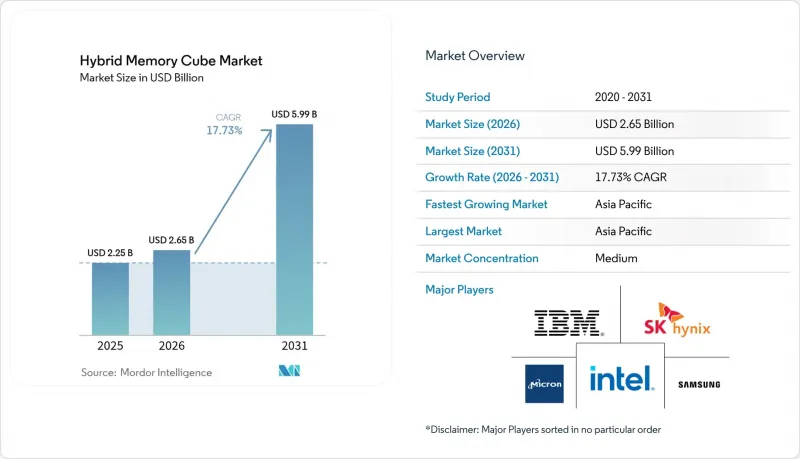
本報告按最終用戶行業(企業存儲、汽車ADAS等)、內存容量(2GB-8GB、8GB-16GB、16GB-32GB、32GB以上)、應用(處理器快取、數據緩衝區、顯存、工業和物聯網邊緣)、技術節點(光連接模組HMC、基於晶片的HMC等)以及地區進行細分。市場預測以美元(USD)為單位。
全球混合儲存立方體市場趨勢與洞察
人工智慧和高效能運算工作負載的快速成長,對高頻寬記憶體的需求日益增加。
大規模語言模型的訓練凸顯了「記憶體牆」現象,即計算單元尚未達到飽和時,計算就會停滯。混合記憶體立方體 (HMC) 封裝可提供高達 320 GB/s 的頻寬,從而保障 GPU 和 Tensor Core 的資料供應。隨著即時語言翻譯和用於自主感知的邊緣推理技術的應用,低延遲 DRAM 替代方案變得至關重要,這進一步鞏固了對垂直堆疊記憶體的需求。美光科技報告稱,到 2024 會計年度,AI 伺服器的記憶體容量將是傳統企業級節點的兩倍,高頻寬產品的構成比將持續成長。 IEEE 的研究發現,與 DDR5 相比, 3D互連可將每位元的能耗降低 40%,從而降低兆瓦級叢集的營運成本。隨著持續的微調和搜尋聚合產生將記憶體使用量推高至Terabyte級以上,混合記憶體立方體的模組化擴充性使其成為這些環境中極具吸引力的選擇。早期採用者也指出了延遲確定性的優勢,這提高了對話式 AI 工作負載的服務品質 (QoS) 指標。
不斷擴大的企業儲存和超大規模資料中心更新週期
超大規模資料中心業者正在以整合運算儲存處理器的全快閃節點取代硬碟陣列,而這些晶片需要頻寬來管理平行的NAND通道,同時最大限度地減少佇列深度。英特爾強調,下一代儲存控制器將依靠高頻寬記憶體來加速線上重複資料刪除、擦除編碼和加密。隨著企業採用可組合基礎設施,企業級更新周期正在縮短,這進一步凸顯了對混合記憶體立方體支援的基於資料包的記憶體介面的需求。為了反映這一轉變,三星透露,到2024年,企業級固態硬碟中堆疊記憶體的採用率將年增一倍。諸如ISO 27001之類的法規結構要求始終開啟加密和審計日誌記錄,這進一步增加了對頻寬的需求。超大規模營運商也尋求減少機架總數,而高頻寬記憶體可以透過降低每個節點的延遲來實現更高密度的部署。
高昂的製造成本和TSV良率的限制
根據SK海力士2024年財報電話會議,TSV的深反應離子蝕刻(DRIE)製程會引入平面DRAM中不存在的缺陷機制,導致每GB成本比DDR5高出60%。低於85%的良率會導致冗餘開銷和晶片面積增加,從而降低毛利率。此外,熱循環過程中銅泵故障會進一步損害鍵合完整性,並加劇先進封裝生產線的廢品率。維修符合TSV標準的無塵室每個項目至少需要5億美元,認證過程耗時近兩年,限制了產能的快速擴張。歐盟RoHS等環境法規增加了材料替代要求,使製程化學更加複雜,並進一步減緩了規模化生產。在良率超過90%之前,廠商可能會將重心放在高階細分市場,而不是大眾市場。
細分市場分析
預計到2025年,企業儲存將佔總營收的40.75%,這主要得益於超大規模業者對全Flash陣列進行升級,採用記憶體語意儲存控制器。這些升級透過採用混合記憶體立方體(HMC)封裝,提高了隨機存取吞吐量,並在並行NAND通道上保持了低尾延遲。隨著感測器融合和車載人工智慧的普及,汽車ADAS工作負載,特別是L3和L4級自動駕駛,預計到2031年將以20.42%的複合年成長率成長。混合記憶體立方體正被通訊、高效能運算和工業自動化領域採用,以滿足其優於傳統DRAM的確定性延遲要求。有關功能安全認證和網路安全的監管要求正在加速安全關鍵產業的採購。
汽車產業的成長凸顯了混合儲存立方體市場向邊緣設備方向的轉變,這些裝置優先考慮散熱效率和持續頻寬。隨著每個設備感測器數量的增加,即時感知演算法直接受益於低延遲記憶體。儘管由於北美和歐洲市場的發展成熟,企業儲存的成長速度目前有所放緩,但持續的容量最佳化正在維持產品的生命週期。電信業者正在利用共享記憶體架構部署 5G 核心網路。諸如 FCC 推廣開放式無線存取網 (Open RAN) 和歐盟機械指令等政府政策也在推動混合儲存立方體支援的模組化記憶體架構的發展。
到2025年,容量在16GB至32GB範圍內的記憶體模組將佔部署總量的37.15%,既滿足雙路伺服器的需求,又實現了成本績效的最佳平衡。隨著大規模語言模型和NUMA系統的推理節點採用多Terabyte記憶體池,容量超過32GB的混合記憶體立方體市場預計將以19.62%的複合年成長率成長。 8GB至16GB的容量範圍主要面向功耗受限的邊緣伺服器,而容量低於8GB的設備在嵌入式工業控制系統中仍然很常見,因為在這些系統中,抗輻射能力和寬溫範圍比單純的容量更為重要。
預計到2024年,每個插槽的平均記憶體容量將從2020年的128 GB加倍,達到256 GB。這是因為人工智慧推理伺服器將模型權重存儲在系統記憶體中,從而擴大了高容量記憶體的目標市場。 5G核心網路中的網路切片編配功能進一步提高了每個節點的容量需求。功能安全性和網路安全標準有效地使可用於冗餘和奇偶校驗的記憶體容量加倍,這進一步證明了控制平面設備中採用更高容量HMC封裝的必要性。
區域分析
預計到2025年,亞太地區將佔據混合儲存立方體市場收入的41.05%,並在2031年之前以19.93%的複合年成長率成長。這主要得益於中國、日本、韓國和印度的半導體扶持政策,以及三星和SK海力士等半導體巨頭的強大製造能力。中國政府計劃在2024年投資150億元人民幣,支持國內堆疊式儲存技術的創新。同時,日本正透過聯合投資支援2nm節點以下的晶片封裝技術。印度的超大規模資料中心業者正在開發需要高頻寬記憶體的區域語言感知型人工智慧模型,提振了國內需求。台灣晶圓層次電子構裝的擴張進一步鞏固了該地區作為異質整合服務中心的地位。
受超大規模雲端更新周期和美國能源局百萬兆級計畫的推動,北美預計將在2025年佔據全球營收的28.35%。英特爾在俄亥俄州投資200億美元的擴建計畫將包括安裝一條先進的封裝生產線,用於將混合記憶體立方體(HMC)晶片直接整合到至強處理器和GPU組件中。亞馬遜雲端服務(AWS)、微軟Azure和Google雲端都在試行解耦式記憶體架構,將高頻寬集中到多個機架上,這種模式既能最大限度地提高利用率,又能降低單一伺服器的成本。加拿大的Vector和Mila實驗室正在部署基於HMC的叢集,以支援國家人工智慧研究目標。出口限制導致先進記憶體的出貨量下降,正在重塑供應鏈分配格局,並刺激對國內產能的投資。
受汽車高級駕駛輔助系統 (ADAS) 和歐洲高效能運算 (EuroHPC)超級電腦部署的推動,歐洲預計將在 2025 年佔據約 17.65% 的銷售額。德國一級供應商博世和大陸集團已將混合儲存立方體 (HMC) 整合到 L3 級感知平台中,以滿足嚴格的延遲要求。該地區主權雲的發展需要符合 GDPR 標準的配置,這就要求採用適用於加密的儲存架構。 2024 年,Arm 擴展了其連貫互連 IP 產品組合,以支援歐洲的汽車和邊緣運算客戶,凸顯了其在本地研發方面的強勁勢頭。歐盟晶片法案已撥款 430 億歐元,旨在使該地區的半導體市場佔有率加倍,部分資金將用於資助堆疊式儲存產品線的先進封裝技術。
其他好處:
- Excel格式的市場預測(ME)表
- 3個月的分析師支持
目錄
第1章:引言
- 研究假設和市場定義
- 調查範圍
第2章:調查方法
第3章執行摘要
第4章 市場狀況
- 市場概覽
- 市場促進因素
- 擴展企業儲存並縮短超大規模資料中心的更新周期
- 人工智慧/高效能運算工作負載的快速成長需要高頻寬內存
- 擴大5G核心網與邊緣網設備的部署
- 美國、中國和歐洲政府主導的百萬兆級運算舉措
- 基於晶片組的異質整合架構正在迅速發展。
- 向雲端平台上的可組合分散式伺服器架構過渡
- 市場限制因素
- 傳統DDRx/LPDDR DRAM技術的壓倒性優勢
- 高昂的製造成本和TSV良率限制
- 3D堆疊式記憶體立方體的溫度控管複雜性
- 供應商生態系統有限,且知識產權授權方面有摩擦
- 產業價值鏈分析
- 宏觀經濟因素的影響
- 監理情勢
- 技術展望
- 波特五力分析
第5章 市場規模與成長預測
- 按最終用戶行業分類
- 企業儲存
- 通訊與網路
- 高效能運算
- 汽車高級駕駛輔助系統(ADAS)
- 其他終端用戶產業
- 按內存容量
- 2 GB~8 GB
- 8 GB~16 GB
- 16 GB~32 GB
- 32 GB 或更多
- 透過使用
- 處理器快取
- 資料緩衝區
- 顯存
- 工業/物聯網邊緣
- 依技術節點
- 基於TSV的混合儲存立方體(第二代)
- 光連接模組HMC
- 晶片基體HMC
- 按地區
- 北美洲
- 美國
- 加拿大
- 墨西哥
- 南美洲
- 巴西
- 阿根廷
- 其他南美國家
- 歐洲
- 德國
- 英國
- 法國
- 義大利
- 西班牙
- 俄羅斯
- 其他歐洲國家
- 亞太地區
- 中國
- 日本
- 印度
- 韓國
- 澳洲
- 其他亞太國家
- 中東和非洲
- 中東
- 沙烏地阿拉伯
- 阿拉伯聯合大公國
- 土耳其
- 其他中東國家
- 非洲
- 南非
- 奈及利亞
- 埃及
- 其他非洲國家
- 中東
- 北美洲
第6章 競爭情勢
- 市場集中度
- 策略趨勢
- 市佔率分析
- 公司簡介
- Micron Technology Inc.
- Intel Corporation
- Samsung Electronics Co., Ltd.
- SK hynix Inc.
- International Business Machines Corporation
- Advanced Micro Devices Inc.
- Xilinx, Inc.
- Fujitsu Ltd.
- Marvell Technology, Inc.
- Rambus Inc.
- Broadcom Inc.
- Cadence Design Systems Inc.
- ASE Technology Holding Co., Ltd.
- Semtech Corporation
- Open-Silicon, Inc.
- Arm Ltd.
- Altera Corporation(Intel PSG)
- Taiwan Semiconductor Manufacturing Company Ltd.
- Hitachi Ltd.
- Renesas Electronics Corporation
第7章 市場機會與未來展望
According to Mordor Intelligence, the hybrid memory cube market size is expected to grow from USD 2.25 billion in 2025 to USD 2.65 billion in 2026 and is forecast to reach USD 5.99 billion by 2031 at 17.73% CAGR over 2026-2031.
This report is Segmented by End-User Industry (Enterprise Storage, Automotive ADAS, and More), Memory Capacity (2 GB To 8 GB, 8 GB To 16 GB, 16 GB To 32 GB, Greater Than 32 GB), Application (Processor Cache, Data Buffer, Graphics Memory, Industrial and IoT Edge), Technology Node (Optical-Interconnect HMC, Chiplet-Based HMC, and More), and Geography. The Market Forecasts are Provided in Terms of Value (USD).
Global Hybrid Memory Cube Market Trends and Insights
Rapid Uptake of AI and HPC Workloads Demanding High-Bandwidth Memory
Large-language-model training has underscored the memory wall, where compute stalls before arithmetic units saturate, and Hybrid Memory Cube packages deliver up to 320 GB/s to keep GPUs and tensor cores fed. Edge inference for real-time language translation and autonomous perception now mandates low-latency DRAM alternatives, cementing demand for vertically stacked memory. Micron reported that AI server memory content doubled relative to traditional enterprise nodes in fiscal 2024, with high-bandwidth products capturing a rising percentage mix. IEEE research has found that 3-D interconnects lower energy per bit by 40% compared to DDR5, thereby reducing operating costs in megawatt-scale clusters. Continuous fine-tuning and retrieval-augmented generation extend memory footprints beyond terabyte levels, and modular scalability makes Hybrid Memory Cube attractive for such regimes. Early adopters also note latency determinism advantages, which improve quality-of-service metrics for conversational AI workloads.
Growing Enterprise Storage and Hyperscale Datacenter Refresh Cycles
Hyperscalers are replacing HDD arrays with all-flash nodes that integrate computational storage processors, and these chips demand bandwidth to manage parallel NAND channels with minimal queue depth. Intel highlighted that next-generation storage controllers rely on high-bandwidth memory to accelerate inline deduplication, erasure coding, and encryption. Enterprise refresh cycles are compressing as organizations adopt composable infrastructure, further emphasizing the need for packet-based memory interfaces that Hybrid Memory Cube supports. Samsung disclosed that enterprise SSD attach rates for stacked memory doubled year-over-year in 2024, reflecting this migration. Regulatory frameworks such as ISO 27001 intensify bandwidth needs by requiring always-on encryption and audit logging. Hyperscale operators also seek ways to reduce total rack count, and high-bandwidth memory reduces per-node latency, enabling denser deployments.
High Manufacturing Cost and TSV Yield Constraints
Deep reactive-ion etching for TSVs introduces defect mechanisms not present in planar DRAM, increasing the per-gigabyte cost by up to 60% relative to DDR5, according to SK hynix's 2024 earnings call. Yields under 85% create redundancy overhead and inflate die area, reducing gross margins. Copper-pumping failures during thermal cycling further damage bond integrity, worsening scrap rates in advanced packaging lines. Each TSV-capable cleanroom retrofit costs at least USD 500 million and needs nearly two years to qualify, limiting rapid capacity expansion. Environmental directives such as the EU's RoHS add material-substitution requirements, complicating process chemistry and further delaying scale-up. Until yield climbs above 90%, vendors are likely to focus on premium niches rather than mass-market volumes.
Other drivers and restraints analyzed in the detailed report include:
- Government-Backed Exascale Computing Initiatives in the United States, China, and Europe
- Chiplet-Based Heterogeneous Integration Architectures Gaining Traction
- Strong Incumbency of Conventional DDRx and LPDDR Technology
For complete list of drivers and restraints, kindly check the Table Of Contents.
Segment Analysis
Enterprise storage contributed 40.75% of 2025 revenue, underpinned by hyperscale operators refreshing all-flash arrays with memory-semantic storage controllers. These upgrades increase random-access throughput and use Hybrid Memory Cube packages to maintain low tail latency across parallel NAND channels. Automotive ADAS workloads, centered on Level 3 and Level 4 autonomy, are projected to rise at a 20.42% CAGR through 2031 as sensor fusion and in-vehicle AI become mainstream. Telecommunications, high-performance computing, and industrial automation each adopt the Hybrid Memory Cube to address deterministic latency needs that outstrip those of conventional DRAM. Regulatory requirements surrounding functional-safety certification and cybersecurity accelerate procurement in safety-critical domains.
Automotive growth highlights the shift of the hybrid memory cube market toward edge devices, which prioritize thermal efficiency and sustained bandwidth. The sensor count per vehicle is climbing, and real-time perception algorithms benefit directly from low-latency memory. Enterprise storage growth is now moderating as penetration reaches mature levels in North America and Europe, though ongoing capacity optimization ensures continued product cycles. Telecommunications operators are leveraging pooled-memory constructs in 5G core deployments. Government policies, such as the FCC's Open RAN push and the EU Machinery Regulation, also champion modular memory architectures that Hybrid Memory Cube supports.
Modules in the 16 GB to 32 GB range captured 37.15% of 2025 deployments, aligning with expectations for dual-socket servers and providing the optimal sweet spot for cost-performance balance. The hybrid memory cube market size for capacities greater than 32 GB is forecast to expand at a 19.62% CAGR as large-language-model inference nodes and NUMA systems deploy multi-terabyte pools. The 8 GB-to-16 GB tier supports power-constrained edge servers, while devices with capacities below 8 GB remain common in embedded industrial controls, where radiation tolerance and extended temperature ratings take precedence over raw capacity.
The average memory per socket has doubled from 128 GB in 2020 to 256 GB in 2024, and the shift toward AI inference servers that store model weights in system memory has widened the addressable high-capacity segment. Network-slice orchestration functions in 5G cores further raise per-node capacity needs. Functional-safety and cybersecurity standards effectively double usable memory to accommodate redundancy and parity, reinforcing the case for moving up to larger HMC packages in control-plane equipment.
Complete Report Scope:
- By End-User Industry
- Enterprise Storage
- Telecommunications and Networking
- High-Performance Computing
- Automotive ADAS
- Other End-User Industry
- By Memory Capacity
- 2 GB-8 GB
- 8 GB-16 GB
- 16 GB-32 GB
- Above 32 GB
- By Application
- Processor Cache
- Data Buffer
- Graphics Memory
- Industrial / IoT Edge
- By Technology Node
- TSV-based Hybrid Memory Cube (Gen 2)
- Optical-interconnect HMC
- Chiplet-based HMC
- By Geography
- North America
- United States
- Canada
- Mexico
- South America
- Brazil
- Argentina
- Rest of South America
- Europe
- Germany
- United Kingdom
- France
- Italy
- Spain
- Russia
- Rest of Europe
- Asia Pacific
- China
- Japan
- India
- South Korea
- Australia
- Rest of Asia Pacific
- Middle East and Africa
- Middle East
- Saudi Arabia
- United Arab Emirates
- Turkey
- Rest of Middle East
- Africa
- South Africa
- Nigeria
- Egypt
- Rest of Africa
- Middle East
- North America
Geography Analysis
The Asia Pacific delivered 41.05% of the hybrid memory cube market revenue in 2025 and is projected to grow at a 19.93% CAGR to 2031, driven by concentrated fabrication capacity at Samsung and SK hynix, as well as pro-semiconductor policies in China, Japan, South Korea, and India. The Chinese government's funds, totaling CNY 15 billion in 2024, target domestic stacked-memory innovation, while Japanese co-investment supports chiplet packaging through 2-nm nodes. Indian hyperscalers are drafting regional language AI models that require high-bandwidth memory, advancing in-country demand. Taiwan's wafer-level packaging expansions further anchor the region as a hub for heterogeneous integration services.
North America represented 28.35% of 2025 revenue, driven by hyperscale cloud refresh cycles and the Department of Energy's exascale programs. Intel's USD 20 billion Ohio expansion will house advanced packaging lines to embed Hybrid Memory Cube dies directly into Xeon and GPU assemblies. Amazon Web Services, Microsoft Azure, and Google Cloud all pilot disaggregated memory fabrics that pool high-bandwidth tiers across racks, a model that maximizes utilization while controlling per-server costs. Canada's Vector and Mila institutes deploy HMC-based clusters to underpin national AI research goals. Export controls restricting advanced memory shipments reshape supply allocation patterns and drive onshore capacity investments.
Europe captured approximately 17.65% of the 2025 revenue, driven by the adoption of automotive ADAS and the installation of EuroHPC supercomputers. German tier-ones Bosch and Continental incorporated Hybrid Memory Cube into Level 3 perception platforms to meet stringent latency budgets. The region's sovereign cloud push requires GDPR-compliant configurations, which in turn need encryption-friendly memory architectures. Arm expanded a coherent interconnect IP portfolio in 2024 to support European automotive and edge customers, underscoring local R&D momentum. The EU Chips Act funnels EUR 43 billion to double the regional semiconductor share, part of which finances advanced packaging for stacked memory lines.
- Micron Technology Inc.
- Intel Corporation
- Samsung Electronics Co., Ltd.
- SK hynix Inc.
- International Business Machines Corporation
- Advanced Micro Devices Inc.
- Xilinx, Inc.
- Fujitsu Ltd.
- Marvell Technology, Inc.
- Rambus Inc.
- Broadcom Inc.
- Cadence Design Systems Inc.
- ASE Technology Holding Co., Ltd.
- Semtech Corporation
- Open-Silicon, Inc.
- Arm Ltd.
- Altera Corporation (Intel PSG)
- Taiwan Semiconductor Manufacturing Company Ltd.
- Hitachi Ltd.
- Renesas Electronics Corporation
Additional Benefits:
- The market estimate (ME) sheet in Excel format
- 3 months of analyst support
TABLE OF CONTENTS
1 INTRODUCTION
- 1.1 Study Assumptions and Market Definition
- 1.2 Scope of the Study
2 RESEARCH METHODOLOGY
3 EXECUTIVE SUMMARY
4 MARKET LANDSCAPE
- 4.1 Market Overview
- 4.2 Market Drivers
- 4.2.1 Growing Enterprise Storage and Hyperscale Datacenter Refresh Cycles
- 4.2.2 Rapid Uptake Of AI / HPC Workloads Demanding High-Bandwidth Memory
- 4.2.3 Expanding 5G Core and Edge Networking Equipment Deployments
- 4.2.4 Government-Backed Exascale Computing Initiatives in the United States, China And Europe
- 4.2.5 Chiplet-Based Heterogeneous Integration Architectures Gaining Traction
- 4.2.6 Shift Toward Composable and Disaggregated Server Architecture in Cloud Platforms
- 4.3 Market Restraints
- 4.3.1 Strong Incumbency of Conventional Ddrx / LPDDR DRAM Technology
- 4.3.2 High Manufacturing Cost and TSV Yield Constraints
- 4.3.3 Thermal Management Complexity In 3-D Stacked Memory Cubes
- 4.3.4 Limited Supplier Ecosystem and IP Licensing Frictions
- 4.4 Industry Value Chain Analysis
- 4.5 Impact of Macroeconomic Factors
- 4.6 Regulatory Landscape
- 4.7 Technological Outlook
- 4.8 Porter's Five Forces Analysis
- 4.8.1 Bargaining Power of Buyers
- 4.8.2 Bargaining Power of Suppliers
- 4.8.3 Threat of New Entrants
- 4.8.4 Threat of Substitute Products
- 4.8.5 Intensity of Competitive Rivalry
5 MARKET SIZE AND GROWTH FORECASTS (VALUE)
- 5.1 By End-User Industry
- 5.1.1 Enterprise Storage
- 5.1.2 Telecommunications and Networking
- 5.1.3 High-Performance Computing
- 5.1.4 Automotive ADAS
- 5.1.5 Other End-User Industry
- 5.2 By Memory Capacity
- 5.2.1 2 GB-8 GB
- 5.2.2 8 GB-16 GB
- 5.2.3 16 GB-32 GB
- 5.2.4 Above 32 GB
- 5.3 By Application
- 5.3.1 Processor Cache
- 5.3.2 Data Buffer
- 5.3.3 Graphics Memory
- 5.3.4 Industrial / IoT Edge
- 5.4 By Technology Node
- 5.4.1 TSV-based Hybrid Memory Cube (Gen 2)
- 5.4.2 Optical-interconnect HMC
- 5.4.3 Chiplet-based HMC
- 5.5 By Geography
- 5.5.1 North America
- 5.5.1.1 United States
- 5.5.1.2 Canada
- 5.5.1.3 Mexico
- 5.5.2 South America
- 5.5.2.1 Brazil
- 5.5.2.2 Argentina
- 5.5.2.3 Rest of South America
- 5.5.3 Europe
- 5.5.3.1 Germany
- 5.5.3.2 United Kingdom
- 5.5.3.3 France
- 5.5.3.4 Italy
- 5.5.3.5 Spain
- 5.5.3.6 Russia
- 5.5.3.7 Rest of Europe
- 5.5.4 Asia Pacific
- 5.5.4.1 China
- 5.5.4.2 Japan
- 5.5.4.3 India
- 5.5.4.4 South Korea
- 5.5.4.5 Australia
- 5.5.4.6 Rest of Asia Pacific
- 5.5.5 Middle East and Africa
- 5.5.5.1 Middle East
- 5.5.5.1.1 Saudi Arabia
- 5.5.5.1.2 United Arab Emirates
- 5.5.5.1.3 Turkey
- 5.5.5.1.4 Rest of Middle East
- 5.5.5.2 Africa
- 5.5.5.2.1 South Africa
- 5.5.5.2.2 Nigeria
- 5.5.5.2.3 Egypt
- 5.5.5.2.4 Rest of Africa
- 5.5.5.1 Middle East
- 5.5.1 North America
6 COMPETITIVE LANDSCAPE
- 6.1 Market Concentration
- 6.2 Strategic Moves
- 6.3 Market Share Analysis
- 6.4 Company Profiles (includes Global level Overview, Market level overview, Core Segments, Financials as available, Strategic Information, Market Rank / Share for key companies, Products and Services, and Recent Developments)
- 6.4.1 Micron Technology Inc.
- 6.4.2 Intel Corporation
- 6.4.3 Samsung Electronics Co., Ltd.
- 6.4.4 SK hynix Inc.
- 6.4.5 International Business Machines Corporation
- 6.4.6 Advanced Micro Devices Inc.
- 6.4.7 Xilinx, Inc.
- 6.4.8 Fujitsu Ltd.
- 6.4.9 Marvell Technology, Inc.
- 6.4.10 Rambus Inc.
- 6.4.11 Broadcom Inc.
- 6.4.12 Cadence Design Systems Inc.
- 6.4.13 ASE Technology Holding Co., Ltd.
- 6.4.14 Semtech Corporation
- 6.4.15 Open-Silicon, Inc.
- 6.4.16 Arm Ltd.
- 6.4.17 Altera Corporation (Intel PSG)
- 6.4.18 Taiwan Semiconductor Manufacturing Company Ltd.
- 6.4.19 Hitachi Ltd.
- 6.4.20 Renesas Electronics Corporation
7 MARKET OPPORTUNITIES AND FUTURE OUTLOOK
- 7.1 White-space and Unmet-need Assessment

 高頻寬記憶體和先進記憶體市場規模、佔有率、成長、全球產業分析、區域趨勢以及 2026 年至 2034 年的預測。AI加速器以高頻寬記憶體的市場規模、市佔率和成長預測(2026-2032年)
 高頻寬記憶體市場報告:趨勢、預測和競爭分析(至2035年)
 2026年人工智慧高頻寬記憶體全球市場報告用於人工智慧(AI)半導體的高頻寬記憶體(HBM)和先進封裝材料:2027-2037 年
 HBM 8層堆疊與12層堆疊:市場佔有率分析、產業趨勢與統計、成長預測(2026-2031年)HBM CoWoS 包裝產能及供需:市佔率分析、產業趨勢與統計及成長預測(2026-2031 年)HPC/超級計算 HBM:市場佔有率分析、產業趨勢與統計、成長預測(2026-2031 年)中國HBM市場:市場佔有率分析、產業趨勢與統計、成長預測(2026-2031年)記憶纖維:市場佔有率分析、產業趨勢與統計、成長預測(2026-2031)