


 |
市場調查報告書
商品編碼
2099758
HPC/超級計算 HBM:市場佔有率分析、產業趨勢與統計、成長預測(2026-2031 年)HBM For HPC and Supercomputing - Market Share Analysis, Industry Trends & Statistics, Growth Forecasts (2026 - 2031) |
||||||

※ 本網頁內容可能與最新版本有所差異。詳細情況請與我們聯繫。
據 Mordor Intelligence 稱,高效能運算 (HPC) 和超級運算 HBM 的市場規模預計將從 2025 年的 6 億美元成長到 2026 年的 7.6 億美元,到 2031 年達到 20.1 億美元,2026 年至 2031 年的複合年成長率為 21.47%。
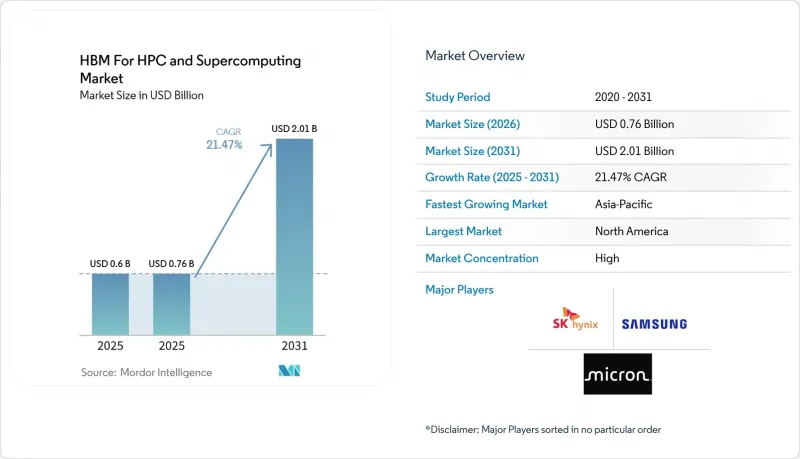
本報告按HBM代數(HBM3、HBM3E、HBM4等)、記憶體容量(最高8GB、8-16GB等)、處理器介面(基於GPU的高效能運算處理器、基於CPU的高效能運算處理器等)、應用領域(科學運算、天氣和氣候建模等)以及地區(北美、亞太等)進行細分。市場預測以美元(USD)計價。
全球高效能運算和超級運算中 HBM 的發展趨勢和見解
對人工智慧訓練和超級運算的需求正在加速成長
高效能運算 (HPC) 和超級運算領域的 HBM 市場正受益於生成式 AI 訓練和傳統模擬之間日益成長的重疊,因為這兩種工作負載現在都在爭奪相同的記憶體密集型運算叢集。 SK 海力士指出,目前的記憶體週期是由 HBM 需求驅動的,而這一成長動能與大規模採用 HBM3E 和 HBM4 的平台量產密切相關。 NVIDIA 目前正將 Vera Rubin 定位為不僅面向 AI,也面向科學計算,並計劃將 Rubin GPU 與 Vera CPU 結合使用,用於洛斯阿拉莫斯國家實驗室的「Mission」、「Vision」和「Veritas」等系統中的公共和機密工作負載。這將使 HPC 和超級運算市場的 HBM基本客群從商業雲端擴展到國家實驗室和國家級運算專案。對於供應商而言,這也將滿足由模型訓練規模化和 AI 模型在模擬工作流程中日益廣泛的應用所驅動的需求。
在下一代加速器中採用HBM3E和HBM4
高效能運算 (HPC) 和超級運算領域的 HBM 市場也受到從 HBM3 向 HBM3E 和 HBM4 過渡的推動,因為這項過渡將改變平台層面的頻寬和容量。三星宣布將於 2026 年 2 月開始量產 HBM4,其新一代 HBM 堆疊的單堆疊頻寬可達 11.7 Gbps,容量可達 3.3 TB/s,相比上一代產品效能顯著提升。 NVIDIA 表示,每顆 Vera Rubin R200 GPU 將配備 288 GB 的 HBM4,實現 22 TB/s 的記憶體頻寬,這意味著系統設計人員將直接採用新一代內存,而無法進行小規模升級。在高效能運算和超級運算領域的 HBM 市場,這意味著採購時間將越來越取決於處理器的可用性以及 HBM 的分配計劃。此外,與高效能 HBM 標準相關的出口限制正在縮小能夠使用尖端配置的認證終端用戶範圍,進一步限制了核准買家和供應管道。
HBM供不應求和認證週期長
高效能運算 (HPC) 和超級運算領域的 HBM 市場仍受到認證週期的限制,其週期遠長於標準 DRAM 的量產週期,尤其是在堆疊高度增加的情況下。三星為未來高堆疊設計申請的虛擬晶片結構專利表明,16 層設計的良率面臨嚴峻壓力,與 8 層設計相比,良率損失高達 40% 至 60%。美光預測,2026 會計年度的資本支出將超過 250 億美元,這表明在供應狀況顯著改善之前,需要進行巨額投資。在高效能運算和超級運算領域的 HBM 市場,如此長的周期會導致配置鎖定風險,因為根據特定記憶體藍圖訂購的系統在交貨前可能會面臨時間和規格的變更。
細分市場分析
到2025年,HBM3將佔高效能運算(HPC)和超級運算市場HBM總量的53.18%,這反映了2024年和2025年「Hopper」世代系統的採購量。雖然HBM2和HBM2E仍在傳統叢集中使用,但隨著營運商將重心放在提升旗艦系統的整體性能上,它們的應用範圍已逐漸縮小。 HBM3E正在成為HPC和超級運算市場HBM的過渡層,連結目前的引進週期和計畫中的HBM4過渡。 SK海力士也支持這一觀點,並指出HBM3E將在2026年繼續佔據HBM總出貨量的重要佔有率。
HBM4是成長最快的記憶體晶片,預計2026年至2031年的複合年成長率將達到22.29%,其成長與NVIDIA Vera Rubin和AMD Instinct MI455X的配置直接相關。據三星稱,其量產的HBM4採用第六代單通道DRAM晶片,速度可擴展至11.7 Gbps至13 Gbps。這表明該產品線在設計之初就考慮到了進一步提升速度。因此,高效能運算(HPC)和超級運算產業的HBM產品藍圖正在縮短,因為預計在2026年中期,HBM4E(16層48 GB配置)的樣品已經交付給客戶。在HPC和超級計算市場的HBM領域,這一縮短的藍圖加大了整合商的資本規劃壓力,因為每一代產品與認證階段之間的穩定期正在縮短。
到了2025年,16GB-32GB容量段在高效能運算(HPC)和超級運算市場中佔據48.63%的HBM市場。這是因為8層HBM3和HBM3E堆疊仍然是主流加速器平台的主流量產配置。隨著Blackwell Ultra及類似系統的量產持續擴大,預計在接下來的過渡期內,該容量段仍將是主要的出貨量。同時,隨著效能和單封裝總記憶體容量的提升,HPC和超級計算HBM市場正向更高密度的堆疊轉換。這意味著,即使買家的興趣轉向更高密度的產品,中等容量段在當前週期中的重要性預計仍將保持。
預計從2026年到2031年,頻寬超過32GB的市場將以22.21%的複合年成長率成長,這主要得益於NVIDIA Vera Rubin R200和AMD MI455X等設計,這些設計需要每個GPU配備更大的記憶體池。一項2025年的同行評審研究表明,3D堆疊HBM中的混合鍵合層數超過12層後,會承受更大的熱應力和機械應力。這解釋了為什麼高效能運算/超級運算HBM市場既面臨著強勁的需求,也面臨著巨大的製程風險。在高效能運算/超級運算HBM市場中,低容量層級的產品在功耗限制比絕對容量更重要的領域仍發揮著重要作用,例如邊緣高效能運算、FPGA部署和嵌入式模擬系統。此外,所有層級的產品都必須遵守標準,因為互通性決策必須符合正式的HBM介面規格和封裝規則。
區域分析
到2025年,北美將佔據高效能運算/超級運算HBM市場43.39%的佔有率,成為目前部署規模最大的區域中心。這種區域主導地位反映了國家實驗室、超大規模資料中心業者和先進運算採購專案在該地區的高度集中,這些機構已經採購了大規模記憶體密集架構。阿貢國家實驗室的「Aurora」系統和美國國家工程與航太中心(NERSC)計畫中的「Doudna」系統表明,北美高效能運算/超級運算HBM市場與採購週期長的大規模公共運算專案緊密相關。出口管制分類號(ECCN)3A090.c下的出口管制條例也影響該地區的高效能運算/超級運算HBM市場,因為最先進的配置與合規性和與盟友的合作密切相關。隨著美國國防高級研究計劃局(DARPA)和國家核安全管理局(NNSA)等機構繼續支持多年期計算項目,北美的需求前景比許多其他地區更為明朗。
儘管到2025年歐洲市場規模仍然較小,但隨著對EuroHPC的新投資,HBM在高效能運算(HPC)和超級運算市場中的作用日益增強。德國的「JUPITER」和法國的「Alice Recoque」計畫清楚地表明,HBM在歐洲的應用正在迅速擴展,尤其是在氣候研究、人工智慧訓練和量子運算模擬工作負載領域。由斯圖加特HLRS領導的「HammerHAI」專案以及NVIDIA與EuroHPC相關的廣泛計劃表明,歐洲HPC和超級計算領域的HBM市場正從選擇性採用轉向更廣泛的機構級部署。此外,該地區日益重視資料主權和認證要求,也為記憶體採購和系統設計增添了合規性的考量。
預計2026年至2031年,亞太地區將以22.34%的複合年成長率成長,成為高效能運算(HPC)和超級運算高密度記憶體(HBM)市場成長最快的地區。該地區既是主要的HBM生產中心,也是自主人工智慧(AI)和HPC專案需求不斷成長的中心,扮演著雙重角色。 2026年7月,三星和SK海力士宣佈在全部區域聯合投資240兆韓元(約1,688億美元)。其中,三星投資56兆韓元(約394億美元),SK海力士投資20兆韓元(約141億美元),顯示雙方在供應端對新增產能和封裝技術的重大投入。此外,日本也向美光廣島工廠擴建計畫提供了5,000億日圓(約33億美元)的資金支持。該設施的投資額為93億美元,目標是在2028年左右開始向UPI工廠交付高密度金屬板(HBM)。雖然中國目前在高密度金屬板消費領域仍佔小規模,但如果技術差距縮小,且規避出口限制的鬥爭持續下去,未來三到四年內,中國國內的高密度金屬板研發努力可能會成為一個更重要的因素。
其他好處:
- Excel格式的市場預測(ME)表
- 3個月的分析師支持
目錄
第1章:引言
- 研究假設和市場定義
- 調查範圍
第2章:調查方法
第3章執行摘要
第4章 市場狀況
- 市場概覽
- 市場促進因素
- 對人工智慧訓練和超級運算的需求正在加速成長
- 在下一代加速器中採用HBM3E和HBM4
- 高效能運算叢集中依賴記憶體的工作負載
- 百萬兆級系統中的協同封裝記憶體架構
- 由於出口限制,先進記憶體供應鏈本地化進程加快
- 透過TSV自動化和先進封裝技術提高產量。
- 市場限制因素
- HBM供不應求和認證週期長
- 過度依賴少數幾家實力雄厚的記憶體供應商
- 高密度堆疊中的熱密度和功率匹配約束
- 高成本記憶體架構與其他記憶體架構的比較
- 產業供應鏈分析
- 宏觀經濟因素對市場的影響
- 監理情勢
- 技術展望
- 波特五力分析
第5章 市場規模與成長預測
- 按世代分類的 HBM
- HBM2 和 HBM2E
- HBM3
- HBM3E
- HBM4
- 每個堆疊的記憶體容量
- 8 GB 或更少
- 8 GB~16 GB
- 16 GB~32 GB
- 32 GB 或更多
- 透過處理器介面
- 基於GPU的高效能運算處理器
- 基於CPU的高效能運算處理器
- AI加速器和客製化ASIC
- 基於FPGA的加速器
- 透過使用
- 科學計算
- 天氣和氣候建模
- 國防和國家安全領域的計算
- 工程模擬與數位孿生
- 人工智慧賦能的高效能運算工作負載
- 按地區
- 北美洲
- 美國
- 加拿大
- 墨西哥
- 歐洲
- 德國
- 英國
- 法國
- 義大利
- 其他歐洲國家
- 亞太地區
- 中國
- 日本
- 韓國
- 台灣
- 印度
- 其他亞太國家
- 南美洲
- 中東和非洲
- 北美洲
第6章 競爭情勢
- 市場集中度
- 策略趨勢
- 市佔率分析
- 公司簡介
- SK hynix Inc.
- Samsung Electronics Co., Ltd.
- Micron Technology, Inc.
- 其他生態系公司
- NVIDIA Corporation
- Advanced Micro Devices, Inc.
- Intel Corporation
- Fujitsu Limited
- IBM Corporation
- Broadcom Inc.
- Marvell Technology, Inc.
- Qualcomm Incorporated
- Rambus Inc.
- Kioxia Corporation
- ASML Holding NV
- Lam Research Corporation
- Applied Materials, Inc.
- Tokyo Electron Limited
- ASE Technology Holding Co., Ltd.
- TSMC
- Amkor Technology, Inc.
第7章 市場機會與未來展望
According to Mordor Intelligence, the HBM for HPC and supercomputing market size is expected to increase from USD 0.60 billion in 2025 to USD 0.76 billion in 2026 and reach USD 2.01 billion by 2031, growing at a CAGR of 21.47% over 2026-2031.
This report is Segmented by HBM Generation (HBM3, HBM3E, and HBM4, and More), Memory Capacity (Up To 8 GB, 8-16 GB, and More), Processor Interface (GPU-Based HPC Processors, CPU-Based HPC Processors, and More), Application (Scientific Computing, Weather and Climate Modeling, and More), and Geography (North America, Asia-Pacific, and More). The Market Forecasts are Provided in Terms of Value (USD).
Global HBM For HPC and Supercomputing Market Trends and Insights
Accelerating AI Training And Supercomputing Demand
The HBM for HPC and supercomputing market is benefiting from the growing overlap between generative AI training and classical simulation, as both workloads now compete for the same memory-intensive compute clusters. SK hynix says the current memory cycle is being led by HBM demand, tying that momentum to the production ramp of platforms that use HBM3E and HBM4 at scale. NVIDIA now positions Vera Rubin for scientific computing as well as AI, with Los Alamos systems such as Mission, Vision, and Veritas set to combine Rubin GPUs with Vera CPUs for open and classified workloads. This broadens the HBM's buyer base in the HPC and supercomputing market beyond commercial cloud into national laboratory and sovereign compute programs. It also means suppliers are serving a demand pool supported by both model training scale and the growing use of AI models in simulation workflows.
HBM3E And HBM4 Adoption In Next-Gen Accelerators
The HBM for HPC and supercomputing market is also being driven by the move from HBM3 to HBM3E and HBM4, as the shift changes both bandwidth and capacity at the platform level. Samsung began HBM4 mass production in February 2026 and said its new stack reaches 11.7 Gbps and 3.3 TB/s per stack, marking a clear performance step over prior generations. NVIDIA says each Vera Rubin R200 GPU features 288 GB of HBM4 and delivers 22 TB/s of memory bandwidth, locking system designers into a new memory generation rather than a minor upgrade path. In the HBM market for HPC and supercomputing, this means procurement timing is increasingly tied to HBM allocation schedules rather than just processor availability. Export rules tied to advanced HBM performance thresholds also narrow the qualified end-user base for the most advanced configurations, reinforcing concentration among approved buyers and supply routes.
Limited HBM Supply And Long Qualification Cycles
The HBM for HPC and supercomputing market remains constrained by qualification cycles that are much longer than standard DRAM ramps, especially as stack heights rise. Samsung's own patent work on dummy die structures for future high-stack designs indicates severe yield pressure in 16-layer designs, with reported losses of 40%-60% compared to 8-layer designs. Micron says fiscal 2026 capital expenditure is expected to exceed USD 25 billion, indicating how much spending remains before supply relief becomes meaningful. For the HBM market in HPC and supercomputing, these long cycles translate into configuration lock-in risk, as systems ordered under one memory roadmap may face timing or specification changes before delivery.
Other drivers and restraints analyzed in the detailed report include:
- Memory-Bound Workloads In HPC Clusters
- Co-Packaged Memory Architectures In Exascale Systems
- Extreme Dependence On A Few Qualified Memory Suppliers
For complete list of drivers and restraints, kindly check the Table Of Contents.
Segment Analysis
HBM3 held 53.18% of the HBM for the HPC and supercomputing market in 2025, reflecting the installed base of Hopper-era systems purchased through 2024 and 2025. HBM2 and HBM2E remained present in legacy clusters, but their roles continued to shrink as operators began upgrading capabilities across flagship systems. HBM3E emerged as the transition layer for HBM in the HPC and supercomputing markets, bridging current deployment cycles with the upcoming move to HBM4. SK hynix says HBM3E will continue to account for a large share of total HBM shipments through 2026, which supports that transition view.
HBM4 is the fastest-growing generation with a 22.29% CAGR from 2026 to 2031, and that rise is tied directly to NVIDIA Vera Rubin and AMD Instinct MI455X configurations. Samsung says its HBM4 mass production uses a 6th-generation 1c DRAM die and can scale from 11.7 Gbps to 13 Gbps, indicating the product line is already being designed for a further speed step. The HBM for HPC and supercomputing industry is therefore moving through a compressed roadmap, because HBM4E samples aimed at 16-layer and 48 GB configurations had already entered customer sampling by mid-2026. In the HBM for HPC and supercomputing market, that compression raises capital planning pressure on integrators, because each generation now has a shorter stable window before the next one enters qualification.
The 16 GB to 32 GB tier accounted for 48.63% of the HBM market share in the HPC and supercomputing market in 2025, as 8-high HBM3 and HBM3E stacks remained the main volume configuration across leading accelerator platforms. That tier should remain the primary shipment base in the near-term transition, as Blackwell Ultra and comparable systems are still ramping in volume. At the same time, the HBM for the HPC and supercomputing market is shifting toward denser stacks as both performance and total memory per package rise. This keeps the middle tier important in the current cycle, even as buyer attention shifts toward higher densities.
The Above 32 GB band is set to grow at a 22.21% CAGR from 2026 to 2031, driven by designs such as NVIDIA Vera Rubin R200 and AMD MI455X that require much larger per-GPU memory pools. A 2025 peer-reviewed study found that hybrid bonding in 3D-stacked HBM creates increasing thermal and mechanical stress at 12+ layers, which explains why this part of the HBM for the HPC and supercomputing market faces both strong demand and significant process risk. Lower-capacity tiers still matter in the HBM for HPC and supercomputing markets, including edge HPC, FPGA deployments, and embedded simulation systems, where power limits matter more than absolute capacity. Standards compliance also remains important across all tiers, as interoperability decisions must still align with formal HBM interface specifications and packaging rules.
Complete Report Scope:
- By HBM Generation
- HBM2 and HBM2E
- HBM3
- HBM3E
- HBM4
- By Memory Capacity Per Stack
- Up to 8 GB
- 8 GB to 16 GB
- 16 GB to 32 GB
- Above 32 GB
- By Processor Interface
- GPU-based HPC Processors
- CPU-based HPC Processors
- AI Accelerators and Custom ASICs
- FPGA-based Accelerators
- By Application
- Scientific Computing
- Weather and Climate Modeling
- Defense and National Security Computing
- Engineering Simulation and Digital Twins
- AI-enabled HPC Workloads
- By Geography
- North America
- United States
- Canada
- Mexico
- Europe
- Germany
- United Kingdom
- France
- Italy
- Rest of Europe
- Asia-Pacific
- China
- Japan
- South Korea
- Taiwan
- India
- Rest of Asia-Pacific
- South America
- Middle East and Africa
- North America
Geography Analysis
North America held 43.39% of the HBM market share for the HPC and supercomputing market in 2025, making it the largest regional base for current deployments. The region's lead reflects the concentration of national laboratories, hyperscalers, and advanced computing procurement programs that already buy memory-rich architectures at scale. Aurora at Argonne and the planned Doudna system at NERSC show how the HBM for the HPC and supercomputing market in North America is tied to very large public computing programs with long buying cycles. Export control rules under ECCN 3A090.c also shape the HBM for the HPC and supercomputing markets in this region, because the most advanced configurations are closely tied to compliance and allied-country access. Demand visibility is therefore stronger in North America than in many other regions, since agencies such as DARPA and NNSA continue to support multiyear compute programs.
Europe remained smaller in 2025, but its role in the HBM for HPC and supercomputing market is rising with new EuroHPC spending. JUPITER in Germany and Alice Recoque in France reflect a clear scale-up in European HBM use, especially for climate research, AI training, and quantum-oriented simulation workloads. HLRS Stuttgart's HammerHAI and NVIDIA's broader EuroHPC-linked plans show that the HBM for HPC and supercomputing market in Europe is moving from selective adoption to wider institutional rollout. Data sovereignty and certification requirements also matter more here, which adds a compliance layer to memory sourcing and system design.
Asia-Pacific is projected to grow at a 22.34% CAGR from 2026 to 2031, which makes it the fastest-growing regional part of the HBM for HPC and supercomputing market. The region has a dual role, because it is both the main production base for HBM and a growing demand center for sovereign AI and HPC programs. Samsung and SK hynix announced combined regional investment of KRW 240 trillion (USD 168.8 billion) in July 2026, including Samsung's KRW 56 trillion (USD 39.4 billion) and SK hynix's KRW 20 trillion (USD 14.1 billion), which shows how much new capacity and packaging depth are being directed into the supply side. Japan also backed Micron's Hiroshima expansion with JPY 500 billion (USD 3.3 billion) in support, while the facility investment itself was stated at USD 9.3 billion and is aimed at future HBM shipments around 2028 UPI. China remains smaller by current HBM consumption, but domestic HBM efforts could become a stronger variable over the next 3-4 years if technology gaps narrow and export control workarounds remain contested.
- SK hynix Inc.
- Samsung Electronics Co., Ltd.
- Micron Technology, Inc.
Additional Benefits:
- The market estimate (ME) sheet in Excel format
- 3 months of analyst support
TABLE OF CONTENTS
1 INTRODUCTION
- 1.1 Study Assumptions and Market Definition
- 1.2 Scope of the Study
2 RESEARCH METHODOLOGY
3 EXECUTIVE SUMMARY
4 MARKET LANDSCAPE
- 4.1 Market Overview
- 4.2 Market Drivers
- 4.2.1 Accelerating AI Training and Supercomputing Demand
- 4.2.2 HBM3E and HBM4 Adoption in Next-Gen Accelerators
- 4.2.3 Memory-Bound Workloads in HPC Clusters
- 4.2.4 Co-Packaged Memory Architectures in Exascale Systems
- 4.2.5 Export-Control-Driven Localization of Advanced Memory Supply Chains
- 4.2.6 Yield Improvement Through TSV and Advanced Packaging Automation
- 4.3 Market Restraints
- 4.3.1 Limited HBM Supply and Long Qualification Cycles
- 4.3.2 Extreme Dependence on A Few Qualified Memory Suppliers
- 4.3.3 Thermal Density and Power Integrity Constraints in Dense Stacks
- 4.3.4 High Cost Per Bit Versus Alternative Memory Architectures
- 4.4 Industry Supply Chain Analysis
- 4.5 Impact of Macroeconomic Factors on the Market
- 4.6 Regulatory Landscape
- 4.7 Technological Outlook
- 4.8 Porter's Five Forces Analysis
- 4.8.1 Bargaining Power of Suppliers
- 4.8.2 Bargaining Power of Buyers
- 4.8.3 Threat of New Entrants
- 4.8.4 Threat of Substitutes
- 4.8.5 Intensity of Competitive Rivalry
5 MARKET SIZE AND GROWTH FORECASTS (VALUE)
- 5.1 By HBM Generation
- 5.1.1 HBM2 and HBM2E
- 5.1.2 HBM3
- 5.1.3 HBM3E
- 5.1.4 HBM4
- 5.2 By Memory Capacity Per Stack
- 5.2.1 Up to 8 GB
- 5.2.2 8 GB to 16 GB
- 5.2.3 16 GB to 32 GB
- 5.2.4 Above 32 GB
- 5.3 By Processor Interface
- 5.3.1 GPU-based HPC Processors
- 5.3.2 CPU-based HPC Processors
- 5.3.3 AI Accelerators and Custom ASICs
- 5.3.4 FPGA-based Accelerators
- 5.4 By Application
- 5.4.1 Scientific Computing
- 5.4.2 Weather and Climate Modeling
- 5.4.3 Defense and National Security Computing
- 5.4.4 Engineering Simulation and Digital Twins
- 5.4.5 AI-enabled HPC Workloads
- 5.5 By Geography
- 5.5.1 North America
- 5.5.1.1 United States
- 5.5.1.2 Canada
- 5.5.1.3 Mexico
- 5.5.2 Europe
- 5.5.2.1 Germany
- 5.5.2.2 United Kingdom
- 5.5.2.3 France
- 5.5.2.4 Italy
- 5.5.2.5 Rest of Europe
- 5.5.3 Asia-Pacific
- 5.5.3.1 China
- 5.5.3.2 Japan
- 5.5.3.3 South Korea
- 5.5.3.4 Taiwan
- 5.5.3.5 India
- 5.5.3.6 Rest of Asia-Pacific
- 5.5.4 South America
- 5.5.5 Middle East and Africa
- 5.5.1 North America
6 COMPETITIVE LANDSCAPE
- 6.1 Market Concentration
- 6.2 Strategic Moves
- 6.3 Market Share Analysis
- 6.4 Company Profiles (includes Global Level Overview, Market Level Overview, Core Segments, Financials as available, Strategic Information, Products and Services, Recent Developments)
- 6.4.1 SK hynix Inc.
- 6.4.2 Samsung Electronics Co., Ltd.
- 6.4.3 Micron Technology, Inc.
- 6.5 Other Ecosystem Players
- 6.5.1 NVIDIA Corporation
- 6.5.2 Advanced Micro Devices, Inc.
- 6.5.3 Intel Corporation
- 6.5.4 Fujitsu Limited
- 6.5.5 IBM Corporation
- 6.5.6 Broadcom Inc.
- 6.5.7 Marvell Technology, Inc.
- 6.5.8 Qualcomm Incorporated
- 6.5.9 Rambus Inc.
- 6.5.10 Kioxia Corporation
- 6.5.11 ASML Holding N.V.
- 6.5.12 Lam Research Corporation
- 6.5.13 Applied Materials, Inc.
- 6.5.14 Tokyo Electron Limited
- 6.5.15 ASE Technology Holding Co., Ltd.
- 6.5.16 TSMC
- 6.5.17 Amkor Technology, Inc.
7 MARKET OPPORTUNITIES AND FUTURE OUTLOOK
- 7.1 White-Space and Unmet-Need Assessment

 2026年人工智慧高頻寬記憶體全球市場報告
 用於人工智慧(AI)半導體的高頻寬記憶體(HBM)和先進封裝材料:2027-2037 年
 混合儲存立方體:市場佔有率分析、行業趨勢和統計數據、成長預測(2026-2031 年)HBM 8層堆疊與12層堆疊:市場佔有率分析、產業趨勢與統計、成長預測(2026-2031年)HBM CoWoS 包裝產能及供需:市佔率分析、產業趨勢與統計及成長預測(2026-2031 年)中國HBM市場:市場佔有率分析、產業趨勢與統計、成長預測(2026-2031年)記憶纖維:市場佔有率分析、產業趨勢與統計、成長預測(2026-2031)
 高頻寬記憶體 (HBM) 市場預測至 2034 年—按產品類型、儲存容量、封裝技術、頻寬、應用、最終用戶和地區分類的全球分析下一代人腦記憶體:市場佔有率分析、行業趨勢和統計數據、成長預測(2026-2031 年)日本HBM市場:市場佔有率分析、產業趨勢與統計、成長預測(2026-2031年)