


 |
市場調查報告書
商品編碼
2099489
下一代人腦記憶體:市場佔有率分析、行業趨勢和統計數據、成長預測(2026-2031 年)Next-Generation HBM - Market Share Analysis, Industry Trends & Statistics, Growth Forecasts (2026 - 2031) |
||||||

※ 本網頁內容可能與最新版本有所差異。詳細情況請與我們聯繫。
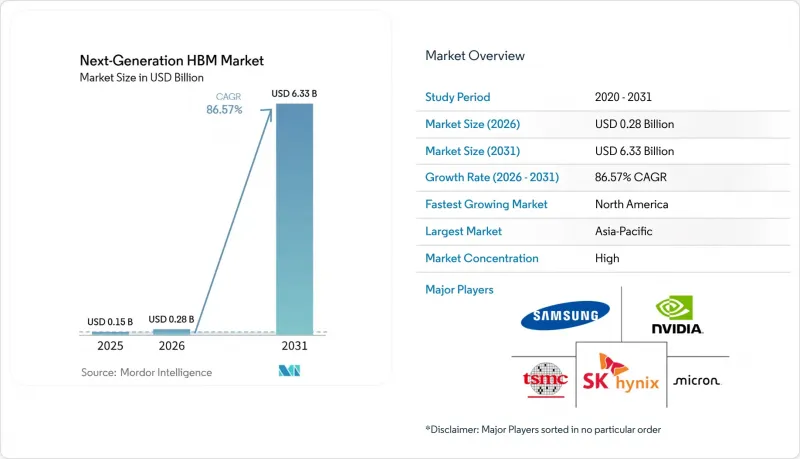
據 Mordor Intelligence 稱,下一代 HBM 的市場規模在 2025 年價值 1.5 億美元,預計從 2026 年到 2031 年將以 86.57% 的複合年成長率成長,到 2031 年達到 63.3 億美元。
本報告按技術(HBM2、HBM2E、HBM3、HBM3E、HBM4)、單棧記憶體容量(4 GB、8 GB、16 GB、24 GB、32 GB 及以上)、處理器介面(GPU、CPU、AI 加速器和 ASIC、FPGA 等)、應用程式(AI 和服務供應商等產業市場預測以美元計價。
全球下一代人腦血分子市場趨勢與洞察
AI伺服器的激增和搭載率。
目前,所有主流AI平台都在增加每個處理器上的HBM記憶體容量,與上一代相比,這表明下一代HBM市場的成長速度超過了加速器單元本身的需求。 NVIDIA透露,其Vera Rubin NVL72平台在72個GPU上使用了20.7 TB的HBM4內存,內存頻寬高達1580 TB/s,充分展現了系統級內存密集度的快速成長。 SK海力士也報告稱,其2025會計年度的HBM業務年增超過一倍,證實AI伺服器的部署已經顯著推動了超高容量記憶體的銷售成長。因此,下一代HBM市場的發展動力來自新伺服器的部署以及每個機架記憶體配置的日益複雜化。向機架級AI系統的轉變進一步強化了這一趨勢,在機架級AI系統中,平台的經濟價值不僅取決於運算密度,還取決於持續的記憶體吞吐量。因此,能夠快速批量生產認證產品的供應商比那些產品僅僅「紙上談兵」的供應商具有顯著優勢。
在下一代人工智慧加速器中採用HBM4
HBM4 正在推動下一代 HBM 市場的發展,它不僅顯著提升了頻寬,還透過架構上的改進,實現了對未來 AI 平台更精細的最佳化。美光科技宣布,其 36GB 12 層 HBM4 產品頻寬超過 2.8TB/s,能源效率比 HBM3E 提升 20% 以上,並已於 2026 年初開始量產。三星也於 2026 年 2 月開始量產 HBM4,隨後宣布其 HBM4 累計銷售額在 130 天內達到 10 億美元。這標誌著新一代記憶體的商業化進程異常迅速。向 HBM4 的過渡也提高了技術要求。由於每個晶片的 I/O 數量比上一代加倍,堆疊良率、與基礎晶片的整合以及封裝級檢驗都變得更加困難。實際上,這種複雜性限制了新廠商的進入,而下一代 HBM 市場的格局正由那些同時具備 DRAM 製程和封裝技術優勢的供應商所主導。此外,這提高了客製化 HBM 計畫的價值,並正在成為推出頂級 AI 加速器的直接差異化因素。
由於CoWoS和SoIC技術的限制,先進封裝的產能受到限制。
下一代HBM市場最大的短期限制仍然是先進封裝的供應狀況。經過認證的記憶體堆疊需要確保有限的整合插槽才能作為加速器產品出貨。台積電指出,向更先進封裝(例如CoPoS)的過渡受到玻璃中介層均勻性和翹曲控制等技術挑戰的阻礙,這延長了現有封裝流程的壓力。這意味著,即使HBM的良率良好,出貨也可能因整合階段的第二個瓶頸而受阻,尤其是對於本身就對製程控制要求嚴格的高堆疊產品而言。當客戶需要最新配置時,此限制因素會更加嚴峻,因為HBM4和HBM4E產品對溫度控管、凸塊完整性和封裝檢驗提出了更高的要求。供應商正在透過增加後端投資來應對,但在下一代HBM市場中,已公佈的封裝能力與可靠的、經過認證的吞吐量之間仍然存在時間差。這種時間差導致配額緊張,維持了高價,並限制了供應速度跟上主要AI平台的需求趨勢。
細分市場分析
儘管預計到 2025 年 HBM3E 將佔據該技術領域 51.84% 的佔有率,但 HBM4 預計將以 87.58% 的複合年成長率 (CAGR) 成長至 2031 年。 HBM3E 已在目前的 AI 基礎設施中廣泛應用,並擁有良好的部署記錄,在下一代 HBM 市場中仍然至關重要,因為它可以為客戶提供經過認證的過渡解決方案,直到 HBM4 實現大規模量產。 NVIDIA 目前及短期平台發布速度的加快,也使得 HBM3E 的重要性得以延續,因為超大規模資料中心業者在部署現有加速器系統的同時,也為向下一代記憶體的過渡做好準備。然而,HBM4 正在改變這一領域的格局,它提供了更高的頻寬、更大的客製化設計柔軟性,以及與即將推出的機架式 AI 系統更強大的整合能力。據美光科技稱,其 36 GB 12 層 HBM4 產品的吞吐量超過 2.8 TB/s,並且比 HBM3E 的能源效率提高了 20% 以上。這就解釋了為什麼客戶們都在爭相認證他們的新節點。
下一代HBM市場也表明,技術領先地位不再僅僅取決於DRAM的密度和速度,因為基片設計以及與代工廠的合作變得比以往的內存週期更為關鍵。三星表示,其HBM4採用4nm基片,隨後出貨了HBM4E 12層樣品,實現了高達16Gbps的單引腳速度和3.6TB/s的頻寬,這表明技術競爭正在迅速加劇。 SK海力士於2026年6月發布了HBM4E樣品,將客製化HBM定位為策略重點。這表明,下一代HBM市場正在從單純的標準組件競爭轉向客戶客製化的最佳化。 HBM2、HBM2E和HBM3等老一代產品在網路和傳統高效能運算(HPC)應用中仍有需求,因為在這些應用中,成本和認證記錄比絕對頻寬更為重要。然而,這種轉型路徑使得新進入者更難進入市場。這是因為現在要求供應商同時展現出在記憶體製程技術、先進封裝和與基礎晶片整合方面的強大能力。
到2025年,24GB容量的記憶體將佔據市場主導地位,市佔率高達47.12%,而32GB及以上容量的記憶體預計將在2031年之前以87.51%的複合年成長率成長。 24GB容量是下一代HBM市場部署基礎的核心。這是因為它與許多當前AI系統使用的配置相匹配,為客戶提供了效能、良率和可部署容量之間的平衡。由於現有的伺服器基礎設施和採購週期仍然支撐著對該容量範圍內經認證的HBM3E堆疊的強勁需求,因此這項部署基礎不太可能很快消失。然而,成長的重點已經轉向更高容量,因為新的AI系統需要比以往平台更高的每個加速器記憶體和每個訓練集群頻寬。美光宣布,已於2026年第一季向多家客戶交付了48GB 16層HBM4樣品,這表明其產品藍圖正在迅速超越當前的主流容量範圍。
這項轉變意義重大,因為下一代高容量堆疊式HBM市場正隨著每一代平台的更新而不斷擴大,而人工智慧相關記憶體的最低要求也在穩步提高。隨著堆疊高度的增加,技術難度也隨之增加,因為晶片減薄、對準和熱控制變得更加複雜。即使晶圓供應狀況看似有利,這也可能導致實際成品產量下降。 IEEE 的相關封裝分析和來源文件草案指出,隨著單一封裝層數的增加,穿透矽通孔(TSV) 的複雜性以及高堆疊組裝中的損耗也變得更加嚴重。 4GB、8GB 和 16GB 等低容量規格仍然在網路設備、邊緣推理硬體和傳統運算節點中發揮重要作用,在這些應用中,每美元頻寬仍然是重要的購買因素。儘管如此,下一代HBM市場的長期發展方向是明確的:高容量規格正從孤立的高階選項轉變為商業性的大規模生產產品。
區域分析
2025年,亞太地區佔了下一代HBM市場71.04%的佔有率。該地區的主導地位主要得益於韓國SK海力士和三星電子在商用HBM生產方面的集中優勢,而台灣地區仍然是先進封裝和整合的中心。 SK海力士公佈的2025年銷售額為97.1467兆韓元(約702億美元),該數據採用2025年IRS平均年外匯(數據來源草案中引用),並指出HBM銷售額同比成長超過一倍。 2026年6月,韓國宣布了一項國家投資計劃,其中包括為四家新的記憶體工廠、一個HBM封裝中心和一個人工智慧資料中心提供大規模資金,進一步鞏固了其市場地位。韓國的《人工智慧基礎法》於2026年1月22日生效,該法案為支持國內人工智慧基礎設施建設提供了政策框架,並提升了韓國作為長期記憶體投資目的地的吸引力。
預計到2031年,北美將以87.38%的複合年成長率成長,成為下一代HBM市場成長最快的區域板塊。由於最大的超大規模資料中心業者和加速器買家都位於美國,需求集中於此,這有助於企業保持與主要人工智慧平台所有者密切相關的採購優勢。作為唯一總部位於美國的HBM製造商,美光科技已根據《晶片法案》(CHIPS Act)獲得高達64億美元的津貼,用於在愛達荷州和紐約州建設DRAM晶圓廠,並正在加強其在美國本土的HBM產能。 SK海力士也在印第安納州建造一座先進封裝工廠,進一步深化其在北美的業務佈局,而不僅限於需求集中的地區。歐洲仍然是次要的需求區域,其成長主要受德國汽車運算需求以及英國等市場對硬體政策的廣泛關注所驅動。
南美洲和中東及非洲地區在下一代HBM市場仍處於早期階段,但這兩個地區的重要性正因人工智慧基礎設施的建置而非本地記憶體生產而日益凸顯。南美洲的主要驅動力是雲端運算和企業資料中心的擴張,隨著該地區人工智慧工作負載的成長,對進口加速器的需求也在上升。中東和非洲則受益於國家主導的人工智慧戰略和大規模資料中心建設規劃,尤其是在政府大力支持運算能力大規模擴張的地區。由於這兩個地區在2026年至2031年間都不太可能建立自己的HBM生產體系,因此它們的需求前景將繼續受到全球供應分配、出口限制以及主要生產商價格紀律的密切影響。
其他好處:
- Excel格式的市場預測(ME)表
- 3個月的分析師支持
目錄
第1章:引言
- 研究假設和市場定義
- 調查範圍
第2章:調查方法
第3章執行摘要
第4章 市場狀況
- 市場概覽
- 市場促進因素
- AI伺服器的激增和搭載率。
- 在下一代人工智慧加速器中採用HBM4
- 擴大先進包裝的生產能力
- 主權人工智慧和在地記憶定位的獎勵
- 邊緣人工智慧推理在汽車高階駕駛輔助系統的應用
- 光電賦能的HBM藍圖
- 市場限制因素
- CoWoS和SoIC先進封裝生產能力不足
- 高層設計中TSV的良率降低
- 對先進人工智慧加速器和人腦模型相關供應鏈的出口限制
- 超寬頻裝置的熱密度極限
- 產業價值鏈分析
- 宏觀經濟因素對市場的影響
- 監理情勢
- 技術展望
- 波特五力分析
第5章 市場規模與成長預測
- 透過技術
- HBM2
- HBM2E
- HBM3
- HBM3E
- HBM4
- 每個堆疊的記憶體容量
- 4 GB
- 8 GB
- 16 GB
- 24 GB
- 32 GB 或更多
- 透過處理器介面
- GPU
- CPU
- AI加速器和ASIC
- FPGA
- 其他處理器介面
- 透過使用
- 人工智慧和資料中心伺服器
- 網路
- 高效能運算
- 家用電子產品
- 汽車和運輸業
- 其他用途
- 按最終用途行業分類
- 雲端服務供應商
- 企業資料中心
- 通訊業者
- 汽車原廠設備製造商
- 其他終端用戶產業
- 按地區
- 北美洲
- 美國
- 加拿大
- 墨西哥
- 歐洲
- 德國
- 英國
- 法國
- 義大利
- 其他歐洲國家
- 亞太地區
- 中國
- 日本
- 韓國
- 台灣
- 印度
- 其他亞太國家
- 南美洲
- 中東和非洲
- 北美洲
第6章 競爭情勢
- 市場集中度
- 策略趨勢
- 市佔率分析
- 公司簡介
- SK Hynix Inc.
- Samsung Electronics Co., Ltd.
- Micron Technology, Inc.
- NVIDIA Corporation
- Taiwan Semiconductor Manufacturing Company Limited
- Advanced Micro Devices, Inc.
- Intel Corporation
- Broadcom Inc.
- Marvell Technology, Inc.
- Applied Materials, Inc.
- ASML Holding NV
- TSMC
- Amkor Technology, Inc.
- ASE Technology Holding Co., Ltd.
- Powertech Technology Inc.
- United Microelectronics Corporation
- Cadence Design Systems, Inc.
- Synopsys, Inc.
- Rambus Inc.
- JCET Group Co., Ltd.
第7章 市場機會與未來展望
According to Mordor Intelligence, the next-generation HBM market size was valued at USD 0.15 billion in 2025 and is projected to reach USD 6.33 billion by 2031, at a CAGR of 86.57% during 2026-2031.
This report is Segmented by Technology (HBM2, HBM2E, HBM3, HBM3E, and HBM4), Memory Capacity Per Stack (4 GB, 8 GB, 16 GB, 24 GB, and 32 GB and Above), Processor Interface (GPU, CPU, AI Accelerator and ASIC, FPGA, and More), Application (AI and Data Center Servers, and More), End Use Industry (Cloud Service Providers, and More), and Geography. The Market Forecasts are Provided in Terms of Value (USD).
Global Next-Generation HBM Market Trends and Insights
AI Server Proliferation and GPU Attach Rates
Every major AI platform now carries a larger HBM load per processor than the previous one, indicating the next-generation HBM market is growing faster than accelerator unit demand alone. NVIDIA disclosed that Vera Rubin NVL72 uses 20.7 TB of HBM4 and 1,580 TB/s of memory bandwidth across 72 GPUs, demonstrating how quickly system-level memory intensity is rising. SK Hynix also reported that its HBM business more than doubled year over year in FY2025, confirming that AI server deployments are already translating into significant expansion in very large memory revenue. The next-generation HBM market is therefore being pulled forward by both new server installations and richer memory configurations within each installed rack. That pattern is reinforced by the move toward rack-scale AI systems, where the economic value of the platform depends on sustained memory throughput rather than raw compute density alone. As a result, suppliers that can ramp qualified volume quickly are in a stronger position than those that simply have product availability on paper.
HBM4 Adoption In Next-Generation AI Accelerators
HBM4 is driving the next-generation HBM market by combining a significant increase in bandwidth with architectural changes that enable tighter optimization for upcoming AI platforms. Micron stated that its HBM4 36 GB 12-high product delivered more than 2.8 TB/s of bandwidth and over 20% better power efficiency than HBM3E, while entering high-volume production in early 2026. Samsung also began mass production shipments of HBM4 in February 2026 and later said cumulative HBM4 sales reached USD 1 billion within 130 days, pointing to an unusually fast commercial ramp for a new memory generation. The move to HBM4 also raises technical demands, as the I/O count per die doubles compared with earlier generations, making stack yield, base-die integration, and package-level validation more difficult. In practice, that complexity limits broad participation and keeps the next-generation HBM market centered on suppliers that can pair DRAM process strength with packaging discipline. It also raises the value of custom HBM programs, which are becoming a direct differentiator in top-tier AI accelerator launches.
Limited CoWoS and SoIC Advanced-Packaging Capacity
The largest near-term restraint on the next-generation HBM market remains the availability of advanced packaging, as qualified memory stacks still need scarce integration slots before they can ship in accelerator products. TSMC has indicated that more advanced packaging transitions, such as CoPoS, have been delayed by engineering challenges tied to glass interposer uniformity and warpage control, which keeps pressure on current packaging flows for longer. This means even well-yielding HBM output can be held back by a second bottleneck at the integration stage, especially for high-stack products that already require tighter process control. The restraint is more severe when customers need the newest configurations, because HBM4 and HBM4E products place additional demands on thermal handling, bump integrity, and package validation. Suppliers are responding with higher backend investment, but the next-generation HBM market still faces a lag between announced packaging capacity and dependable, qualified throughput. That lag keeps allocation tight, supports premium pricing, and limits how quickly supply can match the demand profile of leading AI platforms.
Other drivers and restraints analyzed in the detailed report include:
- Advanced Packaging Capacity Expansion
- Sovereign AI and Local Memory Localization Incentives
- Export Controls on Advanced AI Accelerators And HBM-Linked Supply Chains
For complete list of drivers and restraints, kindly check the Table Of Contents.
Segment Analysis
HBM3E held 51.84% of the technology segment in 2025, while HBM4 is projected to expand at 87.58% CAGR through 2031. HBM3E remains important in the next-generation HBM market because it already supports meaningful deployment across current AI infrastructure and gives customers a qualified bridge while HBM4 volume ramps. NVIDIA's current and near-term platform cadence has helped keep HBM3E relevant, since hyperscalers continue to deploy existing accelerator systems even as they prepare for the next memory generation. HBM4, however, is changing the pace of this category by offering much higher bandwidth, greater flexibility for customized designs, and stronger alignment with upcoming rack-scale AI systems. Micron said its HBM4 36 GB 12-high product exceeded 2.8 TB/s and improved power efficiency by more than 20% compared with HBM3E, which explains why customers are moving quickly to qualify the new node.
The next-generation HBM market also shows that technology leadership is no longer defined only by DRAM density or speed, because base-die design and foundry coordination now matter much more than they did in earlier memory cycles. Samsung stated that its HBM4 uses a 4-nm base die and later shipped HBM4E 12-high samples with up to 16 Gbps per pin and 3.6 TB/s bandwidth, showing how quickly the technology ladder is tightening. SK Hynix followed with HBM4E samples in June 2026 and highlighted custom HBM as a strategic priority, which signals that the next-generation HBM market is moving toward customer-specific optimization rather than simple standard part competition. Older generations such as HBM2, HBM2E, and HBM3 still have room in networking and legacy HPC uses, where cost and qualification history can matter more than absolute bandwidth. Even so, the transition path makes entry harder for new participants, because suppliers now need credible strength in memory process technology, advanced packaging, and base-die coordination at the same time.
The 24 GB tier led with 47.12% share in 2025, while 32 GB and above is projected to grow at 87.51% CAGR through 2031. The 24 GB tier sits at the center of the installed base in the next-generation HBM market because it matches the configuration used in many current AI systems and gives customers a known balance between performance, yield, and deployable volume. That installed base will not disappear quickly, as existing server fleets and procurement cycles continue to support strong demand for qualified HBM3E stacks in this capacity range. The growth center has already moved higher, however, because newer AI systems need more memory per accelerator and more bandwidth per training cluster than earlier platforms required. Micron said it shipped HBM4 48 GB 16-high samples to multiple customers in Q1 2026, indicating how quickly the product roadmap is moving beyond the current mainstream tier.
This shift matters because the next-generation HBM market for higher-capacity stacks is growing with each platform generation, and the new floor for AI-relevant memory content is steadily rising. As stack height increases, the technical burden also rises because die thinning, alignment, and thermal control become more sensitive, which can reduce effective finished-unit output even when wafer availability appears healthy. IEEE and related packaging analysis in the source draft highlighted that through-silicon-via complexity and high-stack assembly losses become more serious as more layers are added to a single package. Smaller tiers such as 4 GB, 8 GB, and 16 GB remain relevant in networking devices, edge inference hardware, and legacy compute nodes where bandwidth per dollar still shapes purchasing decisions. Still, the long-term direction of the next-generation HBM market is clear, because premium capacity tiers are becoming commercial volume products rather than isolated high-end options.
Complete Report Scope:
- By Technology
- HBM2
- HBM2E
- HBM3
- HBM3E
- HBM4
- By Memory Capacity per Stack
- 4 GB
- 8 GB
- 16 GB
- 24 GB
- 32 GB and Above
- By Processor Interface
- GPU
- CPU
- AI Accelerator and ASIC
- FPGA
- Other Processor Interfaces
- By Application
- AI and Data Center Servers
- Networking
- High-Performance Computing
- Consumer Electronics
- Automotive and Transportation
- Other Applications
- By End Use Industry
- Cloud Service Providers
- Enterprise Data Centers
- Telecommunications Operators
- Automotive OEMs
- Other End Use Industries
- By Geography
- North America
- United States
- Canada
- Mexico
- Europe
- Germany
- United Kingdom
- France
- Italy
- Rest of Europe
- Asia-Pacific
- China
- Japan
- South Korea
- Taiwan
- India
- Rest of Asia-Pacific
- South America
- Middle East and Africa
- North America
Geography Analysis
Asia-Pacific held 71.04% of the next-generation HBM market share in 2025. The region leads because South Korea concentrates commercial HBM production at SK Hynix and Samsung Electronics, while Taiwan remains central to advanced packaging and integration. SK Hynix reported FY2025 revenue of KRW 97,146.7 billion (USD 70.2 billion), using the IRS 2025 yearly average exchange rate provided in the source draft, and said HBM revenue more than doubled year over year. South Korea strengthened that position in June 2026 with a national investment plan that included four new memory fabs, an HBM packaging hub, and major funding for AI data centers. The South Korean AI Framework Act, effective January 22, 2026, added a policy layer to support domestic AI infrastructure and reinforce the country's appeal as a destination for long-term memory investment.
North America is projected to grow at 87.38% CAGR through 2031, making it the fastest-expanding regional block in the next-generation HBM market. Demand is concentrated in the United States because the largest hyperscaler and accelerator buyers are based there, and that keeps procurement power close to the leading AI platform owners. Micron, the only U.S.-based HBM producer, secured CHIPS Act grants of up to USD 6.4 billion for DRAM fab construction in Idaho and New York, while also advancing domestic HBM-related capability. SK Hynix is also building advanced packaging facilities in Indiana, which deepens North American participation beyond demand concentration alone. Europe remains a secondary demand region, led by automotive compute needs in Germany and by broader hardware policy interest in markets such as the United Kingdom.
South America and the Middle East and Africa are still early-stage regions in the next-generation HBM market, but both are gaining relevance through AI infrastructure build-outs rather than through local memory production. South America is driven mainly by cloud and enterprise data center expansion, which increases imported accelerator demand as regional AI workloads grow. The Middle East and Africa are being supported by sovereign AI and large data center ambitions, especially where governments are backing compute capacity at scale. Neither region is likely to establish indigenous HBM production during 2026-2031, so their demand outlook remains closely tied to global supply allocation, export compliance, and price discipline among the established producers.
- SK Hynix Inc.
- Samsung Electronics Co., Ltd.
- Micron Technology, Inc.
- NVIDIA Corporation
- Taiwan Semiconductor Manufacturing Company Limited
- Advanced Micro Devices, Inc.
- Intel Corporation
- Broadcom Inc.
- Marvell Technology, Inc.
- Applied Materials, Inc.
- ASML Holding N.V.
- TSMC
- Amkor Technology, Inc.
- ASE Technology Holding Co., Ltd.
- Powertech Technology Inc.
- United Microelectronics Corporation
- Cadence Design Systems, Inc.
- Synopsys, Inc.
- Rambus Inc.
- JCET Group Co., Ltd.
Additional Benefits:
- The market estimate (ME) sheet in Excel format
- 3 months of analyst support
TABLE OF CONTENTS
1 INTRODUCTION
- 1.1 Study Assumptions and Market Definition
- 1.2 Scope of the Study
2 RESEARCH METHODOLOGY
3 EXECUTIVE SUMMARY
4 MARKET LANDSCAPE
- 4.1 Market Overview
- 4.2 Market Drivers
- 4.2.1 AI Server Proliferation and GPU Attach Rates
- 4.2.2 HBM4 Adoption in Next-Generation AI Accelerators
- 4.2.3 Advanced Packaging Capacity Expansion
- 4.2.4 Sovereign AI and Local Memory Localization Incentives
- 4.2.5 Edge AI Inference in Automotive ADAS
- 4.2.6 Photonics-Ready HBM Roadmaps
- 4.3 Market Restraints
- 4.3.1 Limited CoWoS and SoIC Advanced-Packaging Capacity
- 4.3.2 TSV Yield Losses in High-Stack Designs
- 4.3.3 Export Controls on Advanced AI Accelerators and HBM-Linked Supply Chains
- 4.3.4 Thermal Density Limits in Ultra-High-Bandwidth Devices
- 4.4 Industry Value Chain Analysis
- 4.5 Impact of Macroeconomic Factors on the Market
- 4.6 Regulatory Landscape
- 4.7 Technological Outlook
- 4.8 Porter's Five Forces Analysis
- 4.8.1 Bargaining Power of Buyers
- 4.8.2 Bargaining Power of Suppliers
- 4.8.3 Threat of New Entrants
- 4.8.4 Threat of Substitutes
- 4.8.5 Intensity of Competitive Rivalry
5 MARKET SIZE AND GROWTH FORECASTS (VALUE)
- 5.1 By Technology
- 5.1.1 HBM2
- 5.1.2 HBM2E
- 5.1.3 HBM3
- 5.1.4 HBM3E
- 5.1.5 HBM4
- 5.2 By Memory Capacity per Stack
- 5.2.1 4 GB
- 5.2.2 8 GB
- 5.2.3 16 GB
- 5.2.4 24 GB
- 5.2.5 32 GB and Above
- 5.3 By Processor Interface
- 5.3.1 GPU
- 5.3.2 CPU
- 5.3.3 AI Accelerator and ASIC
- 5.3.4 FPGA
- 5.3.5 Other Processor Interfaces
- 5.4 By Application
- 5.4.1 AI and Data Center Servers
- 5.4.2 Networking
- 5.4.3 High-Performance Computing
- 5.4.4 Consumer Electronics
- 5.4.5 Automotive and Transportation
- 5.4.6 Other Applications
- 5.5 By End Use Industry
- 5.5.1 Cloud Service Providers
- 5.5.2 Enterprise Data Centers
- 5.5.3 Telecommunications Operators
- 5.5.4 Automotive OEMs
- 5.5.5 Other End Use Industries
- 5.6 By Geography
- 5.6.1 North America
- 5.6.1.1 United States
- 5.6.1.2 Canada
- 5.6.1.3 Mexico
- 5.6.2 Europe
- 5.6.2.1 Germany
- 5.6.2.2 United Kingdom
- 5.6.2.3 France
- 5.6.2.4 Italy
- 5.6.2.5 Rest of Europe
- 5.6.3 Asia-Pacific
- 5.6.3.1 China
- 5.6.3.2 Japan
- 5.6.3.3 South Korea
- 5.6.3.4 Taiwan
- 5.6.3.5 India
- 5.6.3.6 Rest of Asia-Pacific
- 5.6.4 South America
- 5.6.5 Middle East and Africa
- 5.6.1 North America
6 COMPETITIVE LANDSCAPE
- 6.1 Market Concentration
- 6.2 Strategic Moves
- 6.3 Market Share Analysis
- 6.4 Company Profiles (includes Global Level Overview, Market Level Overview, Core Segments, Financials as available, Strategic Information, Market Rank/Share, Products and Services, Recent Developments)
- 6.4.1 SK Hynix Inc.
- 6.4.2 Samsung Electronics Co., Ltd.
- 6.4.3 Micron Technology, Inc.
- 6.4.4 NVIDIA Corporation
- 6.4.5 Taiwan Semiconductor Manufacturing Company Limited
- 6.4.6 Advanced Micro Devices, Inc.
- 6.4.7 Intel Corporation
- 6.4.8 Broadcom Inc.
- 6.4.9 Marvell Technology, Inc.
- 6.4.10 Applied Materials, Inc.
- 6.4.11 ASML Holding N.V.
- 6.4.12 TSMC
- 6.4.13 Amkor Technology, Inc.
- 6.4.14 ASE Technology Holding Co., Ltd.
- 6.4.15 Powertech Technology Inc.
- 6.4.16 United Microelectronics Corporation
- 6.4.17 Cadence Design Systems, Inc.
- 6.4.18 Synopsys, Inc.
- 6.4.19 Rambus Inc.
- 6.4.20 JCET Group Co., Ltd.
7 MARKET OPPORTUNITIES AND FUTURE OUTLOOK
- 7.1 White-Space and Unmet-Need Assessment

 2026年人工智慧高頻寬記憶體全球市場報告
 用於人工智慧(AI)半導體的高頻寬記憶體(HBM)和先進封裝材料:2027-2037 年
 混合儲存立方體:市場佔有率分析、行業趨勢和統計數據、成長預測(2026-2031 年)HBM 8層堆疊與12層堆疊:市場佔有率分析、產業趨勢與統計、成長預測(2026-2031年)HBM CoWoS 包裝產能及供需:市佔率分析、產業趨勢與統計及成長預測(2026-2031 年)HPC/超級計算 HBM:市場佔有率分析、產業趨勢與統計、成長預測(2026-2031 年)中國HBM市場:市場佔有率分析、產業趨勢與統計、成長預測(2026-2031年)記憶纖維:市場佔有率分析、產業趨勢與統計、成長預測(2026-2031)
 高頻寬記憶體 (HBM) 市場預測至 2034 年—按產品類型、儲存容量、封裝技術、頻寬、應用、最終用戶和地區分類的全球分析日本HBM市場:市場佔有率分析、產業趨勢與統計、成長預測(2026-2031年)