


 |
市場調查報告書
商品編碼
2099752
中國HBM市場:市場佔有率分析、產業趨勢與統計、成長預測(2026-2031年)China HBM - Market Share Analysis, Industry Trends & Statistics, Growth Forecasts (2026 - 2031) |
||||||

※ 本網頁內容可能與最新版本有所差異。詳細情況請與我們聯繫。
根據 Mordor Intelligence 預測,中國 HBM 市場規模預計到 2025 年將達到 2.4044 億美元,到 2026 年將達到 3.0188 億美元,到 2031 年將達到 9.4357 億美元,2026 年至 2031 年的複合年成長率為 25%。
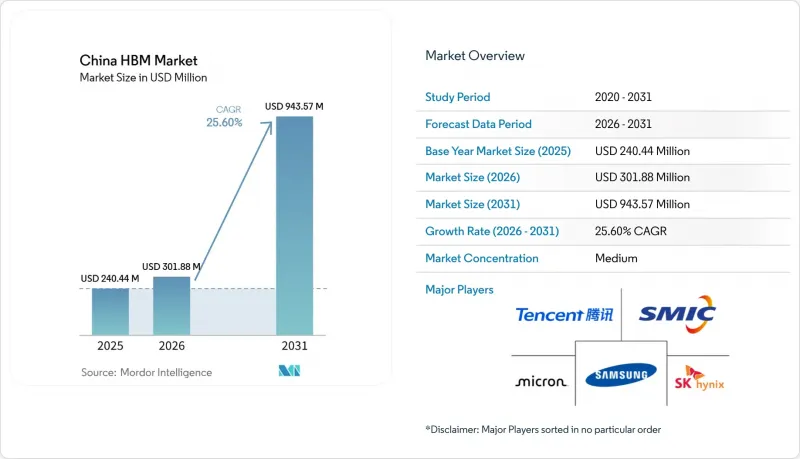
本報告按HBM類型(HBM2E及更早版本、HBM3、HBM3E、HBM4等)、技術領域(1X及更高傳統節點等)、終端用戶行業(雲端服務供應商和超大規模資料中心業者等)、應用領域(AI模型訓練等)以及封裝類型(基於2.5D中介層的先進封裝、扇出型細分。市場預測以美元計價。
國人血腦障壁市場趨勢與洞察
出口限制導致的進口替代重組了採購邏輯
美國出口限制仍然是中國HBM市場最大的干擾因素,改變了採購選擇和投資時機。 2024年12月,美國工業與安全局(BIS)擴大了限制範圍,將HBM、DRAM和先進封裝半導體製造設備納入其中,這大大縮小了中國買家獲取HBM3及更高版本的機會。這項變更迫使中國人工智慧晶片公司依賴先前已鎖定的庫存,並以正常產品週期無法實現的速度加快國內認證專案。這不僅是產業政策問題,因為HBM供應的延遲直接限制了國內人工智慧加速器的出貨速度,並減緩了新型運算叢集的部署。因此,中國HBM市場已從成本效益之爭轉變為“供應保障模式”,國內產能具有戰略價值,即便尚未完全實現經濟可行性。 CXMT獲準於2026年6月上市也表明,資本形成迅速響應了貿易政策的轉變,新資金被用於擴大產能和實現HBM商業化。
AI 伺服器和 GPU 的記憶體密度需求不斷成長,這將決定基準需求。
中國HBM市場低階需求正在上升。這是因為隨著每一代AI加速器的推出,單機容量和頻寬的要求都在不斷提高。華為於2026年3月發布的Ascend 950PR整合了112GB HBM,實現了1.6TB/s的記憶體頻寬,相比之前的平台有了顯著提升。 Ascend 950DT的藍圖已經指明了下一步的發展方向,即把HBM容量提升至144GB,頻寬至4TB/s,以應對更苛刻的訓練和推理任務。這一點至關重要,因為記憶體需求並非線性成長,每一代晶片的推出都會增加本地HBM供應、封裝準備和檢驗週期的壓力。因此,中國HBM市場的發展受到難以推遲的技術需求的驅動,尤其是在國內加速器計畫旨在達到全球性能基準的情況下。此外,隨著記憶體密度的增加,封裝和散熱設計的重要性也隨之增加,需求的成長不再侷限於記憶體晶片的生產。
高層 HBM 製造程序良率的下降限制了大規模生產的擴張。
良率仍然是高層HBM生產中的一個嚴重限制因素,因為隨著層數的增加和鍵合公差的日益嚴格,良率的降低難度也隨之增加。初步草案指出,即使每層性能優異,封裝完成前整體層良率的顯著下降也會減緩量產擴張的步伐並增加成本。這個問題不僅限於單一製程步驟,還會影響到許多因素,包括穿透矽通孔(TSV)的形成、鍵結一致性、熱控制、測試覆蓋率以及最終封裝的可靠性。因此,在國內供應商能夠在工程設計和早期量產階段穩定實現商業性可行的良率之前,中國HBM市場仍將對生產成熟度保持高度敏感。出口限制也是一個重要因素,因為它限制了企業取得海外製造設備、校準支援和良率提昇技術等通常有助於縮短量產推出時間的資源。
細分市場分析
截至2025年,HBM2E及更早幾代產品佔據了中國HBM市場44.17%的佔有率,這表明在進口新產品受限的時期,現有需求仍然依賴傳統產品。然而,這一龐大的市場佔有率並不能反映客戶的真正需求,因為國內人工智慧專案對更高頻寬的需求日益成長,而老款HBM產品無法長期滿足這一需求。這個細分市場之所以仍然重要,是因為監管實施前的採購造成了暫時的庫存過剩,為買家提供了一個短暫的過渡期,使他們能夠在國產替代產品完成認證流程期間維持現有部署。因此,在中國HBM產業,這一傳統產品層扮演著過渡的角色,而非最終的穩定狀態。 HBM3和HBM3E正處於這一過渡階段,它們既滿足了當前的部署需求,也為國產產品即將成熟的下一階段提供了銜接。
預計到2031年,HBM4將以26.57%的複合年成長率成長,使其成為產品長期需求走向最清晰的指標。這一成長反映了採購計劃超越了當前的供應限制,並預測了未來幾代加速器所需的性能水平。儘管該細分市場仍處於商業性的早期階段,但其成長跡象表明,中國買家並未基於過去的規格進行規劃。根據需求趨勢判斷,HBM4E及後續幾代產品雖然目前規模較小,但如果模具、良率和封裝方面的障礙得到緩解,則有望迅速發展。因此,儘管目前的出貨量仍依賴較舊的記憶體系列,但中國HBM市場正受到未來效能需求的驅動。
到2025年,1Z以下的先進節點將佔中國HBM市場規模的49.63%,證實了主要需求集中在目前已上市的最高密度晶片配置。此節點類別也是技術配置中成長最快的部分。這是因為國內加速器需要更高的密度和更嚴格的性能要求才能在訓練和推理部署中保持競爭力。因此,1Z和1Y節點的角色將有所限制,儘管仍然重要,主要體現在那些成本、可用性和相容性比絕對頻寬更重要的工作負載中。 1X以上的舊節點將繼續服務於傳統應用場景和低需求應用場景,但隨著以人工智慧為中心的部署成為主流,它們的相對重要性正在下降。因此,中國HBM市場正在圍繞先進節點進行整合,這不僅是出於行銷和藍圖規劃的考慮,也是出於晶片結構方面的結構性原因。
這種轉變也解釋了為什麼關於技術節點的討論無法與出口限制和工具取得脫鉤。草案將先進節點的進展與仍受光刻和EDA技術制約的製程能力連結起來,這意味著供應改進不會在所有節點層級上同步進行。實際上,即使本地供應緊張,對先進節點的需求也可能保持強勁,因為即使國內製造基礎設施尚未完全發展,客戶需求仍在成長。因此,中國HBM產業中最具吸引力的節點層級與最容易供應的節點層級之間很可能出現持續的差距。這種不平衡是先進節點層級將在2025年主導並同時成為未來投資最大驅動力的原因之一。
其他好處:
- Excel格式的市場預測(ME)表
- 3個月的分析師支持
目錄
第1章:引言
- 研究假設和市場定義
- 調查範圍
第2章:調查方法
第3章執行摘要
第4章 市場狀況
- 市場概覽
- 市場促進因素
- 加速人工智慧伺服器和GPU的記憶體密度需求
- 一款中國獨有的人工智慧運算本地化程序
- 國內先進包裝生產能力快速擴張
- 出口限制導致的進口替代
- 混合鍵結和TSV生態系的追趕
- 為超大規模雲端應用採購國產內存
- 市場限制因素
- 取得最先進的EDA和製程工具的機會有限。
- 高堆疊HBM製造流程的良率下降
- 針對人工智慧加速器客戶的嚴格認證流程。
- 對進口先進材料和基板的依賴
- 供應鏈分析
- 監理情勢
- 技術展望
- 波特五力分析
第5章 市場規模與成長預測
- HBM 型
- HBM2E 及更早世代
- HBM3
- HBM3E
- HBM4
- HBM4E
- 按技術領域
- 1X 或更高版本以及傳統節點
- 1Y節點
- 1Z 節點
- 小於 1Z 的高階節點
- 按最終用途行業分類
- 雲端服務供應商和超大規模資料中心業者雲端服務商
- 網際網路平台和人工智慧模型開發公司
- 政府、國防、研究和學術機構
- 企業資料中心
- 通訊業者和網路設備供應商
- 其他終端用戶產業
- 透過使用
- 訓練人工智慧模型
- AI模型推理
- 高效能運算和科學運算
- 專業圖形、渲染和視覺化
- 網路與通訊處理
- 其他用途
- 按包裝類型
- 採用 2.5D 中介層的封裝
- 3D堆疊
- 扇出高級封裝
第6章 競爭情勢
- 市場集中度
- 策略趨勢
- 市佔率分析
- 公司簡介
- ChangXin Memory Technologies, Inc.
- Samsung Electronics Co., Ltd.
- SK hynix Inc.
- Micron Technology, Inc.
- Tongfu Microelectronics Co., Ltd.
- Jiangsu Changjiang Electronics Technology Co., Ltd.
- NAURA Technology Group Co., Ltd.
- Advanced Micro-Fabrication Equipment Inc.
- Piotech Inc.
- ACM Research, Inc.
- Shenzhen Kingsemi Co., Ltd.
- U-Precision Technology Co., Ltd.
- Huawei Technologies Co., Ltd.
- Semiconductor Manufacturing International Corporation
- Inspur Electronic Information Industry Co., Ltd.
- Alibaba Cloud Computing Ltd.
- Tencent Holdings Limited
- Sugon Information Industry Co., Ltd.
第7章 市場機會與未來展望
According to Mordor Intelligence, the China HBM market size is projected to be USD 240.44 million in 2025, USD 301.88 million in 2026, and reach USD 943.57 million by 2031, growing at a CAGR of 25.60% from 2026 to 2031.
This report is Segmented by HBM Type (HBM2E and Earlier Generations, HBM3, HBM3E, HBM4, and More), Technology Node (1X and Above Legacy Nodes, and More), End Use Industry (Cloud Service Providers and Hyperscalers, and More), Application (AI Model Training, and More) and Packaging Type (2. 5D Interposer-Based Packaging, Fan-Out Advanced Packaging, and More). The Market Forecasts are Provided in Terms of Value (USD).
China HBM Market Trends and Insights
Export-Control-Induced Import Substitution Reshapes Procurement Logic
US export controls remain the most disruptive force in the China HBM market because they changed both sourcing options and investment timing. In December 2024, the Bureau of Industry and Security expanded controls to cover HBM, DRAM, and advanced packaging semiconductor manufacturing equipment, which sharply narrowed access to HBM3 and higher products for Chinese buyers. That shift pushed Chinese AI chip companies to rely on previously secured inventory while advancing domestic qualification programs much faster than a typical product cycle would allow. The issue is not only industrial policy, because delayed HBM supply directly limits the shipment pace of domestic AI accelerators and slows the deployment of new computing clusters. The China HBM market, therefore, moved from a cost-and-performance discussion toward a supply-assurance model in which local capacity carries strategic value even before it reaches full-scale economics. CXMT's June 2026 IPO approval also showed how quickly capital formation followed this change in trade policy, with the new funding directed toward capacity and HBM commercialization.
Accelerating AI Server and GPU Memory Density Requirements Set the Demand Baseline
The demand floor for the China HBM market is rising because each new AI accelerator generation requires more capacity and more bandwidth per device. Huawei's Ascend 950PR, launched in March 2026, integrated 112 GB of HBM and delivered 1.6 TB/s of memory bandwidth, which marked a major increase over the earlier platform. The next step was already visible in the Ascend 950DT roadmap, which moved toward 144 GB of HBM and 4 TB/s of bandwidth for more demanding training and inference tasks. This matters because memory requirements do not increase linearly, and each chip generation increases the strain on local HBM availability, packaging readiness, and validation cycles. The China HBM market is therefore being boosted by a technical requirement that is difficult to defer, especially as domestic accelerator programs aim to match global performance benchmarks. Higher memory density has also widened the importance of packaging and thermal integration, so demand growth now reaches well beyond memory die production alone.
Yield Losses in High-Stack HBM Manufacturing Constrain Volume Scale-Up
Yield remains a serious restraint because high-stack HBM production becomes harder with every additional layer and every tighter bonding tolerance. The original draft noted that even when per-layer performance is strong, cumulative stack yield can fall meaningfully before packaging is complete, slowing and increasing the cost of scale-up. This issue is broader than a single process step because it touches through-silicon via formation, bonding consistency, thermal control, test coverage, and final package reliability. The China HBM market will therefore remain sensitive to production maturity until domestic suppliers can stabilize commercially viable yields across engineering and early mass production runs. Export restrictions also matter here because they reduce access to foreign tools, calibration support, and yield-improvement know-how that would normally help shorten the ramp period.
Other drivers and restraints analyzed in the detailed report include:
- China-Specific AI Compute Localization Programs Create Captive Demand
- Rapid Expansion of Domestic Advanced Packaging Capacity Removes a Critical Bottleneck
- Limited Access to Leading-Edge EDA and Process Tools Imposes a Structural Ceiling
For complete list of drivers and restraints, kindly check the Table Of Contents.
Segment Analysis
HBM2E and earlier generations accounted for 44.17% of the China HBM market in 2025, indicating that the installed demand base still relied on legacy supply during a period of restricted access to newer imported products. That leading share did not reflect a settled customer preference, because domestic AI programs increasingly require higher bandwidth classes that older HBM cannot support for long. The segment remained important because pre-control procurement had created a temporary inventory cushion, which gave buyers a short window to sustain deployments while local alternatives moved through qualification. In the China HBM industry, this legacy tier therefore acted as a bridge rather than a stable end state. HBM3 and HBM3E sit in the middle of that transition, because they connect current deployment needs with the next stage of domestic production readiness.
HBM4 is projected to expand at a 26.57% CAGR through 2031, which makes it the clearest marker of where long-term product demand is heading. That growth reflects procurement plans that are already looking beyond present supply constraints and toward performance levels needed by later accelerator generations. The segment is still early in commercial terms, but its growth signal shows that Chinese buyers are not planning around yesterday's specification set. HBM4E and later generations remain smaller today, yet the direction of demand suggests that once tooling, yield, and packaging barriers ease, these tiers could gain momentum quickly. The China HBM market is therefore being pulled forward by future performance requirements even while present shipments still lean on older memory families.
Advanced nodes below 1Z accounted for 49.63% of the China HBM market size in 2025, which confirms that the leading demand pool is already concentrated around the densest die configurations available. This node category also represented the fastest-moving part of the technology mix, because domestic accelerators need higher density and tighter performance envelopes to remain viable in training and inference deployments. That leaves 1Z and 1Y nodes with an important but narrower role, mainly in workloads where cost, availability, and compatibility still matter more than absolute bandwidth. Older 1X and above nodes continue to serve legacy and less demanding use cases, but they are losing relative weight as AI-centered deployments become more dominant. The China HBM market is therefore consolidating around advanced nodes for structural reasons tied to chip architecture, not only for marketing or roadmap reasons.
This shift also explains why the discussion of technology nodes cannot be separated from export controls and tool access. The draft linked advanced node progression to the same process capabilities that remain exposed to lithography and EDA constraints, meaning supply improvements will not advance evenly across all node tiers. In practical terms, leading node demand can stay strong even when local supply remains tight, because customer requirements keep moving upward regardless of domestic manufacturing readiness. The China HBM industry is therefore likely to show a persistent gap between the most attractive node segment and the easiest node segment to supply. That imbalance is one reason the advanced-node tier held the lead in 2025 while also shaping the strongest pull on future investment.
Complete Report Scope:
- By HBM Type
- HBM2E and Earlier Generations
- HBM3
- HBM3E
- HBM4
- HBM4E
- By Technology Node
- 1X and above Legacy Nodes
- 1Y Node
- 1Z Node
- Advanced Nodes below 1Z
- By End Use Industry
- Cloud Service Providers and Hyperscalers
- Internet Platforms and AI Model Developers
- Government, Defense, Research, and Academic Institutions
- Enterprise Data Centers
- Telecommunications Operators and Network Equipment Providers
- Other End Use Industries
- By Application
- AI Model Training
- AI Model Inference
- HPC and Scientific Computing
- Professional Graphics, Rendering, and Visualization
- Network and Telecom Processing
- Other Applications
- By Packaging Type
- 2.5D Interposer-Based Packaging
- 3D Stacking
- Fan-Out Advanced Packaging
List of Companies Covered in this Report:
- ChangXin Memory Technologies, Inc.
- Samsung Electronics Co., Ltd.
- SK hynix Inc.
- Micron Technology, Inc.
- Tongfu Microelectronics Co., Ltd.
- Jiangsu Changjiang Electronics Technology Co., Ltd.
- NAURA Technology Group Co., Ltd.
- Advanced Micro-Fabrication Equipment Inc.
- Piotech Inc.
- ACM Research, Inc.
- Shenzhen Kingsemi Co., Ltd.
- U-Precision Technology Co., Ltd.
- Huawei Technologies Co., Ltd.
- Semiconductor Manufacturing International Corporation
- Inspur Electronic Information Industry Co., Ltd.
- Alibaba Cloud Computing Ltd.
- Tencent Holdings Limited
- Sugon Information Industry Co., Ltd.
Additional Benefits:
- The market estimate (ME) sheet in Excel format
- 3 months of analyst support
TABLE OF CONTENTS
1 INTRODUCTION
- 1.1 Study Assumptions and Market Definition
- 1.2 Scope of the Study
2 RESEARCH METHODOLOGY
3 EXECUTIVE SUMMARY
4 MARKET LANDSCAPE
- 4.1 Market Overview
- 4.2 Market Drivers
- 4.2.1 Accelerating AI Server and GPU Memory Density Requirements
- 4.2.2 China-Specific AI Compute Localization Programs
- 4.2.3 Rapid Expansion of Domestic Advanced Packaging Capacity
- 4.2.4 Export-Control-Induced Import Substitution
- 4.2.5 Hybrid Bonding and TSV Ecosystem Catch-Up
- 4.2.6 Hyperscale Cloud Procurement of Domestic Memory
- 4.3 Market Restraints
- 4.3.1 Limited Access to Leading-Edge EDA and Process Tools
- 4.3.2 Yield Losses in High-Stack HBM Manufacturing
- 4.3.3 Tight Qualification Cycles for AI Accelerator Customers
- 4.3.4 Dependence on Imported Advanced Materials and Substrates
- 4.4 Supply Chain Analysis
- 4.5 Regulatory Landscape
- 4.6 Technological Outlook
- 4.7 Porter's Five Forces Analysis
- 4.7.1 Threat Of New Entrants
- 4.7.2 Bargaining Power Of Suppliers
- 4.7.3 Bargaining Power Of Buyers
- 4.7.4 Threat Of Substitutes
- 4.7.5 Intensity of Competitive Rivalry
5 MARKET SIZE AND GROWTH FORECASTS (VALUE)
- 5.1 By HBM Type
- 5.1.1 HBM2E and Earlier Generations
- 5.1.2 HBM3
- 5.1.3 HBM3E
- 5.1.4 HBM4
- 5.1.5 HBM4E
- 5.2 By Technology Node
- 5.2.1 1X and above Legacy Nodes
- 5.2.2 1Y Node
- 5.2.3 1Z Node
- 5.2.4 Advanced Nodes below 1Z
- 5.3 By End Use Industry
- 5.3.1 Cloud Service Providers and Hyperscalers
- 5.3.2 Internet Platforms and AI Model Developers
- 5.3.3 Government, Defense, Research, and Academic Institutions
- 5.3.4 Enterprise Data Centers
- 5.3.5 Telecommunications Operators and Network Equipment Providers
- 5.3.6 Other End Use Industries
- 5.4 By Application
- 5.4.1 AI Model Training
- 5.4.2 AI Model Inference
- 5.4.3 HPC and Scientific Computing
- 5.4.4 Professional Graphics, Rendering, and Visualization
- 5.4.5 Network and Telecom Processing
- 5.4.6 Other Applications
- 5.5 By Packaging Type
- 5.5.1 2.5D Interposer-Based Packaging
- 5.5.2 3D Stacking
- 5.5.3 Fan-Out Advanced Packaging
6 COMPETITIVE LANDSCAPE
- 6.1 Market Concentration
- 6.2 Strategic Moves
- 6.3 Market Share Analysis
- 6.4 Company Profiles (includes Global Level Overview, Market Level Overview, Core Segments, Financials as available, Strategic Information, Market Rank/Share, Products and Services, Recent Developments)
- 6.4.1 ChangXin Memory Technologies, Inc.
- 6.4.2 Samsung Electronics Co., Ltd.
- 6.4.3 SK hynix Inc.
- 6.4.4 Micron Technology, Inc.
- 6.4.5 Tongfu Microelectronics Co., Ltd.
- 6.4.6 Jiangsu Changjiang Electronics Technology Co., Ltd.
- 6.4.7 NAURA Technology Group Co., Ltd.
- 6.4.8 Advanced Micro-Fabrication Equipment Inc.
- 6.4.9 Piotech Inc.
- 6.4.10 ACM Research, Inc.
- 6.4.11 Shenzhen Kingsemi Co., Ltd.
- 6.4.12 U-Precision Technology Co., Ltd.
- 6.4.13 Huawei Technologies Co., Ltd.
- 6.4.14 Semiconductor Manufacturing International Corporation
- 6.4.15 Inspur Electronic Information Industry Co., Ltd.
- 6.4.16 Alibaba Cloud Computing Ltd.
- 6.4.17 Tencent Holdings Limited
- 6.4.18 Sugon Information Industry Co., Ltd.
7 MARKET OPPORTUNITIES AND FUTURE OUTLOOK
- 7.1 White-Space And Unmet-Need Assessment

 2026年人工智慧高頻寬記憶體全球市場報告
 用於人工智慧(AI)半導體的高頻寬記憶體(HBM)和先進封裝材料:2027-2037 年
 混合儲存立方體:市場佔有率分析、行業趨勢和統計數據、成長預測(2026-2031 年)HBM 8層堆疊與12層堆疊:市場佔有率分析、產業趨勢與統計、成長預測(2026-2031年)HBM CoWoS 包裝產能及供需:市佔率分析、產業趨勢與統計及成長預測(2026-2031 年)HPC/超級計算 HBM:市場佔有率分析、產業趨勢與統計、成長預測(2026-2031 年)記憶纖維:市場佔有率分析、產業趨勢與統計、成長預測(2026-2031)
 高頻寬記憶體 (HBM) 市場預測至 2034 年—按產品類型、儲存容量、封裝技術、頻寬、應用、最終用戶和地區分類的全球分析下一代人腦記憶體:市場佔有率分析、行業趨勢和統計數據、成長預測(2026-2031 年)日本HBM市場:市場佔有率分析、產業趨勢與統計、成長預測(2026-2031年)