

 |
市場調查報告書
商品編碼
2099259
日本HBM市場:市場佔有率分析、產業趨勢與統計、成長預測(2026-2031年)Japan HBM - Market Share Analysis, Industry Trends & Statistics, Growth Forecasts (2026 - 2031) |
||||||

※ 本網頁內容可能與最新版本有所差異。詳細情況請與我們聯繫。
根據 Mordor Intelligence 預測,日本高頻寬記憶體市場預計將從 2025 年的 8,448 萬美元成長到 2026 年的 1.0607 億美元,到 2031 年達到 3.1153 億美元,2026 年至 2031 年的複合年成長率預計為 24.05%。
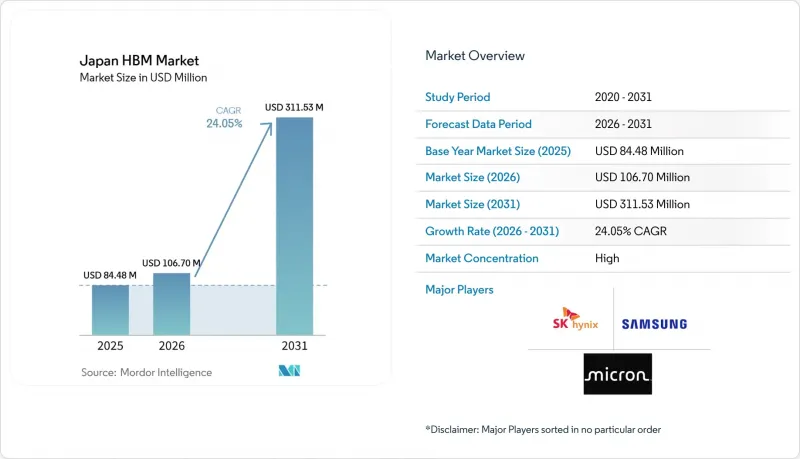
本報告依HBM類型(HBM3、HBM3E、HBM4、HBM4E等)、技術領域(1X及以上、1Y、1Z等)、終端用戶產業(雲端服務供應商、網際網路平台、政府機構、企業、電信業者等)、應用領域(人工智慧訓練、推理、高效能運算、圖形處理、網路等)、以及裝置區隔(2.5D)、出扇裝置類型。市場預測以美元計價。
日本人血腦屏障市場的趨勢與洞察
日本資料中心快速採用人工智慧加速器
日本高頻寬記憶體市場正受到該地區最集中的人工智慧運算建設週期之一的推動,因為新的GPU叢集直接轉化為每個系統HBM記憶體消耗量的增加。微軟宣佈到2029年將在日本投資100億美元,重點用於資料中心和人工智慧基礎建設,凸顯了日本未來巨大的運算需求。 GMI Cloud也在鹿兒島縣宣布了一項120億美元的“主權人工智慧舉措”,初期計畫裝置容量為350兆瓦,長期目標為1吉瓦,這將進一步推動對加速器記憶體的大規模需求。隨後,Softbank Corporation宣布計畫於2026年10月推出基於NVIDIA GB200 NVL72系統的人工智慧資料中心GPU雲端服務,為日本國內用戶提供「推理即服務」(Inference-as-a-Service)功能。這些舉措意義重大,因為它們有望縮短整個日本高頻寬記憶體市場的前置作業時間,而無需買家在每個設施建成後才進行記憶體採購計劃。因此,出現了一種需求模式,即供應合約談判提前進行,營運商更加重視能夠保證初始訓練系統和後續推理叢集供應量的供應商。
向 HBM3E 和 HBM4 過渡以進行高級計算
在日本高頻寬記憶體市場,由於人工智慧加速器對效能的要求日益嚴苛,遠超傳統記憶體更新周期,世代更迭正在加速。 2025年4月,JEDEC發布了JESD270-4 HBM4標準,引入了2048位元介面,單堆疊最大頻寬可達2.048 TB/s。這提高了新型加速器平台的性能標準。 SK海力士於2025年3月出貨了12層HBM4樣品,隨後於2026年6月出貨了12層HBM4E樣品。該公司表示,與HBM4相比,HBM4E單堆疊容量達到48GB,散熱性能更佳,能源效率更高。這一系列發展正在改變消費者的購買行為。儘管HBM3E仍是旗艦產品,但平台所有者已開始在認證週期早期就著手準備HBM4和HBM4E。美光的廣島計劃也在這一轉變中發揮了重要作用。該工廠將極紫外光刻技術引入日本,用於晶片的大規模生產,為日後進軍下一代高頻寬記憶體(HBM)市場奠定了本土基礎。因此,日本高頻寬記憶體市場正從單純的容量競爭轉向世代競爭,早期認證、散熱性能和能源效率等因素對商業性價值的影響日益顯著。
對進口成品高密度脂蛋白鋼堆的嚴重依賴
日本高頻寬記憶體市場仍存在結構性風險。成品HBM堆疊晶片僅來自少數幾家海外製造商,而日本最大的優勢在於上游工程,例如材料、設備和整合支援。這意味著,儘管日本國內買家受益於其強大的供應鏈,但隨著全球堆疊晶片產能趨緊,他們仍然面臨價格和供應風險。經濟產業省(METI)的補貼政策顯然意識到了這一弱點,其對廣島美光公司的支持主要旨在確保日本國內的先進記憶體產能長期穩定。然而,由於日本國內成品堆疊晶片的生產仍處於推出階段而非量產階段,僅靠區域風險對沖無法完全消除短期採購風險。在人工智慧叢集,這個問題尤其關鍵,因為部署進度不僅取決於伺服器和設施的準備情況,還取決於記憶體供應情況。即使國內需求強勁,在國內供應擴大之前,日本的高頻寬記憶體市場仍將容易受到來自日本以外的供應中斷的影響。
細分市場分析
2025年日本國內高頻寬記憶體市場按HBM類型分類的市場佔有率中,HBM3E佔比高達68.53%,顯示其仍是日本首次大規模部署人工智慧訓練系統的首選。其主導地位得益於當時HBM3E是先進加速器叢集唯一廣泛可用且供應充足的選項。預計到2031年,HBM4E及後續幾代HBM將以24.98%的複合年成長率成長,成為日本高頻寬記憶體市場中HBM類型構成中成長最快的細分市場。 JEDEC於2025年正式製定的更高績效標準,為採購者提供了更清晰的認證路徑和未來的採購規劃。隨後,SK 海力士於 2025 年 3 月交付了 12 層 HBM4 樣品,並於 2026 年 6 月交付了 12 層 HBM4E 樣品,從而促進了這一過渡,幫助下一代產品從藍圖階段過渡到客戶的實際評估階段。
該細分市場未能一次全面轉型的原因在於,日本買家在選擇當前幾代HBM產品時,需要綜合考慮價格、供貨情況、熱穩定性以及平台上市時間等因素。 HBM4和HBM4E在全面量產前就已備受關注,因為下一代加速器計劃已將這些更高性能的產品納入考慮。 HBM3在注重成本的部署中仍然佔據重要地位,但隨著HBM3E在各級買家中的普及,其作用正在減弱。 HBM2E及更早幾代產品正從大規模採購轉向維護和舊系統支援領域。雖然這種產品層級分類正將支出重心轉移到更新的製程節點和產品代際上,但日本高頻寬記憶體產業的規模仍然足以滿足高階和中端市場的需求。
截至2025年,1Z以下先進節點將佔據日本高頻寬記憶體市場49.18%的佔有率,預計到2031年將以24.84%的複合年成長率成長。這將使該細分市場成為規模最大、成長最快的技術節點類別,佔據獨特的市場地位。這一趨勢反映了後續HBM產品延長了現有節點的壽命而非取代它們,從而導致市場出現短暫的停滯期。此細分市場的強勁成長得益於與新型DRAM架構相關的生產轉移以及高效能記憶體堆疊對更先進製程控制的需求。 2026年3月,JX Advanced Metals在其茨城工廠建成了高純度CVD和ALD材料的新量產生產線,這明確表明此次擴張與包括HBM在內的先進半導體密切相關。此舉意義重大,因為日本在先進節點領域的增值佔有率通常不僅來自最終的堆疊組裝,還來自材料品質和製程支援。
2025年,1Z節點仍佔據第二大市場。這主要得益於其對舊款HBM3E產品的持續支持,這些產品的採購週期在企業和通訊相關部署中仍在繼續。雖然1Y節點在傳統HBM3的供應中仍佔有一定佔有率,但老款1X以上節點的市場佔有率持續穩定下降,這與公共部門和研究領域更長週期的需求相符。日本供應商不僅在為當前的節點配置做準備,也在為當前浪潮過後的發展做好準備。 2026年6月,東都半導體宣布投資4.95億美元用於1nm時代的半導體材料。這表明日本國內材料製造商已為下一階段的製程需求做好準備。這將確保日本高頻寬記憶體市場持續保持上游工程優勢,因為即使在日本大規模生產HBM堆疊晶片之前,日本企業也能從未來的節點過渡中獲益。
其他好處:
- Excel格式的市場預測(ME)表
- 3個月的分析師支持
目錄
第1章:引言
- 研究假設和市場定義
- 調查範圍
第2章:調查方法
第3章執行摘要
第4章 市場狀況
- 市場概覽
- 市場促進因素
- 日本資料中心快速採用人工智慧加速器
- 政府支持國內半導體生產能力
- 向 HBM3E 和 HBM4 過渡以進行高級計算
- 先進包裝技術帶來的產能限制正在推動優質高分子骨材的供應。
- 對高精度材料、測試和熱控制的需求日益成長。
- 日圓疲軟提振了半導體產業的投資和採購。
- 市場限制因素
- 對進口成品HBM堆疊的高度依賴
- 高分子束製造的資本密集度極高
- 12層和16層堆疊生產中良率下降的風險。
- 國內大規模生產認證的瓶頸
- 供應鏈分析
- 監理情勢
- 技術展望
- 波特五力分析
第5章 市場規模與成長預測
- HBM 型
- HBM2E 及更早世代
- HBM3
- HBM3E
- HBM4
- HBM4E
- 按技術領域
- 1X 以上版本和傳統節點
- 1Y節點
- 1Z 節點
- 小於 1Z 的高階節點
- 按最終用途行業分類
- 雲端服務供應商和超大規模資料中心業者雲端服務商
- 網際網路平台和人工智慧模型開發公司
- 政府、國防、研究和學術機構
- 企業資料中心
- 通訊業者和網路設備供應商
- 其他企業部門
- 透過使用
- 訓練人工智慧模型
- AI模型推理
- 高效能運算和科學運算
- 專業圖形、渲染和視覺化
- 網路與通訊處理
- 其他高頻寬運算工作負載
- 按包裝類型
- 採用 2.5D 中介層的封裝
- 3D堆疊
- 扇出高級封裝
第6章 競爭情勢
- 市場集中度
- 策略趨勢
- 市佔率分析
- 公司簡介
- Samsung Electronics Co., Ltd.
- SK hynix Inc.
- Micron Technology, Inc.
- Other Ecosystem Players
- Kioxia Corporation
- Tokyo Electron Limited
- Advantest Corporation
- Shin-Etsu Chemical Co., Ltd.
- SUMCO Corporation
- Renesas Electronics Corporation
- Sony Semiconductor Solutions Corporation
- Toshiba Corporation
- Rapidus Corporation
- Disco Corporation
- Hitachi High-Tech Corporation
- JSR Corporation
- Tokyo Ohka Kogyo Co., Ltd.
- Ibiden Co., Ltd.
- Shinko Electric Industries Co., Ltd.
- Kyocera Corporation
- Sumitomo Bakelite Co., Ltd.
第7章 市場機會與未來展望
According to Mordor Intelligence, the Japan high bandwidth memory market size is expected to increase from USD 84.48 million in 2025 to USD 106.07 million in 2026 and reach USD 311.53 million by 2031, growing at a CAGR of 24.05% over 2026-2031.
This report is Segmented by HBM Type (HBM3, HBM3E, HBM4, HBM4E, and More), Technology Node (1X and Above, 1Y, 1Z, and More) End Use Industry (Cloud Providers, Internet Platforms, Government, Enterprise, Telecom, and Others), Application (AI Training, Inference, HPC, Graphics, Network, and More) and Packaging Type (2. 5D Interposer, 3D Stacking, and Fan-Out). The Market Forecasts are Provided in Terms of Value (USD).
Japan HBM Market Trends and Insights
Rapid AI Accelerator Deployment In Japan's Data Centers
The Japan high bandwidth memory market is being pushed by one of the most concentrated AI compute build cycles in the region, because new GPU clusters convert directly into higher HBM consumption per system. Microsoft announced a USD 10 billion investment in Japan through 2029, focused on data centers and AI infrastructure, underscoring the scale of upcoming compute demand in the country. GMI Cloud also unveiled a USD 12 billion sovereign AI initiative in Kagoshima with an initial 350MW plan and a long-term 1GW target, adding another large demand anchor for accelerator memory. SoftBank followed with its October 2026 launch plan for an AI Data Center GPU Cloud service based on NVIDIA GB200 NVL72 systems and Inference-as-a-Service capabilities for domestic users. These commitments matter because buyers are no longer waiting for each facility to open before planning memory procurement, and that is shortening lead-time expectations across the Japanese high-bandwidth memory market. The result is a demand pattern in which supply commitments are negotiated earlier, with operators placing greater value on vendors that can guarantee volume for both initial training systems and later inference clusters.
Shift Toward HBM3E And HBM4 For Advanced Compute
The generation transition is moving quickly in the Japan high bandwidth memory market because the performance requirements of AI accelerators are increasing faster than the usual memory replacement cycle. JEDEC released the JESD270-4 HBM4 standard in April 2025, introducing a 2048-bit interface and a bandwidth of up to 2.048 TB/s per stack, which raised the performance baseline for new accelerator platforms. SK hynix shipped 12-layer HBM4 samples in March 2025 and then moved ahead with 12-layer HBM4E sample shipments in June 2026, reporting 48GB capacity per stack, lower heat resistance, and better power efficiency than HBM4. That sequence is changing buyer behavior because platform owners are now preparing for HBM4 and HBM4E earlier in the qualification cycle, even as HBM3E remains the main-volume product. Micron's Hiroshima program also matters to this shift because the site deployed EUV lithography for mass chip production in Japan, creating a local path to participate in later HBM generations once production begins. As a result, the Japan high bandwidth memory market is moving from a simple capacity race into a generation race where early qualification, thermal performance, and power efficiency increasingly shape commercial value.
Heavy Dependence On Imported Finished HBM Stacks
The Japan high bandwidth memory market still carries a structural risk because finished HBM stacks are sourced from a very small group of overseas producers, while Japan's strongest role remains upstream in materials, equipment, and integration support. This means domestic buyers benefit from Japan's deep supply chain but still face pricing and availability risks as global stack output tightens. METI's subsidy approach clearly recognizes this weakness, as support for Micron in Hiroshima was framed around securing advanced memory capacity within Japan over time. Even so, that local hedge will not fully solve near-term procurement exposure because domestic finished stack production is still in the build phase rather than in commercial volume. The issue is more important in AI clusters because deployment schedules are closely tied to memory availability, not only to server or facility readiness. Until local supply expands, the Japanese high-bandwidth memory market will remain vulnerable to disruptions originating outside Japan, even when domestic demand conditions remain strong.
Other drivers and restraints analyzed in the detailed report include:
- Government Backing For Domestic Semiconductor Capacity
- Advanced Packaging Capacity Constraints Favor Premium HBM Supply
- Extremely High Capital Intensity Of HBM Fabrication
For complete list of drivers and restraints, kindly check the Table Of Contents.
Segment Analysis
HBM3E held 68.53% of the Japanese high-bandwidth memory market share by HBM type in 2025, indicating it remained the default choice for the first large wave of AI training system deployments in Japan. Its lead was supported by the fact that it was the only high-volume option broadly available for advanced accelerator clusters during that period. HBM4E and later-generation HBM are projected to grow at a 24.98% CAGR through 2031, making them the fastest-growing segment of the HBM type mix in the Japanese high-bandwidth memory market. JEDEC's HBM4 standard formalized a higher-performance baseline in 2025, providing buyers with a clearer path for qualification and future procurement planning. SK hynix then strengthened the transition by shipping 12-layer HBM4 samples in March 2025 and 12-layer HBM4E samples in June 2026, which helped move later generations from roadmap status into practical customer evaluation.
The segment is not shifting all at once because Japanese buyers still need a mix of price, availability, thermal stability, and platform timing when they choose between active HBM generations. HBM4 and HBM4E are attracting interest ahead of full-volume availability because next-generation accelerator programs are already being planned around their higher-performance envelope. HBM3 remains relevant in cost-sensitive deployments, but its role is narrowing as HBM3E becomes more established across buyer tiers. HBM2E and earlier generations are moving into maintenance and legacy support rather than new large-scale procurement. This layering of products keeps the Japan high-bandwidth memory industry broad enough to support both premium and mid-tier demand, even as the spending center of gravity shifts toward later nodes and generations.
Advanced nodes below 1Z accounted for 49.18% of the Japan high-bandwidth memory market in 2025 and are projected to expand at a 24.84% CAGR through 2031, giving this segment the unusual position of being both the largest and the fastest-growing technology node category. That pattern reflects the fact that later HBM products are extending the life of these nodes rather than replacing them, resulting in a short plateau. The segment's strength was supported by production shifts linked to newer DRAM architectures and by the need for more advanced process control in high-performance memory stacks. JX Advanced Metals completed a new mass production line for high-purity CVD and ALD materials at its Ibaraki site in March 2026, and the company explicitly linked the expansion to advanced semiconductors, including HBM. That move matters because Japan's share of value in advanced nodes often comes from materials quality and process support rather than from final stack assembly alone.
The 1Z node remained the second-largest position in 2025 because it continued to support earlier HBM3E products that were still active in procurement cycles across enterprise and telecom-related deployments. The 1Y node retained a role in legacy HBM3 supply, while older 1X and higher nodes continued in a managed decline tied to longer-cycle public and research demand. Suppliers in Japan are also preparing for what comes after the current wave, not only for the present node mix. Toto announced a USD 495 million investment in semiconductor materials for the 1nm era in June 2026, which showed that local materials players were already positioning for the next set of process requirements. This gives the Japanese high-bandwidth memory market a durable upstream advantage, as Japanese firms can capture value from future node transitions even before domestic high-volume HBM stack production reaches scale.
Complete Report Scope:
- By HBM Type
- HBM2E and Earlier Generations
- HBM3
- HBM3E
- HBM4
- HBM4E
- By Technology Node
- 1X And Above Legacy Nodes
- 1Y Node
- 1Z Node
- Advanced Nodes Below 1Z
- By End Use Industry
- Cloud Service Providers and Hyperscalers
- Internet Platforms and AI Model Developers
- Government, Defense, Research, and Academic Institutions
- Enterprise Data Centers
- Telecommunications Operators and Network Equipment Providers
- Other Enterprise Verticals
- By Application
- AI Model Training
- AI Model Inference
- HPC and Scientific Computing
- Professional Graphics, Rendering, and Visualization
- Network and Telecom Processing
- Other High-Bandwidth Compute Workloads
- By Packaging Type
- 2.5D Interposer-Based Packaging
- 3D Stacking
- Fan-Out Advanced Packaging
List of Companies Covered in this Report:
- Samsung Electronics Co., Ltd.
- SK hynix Inc.
- Micron Technology, Inc.
Additional Benefits:
- The market estimate (ME) sheet in Excel format
- 3 months of analyst support
TABLE OF CONTENTS
1 Introduction
- 1.1 Study Assumptions and Market Definition
- 1.2 Scope of the Study
2 Research Methodology
3 Executive Summary
4 Market Landscape
- 4.1 Market Overview
- 4.2 Market Drivers
- 4.2.1 Rapid AI Accelerator Deployment in Japan's Data Centers
- 4.2.2 Government Backing for Domestic Semiconductor Capacity
- 4.2.3 Shift Toward HBM3E and HBM4 For Advanced Compute
- 4.2.4 Advanced Packaging Capacity Constraints Favor Premium HBM Supply
- 4.2.5 Rising Need For Precision Materials, Testing, and Thermal Control
- 4.2.6 Weak Yen Supporting Semiconductor Investment and Procurement
- 4.3 Market Restraints
- 4.3.1 Heavy Dependence on Imported Finished HBM Stacks
- 4.3.2 Extremely High Capital Intensity of HBM Fabrication
- 4.3.3 Yield Loss Risk in 12-Hi and 16-Hi Stack Production
- 4.3.4 Domestic Volume Manufacturing and Qualification Bottlenecks
- 4.4 Supply Chain Analysis
- 4.5 Regulatory Landscape
- 4.6 Technological Outlook
- 4.7 Porter's Five Forces Analysis
- 4.7.1 Threat of New Entrants
- 4.7.2 Bargaining Power of Suppliers
- 4.7.3 Bargaining Power of Buyers
- 4.7.4 Threat of Substitutes
- 4.7.5 Industry Rivalry
5 Market Size and Growth Forecasts
- 5.1 By HBM Type
- 5.1.1 HBM2E and Earlier Generations
- 5.1.2 HBM3
- 5.1.3 HBM3E
- 5.1.4 HBM4
- 5.1.5 HBM4E
- 5.2 By Technology Node
- 5.2.1 1X And Above Legacy Nodes
- 5.2.2 1Y Node
- 5.2.3 1Z Node
- 5.2.4 Advanced Nodes Below 1Z
- 5.3 By End Use Industry
- 5.3.1 Cloud Service Providers and Hyperscalers
- 5.3.2 Internet Platforms and AI Model Developers
- 5.3.3 Government, Defense, Research, and Academic Institutions
- 5.3.4 Enterprise Data Centers
- 5.3.5 Telecommunications Operators and Network Equipment Providers
- 5.3.6 Other Enterprise Verticals
- 5.4 By Application
- 5.4.1 AI Model Training
- 5.4.2 AI Model Inference
- 5.4.3 HPC and Scientific Computing
- 5.4.4 Professional Graphics, Rendering, and Visualization
- 5.4.5 Network and Telecom Processing
- 5.4.6 Other High-Bandwidth Compute Workloads
- 5.5 By Packaging Type
- 5.5.1 2.5D Interposer-Based Packaging
- 5.5.2 3D Stacking
- 5.5.3 Fan-Out Advanced Packaging
6 Competitive Landscape
- 6.1 Market Concentration
- 6.2 Strategic Moves
- 6.3 Market Share Analysis
- 6.4 Company Profiles (includes Global Level Overview, Market Level Overview, Core Segments, Financials as available, Strategic Information, Products and Services, Recent Developments)
- 6.4.1 Samsung Electronics Co., Ltd.
- 6.4.2 SK hynix Inc.
- 6.4.3 Micron Technology, Inc.
- 6.5 Other Ecosystem Players
- 6.5.1 Kioxia Corporation
- 6.5.2 Tokyo Electron Limited
- 6.5.3 Advantest Corporation
- 6.5.4 Shin-Etsu Chemical Co., Ltd.
- 6.5.5 SUMCO Corporation
- 6.5.6 Renesas Electronics Corporation
- 6.5.7 Sony Semiconductor Solutions Corporation
- 6.5.8 Toshiba Corporation
- 6.5.9 Rapidus Corporation
- 6.5.10 Disco Corporation
- 6.5.11 Hitachi High-Tech Corporation
- 6.5.12 JSR Corporation
- 6.5.13 Tokyo Ohka Kogyo Co., Ltd.
- 6.5.14 Ibiden Co., Ltd.
- 6.5.15 Shinko Electric Industries Co., Ltd.
- 6.5.16 Kyocera Corporation
- 6.5.17 Sumitomo Bakelite Co., Ltd.
7 Market Opportunities and Future Outlook
- 7.1 White-Space and Unmet-Need Assessment

 2026年人工智慧高頻寬記憶體全球市場報告
 用於人工智慧(AI)半導體的高頻寬記憶體(HBM)和先進封裝材料:2027-2037 年
 混合儲存立方體:市場佔有率分析、行業趨勢和統計數據、成長預測(2026-2031 年)HBM 8層堆疊與12層堆疊:市場佔有率分析、產業趨勢與統計、成長預測(2026-2031年)HBM CoWoS 包裝產能及供需:市佔率分析、產業趨勢與統計及成長預測(2026-2031 年)HPC/超級計算 HBM:市場佔有率分析、產業趨勢與統計、成長預測(2026-2031 年)中國HBM市場:市場佔有率分析、產業趨勢與統計、成長預測(2026-2031年)記憶纖維:市場佔有率分析、產業趨勢與統計、成長預測(2026-2031)
 高頻寬記憶體 (HBM) 市場預測至 2034 年—按產品類型、儲存容量、封裝技術、頻寬、應用、最終用戶和地區分類的全球分析下一代人腦記憶體:市場佔有率分析、行業趨勢和統計數據、成長預測(2026-2031 年)