

 |
市場調查報告書
商品編碼
2119614
日本快閃記憶體市場:市場佔有率分析、產業趨勢與統計及成長預測(2026-2031)Japan Flash Memory - Market Share Analysis, Industry Trends & Statistics, Growth Forecasts (2026 - 2031) |
||||||

※ 本網頁內容可能與最新版本有所差異。詳細情況請與我們聯繫。
根據 Mordor Intelligence 估計,2026 年日本快閃記憶體市場規模將達到 32.5 億美元,高於 2025 年的 31.6 億美元,預計到 2031 年將達到 37.5 億美元。
預計 2026 年至 2031 年的複合年成長率為 2.90%。
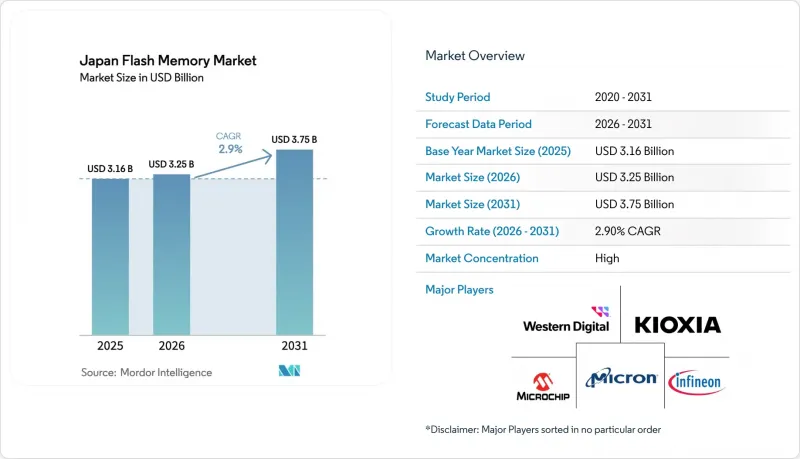
本報告依記憶體類型(3D NAND、2D NAND(平面)、NOR快閃記憶體等)、容量(256MB以下、512MB至2GB、其他)、介面/外形規格(eMMC、UFS、SATA SSD等)、最終用戶應用(資料中心/企業伺服器、行動裝置/平板電腦、汽車、工業/物聯網裝置等)和地區裝置和地區。市場預測以美元(USD)為單位。
日本快閃記憶體市場趨勢與洞察
SSD在消費級和企業級PC中的應用正在快速成長。
企業級升級週期正果斷轉向延遲僅為個位數微秒級的NVMe存儲,從而減少東京和大阪資料中心叢集的機架面積和功耗。隨著PCIe Gen4固態硬碟在中階系統中逐漸普及,筆記型電腦製造商也跟進。西部資料的218層BiCS固態硬碟現已大量出貨,可為金融和公共部門工作負載提供每天3塊硬碟的寫入耐久性。 5G的部署也加速了消費市場的普及,這主要得益於路由器和基地台對本地快取需求的成長。這些因素共同推動了整體成長0.6個百分點,預計其影響將在2026年至2028年間達到高峰。
由於內部儲存容量增加,智慧型手機產量擴大
索尼、夏普和京瓷的高階智慧型手機配備 256GB 和 512GB 的儲存空間,支援 4K影片和 AI影像處理。蘋果保持著市場主導地位,但本土品牌在注重耐用性和高解析度攝影機的細分市場中也佔有一席之地。 5G 無線通訊用戶已超過半數,這導致照片和影片檔案體積增大。這些趨勢將使長期複合年成長率 (CAGR) 提高 0.5 個百分點。
NAND快閃記憶體價格週期性波動和庫存過剩
2024年第四季,晶圓合約價格較上季下降6.2%,預計2025年第一季將進一步下跌10-15%,之後略有回升。晶圓廠業者在擴大產能的同時,利潤率面臨壓力。鎧俠在其IPO招股說明書中揭露,其庫存僅夠維持90天,面臨進一步降價的風險。這種劇烈的價格波動已使預計複合年成長率下調0.5個百分點,並使2026年之前的現金流計劃變得複雜。
細分市場分析
預計到2025年,3D NAND快閃記憶體將佔日本快閃記憶體市場48.45%的佔有率,這主要得益於資料中心向全Flash陣列的轉型以及汽車產業對UFS 4.0模組的廣泛應用。這一佔有率將構成日本快閃記憶體市場在整個預測期內的基石,並透過超過218層的高密度裝置保持具有競爭力的平均售價。三星和SK海力士正在大力推動300層裝置的部署,這給現有製造商帶來了成本壓力,同時也隨著Terabyte級封裝的普及擴大了潛在市場規模。
其他非揮發性儲存技術,主要是MRAM和ReRAM,預計將以4.05%的複合年成長率成長,這主要得益於汽車和工業設備對即時啟動功能和百萬次循環壽命的需求。鎧俠(Kioxia)和SK海力士(SK hynix)共同開發的OCTRAM交叉點設計是這快速成長的基礎。雖然NOR快閃記憶體和平面NAND快閃記憶體仍然用於傳統設計,但隨著垂直堆疊技術降低晶圓成本,它們的市佔率正在下降。受這些趨勢的影響,預計日本快閃記憶體市場將在預測期內向3D結構轉型,同時保持其多樣性。
到2025年,64GB至256GB容量等級的手機將佔總銷量的37.15%,這主要得益於智慧型手機材料清單(BOM)中對128GB和256GB容量的偏好。除了照片和影片檔案體積的不斷增大,營運商提供的無限資料通訊套餐也促使消費者選擇更大容量的手機。
預計512Gb以上容量的快閃記憶體市場將以3.62%的複合年成長率成長,隨著1TB儲存模組整合到人工智慧邊緣設備和ADAS平台中,日本該容量快閃記憶體市場的規模預計將會擴大。鎧俠(Kioxia)新推出的2Tb QLC晶片透過將1TB UFS組件整合到單一封裝中,加速了這項轉型。在微控制器和物聯網感測器領域,低容量快閃記憶體仍然至關重要,因為在這些應用中,能源效率和小型化比單純的容量更為重要。
其他好處:
- Excel格式的市場預測(ME)表
- 3個月的分析師支持
目錄
第1章:引言
- 研究假設和市場定義
- 調查範圍
第2章:調查方法
第3章執行摘要
第4章 市場狀況
- 市場概覽
- 宏觀經濟趨勢的影響
- 市場促進因素
- 固態硬碟在消費級和企業級PC中的應用正在迅速成長。
- 由於內部儲存容量增加,智慧型手機產量擴大
- 汽車ADAS和車載資訊娛樂系統的快速發展
- 需要本地快閃儲存的物聯網邊緣設備數量激增。
- 政府對國內先進快閃製造廠給予優惠待遇
- 日本穿戴裝置中 3D NAND 的應用與元宇宙相關。
- 市場限制因素
- NAND快閃記憶體價格週期性波動和庫存過剩
- 最小長度為 1z-Nm 的節點面臨的可靠性挑戰
- 國內能源成本上漲給獲利能力帶來了壓力。
- 高純度氫氟酸和光阻劑用化學品的供應風險
- 監理情勢
- 產業價值鏈分析
- 技術展望
- 波特五力分析
第5章 市場規模與成長預測
- 按記憶體類型
- 3D NAND
- 2D NAND(平面)
- NOR 沖洗
- 其他
- 按產能
- 256 MB 或更少
- 512 Mb~2 Gb
- 4 Gb~32 Gb
- 64 Gb~256 Gb
- 512 GB 或更多
- 按介面/外形規格
- eMMC
- UFS
- SATA SSD
- PCIe/NVMe SSD
- SPI NOR
- USB隨身碟/行動儲存裝置
- 透過最終用戶應用程式
- 資料中心企業伺服器
- 手機和平板電腦
- 汽車(ADAS、資訊娛樂系統)
- 工業和物聯網設備
- 客戶端運算(PC、筆記型電腦、客戶端固態硬碟)
- 消費性電子設備(遊戲、穿戴式裝置)
- 其他
第6章 競爭情勢
- 市場集中度
- 策略趨勢
- 市佔率分析
- 公司簡介
- Infineon Technologies AG
- Micron Technology, Inc.
- Kioxia Holdings Corporation
- Western Digital Corporation
- Microchip Technology Incorporated
- Transcend Information, Inc.
- Renesas Electronics Corporation
- Winbond Electronics Corporation
- GigaDevice Semiconductor Inc.
- Samsung Electronics Co., Ltd.
- SK hynix Inc.
- Sony Semiconductor Solutions Corporation
- Panasonic Holdings Corporation
- Toshiba Electronic Devices and Storage Corporation
- Rohm Co., Ltd.
- Macronix International Co., Ltd.
- Integrated Silicon Solution, Inc.(ISSI)
- Silicon Motion Technology Corporation
- ATP Electronics, Inc.
- Kingston Technology Company, Inc.
- Phison Electronics Corporation
- Cypress Semiconductor Corporation
第7章 市場機會與未來展望
According to Mordor Intelligence, Japan flash memory market size in 2026 is estimated at USD 3.25 billion, growing from 2025 value of USD 3.16 billion with 2031 projections showing USD 3.75 billion, growing at 2.90% CAGR over 2026-2031.
This report is Segmented by Memory Type (3D NAND, 2D NAND, NOR Flash, and More), Density (Up To 256 Mb, 512 Mb-2 Gb, and More), Interface/Form Factor (eMMC, UFS, SATA SSD, and More), End User Application (Data Center and Enterprise Servers, Mobile and Tablets, Automotive, Industrial and IoT Devices, and More), and Geography. The Market Forecasts are Provided in Terms of Value (USD).
Japan Flash Memory Market Trends and Insights
Surging Adoption of SSDs in Consumer and Enterprise PCs
Enterprise refresh cycles are shifting decisively toward NVMe storage, which delivers single-digit microsecond latency, thereby reducing rack footprints and power draw in data center clusters located in Tokyo and Osaka. Notebook makers are mirroring this shift as PCIe Gen4 drives become mainstream in mid-range systems. Western Digital's 218-layer BiCS devices now ship in volume, providing 3 drive writes per day endurance for finance and public-sector workloads. Consumer adoption is accelerating as the 5G rollout drives the need for local caching in routers and base stations. Together, these factors add 0.6 percentage points to overall growth, with peak influence expected between 2026 and 2028.
Expanding Smartphone Production with Higher On-Board Storage
Premium handsets from Sony, Sharp, and Kyocera feature 256 GB and 512 GB storage, enabling 4K video capture and AI-driven imaging. Apple retains a commanding share, but local brands keep niche segments that value ruggedization and high-resolution cameras. Fifth-generation wireless penetration already covers more than half the subscriber base, driving photo and video file sizes higher. These trends deliver a 0.5 percentage-point uplift to the long-term CAGR.
Cyclical NAND Price Volatility and Inventory Gluts
Contract prices fell 6.2% quarter on quarter in 4Q 2024 and are forecast to dip another 10-15% in 1Q 2025 before a modest rebound. Fab operators face margin compression just as new capacity ramps. Kioxia flagged 90 days of inventory in its IPO prospectus, exposing it to further markdowns. This pricing whiplash subtracts 0.5 percentage points from the projected CAGR and complicates cash-flow planning through 2026.
Other drivers and restraints analyzed in the detailed report include:
- Rapid Growth of Automotive ADAS and In-Vehicle Infotainment
- Government Incentives for Domestic Advanced-Flash Fabs
- High Domestic Energy Costs Pressuring Fab Economics
For complete list of drivers and restraints, kindly check the Table Of Contents.
Segment Analysis
3D NAND captured 48.45% revenue in 2025 on the back of data-center conversions to all-flash arrays and automotive adoption of UFS 4.0 modules. This share anchors the Japan flash memory market through the forecast, with density scaling beyond 218 layers keeping average selling prices competitive. Samsung and SK hynix push toward 300-layer devices, putting cost pressure on incumbents yet widening the total addressable pool as terabyte-class packages proliferate.
Other non-volatile technologies, chiefly MRAM and ReRAM, are forecast to expand at a 4.05% CAGR as automotive and industrial equipment require instant-on capability and million-cycle endurance. Kioxia's OCTRAM crosspoint design, co-developed with SK hynix, underpins this surge. NOR and planar NAND linger in legacy designs but cede ground as vertical stacking shrinks die costs. These dynamics keep the Japan flash memory market diversified yet tilted toward 3D structures over the forecast window.
The 64 Gb-256 Gb class held 37.15% revenue in 2025, tied to smartphone bills of materials that favor 128 GB and 256 GB capacities. Rising photo and video file sizes, combined with carrier bundling of unlimited data, nudge consumers toward higher SKUs.
The 512 Gb-and-above bracket is projected to grow at a 3.62% CAGR, lifting the Japan flash memory market size for this density group as AI edge devices and ADAS platforms embed 1 TB storage modules. Kioxia's new 2 Tb QLC die enables single-package 1 TB UFS parts, accelerating the migration. Lower-density tiers remain vital for microcontrollers and IoT sensors where energy efficiency and tiny footprints outweigh raw capacity.
Complete Report Scope:
- By Memory Type
- 3D NAND
- 2D NAND (Planar)
- NOR Flash
- Other Memory Type
- By Density
- Up to 256 Mb
- 512 Mb - 2 Gb
- 4 Gb - 32 Gb
- 64 Gb - 256 Gb
- 512 Gb and Above
- By Interface / Form Factor
- eMMC
- UFS
- SATA SSD
- PCIe / NVMe SSD
- SPI NOR
- USB Flash and Removables
- By End User Application
- Data Center and Enterprise Servers
- Mobile and Tablets
- Automotive (ADAS, Infotainment)
- Industrial and IoT Devices
- Client Computing (PC, Laptop, Client SSD)
- Consumer Electronics (Gaming, Wearables)
- Other End User Application
List of Companies Covered in this Report:
- Infineon Technologies AG
- Micron Technology, Inc.
- Kioxia Holdings Corporation
- Western Digital Corporation
- Microchip Technology Incorporated
- Transcend Information, Inc.
- Renesas Electronics Corporation
- Winbond Electronics Corporation
- GigaDevice Semiconductor Inc.
- Samsung Electronics Co., Ltd.
- SK hynix Inc.
- Sony Semiconductor Solutions Corporation
- Panasonic Holdings Corporation
- Toshiba Electronic Devices and Storage Corporation
- Rohm Co., Ltd.
- Macronix International Co., Ltd.
- Integrated Silicon Solution, Inc. (ISSI)
- Silicon Motion Technology Corporation
- ATP Electronics, Inc.
- Kingston Technology Company, Inc.
- Phison Electronics Corporation
- Cypress Semiconductor Corporation
Additional Benefits:
- The market estimate (ME) sheet in Excel format
- 3 months of analyst support
TABLE OF CONTENTS
1 INTRODUCTION
- 1.1 Study Assumptions and Market Definition
- 1.2 Scope of the Study
2 RESEARCH METHODOLOGY
3 EXECUTIVE SUMMARY
4 MARKET LANDSCAPE
- 4.1 Market Overview
- 4.2 Impact of Macro Trends
- 4.3 Market Drivers
- 4.3.1 Surging Adoption Of SSDs In Consumer And Enterprise PCs
- 4.3.2 Expanding Smartphone Production With Higher On-Board Storage
- 4.3.3 Rapid Growth Of Automotive ADAS And In-Vehicle Infotainment
- 4.3.4 Proliferation Of IoT Edge Devices Needing Local Flash Storage
- 4.3.5 Government Incentives For Domestic Advanced-Flash Fabs
- 4.3.6 3D NAND Use in Metaverse-Related Japanese Wearables
- 4.4 Market Restraints
- 4.4.1 Cyclical NAND Price Volatility And Inventory Gluts
- 4.4.2 Reliability Challenges At Sub-1z-Nm Nodes
- 4.4.3 High Domestic Energy Costs Pressuring Fab Economics
- 4.4.4 Supply Risk Of High-Purity HF And Photo-Resist Chemicals
- 4.5 Regulatory Landscape
- 4.6 Industry Value Chain Analysis
- 4.7 Technological Outlook
- 4.8 Porter's Five Forces Analysis
- 4.8.1 Threat of New Entrants
- 4.8.2 Bargaining Power of Buyers
- 4.8.3 Bargaining Power of Suppliers
- 4.8.4 Threat of Substitutes
- 4.8.5 Intensity of Competitive Rivalry
5 MARKET SIZE AND GROWTH FORECASTS (VALUE)
- 5.1 By Memory Type
- 5.1.1 3D NAND
- 5.1.2 2D NAND (Planar)
- 5.1.3 NOR Flash
- 5.1.4 Other Memory Type
- 5.2 By Density
- 5.2.1 Up to 256 Mb
- 5.2.2 512 Mb - 2 Gb
- 5.2.3 4 Gb - 32 Gb
- 5.2.4 64 Gb - 256 Gb
- 5.2.5 512 Gb and Above
- 5.3 By Interface / Form Factor
- 5.3.1 eMMC
- 5.3.2 UFS
- 5.3.3 SATA SSD
- 5.3.4 PCIe / NVMe SSD
- 5.3.5 SPI NOR
- 5.3.6 USB Flash and Removables
- 5.4 By End User Application
- 5.4.1 Data Center and Enterprise Servers
- 5.4.2 Mobile and Tablets
- 5.4.3 Automotive (ADAS, Infotainment)
- 5.4.4 Industrial and IoT Devices
- 5.4.5 Client Computing (PC, Laptop, Client SSD)
- 5.4.6 Consumer Electronics (Gaming, Wearables)
- 5.4.7 Other End User Application
6 COMPETITIVE LANDSCAPE
- 6.1 Market Concentration
- 6.2 Strategic Moves
- 6.3 Market Share Analysis
- 6.4 Company Profiles (includes Global-level Overview, Market-level Overview, Core Segments, Financials as available, Strategic Information, Market Rank/Share for key companies, Products and Services, Recent Developments)
- 6.4.1 Infineon Technologies AG
- 6.4.2 Micron Technology, Inc.
- 6.4.3 Kioxia Holdings Corporation
- 6.4.4 Western Digital Corporation
- 6.4.5 Microchip Technology Incorporated
- 6.4.6 Transcend Information, Inc.
- 6.4.7 Renesas Electronics Corporation
- 6.4.8 Winbond Electronics Corporation
- 6.4.9 GigaDevice Semiconductor Inc.
- 6.4.10 Samsung Electronics Co., Ltd.
- 6.4.11 SK hynix Inc.
- 6.4.12 Sony Semiconductor Solutions Corporation
- 6.4.13 Panasonic Holdings Corporation
- 6.4.14 Toshiba Electronic Devices and Storage Corporation
- 6.4.15 Rohm Co., Ltd.
- 6.4.16 Macronix International Co., Ltd.
- 6.4.17 Integrated Silicon Solution, Inc. (ISSI)
- 6.4.18 Silicon Motion Technology Corporation
- 6.4.19 ATP Electronics, Inc.
- 6.4.20 Kingston Technology Company, Inc.
- 6.4.21 Phison Electronics Corporation
- 6.4.22 Cypress Semiconductor Corporation
7 MARKET OPPORTUNITIES AND FUTURE OUTLOOK
- 7.1 White-space and Unmet-need Assessment

 汽車級SLC NAND市場:全球市場預測,2026-2032年採用 Xtacking 架構的 SLC NAND快閃記憶體市場:全球市場預測,2026-2032 年
 2026年全球串列NOR快閃記憶體資料市場報告
 人工智慧的蓬勃發展將導致NOR快閃供不應求:2026年產業展望
 802.11ac Wave 2 市場規模、佔有率和成長分析:按組件、設備類型、頻段、最終用戶、應用、分銷管道和地區分類 - 行業預測,2026-2033 年
 軍用級保護殼市場分析與預測(至2035年):類型、產品、服務、技術、應用、材料類型、部署、最終用戶、功能、安裝配置人工智慧蓬勃發展與DRAM供不應求:全球DRAM市場展望(2027年)
 人工智慧記憶體:市場佔有率分析、產業趨勢與統計、成長預測(2026-2031)汽車產業NOR快閃記憶體:市場佔有率分析、產業趨勢與統計及成長預測(2026-2031年)AI加速器記憶體:市場佔有率分析、產業趨勢與統計資料、成長預測(2026-2031年)