


 |
市場調查報告書
商品編碼
2098553
高速LPDDR5X DRAM:市場佔有率分析、產業趨勢與統計數據、成長預測(2026-2031年)High-Speed LPDDR5X DRAM - Market Share Analysis, Industry Trends & Statistics, Growth Forecasts (2026 - 2031) |
||||||

※ 本網頁內容可能與最新版本有所差異。詳細情況請與我們聯繫。
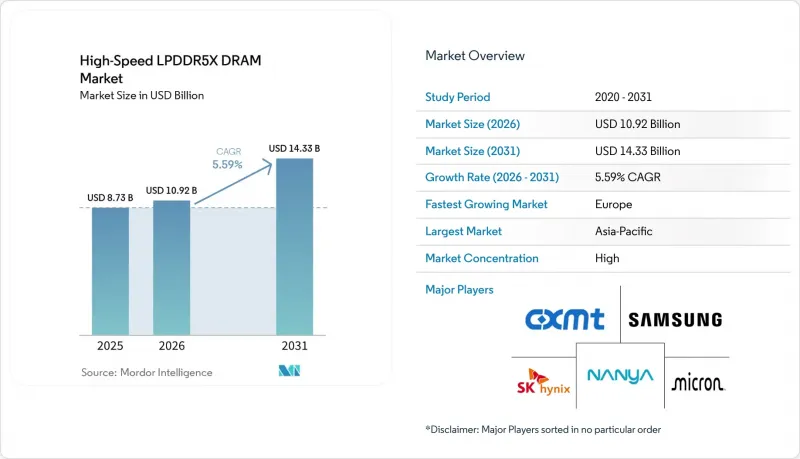
根據 Mordor Intelligence 預測,高速 LPDDR5X DRAM 的市場規模預計將從 2025 年的 87.3 億美元成長到 2026 年的 109.2 億美元,到 2031 年達到 143.3 億美元,2026 年至 2031 年的複合年成長率為 5.59%。
本報告依速度等級(每腳 7,500 Mb/s、8,533 Mb/s、9,600 Mb/s 和 10,667/10,700 Mb/s)、晶片容量(8 GB、12 GB、16 GB、24 GB、32 GB 及更高)、終端設備(智慧型電腦、平板裝置、輕薄電腦、輕薄電腦、輕薄電腦、平板設備/平板電腦、輕薄電腦、輕薄電腦、輕薄電腦、平板裝置、輕薄電腦)、平板裝置、輕薄電腦、輕電設備、輕電設備、平板電腦、輕薄電腦、輕電設備、智慧型電腦、平板裝置、輕薄電腦、平板裝置、輕電設備/平板裝置PC、Chromebook、車載資訊娛樂系統 (IVI)、高級駕駛輔助系統 (ADAS)、中央處理器 (CPU) 等)以及地區進行細分。市場預測以美元 (USD) 為單位。
全球高速LPDDR5X DRAM市場趨勢及洞察
搭載GenAI技術的旗艦智慧型手機內存容量增加
裝置端人工智慧 (AI) 對智慧型手機記憶體選擇的影響速度遠超傳統智慧型手機的換代週期。 2025 年 6 月,美光科技宣布,其基於一年製程的 10.7 Gbps LPDDR5X 記憶體將 Llama 2查詢回應時間提升了 30%,翻譯結果提升了 50% 以上,建議引擎效能提升了 25%。這表明,頻寬與行動裝置 AI 性能的提升直接相關。美光科技也表示,這些樣品採用 16 GB 封裝,並計劃在 2026 年為旗艦智慧型手機提供 8 GB 至 32 GB 的容量範圍。這與 AI 智慧型手機內存配置日益豐富的趨勢相符。三星的超薄 LPDDR5X 封裝解決了散熱和厚度方面的限制,使得在更輕薄的智慧型手機設計中實用化高密度記憶體成為可能。因此,高速 LPDDR5X 動態隨機存取記憶體 (DRAM) 市場將繼續與 AI 旗艦智慧型手機的發布緊密相關。這是因為設備製造商需要大容量和高數據傳輸速度來支援其設備上的推理功能。
8533相容高階SoC的標準化
在高階LPDDR5X的推出過程中,每腳8,533 Mb/s的規格已成為性能最穩定的點。 JEDEC LPDDR5X規範為控制器檢驗和運行參數建立了一個通用框架,有助於更廣泛的生態系統與該規格保持一致。隨後,CXMT確認了LPDDR5X產品的量產,並宣佈在8,533 Mbps、9,600 Mbps和10,667 Mbps規格方面取得了持續進展。這表明核心高階規格的主流產品供應鏈得到了改善。這對高速LPDDR5X DRAM市場具有重要意義,因為廣泛認可的速度規格降低了認證流程的門檻,並使更多元件專案能夠在通用平台上實現量產。此外,它還更清楚地分類了驅動擴展的規格和與高階差異化以及向新製程節點遷移相關的高速規格。
供應商集中度與分配風險
高速LPDDR5X DRAM的供應仍集中在少數幾家領先廠商手中。三星、SK海力士和美光憑藉其尖端的LPDDR5X產品繼續引領市場,而CXMT仍在努力鞏固其作為第四大可靠供應商的地位。 SK海力士推出面向伺服器的SOCAMM2晶片表明,LPDDR5X晶片正開始向智慧型手機以外的高價值應用領域拓展,這可能會加劇整個市場的配額管理。 CXMT的IPO招股說明書概述了其技術升級的投資計劃,但也證實競爭對手的追趕進程尚未完成,仍在進行中。因此,一旦旗艦智慧型手機、AI PC和AI伺服器封裝的需求同時成長,高速LPDDR5X DRAM市場將面臨供應調整的壓力。
細分市場分析
2025年,每腳8,533 Mb/s的LPDDR5X DRAM將佔據高速LPDDR5X DRAM市佔率的61.29%,成為高階裝置產品線的主要量產等級。這一地位體現了主流系統晶片(SoC)整個產品藍圖的長期檢驗。 LPDDR5X的擴充功能使記憶體控制器開發團隊有時間針對此速度等級進行最佳化。這種成熟度對於高速LPDDR5X DRAM市場意義重大,因為它降低了將大規模旗艦級和更高等級產品量產集中於單一、廣泛認可的等級的風險。隨著OEM廠商和供應商將更快的標準標準化,以適應向更高性能AI賦能元件的廣泛轉變,傳統的7,500 Mb/s等級的市場佔有率正在萎縮。 CXMT開始量產8,533 Mbps的LPDDR5X DRAM,進一步拓寬了這項商業性最重要的等級的供應選擇範圍。
預計到2031年,每腳10,667/10,700 Mb/s的LPDDR5X記憶體市場將以6.39%的複合年成長率成長,成為高速LPDDR5X DRAM市場中成長最快的速度等級。 2025年6月,美光宣布其基於1Y製程的LPDDR5X記憶體運行速度將達到10.7 Gbps,比7.5 Gbps的1B代產品速度提升43%,並表示其目標是在2026年應用於旗艦智慧型手機。三星也正在開發針對人工智慧應用最佳化的10.7 Gbps LPDDR5X產品,顯示主要供應商正在並行推進高速記憶體的研發。 9,600 Mb/s等級仍然發揮核心作用,因為它支援筆記型電腦記憶體模組和汽車記憶體項目,這些應用需要在速度、檢驗和系統級穩定性之間取得平衡。這在高速LPDDR5X DRAM市場中形成了一種分層結構。 8,533 Mb/s 可實現擴展,9,600 Mb/s 支援在各種平台上的柔軟性,而 10,667/10,700 Mb/s 則可滿足下一個高級升級週期的需求。
區域分析
到2025年,亞太地區將佔據高速LPDDR5X DRAM市場81.21%的佔有率,反映出該地區對記憶體製造、裝置組裝和最終產品的高度集中需求。韓國仍然是主要的生產基地,三星和SK海力士在行動、運算和汽車應用領域引領LPDDR5X先進藍圖的發展。中國作為主要的智慧型手機製造地和CXMT LPDDR5X業務拓展的關鍵市場,正從供需兩端鞏固亞太地區的基礎。根據CXMT的IPO招股說明書,該公司正在擴大其國內智慧型手機LPDDR基本客群,包括小米、OPPO、vivo和傳音,凸顯了在中國在地採購日益成長的重要性。台灣和日本透過封裝、電子製造和高可靠性應用為市場提供支持,而印度和東南亞的智慧型手機組裝量持續成長,並逐步過渡到配備LPDDR5X的機型。
預計到2031年,歐洲高速LPDDR5X DRAM市場將以6.37%的複合年成長率成長,成為該市場成長最快的地區。推動這一成長的主要動力來自軟體定義車輛(SDV)專案和集中式車輛運算,這些專案需要低功耗記憶體來滿足嚴格的可靠性和安全性要求。恩智浦半導體(NXP)的S32N7平台表明,汽車運算架構正在向域處理和中央處理模型轉變,以滿足更高的LPDDR5X部署要求。此外,歐洲企業和教育機構對人工智慧PC的日益普及也推動了對支援LPDDR5X的筆記型電腦設計及相關模組規格的需求。
北美地區在高速LPDDR5X動態隨機存取記憶體(DRAM)市場中仍佔據著重要的戰略地位,這主要得益於AI PC平台的發展趨勢、對超大規模運算的需求以及美光在該地區作為主要DRAM製造商的地位。美光目前豐富的LPDDR5X組件和LPCAM2模組產品組合,使該地區的系統製造商能夠同時利用行動裝置和筆記型電腦的外形尺寸。 SK海力士針對NVIDIA Vera-Rubin平台推出的SOCAMM2項目,進一步凸顯了北美作為AI伺服器部署中LPDDR5X需求新中心的地位。包括南美、中東和非洲以及大洋洲在內的世界其他地區,由於收入規模相對較小,且當地需求仍嚴重依賴進口設備和對成本敏感的產品,預計LPDDR5X的普及速度將較為緩慢。
其他好處:
- Excel格式的市場預測(ME)表
- 3個月的分析師支持
目錄
第1章:引言
- 研究假設和市場定義
- 調查範圍
第2章:調查方法
第3章執行摘要
第4章 市場狀況
- 市場概覽
- 市場促進因素
- 搭載GenAI技術的旗艦智慧型手機內存容量增加
- 8533就緒高階SoC的標準化
- LPDDR4X 產量的減少正在加速這一轉變。
- AI PC 和 Chromebook 採用低功耗內存
- 採用集中式運算和符合安全標準的LPDDR進行汽車應用。
- 由於封裝厚度減小,散熱性能得到提升,從而可以提高容量。
- 市場限制因素
- 供應商集中度與分配風險
- 中階處理器相容性差距
- 高速訊號和熱檢驗的負擔
- 價格敏感型設備中記憶體物料清單成本不斷上漲
- 產業供應鏈分析
- 產業價值鏈分析
- 監理情勢
- 技術展望
- 宏觀經濟因素的影響
- 波特五力分析
第5章 市場規模與成長預測
- 速度等級
- 每個引腳 7,500 Mb/s
- 每個引腳 8,533 Mb/s
- 每腳 9,600 Mb/s
- 每腳 10,667/10,700 Mb/s
- 按模具密度
- 8 GB
- 12 GB
- 16 GB
- 24 GB
- 32 GB
- 64 GB 或更多
- 透過終端設備
- 智慧型手機
- 藥片
- 輕薄筆記型電腦/人工智慧電腦
- Chromebook
- 汽車車載資訊娛樂系統 (IVI)、高級駕駛輔助系統 (ADAS) 和中央處理器
- 嵌入式/邊緣人工智慧設備和增強/虛擬實境
- 按地區
- 北美洲
- 歐洲
- 亞太地區
- 中國
- 日本
- 韓國
- 台灣
- 其他亞太國家
- 世界其他地區
第6章 競爭情勢
- 市場集中度
- 策略趨勢
- 市佔率分析
- 公司簡介
- Samsung Electronics Co., Ltd.
- SK hynix Inc.
- Micron Technology, Inc.
- ChangXin Memory Technologies Group Co., Ltd.
- Nanya Technology Corporation
- BIWIN Storage Technology Co., Ltd.
- ADATA Technology Co., Ltd.
- Innodisk Corporation
- Apacer Technology Inc.
- Framework Computer Inc.
- Memorysolution GmbH
- Jet One Technology Co., Ltd.
第7章 市場機會與未來展望
According to Mordor Intelligence, the high-speed LPDDR5X DRAM market size is expected to increase from USD 8.73 billion in 2025 to USD 10.92 billion in 2026 and reach USD 14.33 billion by 2031, growing at a CAGR of 5.59% over 2026-2031.
This report is Segmented by Speed Grade (7, 500 Mb/S Per Pin, 8, 533 Mb/S Per Pin, 9, 600 Mb/S Per Pin, and 10, 667 / 10, 700 Mb/S Per Pin), Die Density (8 GB, 12 GB, 16 GB, 24 GB, 32 GB, and More), End Device (Smartphones, Tablets, Thin-And-Light Notebooks / AI PCs, Chromebooks, Automotive IVI, ADAS, and Central Compute, and More), and Geography. The Market Forecasts are Provided in Terms of Value (USD).
Global High-Speed LPDDR5X DRAM Market Trends and Insights
GenAI Flagship Smartphone Memory Content Expansion
On-device AI is changing smartphone memory decisions faster than earlier handset upgrade cycles had assumed. Micron said in June 2025 that its 1Y-based LPDDR5X at 10.7 Gbps improved Llama 2 query response time by 30%, translation results by more than 50%, and recommendation engine performance by 25%, which tied bandwidth directly to visible AI performance gains in mobile devices. Micron also said those samples were being supplied in 16 GB packages, with an 8 GB to 32 GB capacity range planned for 2026 flagship smartphones, which aligns with the move toward richer memory configurations in AI-ready phones. Samsung's ultra-thin LPDDR5X package addresses heat resistance and thickness constraints, enabling practical use of higher memory density in slimmer phone designs. This keeps the high-speed LPDDR5X dynamic random-access memory (DRAM) market closely tied to flagship AI phone launches, as device makers now need both higher capacity and faster data rates to support on-device inference.
8533-Ready Premium SoC Standardization
The 8,533 Mb/s per pin class has become the most stable performance point for premium LPDDR5X deployments. JEDEC's LPDDR5X documentation established a common framework for controller validation and operating parameters, helping the broader ecosystem align around this grade. CXMT later confirmed mass production of LPDDR5X products and publicly showed continued progress across 8,533 Mbps, 9,600 Mbps, and 10,667 Mbps variants, which indicates that mainstream supply depth at the core premium grade is improving. This matters in the high-speed LPDDR5X DRAM market because a widely accepted speed grade lowers qualification friction and lets more device programs move to volume production on a common footing. It also creates a clearer boundary between the grade that drives scale and the faster bins that remain tied to premium differentiation and newer node transitions.
Supplier Concentration and Allocation Risk
Supply in the high-speed LPDDR5X DRAM market remains concentrated around a very small group of advanced manufacturers. Samsung, SK hynix, and Micron continue to lead the most advanced LPDDR5X products, while CXMT is still building its position as a fourth credible source. SK hynix's server-focused SOCAMM2 launch shows that LPDDR5X dies are now being directed into additional high-value formats beyond smartphones, which can tighten allocation discipline across the market. CXMT's IPO prospectus showed a planned investment path for technology upgrades, but it also confirmed that the competitive catch-up process is still underway rather than complete. That leaves the high-speed LPDDR5X DRAM market exposed to allocation pressure whenever flagship phone demand, AI PC demand, and AI server packaging demand rise at the same time.
Other drivers and restraints analyzed in the detailed report include:
- LPDDR4X Production Drawdown Accelerating Migration
- AI PC and Chromebook Low-Power Memory Uptake
- Memory BOM Inflation for Price-Sensitive Devices
For complete list of drivers and restraints, kindly check the Table Of Contents.
Segment Analysis
The 8,533 Mb/s per pin tier held 61.29% of the high-speed LPDDR5X DRAM market share in 2025, making it the primary volume grade for premium device programs. That position reflects a long validation window across leading system-on-chip roadmaps, because the LPDDR5X extension gave memory controller teams time to optimize around this speed class. In the high-speed LPDDR5X DRAM market, that maturity matters because it lowers the risk of moving large flagship and upper-tier volumes onto a single widely accepted grade. The earlier 7,500 Mb/s tier has been giving way as OEMs and suppliers standardize on higher speeds, consistent with the broader shift toward more capable AI-ready devices. CXMT's move into mass production at 8,533 Mbps also broadens supply options at the grade that carries the largest commercial weight.
The 10,667/10,700 Mb/s per pin segment is projected to grow at a 6.39% CAGR through 2031, making it the fastest-rising speed class in the high-speed LPDDR5X DRAM market. Micron said in June 2025 that its 1Y-based LPDDR5X operates at 10.7 Gbps and delivers a 43% speed increase over the 7.5 Gbps 1B generation, while also targeting 2026 flagship smartphones. Samsung also developed a 10.7 Gbps LPDDR5X product optimized for AI applications, demonstrating that leading suppliers are pushing the upper end of the speed range in parallel. The 9,600 Mb/s tier keeps a strong middle role, because it supports notebook modules and automotive memory programs that need a balance of speed, validation, and system-level stability. This creates a layered structure inside the high-speed LPDDR5X DRAM market, where 8,533 Mb/s drives scale, 9,600 Mb/s supports broader platform flexibility, and 10,667/10,700 Mb/s captures the next premium upgrade cycle.
Complete Report Scope:
- By Speed Grade
- 7,500 Mb/s per pin
- 8,533 Mb/s per pin
- 9,600 Mb/s per pin
- 10,667 / 10,700 Mb/s per pin
- By Die Density
- 8 GB
- 12 GB
- 16 GB
- 24 GB
- 32 GB
- 64 GB and Above
- By End Device
- Smartphones
- Tablets
- Thin-and-Light Notebooks / AI PCs
- Chromebooks
- Automotive IVI, ADAS and Central Compute
- Embedded / Edge AI Devices and AR/VR
- By Geography
- North America
- Europe
- Asia-Pacific
- China
- Japan
- South Korea
- Taiwan
- Rest of Asia-Pacific
- Rest of the World
Geography Analysis
Asia-Pacific accounted for 81.21% of the high-speed LPDDR5X DRAM market in 2025, reflecting the region's deep concentration of memory manufacturing, device assembly, and end-product demand. South Korea remains the leading production center, with Samsung and SK hynix driving much of the advanced LPDDR5X roadmap across mobile, computing, and automotive use cases. China reinforces the region on both the demand and supply sides, as it is a major smartphone manufacturing base and the home market for CXMT's LPDDR5X expansion. CXMT's IPO prospectus said the company had established a growing domestic smartphone LPDDR customer base, including Xiaomi, OPPO, vivo, and Transsion, underscoring the growing relevance of local sourcing in China. Taiwan and Japan add support through packaging, electronics manufacturing, and high-reliability applications, while India and Southeast Asia continue to absorb rising smartphone assembly volumes and a gradual move toward LPDDR5X-enabled models.
Europe is projected to grow at a 6.37% CAGR through 2031, making it the fastest-growing region in the high-speed LPDDR5X DRAM market. The strongest support comes from software-defined vehicle programs and centralized vehicle compute, where low-power memory must meet strict reliability and safety requirements. NXP's S32N7 platform demonstrates how automotive compute architectures are moving toward domain- and central-processing models that align with higher LPDDR5X content requirements. Europe also benefits from AI PC adoption in enterprise and education purchases, which supports demand for LPDDR5X notebook designs and related module formats.
North America remains a strategically important part of the high-speed LPDDR5X dynamic random access memory (DRAM) market because it combines AI PC platform activity, hyperscale compute demand, and Micron's position as the region's large-scale DRAM producer. Micron's current LPDDR5X component and LPCAMM2 module portfolio gives system makers in the region access to both mobile and notebook-oriented form factors. SK hynix's SOCAMM2 program for NVIDIA's Vera-Rubin platform further underlines North America's role as an emerging demand center for LPDDR5X in AI server deployments. The Rest of the World, including South America, the Middle East, Africa, and Oceania, remains a smaller revenue pool, where LPDDR5X adoption is likely to remain gradual because local demand still leans toward imported devices and cost-sensitive product tiers.
- Samsung Electronics Co., Ltd.
- SK hynix Inc.
- Micron Technology, Inc.
- ChangXin Memory Technologies Group Co., Ltd.
- Nanya Technology Corporation
- BIWIN Storage Technology Co., Ltd.
- ADATA Technology Co., Ltd.
- Innodisk Corporation
- Apacer Technology Inc.
- Framework Computer Inc.
- Memorysolution GmbH
- Jet One Technology Co., Ltd.
Additional Benefits:
- The market estimate (ME) sheet in Excel format
- 3 months of analyst support
TABLE OF CONTENTS
1 INTRODUCTION
- 1.1 Study Assumptions and Market Definition
- 1.2 Scope of the Study
2 RESEARCH METHODOLOGY
3 EXECUTIVE SUMMARY
4 MARKET LANDSCAPE
- 4.1 Market Overview
- 4.2 Market Drivers
- 4.2.1 GenAI Flagship Smartphone Memory Content Expansion
- 4.2.2 8533-Ready Premium SoC Standardization
- 4.2.3 LPDDR4X Production Drawdown Accelerating Migration
- 4.2.4 AI PC and Chromebook Low-Power Memory Uptake
- 4.2.5 Automotive Centralized Compute and Safety-Grade LPDDR Adoption
- 4.2.6 Thin-Package Thermal Gains Enabling Higher Capacities
- 4.3 Market Restraints
- 4.3.1 Supplier Concentration and Allocation Risk
- 4.3.2 Mid-Tier Processor Compatibility Gaps
- 4.3.3 High-Speed Signal and Thermal Validation Burden
- 4.3.4 Memory BOM Inflation for Price-Sensitive Devices
- 4.4 Industry Supply Chain Analysis
- 4.5 Industry Value Chain Analysis
- 4.6 Regulatory Landscape
- 4.7 Technological Outlook
- 4.8 Impact of Macroeconomic Factors
- 4.9 Porter's Five Forces Analysis
- 4.9.1 Bargaining Power of Suppliers
- 4.9.2 Bargaining Power of Buyers
- 4.9.3 Threat of New Entrants
- 4.9.4 Threat of Substitutes
- 4.9.5 Intensity of Competitive Rivalry
5 MARKET SIZE AND GROWTH FORECASTS (VALUE)
- 5.1 By Speed Grade
- 5.1.1 7,500 Mb/s per pin
- 5.1.2 8,533 Mb/s per pin
- 5.1.3 9,600 Mb/s per pin
- 5.1.4 10,667 / 10,700 Mb/s per pin
- 5.2 By Die Density
- 5.2.1 8 GB
- 5.2.2 12 GB
- 5.2.3 16 GB
- 5.2.4 24 GB
- 5.2.5 32 GB
- 5.2.6 64 GB and Above
- 5.3 By End Device
- 5.3.1 Smartphones
- 5.3.2 Tablets
- 5.3.3 Thin-and-Light Notebooks / AI PCs
- 5.3.4 Chromebooks
- 5.3.5 Automotive IVI, ADAS and Central Compute
- 5.3.6 Embedded / Edge AI Devices and AR/VR
- 5.4 By Geography
- 5.4.1 North America
- 5.4.2 Europe
- 5.4.3 Asia-Pacific
- 5.4.3.1 China
- 5.4.3.2 Japan
- 5.4.3.3 South Korea
- 5.4.3.4 Taiwan
- 5.4.3.5 Rest of Asia-Pacific
- 5.4.4 Rest of the World
6 COMPETITIVE LANDSCAPE
- 6.1 Market Concentration
- 6.2 Strategic Moves
- 6.3 Market Share Analysis
- 6.4 Company Profiles (includes Global Level Overview, Market Level Overview, Core Segments, Financials as available, Strategic Information, Market Rank/Share, Products and Services, Recent Developments)
- 6.4.1 Samsung Electronics Co., Ltd.
- 6.4.2 SK hynix Inc.
- 6.4.3 Micron Technology, Inc.
- 6.4.4 ChangXin Memory Technologies Group Co., Ltd.
- 6.4.5 Nanya Technology Corporation
- 6.4.6 BIWIN Storage Technology Co., Ltd.
- 6.4.7 ADATA Technology Co., Ltd.
- 6.4.8 Innodisk Corporation
- 6.4.9 Apacer Technology Inc.
- 6.4.10 Framework Computer Inc.
- 6.4.11 Memorysolution GmbH
- 6.4.12 Jet One Technology Co., Ltd.
7 MARKET OPPORTUNITIES AND FUTURE OUTLOOK
- 7.1 White-Space and Unmet-Need Assessment

 802.11ac Wave 2 市場規模、佔有率和成長分析:按組件、設備類型、頻段、最終用戶、應用、分銷管道和地區分類 - 行業預測,2026-2033 年
 日本快閃記憶體市場:市場佔有率分析、產業趨勢與統計及成長預測(2026-2031)
 軍用級保護殼市場分析與預測(至2035年):類型、產品、服務、技術、應用、材料類型、部署、最終用戶、功能、安裝配置
 人工智慧蓬勃發展與DRAM供不應求:全球DRAM市場展望(2027年)人工智慧記憶體:市場佔有率分析、產業趨勢與統計、成長預測(2026-2031)汽車產業NOR快閃記憶體:市場佔有率分析、產業趨勢與統計及成長預測(2026-2031年)AI加速器記憶體:市場佔有率分析、產業趨勢與統計資料、成長預測(2026-2031年)德國 NOR Flush:市場佔有率分析、行業趨勢和統計數據、成長預測(2026-2031 年)東南亞NOR快閃記憶體:市場佔有率分析、產業趨勢與統計、成長預測(2026-2031年)NOR Flush(英國):市場佔有率分析、行業趨勢和統計數據、成長預測(2026-2031 年)