


 |
市場調查報告書
商品編碼
2099810
人工智慧記憶體:市場佔有率分析、產業趨勢與統計、成長預測(2026-2031)AI Memory - Market Share Analysis, Industry Trends & Statistics, Growth Forecasts (2026 - 2031) |
||||||

※ 本網頁內容可能與最新版本有所差異。詳細情況請與我們聯繫。
根據 Mordor Intelligence 預測,人工智慧記憶體市場規模將從 2025 年的 217.2 億美元成長到 2026 年的 279.3 億美元,然後在 2031 年達到 982.8 億美元,2026 年至 2031 年的複合年成長率為 28.61%。
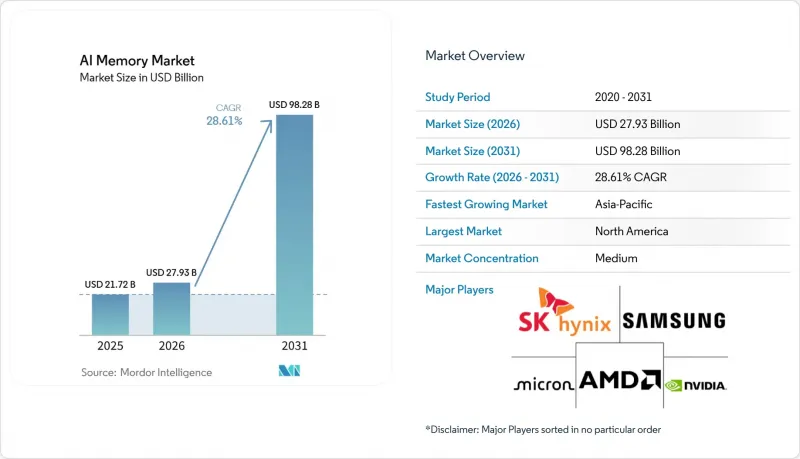
本報告按記憶體技術(HBM、用於AI伺服器的DRAM、GDDR、用於AI邊緣記憶體的LPDDR等)、AI應用(AI訓練和模型開發、AI推理、高效能運算和科學領域的AI)、運算平台(AI伺服器、AI運算加速器、AI網路基礎設施、邊緣AI系統等)以及地區進行細分。市場預測以美元(USD)為單位。
全球人工智慧記憶體市場趨勢與洞察
在人工智慧加速器中擴大 HBM3E 和 HBM4 的應用
隨著加速器廠商在每一代新平台上不斷追求更高的頻寬和能源效率,HBM3E 向 HBM4 的過渡正在加速。 2026 年 5 月,NVIDIA 宣布其 Vera Rubin 平台已進入全面量產階段。這證實了對下一代記憶體的需求與實際生產部署直接相關,而不僅僅是早期樣品的供應。這一點意義重大,因為 HBM 不再是尖端 AI 系統的高階選項,而是計算堆疊中不可或缺的元件。隨著買家將硬體藍圖與更高效能的加速器相匹配,記憶體規劃將更早啟動,並持續更長時間。這將使採購模式從短期組件採購轉向平台級承諾。在 AI 記憶體市場,這一趨勢將使 HBM 繼續保持其在收入成長和策略供應商地位方面的核心地位。
超大規模 AI 伺服器叢集擴展
大規模人工智慧伺服器專案正從分階段試點運行過渡到涵蓋整個雲端基礎架構的全面引進週期。 2026年2月,AMD和Meta Platforms宣布擴大合作,共同部署6吉瓦的AMD GPU基礎設施,預計首批1吉瓦產品將於2026年下半年開始出貨。如此大規模的部署將同時引入HBM、伺服器DRAM、儲存記憶體和網路記憶體。這意味著成長將不再局限於單一記憶體類型,而是遍及支援人工智慧叢集的整個技術堆疊。能夠提供可靠認證、穩定產量和藍圖連續性的供應商將更具優勢。因此,人工智慧記憶體市場正受益於伺服器數量的成長以及每個部署系統中記憶體容量的增加。
封裝層面的嚴格熱設計和良率限制。
與傳統記憶體相比,先進堆疊式記憶體更難擴展,因為更多層需要在更窄的熱設計範圍內協同工作。這一點對於HBM(高密度記憶體)尤其重要,因為成品的品質很大程度取決於封裝品質和晶圓供應。即使終端需求強勁,封裝效能不佳也可能導致加速器交付延遲。此外,每一代產品在量產出貨前都必須滿足熱設計、可靠性和平台級要求,而檢驗也需要時間。這會縮短新一代產品量產的有效週期。因此,即使在需求強勁的環境下,人工智慧記憶體市場仍然容易受到封裝級執行風險的影響。
細分市場分析
2025年,HBM佔據了AI記憶體市場55.60%的佔有率,這表明超大規模訓練基礎設施對當年的收入產生了顯著影響。這一主導地位源自於主流AI加速器依賴極高頻寬的內存,否則它們將無法維持預期的吞吐量。 NVIDIA於2026年5月宣布Vera Rubin將全面投產,證實了隨著下一代系統的全面部署,對HBM的需求將持續成長。用於AI伺服器的DRAM仍然保持著第二大技術層級的地位,因為大規模AI系統仍需要在加速器周圍配備充足的主記憶體。
受GDDR7商用部署的推動,GDDR預計將在AI記憶體市場實現最快的成長,到2031年複合年成長率將達到29.44%。 Rambus指出,GDDR7已於2024年3月由JEDEC標準化,為圖形和加速器應用帶來更高的效能。在AI記憶體產業,這將使GDDR在GPU和邊緣加速器領域佔據更有利的地位,這些裝置需要更高的頻寬,但不一定需要HBM級封裝。 LPDDR作為一種AI邊緣內存,預計也將隨著推理系統和邊緣設備在嚴格的散熱限制下對每瓦頻寬而擴展。其他記憶體技術,特別是基於CXL的擴展技術,預計也將進一步成長。 Penguin Solutions在2026年3月宣布推出一款可量產的基於CXL的KV快取伺服器,其記憶體容量高達11TB,適用於企業級推理應用。
區域分析
到2025年,北美將佔據AI記憶體市場38.41%的佔有率,成為最大的區域需求中心。這一主導地位源自於超大規模資料中心業者對AI基礎設施的擴張,這使得記憶體不再只是日常伺服器元件,而是成為一項策略性採購專案。此外,該地區還聚集了許多大型雲端平台和加速器平台買家,為認證供應商提供了強勁的市場動力。因此,無論是在短期資源配置決策或長期平台規劃方面,北美都將繼續在AI記憶體市場佔據核心地位。
預計到2031年,亞太地區將以29.48%的複合年成長率成長,成為人工智慧記憶體市場成長最快的地區。該地區在需求和生產兩端都扮演著至關重要的角色,擁有許多大型HBM製造地和完善的封裝生態系統。韓國仍然是先進人工智慧記憶體的核心生產中心,而日本正透過對HBM產能的新投資,進一步鞏固其作為重要製造地的地位。在中國,儘管技術限制了可部署的記憶體基礎設施類型,但國內人工智慧模型的不斷發展正在創造新的需求基礎。在雲端運算的擴張和人工智慧新創企業數量的成長的推動下,印度預計在預測期內崛起為消費市場。
儘管到2025年,歐洲和其他地區在人工智慧記憶體市場的佔有率將會縮小,但它們的需求模式卻具有鮮明的戰略特色。在歐洲,需求主要集中在工業人工智慧、金融服務、生命科學以及注重可追溯性和能源效率的國家主導運算項目。南美、中東和非洲仍處於早期市場階段,但隨著主權雲端專案的發展和資料中心投資的不斷擴大,全部區域對人工智慧推理的需求正在持續成長。這意味著,儘管北美仍然是銷售最集中的地區,亞太地區仍然是生產最集中的地區,但人工智慧記憶體市場的全球覆蓋範圍正在不斷擴大。
其他好處:
- Excel格式的市場預測(ME)表
- 3個月的分析師支持
目錄
第1章:引言
- 研究假設和市場定義
- 調查範圍
第2章:調查方法
第3章執行摘要
第4章 市場狀況
- 市場概覽
- 市場促進因素
- 在人工智慧加速器中擴大 HBM3E 和 HBM4 的應用
- 人工智慧訓練和推理中計算密度的增加
- 超大規模 AI 伺服器叢集擴展
- 提高最先進GPU和ASIC的每瓦頻寬需求
- 長上下文智慧體人工智慧工作負載中鍵值快取的持續成長
- AI伺服器和機架的記憶體容量增加
- 市場限制因素
- 封裝層面存在嚴格的散熱和良率限制。
- 先進高密度脂蛋白(HBM)的供應基礎合格。
- 對先進包裝能力的高度依賴
- 所有世代的人體生物模型通用著快速過時的風險。
- 產業價值鏈分析
- 產業供應鏈分析
- 宏觀經濟因素對市場的影響
- 監理情勢
- 技術展望
- 波特五力分析
第5章 市場規模與成長預測
- 透過儲存技術
- HBM
- 用於人工智慧伺服器的DRAM
- GDDR
- AI Edge 記憶體 LPDDR
- 其他儲存技術(CXL 儲存和其他新興儲存類型)
- 人工智慧應用類別
- 人工智慧訓練和模型開發
- 人工智慧推理
- 高效能運算和科學人工智慧
- 透過運算平台
- 人工智慧伺服器
- 人工智慧運算加速器
- 人工智慧網路基礎設施
- 邊緣人工智慧系統
- 其他運算平台(專用人工智慧運算平台和人工智慧工作站)
- 按地區
- 北美洲
- 美國
- 加拿大
- 墨西哥
- 歐洲
- 英國
- 德國
- 法國
- 義大利
- 其他歐洲國家
- 亞太地區
- 中國
- 日本
- 韓國
- 印度
- 其他亞太國家
- 南美洲
- 中東和非洲
- 北美洲
第6章 競爭情勢
- 市場集中度
- 策略趨勢
- 市佔率分析
- 公司簡介
- SK hynix Inc.
- Samsung Electronics Co., Ltd.
- Micron Technology, Inc.
- NVIDIA Corporation
- Advanced Micro Devices, Inc.
- Intel Corporation
- Broadcom Inc.
- Marvell Technology, Inc.
- Taiwan Semiconductor Manufacturing Company Limited
- ASML Holding NV
- Applied Materials, Inc.
- Lam Research Corporation
- KLA Corporation
- Tokyo Electron Limited
- Amkor Technology, Inc.
- ASE Technology Holding Co., Ltd.
- JCET Group Co., Ltd.
- Powertech Technology Inc.
- Google LLC
- Amazon.com, Inc.
- Meta Platforms, Inc.
第7章 市場機會與未來展望
According to Mordor Intelligence, the AI memory market size is expected to grow from USD 21.72 billion in 2025 to USD 27.93 billion in 2026 and is forecast to reach USD 98.28 billion by 2031 at 28.61% CAGR over 2026-2031.
This report is Segmented by Memory Technology (HBM, AI Server DRAM, GDDR, AI Edge Memory LPDDR, and More), AI Application (AI Training and Model Development, AI Inference, and AI Inference, and HPC and Scientific AI), Computing Platform (AI Servers, AI Compute Accelerators, AI Networking Infrastructure, Edge AI Systems, and More), and Geography. The Market Forecasts are Provided in Terms of Value (USD).
Global AI Memory Market Trends and Insights
Growing Adoption of HBM3E And HBM4 in AI Accelerators
The move from HBM3E to HBM4 is progressing quickly as accelerator vendors push for more bandwidth and better power efficiency in each new platform generation. NVIDIA stated in May 2026 that the Vera Rubin platform was ramping into full production, which confirms that next-generation memory demand is now tied directly to production deployments rather than early sampling activity. This matters because HBM is no longer a premium option inside leading AI systems and has become a required part of the compute stack. As buyers align hardware roadmaps with more capable accelerators, memory planning starts earlier and stays locked in for longer periods. That shifts procurement from short-cycle component buying toward platform-level commitment. For the AI memory market, this keeps HBM at the center of revenue growth and strategic supplier positioning.
Expansion of Hyperscale AI Server Fleets
Large AI server programs are moving from staged pilots to committed deployment cycles across cloud infrastructure. AMD and Meta Platforms announced in February 2026 an expanded partnership to deploy 6 gigawatts of AMD GPU infrastructure, with shipments for the first-gigawatt phase beginning in the second half of 2026. Each rollout of that scale pulls in HBM, server DRAM, storage memory, and networking memory at the same time. That means growth is not confined to a single memory type and instead spreads across the full stack that supports AI clusters. It also favors suppliers that can offer dependable qualification, stable output, and roadmap continuity. The AI memory market is therefore benefiting from both larger fleet counts and higher memory content inside each deployed system.
High Package-Level Thermal and Yield Constraints
Advanced stacked memory is harder to scale than conventional memory because more layers have to perform together inside a tighter thermal envelope. This is especially important in HBM, where finished output depends on packaging quality as much as wafer supply. If packaging performance slips, accelerator deliveries can slow even when end demand stays firm. Validation also takes time because each generation has to clear thermal, reliability, and platform-level requirements before volume shipment. That can narrow the usable ramp window for a new product generation. The AI memory market therefore stays exposed to package-level execution risk even when demand conditions remain strong.
Other drivers and restraints analyzed in the detailed report include:
- Rising AI Training and Inference Compute Density
- Memory Content Inflation in AI Servers and Racks
- Limited Qualified Supply Base for Advanced HBM
For complete list of drivers and restraints, kindly check the Table Of Contents.
Segment Analysis
HBM held 55.60% of AI memory market share in 2025, which shows how strongly hyperscale training infrastructure shaped revenue during the year. Its lead came from the fact that leading AI accelerators depend on very high bandwidth memory and cannot sustain expected throughput without it. NVIDIA said in May 2026 that Vera Rubin was ramping into full production, which supports continued HBM demand as next-generation systems move into active deployment. AI Server DRAM remained the second-largest technology layer because large AI systems still need substantial main memory around the accelerator complex.
GDDR is projected to record the fastest AI memory market size growth at 29.44% CAGR through 2031, supported by the commercial rollout of GDDR7. Rambus noted that GDDR7 was standardized by JEDEC in March 2024 and brought a higher-performance path for graphics and accelerator applications. Within the AI memory industry, that gives GDDR a stronger position in GPUs and edge accelerators that need higher bandwidth but do not always require HBM-class packaging. AI Edge Memory LPDDR is also set to expand as inference systems and edge devices need better bandwidth per watt under tight thermal limits. Other memory technology, including CXL-based expansion, adds a longer runway because Penguin Solutions introduced a production-ready CXL-based KV cache server with up to 11TB of memory for enterprise inference in March 2026.
Complete Report Scope:
- By Memory Technology
- HBM
- AI Server DRAM
- GDDR
- AI Edge Memory LPDDR
- Other Memory Technologies (CXL Memory and Other Emerging Memory Types)
- By AI Application
- AI Training and Model Development
- AI Inference
- HPC and Scientific AI
- By Computing Platform
- AI Servers
- AI Compute Accelerators
- AI Networking Infrastructure
- Edge AI Systems
- Other Computing Platforms (Specialized AI Computing Platforms and AI Workstations)
- By Geography
- North America
- United States
- Canada
- Mexico
- Europe
- United Kingdom
- Germany
- France
- Italy
- Rest of Europe
- Asia-Pacific
- China
- Japan
- South Korea
- India
- Rest of Asia-Pacific
- South America
- Middle East and Africa
- North America
Geography Analysis
North America held 38.41% of AI memory market share in 2025, which made it the largest regional demand center. Its lead came from hyperscaler AI infrastructure buildouts that turned memory into a strategic procurement item instead of a routine server component. The region also benefits from the concentration of major cloud and accelerator platform buyers, which gives it strong pull on qualified supply. This keeps North America central to both near-term allocation decisions and longer-term platform planning in the AI memory market.
Asia-Pacific is projected to grow at a 29.48% CAGR through 2031, making it the fastest-growing region in the AI memory market. The region matters on both the demand side and the production side because it houses the main HBM manufacturing base and much of the supporting packaging ecosystem. South Korea remains the core production center for advanced AI memory, while Japan is strengthening its role as an additional manufacturing node through new investment in HBM capacity. China adds another layer of demand through rising domestic AI model development, even as technology restrictions shape the type of memory infrastructure that can be deployed. India is emerging more as a consumption market during the forecast period, supported by cloud expansion and a growing AI startup base.
Europe and the remaining regions represented a smaller share of the AI memory market in 2025, but their demand pattern is strategically distinct. In Europe, demand is centered on industrial AI, financial services, life sciences, and sovereign computing programs that place a premium on traceability and energy efficiency. South America, the Middle East, and Africa remain earlier-stage markets, yet they are developing additional AI inference demand through sovereign cloud programs and wider regional data center investment. This means the global footprint of the AI memory market is broadening even though revenue concentration remains highest in North America and production concentration remains strongest in Asia-Pacific.
- SK hynix Inc.
- Samsung Electronics Co., Ltd.
- Micron Technology, Inc.
- NVIDIA Corporation
- Advanced Micro Devices, Inc.
- Intel Corporation
- Broadcom Inc.
- Marvell Technology, Inc.
- Taiwan Semiconductor Manufacturing Company Limited
- ASML Holding N.V.
- Applied Materials, Inc.
- Lam Research Corporation
- KLA Corporation
- Tokyo Electron Limited
- Amkor Technology, Inc.
- ASE Technology Holding Co., Ltd.
- JCET Group Co., Ltd.
- Powertech Technology Inc.
- Google LLC
- Amazon.com, Inc.
- Meta Platforms, Inc.
Additional Benefits:
- The market estimate (ME) sheet in Excel format
- 3 months of analyst support
TABLE OF CONTENTS
1 INTRODUCTION
- 1.1 Study Assumptions and Market Definition
- 1.2 Scope of the Study
2 RESEARCH METHODOLOGY
3 EXECUTIVE SUMMARY
4 MARKET LANDSCAPE
- 4.1 Market Overview
- 4.2 Market Drivers
- 4.2.1 Growing Adoption of HBM3E and HBM4 in AI Accelerators
- 4.2.2 Rising AI Training and Inference Compute Density
- 4.2.3 Expansion of Hyperscale AI Server Fleets
- 4.2.4 Higher Bandwidth Demand Per Watt in Advanced GPUs and ASICs
- 4.2.5 Persistent KV Cache Growth in Long-Context Agentic AI Workloads
- 4.2.6 Memory Content Inflation in AI Servers and Racks
- 4.3 Market Restraints
- 4.3.1 High Package-Level Thermal and Yield Constraints
- 4.3.2 Limited Qualified Supply Base for Advanced HBM
- 4.3.3 Heavy Dependence on Advanced Packaging Capacity
- 4.3.4 Rapid Obsolescence Risk Across HBM Generations
- 4.4 Industry Value Chain Analysis
- 4.5 Industry Supply Chain Analysis
- 4.6 Impact of Macroeconomic Factors on the Market
- 4.7 Regulatory Landscape
- 4.8 Technological Outlook
- 4.9 Porter's Five Forces Analysis
- 4.9.1 Bargaining Power of Suppliers
- 4.9.2 Bargaining Power of Buyers
- 4.9.3 Threat of New Entrants
- 4.9.4 Threat of Substitutes
- 4.9.5 Competitive Rivalry
5 MARKET SIZE AND GROWTH FORECASTS (VALUE)
- 5.1 By Memory Technology
- 5.1.1 HBM
- 5.1.2 AI Server DRAM
- 5.1.3 GDDR
- 5.1.4 AI Edge Memory LPDDR
- 5.1.5 Other Memory Technologies (CXL Memory and Other Emerging Memory Types)
- 5.2 By AI Application
- 5.2.1 AI Training and Model Development
- 5.2.2 AI Inference
- 5.2.3 HPC and Scientific AI
- 5.3 By Computing Platform
- 5.3.1 AI Servers
- 5.3.2 AI Compute Accelerators
- 5.3.3 AI Networking Infrastructure
- 5.3.4 Edge AI Systems
- 5.3.5 Other Computing Platforms (Specialized AI Computing Platforms and AI Workstations)
- 5.4 By Geography
- 5.4.1 North America
- 5.4.1.1 United States
- 5.4.1.2 Canada
- 5.4.1.3 Mexico
- 5.4.2 Europe
- 5.4.2.1 United Kingdom
- 5.4.2.2 Germany
- 5.4.2.3 France
- 5.4.2.4 Italy
- 5.4.2.5 Rest of Europe
- 5.4.3 Asia-Pacific
- 5.4.3.1 China
- 5.4.3.2 Japan
- 5.4.3.3 South Korea
- 5.4.3.4 India
- 5.4.3.5 Rest of Asia-Pacific
- 5.4.4 South America
- 5.4.5 Middle East and Africa
- 5.4.1 North America
6 COMPETITIVE LANDSCAPE
- 6.1 Market Concentration
- 6.2 Strategic Moves
- 6.3 Market Share Analysis
- 6.4 Company Profiles (includes Global Level Overview, Market Level Overview, Core Segments, Financials as available, Strategic Information, Market Rank/Share, Products and Services, Recent Developments)
- 6.4.1 SK hynix Inc.
- 6.4.2 Samsung Electronics Co., Ltd.
- 6.4.3 Micron Technology, Inc.
- 6.4.4 NVIDIA Corporation
- 6.4.5 Advanced Micro Devices, Inc.
- 6.4.6 Intel Corporation
- 6.4.7 Broadcom Inc.
- 6.4.8 Marvell Technology, Inc.
- 6.4.9 Taiwan Semiconductor Manufacturing Company Limited
- 6.4.10 ASML Holding N.V.
- 6.4.11 Applied Materials, Inc.
- 6.4.12 Lam Research Corporation
- 6.4.13 KLA Corporation
- 6.4.14 Tokyo Electron Limited
- 6.4.15 Amkor Technology, Inc.
- 6.4.16 ASE Technology Holding Co., Ltd.
- 6.4.17 JCET Group Co., Ltd.
- 6.4.18 Powertech Technology Inc.
- 6.4.19 Google LLC
- 6.4.20 Amazon.com, Inc.
- 6.4.21 Meta Platforms, Inc.
7 MARKET OPPORTUNITIES AND FUTURE OUTLOOK
- 7.1 White-Space and Unmet-Need Assessment

 802.11ac Wave 2 市場規模、佔有率和成長分析:按組件、設備類型、頻段、最終用戶、應用、分銷管道和地區分類 - 行業預測,2026-2033 年
 日本快閃記憶體市場:市場佔有率分析、產業趨勢與統計及成長預測(2026-2031)
 軍用級保護殼市場分析與預測(至2035年):類型、產品、服務、技術、應用、材料類型、部署、最終用戶、功能、安裝配置
 人工智慧蓬勃發展與DRAM供不應求:全球DRAM市場展望(2027年)汽車產業NOR快閃記憶體:市場佔有率分析、產業趨勢與統計及成長預測(2026-2031年)AI加速器記憶體:市場佔有率分析、產業趨勢與統計資料、成長預測(2026-2031年)高速LPDDR5X DRAM:市場佔有率分析、產業趨勢與統計數據、成長預測(2026-2031年)德國 NOR Flush:市場佔有率分析、行業趨勢和統計數據、成長預測(2026-2031 年)東南亞NOR快閃記憶體:市場佔有率分析、產業趨勢與統計、成長預測(2026-2031年)NOR Flush(英國):市場佔有率分析、行業趨勢和統計數據、成長預測(2026-2031 年)