


 |
市場調查報告書
商品編碼
2100758
汽車產業NOR快閃記憶體:市場佔有率分析、產業趨勢與統計及成長預測(2026-2031年)NOR Flash Memory for the Automotive Industry - Market Share Analysis, Industry Trends & Statistics, Growth Forecasts (2026 - 2031) |
||||||

※ 本網頁內容可能與最新版本有所差異。詳細情況請與我們聯繫。
據 Mordor Intelligence 稱,汽車行業 NOR 快閃記憶體的市場規模預計將從 2025 年的 5.7516 億美元成長到 2026 年的 6.1566 億美元,預計到 2031 年將達到 8.6521 億美元。
預計從 2026 年到 2031 年,其複合年成長率將達到 7.04%。
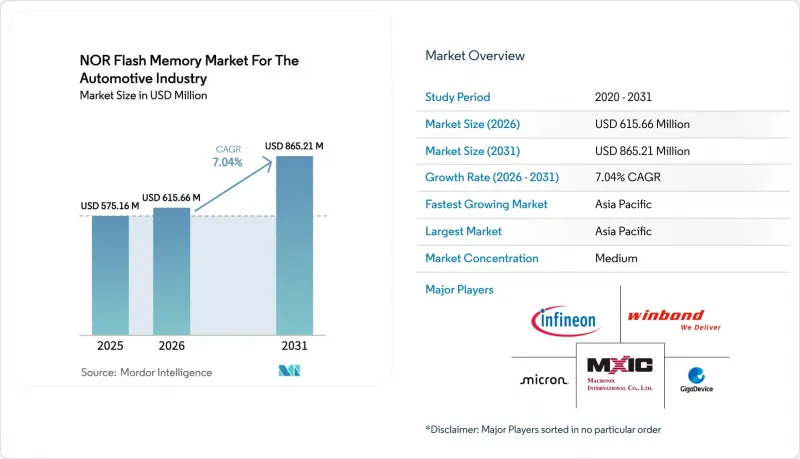
本報告按類型(串行、平行)、介面(SPI 單/雙介面、其他)、容量(2 Mb 或更小 NOR 介面、其他)、電壓(3V 等級、1.8V 等級、其他)、製程節點(90 nm 及更早、其他)、封裝類型(WLCSP/CSP、QFN/SOIC、其他)及地區進行細分。市場預測以價值(美元)和數量(單位)表示。
汽車產業NOR快閃記憶體市場的趨勢與發展。
ADAS 和網域控制器的程式碼大小呈爆炸式成長,推動了對汽車串列 NOR 的需求。
現代汽車軟體的程式碼量已超過十億行,韌體容量遠遠超出傳統儲存的極限。 ADAS模組已佔據應用需求的很大一部分,其程式碼量是分散式ECU設計的四倍之多。美光預測,到2026年,單一設備的總記憶體容量將成長三倍,到2030年,高階車型的記憶體容量將達到4TB。這一趨勢使得串行NOR快閃記憶體成為安全關鍵邏輯的即時啟動儲存標準,並顯著推動了汽車NOR快閃記憶體市場的成長。
基於區域/服務導向的電子電氣架構需要即時啟動內存
在區域架構中,功能按物理域進行集群,要求記憶體能夠在 100 毫秒內啟動核心子系統。原地執行 (XIP) 功能使串行 NOR 成為理想的啟動介質,結合八進位介面,讀取吞吐量可達 400 MB/s。美光的功能安全藍圖與此轉型相契合,將自主性、電氣化和連接性的 ASIL 機制整合到單一設備套件中。預計到 2030 年,OEM 廠商從分散式拓撲向區域拓撲的轉變將涵蓋大多數新平台,從而鞏固對低延遲 NOR 的需求。
容量超過 256 Mb 的 QSPI NAND 的成本溢價限制了其在資訊娛樂系統中的應用。
在容量超過256Mb時,NOR快閃記憶體的價格比QSPI NAND快閃記憶體高出約35%,這阻礙了其在對成本要求較高的車載資訊娛樂系統中的普及。技嘉科技的混合快閃記憶體GD5F1GM9旨在以接近NAND快閃記憶體的成本實現與NOR快閃記憶體相近的讀取效能,從而逐步削弱NOR快閃存在安全性要求不高的細分市場中的優勢。因此,中型OEM廠商正延後採用高容量NOR閃存,減緩了NOR快閃存在汽車產業的整體成長動能。
細分市場分析
串行NOR快閃記憶體元件憑藉其引腳數量更少、電磁相容性(EMC)優於平行裝置的優勢,預計到2025年將佔據汽車NOR快閃記憶體市場80.65%的佔有率。該技術的「原地執行」功能允許直接執行程式碼,從而最大限度地減少啟動延遲,這對於ADAS和網域控制器至關重要。雖然八進位介面正在縮小與平行裝置的頻寬差距,但串行NOR快閃記憶體仍然保持著其在基板空間方面的優勢,並且預計這一優勢將繼續保持。並行NOR快閃記憶體裝置目前仍主要用於頻寬已飽和的舊有系統和資訊娛樂模組,預計其市場佔有率將持續下降。
該領域的成長勢頭依賴於創新技術,例如Microchip的「SuperFlash」分柵架構,可將擦除時間縮短至25毫秒以內。隨著汽車製造商向集中式和分區式平台轉型,韌體容量不斷增加,但引腳高效的封裝方式仍然備受青睞。因此,儘管每個插槽的絕對容量在增加,但串行NOR快閃存在汽車行業的市場佔有率預計只會略有上升。
儘管預計到 2025 年 Quad SPI 將佔據 40.62% 的市場佔有率,但 Octal SPI 正以 7.12% 的複合年成長率 (CAGR) 持續成長至 2031 年,這主要得益於其高達 400 MB/s 的讀取速度。此介面可在 20 毫秒內實現加密安全啟動,滿足監管要求和最終用戶對即時啟動的期望。美光的 Xccela 系列產品正是這一飛躍的體現,它將高頻寬與 AEC-Q100 1 級可靠性完美結合。由於 JEDEC 的 xSPI 標準確保了跨廠商相容性,系統設計人員正傾向於選擇 Octal SPI 以確保未來的可擴展性。
單/雙路SPI介面在基礎汽車電子模組中憑藉成本優勢仍佔據一定的市場佔有率,但不太可能重新奪回失去的市場佔有率。在汽車產業的NOR快閃記憶體市場,預計到2031年,八路解決方案的規模將顯著擴大,而隨著對同等OTA吞吐量的追求不斷提高,對四路解決方案的需求預計將逐步成長。
區域分析
2025年,底特律和矽谷的合作加速了軟體定義汽車(SDV)專案的推進,使北美在汽車NOR快閃貨出貨量中佔據了相當大的佔有率。隨著網路安全監管力道的不斷加強,安全啟動和認證更新記憶體的應用也在穩步推進。 《晶片和資訊安全法案》(CHIPS Act)的獎勵旨在實現關鍵半導體的在地採購,從而有望降低跨太平洋的物流風險。
歐洲仍然是至關重要的市場,這主要得益於高階品牌率先採用基於區域的架構,從而推動了對高頻寬NOR快閃記憶體的需求。嚴格的ISO 26262合規標準持續強化了ASIL認證元件的採購趨勢。歐盟計劃在2030年將其半導體製造能力加倍,重點發展更大節點的汽車生產線,為應對遠東地區供應中斷提供了戰略風險對沖。
亞太地區是汽車NOR快閃記憶體市場供應量的主要驅動力。中國積極擴張採用55nm/40nm製程的製造地,不僅能滿足國內快速成長的電動車產業的供應需求,也對全球價格造成下行壓力。日本和韓國依靠成熟的IDM生態系統來確保車規級產品品質的穩定性,而台灣作為先進光刻技術中心,則存在系統性的地緣政治風險。預計東協與中日韓(ASEAN+3)集團將維持電子產品出口成長勢頭,宏觀經濟成長預計將持續強勁至2026年。
其他福利
- Excel格式的市場預測(ME)表
- 3個月的分析師支持
目錄
第1章:引言
- 研究假設和市場定義
- 調查範圍
第2章:調查方法
第3章執行摘要
第4章 市場狀況
- 市場概覽
- 市場促進因素
- ADAS 和網域控制站的程式碼量激增,推動了對汽車串列 NOR 閘的需求增加。
- 需要即時啟動記憶體的基於區域/服務導向的電子電氣架構
- Octal 和 xSPI 的廣泛應用使得軟體定義車輛能夠在 20 毫秒內實現安全啟動。
- 中國 55nm/40nm 汽車 NOR 產能的不斷擴大,正在推動 OEM 廠商實現本土化。
- 電動車動力傳動系統的電氣化正在推動高密度 NOR 記憶體的普及,每個 ECU 的儲存容量超過 256 Mb。
- 市場限制因素
- 容量超過 256Mb 的 Qspi NAND 的成本溢價限制了車載資訊娛樂系統的普及。
- 超越 40nm 製程的擴展瓶頸-用於實現超過 1Gb 程式碼容量的 MRAM/ReRAM藍圖
- 鑄造廠集中在台灣和中國大陸,加劇了地緣政治供應鏈風險。
- 來自中國的新參與企業給ASP帶來了壓力,導致研發預算捉襟見肘。
- 產業價值鏈分析
- 宏觀經濟趨勢影響分析
- 監管和技術展望
- 波特五力分析
- 價格分析
第5章 市場規模與成長預測
- 按類型
- 序號
- 平行線
- 透過介面
- SPI 單/雙路
- Quad SPI
- 八進位和xSPI
- 按產能
- 2MB 或更少
- 2~4Mb
- 4~8Mb
- 8~16Mb
- 16~32Mb
- 32~64Mb
- 64~128Mb
- 128~256Mb
- 超過 256MB
- 透過電壓
- 3V級
- 1.8V 類
- 寬電壓範圍(1.65至3.6V)
- 其他電壓
- 依製程技術節點
- 90奈米及更早
- 65nm
- 55奈米(包括58奈米)
- 45nm
- 28奈米或更小
- 按包裝類型
- WLCSP/CSP
- QFN/SOIC
- BGA/FBGA
- 其他
- 按地區
- 北美洲
- 美國
- 加拿大
- 墨西哥
- 歐洲
- 德國
- 法國
- 英國
- 義大利
- 其他歐洲國家
- 亞太地區
- 中國
- 日本
- 韓國
- 台灣
- 印度
- 東南亞
- 其他亞太國家
- 中東和非洲
- 中東
- 沙烏地阿拉伯
- 阿拉伯聯合大公國
- 其他中東國家
- 非洲
- 南非
- 埃及
- 其他非洲地區
- 中東
- 南美洲
- 巴西
- 阿根廷
- 南美洲其他地區
- 北美洲
第6章 競爭情勢
- 市場集中度
- 策略趨勢
- 供應商定位分析
- 公司簡介
- Winbond Electronics Corporation
- Macronix International Co. Ltd.
- GigaDevice Semiconductor Inc.
- Infineon Technologies AG
- Micron Technology Inc.
- Integrated Silicon Solution Inc.
- Microchip Technology Inc.
- Renesas Electronics Corporation
- Elite Semiconductor Microelectronics Technology Inc.
- Wuhan XMC
- Puya Semiconductor(Shanghai)Co. Ltd.
- Zbit Semiconductor
- YMTC-Xian Longsys
- Giantec Semiconductor
- Longsys
第7章 投資分析
第8章 市場機會與未來展望
According to Mordor Intelligence, NOR flash memory market size for the automotive industry market size in 2026 is estimated at USD 615.66 million, growing from 2025 value of USD 575.16 million with 2031 projections showing USD 865.21 million, growing at 7.04% CAGR over 2026-2031.
This report is Segmented by Type (Serial, Parallel), Interface (SPI Single/Dual, and More), Density (2 Mb and Less NOR, and More), Voltage (3V Class, 1. 8V Class, and More), Process Technology Node (90 Nm and Older, and More), Packaging Type (WLCSP/CSP, QFN / SOIC, and More), and Geography. The Market Forecasts are Provided in Terms of Value (USD) and Volume (Units).
Insights and Trends of NOR Flash Memory Market for the Automotive Industry
ADAS and Domain-Controller Code Size Explosion Elevating Automotive-grade Serial NOR Demand
Modern vehicle software now exceeds one billion lines of code, pushing firmware footprints well beyond legacy storage limits. ADAS modules already account for a significant share of application demand and require up to four times more code than distributed ECU designs. Micron projects total memory per vehicle to triple by 2026, with high-end models soaring toward 4 TB by 2030. This trajectory positions Serial NOR as the de facto instant-boot store for safety-critical logic, creating a measurable uplift in the NOR flash memory market for the automotive industry.
Zonal/Service-Oriented E/E Architectures Requiring Instant-On Boot Memories
Zonal architectures cluster functions by physical domain, obliging memories to wake core subsystems in under 100 milliseconds. Execute-in-place (XIP) ability makes Serial NOR the preferred boot medium, and when coupled with Octal interfaces, read throughput reaches 400 MB/s. Micron's functional-safety roadmap aligns with this pivot by embedding ASIL mechanisms that address autonomy, electrification, and connectivity in one device suite.OEM migration from distributed to zonal topologies is forecast to cover a majority of new platforms by 2030, cementing demand for low-latency NOR.
Cost Premium over QSPI NAND Beyond 256 Mb Limiting Infotainment Deployments
NOR maintains roughly a 35% price delta versus QSPI NAND at greater than 256 Mb densities, discouraging adoption in cost-sensitive infotainment head units. GigaDevice's hybrid GD5F1GM9 aims to replicate NOR-like reads at NAND-like cost, eroding NOR's incumbency in non-safety domains. Mid-segment OEMs are therefore deferring high-density NOR design-ins, which tempers the overall NOR flash memory market for the automotive industry trajectory.
Other drivers and restraints analyzed in the detailed report include:
- Octal and xSPI Proliferation Enabling Less Than 20 ms Secure Boot for Software-Defined Vehicles
- China's 55 nm/40 nm Automotive NOR Capacity Build-Out Supporting OEM Localization
- Scaling Wall at <= 40 nm Steering Roadmaps Toward MRAM/ReRAM for Greater Than 1 Gb Code
For complete list of drivers and restraints, kindly check the Table Of Contents.
Segment Analysis
Serial NOR captured 80.65% of the 2025 NOR flash memory market for the automotive industry, benefiting from lower pin count and superior electromagnetic compatibility versus parallel devices. The technology's execute-in-place capability allows direct code execution, which minimizes boot latency, an imperative for ADAS and domain controllers. This dominance is expected to hold as Octal interfaces close the bandwidth gap with parallel variants, preserving Serial NOR's board-space advantage. Parallel NOR persists chiefly in legacy or bandwidth-saturated infotainment modules, yet its share is projected to decline steadily.
The segment's momentum hinges on innovations such as Microchip's split-gate SuperFlash architecture that slashes erase time below 25 ms. As carmakers shift toward centralized and zonal platforms, firmware volume rises, but the preference remains for pin-efficient packages. Consequently, Serial NOR's share of the NOR flash memory market for the automotive industry size is forecast to edge higher even while absolute capacity per socket grows.
Quad SPI delivered 40.62% revenue share in 2025, but Octal SPI is advancing at 7.12% CAGR through 2031, propelled by its 400 MB/s read ceiling. The interface enables sub-20 ms cryptographically secure boot, meeting regulatory as well as end-user expectations for instantaneous start-up. Micron's Xccela family exemplifies this leap by coupling high bandwidth with AEC-Q100 Grade 1 reliability. As JEDEC's xSPI creates vendor interchangeability, system designers favor Octal to future-proof platforms.
Single/Dual SPI retains a cost niche in basic body-electronics modules but is unlikely to reclaim lost ground. NOR flash memory market for the automotive industry size for Octal solutions is forecast to grow significantly by 2031, while the demand for Quad is anticipated to gradually migrate upward in pursuit of OTA throughput parity.
Complete Report Scope:
- By Type
- Serial NOR Flash
- Parallel NOR Flash
- By Interface
- SPI Single / Dual
- Quad SPI
- Octal and xSPI
- By Density
- Less than or equal to 2 Mb
- Greater than 2 Mb - 4 Mb
- Greater than 4 Mb - 8 Mb
- Greater than 8 Mb - 16 Mb
- Greater than 16 Mb - 32 Mb
- Greater than 32 Mb - 64 Mb
- Greater than 64 Mb - 128 Mb
- Greater than 128 Mb - 256 Mb
- Greater than 256 Mb
- By Voltage
- 3 V Class
- 1.8 V Class
- Wide-Voltage (1.65-3.6 V)
- Other Voltage
- By Process Technology Node
- 90 nm and Older
- 65 nm
- 55 nm (incl. 58 nm)
- 45 nm
- 28 nm and Below
- By Packaging Type
- WLCSP / CSP
- QFN / SOIC
- BGA / FBGA
- Other Packaging Type
- By Geography
- North America
- United States
- Canada
- Mexico
- Europe
- Germany
- France
- United Kingdom
- Italy
- Rest of Europe
- Asia-Pacific
- China
- Japan
- South Korea
- Taiwan
- India
- South East Asia
- Rest of Asia-Pacific
- Middle East and Africa
- Middle East
- Saudi Arabia
- United Arab Emirates
- Rest of Middle East
- Africa
- South Africa
- Egypt
- Rest of Africa
- Middle East
- South America
- Brazil
- Argentina
- Rest of South America
- North America
Geography Analysis
North America contributed a substantial share of the Automotive NOR flash shipments in 2025 as Detroit and Silicon Valley allies accelerated software-defined vehicle programs. Regulatory focus on cybersecurity pushes adoption of secure-boot, authenticated update memory. Policy incentives under the CHIPS Act aim to localize crucial semiconductors, which could gradually derisk trans-Pacific logistics.
Europe remains pivotal because premium marques embed zonal architectures first, pulling through high-bandwidth NOR. Stringent ISO 26262 compliance norms continue to shape procurement toward ASIL-certified devices. The European Union's plan to double chip manufacturing capacity by 2030 concentrates on larger-node automotive flows, a strategic hedge against Far-East disruptions.
Asia-Pacific is the volume engine of the NOR flash memory market for the automotive industry; China's aggressive fabrication build-out at 55 nm/40 nm unlocks supply for its surging EV sector while exerting downward price pressure globally. Japan and South Korea rely on established IDM ecosystems for consistent automotive-grade quality, whereas Taiwan's centrality to advanced lithography introduces systemic geopolitical risk. The ASEAN+3 bloc forecasts steady macroeconomic growth through 2026, sustaining electronics export momentum.
- Winbond Electronics Corporation
- Macronix International Co. Ltd.
- GigaDevice Semiconductor Inc.
- Infineon Technologies AG
- Micron Technology Inc.
- Integrated Silicon Solution Inc.
- Microchip Technology Inc.
- Renesas Electronics Corporation
- Elite Semiconductor Microelectronics Technology Inc.
- Wuhan XMC
- Puya Semiconductor (Shanghai) Co. Ltd.
- Zbit Semiconductor
- YMTC-Xian Longsys
- Giantec Semiconductor
- Longsys
Additional Benefits:
- The market estimate (ME) sheet in Excel format
- 3 months of analyst support
TABLE OF CONTENTS
1 INTRODUCTION
- 1.1 Study Assumptions and Market Definition
- 1.2 Scope of the Study
2 RESEARCH METHODOLOGY
3 EXECUTIVE SUMMARY
4 MARKET LANDSCAPE
- 4.1 Market Overview
- 4.2 Market Drivers
- 4.2.1 ADAS and Domain-Controller Code Size Explosion Elevating Automotive-grade Serial NOR Demand
- 4.2.2 Zonal/Service-Oriented E/E Architectures Requiring Instant-On Boot Memories
- 4.2.3 Octal and xSPI Proliferation Enabling less than 20 ms Secure Boot for Software-Defined Vehicles
- 4.2.4 China's 55 nm/40 nm Automotive NOR Capacity Build-out Supporting OEM Localisation
- 4.2.5 EV Power-Train Electrification Driving Greater Than 256 Mb High-Density NOR Adoption per ECU
- 4.3 Market Restraints
- 4.3.1 Cost Premium over Qspi NAND Beyond 256 Mb Limiting Infotainment Deployments
- 4.3.2 Scaling Wall at more than 40 nm Steering Roadmaps Towards MRAM/ReRAM for Greater Than 1 Gb Code
- 4.3.3 Foundry Concentration in Taiwan and PRC Increasing Geopolitical Supply-Risk
- 4.3.4 ASP Compression from New Chinese Entrants Squeezing R&D Budgets
- 4.4 Industry Value Chain Analysis
- 4.5 Macro Trend Impact Analysis
- 4.6 Regulatory and Technological Outlook
- 4.7 Porter's Five Forces Analysis
- 4.7.1 Bargaining Power of Suppliers
- 4.7.2 Bargaining Power of Buyers
- 4.7.3 Threat of New Entrants
- 4.7.4 Threat of Substitute Products
- 4.7.5 Intensity of Competitive Rivalry
- 4.8 Pricing Analysis
5 MARKET SIZE AND GROWTH FORECASTS (VALUE)
- 5.1 By Type
- 5.1.1 Serial NOR Flash
- 5.1.2 Parallel NOR Flash
- 5.2 By Interface
- 5.2.1 SPI Single / Dual
- 5.2.2 Quad SPI
- 5.2.3 Octal and xSPI
- 5.3 By Density
- 5.3.1 Less than or equal to 2 Mb
- 5.3.2 Greater than 2 Mb - 4 Mb
- 5.3.3 Greater than 4 Mb - 8 Mb
- 5.3.4 Greater than 8 Mb - 16 Mb
- 5.3.5 Greater than 16 Mb - 32 Mb
- 5.3.6 Greater than 32 Mb - 64 Mb
- 5.3.7 Greater than 64 Mb - 128 Mb
- 5.3.8 Greater than 128 Mb - 256 Mb
- 5.3.9 Greater than 256 Mb
- 5.4 By Voltage
- 5.4.1 3 V Class
- 5.4.2 1.8 V Class
- 5.4.3 Wide-Voltage (1.65-3.6 V)
- 5.4.4 Other Voltage
- 5.5 By Process Technology Node
- 5.5.1 90 nm and Older
- 5.5.2 65 nm
- 5.5.3 55 nm (incl. 58 nm)
- 5.5.4 45 nm
- 5.5.5 28 nm and Below
- 5.6 By Packaging Type
- 5.6.1 WLCSP / CSP
- 5.6.2 QFN / SOIC
- 5.6.3 BGA / FBGA
- 5.6.4 Other Packaging Type
- 5.7 By Geography
- 5.7.1 North America
- 5.7.1.1 United States
- 5.7.1.2 Canada
- 5.7.1.3 Mexico
- 5.7.2 Europe
- 5.7.2.1 Germany
- 5.7.2.2 France
- 5.7.2.3 United Kingdom
- 5.7.2.4 Italy
- 5.7.2.5 Rest of Europe
- 5.7.3 Asia-Pacific
- 5.7.3.1 China
- 5.7.3.2 Japan
- 5.7.3.3 South Korea
- 5.7.3.4 Taiwan
- 5.7.3.5 India
- 5.7.3.6 South East Asia
- 5.7.3.7 Rest of Asia-Pacific
- 5.7.4 Middle East and Africa
- 5.7.4.1 Middle East
- 5.7.4.1.1 Saudi Arabia
- 5.7.4.1.2 United Arab Emirates
- 5.7.4.1.3 Rest of Middle East
- 5.7.4.2 Africa
- 5.7.4.2.1 South Africa
- 5.7.4.2.2 Egypt
- 5.7.4.2.3 Rest of Africa
- 5.7.4.1 Middle East
- 5.7.5 South America
- 5.7.5.1 Brazil
- 5.7.5.2 Argentina
- 5.7.5.3 Rest of South America
- 5.7.1 North America
6 COMPETITIVE LANDSCAPE
- 6.1 Market Concentration
- 6.2 Strategic Moves
- 6.3 Vendor Positioning Analysis
- 6.4 Company Profiles (includes Global level Overview, Market level overview, Core Segments, Financials as available, Strategic Information, Market Rank/Share for key companies, Products and Services, and Recent Developments)
- 6.4.1 Winbond Electronics Corporation
- 6.4.2 Macronix International Co. Ltd.
- 6.4.3 GigaDevice Semiconductor Inc.
- 6.4.4 Infineon Technologies AG
- 6.4.5 Micron Technology Inc.
- 6.4.6 Integrated Silicon Solution Inc.
- 6.4.7 Microchip Technology Inc.
- 6.4.8 Renesas Electronics Corporation
- 6.4.9 Elite Semiconductor Microelectronics Technology Inc.
- 6.4.10 Wuhan XMC
- 6.4.11 Puya Semiconductor (Shanghai) Co. Ltd.
- 6.4.12 Zbit Semiconductor
- 6.4.13 YMTC-Xian Longsys
- 6.4.14 Giantec Semiconductor
- 6.4.15 Longsys
7 INVESTMENT ANALYSIS
8 MARKET OPPORTUNITIES AND FUTURE OUTLOOK

 802.11ac Wave 2 市場規模、佔有率和成長分析:按組件、設備類型、頻段、最終用戶、應用、分銷管道和地區分類 - 行業預測,2026-2033 年
 日本快閃記憶體市場:市場佔有率分析、產業趨勢與統計及成長預測(2026-2031)
 軍用級保護殼市場分析與預測(至2035年):類型、產品、服務、技術、應用、材料類型、部署、最終用戶、功能、安裝配置
 人工智慧蓬勃發展與DRAM供不應求:全球DRAM市場展望(2027年)人工智慧記憶體:市場佔有率分析、產業趨勢與統計、成長預測(2026-2031)AI加速器記憶體:市場佔有率分析、產業趨勢與統計資料、成長預測(2026-2031年)高速LPDDR5X DRAM:市場佔有率分析、產業趨勢與統計數據、成長預測(2026-2031年)德國 NOR Flush:市場佔有率分析、行業趨勢和統計數據、成長預測(2026-2031 年)東南亞NOR快閃記憶體:市場佔有率分析、產業趨勢與統計、成長預測(2026-2031年)NOR Flush(英國):市場佔有率分析、行業趨勢和統計數據、成長預測(2026-2031 年)