


 |
市場調查報告書
商品編碼
2117415
英國礦業機械:市場佔有率分析、產業趨勢與統計、成長預測(2026-2031)United Kingdom Mining Equipment - Market Share Analysis, Industry Trends & Statistics, Growth Forecasts (2026 - 2031) |
||||||

※ 本網頁內容可能與最新版本有所差異。詳細情況請與我們聯繫。
據 Mordor Intelligence 稱,2025 年英國採礦設備市場價值 8.9 億美元,預計到 2031 年將達到 11.1 億美元,而 2026 年為 9.2 億美元,2026 年至 2031 年的複合年成長率為 3.78%。
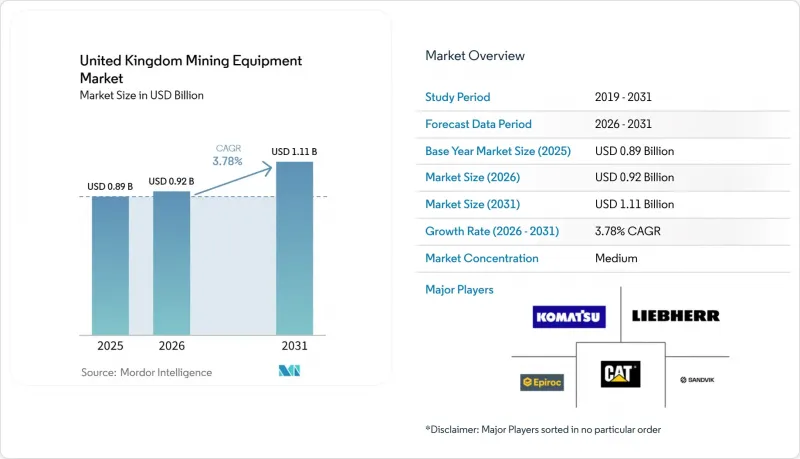
本報告按設備類型(露天採礦機械、地下採礦機械等)、自動化程度(手動機械、半自動機械等)、動力傳動系統類型(內燃機等)、功率輸出(小於500馬力等)、應用領域(金屬礦開採等)和地區進行細分。市場預測以美元計價。
英國礦業機械市場趨勢與洞察
電池關鍵金屬的需求不斷成長
國家大幅提高鋰產量的目標正在重啟曾經被認為是無利可圖的深井和地熱計畫。康沃爾Cornwall)近期提供的資金籌措以及南克羅夫蒂礦區(South Crofty)的撥款正在刺激對高性能鑽機、潛水泵和礦物加工設備的投資。此外,在有利的APT價格支持下,鎢業西部公司(Tungsten West)的赫默登礦(Hemerdon mine)重啟計劃需要重型裝載機和大容量卡車來處理巨大的資源量,這增加了對耐磨破碎機的需求。設備設計也在不斷發展。鋰運作迴路需要耐腐蝕泵,而鎢的高硬度則需要能耗更高的破碎系統。此外,國內提煉能力的不足導致了銅廢料的大規模出口,但扶持政策有望為冶煉和電解提煉線創造成長機會。
政府獎勵基於英國的“重要礦產戰略”
國家財富基金提供的巨額津貼和同等數額的資金投入縮短了從探勘到開發的時間。塔瑪礦業公司(Tamar Minerals)和北方鋰業公司(Northern Lithium)正在擴大鑽探作業,並加快引進鑽石岩芯鑽機和地球物理感測器。英美資源集團(Anglo American)和三菱商事株式會社(Mitsubishi Corporation)已對伍德史密斯多鹵石礦(Woodsmith Polyhalite Mine)進行了大量投資,確保了在首次開採礦石之前,對建築挖掘機和隧道掘進機的穩定需求。目的地設備製造商(OEM)已在礦區設立了零件倉庫。例如,山特維克(Sandvik)擴大了與瑞泰克(Retec)的合作,顯著縮短了關鍵零件的前置作業時間。然而,儘管取得了這些進展,專案核准仍然是一個瓶頸。森林伍德採石場(Forest Wood Quarry)在經過徹底調查後最終獲得批准,但這仍然凸顯了可能延誤機械交付的挑戰。
嚴格的環境許可和ESG審查
現在,向環境署提交的申請需要進行全面的生態、噪音和交通評估。這些要求顯著延長了申請流程,並可能導致每個項目產生高額諮詢費。此外,礦業修復局的費用進一步增加了成本。金融機構在提供資金前,要求申請者提交包含排放氣體和生物多樣性應對措施的詳細計畫。此外,監管人員短缺也可能導致即使符合所有合規標準的提案也獲得延遲批准。這些延誤迫使供應商在現場作業因天氣原因受限之前運輸機械設備。
細分市場分析
到2025年,露天採礦設備將佔英國採礦機械市場的45.27%。國內總產量反映了較高的生產水準。移動式破碎機和篩分機正日益取代固定式設備。這一趨勢在大型基礎建設工地尤為明顯,移動式設備有助於減少運輸次數。地下採礦機械仍然是一個小眾市場,但它是一個重要的細分市場,尤其是在Cornwall的鋰礦和錫礦。由於業主優先考慮提高燃油效率以符合環保標準,鑽孔機和破碎機的更換週期正在縮短。
預計裝載機市場將以6.46%的複合年成長率成長,加速英國礦業設備市場的整體成長。洛蒙德工廠近期進行的設備升級,包括引進多台JCB設備,充分展現了該產業的規模。雖然高功率裝載機在採石場已較為常見,但高功率的裝載機也開始應用於赫默頓等金屬礦場。負載容量監測、胎壓監測系統以及出廠預裝的自動駕駛套件等功能正逐漸成為標配,這也推高了平均售價。
即使到了2025年,儘管手動機械預計仍將保持68.28%的市場佔有率,但全自動機械預計將以7.43%的複合年成長率成為成長最快的市場,進一步加速英國礦業機械市場的整體成長。 Sibelco公司與貝爾公司合作的B40E示範計畫顯著降低了運輸成本,為德文郡和約克郡的其他採石場樹立了標竿。對於預算不足以購買全自動化系統的中型採石場而言,升級到Caterpillar的「Grade with Assist」等半自動化系統是一個切實可行的替代方案。
雖然連接和LiDAR的初始成本較高,但在高流量環境下,投資回報往往很快,因此其部署非常值得。然而,由於英國缺乏針對自動駕駛的具體法規,營運商只能依賴 ISO 17757 標準,這阻礙了自動駕駛技術的廣泛應用,直到責任問題得到解決。
其他好處:
- Excel格式的市場預測(ME)表
- 3個月的分析師支持
目錄
第1章:引言
- 市場分析與定義的前提條件
- 分析範圍
第2章 分析方法
第3章執行摘要
第4章 市場狀況
- 市場概覽
- 市場促進因素
- 電池關鍵金屬的需求不斷成長
- 基於英國關鍵礦產策略的政府獎勵
- 更換車輛以符合嚴格的第五階段排放氣體法規
- 自動化運輸系統的擴展
- 將廢棄礦山重新用於地熱發電和重要金屬開採
- 受高鐵二號線和離岸風力發電基礎工程的影響,骨材需求激增。
- 市場限制因素
- 嚴格的環境許可製度和ESG審查
- 大宗商品價格波動正在抑制資本投資週期。
- 英國先進自動化領域工程師短缺
- 英國脫歐後的投資與信任差距
- 價值鍊和供應鏈分析
- 監理情勢
- 技術展望
- 波特五力分析
第5章:預測市場規模與成長率
- 按機器類型
- 露天採礦機械
- 地下採礦機械
- 礦物加工設備
- 鑽頭破碎機
- 破碎、研磨與分類機
- 裝載機
- 礦用卡車
- 按自動化級別
- 手動機器
- 半自動機器
- 全自動機器
- 依動力傳動系統類型
- 內燃機
- 電池供電
- 混合
- 依輸出類型
- 低於500馬力
- 500~1,000 HP
- 1000馬力或以上
- 透過使用
- 金屬礦開採
- 礦產開採
- 採煤
- 按地區
- 英格蘭
- 蘇格蘭
- 威爾斯
- 北愛爾蘭
第6章 競爭情勢
- 市場集中度
- 策略趨勢
- 市佔率分析
- 公司簡介
- Caterpillar Inc.
- Komatsu Ltd.
- Sandvik AB
- Epiroc AB
- Liebherr Group
- Hitachi Construction Machinery Co. Ltd.
- AB Volvo(Volvo Construction Equipment)
- JC Bamford Excavators Limited
- Bell Equipment UK Ltd.
- Atlas Copco AB
- Terex Corp.
- HD Hyundai Infracore
- Sany Heavy Industry Co. Ltd.
- XCMG Group
- Metso Corporation
- thyssenkrupp Mining Technologies
- Normet UK Ltd.
- Weir Group PLC(UK)
- Wirtgen Group(John Deere)
第7章 市場機會與未來展望
According to Mordor Intelligence, the United Kingdom mining equipment market size was valued at USD 0.89 billion in 2025 and is estimated to grow from USD 0.92 billion in 2026 to reach USD 1.11 billion by 2031, growing at a CAGR of 3.78% over 2026-2031.
This report is Segmented by Equipment Type (Surface Mining Equipment, Underground Mining Equipment, and More), Automation Level (Manual Equipment, Semi-Autonomous Equipment, and More), Powertrain Type (Internal Combustion Engine Vehicles and More), Power Output (Below 500 HP and More), Application (Metal Mining and More), and Geography. The Market Forecasts are Provided in Terms of Value (USD).
United Kingdom Mining Equipment Market Trends and Insights
Growing Demand for Battery-Critical Metals
The national goal of significantly increasing lithium production has revived deep-shaft and geothermal projects once considered uneconomic. Cornish Lithium's recent financing and South Crofty's allocation are driving investment in high-specification drilling rigs, submersible pumps, and mineral processors. Tungsten West's planned Hemerdon restart, supported by favorable APT prices, will require heavy-duty loaders and large-capacity trucks to handle substantial resource volumes, boosting demand for wear-protected crushers. Equipment designs are evolving: lithium-brine circuits now require corrosion-resistant pumps, while tungsten's high hardness necessitates more energy-intensive crushing systems. Additionally, the lack of domestic refining capacity, which has led to significant copper scrap exports, presents opportunities for growth in smelting and electrowinning lines if supportive policies are introduced .
Government Incentives under the UK Critical Minerals Strategy
With a significant grant pool and matched equity from the National Wealth Fund, exploration-to-development timelines are shrinking. Tamar Minerals and Northern Lithium have ramped up their drilling campaigns, hastening the acquisition of diamond-core rigs and geophysical sensors. Anglo American and Mitsubishi are committing substantial investments to the Woodsmith polyhalite mine, ensuring steady demand for construction shovels and shaft-sinking machines even before the first ore is extracted. Original Equipment Manufacturers (OEMs) are setting up localized parts depots; for instance, Sandvik expanded its Retec partnership, significantly reducing lead times for critical components. Yet, despite this progress, planning approval remains a bottleneck. Forest Wood Quarry secured consent only after extensive studies, highlighting the challenges that can still delay equipment deliveries.
Strict Environmental Permitting and ESG Scrutiny
Environmental Agency applications now mandate comprehensive ecological, noise, and traffic studies. These requirements can significantly extend the application process and lead to substantial consultant fees per site. Additionally, charges from the Mining Remediation Authority further increase costs. Institutional lenders require detailed plans before disbursing funds that address emissions and biodiversity. Moreover, staffing backlogs at regulatory bodies delay approvals, even for proposals that meet all compliance standards. This delay compresses the timeframe for suppliers to transport machinery, especially before weather conditions restrict site operations.
Other drivers and restraints analyzed in the detailed report include:
- Fleet Replacement to Meet Stringent Stage V Emission Norms
- Rising Adoption of Autonomous Haulage Systems
- Commodity-Price Volatility Curbing CAPEX Cycles
For complete list of drivers and restraints, kindly check the Table Of Contents.
Segment Analysis
Surface units accounted for 45.27% of the United Kingdom mining equipment market share in 2025. The national aggregate output reflects significant production levels. Mobile crushers and screens are increasingly replacing static installations. This trend is particularly noticeable on major infrastructure worksites, where relocatable plants help reduce haulage runs. Underground machinery remains a niche but valuable segment, especially in connection with lithium and tin shafts in Cornwall. Drills and breakers are experiencing shorter replacement cycles as owners prioritize fuel-efficiency improvements required for compliance with environmental standards.
Loaders are forecast to grow at a 6.46% CAGR, accelerating overall United Kingdom mining equipment market growth. Lomond Plant's recent fleet renewal, featuring multiple JCB units, underscores the industry's scale. In quarries, high-powered loaders are the norm, whereas metal pits, like Hemerdon, are now seeing the entry of even more powerful loaders. Features like payload monitoring, tire-pressure systems, and factory-fitted autonomy kits are becoming standard, contributing to higher average selling prices.
Manual units retained 68.28% market share in 2025, yet fully autonomous machines will post the fastest 7.43% CAGR, improving the overall trajectory of the United Kingdom mining equipment market. At Sibelco, Bell's B40E demonstration significantly reduced haul costs, setting a benchmark for other pits in Devon and Yorkshire. For mid-tier quarries without the budget for full autonomy, semi-autonomous upgrades like Caterpillar's Grade with Assist serve as a practical alternative.
While the initial costs for connectivity and LiDAR pose challenges, sites with high throughput often see rapid returns on investment, making the adoption worthwhile. However, the absence of UK-specific autonomous regulations means operators lean on ISO 17757, hindering broader adoption until liability concerns are addressed.
Complete Report Scope:
- By Equipment Type
- Surface Mining Equipment
- Underground Mining Equipment
- Mineral Processing Equipment
- Drills and Breakers
- Crushing, Pulverizing and Screening Equipment
- Loaders
- Mining Trucks
- By Automation Level
- Manual Equipment
- Semi-Autonomous Equipment
- Fully Autonomous Equipment
- By Powertrain Type
- Internal-Combustion Engine Vehicles
- Battery-Electric Vehicles
- Hybrid Vehicles
- By Power Output
- Below 500 HP
- 500 - 1,000 HP
- Above 1,000 HP
- By Application
- Metal Mining
- Mineral Mining
- Coal Mining
- By Geography
- England
- Scotland
- Wales
- Northern Ireland
List of Companies Covered in this Report:
- Caterpillar Inc.
- Komatsu Ltd.
- Sandvik AB
- Epiroc AB
- Liebherr Group
- Hitachi Construction Machinery Co. Ltd.
- AB Volvo (Volvo Construction Equipment)
- J.C. Bamford Excavators Limited
- Bell Equipment UK Ltd.
- Atlas Copco AB
- Terex Corp.
- HD Hyundai Infracore
- Sany Heavy Industry Co. Ltd.
- XCMG Group
- Metso Corporation
- thyssenkrupp Mining Technologies
- Normet UK Ltd.
- Weir Group PLC (UK)
- Wirtgen Group (John Deere)
Additional Benefits:
- The market estimate (ME) sheet in Excel format
- 3 months of analyst support
TABLE OF CONTENTS
1 Introduction
- 1.1 Study Assumptions & Market Definition
- 1.2 Scope of the Study
2 Research Methodology
3 Executive Summary
4 Market Landscape
- 4.1 Market Overview
- 4.2 Market Drivers
- 4.2.1 Growing Demand for Battery-Critical Metals
- 4.2.2 Government Incentives Under the UK Critical Minerals Strategy
- 4.2.3 Fleet Replacement to Meet Stringent Stage V Emission Norms
- 4.2.4 Rising Adoption of Autonomous Haulage Systems
- 4.2.5 Repurposing Legacy Mine Sites for Geothermal and Critical-Metal Extraction
- 4.2.6 Surge In Aggregates Demand From HS2 and Offshore-Wind Foundations
- 4.3 Market Restraints
- 4.3.1 Strict Environmental Permitting and ESG Scrutiny
- 4.3.2 Commodity-Price Volatility Curbing CAPEX Cycles
- 4.3.3 Shortage of UK Technicians for Advanced Automation
- 4.3.4 Post-Brexit Investment-Confidence Gap
- 4.4 Value / Supply-Chain Analysis
- 4.5 Regulatory Landscape
- 4.6 Technological Outlook
- 4.7 Porter's Five Forces
- 4.7.1 Threat of New Entrants
- 4.7.2 Bargaining Power of Buyers
- 4.7.3 Bargaining Power of Suppliers
- 4.7.4 Threat of Substitutes
- 4.7.5 Competitive Rivalry
5 Market Size & Growth Forecasts (Value, USD)
- 5.1 By Equipment Type
- 5.1.1 Surface Mining Equipment
- 5.1.2 Underground Mining Equipment
- 5.1.3 Mineral Processing Equipment
- 5.1.4 Drills and Breakers
- 5.1.5 Crushing, Pulverizing and Screening Equipment
- 5.1.6 Loaders
- 5.1.7 Mining Trucks
- 5.2 By Automation Level
- 5.2.1 Manual Equipment
- 5.2.2 Semi-Autonomous Equipment
- 5.2.3 Fully Autonomous Equipment
- 5.3 By Powertrain Type
- 5.3.1 Internal-Combustion Engine Vehicles
- 5.3.2 Battery-Electric Vehicles
- 5.3.3 Hybrid Vehicles
- 5.4 By Power Output
- 5.4.1 Below 500 HP
- 5.4.2 500 - 1,000 HP
- 5.4.3 Above 1,000 HP
- 5.5 By Application
- 5.5.1 Metal Mining
- 5.5.2 Mineral Mining
- 5.5.3 Coal Mining
- 5.6 By Geography
- 5.6.1 England
- 5.6.2 Scotland
- 5.6.3 Wales
- 5.6.4 Northern Ireland
6 Competitive Landscape
- 6.1 Market Concentration
- 6.2 Strategic Moves
- 6.3 Market Share Analysis
- 6.4 Company Profiles (Includes Global level Overview, Market level overview, Core Segments, Financials as available, Strategic Information, Market Rank/Share for key companies, Products & Services, and Recent Developments)
- 6.4.1 Caterpillar Inc.
- 6.4.2 Komatsu Ltd.
- 6.4.3 Sandvik AB
- 6.4.4 Epiroc AB
- 6.4.5 Liebherr Group
- 6.4.6 Hitachi Construction Machinery Co. Ltd.
- 6.4.7 AB Volvo (Volvo Construction Equipment)
- 6.4.8 J.C. Bamford Excavators Limited
- 6.4.9 Bell Equipment UK Ltd.
- 6.4.10 Atlas Copco AB
- 6.4.11 Terex Corp.
- 6.4.12 HD Hyundai Infracore
- 6.4.13 Sany Heavy Industry Co. Ltd.
- 6.4.14 XCMG Group
- 6.4.15 Metso Corporation
- 6.4.16 thyssenkrupp Mining Technologies
- 6.4.17 Normet UK Ltd.
- 6.4.18 Weir Group PLC (UK)
- 6.4.19 Wirtgen Group (John Deere)
7 Market Opportunities & Future Outlook

 中國礦山機械:市場佔有率分析、產業趨勢與統計、成長預測(2026-2031年)印度礦業機械:市場佔有率分析、產業趨勢與統計、成長預測(2026-2031)德國礦業機械:市場佔有率分析、產業趨勢與統計、成長預測(2026-2031)非洲礦業機械:市場佔有率分析、產業趨勢與統計、成長預測(2026-2031 年)馬來西亞礦業機械:市場佔有率分析、產業趨勢與統計、成長預測(2026-2031)日本礦業機械:市場佔有率分析、產業趨勢及統計、成長預測(2026-2031)法國礦業機械:市場佔有率分析、產業趨勢與統計、成長預測(2026-2031)西班牙礦業機械:市場佔有率分析、產業趨勢與統計、成長預測(2026-2031)
 礦業機械市場報告:趨勢、預測與競爭分析(至2035年)
 自主採礦機械市場規模、佔有率、成長、全球產業分析、區域趨勢及2026-2034年預測。