


 |
市場調查報告書
商品編碼
2114022
南美洲高性能電動車:市場佔有率分析、產業趨勢與統計及成長預測(2026-2031 年)South America Automotive High Performance Electric Vehicles - Market Share Analysis, Industry Trends & Statistics, Growth Forecasts (2026 - 2031) |
||||||

※ 本網頁內容可能與最新版本有所差異。詳細情況請與我們聯繫。
據 Mordor Intelligence 稱,2025 年南美高性能電動車 (EV) 市場價值為 12.6 億美元,預計到 2031 年將從 2026 年的 15.1 億美元成長至 37.4 億美元,預測期(2026-2031 年)的複合年成長率為 19.86%。
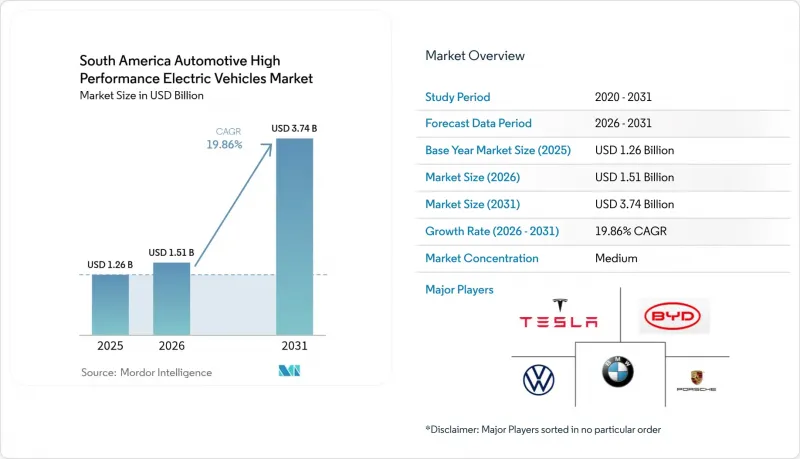
本報告按驅動系統(例如,電池式電動車)、車輛類型(例如,乘用車、輕型商用車)、最大輸出功率(例如,小於200千瓦)、電池化學成分(例如,磷酸鋰鐵(LFP))、價格範圍(例如,小於5萬美元)和國家進行細分。市場預測以美元計價。
南美洲高性能電動車市場趨勢及洞察。
公共直流快速充電走廊快速擴張
巴西計畫在2035年安裝15萬個充電樁,需要25億美元投資,體現了政府解決電動車續航里程問題的決心。庫里蒂巴的「電動車中心」能夠動態管理電力負荷,其軟體最佳化了與電網的整合,並建立了一套降低部署成本的系統。比亞迪和Raizen Power正在共同建造利用可再生能源的充電站,而再生能源佔巴西電網的85%,為南美洲電動車市場帶來了獨特的永續性發展概念。烏拉圭正在加速這一進程,在Evergo和Ventus的資助下部署了240個充電樁(其中40%為快速充電樁),證明即使是小規模經濟體也能在短時間內實現近乎全國範圍的覆蓋。智利正以其快速成長的電動公車車隊為基礎進行充電樁部署,將公共採購轉變為推動私人使用網路建設的催化劑。
績效提升-南方共同市場的關稅豁免促進了電動車進口
巴西2018年第97號決議暫時將進口關稅從35%降至零,允許中國汽車製造商在2023年佔據巴西電池式電動車(BEV)進口量的92%,並以極具吸引力的價格向巴西展示室大量投放高性能車型。阿根廷也將類似措施延長至2025年,擴大了區域內免稅銷售的期限。製造商們爭相提前交付7,000輛汽車,以應對巴西計劃於2026年逐步恢復35%的關稅。 2024年,巴西高性能電動車的進口量激增229%,證實一旦消除金融壁壘,市場需求將爆炸性成長。這段免稅期提高了消費者對下一代產品的期望,同時也給現有製造商帶來了壓力,迫使其盡快轉型為在地化生產。
在巴西,生質乙醇產業組織正在推遲對電池電動車(BEV)的財政激勵措施。
甘蔗產業年產量高達353億公升,並享有國會的強力支持,因此,僅針對電池式電動車(BEV)推出獎勵在政治上難以推進。諸如RenovaBio之類的項目正在將脫碳積分轉向生質燃料,從而將電動車選項邊緣化。巴西石油公司(Petrobras)已撥款22億美元用於乙醇基礎建設,提振了長期需求預測。因此,仍需消耗液體燃料的混合動力汽車比純電動車更有可能獲得政策批准,儘管充電基礎設施正在發展,但轉型步伐卻在放緩。
細分市場分析
至2025年,插電式混合動力汽車(PHEV)將佔南美洲高性能電動車市場67.54%的佔有率。巴西覆蓋全國的乙醇加氣站網路為此提供了有力支撐,確保了車輛續航里程的無縫銜接。隨著充電樁的普及性和總擁有成本(TCO)的降低,電池式電動車的銷量正以17.91%的複合年成長率成長。消費者在選擇混合動力汽車時,通常會考慮其續航里程、加氣便利性和城際旅行的可靠性。豐田在索羅卡巴工廠擴展的靈活燃料混合動力項目,展示如何將全球平臺本地化,使其與乙醇相容。
隨著汽車製造商不斷改進其生物混合動力技術,南美洲高性能電動車市場持續發展。 Stellantis 已將 56 億歐元預算的一部分用於研發生物混合動力系統,該系統將小型電池與高效能乙醇引擎相結合,從而在降低二氧化碳排放的同時,保持較低的購車價格。雷諾和吉利的合作正在豐富中檔車型的選擇,推出基於中國經濟型架構的低排放氣體跨界車。在都市區運作週期可預測且充電密度匹配的地區,政府車隊率先採用者純電動車,但私人買家往往傾向於選擇混合動力汽車,直到都會區以外的基礎設施達到類似水平。
2025年,受巴西都市區個人用車需求的推動,乘用車將佔南美洲高性能電動車市場85.76%的佔有率。然而,由於物流公司尋求降低燃料和維護成本,輕型商用車預計將以19.05%的複合年成長率實現最高成長。對於車隊營運商而言,經濟效益顯而易見,因為在充電站進行夜間充電可以最大限度地減少運作,並避免公共基礎設施短缺。
車隊電氣化也得到了政策支持。在秘魯、巴拉圭和智利,政府利用環保交通津貼採購電動公車和貨車,確保了訂單量並穩定了工廠生產。 U Power 和 Ualabee 計劃用換電貨車替換 8 萬輛共享汽車,展示了一種高利用率車輛的創新經營模式。隨著供應趨於穩定,預計到 2027 年之前,商用車的總擁有成本將與燃油車持平,這將促進銷量成長,刺激次市場,並鼓勵個人用戶採用二手車。
其他好處:
- Excel格式的市場預測(ME)表
- 3個月的分析師支持
目錄
第1章:引言
- 研究假設和市場定義
- 調查範圍
第2章:調查方法
第3章執行摘要
第4章 市場狀況
- 市場概覽
- 市場促進因素
- 將鋰三角供應鏈融入區域電動車生產。
- 中國企業提供高附加價值產品,正在縮小性價比差距。
- 公共直流快速充電走廊快速擴張
- 受南方共同市場關稅豁免政策的推動,高性能電動車的進口量正在增加。
- OEM在地化-例如:BMWAlakuari插電式混合動力車款系列
- Prestige Motorsport Marketing(英特拉格斯電動車圈速紀錄)
- 市場限制因素
- 高固定價格與彈性燃料內燃機(ICE)替代方案
- 在巴西,由於生質乙醇產業團體的遊說,電動車稅收優惠政策的訂定被推遲了。
- 東京都會區以外地區引進 800V 超快充電樁的步伐正在放緩。
- 乾旱影響水力發電,引發對電網穩定性的擔憂。
- 價值供應鏈分析
- 監理情勢
- 技術展望
- 波特五力模型
- 新進入者的威脅
- 買方/消費者議價能力
- 供應商的議價能力
- 替代品的威脅
- 競爭公司之間的競爭
- 專利與創新趨勢
第5章 市場規模與成長預測
- 透過驅動系統
- 電池式電動車(BEV)
- 插電式混合動力車(PHEV)
- 車輛類型
- 搭乘用車
- 輕型商用車/多用途車
- 中型和大型商用車輛
- 按峰值輸出
- 小於200千瓦
- 201~400 kW
- 400千瓦或以上
- 電池化學成分
- 磷酸鋰鐵(LFP)
- 鎳錳鈷(NMC)
- 鎳鈷鋁合金(NCA)
- 先進固態電池/高矽原型
- 價格範圍(美元)
- 不足50,000
- 50,001~75,000
- 75,001~100,000
- 超過10萬
- 國家
- 巴西
- 阿根廷
- 智利
- 秘魯
- 哥倫比亞
- 烏拉圭
- 其他南美國家
第6章 競爭情勢
- 市場集中度
- 策略趨勢
- 市佔率分析
- 公司簡介
- BMW Group
- Mercedes-Benz Group AG
- Tesla Inc.
- BYD Co. Ltd.
- Porsche AG
- Nissan Motor Co.
- Ford Motor Co.
- Volkswagen AG
- Renault Group
- Geely Auto Ltd.
- Kia Corporation
- Mitsubishi Motors
- Audi AG
- Great Wall Motor(ORA)
- General Motors(Chevrolet)
- Stellantis NV(Peugeot, Fiat)
- Jaguar Land Rover Automotive Plc
- Chery Automobile
- JAC Motors Inc.
- Lotus Group
第7章 市場機會與未來展望
According to Mordor Intelligence, the south american automotive high-performance electric vehicle market size was valued at USD 1.26 billion in 2025 and estimated to grow from USD 1.51 billion in 2026 to reach USD 3.74 billion by 2031, at a CAGR of 19.86% during the forecast period (2026-2031).
This report is Segmented by Drive Type (Battery-Electric Vehicles, and More), Vehicle Type (Passenger Cars, Light Commercial Vehicles, and More), Peak Power Output (Below 200 KW, and More), Battery Chemistry (Lithium-Iron-Phosphate (LFP), and More), Price Band (Below USD 50, 000, and More) and Country. The Market Forecasts are Provided in Terms of Value (USD).
South America Automotive High Performance Electric Vehicles Market Trends and Insights
Rapid Expansion of Public DC Fast-Charging Corridors
Brazil targets 150,000 chargers by 2035, requiring USD 2.5 billion and signalling state commitment to eliminate range anxiety. Curitiba's electrocenters manage power loads dynamically, illustrating how software optimises grid interaction and keeps deployment costs contained. BYD and Raizen Power co-installed stations that leverage Brazil's 85% renewable grid, giving the South American electric vehicle market a unique sustainability narrative. Uruguay complements this momentum with 240 chargers-40% of them rapid-funded by Evergo and Ventus, proving smaller economies can reach near-national coverage quickly. Chile anchors its roll-out on fast-growing electric bus fleets, turning public procurement into a catalyst for private-use networks.
Rising Performance-EV Imports Helped by Mercosur Tariff Waivers
Brazil's Resolution 97/2018 temporarily cut import duties from 35% to zero, allowing Chinese OEMs to seize 92% of 2023 BEV imports and flood showrooms with high-spec models at compelling prices. Argentina extended similar treatment for 2025, widening the regional window for tariff-free sales. Manufacturers rushed to pre-position 7,000 units ahead of Brazil's phased tariff reinstatement that will reach 35% in 2026. During 2024, Brazil's performance-EV imports jumped 229%, confirming pent-up demand once fiscal barriers drop. The waiver phase primes consumer expectations for next-generation products and pressures incumbents to localise production sooner rather than later.
Bio-Ethanol Lobby Delaying BEV Fiscal Incentives in Brazil
The sugarcane industry produces 35.3 billion liters annually and commands strong congressional backing, making exclusive BEV incentives politically fraught. Programs like RenovaBio channel decarbonization credits toward biofuels, sidelining electric options. Petrobras has earmarked USD 2.2 billion for ethanol infrastructure, reinforcing long-term demand expectations. As a result, hybrids that still consume liquid fuel gain easier policy passage than full BEVs, slowing the transition despite rising charging coverage.
Other drivers and restraints analyzed in the detailed report include:
- OEM Localisation - BMW Araquari PHEV Line-Up
- Prestige Motorsport Marketing (Interlagos EV Lap Records)
- Hydropower Droughts Causing Grid-Stability Concerns
For complete list of drivers and restraints, kindly check the Table Of Contents.
Segment Analysis
Plug-in hybrid electric vehicles held 67.54% share of the South American high perfromance electric vehicle market in 2025, buoyed by Brazil's nationwide ethanol pumps that deliver seamless range security. Battery-electric volumes are climbing at an 17.91% CAGR as chargers proliferate and total cost of ownership improves. Consumers weigh trip length and fueling convenience, often selecting hybrids for intercity reliability. Toyota's flex-fuel hybrid programme, scaled up at Sorocaba, demonstrates how global platforms can localize for ethanol compatibility.
The South American high perfromance electric vehicle market continues to shift as OEMs hone bio-hybrid technologies. Stellantis is allocating part of its EUR 5.6 billion budget to Bio-Hybrid drivetrains that pair smaller batteries with efficient ethanol engines, reducing purchase price while cutting tailpipe CO2. Renault-Geely's cooperation brings low-emission crossovers built on cost-efficient Chinese architectures, diversifying options in the mid-price tier. Government fleets are early adopters of pure BEVs where predictable urban duty cycles align with charger density, but private buyers gravitate toward hybrids until infrastructure reaches parity outside capitals.
Passenger cars commanded 85.76% of the South American high performance electric vehicle market size in 2025, anchored by private-use demand in Brazil's urban centers. However, light commercial vehicles grow fastest at 19.05% CAGR because delivery operators chase fuel and maintenance savings. Depot-based overnight charging minimizes downtime and sidesteps public-infrastructure gaps, making economics straightforward for fleets.
Fleet electrification also attracts policy support. Peru, Paraguay, and Chile channel green-transit grants into e-bus and van procurement, locking in bulk orders that stabilize factory volumes. U Power and Ualabee target 80,000 ride-hailing replacements using battery-swap vans, illustrating creative models for high-utilization vehicles. As supply stabilizes, commercial total-cost parity is forecasted before 2027, amplifying volumes that feed secondary markets for used EVs, catalyzing private adoption.
Complete Report Scope:
- By Drive Type
- Battery-Electric Vehicles (BEV)
- Plug-in Hybrid Electric Vehicles (PHEV)
- By Vehicle Type
- Passenger Cars
- Light Commercial/Utility Vehicles
- Medium and Heavy-Duty Commercial Vehicles
- By Peak Power Output
- Below 200 kW
- 201 - 400 kW
- Above 400 kW
- By Battery Chemistry
- Lithium-Iron-Phosphate (LFP)
- Nickel-Manganese-Cobalt (NMC)
- Nickel-Cobalt-Aluminum (NCA)
- Advanced Solid-State / High-Silicon Prototype
- By Price Band (USD)
- Less than 50,000
- 50,001 - 75,000
- 75,001 - 100,000
- More than 100 000
- By Country
- Brazil
- Argentina
- Chile
- Peru
- Colombia
- Uruguay
- Rest of South America
List of Companies Covered in this Report:
- BMW Group
- Mercedes-Benz Group AG
- Tesla Inc.
- BYD Co. Ltd.
- Porsche AG
- Nissan Motor Co.
- Ford Motor Co.
- Volkswagen AG
- Renault Group
- Geely Auto Ltd.
- Kia Corporation
- Mitsubishi Motors
- Audi AG
- Great Wall Motor (ORA)
- General Motors (Chevrolet)
- Stellantis N.V. (Peugeot, Fiat)
- Jaguar Land Rover Automotive Plc
- Chery Automobile
- JAC Motors Inc.
- Lotus Group
Additional Benefits:
- The market estimate (ME) sheet in Excel format
- 3 months of analyst support
TABLE OF CONTENTS
1 Introduction
- 1.1 Study Assumptions & Market Definition
- 1.2 Scope of the Study
2 Research Methodology
3 Executive Summary
4 Market Landscape
- 4.1 Market Overview
- 4.2 Market Drivers
- 4.2.1 Integrating Lithium-Triangle Supply Chains into Regional BEV Builds
- 4.2.2 Chinese Premium-Value Entrants Closing Price-Performance Gap
- 4.2.3 Rapid Expansion of Public DC Fast-Charging Corridors
- 4.2.4 Rising Performance-EV Imports Helped By Mercosur Tariff Waivers
- 4.2.5 OEM Localisation - E.G., BMW Araquari PHEV Line-Up
- 4.2.6 Prestige Motorsport Marketing (Interlagos EV Lap Records)
- 4.3 Market Restraints
- 4.3.1 High Sticker Prices Vs. Flex-Fuel ICE Alternatives
- 4.3.2 Bio-Ethanol Lobby Delaying BEV Fiscal Incentives In Brazil
- 4.3.3 Slow Roll-Out Of 800 V Ultra-Fast Chargers Outside Capital Cities
- 4.3.4 Hydropower Droughts Causing Grid-Stability Concerns
- 4.4 Value / Supply-Chain Analysis
- 4.5 Regulatory Landscape
- 4.6 Technological Outlook
- 4.7 Porter's Five Forces
- 4.8 Threat of New Entrants
- 4.8.1 Bargaining Power of Buyers/Consumers
- 4.8.2 Bargaining Power of Suppliers
- 4.8.3 Threat of Substitute Products
- 4.8.4 Intensity of Competitive Rivalry
- 4.8.5 Patent & Innovation Landscape
5 Market Size & Growth Forecasts (Value (USD))
- 5.1 By Drive Type
- 5.1.1 Battery-Electric Vehicles (BEV)
- 5.1.2 Plug-in Hybrid Electric Vehicles (PHEV)
- 5.2 By Vehicle Type
- 5.2.1 Passenger Cars
- 5.2.2 Light Commercial/Utility Vehicles
- 5.2.3 Medium and Heavy-Duty Commercial Vehicles
- 5.3 By Peak Power Output
- 5.3.1 Below 200 kW
- 5.3.2 201 - 400 kW
- 5.3.3 Above 400 kW
- 5.4 By Battery Chemistry
- 5.4.1 Lithium-Iron-Phosphate (LFP)
- 5.4.2 Nickel-Manganese-Cobalt (NMC)
- 5.4.3 Nickel-Cobalt-Aluminum (NCA)
- 5.4.4 Advanced Solid-State / High-Silicon Prototype
- 5.5 By Price Band (USD)
- 5.5.1 Less than 50,000
- 5.5.2 50,001 - 75,000
- 5.5.3 75,001 - 100,000
- 5.5.4 More than 100 000
- 5.6 By Country
- 5.6.1 Brazil
- 5.6.2 Argentina
- 5.6.3 Chile
- 5.6.4 Peru
- 5.6.5 Colombia
- 5.6.6 Uruguay
- 5.6.7 Rest of South America
6 Competitive Landscape
- 6.1 Market Concentration
- 6.2 Strategic Moves
- 6.3 Market Share Analysis
- 6.4 Company Profiles (includes Global level Overview, Market level overview, Core Segments, Financials as available, Strategic Information, Market Rank/Share for key companies, Products & Services, and Recent Developments)
- 6.4.1 BMW Group
- 6.4.2 Mercedes-Benz Group AG
- 6.4.3 Tesla Inc.
- 6.4.4 BYD Co. Ltd.
- 6.4.5 Porsche AG
- 6.4.6 Nissan Motor Co.
- 6.4.7 Ford Motor Co.
- 6.4.8 Volkswagen AG
- 6.4.9 Renault Group
- 6.4.10 Geely Auto Ltd.
- 6.4.11 Kia Corporation
- 6.4.12 Mitsubishi Motors
- 6.4.13 Audi AG
- 6.4.14 Great Wall Motor (ORA)
- 6.4.15 General Motors (Chevrolet)
- 6.4.16 Stellantis N.V. (Peugeot, Fiat)
- 6.4.17 Jaguar Land Rover Automotive Plc
- 6.4.18 Chery Automobile
- 6.4.19 JAC Motors Inc.
- 6.4.20 Lotus Group
7 Market Opportunities & Future Outlook

 2026年全球電動車市場預測印度電動車市場,2025-2032年
 北美電動車市場:市場佔有率分析、產業趨勢與統計、成長預測(2026-2031)新加坡電動車市場:市場佔有率分析、產業趨勢與統計及成長預測(2026-2031年)法國電動車市場:市場佔有率分析、產業趨勢與統計及成長預測(2026-2031)電動車:市場佔有率分析、產業趨勢與統計、成長預測(2026-2031)越南電動車市場:市場佔有率分析、產業趨勢與統計及成長預測(2026-2031年)電動車中800V架構的演變非洲電動車:市場佔有率分析、產業趨勢與統計及成長預測(2026-2031 年)東協電動車市場:市場佔有率分析、產業趨勢與統計及成長預測(2026-2031)