


 |
市場調查報告書
商品編碼
2124411
東協電動車市場:市場佔有率分析、產業趨勢與統計及成長預測(2026-2031)ASEAN Electric Vehicle - Market Share Analysis, Industry Trends & Statistics, Growth Forecasts (2026 - 2031) |
||||||

※ 本網頁內容可能與最新版本有所差異。詳細情況請與我們聯繫。
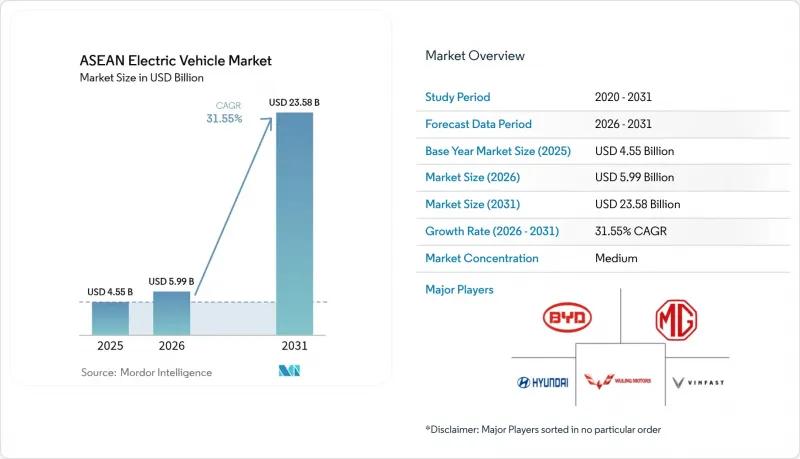
根據 Mordor Intelligence 預測,東協電動車市場規模將從 2025 年的 45.5 億美元成長到 2026 年的 59.9 億美元,然後在 2031 年達到 235.8 億美元,2026 年至 2031 年的複合年成長率為 31.55%。
本報告按車輛類型(二輪車和三輪車、乘用車、其他)、動力系統技術(電池式電動車(BEV)、插電式混合動力汽車 (PHEV)、其他)、充電等級(交流慢充/二級充電、直流快充)、最終用戶類型和國家/地區(印尼、泰國、其他國家/地區)進行分類。市場預測以貨幣價值(美元)和銷售(輛)兩種形式呈現。
東協電動車市場趨勢與洞察
政府採購支持和消費稅優惠
積極的財政措施正在推動東協市場儘早普及電動車。泰國已投入340億泰銖用於補貼,並規定本地組裝是獲得補貼的必要條件,這項措施與印尼的政策類似,印尼對電池式電動車免徵0%的奢侈品稅和1%的增值稅,直至2025年。越南已將免註冊費的政策延長至2027年,而馬來西亞則計劃透過降低購置稅和免徵進口關稅,使電動車到2030年佔其汽車銷量的20%。菲律賓根據其《電動車產業發展法》,規定電動車必須佔政府和企業車輛總數的5%,並透過免稅進口進一步降低進口成本。這些協調一致的措施促進了泰國電動車銷量的成長,並推動了越南電動摩托車銷量的激增。
OEM廠商為在地化生產所做的努力
東協電動車市場正從進口主導轉向本地主導。比亞迪在印尼投資10億美元的工廠計劃於2025年下半年運作,年產能將達到15萬輛;其位於雅加達附近現代汽車園區的投資15.5億美元項目將新增25萬輛的產能。泰國已獲得來自中國汽車製造商超過30億美元的投資承諾,其中長城汽車和奇瑞汽車是核心投資者。 VinFast的海外擴張計畫包括在印尼和印度新建生產線,而吉利汽車則透過與印尼汽車貿易公司PT Handal Indonesia Motor的合資企業進入市場,並計劃在三年內將其零售網路擴展至100家門市。這些工廠將滿足日益嚴格的在地採購標準,降低物流成本,並為涵蓋電池、電力電子和軟體的零件生態系統奠定基礎。
內燃機車(ICE)與零售版之間存在著很大的價格差異。
在整個東協地區,入門級電動車的價格通常是同級內燃機汽車的兩倍,這阻礙了它們在大眾市場的普及。在印尼,儘管銷售量激增267%,但到2025年上半年,其市場滲透率仍僅9.1%。這是因為持續高昂的價格差異抑制了價格敏感型消費者的購買意願。在泰國的豪華車細分市場,隨著獎勵逐步減少,需求放緩,這表明市場需求對補貼取消具有韌性。貨運公司指出,中型卡車的初始成本較高,但電池更換試點計畫預計將在整個生命週期中降低30-40%的成本。價格的持續下降將取決於本地生產的電池組以及該地區新工廠帶來的規模經濟效益。
細分市場分析
2025年,乘用車佔東協電動車市場的46.55%,但在越南,受VinFast國內銷量488%成長的推動,電動二輪車的銷量在2025年上半年激增。兩輪和三輪車正在重塑成長格局,預計到2031年將以32.40%的複合年成長率成長。印尼和泰國也透過免除停車費和牌照費等共享出行激勵措施,複製了這一成長勢頭。輕型商用車市場正蓬勃發展,因為電商配送車輛的燃料成本降低了20-30%,促使物流業者強制推行電氣化。同時,中型和重型卡車的發展相對滯後,仍在等待高能量密度電池和能夠抵消初期成本差異的財政措施。
都市區外送騎士稱讚換電網路帶來的便利,充電時間縮短至兩分鐘以內。越南的目標是到2030年引進一百萬輛零排放摩托車,這一目標與河內市免徵堵塞費的政策密切相關。新加坡正在試辦電動共享出行許可製度,優先保障機場高密度接客點的零排放車輛,進而提高駕駛人的盈利。公車和長途客車也受益於市政採購目標。新加坡的目標是到2030年將電動公車佔其車隊的50%,而越南義安省則強制規定從2025年起所有新車必須為純電動車。這些措施共同推動了東協電動車市場交通方式的多元化發展。
預計到2025年,電池式電動車(BEV)將佔據東協電動車市場85.70%的佔有率,並成為各大汽車製造商(OEM)2031年前發展藍圖的基石。電池價格下降、能量密度提高以及充電網路的擴展正在增強消費者的信心。插電式混合動力汽車(PHV)在泰國開闢了一片利基市場,因為泰國公眾對高速公路充電基礎設施的可用性仍然持懷疑態度。豐田正利用其品牌影響力,將家用充電樁安裝服務與延長保固期捆綁銷售,以確保混合動力汽車的殘值。
儘管燃料電池汽車起步規模小規模,但預計在2026年至2031年間,其複合年成長率將達到38.90%,成為成長最快的產業之一。印尼國家電力公司(PLN)於2024年在雅加達開設了該地區首個加氫站,並計劃建造22座綠色氫氣工廠,年產能達203噸。在新加坡,氫燃料電池公車正在港口附近的專用車道上進行測試;馬來西亞國家石油公司(Petronas)正在考慮在商用車輛中使用藍氫。一個東協工作小組正在製定燃料電池安全標準草案,以符合聯合國第134號法規的要求,這是大規模進口燃料電池的先決條件。這種技術多樣性使東協電動車市場免受原料價格波動的影響。
其他好處
- Excel格式的市場預測(ME)表
- 3個月的分析師支持
目錄
第1章:引言
- 研究假設和市場定義
- 調查範圍
第2章:調查方法
第3章執行摘要
第4章 市場狀況
- 市場概覽
- 市場促進因素
- 政府採購支持和消費稅優惠
- OEM廠商為在地化生產所做的努力
- 直流快速充電走廊的快速發展
- 高鎳含量電池的優勢。
- 跨境電動車免稅貿易
- 摩托車電池更換生態系統的擴展
- 市場限制因素
- 內燃機車(ICE)與零售版之間存在著很大的價格差異。
- 大城市以外地區充電基礎設施發展有差異。
- 系統不穩定性和尖峰負載限制
- 文化上對柴油皮卡的偏好
- 價值供應鏈分析
- 監理情勢
- 技術展望
- 波特五力模型
第5章 市場規模與成長預測
- 按車輛類型
- 二輪車和三輪車
- 搭乘用車
- 輕型商用車
- 中型重型商用車
- 巴士和長途汽車
- 傳動系統技術
- 電池式電動車(BEV)
- 插電式混合動力車(PHEV)
- 燃料電池電動車(FCEV)
- 混合動力電動車(HEV)
- 按充電等級
- 交流低速充電/二級充電
- 直流快速充電(50kW 或以上)
- 按最終用戶類型
- 個人/家庭
- 商用車和物流
- 政府和公共運輸
- 國家
- 印尼
- 泰國
- 馬來西亞
- 越南
- 菲律賓
- 新加坡
- 緬甸
- 柬埔寨
- 寮國
- 汶萊
第6章 競爭情勢
- 市場集中度
- 策略趨勢
- 市佔率分析
- 公司簡介
- BYD Co. Ltd.
- SAIC Motor/MG Motor
- Hyundai Motor Company
- Toyota Motor Corporation
- Honda Motor Co., Ltd.
- Mitsubishi Motors Corporation
- Nissan Motor Corporation
- VinFast Auto Ltd.
- Wuling Motors
- Great Wall Motor
- GAC Aion
- Chery Automobile
- Tesla Inc.
- BMW Group
- Mercedes-Benz Group
- Kia Corp.
- Isuzu Motors
- BAIC Group
- Stellantis NV
- UD Trucks
第7章 市場機會與未來展望
According to Mordor Intelligence, the ASEAN electric vehicle market size is expected to grow from USD 4.55 billion in 2025 to USD 5.99 billion in 2026 and is forecast to reach USD 23.58 billion by 2031 at 31.55% CAGR over 2026-2031.
This report is Segmented by Vehicle Type (Two and Three Wheelers, Passenger Cars, and More), Drive-Train Technology (Battery Electric Vehicles (BEV), Plug-In Hybrid Electric Vehicles (PHEV), and More), Charging Level (AC Slow/Level-2, DC Fast), End-User Type, and Country (Indonesia, Thailand, and More). The Market Forecasts are Provided in Terms of Value (USD) and Volume (Units).
ASEAN Electric Vehicle Market Trends and Insights
Government Purchase and Excise-Tax Incentives
Aggressive fiscal programs underpin early adoption across the ASEAN electric vehicle market. Thailand channels 34 billion baht in subsidies that require local assembly for eligibility, a policy mirrored by Indonesia's 0% luxury tax and 1% VAT on battery electric vehicles through 2025. Vietnam has extended registration-fee exemptions until 2027, while Malaysia targets a 20% EV sales mix by 2030 via purchase-tax relief and import-duty waivers. The Philippines mandates a 5% EV share in government and corporate fleets under the Electric Vehicle Industry Development Act, further reducing landed costs through zero-tariff imports. These coordinated instruments have lifted Thailand's EV sales and turbocharged Vietnam's electric-motorcycle sales volumes.
OEM Localization Commitments
The ASEAN electric vehicle market is shifting from import-led to locally manufactured supply. BYD's USD 1 billion Indonesian hub coming online in late 2025 will produce 150,000 vehicles annually, while Hyundai's USD 1.55 billion complex near Jakarta adds 250,000-unit capacity. Thailand has secured over USD 3 billion in Chinese OEM pledges, anchored by Great Wall Motor and Chery. VinFast's outward expansion includes new lines in Indonesia and India, and Geely enters via a joint venture with PT Handal Indonesia Motor to scale 100 retail outlets in three years. These factories meet rising local-content thresholds, compress logistics costs, and seed component ecosystems across batteries, power electronics, and software.
High Retail Price Gap Vs. ICE
Entry-level EVs across ASEAN are often priced at twice that of comparable internal-combustion models, curbing mass-market uptake. Indonesia's penetration reached 9.1% in 1H 2025 despite a 267% sales spike, as the remaining sticker premium deters cost-sensitive buyers. Thailand's premium-car sub-segment experienced softening demand once incentives tapered, revealing elasticity to subsidy removal. Freight operators highlight elevated upfront costs for medium-duty trucks, even though battery-swap pilots hint at 30-40% lifetime savings. Continual price compression depends on localized battery packs and scale economics from new regional plants .
Other drivers and restraints analyzed in the detailed report include:
- Rapid Roll-Out of DC Fast-Charging Corridors
- Nickel-Rich Battery Supply Advantage
- Patchy Charging Outside Tier-1 Cities
For complete list of drivers and restraints, kindly check the Table Of Contents.
Segment Analysis
Passenger cars delivered 46.55% of the ASEAN electric vehicle market in 2025, yet electric motorcycles posted a sales jump in Vietnam in 1H 2025, powered by VinFast's 488% domestic surge. Two- and three-wheelers are rewriting the growth script, projecting a growth of 32.40% CAGR by 2031. Indonesia and Thailand replicate this momentum through ride-hail incentives that waive parking fees and license-plate charges. The light-commercial segment gains traction as e-commerce fulfillment fleets log 20-30% fuel savings, nudging logistics operators toward electrification mandates. Medium and heavy trucks lag while waiting for higher-density batteries and fiscal levers that neutralize upfront differentials.
Urban delivery riders cite the convenience of battery-swap networks that compress refueling to under two minutes. Vietnam targets 1 million zero-emission motorcycles by 2030, an ambition linked to congestion-charge exemptions in Hanoi. Singapore pilots electric ride-hail permits that prioritize emissions-free vehicles at high-density airport ranks, enhancing driver economics. Buses and coaches benefit from municipal procurement targets, with Singapore aiming for 50% electric buses by 2030 and Vietnam's Nghe An province mandating fully electric additions from 2025. Collectively, these policies accelerate modal diversification within the ASEAN electric vehicle market.
Battery electric vehicles maintained 85.70% ASEAN electric vehicle market share in 2025 and anchor most OEM roadmaps through 2031. Lower battery prices, rising energy density, and expanded charging corridors reinforce consumer confidence. Plug-in hybrids carve out a transition niche in Thailand where public skepticism over highway charger availability lingers. Toyota leverages brand equity by bundling home-charger installation and extended warranties, insulating hybrid residual values.
Fuel-cell electric vehicles register the highest 2026-2031 CAGR at 38.90% from a small base. Indonesia's PLN opened the sub-region's first hydrogen station in Jakarta in 2024 and plans 22 green-hydrogen plants producing 203 tons yearly. Singapore tests hydrogen buses on dedicated lanes near port zones, and Malaysia's Petronas evaluates blue-hydrogen blending for commercial fleets. A pan-ASEAN working group is drafting fuel-cell safety codes to align with UN Regulation 134, a prerequisite for scaled imports. This technology pluralism cushions the ASEAN electric vehicle market against raw-material volatility.
Complete Report Scope:
- By Vehicle Type
- Two and Three Wheelers
- Passenger Cars
- Light Commercial Vehicles
- Medium and Heavy Commercial Vehicles
- Buses and Coaches
- By Drive-train Technology
- Battery Electric Vehicles (BEV)
- Plug-in Hybrid Electric Vehicles (PHEV)
- Fuel-Cell Electric Vehicles (FCEV)
- Hybrid Electric Vehicles (HEV)
- By Charging Level
- AC Slow / Level-2
- DC Fast (>= 50 kW)
- By End-User Type
- Personal / Household
- Commercial Fleet and Logistics
- Government and Public Transport
- By Country
- Indonesia
- Thailand
- Malaysia
- Vietnam
- Philippines
- Singapore
- Myanmar
- Cambodia
- Laos
- Brunei
List of Companies Covered in this Report:
- BYD Co. Ltd.
- SAIC Motor / MG Motor
- Hyundai Motor Company
- Toyota Motor Corporation
- Honda Motor Co., Ltd.
- Mitsubishi Motors Corporation
- Nissan Motor Corporation
- VinFast Auto Ltd.
- Wuling Motors
- Great Wall Motor
- GAC Aion
- Chery Automobile
- Tesla Inc.
- BMW Group
- Mercedes-Benz Group
- Kia Corp.
- Isuzu Motors
- BAIC Group
- Stellantis NV
- UD Trucks
Additional Benefits:
- The market estimate (ME) sheet in Excel format
- 3 months of analyst support
TABLE OF CONTENTS
1 Introduction
- 1.1 Study Assumptions & Market Definition
- 1.2 Scope of the Study
2 Research Methodology
3 Executive Summary
4 Market Landscape
- 4.1 Market Overview
- 4.2 Market Drivers
- 4.2.1 Government Purchase and Excise-Tax Incentives
- 4.2.2 OEM Localization Commitments
- 4.2.3 Rapid Roll-Out of DC Fast-Charging Corridors
- 4.2.4 Nickel-Rich Battery Supply Advantage
- 4.2.5 Cross-Border Zero-Tariff EV Trade
- 4.2.6 Two-Wheeler Battery-Swap Ecosystems Scaling
- 4.3 Market Restraints
- 4.3.1 High Retail Price Gap Vs. ICE
- 4.3.2 Patchy Charging Outside Tier-1 Cities
- 4.3.3 Grid Instability and Peak-Load Limits
- 4.3.4 Cultural Preference for Diesel Pick-Ups
- 4.4 Value / Supply-Chain Analysis
- 4.5 Regulatory Landscape
- 4.6 Technological Outlook
- 4.7 Porter's Five Forces
- 4.7.1 Threat of New Entrants
- 4.7.2 Bargaining Power of Buyers/Consumers
- 4.7.3 Bargaining Power of Suppliers
- 4.7.4 Threat of Substitute Products
- 4.7.5 Intensity of Competitive Rivalry
5 Market Size & Growth Forecasts (Value (USD) and Volume (Units))
- 5.1 By Vehicle Type
- 5.1.1 Two and Three Wheelers
- 5.1.2 Passenger Cars
- 5.1.3 Light Commercial Vehicles
- 5.1.4 Medium and Heavy Commercial Vehicles
- 5.1.5 Buses and Coaches
- 5.2 By Drive-train Technology
- 5.2.1 Battery Electric Vehicles (BEV)
- 5.2.2 Plug-in Hybrid Electric Vehicles (PHEV)
- 5.2.3 Fuel-Cell Electric Vehicles (FCEV)
- 5.2.4 Hybrid Electric Vehicles (HEV)
- 5.3 By Charging Level
- 5.3.1 AC Slow / Level-2
- 5.3.2 DC Fast (>= 50 kW)
- 5.4 By End-User Type
- 5.4.1 Personal / Household
- 5.4.2 Commercial Fleet and Logistics
- 5.4.3 Government and Public Transport
- 5.5 By Country
- 5.5.1 Indonesia
- 5.5.2 Thailand
- 5.5.3 Malaysia
- 5.5.4 Vietnam
- 5.5.5 Philippines
- 5.5.6 Singapore
- 5.5.7 Myanmar
- 5.5.8 Cambodia
- 5.5.9 Laos
- 5.5.10 Brunei
6 Competitive Landscape
- 6.1 Market Concentration
- 6.2 Strategic Moves
- 6.3 Market Share Analysis
- 6.4 Company Profiles (Includes Global Level Overview, Market Level Overview, Core Segments, Financials as Available, Strategic Information, Market Rank/Share for Key Companies, Products and Services, SWOT Analysis, and Recent Developments)
- 6.4.1 BYD Co. Ltd.
- 6.4.2 SAIC Motor / MG Motor
- 6.4.3 Hyundai Motor Company
- 6.4.4 Toyota Motor Corporation
- 6.4.5 Honda Motor Co., Ltd.
- 6.4.6 Mitsubishi Motors Corporation
- 6.4.7 Nissan Motor Corporation
- 6.4.8 VinFast Auto Ltd.
- 6.4.9 Wuling Motors
- 6.4.10 Great Wall Motor
- 6.4.11 GAC Aion
- 6.4.12 Chery Automobile
- 6.4.13 Tesla Inc.
- 6.4.14 BMW Group
- 6.4.15 Mercedes-Benz Group
- 6.4.16 Kia Corp.
- 6.4.17 Isuzu Motors
- 6.4.18 BAIC Group
- 6.4.19 Stellantis NV
- 6.4.20 UD Trucks
7 Market Opportunities & Future Outlook
- 7.1 White-space & Unmet-need Assessment

 2026年全球電動車市場預測印度電動車市場,2025-2032年
 北美電動車市場:市場佔有率分析、產業趨勢與統計、成長預測(2026-2031)新加坡電動車市場:市場佔有率分析、產業趨勢與統計及成長預測(2026-2031年)法國電動車市場:市場佔有率分析、產業趨勢與統計及成長預測(2026-2031)電動車:市場佔有率分析、產業趨勢與統計、成長預測(2026-2031)越南電動車市場:市場佔有率分析、產業趨勢與統計及成長預測(2026-2031年)電動車中800V架構的演變非洲電動車:市場佔有率分析、產業趨勢與統計及成長預測(2026-2031 年)800V電動車架構的市場規模、佔有率、成長、全球產業分析、區域趨勢與2026年至2034年預測