


 |
市場調查報告書
商品編碼
2117257
新加坡電動車市場:市場佔有率分析、產業趨勢與統計及成長預測(2026-2031年)Singapore Electric Vehicle - Market Share Analysis, Industry Trends & Statistics, Growth Forecasts (2026 - 2031) |
||||||

※ 本網頁內容可能與最新版本有所差異。詳細情況請與我們聯繫。
根據 Mordor Intelligence 預測,新加坡電動車 (EV) 市場將從 2025 年的 4.6 億美元成長到 2026 年的 6.2 億美元,到 2031 年達到 27.5 億美元。
這意味著在預測期(2026-2031 年)內,複合年成長率將達到 34.72%。
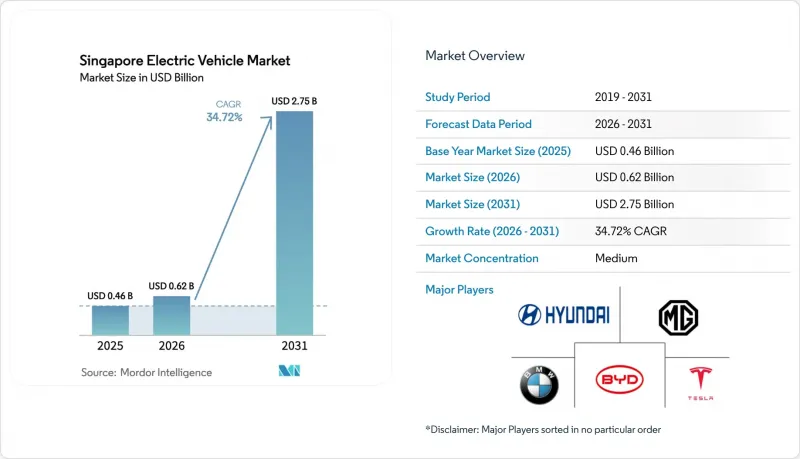
本報告按車輛類型(乘用車和商用車)、驅動方式(電池式電動車(BEV)、插電式混合動力汽車 (PHEV) 等)、電池容量(50 kWh 及以下和以上)以及最終用戶(個人車主、商業車隊營運商等)進行細分。市場預測以貨幣價值(美元)和銷售(輛)兩種形式呈現。
新加坡電動車市場趨勢與洞察
政府獎勵計畫促進整體擁有成本平價
一項整合了「早期電動車推廣獎勵」和「車輛排放氣體法規(VES)A1級補貼」的雙重補貼計劃,顯著縮小了電動車與汽油車之間的價格差距。這些補貼優先考慮即時成本節約,使得入門級純電動轎車的稅後價格已經超過了汽油車。符合資格的車款免收額外註冊費(0美元)進一步提振了比亞迪Atto 3等中檔進口車款的需求。電動車的普及率正在飆升,享受雙重補貼的電動車和計程車數量也在增加。政策制定者建議透過降低A2級補貼來推動從過渡性混合動力汽車向完全零排放車型的轉變,這與不斷發展的充電網路一致。這些獎勵不僅縮短了頻繁駕駛者的購車回本期,也促進了電動車的更廣泛普及。
快速部署公共和公寓充電站,目標是達到 60,000 個單位。
新加坡的充電網路正在擴展,並遵循一項具有法律約束力的藍圖,旨在未來幾年內大幅擴建此基礎設施。現行法規要求私人公寓在其部分物業上安裝運作中的充電樁,並在其他空間預先鋪設線路,以減輕居民未來進行維修時的不便。大多數住宅區至少配備一個充電樁。然而,使用數據顯示,人們更傾向於使用職場和公共快速充電點,這表明夜間充電仍然是公寓居住者面臨的一大難題。能源市場管理局 (EMA) 的 V2G 沙盒舉措允許車主在高峰時段將電力回饋電網,有助於降低能源成本。高密度、可靠的充電基礎設施的建設正在緩解人們對續航里程的擔憂,並使沒有專用車庫的消費者更容易擁有電動車。
電動車的初始成本高且擁車成本波動較大的問題仍然存在。
擁車證(COE)競標價格已創歷史新高,有時甚至超過入門級電動車的市場價格,削弱了補貼計畫的有效性,加重了家庭負擔。 A2級車輛排放補貼的削減降低了對高功率車型的支持力度,迫使購買豪華車的消費者承擔額外的稅負。車輛部署負責人面臨著在漫長的採購週期內應對擁車證價格波動的挑戰,儘管清潔能源部署義務即將到來,但這可能會延遲大宗訂單的交付。高昂的前期成本仍然是新加坡電動車市場成長的最大障礙,尤其對沒有租賃選擇的中等收入家庭影響巨大。
細分市場分析
預計到2025年,新加坡電動車市場中乘用車將佔79.67%的市場。同時,受共享出行、宅配和公共運輸業者的強勁推動,商用車市場預計到2031年將實現37.21%的複合年成長率。掀背車和轎車仍然是入門級購車者的熱門選擇,這得益於針對特定價位車型的優惠政策。同時,像起亞EV5這樣的緊湊型SUV也越來越受到那些希望以實惠價格獲得更大空間的消費者的青睞。
輕型商用車正在推動商業領域的普及,與傳統柴油車相比,它們能顯著降低成本,聯邦快遞推出電動車型是一個很好的例子。公車產業也在快速電氣化,大規模競標加速了車庫充電基礎設施的投資,同時也惠及了夜間卡車充電。中型和重型卡車由於負載容量和續航里程的限制以及車型選擇有限,面臨許多挑戰。然而,主要製造商推出電動卡車表明,電動卡車在都市區貨運中的經濟性正日益受到認可。總體而言,車隊策略正在重塑新加坡的電動車市場,其重點正轉向高利用率運作模式,以最大限度地節省燃油。
預計到2025年,電池式電動車(BEV)將佔新加坡電動車市場佔有率的82.23%,並預計到2031年將以35.78%的複合年成長率成長。這將鞏固其作為新加坡電動車市場事實上的標準平台的地位。插電式混合動力汽車在經常跨境馬來西亞的駕駛者中仍然很受歡迎,但由於車輛能源系統(VES)獎勵的減少和監管要求,該細分市場的成長受到限制。燃料電池技術的發展仍處於規劃階段,但現代汽車與新加坡經濟發展局(EDB)簽署的氫能合作備忘錄(MoU)正在奠定基礎。然而,其成功將取決於對加氫基礎設施的同步投資。
隨著公共充電基礎設施的擴展和中程純電動車實際續航里程的提升,一些主要的實際挑戰正在逐步解決。汽車製造商的銷售數據顯示,越來越多的消費者在過渡階段完全跳過了混合動力汽車。比亞迪品牌排名躍居榜首,超越豐田,便是這項轉變的有力佐證。隨著純電動車價格的持續下降和監管的日益嚴格,市場關注點正不斷轉向純電動車。
其他好處:
- Excel格式的市場預測(ME)表
- 3個月的分析師支持
目錄
第1章:引言
- 研究假設和市場定義
- 調查範圍
第2章:調查方法
第3章執行摘要
第4章 市場狀況
- 市場概覽
- 市場促進因素
- 政府獎勵計畫促進整體擁有成本平價
- 為實現6萬個充電樁的目標,公共充電站和公寓大樓充電站的快速部署正在進行中。
- 擁車證和車輛排放證的改革不利於內燃機車所有權
- 到 2028 年,將電池組成本降低到每千瓦時 80 美元以下的藍圖。
- 叫車和物流公司為實現車輛脫碳所做的努力
- 全國範圍內的V2G示範計畫為輔助服務產生收入打開了大門。
- 市場限制因素
- 電動車初始價格高昂以及擁車證(COE)價格波動
- 組屋擴建停車位以安裝充電樁的能力有限。
- 新加坡對小批量銷售的右舵車型的配額有限。
- 對功率超過150千瓦的快速充電走廊進行電網升級改造的資本投資
- 價值供應鏈分析
- 監理情勢
- 技術展望
- 波特五力模型
第5章 市場規模及成長預測-價值(美元)與銷售
- 按車輛類型
- 搭乘用車
- 掀背車
- 轎車
- 運動型多用途車
- 多用途車輛
- 商用車輛
- 輕型商用車
- 中型商用車
- 大型商用車輛
- 巴士和長途汽車
- 搭乘用車
- 透過驅動系統
- 電池式電動車(BEV)
- 插電式混合動力車(PHEV)
- 燃料電池電動車(FCEV)
- 按電池容量
- 50千瓦時或更少
- 51~75 kWh
- 75度或以上
- 最終用戶
- 個人所有者
- 商用車輛營運商
- 叫車和共享汽車
- 物流/配送
- 政府和公共部門車輛
第6章 競爭情勢
- 市場集中度
- 策略趨勢
- 市佔率分析
- 公司簡介
- Tesla Inc.
- BYD Co. Ltd
- Hyundai Motor Company
- Kia Corporation
- MG Motor(SAIC Motor)
- BMW AG
- Mercedes-Benz Group AG
- Audi AG
- Nissan Motor Co. Ltd.
- Toyota Motor Corporation
- Mitsubishi Motors Corporation
- AB Volvo
- Renault Group
- Xpeng Inc
第7章 市場機會與未來展望
According to Mordor Intelligence, the Singapore electric vehicle market size is expected to grow from USD 0.46 billion in 2025 to USD 0.62 billion in 2026 and is forecast to reach USD 2.75 billion by 2031, reflecting a 34.72% CAGR over the forecast period (2026-2031).
This report is Segmented by Vehicle Type (Passenger Cars and Commercial Vehicles), Drive Train Technology (Battery Electric Vehicles (BEV), Plug-In Hybrid Electric Vehicles (PHEV), and More), Battery Capacity (Up To 50 KWh and More), and End User (Private Individual Owners, Commercial Fleet Operators, and More). The Market Forecasts are Provided in Terms of Value (USD) and Volume (Units).
Singapore Electric Vehicle Market Trends and Insights
Government Incentive Schemes Driving TCO Parity
By integrating the Early EV Adoption Incentive with the Vehicle Emissions Scheme A1 tier, a dual-rebate architecture significantly reduces sticker-price disparities. These rebates prioritize immediate savings, allowing entry-level battery-electric sedans to surpass their gasoline counterparts in post-tax price. The zero-dollar Additional Registration Fee for eligible models continues to boost demand for mid-range imports, such as the BYD Atto 3. Adoption has surged, with a growing number of electric cars and taxis benefiting from the dual rebates. By reducing Band A2 benefits, policymakers indicate a shift from transitional hybrids to fully zero-emission models, aligning with the evolving charging network. These incentives not only shorten payback periods for frequent drivers but also support a broader acceptance of electric vehicles.
Rapid Roll-Out of Public and Condo Chargers Toward 60 k Target
The island has a growing network of charge points and is following a legally binding roadmap to significantly expand this infrastructure in the coming years . Regulations now require private condominiums to include active chargers in a portion of their lots and pre-install wiring in additional spaces, reducing future retrofitting challenges for residents. A majority of Housing & Development Board estates are equipped with at least one charger. However, usage patterns indicate a preference for workplace and public fast-charging sites, highlighting ongoing challenges with overnight charging for apartment residents. The Energy Market Authority's V2G sandbox initiative enables motorists to return power to the grid during peak periods, helping reduce energy costs. The development of a dense, reliable charging infrastructure has helped alleviate range anxiety, making electric vehicles more accessible to consumers without private garages.
Persistently High EV Upfront Price and COE Volatility
Record COE bids have occasionally surpassed the open-market value of entry-level electric cars, undermining rebates and straining household budgets. Band A2 VES rebates have been reduced, diminishing support for high-power models and forcing premium buyers to bear additional taxes. Fleet planners face challenges managing COE fluctuations across extended procurement cycles, which can delay bulk orders despite the impending cleaner-energy mandate. High upfront costs remain the most significant barrier to the growth of the Singapore electric vehicle market, particularly for middle-income households without access to leasing options.
Other drivers and restraints analyzed in the detailed report include:
- COE and VES Reforms Penalizing ICE Ownership
- Battery-Pack Cost Road-map Below USD 80/kWh by 2028
- Limited HDB Parking Upgrade Capacity for Chargers
For complete list of drivers and restraints, kindly check the Table Of Contents.
Segment Analysis
Passenger cars accounted for 79.67% of the 2025 Singapore electric vehicle market share. Commercial vehicles, however, are slated to post a 37.21% CAGR through 2031, buoyed by decisive moves from ride-hailing, parcel, and public-transport operators. Hatchbacks and sedans remain popular choices for entry-level buyers, supported by favorable policies for models within specific price thresholds. At the same time, compact SUVs, such as the Kia EV5, are gaining traction among buyers seeking additional space at competitive price points.
Light vans are driving commercial adoption, with examples like FedEx's deployment of electric models demonstrating significant cost savings compared to traditional diesel vehicles. The bus segment is electrifying at a rapid pace, supported by large-scale tenders that are fostering investments in depot-charging infrastructure, which also benefits nighttime truck charging. Medium and heavy trucks face challenges due to payload and range limitations, as well as fewer model options. However, the introduction of electric trucks by leading manufacturers highlights the growing validation of their economic viability in urban freight. Overall, fleet strategies are reshaping the electric vehicle market in Singapore, shifting focus toward high-utilization duty cycles that maximize fuel-saving benefits.
Battery electric vehicles accounted for 82.23% of the 2025 Singapore electric vehicle market share and are forecast to grow at a 35.78% CAGR to 2031, solidifying their status as the de facto platform in the Singapore electric vehicle market. Drivers who frequently cross into Malaysia still favor plug-in hybrids, but dwindling VES incentives and regulatory mandates are limiting the segment's growth. While fuel-cell initiatives are still in the exploratory phase, Hyundai's hydrogen MoU with the Economic Development Board sets the stage. Still, its success is contingent on simultaneous investments in refueling infrastructure.
With expanded public charging and improved real-world ranges for mid-tier BEVs, significant practical challenges are being addressed. Sales data from OEMs reveal a growing trend: buyers are bypassing transitional hybrids altogether. This shift is highlighted by BYD's rise to the top of the brand rankings, surpassing Toyota. As BEV prices continue to decline and regulations tighten, the market's focus is increasingly leaning towards pure electric options.
Complete Report Scope:
- By Vehicle Type
- Passenger Cars
- Hatchback
- Sedan
- Sport-Utility Vehicle
- Multi-Purpose Vehicle
- Commercial Vehicles
- Light Commercial Vehicles
- Medium Commercial Vehicles
- Heavy Commercial Vehicles
- Buses & Coaches
- Passenger Cars
- By Drive Train Technology
- Battery Electric Vehicles (BEV)
- Plug-in Hybrid Electric Vehicles (PHEV)
- Fuel Cell Electric Vehicles (FCEV)
- By Battery Capacity
- Up to 50 kWh
- 51 to 75 kWh
- Above 75 kWh
- By End User
- Private Individual Owners
- Commercial Fleet Operators
- Ride-hailing & Car-sharing
- Logistics & Delivery
- Government & Public-Sector Fleets
List of Companies Covered in this Report:
- Tesla Inc.
- BYD Co. Ltd
- Hyundai Motor Company
- Kia Corporation
- MG Motor (SAIC Motor)
- BMW AG
- Mercedes-Benz Group AG
- Audi AG
- Nissan Motor Co. Ltd.
- Toyota Motor Corporation
- Mitsubishi Motors Corporation
- AB Volvo
- Renault Group
- Xpeng Inc
Additional Benefits:
- The market estimate (ME) sheet in Excel format
- 3 months of analyst support
TABLE OF CONTENTS
1 Introduction
- 1.1 Study Assumptions & Market Definition
- 1.2 Scope of the Study
2 Research Methodology
3 Executive Summary
4 Market Landscape
- 4.1 Market Overview
- 4.2 Market Drivers
- 4.2.1 Government incentive schemes driving TCO parity
- 4.2.2 Rapid roll-out of public & condo chargers toward 60k target
- 4.2.3 COE & VES reforms penalising ICE ownership
- 4.2.4 Battery-pack cost road-map below USD 80/kWh by 2028
- 4.2.5 Fleet decarbonisation pledges by ride-hailing & logistics firms
- 4.2.6 Nation-wide V2G pilot unlocking ancillary-services revenue
- 4.3 Market Restraints
- 4.3.1 Persistently high EV upfront price & COE volatility
- 4.3.2 Limited HDB parking upgrade capacity for chargers
- 4.3.3 Scarce RHD model allocations for Singapore's small volume
- 4.3.4 Grid upgrade capex for Above 150 kW fast-charge corridors
- 4.4 Value / Supply-Chain Analysis
- 4.5 Regulatory Landscape
- 4.6 Technological Outlook
- 4.7 Porter's Five Forces
- 4.7.1 Threat of New Entrants
- 4.7.2 Bargaining Power of Buyers
- 4.7.3 Bargaining Power of Suppliers
- 4.7.4 Threat of Substitute Products
- 4.7.5 Intensity of Competitive Rivalry
5 Market Size & Growth Forecasts - Value (USD) and Volume (Units)
- 5.1 By Vehicle Type
- 5.1.1 Passenger Cars
- 5.1.1.1 Hatchback
- 5.1.1.2 Sedan
- 5.1.1.3 Sport-Utility Vehicle
- 5.1.1.4 Multi-Purpose Vehicle
- 5.1.2 Commercial Vehicles
- 5.1.2.1 Light Commercial Vehicles
- 5.1.2.2 Medium Commercial Vehicles
- 5.1.2.3 Heavy Commercial Vehicles
- 5.1.2.4 Buses & Coaches
- 5.1.1 Passenger Cars
- 5.2 By Drive Train Technology
- 5.2.1 Battery Electric Vehicles (BEV)
- 5.2.2 Plug-in Hybrid Electric Vehicles (PHEV)
- 5.2.3 Fuel Cell Electric Vehicles (FCEV)
- 5.3 By Battery Capacity
- 5.3.1 Up to 50 kWh
- 5.3.2 51 to 75 kWh
- 5.3.3 Above 75 kWh
- 5.4 By End User
- 5.4.1 Private Individual Owners
- 5.4.2 Commercial Fleet Operators
- 5.4.2.1 Ride-hailing & Car-sharing
- 5.4.2.2 Logistics & Delivery
- 5.4.3 Government & Public-Sector Fleets
6 Competitive Landscape
- 6.1 Market Concentration
- 6.2 Strategic Moves
- 6.3 Market Share Analysis
- 6.4 Company Profiles (Includes Global Level Overview, Market Level Overview, Core Segments, Financials as Available, Strategic Information, Market Rank/Share for Key Companies, Products and Services, SWOT Analysis, and Recent Developments)
- 6.4.1 Tesla Inc.
- 6.4.2 BYD Co. Ltd
- 6.4.3 Hyundai Motor Company
- 6.4.4 Kia Corporation
- 6.4.5 MG Motor (SAIC Motor)
- 6.4.6 BMW AG
- 6.4.7 Mercedes-Benz Group AG
- 6.4.8 Audi AG
- 6.4.9 Nissan Motor Co. Ltd.
- 6.4.10 Toyota Motor Corporation
- 6.4.11 Mitsubishi Motors Corporation
- 6.4.12 AB Volvo
- 6.4.13 Renault Group
- 6.4.14 Xpeng Inc
7 Market Opportunities & Future Outlook

 2026年全球電動車市場預測印度電動車市場,2025-2032年
 北美電動車市場:市場佔有率分析、產業趨勢與統計、成長預測(2026-2031)法國電動車市場:市場佔有率分析、產業趨勢與統計及成長預測(2026-2031)電動車:市場佔有率分析、產業趨勢與統計、成長預測(2026-2031)越南電動車市場:市場佔有率分析、產業趨勢與統計及成長預測(2026-2031年)電動車中800V架構的演變非洲電動車:市場佔有率分析、產業趨勢與統計及成長預測(2026-2031 年)東協電動車市場:市場佔有率分析、產業趨勢與統計及成長預測(2026-2031)800V電動車架構的市場規模、佔有率、成長、全球產業分析、區域趨勢與2026年至2034年預測