


 |
市場調查報告書
商品編碼
2117282
法國電動車市場:市場佔有率分析、產業趨勢與統計及成長預測(2026-2031)France Electric Vehicles - Market Share Analysis, Industry Trends & Statistics, Growth Forecasts (2026 - 2031) |
||||||

※ 本網頁內容可能與最新版本有所差異。詳細情況請與我們聯繫。
根據 Mordor Intelligence 預測,法國電動車市場規模將從 2025 年的 305.6 億美元成長到 2026 年的 341.7 億美元,然後在 2031 年達到 543.6 億美元,2026 年至 2031 年的複合年成長率為 11.83%。
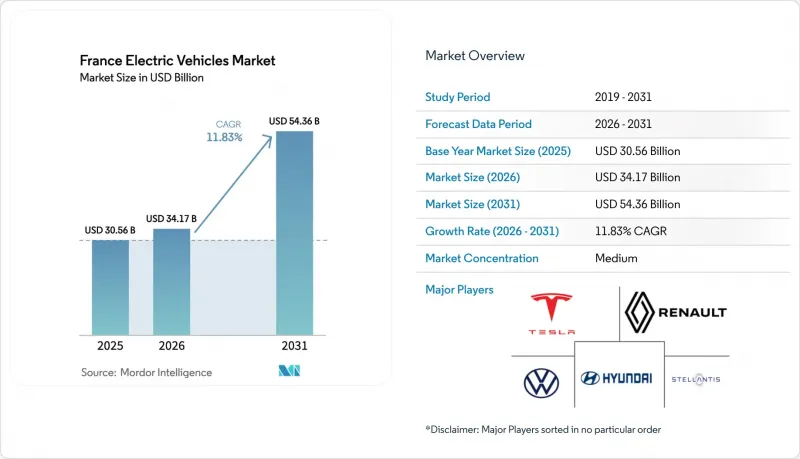
本報告按動力系統(電池式電動車、插電式混合動力汽車等)、車輛類型(乘用車和商用車)、充電方式(交流電22千瓦或以下(典型值)等)、最終用途(私人所有等)以及電池容量(小於50千瓦時等)進行細分。市場規模和預測以價值(美元)和銷售(輛)表示。
法國電動車市場趨勢與分析
慷慨的採購支援和稅收優惠
2025年,一項針對符合資格的電池式電動車的政府補貼計畫降低了實際初始成本,從而促進了註冊量的成長。一項每月補貼100歐元(約117.87美元)的社會租賃計劃,使5萬個低收入家庭,特別是都市區的家庭,能夠擁有電動車。 Stellantis公司在其ACC和Verkor工廠的本地電池生產不僅滿足了獎勵的“原產地要求”,而且還加強了供應鏈。雖然預計從2026年起補貼將逐步減少,但電池價格的下降有望抵消這些影響。這項政策框架不僅將在短期內促進銷售量,而且將在長期內引導市場走向永續的成本競爭力。
全國部署快速充電樁
由於公共和私人津貼,充電基礎設施正在主要高速公路和職場沿線建設,預計到2025年底,已安裝的充電樁數量將達到約14.7萬個。由Mobilize和其他網路提供的超快速直流充電站可將75千瓦時電池組的充電速度提高三倍,從而提升長途旅行的便利性。儘管區域間仍有差異,但計畫於2030年建成的2.5萬個超快速充電樁可望縮小大西洋和地中海沿岸高速公路沿線的差距。在巴黎附近的A10高速公路上進行的動態無線充電試點項目,證明了該方案對在高速公路上行駛的重型卡車的實用性。持續的推廣將防止充電排隊阻礙高普及率地區的車輛成長。
電動車的初始購買價格以及與內燃機汽車的價格差異
電池式電動車(BEV)的平均零售價格顯著高於同級的內燃機汽車(ICE)。對於家庭收入中位數低於全國平均10%以上的地區,獎勵只能部分彌補價格差距。售價低於25,000歐元(約29,467美元)的入門車型市場佔有率有限,大多數消費者選擇價格更高的車型。汽車製造商的降價顯示競爭壓力加劇,同時也威脅到利潤率。除非電池價格降至每千瓦時100美元左右,否則對價格敏感的消費者,尤其是居住在農村地區的消費者,很可能會延後購車計畫。
細分市場分析
在大都會圈充電網路發展的推動下,預計到2025年,電池式電動車(BEV)將佔據67.65%的市場佔有率。燃料電池汽車(FCEV)正以18.37%的複合年成長率快速成長,這得益於90億歐元的氫能相關資金支持以及到2030年建成1000座加氫站的目標。霍頓公司在國內生產的燃料電池廂型車續航里程達400公里,加氫時間僅需5分鐘,非常適合物流業者使用。隨著基礎設施問題的緩解,插電式混合動力汽車的市場佔有率正在下降,消費者逐漸轉向純電動車。
燃料電池的應用主要集中在大型車輛和高運轉率車輛領域,因為在這些領域,維持負載容量比氫氣成本更為重要。雖然乘用車燃料電池車型仍然不多,但燃料電池堆和儲罐供應商的產能已經成熟。政府設定的加氫站目標為每座投資300萬至500萬歐元(354萬至589萬美元),雖然具有挑戰性,但如果電解槽項目與剩餘可再生能源發電相結合,這一目標並非無法實現。因此,在法國電動車市場,氫能扮演的是補充角色,而非取代主導的電池系統。
預計到2025年,乘用車將佔新車註冊量的95.26%,主要得益於車型多樣化、電池價格下降以及消費者對家用充電的熟悉程度提高。重型卡車的基數最初僅為2000輛,但由於巴黎、里昂和馬賽等低排放氣體區的貨運公司被迫逐步淘汰柴油車輛,其年複合成長率已達17.03%。 A7和A10高速公路沿線每隔60-80公里安裝的高容量充電樁已將充電時間縮短至45分鐘,使得400公里短途運輸對電動卡車而言具有商業性可行性。市政當局對電動垃圾車、工程車輛和送貨車輛的補貼進一步擴大了目標市場。因此,貨運電氣化正在縮小法國電動車市場中商用車和乘用車需求之間長期存在的差距。
雷諾Kangoo E-Tech和雪鐵龍e-Berlingo等小型商用車在法國上法蘭西大區和新阿基坦大區的熟練工人中越來越受歡迎,他們可以在工作地點為貨車進行夜間充電。隨著市政當局大力推廣零排放公共交通目標,採用阿爾斯通Aptis和依維柯E-Way平台的城市和城際公車已佔據0.8%的市場佔有率。隨著卡車數量的快速成長,電池租賃模式日益受到關注,這種模式可以將資本投資成本從營運商的資產負債表中剝離,並確保在服務期滿後實現價值回收。卡車製造商斯堪尼亞透露,其電動卡車預計將於2026年初開始使用商用兆瓦級充電系統(MCS)。同時,一項計畫於2026年啟動的MCS示範計畫旨在將停車時間縮短至30分鐘內,為長途運輸的全面電氣化鋪平道路。這些發展表明,法國電動車市場的貨運領域將大幅擴張。
其他好處:
- Excel格式的市場預測(ME)表
- 3個月的分析師支持
目錄
第1章:引言
- 研究假設和市場定義
- 調查範圍
第2章:調查方法
第3章執行摘要
第4章 市場狀況
- 市場概覽
- 市場促進因素
- 慷慨的購屋支援措施和稅收優惠
- 全國部署快速充電樁(Afitf/Ademe津貼)
- 鋰離子電池成本曲線的壓縮
- 企業車輛強制電氣化(2025 年分配目標)
- 二手電池的轉售提高了整體成本效益。
- 透過RTE彈性市場實現車網互動收入流
- 市場限制因素
- 電動車的初始購買價格高於內燃機汽車(ICE)。
- 農村充電基礎設施發展不平衡
- 關鍵礦物供應瓶頸限制了對整車製造商的配額。
- 經銷商在電動車售後服務和培訓方面的能力差距。
- 價值供應鏈分析
- 監理情勢
- 技術展望
- 波特五力模型
第5章 市場規模與成長預測
- 依推進類型
- 電池式電動車(BEV)
- 插電式混合動力車(PHEV)
- 燃料電池汽車(FCEV)
- 車輛類型
- 搭乘用車
- 掀背車
- 轎車
- SUV(運動型多用途車)
- 多用途車輛 (MUV)
- 商用車輛
- 輕型商用車(LCV)
- 大型卡車
- 城市和城際巴士
- 搭乘用車
- 透過充電方法
- 交流電(22 千瓦或以上)(典型值)
- 直流22-150千瓦(快速充電)
- 直流電,功率小於 150 千瓦(超快)
- 按最終用途
- 個人所有
- 公司車輛及租賃車輛
- 政府和地方政府車輛
- 共享出行(汽車共享/乘車大廳)
- 按電池容量
- 小於 50 千瓦時
- 50~75 kWh
- 75度或以上
第6章 競爭情勢
- 市場集中度
- 策略趨勢
- 市佔率分析
- 公司簡介
- Renault SA
- Tesla Inc.
- Stellantis NV
- Volkswagen AG
- Hyundai Motor Group
- BMW AG
- Mercedes-Benz Group AG
- BYD Co Ltd
- MG Motor(SAIC)
- Nissan Motor Co., Ltd.
- Toyota Motor Corporation
- Volvo Car AB
- Polestar Automotive
第7章 市場機會與未來展望
According to Mordor Intelligence, the french electric vehicle market size is expected to grow from USD 30.56 billion in 2025 to USD 34.17 billion in 2026 and is forecast to reach USD 54.36 billion by 2031 at 11.83% CAGR over 2026-2031.
This report is Segmented by Propulsion Type (Battery Electric Vehicles, Plug-In Hybrid Electric Vehicles, and More), Vehicle Type (Passenger Cars and Commercial Vehicles), Charging Type (AC <= 22 KW (Normal), and More), End-Use (Private Ownership, and More) and Battery Capacity (Less Than 50 KWh and More). The Market Sizes and Forecasts are Provided in Terms of Value (USD) and Volume (Units).
France Electric Vehicles Market Trends and Insights
Robust Purchase and Tax Incentives
In 2025, government rebates for qualifying battery electric cars effectively reduced up-front costs and boosted registrations. A social-leasing initiative, set at EUR 100 (USD 117.87) monthly, enabled 50,000 low-income households to access electric vehicles, especially in urban areas. Localized cell production at Stellantis ACC and Verkor plants not only satisfies the incentive's origin stipulation but also strengthens supply chains. Although bonus amounts will decrease post-2026, falling battery prices are expected to counterbalance the diminishing subsidies. This policy framework not only propels immediate sales but also steers the market towards sustainable cost competitiveness in the long run.
Nationwide Fast-Charger Roll-Out
Public-private grants underpin corridor and workplace charging, lifting installed ports to roughly 147,000 by late 2025. Ultra-fast DC hubs from Mobilize and other networks triple charging speed for 75 kWh packs, improving convenience for long-distance travel. Regional disparities persist, yet the planned 25,000 ultra-rapid ports by 2030 will narrow gaps along the Atlantic and Mediterranean highways. Dynamic in-road wireless charging pilots on the A10 near Paris validate solutions for heavy trucks at highway speed. Sustained expansion prevents charging queues from constraining fleet growth in high-penetration zones.
Higher Up-Front EV Sticker Price vs ICE
Average battery-electric cars retailed a significant price premium over internal-combustion equivalents. Incentives close only part of the gap for households in regions where the median income trails the national average by more than 10%. Entry-level models priced below EUR 25,000 (USD 29,467) capture a limited share, leaving most buyers in higher price bands. Automaker price cuts signal competitive pressure yet threaten margins. Until battery prices fall near USD 100/kWh, price-sensitive consumers, especially in rural departments, will postpone purchases.
Other drivers and restraints analyzed in the detailed report include:
- Lithium-Ion Battery Cost Curve Compression
- Corporate Fleet Electrification Mandates
- Uneven Rural Charging Coverage
For complete list of drivers and restraints, kindly check the Table Of Contents.
Segment Analysis
Battery-electric vehicles commanded a 67.65% share in 2025, on the back of dense charging grids in metropolitan areas. Fuel-cell electric vehicles scale at an 18.37% CAGR, supported by EUR 9 billion in hydrogen funding and a target of 1,000 refueling stations by 2030. Domestic production of fuel-cell van models at Hordain offers a 400-kilometer range with five-minute refueling, making it suitable for logistics operators. Plug-in hybrids decline as buyers migrate to pure-battery formats once infrastructure anxiety subsides.
Fuel-cell adoption centers on heavy-duty and high-utilization fleets where payload preservation outweighs hydrogen costs. Passenger fuel-cell models remain scarce, yet supplier capacity for stacks and tanks has matured. Government station targets imply investment of EUR 3-5 million (USD 3.54-5.89 million) per site, challenging but achievable if electrolyzer projects align with surplus renewable generation. Hydrogen, therefore, supplements rather than displaces the dominant battery segment in the French electric vehicle market.
Passenger cars accounted for 95.26% of 2025 registrations, driven by broad model variety, falling battery prices, and consumer familiarity with home charging. Heavy trucks, starting from a low 2,000-unit base, post a 17.03% CAGR as freight companies navigate low-emission zones in Paris, Lyon, and Marseille, triggering mandatory diesel phase-outs. High-capacity chargers sited every 60-80 kilometers along the A7 and A10 corridors reduce dwell times to 45 minutes, making 400-kilometer electric drayage runs commercially viable. Municipal subsidies for electric refuse, construction, and delivery vehicles further widen the addressable market. As a result, freight electrification begins to narrow the historical gap in volume between commercial and passenger demand in the French electric vehicle market.
Light commercial vehicles, including the Renault Kangoo E-Tech and Citroen e-Berlingo, appeal to artisans who can charge vans overnight at depots in Hauts-de-France and Nouvelle-Aquitaine. City and inter-city buses, powered by Alstom's Aptis and Iveco's E-Way platforms, reached 0.8% share as municipalities enforced zero-emission public-transport targets. Rapid truck uptake is attracting battery-leasing models that capex-shift packs off carrier balance sheets and guarantee end-of-life value recovery. Truck manufacturer Scania has revealed that its electric trucks are expected to start using the commercially available Megawatt Charging System (MCS) in early 2026. Meanwhile, dedicated pilots for the MCS, set for 2026, aim to reduce dwell times to under 30 minutes, paving the way for genuine long-haul electrification. Together, these developments hint at a significant boost for the freight segments in France's electric vehicle market.
Complete Report Scope:
- By Propulsion Type
- Battery Electric Vehicles (BEV)
- Plug-in Hybrid Electric Vehicles (PHEV)
- Fuel-Cell Electric Vehicles (FCEV)
- By Vehicle Type
- Passenger Cars
- Hatchback
- Sedan
- SUV (Sports Utility Vehicle)
- MUV (Multi Utility Vehicle)
- Commercial Vehicles
- Light Commercial Vehicles (LCV)
- Heavy Trucks
- City & Inter-city Buses
- Passenger Cars
- By Charging Type
- AC (greater than equals) 22 kW (Normal)
- DC 22-150 kW (Fast)
- DC Less than 150 kW (Ultra-fast)
- By End-use
- Private Ownership
- Corporate & Leasing Fleets
- Government & Municipal Fleets
- Shared Mobility (Car-share/Ride-hail)
- By Battery Capacity
- Less than 50 kWh
- 50-75 kWh
- Above 75 kWh
List of Companies Covered in this Report:
- Renault S.A.
- Tesla Inc.
- Stellantis N.V.
- Volkswagen AG
- Hyundai Motor Group
- BMW AG
- Mercedes-Benz Group AG
- BYD Co Ltd
- MG Motor (SAIC)
- Nissan Motor Co., Ltd.
- Toyota Motor Corporation
- Volvo Car AB
- Polestar Automotive
Additional Benefits:
- The market estimate (ME) sheet in Excel format
- 3 months of analyst support
TABLE OF CONTENTS
1 Introduction
- 1.1 Study Assumptions & Market Definition
- 1.2 Scope of the Study
2 Research Methodology
3 Executive Summary
4 Market Landscape
- 4.1 Market Overview
- 4.2 Market Drivers
- 4.2.1 Robust Purchase and Tax Incentives
- 4.2.2 Nationwide Fast-Charger Roll-Out (Afitf/Ademe Grants)
- 4.2.3 Lithium-Ion Battery Cost Curve Compression
- 4.2.4 Corporate Fleet Electrification Mandates (LOM 2025 Quotas)
- 4.2.5 Second-Life Battery Resale Boosting Total-Cost Economics
- 4.2.6 Vehicle-To-Grid Revenue Streams Via RTE Flexibility Markets
- 4.3 Market Restraints
- 4.3.1 Higher Upfront EV Sticker Price Vs. ICE
- 4.3.2 Uneven Rural Charging Coverage
- 4.3.3 Critical-Mineral Supply Bottlenecks Curbing OEM Allocation
- 4.3.4 Dealership Capability Gap On EV After-Sales & Education
- 4.4 Value / Supply-Chain Analysis
- 4.5 Regulatory Landscape
- 4.6 Technological Outlook
- 4.7 Porter's Five Forces
- 4.7.1 Threat of New Entrants
- 4.7.2 Bargaining Power of Suppliers
- 4.7.3 Bargaining Power of Buyers
- 4.7.4 Threat of Substitutes
- 4.7.5 Competitive Rivalry
5 Market Size & Growth Forecasts (Value (USD) and Volume (Units))
- 5.1 By Propulsion Type
- 5.1.1 Battery Electric Vehicles (BEV)
- 5.1.2 Plug-in Hybrid Electric Vehicles (PHEV)
- 5.1.3 Fuel-Cell Electric Vehicles (FCEV)
- 5.2 By Vehicle Type
- 5.2.1 Passenger Cars
- 5.2.1.1 Hatchback
- 5.2.1.2 Sedan
- 5.2.1.3 SUV (Sports Utility Vehicle)
- 5.2.1.4 MUV (Multi Utility Vehicle)
- 5.2.2 Commercial Vehicles
- 5.2.2.1 Light Commercial Vehicles (LCV)
- 5.2.2.2 Heavy Trucks
- 5.2.2.3 City & Inter-city Buses
- 5.2.1 Passenger Cars
- 5.3 By Charging Type
- 5.3.1 AC (greater than equals) 22 kW (Normal)
- 5.3.2 DC 22-150 kW (Fast)
- 5.3.3 DC Less than 150 kW (Ultra-fast)
- 5.4 By End-use
- 5.4.1 Private Ownership
- 5.4.2 Corporate & Leasing Fleets
- 5.4.3 Government & Municipal Fleets
- 5.4.4 Shared Mobility (Car-share/Ride-hail)
- 5.5 By Battery Capacity
- 5.5.1 Less than 50 kWh
- 5.5.2 50-75 kWh
- 5.5.3 Above 75 kWh
6 Competitive Landscape
- 6.1 Market Concentration
- 6.2 Strategic Moves
- 6.3 Market Share Analysis
- 6.4 Company Profiles (includes Global Level Overview, Market Level Overview, Core Segments, Financials as Available, Strategic Information, Market Rank/Share for Key Companies, Products and Services, SWOT Analysis, and Recent Developments)
- 6.4.1 Renault S.A.
- 6.4.2 Tesla Inc.
- 6.4.3 Stellantis N.V.
- 6.4.4 Volkswagen AG
- 6.4.5 Hyundai Motor Group
- 6.4.6 BMW AG
- 6.4.7 Mercedes-Benz Group AG
- 6.4.8 BYD Co Ltd
- 6.4.9 MG Motor (SAIC)
- 6.4.10 Nissan Motor Co., Ltd.
- 6.4.11 Toyota Motor Corporation
- 6.4.12 Volvo Car AB
- 6.4.13 Polestar Automotive
7 Market Opportunities & Future Outlook
- 7.1 White-space & unmet-need assessment

 2026年全球電動車市場預測印度電動車市場,2025-2032年
 北美電動車市場:市場佔有率分析、產業趨勢與統計、成長預測(2026-2031)新加坡電動車市場:市場佔有率分析、產業趨勢與統計及成長預測(2026-2031年)電動車:市場佔有率分析、產業趨勢與統計、成長預測(2026-2031)越南電動車市場:市場佔有率分析、產業趨勢與統計及成長預測(2026-2031年)電動車中800V架構的演變非洲電動車:市場佔有率分析、產業趨勢與統計及成長預測(2026-2031 年)東協電動車市場:市場佔有率分析、產業趨勢與統計及成長預測(2026-2031)800V電動車架構的市場規模、佔有率、成長、全球產業分析、區域趨勢與2026年至2034年預測