


 |
市場調查報告書
商品編碼
2097467
東協數位化工作場所:市場佔有率分析、產業趨勢與統計及成長預測(2026-2031)ASEAN Digital Workplace - Market Share Analysis, Industry Trends & Statistics, Growth Forecasts (2026 - 2031) |
||||||

※ 本網頁內容可能與最新版本有所差異。詳細情況請與我們聯繫。
根據 Mordor Intelligence 預測,東協數位工作場所市場規模將從 2025 年的 26.1 億美元成長到 2026 年的 32.7 億美元,然後在 2031 年達到 105.9 億美元,2026 年至 2031 年的複合年成長率為 26.49%。
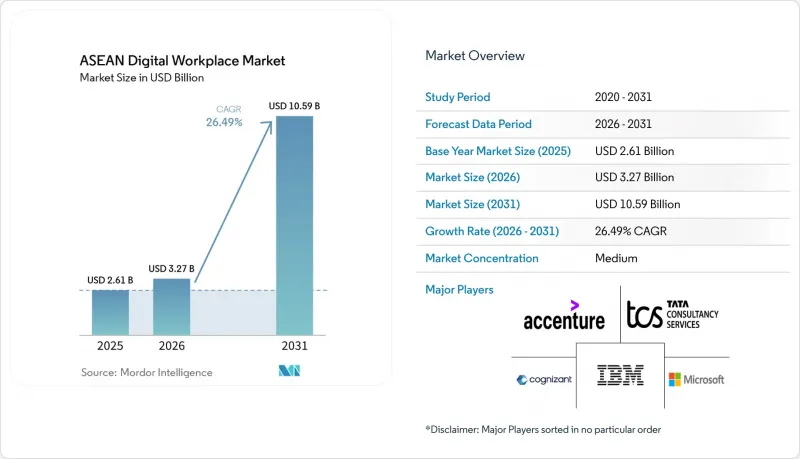
本報告按組件(解決方案和服務)、部署模式(雲端、本地部署等)、組織規模(大型企業和中小企業)、最終用戶行業(IT和電信、銀行、金融服務和保險、醫療保健、製造業、零售業、政府和公共部門、教育等)以及地區進行細分。市場預測以價值(美元)表示。
東協數位化工作場所市場的趨勢與洞察
向混合辦公和遠距辦公模式的過渡正在推進。
在東協各主要商業中心,混合辦公已成為標準商業模式,這項轉變正推動東協數位工作場所市場強勁成長。這是因為企業需要穩定的工具、安全的存取以及跨地域的協調工作流程,以支援分散的團隊合作。混合辦公模式的日益普及也使市場受益,迫使企業用更易於管理且長期更安全的整合式工作場所系統取代並行運行的遠端存取系統。此外,《東協2030年數位總體規劃》呼籲2028年加強公共管理部門的數位化能力和轉型管理能力,為此轉型提供了進一步的製度支持,並將需求基礎擴展到私營企業之外。區域框架也顯示,61%的受訪相關人員將雲端和資料中心列為首要基礎設施需求,這表明混合辦公的需求如今已與東協更廣泛的數位基礎設施決策息息相關。因此,東協數位化工作場所市場對臨時性工作政策調整的依賴性降低,而更重視員工跨國家和業務部門連結、協作和存取系統的長期重塑。此外,隨著混合辦公模式的日益成熟,買家越來越希望減少需要管理的系統數量,這提升了能夠將協作、終端控制和存取管治整合到單一解決方案中的供應商的價值。
對基於雲端的協作套件的需求日益成長
基於雲端的協作套件正成為企業大規模部署通訊、文件管理、工作流程自動化和人工智慧功能的關鍵基礎,如今已成為東協數位化工作場所市場的核心成長引擎。微軟宣布,將在2025年至2029年間投資55億美元用於新加坡的雲端和人工智慧基礎設施及運營,進一步鞏固新加坡作為企業雲端採用和生態系統發展區域中心的地位。微軟365 Copilot將於2026年4月部署到Accenture的74.3萬名員工,這也顯示人工智慧不再是獨立的實驗系統,而是透過主流工作場所套件得以應用。在印度尼西亞,與微軟相關的報告指出,到2025年,59%的高階主管將部署人工智慧代理,95%的高階主管計劃在12至18個月內擴大部署規模。這表明,對雲端套件的需求不僅源於提高基本生產力的需求,也源於自動化應用場景。馬來西亞也呈現類似的趨勢,人工智慧採用率從2025年下半年的19.7%上升至2026年第一季的21.8%,這將進一步推動雲端優先工作場所平台訂閱量的成長。因此,東協數位工作場所市場正日益受到平台生態系統的影響,這些生態系統將生產力、自動化、管治和人工智慧整合到單一訂閱服務中。
與傳統企業系統整合的複雜性
傳統基礎設施持續阻礙東協數位化工作場所市場的發展,許多公司仍在運作過時的生產、銀行或管理系統,這些系統難以與新的工作場所平台整合。 《商業時報》2025年的報告指出,東協地區的製造商在推廣人工智慧和先進技術的應用方面舉步維艱。這是因為許多工廠建於十多年前,依賴不相容的多供應商系統——這項挑戰與更廣泛的工作場所轉型所面臨的挑戰類似。這個問題不僅僅是軟體相容性問題,因為IT團隊花費大量時間修復整合問題,卻往往缺乏培訓、實施管治和流程重組的資源。印尼工業部試圖透過其「PIDI 4.0」計畫來彌合這一基礎技能差距。雖然該計劃在2022年至2025年間為1921名工人提供了數位化技能培訓,但舊有系統基礎設施的持續存在限制了企業從試點活動過渡到全面部署的速度。因此,在東協數位化工作場所市場,能夠提供連接器、分階段遷移計畫和多層部署模式的供應商比那些要求徹底替換現有基礎設施的供應商更受歡迎。在這些整合障礙消除之前,企業需求的很大一部分進展速度將繼續低於預算計畫的預期。
細分市場分析
到2025年,解決方案將佔據68.32%的市場佔有率,成為東協數位化工作場所市場最大的收入來源。這主要歸功於企業傾向於選擇能夠直接支援通訊、工作流程管理、終端一致性以及面向員工任務的軟體層。此外,許多買家希望擺脫分散的單一功能工具,轉而採用能夠支援數位化員工生命週期更多環節、且供應商數量更少的更廣泛的平台環境,這也是解決方案主導地位的原因之一。在這一市場構成中,整合通訊和協作工具仍然是最廣泛使用的工具,其次是工作流程自動化、知識管理和員工體驗(EX)系統。這反映出東協數位化工作場所產業正朝著圍繞少數高效工具的整合方向發展。隨著企業尋求確保混合存取並實現分散式團隊終端環境的標準化,虛擬桌面基礎架構(VDI)和雲端PC工具也日益受到關注。這些趨勢意味著,儘管服務在實施支援方面仍然至關重要,但東協數位化工作場所市場仍以產品主導支出為中心。
服務業預計在預測期內將以26.89%的複合年成長率持續成長,企業尋求外部支援以應對跨國家和業務部門部署、整合工作以及部署後管理的複雜性。製造業和銀行業對服務業的需求尤其突出,因為傳統架構正在減緩新架構的採用速度,並加重企業內部IT團隊的負擔。埃森哲於2026年4月向74.3萬名員工部署Microsoft 365 Copilot,顯示如今大規模工作場所專案正透過解決方案主導的轉型模式在企業層面實施,而不僅僅是購買軟體。Accenture推出2026年3月推出的Microsoft前配置Accenture實務也反映了類似的趨勢,該實務旨在將企業人工智慧專案從概念階段推進到生產階段,凸顯了緊密整合的軟體和服務交付模式在東協數位化工作場所市場中的價值。未來,同時具備原生平台能力和實施經驗的供應商將更具優勢。這是因為買家越來越傾向於選擇能夠在不增加供應商複雜性的前提下縮短實施時間的合作夥伴。
預計到2025年,雲端運算將佔據66.87%的市場佔有率,並在2031年之前保持27.08%的最高成長率,凸顯了東協數位化工作場所市場正穩步向託管和訂閱式交付模式轉型。雲端運算佔有率的成長源於其能夠滿足該地區對快速部署、輕鬆擴展以及跨地域員工廣泛存取的需求,而無需像本地部署系統那樣進行大規模的內部基礎設施投資。這一轉變也反映出工作場所軟體與人工智慧(AI)應用準備工作之間的聯繫日益緊密,因為許多自動化和輔助功能都可以透過雲端生態系從一開始就獲得。微軟在新加坡的基礎設施建設工作也支持了這一方向,增強了該地區處理雲端和人工智慧工作負載的能力,從而推動了企業工作場所的採用。在本地雲端容量擴張的推動下,馬來西亞的人工智慧採用率從2025年下半年的19.7%上升到第一季的21.8%。這表明基礎設施的可用性與對現代辦公室平台的需求之間存在相關性。
在金融服務、醫療保健和政府機構等受監管行業,本地部署系統的重要性仍然存在。在這些產業中,有關資料居住和以往基礎設施投資的法規仍然對部署決策構成強大的阻力。混合模式的重要性也日益凸顯,因為它們為企業提供了一種切實可行的方法,既能兼顧公共雲端的擴充性,又能嚴格控制敏感資料和工作負載的部署位置。計畫於2026年6月完成的東協資料交換架構(DEFA)談判,可望在一定程度上緩解跨境資料流動中的摩擦,從而逐步增強東協數位工作場所市場多邊部署採用雲端技術的合理性。同時,新加坡的《個人資料保護法》(PDPA)和《東協人工智慧管治與倫理指南》等合規框架將持續影響企業如何界定公共雲端和託管環境之間的界線。簡而言之,部署選擇將繼續受到監管解讀和技術偏好的雙重影響。
其他好處:
- Excel格式的市場預測(ME)表
- 3個月的分析師支持
目錄
第1章:引言
- 研究假設和市場定義
- 調查範圍
第2章:調查方法
第3章執行摘要
第4章 市場狀況
- 市場概覽
- 市場促進因素
- 混合辦公和遠距辦公模式的轉變正在推進。
- 對基於雲端的協作套件的需求日益成長
- 員工體驗平台和數位化應用工具的快速普及。
- 東協中小企業數位化進程
- 對零信任職場安全和合規自動化的需求日益成長。
- 超級應用程式工作流程和行動優先職場文化的興起
- 市場限制因素
- 與傳統企業系統整合的複雜性
- 中小企業的預算限制
- 資料主權、隱私和跨境合規限制
- 數位工作場所管理和變革管理方面的技能差距
- 宏觀經濟因素對市場的影響
- 產業價值鏈分析
- 監理情勢
- 技術展望
- 波特五力分析
第5章 市場規模與成長預測
- 按組件
- 解決方案
- 整合通訊與協作
- 整合端點管理
- 企業移動性與管理
- 員工體驗平台與內網
- 工作流程自動化與知識管理
- 虛擬桌面基礎架構與雲端電腦
- 服務
- 解決方案
- 部署模式
- 雲
- 現場
- 混合
- 按組織規模
- 大公司
- 小型企業
- 按最終用戶行業分類
- 資訊科技/通訊
- BFSI
- 衛生保健
- 製造業
- 零售
- 政府/公共部門
- 教育
- 能源公用事業
- 法律與專業服務
- 其他終端用戶產業
- 按地區
- 新加坡
- 馬來西亞
- 泰國
- 印尼
- 菲律賓
- 越南
- 其他東南亞國協
第6章 競爭情勢
- 市場集中度
- 策略趨勢
- 市佔率分析
- 公司簡介
- Accenture plc
- Atos SE
- Capgemini SE
- Citrix Systems, Inc.
- Cognizant Technology Solutions Corporation
- Cloud Software Group, Inc.
- DXC Technology Company
- Fujitsu Limited
- HCL Technologies Limited
- Hewlett Packard Enterprise Company
- HTC Global Services, Inc.
- IBM Corporation
- Infosys Limited
- Microland Limited
- Microsoft Corporation
- NEC Corporation
- NTT DATA Group Corporation
- RingCentral, Inc.
- Tata Consultancy Services Limited
- Unisys Corporation
- Wipro Limited
- Yonyou Network Technology Co., Ltd.
第7章 市場機會與未來展望
According to Mordor Intelligence, the ASEAN digital workplace market size is expected to grow from USD 2.61 billion in 2025 to USD 3.27 billion in 2026, and is forecast to reach USD 10.59 billion by 2031, at a 26.49% CAGR over 2026-2031.
This report is Segmented by Component (Solutions, and Services), Deployment Mode (Cloud, On-Premises, and More), Organization Size (Large Enterprises, and Small and Medium-Sized Enterprises), End-User Industry (IT and Telecommunications, BFSI, Healthcare, Manufacturing, Retail, Government and Public Sector, Education, and More), and Geography. The Market Forecasts are Provided in Terms of Value (USD).
ASEAN Digital Workplace Market Trends and Insights
Rising Shift To Hybrid and Remote Work Models
Hybrid work has become a normal operating model in major ASEAN business centers, and that change is keeping the ASEAN digital workplace market on a strong upward path because companies now need stable tools for distributed teams, secure access, and coordinated workflows across sites. The market is also benefiting because hybrid work has pushed companies to replace parallel remote access systems with more unified workplace stacks that are easier to manage and secure over time. The ASEAN Digital Masterplan 2030 also gave this shift greater institutional backing by calling for stronger digital competencies and change management capabilities in public administration by 2028, broadening the demand base beyond private enterprise alone. The same regional framework identified cloud and data centers as the top infrastructure priority for 61% of surveyed stakeholders, underscoring that hybrid work needs are now tied to broader digital infrastructure decisions across ASEAN. This is making the ASEAN digital workplace market less dependent on temporary work policy changes and more tied to long-term redesign of how employees connect, collaborate, and access systems across countries and business units. It also raises the value of vendors that can combine collaboration, endpoint control, and access governance into a single offer, because buyers increasingly want fewer systems to manage as hybrid operations mature.
Expanding Demand for Cloud-Based Collaboration Suites
Cloud-based collaboration suites are now a core growth engine for the ASEAN digital workplace market, as they serve as the primary layer through which companies deploy communication, document management, workflow automation, and AI features at scale. Microsoft announced a USD 5.5 billion investment in cloud and AI infrastructure and operations in Singapore for 2025-2029, which reinforced Singapore's role as a regional base for enterprise cloud adoption and ecosystem development. The rollout of Microsoft 365 Copilot to 743,000 Accenture employees in April 2026 also showed that AI is now being delivered through mainstream workplace suites rather than through separate experimental systems. In Indonesia, Microsoft-linked reporting showed that 59% of business leaders had already deployed AI agents in 2025 and that 95% planned to expand that capacity within 12-18 months, indicating that cloud suite demand is being driven by automation use cases, not just basic productivity needs. Malaysia followed a similar trajectory, with AI adoption rising to 21.8% in Q1 2026 from 19.7% in H2 2025, supporting further subscription growth for cloud-first workplace platforms. As a result, the ASEAN digital workplace market is increasingly shaped by platform ecosystems that bundle productivity, automation, governance, and AI into a single subscription.
Integration Complexity With Legacy Enterprise Systems
Legacy infrastructure continues to slow the ASEAN digital workplace market because many enterprises still operate older production, banking, or administrative systems that do not connect easily with newer workplace platforms. The Business Times reported in 2025 that ASEAN manufacturers were struggling to scale AI and advanced technology adoption because many facilities were over a decade old and relied on incompatible multi-vendor systems, a challenge similar to that for broader workplace transformation. This issue goes beyond software compatibility, because IT teams that spend time fixing integrations often have less capacity left for training, rollout governance, and process redesign. Indonesia's Ministry of Industry tried to address the underlying skills gap through the PIDI 4.0 program, which trained 1,921 workers in digital competencies between 2022 and 2025, but the installed base of legacy systems still limits how quickly organizations can move from pilot activity to full deployment. The ASEAN digital workplace market, therefore, favors vendors that can offer connectors, phased migration plans, and layered deployment models rather than demanding the full replacement of existing infrastructure. Until those integration barriers ease, a meaningful share of enterprise demand will continue to move more slowly than budget plans suggest.
Other drivers and restraints analyzed in the detailed report include:
- Fast Adoption of Employee Experience Platforms and Digital Adoption Tools
- Increasing SME Digitization Across ASEAN
- Budget Constraints Among Small and Medium-Sized Enterprises
For complete list of drivers and restraints, kindly check the Table Of Contents.
Segment Analysis
Solutions accounted for 68.32% of the market in 2025 and represented the largest revenue base in the ASEAN digital workplace market, as enterprises preferred software layers that directly support communication, workflow management, endpoint consistency, and employee-facing operations. Solutions also led because many buyers wanted to move away from fragmented point tools and toward broader platform environments that could support more of the digital employee lifecycle under fewer vendors. Unified communication and collaboration tools remained the most widely used part of this mix, followed by workflow automation, knowledge management, and employee experience systems, which reflects how the ASEAN digital workplace industry is consolidating around a smaller set of high-utility tools. Virtual desktop infrastructure and cloud PC tools also gained traction as organizations tried to secure hybrid access and standardize endpoint environments across dispersed teams. This positioning kept the ASEAN digital workplace market centered on product-led spending, even as services remained important for implementation support.
The services segment is expected to generate a CAGR of 26.89% over the forecast period, and it continued to expand as companies sought external support to address rollout complexity, integration work, and post-deployment management across countries and business functions. That demand is especially relevant in manufacturing and banking settings where legacy architecture slows adoption and raises the burden on internal IT teams. Accenture's rollout of Microsoft 365 Copilot to 743,000 employees in April 2026 showed how large workplace programs are now being implemented at enterprise scale through solution-led transformation models rather than narrow software purchases. The same pattern was evident in the March 2026 launch of Accenture's Microsoft forward-deployed engineering practice, built to move enterprise AI programs from concept to production within days, reinforcing the value of tightly linked software and services offerings in the ASEAN digital workplace market. Over time, this should favor providers that can combine native platform capability with implementation depth, because buyers are increasingly selecting partners that can reduce time to deployment without adding another layer of vendor complexity.
Cloud held 66.87% of the market in 2025 and posted the strongest disclosed growth rate at 27.08% through 2031, underscoring how firmly the ASEAN digital workplace market has shifted toward hosted and subscription-based delivery. Cloud won share because it matched the region's need for faster rollout, easier scaling, and broader access across multi-site workforces without requiring the same level of internal infrastructure investment as on-premises systems. This shift also reflects how workplace software is now more closely tied to AI readiness, as many automation and assistant features are initially delivered through cloud ecosystems. Microsoft's infrastructure commitment in Singapore supported that direction by strengthening regional capacity for cloud and AI workloads that feed enterprise workplace adoption. Malaysia's AI adoption rate rose to 21.8% in Q1 2026 from 19.7% in H2 2025, following the expansion of local cloud capacity, suggesting a link between infrastructure availability and demand for modern workplace platforms.
On-premises systems remained relevant in regulated sectors such as financial services, healthcare, and government, where data residency rules and prior infrastructure investments continue to create strong inertia around deployment decisions. Hybrid models also continued to gain relevance because they gave organizations a practical way to balance public cloud scalability with tighter control over sensitive data and workload placement. The June 2026 conclusion of ASEAN DEFA negotiations should help reduce some cross-border data flow friction over time, thereby gradually strengthening the cloud case for multi-country deployments in the ASEAN digital workplace market. At the same time, compliance frameworks such as Singapore's PDPA and the ASEAN Guide on AI Governance and Ethics will continue to shape how companies draw the boundary between public cloud and controlled environments, which means deployment choices will remain tied to regulatory interpretation as much as to technical preference.
Complete Report Scope:
- By Component
- Solutions
- Unified Communication and Collaboration
- Unified Endpoint Management
- Enterprise Mobility and Management
- Employee Experience Platforms and Intranet
- Workflow Automation and Knowledge Management
- Virtual Desktop Infrastructure and Cloud PC
- Services
- Solutions
- By Deployment Mode
- Cloud
- On-Premises
- Hybrid
- By Organization Size
- Large Enterprises
- Small and Medium-sized Enterprises
- By End-User Industry
- IT and Telecommunications
- BFSI
- Healthcare
- Manufacturing
- Retail
- Government and Public Sector
- Education
- Energy and Utilities
- Legal and Professional Services
- Other End-User Industries
- By Geography
- Singapore
- Malaysia
- Thailand
- Indonesia
- Philippines
- Vietnam
- Rest of ASEAN
List of Companies Covered in this Report:
- Accenture plc
- Atos SE
- Capgemini SE
- Citrix Systems, Inc.
- Cognizant Technology Solutions Corporation
- Cloud Software Group, Inc.
- DXC Technology Company
- Fujitsu Limited
- HCL Technologies Limited
- Hewlett Packard Enterprise Company
- HTC Global Services, Inc.
- IBM Corporation
- Infosys Limited
- Microland Limited
- Microsoft Corporation
- NEC Corporation
- NTT DATA Group Corporation
- RingCentral, Inc.
- Tata Consultancy Services Limited
- Unisys Corporation
- Wipro Limited
- Yonyou Network Technology Co., Ltd.
Additional Benefits:
- The market estimate (ME) sheet in Excel format
- 3 months of analyst support
TABLE OF CONTENTS
1 INTRODUCTION
- 1.1 Study Assumptions and Market Definition
- 1.2 Scope of the Study
2 RESEARCH METHODOLOGY
3 EXECUTIVE SUMMARY
4 MARKET LANDSCAPE
- 4.1 Market Overview
- 4.2 Market Drivers
- 4.2.1 Rising Shift to Hybrid and Remote Work Models
- 4.2.2 Expanding Demand for Cloud-Based Collaboration Suites
- 4.2.3 Fast Adoption of Employee Experience Platforms and Digital Adoption Tools
- 4.2.4 Increasing SME Digitization Across ASEAN
- 4.2.5 Growing Need for Zero Trust Workplace Security and Compliance Automation
- 4.2.6 Rise of Super-App Style Workflows and Mobile-First Work Culture
- 4.3 Market Restraints
- 4.3.1 Integration Complexity With Legacy Enterprise Systems
- 4.3.2 Budget Constraints Among Small and Medium-Sized Enterprises
- 4.3.3 Data Sovereignty, Privacy, and Cross-Border Compliance Constraints
- 4.3.4 Skills Gaps in Digital Workplace Administration and Change Management
- 4.4 Impact of Macroeconomic Factors on the Market
- 4.5 Industry Value Chain Analysis
- 4.6 Regulatory Landscape
- 4.7 Technological Outlook
- 4.8 Porter's Five Forces Analysis
- 4.8.1 Threat of New Entrants
- 4.8.2 Bargaining Power of Suppliers
- 4.8.3 Bargaining Power of Buyers
- 4.8.4 Threat of Substitutes
- 4.8.5 Intensity of Competitive Rivalry
5 MARKET SIZE AND GROWTH FORECASTS (VALUE)
- 5.1 By Component
- 5.1.1 Solutions
- 5.1.1.1 Unified Communication and Collaboration
- 5.1.1.2 Unified Endpoint Management
- 5.1.1.3 Enterprise Mobility and Management
- 5.1.1.4 Employee Experience Platforms and Intranet
- 5.1.1.5 Workflow Automation and Knowledge Management
- 5.1.1.6 Virtual Desktop Infrastructure and Cloud PC
- 5.1.2 Services
- 5.1.1 Solutions
- 5.2 By Deployment Mode
- 5.2.1 Cloud
- 5.2.2 On-Premises
- 5.2.3 Hybrid
- 5.3 By Organization Size
- 5.3.1 Large Enterprises
- 5.3.2 Small and Medium-sized Enterprises
- 5.4 By End-User Industry
- 5.4.1 IT and Telecommunications
- 5.4.2 BFSI
- 5.4.3 Healthcare
- 5.4.4 Manufacturing
- 5.4.5 Retail
- 5.4.6 Government and Public Sector
- 5.4.7 Education
- 5.4.8 Energy and Utilities
- 5.4.9 Legal and Professional Services
- 5.4.10 Other End-User Industries
- 5.5 By Geography
- 5.5.1 Singapore
- 5.5.2 Malaysia
- 5.5.3 Thailand
- 5.5.4 Indonesia
- 5.5.5 Philippines
- 5.5.6 Vietnam
- 5.5.7 Rest of ASEAN
6 COMPETITIVE LANDSCAPE
- 6.1 Market Concentration
- 6.2 Strategic Moves
- 6.3 Market Share Analysis
- 6.4 Company Profiles (includes Global Level Overview, Market Level Overview, Core Segments, Financials as available, Strategic Information, Market Rank/Share, Products and Services, Recent Developments)
- 6.4.1 Accenture plc
- 6.4.2 Atos SE
- 6.4.3 Capgemini SE
- 6.4.4 Citrix Systems, Inc.
- 6.4.5 Cognizant Technology Solutions Corporation
- 6.4.6 Cloud Software Group, Inc.
- 6.4.7 DXC Technology Company
- 6.4.8 Fujitsu Limited
- 6.4.9 HCL Technologies Limited
- 6.4.10 Hewlett Packard Enterprise Company
- 6.4.11 HTC Global Services, Inc.
- 6.4.12 IBM Corporation
- 6.4.13 Infosys Limited
- 6.4.14 Microland Limited
- 6.4.15 Microsoft Corporation
- 6.4.16 NEC Corporation
- 6.4.17 NTT DATA Group Corporation
- 6.4.18 RingCentral, Inc.
- 6.4.19 Tata Consultancy Services Limited
- 6.4.20 Unisys Corporation
- 6.4.21 Wipro Limited
- 6.4.22 Yonyou Network Technology Co., Ltd.
7 MARKET OPPORTUNITIES AND FUTURE OUTLOOK
- 7.1 White-Space and Unmet-Need Assessment

 數位化工作場所市場:2026-2032年全球市場預測(按服務類型、應用、產業、組織規模和部署類型分類)
 教育產業的數位化工作場所:市場佔有率分析、產業趨勢和統計數據以及成長預測(2026-2031 年)越南數位化工作場所:市場佔有率分析、產業趨勢與統計及成長預測(2026-2031)政府和公共部門數位化工作場所:市場佔有率分析、行業趨勢和統計數據以及成長預測(2026-2031 年)法律與專業服務的數位化工作場所:市場佔有率分析、產業趨勢與統計數據以及成長預測(2026-2031 年)製造業數位化工作場所:市場佔有率分析、產業趨勢與統計及成長預測(2026-2031 年)醫療保健領域的數位化工作場所:市場佔有率分析、行業趨勢和統計數據以及成長預測(2026-2031 年)銀行、金融服務和保險 (BFSI) 行業的數位化工作場所:市場佔有率分析、行業趨勢和統計數據以及成長預測(2026-2031 年)亞太地區數位化工作場所:市場佔有率分析、產業趨勢與統計及成長預測(2026-2031 年)北美數位化工作場所:市場佔有率分析、產業趨勢與統計及成長預測(2026-2031 年)