


 |
市場調查報告書
商品編碼
2098466
教育產業的數位化工作場所:市場佔有率分析、產業趨勢和統計數據以及成長預測(2026-2031 年)Digital Workplace In Education - Market Share Analysis, Industry Trends & Statistics, Growth Forecasts (2026 - 2031) |
||||||

※ 本網頁內容可能與最新版本有所差異。詳細情況請與我們聯繫。
根據 Mordor Intelligence 預測,教育產業的數位化工作場所市場規模預計將在 2025 年達到 54.3 億美元,到 2031 年達到 186.8 億美元,2026 年至 2031 年的複合年成長率為 23.04%。
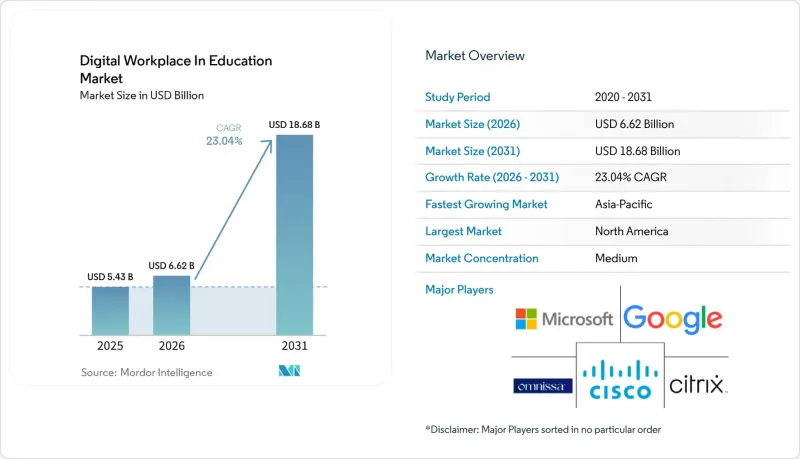
本報告按元件(解決方案[整合通訊與協作、統一端點管理、企業移動性與管理等]和服務)、部署類型(雲端、本地、混合)、組織規模(大型企業、中小企業)和地區進行細分。市場預測以價值(美元)表示。
全球教育產業數位化工作場所市場趨勢及洞察
利用 GenAI 實現知識發現和工作流程自動化
生成式人工智慧 (GenAI) 正在改變教育領域數位化工作場所平台的價值,使其從被動地存取軟體轉變為主動地支援搜尋、草擬、日程安排和知識獲取。經合組織的一份報告顯示,全球 57% 的中學教師表示人工智慧有助於改進課程計劃,到 2024 年,已有 37% 的教師在工作中使用人工智慧工具。這表明,學校採用人工智慧的速度已經領先於許多正式的採購週期。推遲平台整合的教育機構可能會被無法支援人工智慧代理執行日常學術和行政任務的系統所束縛。 2026 年發表在《人工智慧前沿》(Frontiers in Artificial Intelligence) 期刊上的一項研究表明,多代理資訊搜尋管道可以從企業文件中自動創建符合 SCORM 標準的課程,這表明人工智慧原生工作流程工具將在教育領域發揮更加重要的作用。這正在改變教育市場數位化工作場所的採購行為,軟體選擇越來越注重模型整合、管治和工作流程的契合度,而不是個別生產力功能。此外,隨著嵌入式人工智慧逐漸成為基本需求而非進階附加功能,主要平台供應商的地位也不斷增強。
教師與學生之間日益成長的合作需求。
教育市場數位化工作場所短期成長要素之一是從個人溝通工具轉向支援教學和後勤部門營運的單一協作平台。 EDUCAUSE 已將數據驅動決策、面向未來勞動力的準備以及人工智慧感知知識實踐確定為高等教育 IT 領導者在 2026 年的核心優先事項。這凸顯了教育機構對整合工作場所系統日益成長的需求。各機構越來越傾向於選擇能夠減少登入次數、簡化身分管理並在人力資源、學生服務和教師協作方面提供一致體驗的平台。當學生名冊、課程表和教師記錄無縫整合到協作平台時,系統通常更容易被採用,因為使用者無需再在多個獨立的介面之間切換,日常使用量就會增加。教育產業的數位化工作場所市場也受到實際需求的驅動,例如支援混合式教師工作模式、跨校區協作以及在諮詢、行政和學生支援方面快速回應。此外,由於教育機構現在被要求在評估平台設計和資料處理時,將學生記錄與教職員的通訊內容進行可審計的分離,採購標準也變得更加嚴格。
公共教育面臨的預算壓力和漫長的更新週期
預算壓力仍然是限制教育市場(尤其是公立幼兒園至高中系統和小規模的公立學院)數位化工作場所進一步擴展的最明顯因素之一。許多教育機構採用多年合約週期,這意味著即使他們想要採用新工具,也不一定能立即購買。隨著疫情相關緊急資金的結束,2025年和2026年可自由支配的IT預算也將捉襟見肘,迫使許多管理者推遲平台變更並延長現有軟體的使用壽命。這對教育市場的數位化工作場所產生了直接影響,因為高階人工智慧、終端管理和管治功能通常與企業級許可掛鉤,而小規模的機構難以輕易實施。雖然津貼項目和國家框架提供了一些緩解措施,但它們無法完全涵蓋整合工作場所平台所需的大量投資。因此,即使現代化營運需求已經明確,供應商在公共部門的引進週期也面臨延誤。
細分市場分析
到2025年,解決方案在教育產業的數位化工作場所市場規模中佔比高達64.22%。這表明教育機構仍然優先考慮軟體平台而不是單獨的支援合約。整合通訊(UC)和協作工具仍然是這項支出的核心,因為它們塑造了教職員工、管理人員和支援團隊之間的日常溝通,無論是在面對面還是混合式環境中。隨著教育機構尋求減少日程安排、入職培訓、津貼管理和報告等方面的重複性工作,工作流程自動化和知識管理也日益受到關注。高等教育機構對虛擬桌面環境的需求也在不斷成長,因為研究團隊需要安全且靈活地存取運算環境,無論身處何處。在大規模大學系統中,員工體驗(EX)和內網平台的重要性日益凸顯,因為經營團隊越來越重視內部溝通的品質與人才保留、服務一致性和員工協作之間的連結。
儘管服務業歷來所佔佔有率相對較小,但隨著人工智慧、安全和整合等各種工作流程中實施需求的成長,其重要性日益凸顯。許多教育機構缺乏足夠的內部資源來支援複雜套件的配置、維護安全控制以及管理跨部門和跨校區的變更。因此,託管服務是教育數位化工作場所市場成長的實際驅動力,尤其對於那些希望獲得企業級功能但又不想組建大規模內部支援團隊的機構而言更是如此。 「2026 年人工智慧前沿」關於自動化 SCORM 課程創建的調查表明,隨著人工智慧融入教育工作流程,現代工作場所的實施技術已日趨先進。這正是服務在教育產業的數位化工作場所中日益重要的原因之一,因為配置、管治和使用者部署比以往的生產力工具實施需要更多專家支援。這也意味著,即使軟體採購態度依然謹慎,將軟體與強大的部署和監控能力結合的供應商也能進一步提升客戶價值。
區域分析
2025年,北美地區佔全球銷售額的38.22%,並持續維持其作為教育市場數位化工作場所主要區域中心的地位。美國憑藉其高等教育體系、K-12教育技術支出以及供應商的深度滲透,仍然是主要驅動力,這些因素都支持各類教育機構廣泛採用該平台。州級和整個教育系統的合約在該地區也發揮著重要作用,因為它們允許大量用戶遷移到單一平台。 2026年6月,Google與猶他州教育委員會合作,為超過70.8萬名學生和教師提供Gemini for Education和培訓支持,這充分展現了美國教育領域持續大規模採用平台主導技術的趨勢。此外,北美地區擁有嚴格的合規標準,要求教育機構在提供現代化協作環境的同時,遵守《家庭教育權利和隱私法案》(FERPA)、《兒童線上隱私權保護法案》(COPPA)以及州級隱私法規。
預計到2031年,亞太地區將以24.07%的複合年成長率成長,成為教育領域數位化工作場所市場成長最快的區域。這一成長得益於國家層面的數位化計畫、不斷成長的學生人數以及對人工智慧和雲端教育系統的直接政策支援。中國的「教育2026規劃」和福建省「1-1-3-5」數位教育架構的實施框架,都體現了公共政策如何指導基礎設施、智慧系統和學習環境等平台建設。在印度和東南亞,教育機構也正在加速向主導校園模式轉型,以避免傳統本地部署投資帶來的長期延遲。在日本,由於採購慣例和傳統的供應商關係仍然限制著平台遷移的速度,其進展落後於該地區的許多其他國家和地區。
歐洲仍然是教育領域數位化工作場所市場的主要消費地區,其中德國、英國、法國和北歐國家佔據了該地區需求的大部分。德國的「數位契約2.0」尤其重要,該計畫承諾到2030年撥款50億歐元(約54億美元)用於學校的數位化基礎設施建設,並支持系統和培訓方面的長期投資週期。中東地區也備受關注,沙烏地阿拉伯和阿拉伯聯合大公國(阿拉伯聯合大公國)的教育基礎設施計畫正在支持企業級系統的實施,並滿足更嚴格的主權要求。南美洲正穩步發展,巴西尤其引人注目,該國聯邦政府於2026年4月啟動了一項全國性的數位媒體教育內容庫,旨在為教師提供支援。
其他好處:
- Excel格式的市場預測(ME)表
- 3個月的分析師支持
目錄
第1章:引言
- 研究假設和市場定義
- 調查範圍
第2章:調查方法
第3章執行摘要
第4章 市場狀況
- 市場概覽
- 市場促進因素
- 教師與學生之間日益成長的合作需求。
- 在「安全第一」的旗幟下整合分散的教育體系
- 高等教育數位化體驗的現代化
- 利用 GenAI 實現知識發現和工作流程自動化
- 擴大校園行動辦公、自備設備辦公室 (BYOD) 和零信任存取。
- 教育領域的數位化工作場所外包管理
- 市場限制因素
- 公共教育中的預算限制和漫長的更新週期
- 資料隱私、兒童保護和同意方面的合規性問題十分複雜。
- 與傳統SIS、LMS和IAM系統整合面臨的挑戰
- 教職員和行政人員對變化的適應能力較差。
- 產業價值鏈分析
- 監理情勢
- 技術展望
- 波特五力分析
- 宏觀經濟因素對市場的影響
第5章 市場規模與成長預測
- 按組件
- 解決方案
- 整合通訊與協作
- 整合端點管理
- 企業移動性與管理
- 員工體驗平台與內網
- 工作流程自動化與知識管理
- 虛擬桌面基礎架構與雲端電腦
- 服務
- 解決方案
- 部署模式
- 雲
- 現場
- 混合
- 按組織規模
- 大公司
- 小型企業
- 按地區
- 北美洲
- 美國
- 加拿大
- 墨西哥
- 南美洲
- 巴西
- 阿根廷
- 智利
- 哥倫比亞
- 其他南美國家
- 歐洲
- 德國
- 英國
- 法國
- 義大利
- 西班牙
- 荷蘭
- 北歐的
- 俄羅斯
- 其他歐洲國家
- 亞太地區
- 中國
- 日本
- 印度
- 韓國
- 澳洲和紐西蘭
- 東南亞
- 其他亞太國家
- 中東
- 沙烏地阿拉伯
- 阿拉伯聯合大公國
- 土耳其
- 以色列
- 其他中東國家
- 非洲
- 南非
- 埃及
- 奈及利亞
- 肯亞
- 其他非洲國家
- 北美洲
第6章 競爭情勢
- 市場集中度
- 策略趨勢
- 市佔率分析
- 公司簡介
- Microsoft Corporation
- Google LLC
- Cisco Systems, Inc.
- Omnissa, LLC
- Citrix Systems, Inc.
- Unily Group Ltd
- LumApps SAS
- Staffbase GmbH
- Workvivo Limited
- Simpplr, Inc.
- Happeo Oy
- Interact Software Limited
- Claromentis Limited
- Atlassian Corporation Plc
- Zoho Corporation Pvt. Ltd.
- Blackbaud, Inc.
- Anthology Inc.
- PowerSchool Holdings, Inc.
- D2L Inc.
- Instructure Holdings, Inc.
第7章 市場機會與未來展望
According to Mordor Intelligence, the digital workplace in education market size reached USD 5.43 billion in 2025 and is forecast to reach USD 18.68 billion by 2031, growing at a CAGR of 23.04% during 2026-2031.
This report is Segmented by Component (Solutions [Unified Communication and Collaboration, Unified Endpoint Management, Enterprise Mobility and Management, and More] and Services), Deployment Mode (Cloud, On-Premises, and Hybrid), Organization Size (Large Enterprises, and Small and Medium-Sized Enterprises), and Geography. The Market Forecasts are Provided in Terms of Value (USD).
Global Digital Workplace In Education Market Trends and Insights
GenAI-Enabled Knowledge Discovery and Workflow Automation
Generative AI is shifting platform value in the digital workplace in education market from passive software access to active support for search, drafting, scheduling, and knowledge retrieval. The OECD reported that 57% of lower secondary teachers globally said AI improves lesson planning, and 37% already used AI tools for professional work in 2024, which shows that adoption in schools is already moving ahead of many formal procurement cycles. Institutions that delay platform consolidation now face a higher risk of being locked into systems that cannot support AI agents for routine academic and administrative tasks. A 2026 study in Frontiers in Artificial Intelligence showed that a multi-agent retrieval pipeline could automatically create SCORM-compliant courses from enterprise documents, which points to a much deeper role for AI-native workflow tools in education settings. That changes buying behavior in the digital workplace in education market, because software selection now depends more on model integration, governance, and workflow fit than on standalone productivity features. It also strengthens the position of larger platform vendors, because embedded AI is becoming a baseline expectation rather than a premium add-on.
Rising Demand for Unified Staff and Student Collaboration
A major near-term growth force in the digital workplace in education market is the push to replace separate communication tools with one collaboration layer that serves academic delivery and back-office work together. EDUCAUSE highlighted data-informed decision making, future workforce readiness, and AI-aware knowledge practices as central priorities for higher education IT leaders in 2026, which supports stronger institutional demand for connected workplace systems. Institutions are increasingly favoring platforms that reduce the number of logins, simplify identity controls, and create a consistent experience across HR, student services, and faculty coordination. Adoption is usually stronger when course rosters, schedules, and staff records connect cleanly into the collaboration layer, because daily use rises when users do not need to move across multiple disconnected interfaces. The digital workplace in education market is also being lifted by the practical need to support hybrid faculty work, cross-campus coordination, and faster response times in advising, administration, and student support. Procurement standards are also becoming stricter, because institutions want auditable separation between student records and staff communications when they evaluate platform design and data handling.
Budget Pressure and Long Replacement Cycles in Public Education
Budget pressure remains one of the clearest limits on faster expansion in the digital workplace in education market, especially across public K-12 systems and smaller public colleges. Many institutions work within multi-year contract cycles, which means willingness to adopt newer tools does not always translate into immediate purchasing action. The end of emergency pandemic funding also tightened discretionary technology budgets in 2025 and 2026, which forced many administrators to delay platform changes and extend the life of existing software. This has a direct effect on the digital workplace in education market because advanced AI, endpoint management, and governance features are often tied to enterprise licensing tiers that smaller institutions cannot reach quickly. Grant programs and national frameworks provide some relief, but they do not fully cover the broader investment needed for integrated workplace platforms. Vendors therefore face slower conversion cycles in the public segment, even when the operational case for modernization is already clear.
Other drivers and restraints analyzed in the detailed report include:
- Higher Education Digital Experience Modernization
- Security-First Consolidation of Fragmented Education Systems
- Data Privacy, Child Protection, And Consent Compliance Complexity
For complete list of drivers and restraints, kindly check the Table Of Contents.
Segment Analysis
Solutions accounted for 64.22% of the digital workplace in education market size in 2025, which shows that institutions still place the highest value on software platforms rather than stand-alone support contracts. UC and collaboration tools remain the center of this spending because they shape daily communication between faculty, administrators, and support teams across in-person and hybrid settings. Workflow automation and knowledge management are also gaining more attention as institutions try to reduce repetitive work in scheduling, onboarding, grant administration, and reporting. The digital workplace in education market is also seeing stronger demand for virtual desktop environments in higher education, where research teams need secure and flexible access to computing environments across locations. Employee experience and intranet platforms are becoming more relevant in large university systems because leadership teams increasingly connect internal communication quality with retention, service consistency, and workforce coordination.
Services held a smaller share, but they are becoming more important as implementation demands rise across AI, security, and integration workstreams. Many institutions do not have enough internal capacity to configure complex suites, maintain security controls, and support change management across departments and campuses. That is making managed services a practical growth engine in the digital workplace in education market, especially among institutions that want enterprise features without building large in-house support teams. The 2026 Frontiers in Artificial Intelligence study on automated SCORM course creation illustrates how technical modern workplace deployments are becoming when AI is embedded into education workflows. This is one reason services are gaining weight in the digital workplace in education industry, because configuration, governance, and user rollout now require more specialized support than earlier productivity deployments. It also means providers that combine software with strong implementation and monitoring capabilities can deepen account value even when software procurement remains cautious.
Complete Report Scope:
- By Component
- Solutions
- Unified Communication and Collaboration
- Unified Endpoint Management
- Enterprise Mobility and Management
- Employee Experience Platforms and Intranet
- Workflow Automation and Knowledge Management
- Virtual Desktop Infrastructure and Cloud PC
- Services
- Solutions
- By Deployment Mode
- Cloud
- On-Premises
- Hybrid
- By Organization Size
- Large Enterprises
- Small and Medium-Sized Enterprises
- By Geography
- North America
- United States
- Canada
- Mexico
- South America
- Brazil
- Argentina
- Chile
- Colombia
- Rest of South America
- Europe
- Germany
- United Kingdom
- France
- Italy
- Spain
- Netherlands
- Nordics
- Russia
- Rest of Europe
- Asia-Pacific
- China
- Japan
- India
- South Korea
- Australia and New Zealand
- Southeast Asia
- Rest of Asia-Pacific
- Middle East
- Saudi Arabia
- United Arab Emirates
- Turkey
- Israel
- Rest of Middle East
- Africa
- South Africa
- Egypt
- Nigeria
- Kenya
- Rest of Africa
- North America
Geography Analysis
North America held 38.22% of revenue in 2025, which kept it as the leading regional base for the digital workplace in education market. The United States remains the main driver because its higher education system, K-12 technology spending, and deep vendor presence support broad platform adoption across institutional types. Statewide and system-wide agreements also matter more in this region, because they can move large user populations onto one platform at once. Google's June 2026 partnership with the Utah State Board of Education to provide Gemini for Education and training support to more than 708,000 students and educators shows the scale of platform-led deployment now taking shape in U.S. education. North America also sets a demanding compliance standard, because institutions must manage FERPA, COPPA, and state-level privacy rules while still delivering modern collaboration environments.
Asia-Pacific is projected to expand at a 24.07% CAGR through 2031, which makes it the fastest-growing regional block in the digital workplace in education market. Growth in this region is being supported by national digitalization programs, growing enrollment, and direct policy support for AI and cloud-based education systems. China's 2026 education planning direction and Fujian Province's implementation framework for a "1-1-3-5" digital education architecture show how public policy is guiding platform buildout across infrastructure, intelligent systems, and learning environments. India and Southeast Asia are also adding momentum as institutions move toward cloud-led campus models and try to avoid long delays tied to older on-premises investments. Japan remains slower than many regional peers, because procurement practices and legacy vendor relationships still limit the speed of platform transition.
Europe remains a major spending geography in the digital workplace in education market, with Germany, the United Kingdom, France, and the Nordics accounting for much of regional demand. Germany's Digitalpakt 2.0 is especially important because it directs EUR 5 billion, or USD 5.4 billion, toward school digital infrastructure through 2030 and supports a longer investment cycle across systems and training. The Middle East is also gaining attention as education infrastructure programs in Saudi Arabia and the UAE support enterprise-grade deployments with stronger sovereignty requirements. South America is developing at a steadier pace, with Brazil standing out after the federal launch of a national digital and media education collection for teacher support in April 2026.
- Microsoft Corporation
- Google LLC
- Cisco Systems, Inc.
- Omnissa, LLC
- Citrix Systems, Inc.
- Unily Group Ltd
- LumApps SAS
- Staffbase GmbH
- Workvivo Limited
- Simpplr, Inc.
- Happeo Oy
- Interact Software Limited
- Claromentis Limited
- Atlassian Corporation Plc
- Zoho Corporation Pvt. Ltd.
- Blackbaud, Inc.
- Anthology Inc.
- PowerSchool Holdings, Inc.
- D2L Inc.
- Instructure Holdings, Inc.
Additional Benefits:
- The market estimate (ME) sheet in Excel format
- 3 months of analyst support
TABLE OF CONTENTS
1 INTRODUCTION
- 1.1 Study Assumptions and Market Definition
- 1.2 Scope of the Study
2 RESEARCH METHODOLOGY
3 EXECUTIVE SUMMARY
4 MARKET LANDSCAPE
- 4.1 Market Overview
- 4.2 Market Drivers
- 4.2.1 Rising Demand for Unified Staff and Student Collaboration
- 4.2.2 Security-First Consolidation of Fragmented Education Systems
- 4.2.3 Higher Education Digital Experience Modernization
- 4.2.4 GenAI-Enabled Knowledge Discovery and Workflow Automation
- 4.2.5 Campus Mobility, BYOD, and Zero-Trust Access Expansion
- 4.2.6 Managed Digital Workplace Outsourcing in Education
- 4.3 Market Restraints
- 4.3.1 Budget Pressure and Long Replacement Cycles in Public Education
- 4.3.2 Data Privacy, Child Protection, and Consent Compliance Complexity
- 4.3.3 Integration Friction With Legacy SIS, LMS, and IAM Stacks
- 4.3.4 Low Change Absorption Across Faculty and Administrative Teams
- 4.4 Industry Value Chain Analysis
- 4.5 Regulatory Landscape
- 4.6 Technological Outlook
- 4.7 Porter's Five Forces Analysis
- 4.7.1 Bargaining Power of Buyers
- 4.7.2 Bargaining Power of Suppliers
- 4.7.3 Threat of New Entrants
- 4.7.4 Threat of Substitutes
- 4.7.5 Industry Rivalry
- 4.8 Impact of Macroeconomic Factors on the Market
5 MARKET SIZE AND GROWTH FORECASTS (VALUE)
- 5.1 By Component
- 5.1.1 Solutions
- 5.1.1.1 Unified Communication and Collaboration
- 5.1.1.2 Unified Endpoint Management
- 5.1.1.3 Enterprise Mobility and Management
- 5.1.1.4 Employee Experience Platforms and Intranet
- 5.1.1.5 Workflow Automation and Knowledge Management
- 5.1.1.6 Virtual Desktop Infrastructure and Cloud PC
- 5.1.2 Services
- 5.1.1 Solutions
- 5.2 By Deployment Mode
- 5.2.1 Cloud
- 5.2.2 On-Premises
- 5.2.3 Hybrid
- 5.3 By Organization Size
- 5.3.1 Large Enterprises
- 5.3.2 Small and Medium-Sized Enterprises
- 5.4 By Geography
- 5.4.1 North America
- 5.4.1.1 United States
- 5.4.1.2 Canada
- 5.4.1.3 Mexico
- 5.4.2 South America
- 5.4.2.1 Brazil
- 5.4.2.2 Argentina
- 5.4.2.3 Chile
- 5.4.2.4 Colombia
- 5.4.2.5 Rest of South America
- 5.4.3 Europe
- 5.4.3.1 Germany
- 5.4.3.2 United Kingdom
- 5.4.3.3 France
- 5.4.3.4 Italy
- 5.4.3.5 Spain
- 5.4.3.6 Netherlands
- 5.4.3.7 Nordics
- 5.4.3.8 Russia
- 5.4.3.9 Rest of Europe
- 5.4.4 Asia-Pacific
- 5.4.4.1 China
- 5.4.4.2 Japan
- 5.4.4.3 India
- 5.4.4.4 South Korea
- 5.4.4.5 Australia and New Zealand
- 5.4.4.6 Southeast Asia
- 5.4.4.7 Rest of Asia-Pacific
- 5.4.5 Middle East
- 5.4.5.1 Saudi Arabia
- 5.4.5.2 United Arab Emirates
- 5.4.5.3 Turkey
- 5.4.5.4 Israel
- 5.4.5.5 Rest of Middle East
- 5.4.6 Africa
- 5.4.6.1 South Africa
- 5.4.6.2 Egypt
- 5.4.6.3 Nigeria
- 5.4.6.4 Kenya
- 5.4.6.5 Rest of Africa
- 5.4.1 North America
6 COMPETITIVE LANDSCAPE
- 6.1 Market Concentration
- 6.2 Strategic Moves
- 6.3 Market Share Analysis
- 6.4 Company Profiles (includes Global Level Overview, Market Level Overview, Core Segments, Financials as available, Strategic Information, Market Rank/Share, Products and Services, Recent Developments)
- 6.4.1 Microsoft Corporation
- 6.4.2 Google LLC
- 6.4.3 Cisco Systems, Inc.
- 6.4.4 Omnissa, LLC
- 6.4.5 Citrix Systems, Inc.
- 6.4.6 Unily Group Ltd
- 6.4.7 LumApps SAS
- 6.4.8 Staffbase GmbH
- 6.4.9 Workvivo Limited
- 6.4.10 Simpplr, Inc.
- 6.4.11 Happeo Oy
- 6.4.12 Interact Software Limited
- 6.4.13 Claromentis Limited
- 6.4.14 Atlassian Corporation Plc
- 6.4.15 Zoho Corporation Pvt. Ltd.
- 6.4.16 Blackbaud, Inc.
- 6.4.17 Anthology Inc.
- 6.4.18 PowerSchool Holdings, Inc.
- 6.4.19 D2L Inc.
- 6.4.20 Instructure Holdings, Inc.
7 MARKET OPPORTUNITIES AND FUTURE OUTLOOK
- 7.1 White-Space and Unmet-Need Assessment

 2026-2030年全球數位化職場市場
 包容性職場無障礙平台市場預測至2034年—全球無障礙解決方案、身心障礙者支援、無障礙功能、合規標準、最終用戶和區域分析
 零售業數位化工作場所:市場佔有率分析、產業趨勢與統計及成長預測(2026-2031 年)
 數位化工作場所市場:2026-2032年全球市場預測(按服務類型、應用、產業、組織規模和部署類型分類)越南數位化工作場所:市場佔有率分析、產業趨勢與統計及成長預測(2026-2031)政府和公共部門數位化工作場所:市場佔有率分析、行業趨勢和統計數據以及成長預測(2026-2031 年)法律與專業服務的數位化工作場所:市場佔有率分析、產業趨勢與統計數據以及成長預測(2026-2031 年)製造業數位化工作場所:市場佔有率分析、產業趨勢與統計及成長預測(2026-2031 年)醫療保健領域的數位化工作場所:市場佔有率分析、行業趨勢和統計數據以及成長預測(2026-2031 年)銀行、金融服務和保險 (BFSI) 行業的數位化工作場所:市場佔有率分析、行業趨勢和統計數據以及成長預測(2026-2031 年)