


 |
市場調查報告書
商品編碼
2098468
法律與專業服務的數位化工作場所:市場佔有率分析、產業趨勢與統計數據以及成長預測(2026-2031 年)Digital Workplace In Legal and Professional Services - Market Share Analysis, Industry Trends & Statistics, Growth Forecasts (2026 - 2031) |
||||||

※ 本網頁內容可能與最新版本有所差異。詳細情況請與我們聯繫。
根據 Mordor Intelligence 預測,法律與專業服務領域的數位化工作場所市場規模將在 2025 年達到 52.1 億美元,2026 年達到 61.8 億美元,2031 年達到 151.6 億美元。
預計從 2026 年到 2031 年,其複合年成長率將達到 19.68%。
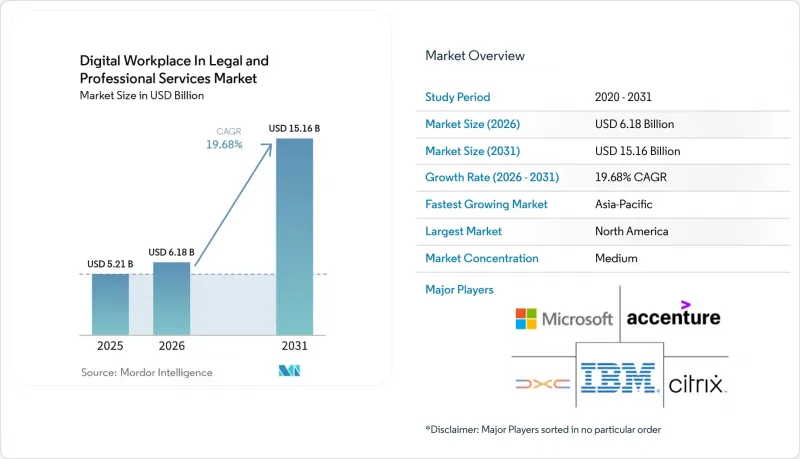
本報告按組件(解決方案[整合通訊與協作、統一端點管理、企業移動性與管理等]和服務)、部署模式(雲端、混合等)、組織規模(大型企業和中小企業)以及地區進行細分。市場預測以價值(美元)表示。
全球法律和專業服務。
法律與專業服務混合工作模式的建立
混合辦公模式正從臨時措施轉變為成熟的營運模式,這推動了法律和專業服務領域數位化辦公市場強勁的需求。一項針對美國律師事務所200強(Am Law 200)的2025年調查發現,55.9%的律所採用了靈活的混合辦公政策,39.5%採用了固定的混合辦公時間表。同時,82%的律所強制要求員工每週到辦公室上班,而完全遠距辦公的政策幾乎消失。這種轉變提高了對每位律師的技術要求,因為無論律師是在辦公室還是在家辦公,律所現在都需要一致的協作品質、存取速度和終端管理。為了支援無論身處何地都能獲得一致的體驗,整合終端管理、虛擬桌面基礎架構和會議系統的投資也持續進行。一項針對美國130位法律專業人士的2026年調查發現,55%採用混合辦公或遠距辦公模式的律師表示,如果被要求每周到辦公室上班3到5天,他們將開始尋找新的工作。這表明,在法律和專業服務市場中,數位化工作場所的品質與員工留任率直接相關。
採用「雲端優先」方法,實現客戶服務和內部工作流程的現代化。
雲端遷移不再只是一項偶然舉措,而已成為一種標準做法。這正在改變法律和專業服務領域供應商在數位化工作場所的競爭方式。一項針對英國律師事務所高階主管的2025年調查發現,64%的受訪者預計其事務所將在2027年之前完成雲端遷移,而94%的受訪者表示對創新資源的需求創歷史新高。調查也指出,相互衝突的優先事項、成本和技術複雜性仍在阻礙遷移進程,這意味著即使雲端遷移策略已經明確,現代化工作仍將繼續進行。這一點至關重要,因為雲端現在是律師事務所大規模運行人工智慧編配、案例分析和工作流程工具的基礎。 Blank Rome於2025年6月決定將其五項核心業務工具標準化到Intapp雲端基礎設施上,這表明領先的律師事務所正在尋求透過平台整合,在法律和專業服務市場的數位化工作場所中獲得更廣泛的成果。
與傳統文件管理、計費和病例管理系統有較高的整合障礙。
在法律和專業服務市場,舊有系統仍然是阻礙數位化工作場所擴展的最明顯限制因素之一。許多律師事務所仍在使用多年來透過自訂連接和本地工作流程調整建構的文件管理、營運管理、計費和案件管理系統。因此,供應商選擇往往優先考慮資料遷移、工作流程映射和互通性,而非功能比較,這使得平台整合變得困難。對於中型律師事務所而言,這項負擔更為沉重,因為它們通常缺乏專門的整合團隊,被迫推遲升級,同時在其核心法律工作流程中繼續使用手動變通方案。實際上,這意味著法律和專業服務行業在採購數位化工作場所時,很大程度上取決於整合架構以及面向用戶的功能。
細分市場分析
到2025年,解決方案將佔法律和專業服務數位化工作場所市場規模的67.33%。這主要得益於協作平台、企業行動工具、工作流程自動化軟體和虛擬桌面基礎架構的廣泛應用。這一領先地位表明,企業持續優先考慮軟體和平台層,因為日常溝通、案件協調和知識存取都依賴於此。該領域的成長並不均衡,因為整合通訊工具在大律師事務所中已趨於成熟,而工作流程自動化、人工智慧驅動的知識管理以及提升員工體驗的工具則發展更為迅速。儘管服務業的重要性依然很高,但大型律師事務所也在積極建立內部卓越中心,以降低其在法律和專業服務服務業的數位化工作場所整體對外部IT支援的依賴。
該領域的主要轉變之一是從文件歸檔到結構化智慧的過渡,後者支持管治的AI應用。 2026年5月,NetDocuments推出了法律脈絡圖譜,該圖譜描繪了整個文件環境中案例、文件、人員和法律概念之間的關係。這種方法為AI工具提供了更深入理解上下文的基礎,而不僅僅依賴對非結構化內容的簡單搜尋。這提升了那些已在管治和專業服務負責人的數位化工作場所中發揮更強大的作用。
區域分析
2025年,北美仍是最大的區域市場,佔據法律和專業服務領域數位化工作場所市場規模的39.56%。這個地位主要由美國推動,美國大型律師事務所對Microsoft 365的滲透率已很高,並且持續投資於Copilot、Harvey AI和Protege等人工智慧層,以完善現有的協作平台。此外,該地區律師事務所之間對法律人才的競爭異常激烈,導致對更流暢的數位化工作體驗(無論是在辦公室還是混合辦公環境中)的需求日益成長,從而使工作場所技術與人才保留之間的聯繫更加緊密。在加拿大,多倫多和溫哥華的主要專業服務網路擴大了支援範圍,而墨西哥仍處於採用數位化工作場所的早期階段,主要關注雲端通訊工具。安全法規和主動威脅預警也影響了該地區法律和專業服務領域對數位化工作場所的需求,引導買家專注於身分管理、終端安全和零信任架構。
歐洲一直是法律和專業服務領域數位化工作場所的主要投資區域。這是因為GDPR及相關隱私需求促使企業轉向注重隱私的雲端設計,而許多傳統系統仍然存在,需要分階段過渡。德國和英國在該地區佔據最大佔有率,英國的法律IT環境表明,雲端並非差異化因素,而是預設的交付模式。在法國、荷蘭和北歐國家,隨著中型企業採用基於雲端的協作和麵向客戶的工具來改善數位化服務的交付,市場持續擴張。 Osborne Clark於2025年完成其3E SaaS遷移,顯示全端式法律雲端轉型正在成為可能,儘管執行起來仍然很複雜。
亞太地區在法律和專業服務領域的數位化工作場所成長最快,這主要得益於中國、印度、韓國和東南亞地區法律部門的擴張。印度尤為突出,其內部法律團隊、四大事務所的服務擴張以及法院數位化專案都推動了對雲端協作、電子取證和工作流程自動化的需求。日本和澳洲則更為成熟,專注於以人工智慧驅動的知識搜尋和整合終端管理為核心的當前升級週期。南美洲仍處於新興市場階段,巴西透過法院數位化和大型律師事務所的現代化引領了數位轉型。同時,中東和非洲仍處於早期市場階段,其發展主要受國家數位轉型計畫以及對安全客戶入口網站和遠端存取工具的初步投資的影響。
其他好處:
- Excel格式的市場預測(ME)表
- 3個月的分析師支持
目錄
第1章:引言
- 研究假設和市場定義
- 調查範圍
第2章:調查方法
第3章執行摘要
第4章 市場狀況
- 市場概覽
- 市場促進因素
- 律師事務所和專業服務持續推行混合辦公模式
- 採用「雲端優先」方法,實現面向客戶和內部工作流程的現代化。
- 對人工智慧驅動的知識搜尋和專案工作流程自動化的需求日益成長。
- 特權、敏感和受監管工作負載的安全優先數位化
- 基於專案的生產力分析和數位化員工體驗管理
- 客戶入口網站整合和分店間的無縫協作
- 市場限制因素
- 與原有文件管理、計費和病例管理系統整合面臨重大挑戰。
- 更嚴格的保密要求、電子證據揭示和資料居住等方面的合規負擔增加。
- 資深法律負責人對計費工時的敏感度以及對變化的緩慢適應能力
- 人工智慧管治在高度敏感的知識工作流程中的風險
- 產業價值鏈分析
- 監理情勢
- 技術展望
- 宏觀經濟因素對市場的影響
- 波特五力分析
第5章 市場規模與成長預測
- 按組件
- 解決方案
- 整合通訊與協作
- 整合端點管理
- 企業移動性與管理
- 員工體驗平台與內網
- 工作流程自動化與知識管理
- 虛擬桌面基礎架構與雲端電腦
- 服務
- 解決方案
- 部署模式
- 雲
- 現場
- 混合
- 按組織規模
- 大公司
- 小型企業
- 按地區
- 北美洲
- 美國
- 加拿大
- 墨西哥
- 南美洲
- 巴西
- 阿根廷
- 智利
- 哥倫比亞
- 其他南美國家
- 歐洲
- 德國
- 英國
- 法國
- 義大利
- 西班牙
- 荷蘭
- 北歐的
- 俄羅斯
- 其他歐洲國家
- 亞太地區
- 中國
- 日本
- 印度
- 韓國
- 澳洲和紐西蘭
- 東南亞
- 其他亞太國家
- 中東
- 沙烏地阿拉伯
- 阿拉伯聯合大公國
- 土耳其
- 以色列
- 其他中東國家
- 非洲
- 南非
- 埃及
- 奈及利亞
- 肯亞
- 其他非洲國家
- 北美洲
第6章 競爭情勢
- 市場集中度
- 策略趨勢
- 市佔率分析
- 公司簡介
- Microsoft Corporation
- Accenture plc
- IBM Corporation
- Citrix Systems, Inc.
- DXC Technology Company
- Capgemini SE
- Cognizant Technology Solutions Corporation
- Tata Consultancy Services Limited
- Wipro Limited
- HCL Technologies Limited
- NTT DATA Group Corporation
- Unisys Corporation
- Fujitsu Limited
- Atos SE
- Kyndryl Holdings, Inc.
- ServiceNow, Inc.
- Cisco Systems, Inc.
- Google LLC
- Atlassian Corporation
- OpenText Corporation
- Adobe Inc.
- Oracle Corporation
第7章 市場機會與未來展望
According to Mordor Intelligence, the digital workplace in legal and professional services market size is projected to be USD 5.21 billion in 2025, USD 6.18 billion in 2026, and reach USD 15.16 billion by 2031, growing at a CAGR of 19.68% from 2026 to 2031.
This report is Segmented by Component (Solutions [Unified Communication and Collaboration, Unified Endpoint Management, Enterprise Mobility and Management, and More] and Services), Deployment Mode (Cloud, Hybrid, and More), Organization Size (Large Enterprises and Small and Medium-Sized Enterprises), and Geography. The Market Forecasts are Provided in Terms of Value (USD).
Global Digital Workplace In Legal and Professional Services Market Trends and Insights
Continuing Hybrid Work in Law Firms and Professional Services
Hybrid work has moved from a temporary arrangement to a steady operating model, and that keeps the digital workplace in legal and professional services market on a strong demand path. A 2025 study of Am Law 200 firms found that 55.9% operated flexible hybrid policies and 39.5% used fixed hybrid schedules, while 82% required specific in-office days and fully remote policies had nearly disappeared. That shift raises the technology standard for each attorney because firms now need the same collaboration quality, access speed, and endpoint control across office and home environments. It also keeps spending active on unified endpoint management, virtual desktop infrastructure, and meeting systems that support a more consistent experience across locations. A 2026 survey of 130 US legal professionals showed that 55% of hybrid and remote attorneys would begin a job search if they were required to return to the office 3-5 days per week, which links digital workplace quality directly to retention in the digital workplace in legal and professional services market.
Cloud-First Modernization of Client-Facing and Internal Workflows
Cloud migration has become an operating default rather than a side initiative, and that is changing how vendors compete in the digital workplace in legal and professional services market. A 2025 survey of UK law firm leaders found that 64% expected their firms to be fully in the cloud by 2027, while 94% reported all-time-high demand for innovation resources. The same study showed that competing priorities, cost, and technical complexity still slowed progress, which means modernization remains active even where cloud direction is already clear. This matters because cloud is now the base layer for AI orchestration, matter analytics, and workflow tools that firms want to run at scale. Blank Rome's June 2025 decision to standardize on Intapp Cloud Infrastructure across five core practice tools showed how large firms are using platform consolidation to unlock wider returns inside the digital workplace in legal and professional services market.
High Integration Friction with Legacy Document, Billing, And Case Management Systems
Legacy systems remain one of the clearest limits on expansion in the digital workplace in legal and professional services market. Many firms still run document management, practice management, billing, and case systems that were built through years of custom connections and local workflow adjustments. That makes platform consolidation slower because data migration, workflow mapping, and interoperability often matter more than feature comparison during vendor review. The burden is heavier for mid-market firms because they often lack dedicated integration teams and must delay upgrades while maintaining manual workarounds across core legal workflows. In practice, this means procurement decisions in the digital workplace in legal and professional services market now depend as much on integration architecture as they do on user-facing functionality.
Other drivers and restraints analyzed in the detailed report include:
- Rising Demand for AI-Assisted Knowledge Retrieval and Matter Workflow Automation
- Security-First Digitization for Privileged, Confidential, and Regulated Workloads
- Elevated Confidentiality, E-Discovery, and Data Residency Compliance Burden
For complete list of drivers and restraints, kindly check the Table Of Contents.
Segment Analysis
Solutions accounted for 67.33% of the digital workplace in legal and professional services market size in 2025, supported by widespread use of collaboration platforms, enterprise mobility tools, workflow automation software, and virtual desktop infrastructure. That lead shows that firms still prioritize the software and platform layer where daily communication, matter coordination, and knowledge access take place. Growth inside the segment is uneven because unified communication tools are closer to maturity at larger firms, while workflow automation, AI-assisted knowledge management, and employee experience tools are expanding faster. The services side remains important, but larger firms are also building internal centers of excellence to reduce dependence on outside IT support across the digital workplace in legal and professional services industry.
A major shift inside this segment is the move from document storage toward structured intelligence that can support governed AI use. NetDocuments introduced its Legal Context Graph in May 2026 to map relationships among matters, documents, people, and legal concepts across the document environment. That approach gives AI tools a more context-aware foundation instead of relying only on raw search across unstructured content. This raises the value of vendors whose data architecture is already built around permissions, matter context, and governed knowledge flow in the digital workplace in legal and professional services market. It also gives specialist providers a more defensible role within the digital workplace in legal and professional services industry as legal buyers look beyond general collaboration features.
Complete Report Scope:
- By Component
- Solutions
- Unified Communication and Collaboration
- Unified Endpoint Management
- Enterprise Mobility and Management
- Employee Experience Platforms and Intranet
- Workflow Automation and Knowledge Management
- Virtual Desktop Infrastructure and Cloud PC
- Services
- Solutions
- By Deployment Mode
- Cloud
- On-Premises
- Hybrid
- By Organization Size
- Large Enterprises
- Small and Medium-Sized Enterprises
- By Geography
- North America
- United States
- Canada
- Mexico
- South America
- Brazil
- Argentina
- Chile
- Colombia
- Rest of South America
- Europe
- Germany
- United Kingdom
- France
- Italy
- Spain
- Netherlands
- Nordics
- Russia
- Rest of Europe
- Asia-Pacific
- China
- Japan
- India
- South Korea
- Australia and New Zealand
- Southeast Asia
- Rest of Asia-Pacific
- Middle East
- Saudi Arabia
- United Arab Emirates
- Turkey
- Israel
- Rest of Middle East
- Africa
- South Africa
- Egypt
- Nigeria
- Kenya
- Rest of Africa
- North America
Geography Analysis
North America held 39.56% of the digital workplace in legal and professional services market size in 2025, which kept it as the leading regional block. The United States drove most of that position because large law firms already had deep Microsoft 365 penetration and continued to invest in AI layers such as Copilot, Harvey AI, and Protege on top of existing collaboration stacks. The region also ties workplace technology more closely to retention because firms compete aggressively for legal talent and need a smoother digital work experience across office and hybrid settings. Canada added support through major professional services networks in Toronto and Vancouver, while Mexico remained at an earlier adoption stage centered on cloud communication tools. Security regulation and active threat warnings also shaped regional demand by pushing buyers toward identity management, endpoint security, and zero-trust architecture in the digital workplace in legal and professional services market.
Europe remained a major investment zone for the digital workplace in legal and professional services market because GDPR and related privacy requirements pushed firms toward privacy-aware cloud designs at the same time that a large installed base of older systems still needed phased migration. Germany and the United Kingdom held the largest national positions within the region, and the UK legal IT environment showed that cloud had become the default delivery model rather than a differentiator. France, the Netherlands, and the Nordic countries continued to expand as mid-market firms adopted cloud-based collaboration and client-facing tools to improve digital service delivery. Osborne Clarke's completion of its 3E SaaS migration in 2025 illustrated how full-stack legal cloud transformation was becoming possible, even if execution remained complex.
Asia-Pacific was the fastest-growing region in the digital workplace in legal and professional services market, supported by legal department expansion in China, India, South Korea, and Southeast Asia. India stood out because in-house legal teams, Big Four service expansion, and court digitization programs were all increasing demand for cloud collaboration, e-discovery, and workflow automation. Japan and Australia remained more mature and focused on the current upgrade cycle, which centered on AI-assisted knowledge retrieval and unified endpoint management. South America was still emerging, with Brazil leading adoption through court digitization and large-firm modernization, while the Middle East and Africa remained earlier-stage markets shaped by national digital transformation plans and initial investment in secure client portals and remote access tools.
- Microsoft Corporation
- Accenture plc
- IBM Corporation
- Citrix Systems, Inc.
- DXC Technology Company
- Capgemini SE
- Cognizant Technology Solutions Corporation
- Tata Consultancy Services Limited
- Wipro Limited
- HCL Technologies Limited
- NTT DATA Group Corporation
- Unisys Corporation
- Fujitsu Limited
- Atos SE
- Kyndryl Holdings, Inc.
- ServiceNow, Inc.
- Cisco Systems, Inc.
- Google LLC
- Atlassian Corporation
- OpenText Corporation
- Adobe Inc.
- Oracle Corporation
Additional Benefits:
- The market estimate (ME) sheet in Excel format
- 3 months of analyst support
TABLE OF CONTENTS
1 INTRODUCTION
- 1.1 Study Assumptions and Market Definition
- 1.2 Scope of the Study
2 RESEARCH METHODOLOGY
3 EXECUTIVE SUMMARY
4 MARKET LANDSCAPE
- 4.1 Market Overview
- 4.2 Market Drivers
- 4.2.1 Continuing Hybrid Work in Law Firms and Professional Services
- 4.2.2 Cloud-First Modernization of Client-Facing and Internal Workflows
- 4.2.3 Rising Demand for AI-Assisted Knowledge Retrieval and Matter Workflow Automation
- 4.2.4 Security-First Digitization for Privileged, Confidential, and Regulated Workloads
- 4.2.5 Matter-Level Productivity Analytics and Digital Employee Experience Management
- 4.2.6 Client Portal Consolidation and Zero-Friction Cross-Office Collaboration
- 4.3 Market Restraints
- 4.3.1 High Integration Friction With Legacy Document, Billing, and Case Management Systems
- 4.3.2 Elevated Confidentiality, E-Discovery, and Data Residency Compliance Burden
- 4.3.3 Billable-Hour Sensitivity and Slow Change Adoption Across Senior Legal Users
- 4.3.4 AI Governance Risk in Privilege-Sensitive Knowledge Workflows
- 4.4 Industry Value Chain Analysis
- 4.5 Regulatory Landscape
- 4.6 Technological Outlook
- 4.7 Impact of Macroeconomic Factors on the Market
- 4.8 Porter's Five Forces Analysis
- 4.8.1 Bargaining Power of Buyers
- 4.8.2 Bargaining Power of Suppliers
- 4.8.3 Threat of New Entrants
- 4.8.4 Threat of Substitutes
- 4.8.5 Intensity of Competitive Rivalry
5 MARKET SIZE AND GROWTH FORECASTS (VALUE)
- 5.1 By Component
- 5.1.1 Solutions
- 5.1.1.1 Unified Communication and Collaboration
- 5.1.1.2 Unified Endpoint Management
- 5.1.1.3 Enterprise Mobility and Management
- 5.1.1.4 Employee Experience Platforms and Intranet
- 5.1.1.5 Workflow Automation and Knowledge Management
- 5.1.1.6 Virtual Desktop Infrastructure and Cloud PC
- 5.1.2 Services
- 5.1.1 Solutions
- 5.2 By Deployment Mode
- 5.2.1 Cloud
- 5.2.2 On-Premises
- 5.2.3 Hybrid
- 5.3 By Organization Size
- 5.3.1 Large Enterprises
- 5.3.2 Small and Medium-Sized Enterprises
- 5.4 By Geography
- 5.4.1 North America
- 5.4.1.1 United States
- 5.4.1.2 Canada
- 5.4.1.3 Mexico
- 5.4.2 South America
- 5.4.2.1 Brazil
- 5.4.2.2 Argentina
- 5.4.2.3 Chile
- 5.4.2.4 Colombia
- 5.4.2.5 Rest of South America
- 5.4.3 Europe
- 5.4.3.1 Germany
- 5.4.3.2 United Kingdom
- 5.4.3.3 France
- 5.4.3.4 Italy
- 5.4.3.5 Spain
- 5.4.3.6 Netherlands
- 5.4.3.7 Nordics
- 5.4.3.8 Russia
- 5.4.3.9 Rest of Europe
- 5.4.4 Asia-Pacific
- 5.4.4.1 China
- 5.4.4.2 Japan
- 5.4.4.3 India
- 5.4.4.4 South Korea
- 5.4.4.5 Australia and New Zealand
- 5.4.4.6 Southeast Asia
- 5.4.4.7 Rest of Asia-Pacific
- 5.4.5 Middle East
- 5.4.5.1 Saudi Arabia
- 5.4.5.2 United Arab Emirates
- 5.4.5.3 Turkey
- 5.4.5.4 Israel
- 5.4.5.5 Rest of Middle East
- 5.4.6 Africa
- 5.4.6.1 South Africa
- 5.4.6.2 Egypt
- 5.4.6.3 Nigeria
- 5.4.6.4 Kenya
- 5.4.6.5 Rest of Africa
- 5.4.1 North America
6 COMPETITIVE LANDSCAPE
- 6.1 Market Concentration
- 6.2 Strategic Moves
- 6.3 Market Share Analysis
- 6.4 Company Profiles (includes Global Level Overview, Market Level Overview, Core Segments, Financials as available, Strategic Information, Market Rank/Share, Products and Services, Recent Developments)
- 6.4.1 Microsoft Corporation
- 6.4.2 Accenture plc
- 6.4.3 IBM Corporation
- 6.4.4 Citrix Systems, Inc.
- 6.4.5 DXC Technology Company
- 6.4.6 Capgemini SE
- 6.4.7 Cognizant Technology Solutions Corporation
- 6.4.8 Tata Consultancy Services Limited
- 6.4.9 Wipro Limited
- 6.4.10 HCL Technologies Limited
- 6.4.11 NTT DATA Group Corporation
- 6.4.12 Unisys Corporation
- 6.4.13 Fujitsu Limited
- 6.4.14 Atos SE
- 6.4.15 Kyndryl Holdings, Inc.
- 6.4.16 ServiceNow, Inc.
- 6.4.17 Cisco Systems, Inc.
- 6.4.18 Google LLC
- 6.4.19 Atlassian Corporation
- 6.4.20 OpenText Corporation
- 6.4.21 Adobe Inc.
- 6.4.22 Oracle Corporation
7 MARKET OPPORTUNITIES AND FUTURE OUTLOOK
- 7.1 White-Space and Unmet-Need Assessment

 2026-2030年全球數位化職場市場
 包容性職場無障礙平台市場預測至2034年—全球無障礙解決方案、身心障礙者支援、無障礙功能、合規標準、最終用戶和區域分析
 零售業數位化工作場所:市場佔有率分析、產業趨勢與統計及成長預測(2026-2031 年)
 數位化工作場所市場:2026-2032年全球市場預測(按服務類型、應用、產業、組織規模和部署類型分類)教育產業的數位化工作場所:市場佔有率分析、產業趨勢和統計數據以及成長預測(2026-2031 年)越南數位化工作場所:市場佔有率分析、產業趨勢與統計及成長預測(2026-2031)政府和公共部門數位化工作場所:市場佔有率分析、行業趨勢和統計數據以及成長預測(2026-2031 年)製造業數位化工作場所:市場佔有率分析、產業趨勢與統計及成長預測(2026-2031 年)醫療保健領域的數位化工作場所:市場佔有率分析、行業趨勢和統計數據以及成長預測(2026-2031 年)銀行、金融服務和保險 (BFSI) 行業的數位化工作場所:市場佔有率分析、行業趨勢和統計數據以及成長預測(2026-2031 年)