


 |
市場調查報告書
商品編碼
2098467
製造業數位化工作場所:市場佔有率分析、產業趨勢與統計及成長預測(2026-2031 年)Digital Workplace In Manufacturing - Market Share Analysis, Industry Trends & Statistics, Growth Forecasts (2026 - 2031) |
||||||

※ 本網頁內容可能與最新版本有所差異。詳細情況請與我們聯繫。
根據 Mordor Intelligence 預測,製造業數位工作場所市場規模預計將在 2025 年達到 94.6 億美元,2026 年達到 110 億美元,到 2031 年達到 244.9 億美元,2026 年至 2031 年的複合年成長率為 17.35%。
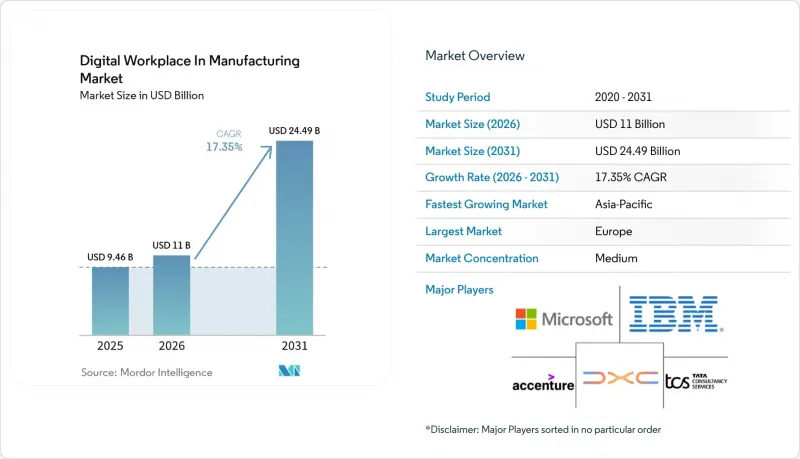
本報告按組件(解決方案[整合通訊與協作、統一端點管理、員工體驗平台和企業內網等]和服務)、部署類型(雲端、本地、混合)、組織規模(大型企業和中小企業)以及地區進行細分。市場預測以價值(美元)表示。
全球數位化工作場所市場趨勢及製造業洞察
生成式人工智慧和協同駕駛技術在製造團隊中主導生產力提升
生成式人工智慧正成為製造業數位化工作場所市場業務的基石。這是因為製造商正在利用生成式人工智慧加速決策,而這些決策先前依賴團隊和班次之間的手動協調。谷歌雲在2025年報告中指出,75%的製造業主管表示生成式人工智慧提高了生產力,65%的高階主管表示它提高了非IT業務流程的效率。根據製造業領導力委員會的一項調查,近90%的製造商計劃在未來兩年內擴大生成式人工智慧的應用,其中49%的製造商預計應用量將顯著成長,高於2024年的35%。微軟在2026年漢諾威工業博覽會上發布了WorkIQ、FabricIQ和FoundryIQ,進一步強化了這個趨勢。這三款產品將協作分析、資產可見性和組織洞察整合到一個統一的工業堆疊中。這正在改變製造業數位化工作場所市場的競爭格局。因為買家擴大比較和評估人工智慧平台,而不是單一生產力提升工具。此外,能夠將人工智慧支援融入日常工廠營運的供應商,在深化長期客戶關係方面更具優勢,從而為簽訂更高價值的合約創造空間。
互聯工人與現場協作平台的快速普及。
在製造業市場中,互聯員工系統正成為數位化工作場所領域成長最活躍的領域之一,彌合了企業系統與現場執行之間的鴻溝。羅克韋爾自動化在2026年報告中指出,亞太地區95%的製造商認為數位轉型對其競爭力至關重要,超過71%的製造商計劃在未來12個月內投資人工智慧和機器學習。 2026年3月,荏原製造啟動了一個知識主導的數位轉型項目,利用人工智慧代理從現場收集隱性知識並將其整合到實際工作流程中。 2026年4月,ServiceNow發布了「工業互聯員工」解決方案,進一步推進了這一方向的發展。該方案透過人工智慧輔助的工作流程,實現流程數位化、基於角色分配任務並儲存知識。這一趨勢在製造業數位化工作場所市場意義重大,因為員工數位化不再僅僅關乎資訊共用,而是與業務永續營運、安全性和培訓品質密切相關。此外,這項措施有助於製造商降低重要技術訣竅在新員工有機會學習之前從工廠洩漏的風險。
整合傳統MES、ERP和OT系統的複雜性。
舊有系統的複雜性仍然是製造業數位化工作場所市場面臨的最大障礙之一。這是因為協作平台必須與過時的工廠系統連接,而這些系統在設計之初並未考慮現代互通性。使用者回饋表明,整合壓力主要集中在MES、ERP和OT環境中,這些環境的現代化改造往往需要在不中斷運作中生產的情況下進行。 NIST製造網路安全概況也支持這一觀點,它將系統上線、設備管理和安全整合視為結構化要求,而非可選升級。計劃於2025年與CyberArk和Device Authority建立合作夥伴關係,也體現了目前為確保互聯製造環境的可靠性,從而實現更廣泛的工作流程自動化所投入的大量精力。事實上,當工廠團隊必須應對未記錄的介面、嚴格的正常運作要求和分階段的遷移路徑時,製造業數位化工作場所的進展就會十分緩慢。因此,實施品質和與工業系統的整合深度仍然是選擇供應商的關鍵標準。
細分市場分析
到2025年,解決方案將佔據製造業數位化工作場所市場佔有率的63.34%,軟體和平台層將成為支出決策的核心。這反映了市場對整合式溝通協作工具、員工體驗平台以及支援辦公室團隊和現場工作人員的工作流程自動化系統的需求。在解決方案組合中,協作主導產品和服務仍然是最大的收入來源,因為它們與製造商已在使用的企業生產力生態系統緊密相關。在製造業數位化工作場所市場,能夠將溝通、知識獲取和業務跟進整合到單一環境中的供應商仍然備受青睞。
這一趨勢也影響著服務前景,儘管到2025年,服務在整體業務中所佔比例仍然相對較小。製造商擴大將部署、遷移和託管支援納入多年轉型契約,而不是作為獨立專案進行採購。 Rootstock預測,到2026年,基於結果的部署模式將更加普遍,這意味著服務的價值正與工廠的業績和部署的深度更加直接地掛鉤。在製造業的數位化工作場所中,服務變得具有戰略意義,即使其目前的收入佔有率不如解決方案。此外,工作流程的重新設計、管治結構的建構以及使用者採納通常會在初始軟體部署後持續很長時間,這有助於與供應商建立長期合作關係。
區域分析
到2025年,歐洲將佔據製造業數位化工作場所市場規模的33.56%,並持續維持其領先地位。德國憑藉其汽車、工程和工業生產網路的集中,仍然是這一需求的核心。根據SAP預測,到2026年中期,Factory-X將擁有47家產業合作夥伴,並進入穩定營運階段。這顯示資料交換和協作式數位化生產在該地區正逐步製度化。此外,該地區也受惠於製造商們對工業4.0投資和流程轉型管理的熟悉程度。西門子在安貝格投資建造智慧工廠,凸顯了歐洲對基於人工智慧的整合生產環境的堅定承諾。
北美仍然是製造業數位化工作場所的領先市場,這主要得益於近岸外包、企業軟體整合和工業人工智慧應用帶來的持續支出成長。網路風險也直接影響該地區的採購行為。 Dragos 和 Marsh McLennan 指出,北美,尤其是在製造業領域,是全球營運技術 (OT) 網路風險最集中的地區。亞太地區預計將以 18.45% 的複合年成長率成長,成為製造業數位化工作場所成長最快的市場。羅克韋爾自動化 2026 年的一項調查顯示,該地區對數位轉型的迫切需求日益成長,尤其是在競爭激烈的環境中。各國的具體需求受到中國智慧製造計畫、印度工業現代化計畫、韓國智慧工廠計畫和日本「社會 5.0」計畫的影響。該地區能夠採用雲端原生和互聯員工模式,且無需承擔傳統工業基地遺留系統負擔的新型工廠,也為市場發展做出了貢獻。
儘管南美、中東和非洲目前的銷售額仍然相對小規模,但它們在製造業市場的數位化工作場所領域中正扮演著越來越積極的角色。在南美,巴西和哥倫比亞的發展勢頭強勁,而阿根廷和智利則對與農產品和採礦業相關的製造業領域表現出越來越濃厚的興趣。在中東,這一趨勢發展更為迅速,這得益於產業多元化計劃的實施以及擁有更完善數位化基礎設施的新型製造園區的建設。非洲仍處於起步階段,目前採用的數位化解決方案主要集中在跨國公司營運的工廠以及能夠彌補基礎設施不足的雲端交付模式。
其他好處:
- Excel格式的市場預測(ME)表
- 3個月的分析師支持
目錄
第1章:引言
- 研究假設和市場定義
- 調查範圍
第2章:調查方法
第3章執行摘要
第4章 市場狀況
- 市場概覽
- 市場促進因素
- 互聯工人與現場協作平台的快速普及。
- 製造業中「雲端優先」數位化工作場所架構的擴展
- 從現場到辦公室環境,對可視性和協作性的需求日益成長。
- 利用生成式人工智慧和 Copilot 提高製造團隊的生產力
- OT 和 IT 的整合催生了對整合身分和存取控制的需求。
- 針對供應鏈和工廠中斷情況的復原力規劃
- 市場限制因素
- 整合傳統MES、ERP和OT系統的複雜性。
- 分散式工廠和行動裝置的網路安全風險
- 工廠員工對變革的抵制以及數位技術採用率低。
- 產業資料管治與跨境合規限制
- 產業價值鏈分析
- 供應鏈分析
- 監理情勢
- 技術展望
- 波特五力分析
- 宏觀經濟因素對市場的影響
第5章 市場規模與成長預測
- 按組件
- 解決方案
- 整合通訊與協作
- 整合端點管理
- 企業移動性與管理
- 員工體驗平台與內網
- 工作流程自動化與知識管理
- 虛擬桌面基礎架構與雲端電腦
- 服務
- 解決方案
- 部署模式
- 雲
- 現場
- 混合
- 按組織規模
- 大公司
- 小型企業
- 按地區
- 北美洲
- 美國
- 加拿大
- 墨西哥
- 南美洲
- 巴西
- 阿根廷
- 智利
- 哥倫比亞
- 其他南美國家
- 歐洲
- 德國
- 英國
- 法國
- 義大利
- 西班牙
- 荷蘭
- 北歐的
- 俄羅斯
- 其他歐洲國家
- 亞太地區
- 中國
- 日本
- 印度
- 韓國
- 澳洲和紐西蘭
- 東南亞
- 其他亞太國家
- 中東
- 沙烏地阿拉伯
- 阿拉伯聯合大公國
- 土耳其
- 以色列
- 其他中東國家
- 非洲
- 南非
- 埃及
- 奈及利亞
- 肯亞
- 其他非洲國家
- 北美洲
第6章 競爭情勢
- 市場集中度
- 策略趨勢
- 市佔率分析
- 公司簡介
- Microsoft Corporation
- IBM Corporation
- Accenture plc
- DXC Technology Company
- Citrix Systems, Inc.
- VMware, Inc.
- NTT DATA Corporation
- Tata Consultancy Services Limited
- Wipro Limited
- Infosys Limited
- HCL Technologies Limited
- Capgemini SE
- Atos SE
- Unisys Corporation
- Fujitsu Limited
- SAP SE
- Oracle Corporation
- Google LLC
- Cisco Systems, Inc.
- ServiceNow, Inc.
第7章 市場機會與未來展望
According to Mordor Intelligence, the digital workplace in manufacturing market size is projected to be USD 9.46 billion in 2025, USD 11.00 billion in 2026, and reach USD 24.49 billion by 2031, growing at a CAGR of 17.35% from 2026 to 2031.
This report is Segmented by Component (Solutions [Unified Communication and Collaboration, Unified Endpoint Management, Employee Experience Platforms and Intranet, and More] and Services), Deployment Mode (Cloud, On-Premises, and Hybrid), Organization Size (Large Enterprises and Small and Medium-Sized Enterprises), and Geography. The Market Forecasts are Provided in Terms of Value (USD).
Global Digital Workplace In Manufacturing Market Trends and Insights
Generative AI and Copilot-Led Productivity Gains for Manufacturing Teams
Generative AI is becoming a working layer inside the digital workplace in manufacturing market, because manufacturers are using it to speed up decisions that once depended on manual coordination across teams and shifts. Google Cloud reported in 2025 that 75% of manufacturing executives said generative AI improved productivity, and 65% said it improved non-IT business process efficiency. The Manufacturing Leadership Council found that nearly 90% of manufacturers planned to increase generative AI usage over the next 2 years, and 49% expected a substantial increase, up from 35% in 2024. Microsoft reinforced this direction at Hannover Messe 2026 with WorkIQ, Fabric IQ, and Foundry IQ, which place collaboration analytics, asset visibility, and institutional knowledge into a unified industrial stack. This is changing the basis of competition in the digital workplace in manufacturing market, because buyers are increasingly comparing AI-ready platforms rather than standalone productivity tools. It also creates room for higher-value contracts, since vendors that can link AI assistance to daily plant routines are in a stronger position to deepen long-term account control.
Rapid Adoption of Connected Worker and Frontline Collaboration Platforms
Connected worker systems are emerging as one of the most active growth areas inside the digital workplace in manufacturing market, because they address the gap between enterprise systems and plant-floor execution. Rockwell Automation reported in 2026 that 95% of manufacturers in Asia-Pacific viewed digital transformation as essential to competitiveness, and more than 71% planned AI and machine learning investments in the next 12 months. Ebara Manufacturing launched a knowledge-driven DX project in March 2026 that used AI agents to capture shop-floor tacit knowledge and place it into live workflows. ServiceNow added to that direction in April 2026 with Industrial Connected Workforce, which digitizes procedures, assigns role-based tasks, and preserves knowledge through AI-assisted workflows. In the digital workplace in manufacturing market, this trend matters because workforce digitization is now tied to continuity, safety, and training quality, not only to message sharing. It also helps manufacturers reduce the risk that critical know-how leaves the factory faster than new workers can absorb it.
Legacy MES, ERP, and OT Integration Complexity
Legacy system complexity remains one of the clearest brakes on the digital workplace in manufacturing market, because collaboration platforms must still connect with older plant systems that were not built for modern interoperability. The user-supplied material shows that integration pressure is centered on MES, ERP, and OT environments, where modernization often has to happen without disrupting live production. NIST's manufacturing cybersecurity profile supports that view by treating onboarding, device management, and secure integration as structured requirements rather than optional upgrades. The CyberArk and Device Authority launch in 2025 also reflects how much effort is now going into making connected manufacturing environments trusted enough for broader workflow automation. In practice, the digital workplace in manufacturing market advances more slowly when plant teams must work around undocumented interfaces, strict uptime requirements, and staged migration paths. This keeps implementation quality and industrial integration depth near the center of vendor selection.
Other drivers and restraints analyzed in the detailed report include:
- Expansion of Cloud-First Digital Workplace Architectures in Manufacturing
- OT-IT Convergence Creating Demand for Unified Identity and Access Controls
- Cybersecurity Exposure Across Distributed Plants and Mobile Devices
For complete list of drivers and restraints, kindly check the Table Of Contents.
Segment Analysis
Solutions held 63.34% of the digital workplace in manufacturing market share in 2025, which kept software and platform layers at the center of spending decisions. That position reflects demand for unified communication and collaboration tools, employee experience platforms, and workflow automation systems that support both office-based teams and plant workers. Within the solutions mix, collaboration-led offerings remain the largest revenue concentration because they sit close to enterprise productivity ecosystems already used by manufacturers. The digital workplace in manufacturing market continues to reward solution vendors that can connect communication, knowledge capture, and operational follow-through in a single environment.
That pattern is also shaping the services outlook, even though services remained the smaller component in 2025. Manufacturers are increasingly buying implementation, migration, and managed support as part of multi-year transformation contracts rather than as isolated projects. Rootstock said in 2026 that outcome-based implementation models are becoming more common, which suggests service value is being tied more directly to plant results and adoption depth. In the digital workplace in manufacturing industry, that makes services strategically important even when current revenue share trails solutions. It also supports longer vendor relationships, because workflow redesign, governance setup, and user adoption often continue well after the first software rollout.
Complete Report Scope:
- By Component
- Solutions
- Unified Communication and Collaboration
- Unified Endpoint Management
- Enterprise Mobility and Management
- Employee Experience Platforms and Intranet
- Workflow Automation and Knowledge Management
- Virtual Desktop Infrastructure and Cloud PC
- Services
- Solutions
- By Deployment Mode
- Cloud
- On-Premises
- Hybrid
- By Organization Size
- Large Enterprises
- Small and Medium-Sized Enterprises
- By Geography
- North America
- United States
- Canada
- Mexico
- South America
- Brazil
- Argentina
- Chile
- Colombia
- Rest of South America
- Europe
- Germany
- United Kingdom
- France
- Italy
- Spain
- Netherlands
- Nordics
- Russia
- Rest of Europe
- Asia-Pacific
- China
- Japan
- India
- South Korea
- Australia and New Zealand
- Southeast Asia
- Rest of Asia-Pacific
- Middle East
- Saudi Arabia
- United Arab Emirates
- Turkey
- Israel
- Rest of Middle East
- Africa
- South Africa
- Egypt
- Nigeria
- Kenya
- Rest of Africa
- North America
Geography Analysis
Europe held 33.56% share of the digital workplace in manufacturing market size in 2025, which kept it in the leading regional position. Germany remained central to this demand base because of its concentration of automotive, engineering, and industrial production networks. SAP said Factory-X had moved into a stable operational phase by mid-2026 with 47 industrial partners, which shows how data exchange and coordinated digital production are becoming more institutionalized in the region. The region also benefits from manufacturers that are already accustomed to Industry 4.0 investment and governed process change. Siemens' smart factory investment in Amberg highlights the scale of European commitment to integrated AI-based production environments.
North America remains a major market for the digital workplace in manufacturing market because near-shoring, enterprise software consolidation, and industrial AI adoption continue to support spending. Cyber risk also has a direct effect on regional buying behavior, as Dragos and Marsh McLennan identified North America as the highest concentration of OT cyber risk globally, especially in manufacturing. Asia-Pacific is projected to expand at an 18.45% CAGR, giving it the fastest growth profile in the digital workplace in manufacturing market. Rockwell Automation's 2026 study points to strong regional urgency around digital transformation, especially in competitive manufacturing environments. Country-level demand is being shaped by China's smart manufacturing push, India's industrial modernization agenda, South Korea's smart factory program, and Japan's Society 5.0 framework. The region is also benefiting from newer factories that can adopt cloud-native and connected worker models without the same legacy burden found in older industrial bases.
South America, the Middle East, and Africa remain smaller in current revenue, but they are becoming more active parts of the digital workplace in manufacturing market. South America is seeing traction in Brazil and Colombia, while Argentina and Chile are drawing interest in manufacturing linked to agribusiness and mining. The Middle East is moving faster where industrial diversification programs and new manufacturing zones are being built with stronger digital foundations. Africa is still at an earlier stage, with adoption centered more heavily in multinational-operated facilities and cloud-based delivery models that can work around infrastructure gaps.
- Microsoft Corporation
- IBM Corporation
- Accenture plc
- DXC Technology Company
- Citrix Systems, Inc.
- VMware, Inc.
- NTT DATA Corporation
- Tata Consultancy Services Limited
- Wipro Limited
- Infosys Limited
- HCL Technologies Limited
- Capgemini SE
- Atos SE
- Unisys Corporation
- Fujitsu Limited
- SAP SE
- Oracle Corporation
- Google LLC
- Cisco Systems, Inc.
- ServiceNow, Inc.
Additional Benefits:
- The market estimate (ME) sheet in Excel format
- 3 months of analyst support
TABLE OF CONTENTS
1 INTRODUCTION
- 1.1 Study Assumptions and Market Definition
- 1.2 Scope of the Study
2 RESEARCH METHODOLOGY
3 EXECUTIVE SUMMARY
4 MARKET LANDSCAPE
- 4.1 Market Overview
- 4.2 Market Drivers
- 4.2.1 Rapid Adoption of Connected Worker and Frontline Collaboration Platforms
- 4.2.2 Expansion of Cloud-First Digital Workplace Architectures in Manufacturing
- 4.2.3 Increasing Need for Shop-Floor to Office-Stack Visibility and Collaboration
- 4.2.4 Generative AI and Copilot-Led Productivity Gains for Manufacturing Teams
- 4.2.5 OT-IT Convergence Creating Demand for Unified Identity and Access Controls
- 4.2.6 Resilience Planning After Supply Chain and Plant Disruption Events
- 4.3 Market Restraints
- 4.3.1 Legacy MES, ERP, and OT Integration Complexity
- 4.3.2 Cybersecurity Exposure Across Distributed Plants and Mobile Devices
- 4.3.3 Workforce Change Resistance and Low Digital Adoption in Plants
- 4.3.4 Industrial Data Governance and Cross-Border Compliance Constraints
- 4.4 Industry Value Chain Analysis
- 4.5 Supply-Chain Analysis
- 4.6 Regulatory Landscape
- 4.7 Technological Outlook
- 4.8 Porter's Five Forces Analysis
- 4.8.1 Bargaining Power of Suppliers
- 4.8.2 Bargaining Power of Buyers
- 4.8.3 Threat of New Entrants
- 4.8.4 Threat of Substitutes
- 4.8.5 Competitive Rivalry
- 4.9 Impact of Macroeconomic Factors on the Market
5 MARKET SIZE AND GROWTH FORECASTS (VALUE)
- 5.1 By Component
- 5.1.1 Solutions
- 5.1.1.1 Unified Communication and Collaboration
- 5.1.1.2 Unified Endpoint Management
- 5.1.1.3 Enterprise Mobility and Management
- 5.1.1.4 Employee Experience Platforms and Intranet
- 5.1.1.5 Workflow Automation and Knowledge Management
- 5.1.1.6 Virtual Desktop Infrastructure and Cloud PC
- 5.1.2 Services
- 5.1.1 Solutions
- 5.2 By Deployment Mode
- 5.2.1 Cloud
- 5.2.2 On-Premises
- 5.2.3 Hybrid
- 5.3 By Organization Size
- 5.3.1 Large Enterprises
- 5.3.2 Small and Medium-Sized Enterprises
- 5.4 By Geography
- 5.4.1 North America
- 5.4.1.1 United States
- 5.4.1.2 Canada
- 5.4.1.3 Mexico
- 5.4.2 South America
- 5.4.2.1 Brazil
- 5.4.2.2 Argentina
- 5.4.2.3 Chile
- 5.4.2.4 Colombia
- 5.4.2.5 Rest of South America
- 5.4.3 Europe
- 5.4.3.1 Germany
- 5.4.3.2 United Kingdom
- 5.4.3.3 France
- 5.4.3.4 Italy
- 5.4.3.5 Spain
- 5.4.3.6 Netherlands
- 5.4.3.7 Nordics
- 5.4.3.8 Russia
- 5.4.3.9 Rest of Europe
- 5.4.4 Asia-Pacific
- 5.4.4.1 China
- 5.4.4.2 Japan
- 5.4.4.3 India
- 5.4.4.4 South Korea
- 5.4.4.5 Australia and New Zealand
- 5.4.4.6 Southeast Asia
- 5.4.4.7 Rest of Asia-Pacific
- 5.4.5 Middle East
- 5.4.5.1 Saudi Arabia
- 5.4.5.2 United Arab Emirates
- 5.4.5.3 Turkey
- 5.4.5.4 Israel
- 5.4.5.5 Rest of Middle East
- 5.4.6 Africa
- 5.4.6.1 South Africa
- 5.4.6.2 Egypt
- 5.4.6.3 Nigeria
- 5.4.6.4 Kenya
- 5.4.6.5 Rest of Africa
- 5.4.1 North America
6 COMPETITIVE LANDSCAPE
- 6.1 Market Concentration
- 6.2 Strategic Moves
- 6.3 Market Share Analysis
- 6.4 Company Profiles (includes Global Level Overview, Market Level Overview, Core Segments, Financials as available, Strategic Information, Market Rank/Share, Products and Services, Recent Developments)
- 6.4.1 Microsoft Corporation
- 6.4.2 IBM Corporation
- 6.4.3 Accenture plc
- 6.4.4 DXC Technology Company
- 6.4.5 Citrix Systems, Inc.
- 6.4.6 VMware, Inc.
- 6.4.7 NTT DATA Corporation
- 6.4.8 Tata Consultancy Services Limited
- 6.4.9 Wipro Limited
- 6.4.10 Infosys Limited
- 6.4.11 HCL Technologies Limited
- 6.4.12 Capgemini SE
- 6.4.13 Atos SE
- 6.4.14 Unisys Corporation
- 6.4.15 Fujitsu Limited
- 6.4.16 SAP SE
- 6.4.17 Oracle Corporation
- 6.4.18 Google LLC
- 6.4.19 Cisco Systems, Inc.
- 6.4.20 ServiceNow, Inc.
7 MARKET OPPORTUNITIES AND FUTURE OUTLOOK
- 7.1 White-Space and Unmet-Need Assessment

 2026-2030年全球數位化職場市場
 包容性職場無障礙平台市場預測至2034年—全球無障礙解決方案、身心障礙者支援、無障礙功能、合規標準、最終用戶和區域分析
 零售業數位化工作場所:市場佔有率分析、產業趨勢與統計及成長預測(2026-2031 年)
 數位化工作場所市場:2026-2032年全球市場預測(按服務類型、應用、產業、組織規模和部署類型分類)教育產業的數位化工作場所:市場佔有率分析、產業趨勢和統計數據以及成長預測(2026-2031 年)越南數位化工作場所:市場佔有率分析、產業趨勢與統計及成長預測(2026-2031)政府和公共部門數位化工作場所:市場佔有率分析、行業趨勢和統計數據以及成長預測(2026-2031 年)法律與專業服務的數位化工作場所:市場佔有率分析、產業趨勢與統計數據以及成長預測(2026-2031 年)醫療保健領域的數位化工作場所:市場佔有率分析、行業趨勢和統計數據以及成長預測(2026-2031 年)銀行、金融服務和保險 (BFSI) 行業的數位化工作場所:市場佔有率分析、行業趨勢和統計數據以及成長預測(2026-2031 年)