


 |
市場調查報告書
商品編碼
2098465
政府和公共部門數位化工作場所:市場佔有率分析、行業趨勢和統計數據以及成長預測(2026-2031 年)Digital Workplace In Government and Public Sector - Market Share Analysis, Industry Trends & Statistics, Growth Forecasts (2026 - 2031) |
||||||

※ 本網頁內容可能與最新版本有所差異。詳細情況請與我們聯繫。
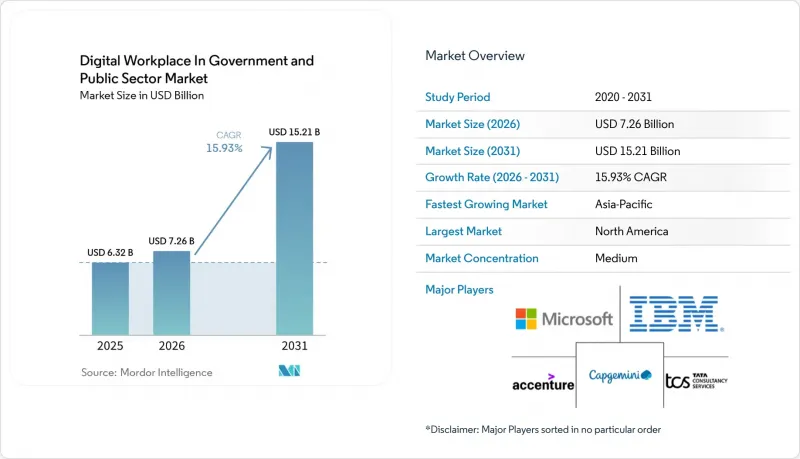
根據 Mordor Intelligence 預測,政府和公共部門數位工作場所的市場規模預計將在 2025 年達到 63.2 億美元,在 2026 年達到 72.6 億美元,到 2031 年達到 152.1 億美元,從 2026 年到 2031 年的複合年成長率為 15.93%。
本報告按組件(解決方案[整合通訊與協作、統一端點管理、企業移動性與管理等]和服務)、部署模式(雲端、混合等)、組織規模(大型企業和中小企業)以及地區進行細分。市場預測以價值(美元)表示。
政府和公共部門全球數位化工作場所市場的趨勢和洞察。
政府機構雲端現代化計畫的擴展
政府機構的雲端現代化正從一項廣泛的政策目標轉變為許多公共機構的營運需求。美國聯邦服務管理局 (GSA) 與 ServiceNow 的「OneGov」合約允許聯邦機構以高達 70% 的折扣購買 ITSM Pro 和 Pro Plus 套餐,預計工作流程效率將提高 30%。這表明集中採購有助於加速採用現代化工作場所平台。德國的「Deutsche Verwaltungscloud 2.0」計畫概述了在 2026 年至 2029 年間為政府機構創建聯邦雲端基礎設施的計劃,這將直接擴大合規性工作場所工具在各級政府中的覆蓋範圍。此外,歐盟委員會於 2026 年 4 月簽署了一份價值 1.8 億歐元(1.94 億美元)的主權雲契約,表明大規模公共機構正在將雲環境的建設視為長期的組織基礎設施,而非一次性的 IT 項目。 FedRAMP 向統一規則和持續授權模式的轉變進一步加速了這一趨勢。這是因為政府機構和供應商正被引導使用雲端服務,雲端服務可以提供持續的合規性證據,而不是定期提交文件。
將生成式人工智慧引入公民和員工知識工作流程
生成式人工智慧正成為政府和公共部門數位化工作場所市場的核心組成部分。這是因為各機構不再將生成式人工智慧局限於有限的試點項目,而是將其應用於日常知識管理、搜尋和支援工作流程中。 2025年7月,美國政府責任署(GAO)報告稱,一些聯邦機構已於2024年將生成式人工智慧的使用和管理過渡到實際營運環境中,證實了其應用活動已超越實驗階段。 2026年5月,日本數位廳啟動了跨政府部門的「GENNAI」先導計畫,該項目面向各部會和機構的約18萬名員工,採用針對行政術語最佳化的、大規模的國產語言模型。這是目前規模最大的政府主導的職場人工智慧計畫之一。 2026年3月,ServiceNow發布了“EmployeeWorks”,進一步強化了這一趨勢。 EmployeeWorks與Moveworks整合,將互動式人工智慧和企業搜尋功能整合到一個面向政府僱員的單一入口網站中。 2026年2月,印度安得拉邦政府宣布將與IBM、BharatGen和NxtGen合作,建構一個以公民為中心、多語言的「自主人工智慧堆疊」。這凸顯了公共部門的人工智慧與國家治理和語言的相關性日益密切。
舊有系統和採購挑戰
傳統基礎設施仍然是政府和公共部門快速採用數位化工作場所市場的最大障礙。根據美國政府責任署 (GAO) 的報告,聯邦機構每年在 IT 方面的支出超過 1000 億美元,其中約 80% 用於現有系統的運作和維護,導致用於全面現代化項目的預算有限。 2025 年 1 月,英國政府內閣辦公室報告稱,2023 年至 2024 年間,風險最高、最關鍵的舊有系統數量增加了 26%,而公共服務的數位化程度僅提高了一半,數位化支出仍比基準水準低 30%。由於各機構必須先撥款以確保業務連續性,才能進行轉型,因此這一趨勢正在減緩過時的協作、終端和工作流程環境的替換速度。雖然採購改革未來可能會改善這種情況,但目前的採購流程仍會延長實施週期,使各機構難以從分散的工具快速過渡到整合的工作場所平台。
細分市場分析
該解決方案預計到2025年將佔據62.55%的市場佔有率,並在2031年之前以16.23%的複合年成長率成長。這表明,買家更加重視整合平台的功能,而非獨立的服務營運。在政府和公共部門的數位化工作場所市場,各機構對整合通訊)和 ServiceNow 達成的「OneGov」協議進一步推動了這一趨勢,該協議為支援人工智慧的工作流程捆綁包提供了大幅折扣,並強調了機構更快、更標準化的現代化進程。微軟計劃於2026年為GCC和GCC High部署“Windows 365 Frontline”,這也凸顯了該解決方案的有效性,因為雲端PC和安全工作空間工具正與協作、終端控制和以身分為中心的存取管理工具一起納入同一採購框架。
儘管服務仍然至關重要,但其角色正從基礎的託管支援轉向平台環境的實施、遷移、整合和管治。 FedRAMP 規則的整合以及向持續授權模式的轉變表明,市場結構正在向優先考慮常規 SaaS 和合規性支援的產品轉變,這可能會隨著時間的推移降低勞動密集型服務模式的相對權重。然而,在政府和公共部門的數位化工作場所,由於內部技能仍然有限,仍需要服務供應商來連接舊有系統、管理變更並支援跨機構部署。簡而言之,服務仍將是合約價值的一部分,而能夠將服務整合到符合合規性的產品平台中,而不是將服務作為獨立終端銷售的供應商,將佔據最有利的地位。
區域分析
到2025年,北美將在政府和公共部門的數位化工作場所市場佔據38.45%的佔有率,繼續保持其在支出和應用方面最大的區域中心地位。該地區受益於成熟的採購和授權框架,尤其是美國總務署(GSA)的「OneGov」合約模式和聯邦合規與應用管理計畫(FedRAMP)大規模的認證服務目錄。美國行政管理和預算辦公室(OMB)和人事管理辦公室(OPM)在2025年初宣布的重返辦公室實施計劃也鼓勵各機構投資於安全的混合辦公環境,而不僅僅是傳統的辦公室模式。微軟面向政府部門擴展雲端PC業務以及FedRAMP 20x的推出,都顯示北美供應商越來越需要兼顧易用性和持續合規性。
亞太地區預計將成為成長最快的地區,到2031年複合年成長率將達到16.67%,這表明隨著政府人工智慧和主權雲端計畫的日趨成熟,政府和公共部門的數位化工作場所市場將快速擴張。 「GENNAI」於2026年5月在日本啟動,是該地區大規模部署政府工作場所人工智慧的最典型案例之一,涉及各部會約18萬名員工。在印度,安得拉邦與IBM、BharatGen和NxtGen於2026年2月聯合推出的主權人工智慧堆疊計畫表明,區域需求與公共服務交付、語言在地化以及高度敏感系統的國內管理密切相關。該地區的成長也與對國內數據處理和政府特定合規框架的高度重視密切相關。因此,擁有本地基礎設施、國內夥伴關係關係以及針對主權需求量身定做的產品選項的供應商,將更有利於在全部區域贏得新訂單。
在歐洲,數位主權相關法規和對可互通公共數位基礎設施的需求共同塑造著這個發展方向。歐盟委員會於2026年6月提案的《雲端運算和人工智慧發展法案》引入了一個包含48項標準的主權框架,旨在推動公共部門採購向更具可審計性和管轄權意識的架構轉型。歐盟委員會於2026年4月宣布的「主權雲端合約」以及德國的DVC 2.0計畫表明,這不再只是一項政策,而是正在以資金支持的基礎設施和部署方案的形式具體化。中東、南美和非洲仍處於起步階段,但在各國數位政府計畫和外部資金的支持下,對協作、工作流程和員工支援平台的需求開始成長。
其他好處:
- Excel格式的市場預測(ME)表
- 3個月的分析師支持
目錄
第1章:引言
- 研究假設和市場定義
- 調查範圍
第2章:調查方法
第3章執行摘要
第4章 市場狀況
- 市場概覽
- 宏觀經濟因素對市場的影響
- 市場促進因素
- 政府擴大雲端現代化計劃
- 擴大政府行政部門安全混合辦公模式
- 將生成式人工智慧引入公民和員工知識工作流程
- 各組織對一體化數位化員工體驗的需求日益成長。
- 員工合規性和可審計性的要求
- 對零信任協作環境日益成長的需求
- 市場限制因素
- 舊有系統和採購摩擦
- 加強資料主權並限制居住要求
- 多廠商互通性的複雜性
- 公共部門預算僵化和多年審核週期
- 產業價值鏈分析
- 供應鏈分析
- 監理情勢
- 技術展望
- 波特五力分析
第5章 市場規模與成長預測
- 按組件
- 解決方案
- 整合通訊與協作
- 整合端點管理
- 企業移動性與管理
- 員工體驗平台與內網
- 工作流程自動化與知識管理
- 虛擬桌面基礎架構與雲端電腦
- 服務
- 解決方案
- 部署模式
- 雲
- 現場
- 混合
- 按組織規模
- 大公司
- 小型企業
- 按地區
- 北美洲
- 美國
- 加拿大
- 墨西哥
- 南美洲
- 巴西
- 阿根廷
- 智利
- 哥倫比亞
- 其他南美國家
- 歐洲
- 德國
- 英國
- 法國
- 義大利
- 西班牙
- 荷蘭
- 北歐的
- 俄羅斯
- 其他歐洲國家
- 亞太地區
- 中國
- 日本
- 印度
- 韓國
- 澳洲和紐西蘭
- 東南亞
- 其他亞太國家
- 中東
- 沙烏地阿拉伯
- 阿拉伯聯合大公國
- 土耳其
- 以色列
- 其他中東國家
- 非洲
- 南非
- 埃及
- 奈及利亞
- 肯亞
- 其他非洲國家
- 北美洲
第6章 競爭情勢
- 市場集中度
- 策略趨勢
- 市佔率分析
- 公司簡介
- Accenture plc
- Atos SE
- Capgemini SE
- Cognizant Technology Solutions Corporation
- DXC Technology Company
- Fujitsu Limited
- HCL Technologies Limited
- Hewlett Packard Enterprise Company
- IBM Corporation
- Infosys Limited
- Kyndryl Holdings, Inc.
- Microsoft Corporation
- Nippon Telegraph and Telephone Corporation
- Oracle Corporation
- ServiceNow, Inc.
- Tata Consultancy Services Limited
- TeamViewer SE
- Unisys Corporation
- Wipro Limited
- Zensar Technologies Limited
第7章 市場機會與未來展望
According to Mordor Intelligence, the digital workplace in government and public sector market size is projected to be USD 6.32 billion in 2025, USD 7.26 billion in 2026, and reach USD 15.21 billion by 2031, growing at a CAGR of 15.93% from 2026 to 2031.
This report is Segmented by Component (Solutions [Unified Communication and Collaboration, Unified Endpoint Management, Enterprise Mobility and Management, and More] and Services), Deployment Mode (Cloud, Hybrid, and More), Organization Size (Large Enterprises and Small and Medium-Sized Enterprises), and Geography. The Market Forecasts are Provided in Terms of Value (USD).
Global Digital Workplace In Government and Public Sector Market Trends and Insights
Rising Government Cloud Modernization Programs
Government cloud modernization has moved from a broad policy goal to an operational requirement inside many public institutions. The GSA and ServiceNow OneGov agreement gave federal agencies discounts of up to 70% on ITSM Pro and Pro Plus bundles and projected workflow efficiency gains of 30%, which shows that centralized buying is being used to speed adoption of modern workplace platforms. Germany's Deutsche Verwaltungscloud 2.0 program set out a federated cloud infrastructure for public administration from 2026 to 2029, which directly expands the addressable base for compliant workplace tools across multiple levels of government. The European Commission also awarded a EUR 180 million (USD 194 million) sovereign cloud contract in April 2026, which shows that large public bodies are now funding cloud environments as long-term institutional infrastructure rather than one-off IT projects. FedRAMP's move toward consolidated rules and a continuous authorization model further supports this trend because agencies and vendors are being pushed toward cloud services that can present ongoing evidence of compliance instead of periodic documentation.
Adoption of Generative AI for Citizen and Employee Knowledge Workflows
Generative AI is becoming a core layer of the digital workplace in government and public sector market because agencies are using it in routine knowledge, search, and support workflows instead of limiting it to narrow pilots. The GAO reported in July 2025 that selected federal agencies had already moved generative AI use and management into active operating environments by 2024, which confirmed that deployment activity had advanced beyond experimentation. Japan's Digital Agency launched the government-wide GENNAI pilot in May 2026 for nearly 180,000 employees across ministries, using domestic large language models tuned to administrative language, which makes it one of the largest state-led workplace AI programs now in operation. ServiceNow strengthened the same direction in March 2026 when it launched EmployeeWorks with Moveworks integration, combining conversational AI and enterprise search in a single government-oriented front door for agency workers. In India, the Government of Andhra Pradesh announced work with IBM, BharatGen, and NxtGen in February 2026 to build a sovereign AI stack for citizen-focused and multilingual AI services, which reinforces how public sector AI is being tied to domestic control and language relevance.
Legacy Systems and Procurement Friction
Legacy infrastructure remains the most persistent barrier to faster adoption in the digital workplace in government and public sector market. The GAO reported that federal agencies spend more than USD 100 billion each year on IT and direct nearly 80% of that amount to operating and maintaining existing systems, which leaves a smaller pool for full modernization programs. The UK Cabinet Office reported in January 2025 that the number of highest-risk and most critical legacy systems rose 26% from 2023 to 2024, while only half of public services were digitized and digital expenditure remained 30% below benchmark levels. That pattern slows the replacement of old collaboration, endpoint, and workflow environments because agencies must fund continuity first and transformation second. Procurement reform may improve this over time, but current buying processes still stretch deployment timelines and make it harder for agencies to move quickly from fragmented tools to integrated workplace platforms.
Other drivers and restraints analyzed in the detailed report include:
- Expansion of Secure Hybrid Work in Public Administration
- Demand for Unified Digital Employee Experience Across Agencies
- Heightened Data Sovereignty and Residency Constraints
For complete list of drivers and restraints, kindly check the Table Of Contents.
Segment Analysis
Solutions accounted for 62.55% of the market in 2025 and are expected to grow at 16.23% CAGR through 2031, which shows that buyers are placing more value on integrated platform capability than on stand-alone service labor. Within the digital workplace in government and public sector market, agencies are directing visible demand toward unified communication and collaboration, employee experience platforms, intranet tools, and secure desktop access because these functions now sit close to daily mission delivery. The GSA and ServiceNow OneGov agreement reinforced that direction by offering deep discounts on AI-enabled workflow bundles and by emphasizing faster, more standardized modernization across agencies. Microsoft's 2026 rollout of Windows 365 Frontline for GCC and GCC High also supports the solutions case because cloud PC and secure workspace tools are moving into the same buying frame as collaboration, endpoint control, and identity-centered access.
The services side is still important, but its role is changing from basic managed support toward implementation, migration, integration, and governance around platform environments. FedRAMP's consolidated rules and transition toward continuous authorization signal a market structure that favors recurring SaaS and compliance-backed products, which reduces the relative weight of labor-heavy service models over time. Even so, the digital workplace in government and public sector industry still needs service providers to connect legacy estates, manage change, and support cross-agency rollout where internal skills remain limited. That means services will remain part of contract value, but the strongest position sits with vendors that can wrap services around a compliant product platform instead of selling services as a separate end point.
Complete Report Scope:
- By Component
- Solutions
- Unified Communication and Collaboration
- Unified Endpoint Management
- Enterprise Mobility and Management
- Employee Experience Platforms and Intranet
- Workflow Automation and Knowledge Management
- Virtual Desktop Infrastructure and Cloud PC
- Services
- Solutions
- By Deployment Mode
- Cloud
- On-Premises
- Hybrid
- By Organization Size
- Large Enterprises
- Small and Medium-Sized Enterprises
- By Geography
- North America
- United States
- Canada
- Mexico
- South America
- Brazil
- Argentina
- Chile
- Colombia
- Rest of South America
- Europe
- Germany
- United Kingdom
- France
- Italy
- Spain
- Netherlands
- Nordics
- Russia
- Rest of Europe
- Asia-Pacific
- China
- Japan
- India
- South Korea
- Australia and New Zealand
- Southeast Asia
- Rest of Asia-Pacific
- Middle East
- Saudi Arabia
- United Arab Emirates
- Turkey
- Israel
- Rest of Middle East
- Africa
- South Africa
- Egypt
- Nigeria
- Kenya
- Rest of Africa
- North America
Geography Analysis
North America held 38.45% of the digital workplace in government and public sector market share in 2025, which kept it as the largest regional base for spending and deployment. The region benefits from mature procurement and authorization frameworks, and the clearest examples are the GSA's OneGov contracting model and FedRAMP's large catalog of certified services. Return-to-office implementation plans issued by OMB and OPM in early 2025 also pushed agencies to invest in secure hybrid environments rather than simple office-only models. Microsoft's government cloud PC expansion and FedRAMP 20x together show that vendors in North America are increasingly expected to pair usability with continuous compliance evidence.
Asia-Pacific is the fastest-growing region with a 16.67% CAGR through 2031, which shows that the digital workplace in government and public sector market size is rising quickly as government AI and sovereign cloud agendas mature. Japan's GENNAI launch in May 2026 gave the region one of the clearest examples of large-scale government workplace AI deployment, with a target base of nearly 180,000 employees across ministries. In India, Andhra Pradesh's February 2026 work with IBM, BharatGen, and NxtGen on a sovereign AI stack showed how regional demand is being linked to public service delivery, language localization, and domestic control of sensitive systems. This regional growth is also tied to a stronger preference for in-country data handling and government-specific compliance structures. Vendors with local infrastructure, domestic partnerships, and sovereign-ready product options are therefore better placed to capture new awards across Asia-Pacific.
Europe is being shaped by a combination of digital sovereignty rules and the need for interoperable public digital infrastructure. The European Commission's Cloud and AI Development Act proposal in June 2026 introduced a 48-criterion sovereignty framework, which is pushing workplace procurement toward more auditable and jurisdiction-aware architectures. The Commission's April 2026 sovereign cloud contract and Germany's DVC 2.0 program show that this is no longer just a policy direction, it is now being translated into funded infrastructure and deployment design. The Middle East, South America, and Africa remain earlier-stage markets, but national digital government programs and external funding support are beginning to widen demand for collaboration, workflow, and employee support platforms.
- Accenture plc
- Atos SE
- Capgemini SE
- Cognizant Technology Solutions Corporation
- DXC Technology Company
- Fujitsu Limited
- HCL Technologies Limited
- Hewlett Packard Enterprise Company
- IBM Corporation
- Infosys Limited
- Kyndryl Holdings, Inc.
- Microsoft Corporation
- Nippon Telegraph and Telephone Corporation
- Oracle Corporation
- ServiceNow, Inc.
- Tata Consultancy Services Limited
- TeamViewer SE
- Unisys Corporation
- Wipro Limited
- Zensar Technologies Limited
Additional Benefits:
- The market estimate (ME) sheet in Excel format
- 3 months of analyst support
TABLE OF CONTENTS
1 INTRODUCTION
- 1.1 Study Assumptions and Market Definition
- 1.2 Scope of the Study
2 RESEARCH METHODOLOGY
3 EXECUTIVE SUMMARY
4 MARKET LANDSCAPE
- 4.1 Market Overview
- 4.2 Impact of Macroeconomic Factors on the Market
- 4.3 Market Drivers
- 4.3.1 Rising Government Cloud Modernization Programs
- 4.3.2 Expansion of Secure Hybrid Work in Public Administration
- 4.3.3 Adoption of Generative AI for Citizen and Employee Knowledge Workflows
- 4.3.4 Demand for Unified Digital Employee Experience Across Agencies
- 4.3.5 Workforce Compliance and Auditability Requirements
- 4.3.6 Rising Need for Zero Trust Collaboration Environments
- 4.4 Market Restraints
- 4.4.1 Legacy Systems and Procurement Friction
- 4.4.2 Heightened Data Sovereignty and Residency Constraints
- 4.4.3 Multi-Vendor Interoperability Complexity
- 4.4.4 Public Sector Budget Rigidity and Multi-Year Approval Cycles
- 4.5 Industry Value Chain Analysis
- 4.6 Supply Chain Analysis
- 4.7 Regulatory Landscape
- 4.8 Technological Outlook
- 4.9 Porter's Five Forces Analysis
- 4.9.1 Threat of New Entrants
- 4.9.2 Bargaining Power of Suppliers
- 4.9.3 Bargaining Power of Buyers
- 4.9.4 Threat of Substitutes
- 4.9.5 Competitive Rivalry
5 MARKET SIZE AND GROWTH FORECASTS (VALUE)
- 5.1 By Component
- 5.1.1 Solutions
- 5.1.1.1 Unified Communication and Collaboration
- 5.1.1.2 Unified Endpoint Management
- 5.1.1.3 Enterprise Mobility and Management
- 5.1.1.4 Employee Experience Platforms and Intranet
- 5.1.1.5 Workflow Automation and Knowledge Management
- 5.1.1.6 Virtual Desktop Infrastructure and Cloud PC
- 5.1.2 Services
- 5.1.1 Solutions
- 5.2 By Deployment Mode
- 5.2.1 Cloud
- 5.2.2 On-Premises
- 5.2.3 Hybrid
- 5.3 By Organization Size
- 5.3.1 Large Enterprises
- 5.3.2 Small and Medium-Sized Enterprises
- 5.4 By Geography
- 5.4.1 North America
- 5.4.1.1 United States
- 5.4.1.2 Canada
- 5.4.1.3 Mexico
- 5.4.2 South America
- 5.4.2.1 Brazil
- 5.4.2.2 Argentina
- 5.4.2.3 Chile
- 5.4.2.4 Colombia
- 5.4.2.5 Rest of South America
- 5.4.3 Europe
- 5.4.3.1 Germany
- 5.4.3.2 United Kingdom
- 5.4.3.3 France
- 5.4.3.4 Italy
- 5.4.3.5 Spain
- 5.4.3.6 Netherlands
- 5.4.3.7 Nordics
- 5.4.3.8 Russia
- 5.4.3.9 Rest of Europe
- 5.4.4 Asia-Pacific
- 5.4.4.1 China
- 5.4.4.2 Japan
- 5.4.4.3 India
- 5.4.4.4 South Korea
- 5.4.4.5 Australia and New Zealand
- 5.4.4.6 Southeast Asia
- 5.4.4.7 Rest of Asia-Pacific
- 5.4.5 Middle East
- 5.4.5.1 Saudi Arabia
- 5.4.5.2 United Arab Emirates
- 5.4.5.3 Turkey
- 5.4.5.4 Israel
- 5.4.5.5 Rest of Middle East
- 5.4.6 Africa
- 5.4.6.1 South Africa
- 5.4.6.2 Egypt
- 5.4.6.3 Nigeria
- 5.4.6.4 Kenya
- 5.4.6.5 Rest of Africa
- 5.4.1 North America
6 COMPETITIVE LANDSCAPE
- 6.1 Market Concentration
- 6.2 Strategic Moves
- 6.3 Market Share Analysis
- 6.4 Company Profiles (includes Global Level Overview, Market Level Overview, Core Segments, Financials as available, Strategic Information, Market Rank/Share, Products and Services, Recent Developments)
- 6.4.1 Accenture plc
- 6.4.2 Atos SE
- 6.4.3 Capgemini SE
- 6.4.4 Cognizant Technology Solutions Corporation
- 6.4.5 DXC Technology Company
- 6.4.6 Fujitsu Limited
- 6.4.7 HCL Technologies Limited
- 6.4.8 Hewlett Packard Enterprise Company
- 6.4.9 IBM Corporation
- 6.4.10 Infosys Limited
- 6.4.11 Kyndryl Holdings, Inc.
- 6.4.12 Microsoft Corporation
- 6.4.13 Nippon Telegraph and Telephone Corporation
- 6.4.14 Oracle Corporation
- 6.4.15 ServiceNow, Inc.
- 6.4.16 Tata Consultancy Services Limited
- 6.4.17 TeamViewer SE
- 6.4.18 Unisys Corporation
- 6.4.19 Wipro Limited
- 6.4.20 Zensar Technologies Limited
7 MARKET OPPORTUNITIES AND FUTURE OUTLOOK
- 7.1 White-Space and Unmet-Need Assessment

 2026-2030年全球數位化職場市場
 包容性職場無障礙平台市場預測至2034年—全球無障礙解決方案、身心障礙者支援、無障礙功能、合規標準、最終用戶和區域分析
 零售業數位化工作場所:市場佔有率分析、產業趨勢與統計及成長預測(2026-2031 年)
 數位化工作場所市場:2026-2032年全球市場預測(按服務類型、應用、產業、組織規模和部署類型分類)教育產業的數位化工作場所:市場佔有率分析、產業趨勢和統計數據以及成長預測(2026-2031 年)越南數位化工作場所:市場佔有率分析、產業趨勢與統計及成長預測(2026-2031)法律與專業服務的數位化工作場所:市場佔有率分析、產業趨勢與統計數據以及成長預測(2026-2031 年)製造業數位化工作場所:市場佔有率分析、產業趨勢與統計及成長預測(2026-2031 年)醫療保健領域的數位化工作場所:市場佔有率分析、行業趨勢和統計數據以及成長預測(2026-2031 年)銀行、金融服務和保險 (BFSI) 行業的數位化工作場所:市場佔有率分析、行業趨勢和統計數據以及成長預測(2026-2031 年)