


 |
市場調查報告書
商品編碼
2098472
醫療保健領域的數位化工作場所:市場佔有率分析、行業趨勢和統計數據以及成長預測(2026-2031 年)Digital Workplace In Healthcare - Market Share Analysis, Industry Trends & Statistics, Growth Forecasts (2026 - 2031) |
||||||

※ 本網頁內容可能與最新版本有所差異。詳細情況請與我們聯繫。
根據 Mordor Intelligence 預測,醫療保健領域的數位化工作場所市場規模預計將在 2025 年達到 72.3 億美元,2026 年達到 89.4 億美元,到 2031 年達到 271.5 億美元,2026 年至 2031 年的複合年成長率為 24.87%。
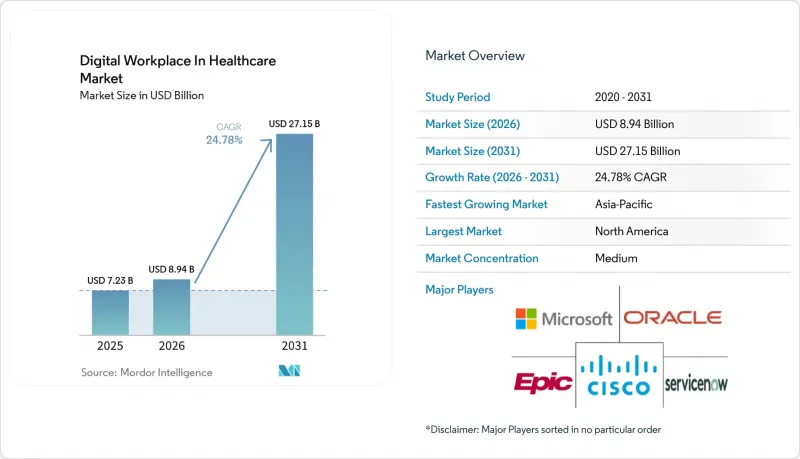
本報告按組件(解決方案[整合通訊與協作、統一端點管理、員工體驗平台和企業內網等]和服務)、部署模式(雲端、本地部署、混合部署)、組織規模(大型企業和中小企業)以及地區進行細分。市場預測以價值(美元)表示。
全球醫療保健數位化工作場所市場趨勢及洞察
整個醫療保健領域對虛擬護理協調的需求日益成長。
隨著混合醫療模式的興起,醫療保健領域的數位化工作場所市場正蓬勃發展。這種模式要求醫護人員在不中斷工作流程的前提下,跨急診室、門診部、居家醫療服務和遠距監測計畫進行協作。醫療服務提供者不再將遠距醫療視為一個獨立的管道,而是需要在同一營運環境中管理病患記錄、任務、安全通訊、會前準備和後續跟進,以避免重複遠端保健和職責分散。這使得採購重點從孤立的通訊工具轉向支援日常會前、會後和會中任務的平台。 2026年3月,亞馬遜網路服務(AWS)發布了Amazon Connect Health,這是一個專門設計的基於代理的人工智慧平台,它將會前患者洞察、情境感知臨床文件和會後醫學編碼整合到一個統一的SDK中,並可與現有的電子健康記錄(EHR)系統整合。此次發布表明,超大規模資料中心業者不再僅僅將醫療協調視為客服中心的一個有限機會,而是將其視為更深入主導醫療保健工作流程的直接途徑。因此,醫療保健領域的數位化工作場所市場正日益受到企業雲端合約的影響,這使得首席資訊長主導的採購團隊對決策擁有更大的影響力,而這種影響力以前僅限於較為狹窄的臨床技術預算。
擴展可互通的臨床協作工作流程
醫療保健領域的數位化工作場所市場也受益於平台轉型,該轉型旨在將臨床、行政和營運任務即時連接起來,而不是將各個部門隔離在獨立的系統中。醫院意識到,如果護理師、醫生和行政團隊仍然需要在多個介面之間切換才能完成簡單的請求或記錄服務問題,那麼溝通工具的價值就無法充分發揮。與電子健康記錄(EHR) 的整合現在已成為選擇供應商的必要條件,因為買家正在尋找能夠在現有臨床工作流程環境中運作的協作工具。 2026 年 2 月,ServiceNow 發布了 Healthcare Operations,它將共用的營運記錄系統整合到電子健康記錄中,使護理團隊能夠在不離開熟悉的工作流程環境的情況下,發出 IT、生物醫學、設施和環境服務的請求。這種模式減少了情境切換,縮短了現場團隊和支援部門之間的回應週期。它還將營運協調整合到臨床工作流程中,而無需外部服務工單處理。這種轉變將促進醫療保健領域的數位化工作場所市場,因為對協作的投資將使患者流動、人員配備效率和服務可靠性更加緊密地結合起來,而且在利潤率和勞動力短缺的情況下,醫療保健提供者不太可能將這些放在次要位置。
整合傳統電子病歷與識別系統的複雜性
醫療保健領域的數位化工作場所市場仍然面臨著巨大的結構性限制。這是因為許多醫療機構使用的電子病歷 (EHR)、身分管理和通訊環境都是隨著時間的推移而建構的,並且在許多方面都進行了客製化。這些現有系統通常包含本機程式碼、過時的訊息標準以及點對點介面,無法順利地對應到新的協作平台或基於 API 的現代架構。 2025 年發表在《健康資訊學趨勢》(Trends in Health Informatics) 上的一篇報導指出,隨著各機構嘗試遷移到可互通的數位化健康環境,分散的 EHR 和交換醫療資訊生態系統仍然需要客製化中間件、資料映射工具以及漫長的整合週期。這導致了高昂且難以預測的實施成本,因為協作平台在買家開始跨大規模醫療網路整合身分識別管理、臨床記錄、排班工具和支援系統之前,可能看起來很簡單。這個問題在大學醫院和多站點醫療服務系統中尤為突出,因為這些機構多年來積累了大量的客製化,一次工作流程的變更就可能同時影響多個運營團隊。因此,在整合規劃、測試和維護必須與平台部署本身給予幾乎同等重視的環境中,醫療保健領域採用數位化工作場所的步伐正在放緩。
細分市場分析
到2025年,解決方案將佔據醫療保健產業數位化工作場所市場佔有率的66.64%,證實了軟體主導平台的支出仍將是市場的核心。醫療保健機構將大部分支出用於整合通訊和協作平台、虛擬桌面基礎架構、工作流程自動化工具以及以員工體驗(EX)為中心的企業內部網,這些平台能夠支援臨床和行政職位的日常運作。這種配置反映了可行的採購模式,因為醫療保健系統往往優先考慮精簡工具,而不是擴大針對小規模獨立產品的諮詢和整合範圍。整合通訊和協作平台仍然是醫療產業數位化工作場所的核心,因為安全通訊、通話、共用工作空間和行動存取如今同時影響著護理協調、員工應對力和管治。
預計到2031年,解決方案領域將以25.22%的複合年成長率成長,反映出市場對能夠標準化醫院園區、門診診所和遠端醫療環境營運的平台層需求持續成長。虛擬桌面基礎架構 (VDI) 和雲端PC模式正在鞏固這一地位,因為醫療服務提供者正在尋求在感染風險較高的臨床環境中提供更一致的存取體驗,在這些環境中,共用工作站和使用者會話切換仍然至關重要。工作流程自動化和知識管理也發揮越來越重要的作用,因為行政負擔仍然是導致員工不滿、服務回應延遲和入職培訓不平衡的直接原因。員工體驗平台正日益被視為一種營運基礎設施,而不僅僅是內部溝通門戶,它可以支援人才保留、政策存取和管理員跟進。雖然服務在醫療保健領域的數位化工作場所市場仍然很重要,但市場需求主要取決於將平台投資與現有電子健康記錄 (EHR) 身份堆疊整合,並在底層臨床系統不斷發展的同時保持長期整合。在與電子病歷 (EHR) 系統連接的環境中,需要持續進行 API 維護、管治檢查和工作流程更新,而不僅僅是部署後的穩定化。隨著買家從一次性部署專案轉向持續的託管支持,服務業也正在發生重大變化。
區域分析
2025年,北美市場佔有率達到35.78%,並持續維持在醫療保健數位化工作場所市場的中心地位。美國仍然是主要驅動力,這得益於其在醫療保健IT領域的高額支出、電子健康記錄(EHR)的廣泛應用以及對合規通訊更為嚴格的課責,這些因素共同支撐了對更結構化職場環境的需求。該地區的買家也越來越傾向於將協作平台視為企業生產力、雲端和安全架構的一部分,而非孤立通訊功能的升級。 2026年3月,Google雲端和CVS Health宣佈建立策略合作夥伴關係,共同開發Health100,這是一個面向消費者、醫療服務提供者、保險公司和數位醫療創新者的整合式健康科技服務平台。這反映了該地區將醫療團隊工作流程與更廣泛的平台生態系統相結合的趨勢。隨著保險公司和醫療服務提供者的整合以及企業雲端策略日益影響工作場所工具的選擇和擴展,這一趨勢將進一步推動醫療保健數位化工作場所市場的發展。
預計到2031年,亞太地區將以25.43%的複合年成長率成長,成為醫療保健數位化工作場所市場成長最快的區域細分市場。這項成長主要得益於各國醫療保健數位化計畫的推進、私立醫院網路的擴張,以及印度、中國、韓國、澳洲和日本等國對人工智慧驅動的文件記錄和護理協調日益成長的需求。 2026年5月,Telstra Health推出了Corus,這是一個基於雲端原生和FHIR協議的護理智慧生態系統,支援跨不同醫療保健環境的人群健康管理、護理導航和護理協調。此次推出表明,該地區的需求正在從基礎數位化轉向具有更清晰互通性的高度互聯工作流程基礎設施。此外,亞太地區許多醫療服務提供者正在建立新的數位化平台,而無需像西方老舊醫院那樣進行大量的傳統客製化,這也有利於醫療保健數位化工作場所市場的發展。
2025年,歐洲預計將佔據領先地位,德國、英國、法國和荷蘭將引領醫療保健領域數位化工作場所市場的普及。尤其值得一提的是,德國在2026年2月發布了聯邦衛生署修訂的「GEMEINSAM DIGITAL 2026」政策,設定目標到2028年,在超過70%的醫療保健和長期照護機構中部署人工智慧驅動的文件創建系統。此政策方向將文件建立和工作流程工具定位為系統層級實施的優先事項,並優先考慮能夠提供符合歐盟資料駐留要求和GDPR合規實施模式的供應商。雖然南美洲和中東及非洲地區仍處於市場範圍內,但本文檔重點關注北美、歐洲和亞太地區正在進行的政策、採購和平台開發工作。
其他好處:
- Excel格式的市場預測(ME)表
- 3個月的分析師支持
目錄
第1章:引言
- 研究假設和市場定義
- 調查範圍
第2章:調查方法
第3章執行摘要
第4章 市場狀況
- 市場概覽
- 宏觀經濟因素對市場的影響
- 市場促進因素
- 所有醫療機構對虛擬照護協調的需求日益成長。
- 擴展可互通的臨床協作工作流程
- 向面向護理團隊的整合式數位化入口過渡
- 對可審計通訊記錄的合規壓力
- 拓展醫療產業的員工體驗與留任計劃
- 對雲端桌面和工作空間標準化的需求日益成長
- 市場限制因素
- 整合傳統電子病歷和身分識別系統的複雜性。
- 分散式工作流程中的網路安全和PHI外洩問題
- 臨床使用者對變革管理的抵制
- 在IT、臨床和營運團隊之間實行分散式預算管理。
- 產業價值鏈分析
- 產業供應鏈分析
- 監理情勢
- 技術展望
- 波特五力分析
第5章 市場規模與成長預測
- 按組件
- 解決方案
- 整合通訊與協作
- 整合端點管理
- 企業移動性與管理
- 員工體驗平台與內網
- 工作流程自動化與知識管理
- 虛擬桌面基礎架構與雲端電腦
- 服務
- 解決方案
- 部署模式
- 雲
- 現場
- 混合
- 按組織規模
- 大公司
- 小型企業
- 按地區
- 北美洲
- 美國
- 加拿大
- 墨西哥
- 南美洲
- 巴西
- 阿根廷
- 智利
- 哥倫比亞
- 其他南美國家
- 歐洲
- 德國
- 英國
- 法國
- 義大利
- 西班牙
- 荷蘭
- 北歐的
- 俄羅斯
- 其他歐洲國家
- 亞太地區
- 中國
- 日本
- 印度
- 韓國
- 澳洲和紐西蘭
- 東南亞
- 其他亞太國家
- 中東
- 沙烏地阿拉伯
- 阿拉伯聯合大公國
- 土耳其
- 以色列
- 其他中東國家
- 非洲
- 南非
- 埃及
- 奈及利亞
- 肯亞
- 其他非洲國家
- 北美洲
第6章 競爭情勢
- 市場集中度
- 策略趨勢
- 市佔率分析
- 公司簡介
- Microsoft Corporation
- Oracle Corporation
- Cisco Systems, Inc.
- VMware, Inc.
- Citrix Systems, Inc.
- ServiceNow, Inc.
- IBM Corporation
- SAP SE
- Zoom Video Communications, Inc.
- Google LLC
- Amazon Web Services, Inc.
- Dell Technologies Inc.
- Hewlett Packard Enterprise Company
- VMware by Broadcom Inc.
- eClinicalWorks LLC
- Epic Systems Corporation
- InterSystems Corporation
- Salesforce, Inc.
- athenahealth, Inc.
- Accenture plc
第7章 市場機會與未來展望
According to Mordor Intelligence, the digital workplace in healthcare market size is projected to be USD 7.23 billion in 2025, USD 8.94 billion in 2026, and reach USD 27.15 billion by 2031, growing at a CAGR of 24.87% from 2026 to 2031.
This report is Segmented by Component (Solutions [Unified Communication and Collaboration, Unified Endpoint Management, Employee Experience Platforms and Intranet, and More] and Services), Deployment Mode (Cloud, On-Premises, and Hybrid), Organization Size (Large Enterprises and Small and Medium-Sized Enterprises), and Geography. The Market Forecasts are Provided in Terms of Value (USD).
Global Digital Workplace In Healthcare Market Trends and Insights
Rising Virtual Care Coordination Needs Across Care Settings
The digital workplace in healthcare market is gaining momentum because hybrid care models now require staff to coordinate across emergency departments, outpatient clinics, home health services, and remote monitoring programs without losing workflow continuity. Providers are no longer treating telehealth as a separate channel, because notes, tasks, secure messaging, pre-visit preparation, and follow-up work now need to sit inside the same operating environment to avoid repeated handoffs and fragmented accountability. This has shifted buying priorities away from isolated communication tools and toward platforms that can support daily work before, during, and after the care encounter. In March 2026, Amazon Web Services launched Amazon Connect Health, a purpose-built agentic AI platform that combines pre-visit patient insights, ambient clinical documentation, and post-visit medical coding within a unified SDK that integrates into existing EHR systems. That launch shows that hyperscalers view care coordination as a direct route to deeper healthcare workflow ownership rather than a limited contact center opportunity. As a result, the digital workplace in healthcare market is increasingly shaped by enterprise cloud agreements, which gives CIO-led procurement teams more influence over decisions that once sat inside narrower clinical technology budgets.
Expansion of Interoperable Clinical Collaboration Workflows
The digital workplace in healthcare market is also benefiting from a broad shift toward platforms that connect clinical, administrative, and operational tasks in real time instead of leaving departments on separate systems. Hospitals have learned that communication tools create less value when nurses, physicians, and administrative teams still need to move between multiple interfaces to complete a simple request or document a service issue. EHR integration now serves as a screening condition in vendor selection, because buyers want collaboration tools that stay inside the same workflow context where clinical work already happens. In February 2026, ServiceNow launched Healthcare Operations, which embeds a shared operational system of record into the electronic medical record and lets care teams raise IT, biomedical, facilities, and environmental services requests without leaving the workflow environment they already use. This model reduces context switching, shortens response loops between frontline teams and support functions, and makes operational coordination part of clinical throughput rather than an external service ticket process. That change supports the digital workplace in healthcare market because it moves collaboration spending closer to patient flow, staffing efficiency, and service reliability, which are harder for providers to delay when margins and labor capacity remain under pressure.
Legacy EHR and Identity System Integration Complexity
The digital workplace in healthcare market still faces a persistent structural constraint because many provider organizations operate on EHR, identity, and messaging environments that were built over long periods and customized at many points. These installed systems often contain local codes, older message standards, and point-to-point interfaces that do not map cleanly into newer collaboration platforms or modern API-based architectures. A 2025 article in Trends in Health Informatics described how fragmented EHR and health information exchange ecosystems continue to require custom middleware, data mapping tools, and long integration timelines when organizations try to move toward interoperable digital health environments. This makes deployment more expensive and less predictable because a collaboration platform may appear straightforward until the buyer begins connecting identity controls, clinical records, scheduling tools, and support systems across a large health network. The problem is especially visible in academic medical centers and multi-site delivery systems where past customization has accumulated over many years and where each workflow change can affect several operational teams at once. The digital workplace in healthcare market therefore advances more slowly in settings where integration planning, testing, and maintenance demand almost as much attention as the platform rollout itself.
Other drivers and restraints analyzed in the detailed report include:
- Shift Toward Unified Digital Front Doors for Care Teams
- Compliance Pressure for Audit-Ready Communication Trails
- Cybersecurity And PHI Exposure Concerns In Distributed Workflows
For complete list of drivers and restraints, kindly check the Table Of Contents.
Segment Analysis
Solutions held 66.64% of digital workplace in healthcare market share in 2025, which confirms that software-led platform spending remained the core of the digital workplace in healthcare market. Providers directed most of that spending toward unified communication and collaboration platforms, virtual desktop infrastructure, workflow automation tools, and employee experience intranets that could support daily work across clinical and administrative settings. This mix reflects a practical buying pattern, because health systems often prefer to reduce tool sprawl before they expand consulting or integration scope around smaller point products. Within the digital workplace in healthcare industry, unified communication and collaboration platforms remained central because secure messaging, calling, shared workspaces, and mobile access now affect care coordination, staff responsiveness, and governance at the same time.
The solutions segment is projected to expand at a 25.22% CAGR through 2031, and that outlook reflects continued demand for platform layers that can standardize work across hospital campuses, ambulatory clinics, and remote care settings. Virtual desktop infrastructure and cloud PC models are strengthening this position because providers want more consistent access experiences in infection-sensitive clinical spaces where shared workstations and shifting user sessions still matter. Workflow automation and knowledge management are also taking a larger role because administrative burden remains a direct source of staff friction, delayed service response, and uneven onboarding. Employee experience platforms are being treated less as internal communication portals and more as operational infrastructure that can support retention, policy access, and manager follow-through. Services remain important to the digital workplace in healthcare market, but their demand is being shaped by the need to connect platform investments into existing EHR identity stacks and to maintain integrations over time as underlying clinical systems change. A meaningful shift is taking place within services as buyers move from one-time implementation projects toward recurring managed support, because EHR-connected environments require continuous API maintenance, governance checks, and workflow updates rather than simple post-launch stabilization.
Complete Report Scope:
- By Component
- Solutions
- Unified Communication and Collaboration
- Unified Endpoint Management
- Enterprise Mobility and Management
- Employee Experience Platforms and Intranet
- Workflow Automation and Knowledge Management
- Virtual Desktop Infrastructure and Cloud PC
- Services
- Solutions
- By Deployment Mode
- Cloud
- On-Premises
- Hybrid
- By Organization Size
- Large Enterprises
- Small and Medium-Sized Enterprises
- By Geography
- North America
- United States
- Canada
- Mexico
- South America
- Brazil
- Argentina
- Chile
- Colombia
- Rest of South America
- Europe
- Germany
- United Kingdom
- France
- Italy
- Spain
- Netherlands
- Nordics
- Russia
- Rest of Europe
- Asia-Pacific
- China
- Japan
- India
- South Korea
- Australia and New Zealand
- Southeast Asia
- Rest of Asia-Pacific
- Middle East
- Saudi Arabia
- United Arab Emirates
- Turkey
- Israel
- Rest of Middle East
- Africa
- South Africa
- Egypt
- Nigeria
- Kenya
- Rest of Africa
- North America
Geography Analysis
North America held 35.78% share in 2025, and that kept the region at the center of the digital workplace in healthcare market. The United States remains the main driver because high healthcare IT spending, broad EHR penetration, and stricter accountability around compliant communication all support demand for more structured work environments. Buyers in this region are also more likely to evaluate collaboration platforms as part of enterprise productivity, cloud, and security architecture rather than as isolated communication upgrades. In March 2026, Google Cloud and CVS Health announced a strategic partnership to develop Health100, an integrated health technology services platform for consumers, care providers, payers, and digital health innovators, which reflects the region's tendency to connect care-team workflow with broader platform ecosystems. That pattern strengthens the digital workplace in healthcare market because payer-provider convergence and enterprise cloud strategy are increasingly influencing how workplace tools are selected and expanded.
Asia-Pacific is projected to expand at a 25.43% CAGR through 2031, making it the fastest-growing regional segment in the digital workplace in healthcare market. Growth is being supported by national health digitalization programs, expanding private hospital networks, and stronger interest in AI-supported documentation and care coordination across India, China, South Korea, Australia, and Japan. In May 2026, Telstra Health launched Corus, a cloud-native and FHIR-native care intelligence ecosystem that supports population health, care navigation, and care coordination across multi-setting healthcare environments. That launch shows that regional demand is moving beyond basic digitization toward more connected workflow infrastructure with clearer interoperability expectations. The digital workplace in healthcare market is also benefiting from the fact that many Asia-Pacific providers are building newer digital layers without carrying the same volume of long-tail legacy customization seen in older Western hospital estates.
Europe recorded a solid position in 2025, with Germany, the United Kingdom, France, and the Netherlands leading adoption in the digital workplace in healthcare market. Germany stands out because the Federal Ministry of Health updated GEMEINSAM DIGITAL 2026 in February 2026 and set a target for AI-assisted documentation to reach more than 70% of health and nursing facilities by 2028. That policy direction is pushing documentation and workflow tools closer to system-level implementation priorities and is favoring vendors that can provide EU data residency and GDPR-ready deployment models. South America and the Middle East and Africa remain part of the market scope, but the source material placed greater momentum on the policy, procurement, and platform activity occurring across North America, Europe, and Asia-Pacific.
- Microsoft Corporation
- Oracle Corporation
- Cisco Systems, Inc.
- VMware, Inc.
- Citrix Systems, Inc.
- ServiceNow, Inc.
- IBM Corporation
- SAP SE
- Zoom Video Communications, Inc.
- Google LLC
- Amazon Web Services, Inc.
- Dell Technologies Inc.
- Hewlett Packard Enterprise Company
- VMware by Broadcom Inc.
- eClinicalWorks LLC
- Epic Systems Corporation
- InterSystems Corporation
- Salesforce, Inc.
- athenahealth, Inc.
- Accenture plc
Additional Benefits:
- The market estimate (ME) sheet in Excel format
- 3 months of analyst support
TABLE OF CONTENTS
1 INTRODUCTION
- 1.1 Study Assumptions and Market Definition
- 1.2 Scope of the Study
2 RESEARCH METHODOLOGY
3 EXECUTIVE SUMMARY
4 MARKET LANDSCAPE
- 4.1 Market Overview
- 4.2 Impact of Macroeconomic Factors on the Market
- 4.3 Market Drivers
- 4.3.1 Rising Virtual Care Coordination Needs Across Care Settings
- 4.3.2 Expansion of Interoperable Clinical Collaboration Workflows
- 4.3.3 Shift Toward Unified Digital Front Doors for Care Teams
- 4.3.4 Compliance Pressure for Audit-Ready Communication Trails
- 4.3.5 Growth in Healthcare Employee Experience and Retention Programs
- 4.3.6 Rising Demand for Cloud-Based Desktop and Workspace Standardization
- 4.4 Market Restraints
- 4.4.1 Legacy EHR and Identity System Integration Complexity
- 4.4.2 Cybersecurity and PHI Exposure Concerns in Distributed Workflows
- 4.4.3 Change Management Resistance Among Clinical Users
- 4.4.4 Fragmented Budget Ownership Across IT, Clinical, and Operations Teams
- 4.5 Industry Value Chain Analysis
- 4.6 Industry Supply Chain Analysis
- 4.7 Regulatory Landscape
- 4.8 Technological Outlook
- 4.9 Porter's Five Forces Analysis
- 4.9.1 Bargaining Power of Buyers
- 4.9.2 Bargaining Power of Suppliers
- 4.9.3 Threat of New Entrants
- 4.9.4 Threat of Substitutes
- 4.9.5 Industry Rivalry
5 MARKET SIZE AND GROWTH FORECASTS (VALUE)
- 5.1 By Component
- 5.1.1 Solutions
- 5.1.1.1 Unified Communication and Collaboration
- 5.1.1.2 Unified Endpoint Management
- 5.1.1.3 Enterprise Mobility and Management
- 5.1.1.4 Employee Experience Platforms and Intranet
- 5.1.1.5 Workflow Automation and Knowledge Management
- 5.1.1.6 Virtual Desktop Infrastructure and Cloud PC
- 5.1.2 Services
- 5.1.1 Solutions
- 5.2 By Deployment Mode
- 5.2.1 Cloud
- 5.2.2 On-Premises
- 5.2.3 Hybrid
- 5.3 By Organization Size
- 5.3.1 Large Enterprises
- 5.3.2 Small and Medium-Sized Enterprises
- 5.4 By Geography
- 5.4.1 North America
- 5.4.1.1 United States
- 5.4.1.2 Canada
- 5.4.1.3 Mexico
- 5.4.2 South America
- 5.4.2.1 Brazil
- 5.4.2.2 Argentina
- 5.4.2.3 Chile
- 5.4.2.4 Colombia
- 5.4.2.5 Rest of South America
- 5.4.3 Europe
- 5.4.3.1 Germany
- 5.4.3.2 United Kingdom
- 5.4.3.3 France
- 5.4.3.4 Italy
- 5.4.3.5 Spain
- 5.4.3.6 Netherlands
- 5.4.3.7 Nordics
- 5.4.3.8 Russia
- 5.4.3.9 Rest of Europe
- 5.4.4 Asia-Pacific
- 5.4.4.1 China
- 5.4.4.2 Japan
- 5.4.4.3 India
- 5.4.4.4 South Korea
- 5.4.4.5 Australia and New Zealand
- 5.4.4.6 Southeast Asia
- 5.4.4.7 Rest of Asia-Pacific
- 5.4.5 Middle East
- 5.4.5.1 Saudi Arabia
- 5.4.5.2 United Arab Emirates
- 5.4.5.3 Turkey
- 5.4.5.4 Israel
- 5.4.5.5 Rest of Middle East
- 5.4.6 Africa
- 5.4.6.1 South Africa
- 5.4.6.2 Egypt
- 5.4.6.3 Nigeria
- 5.4.6.4 Kenya
- 5.4.6.5 Rest of Africa
- 5.4.1 North America
6 COMPETITIVE LANDSCAPE
- 6.1 Market Concentration
- 6.2 Strategic Moves
- 6.3 Market Share Analysis
- 6.4 Company Profiles (includes Global Level Overview, Market Level Overview, Core Segments, Financials as available, Strategic Information, Market Rank/Share, Products and Services, Recent Developments)
- 6.4.1 Microsoft Corporation
- 6.4.2 Oracle Corporation
- 6.4.3 Cisco Systems, Inc.
- 6.4.4 VMware, Inc.
- 6.4.5 Citrix Systems, Inc.
- 6.4.6 ServiceNow, Inc.
- 6.4.7 IBM Corporation
- 6.4.8 SAP SE
- 6.4.9 Zoom Video Communications, Inc.
- 6.4.10 Google LLC
- 6.4.11 Amazon Web Services, Inc.
- 6.4.12 Dell Technologies Inc.
- 6.4.13 Hewlett Packard Enterprise Company
- 6.4.14 VMware by Broadcom Inc.
- 6.4.15 eClinicalWorks LLC
- 6.4.16 Epic Systems Corporation
- 6.4.17 InterSystems Corporation
- 6.4.18 Salesforce, Inc.
- 6.4.19 athenahealth, Inc.
- 6.4.20 Accenture plc
7 MARKET OPPORTUNITIES AND FUTURE OUTLOOK
- 7.1 White-Space and Unmet-Need Assessment

 2026-2030年全球數位化職場市場
 包容性職場無障礙平台市場預測至2034年—全球無障礙解決方案、身心障礙者支援、無障礙功能、合規標準、最終用戶和區域分析
 零售業數位化工作場所:市場佔有率分析、產業趨勢與統計及成長預測(2026-2031 年)
 數位化工作場所市場:2026-2032年全球市場預測(按服務類型、應用、產業、組織規模和部署類型分類)教育產業的數位化工作場所:市場佔有率分析、產業趨勢和統計數據以及成長預測(2026-2031 年)越南數位化工作場所:市場佔有率分析、產業趨勢與統計及成長預測(2026-2031)政府和公共部門數位化工作場所:市場佔有率分析、行業趨勢和統計數據以及成長預測(2026-2031 年)法律與專業服務的數位化工作場所:市場佔有率分析、產業趨勢與統計數據以及成長預測(2026-2031 年)製造業數位化工作場所:市場佔有率分析、產業趨勢與統計及成長預測(2026-2031 年)銀行、金融服務和保險 (BFSI) 行業的數位化工作場所:市場佔有率分析、行業趨勢和統計數據以及成長預測(2026-2031 年)