


 |
市場調查報告書
商品編碼
2073288
葉脊開關:市佔率分析、產業趨勢與統計、成長預測(2026-2031)Leaf-Spine Switch - Market Share Analysis, Industry Trends & Statistics, Growth Forecasts (2026 - 2031) |
||||||

※ 本網頁內容可能與最新版本有所差異。詳細情況請與我們聯繫。
根據 Mordor Intelligence 預測,葉脊式開關市場預計將從 2025 年的 142.1 億美元成長到 2026 年的 164.2 億美元,到 2031 年達到 353.2 億美元,2026 年至 2031 年的複合年成長率為 16.55%。
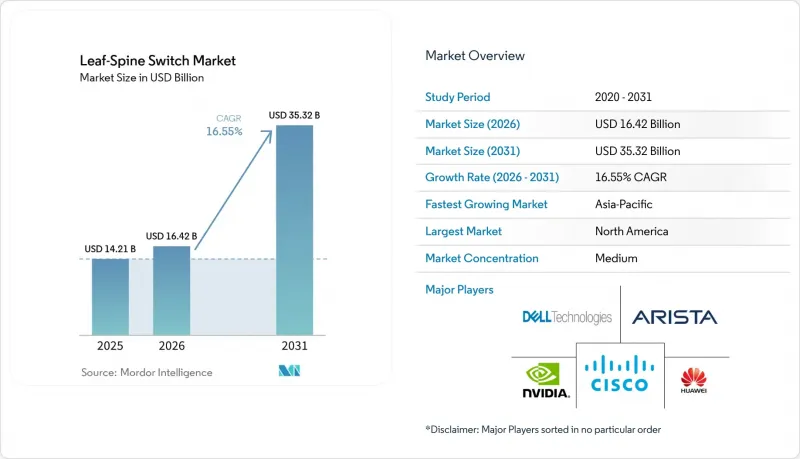
本報告按交換器角色(葉交換器和脊交換機)、產品類型(固定配置交換器和模組化交換器)、連接埠速度(最高 25 GbE、25 GbE 至 100 GbE 以及其他)、資料中心類型(託管資料中心以及其他)、最終用戶產業(雲端服務供應商、通訊業者以及其他)和電信地區營運商進行細分。市場預測以美元 (USD) 為單位。
全球葉脊式開關市場趨勢及洞察
使用超大規模資料中心業者為人工智慧叢集部署 400G 和 800G 網路架構
如果沒有高容量、低延遲的東西頻寬,人工智慧叢集就無法擴展,因此超大規模資料中心業者的投資正在影響葉脊式交換器市場的發展速度。通訊業者現在部署400G和800G等級的網路架構,不再視為特殊邊緣案例,而是作為標準設計方案。 2026年4月,Google發布了Virgo,這是一個扁平化的雙層網路,連接了13.4萬個TPU晶片,其節點間頻寬高達47PB/s。這顯示大規模人工智慧網路架構正在更深入地滲透到專用加速器環境。 2026年5月,Arista宣布其800G乙太網路客戶累積數量已超過100家,並將其2026年人工智慧網路收入目標提高至35億美元。這證實了商業需求已經超越了最初的幾個部署案例。這也正在改變葉脊式交換器市場的產品邊界。這是因為高基數800G系統不僅擴大被用作人工智慧的後端聚合層,而且還被用作傳統的東-西向骨幹網路。這種轉變提高了每個底盤的收入密度,使那些能夠在不增加運維複雜性的前提下提供高密度平台的供應商獲得了優勢。
東西向通訊流量增加和資料中心架構現代化
目前,東西向流量在虛擬化和以人工智慧為導向的資料中心環境中佔據主導地位,這使得葉脊式交換器市場與網路架構現代化之間的聯繫遠比簡單的連接埠更換更為緊密。從三層交換架構到兩層葉脊式架構的轉變,降低了延遲,簡化了路由,並支援人工智慧訓練環境所需的 1:1 無阻塞比。成本優勢也十分顯著。 400G 的每位元成本遠低於 100G,因此對於需要頻寬但又不想完全遷移到 800G 的營運商而言,400G 是首選。轉向超額訂閱模式的轉變同樣重要。許多傳統的企業級設計運作3:1 的無阻塞比,但 GPU叢集需要無阻塞運行,因此在相同的運算資源佔用下,需要更大的交換容量。因此,葉脊式交換器市場不僅受益於人工智慧的普及應用,也受益於現有設備的升級,即以更扁平化的網路架構取代傳統的分層架構。由此帶來的商業機會十分廣闊。這是因為現代化使得通訊業者很難推遲升級,因為它現在可以同時實現性能、能源效率和營運目標。
資本投資以及向 400G 和 800G 過渡的複雜性
由於向 400G 和 800G 過渡不僅僅需要購買交換機,葉脊式交換機市場面臨著切實的投資障礙。光纖相容性問題、連接器不匹配以及主幹線路重建等問題都可能顯著增加運作中設施中數千條鏈路的專案成本。電力也是一個阻礙因素。 800G 系統消耗 800-1000 瓦的功率,這使得在並非為高密度 AI 叢集設計的舊站點部署變得困難。因此,許多通訊業者要求其網路、佈線和設施團隊按順序回應,即使採購意願強烈,也會導致延誤。這造成了葉脊式交換器市場的兩極化。擁有專屬工程團隊的超大規模資料中心業者可以快速行動,而企業級和中型通訊業者通常會將升級週期延長至多個預算週期。因此,需求本身並不疲軟,而是時間節點不穩定。這解釋了儘管中期部署前景依然強勁,但訂單趨勢卻不均衡的原因。
細分市場分析
預計到2025年,葉交換機將佔總銷售額的66.14%,在葉脊交換器市場佔最大佔有率。這是因為所有GPU節點和大多數伺服器終端機仍然終止於機架頂部層。這種部署結構依然穩健,因為叢集節點數量的成長速度超過了單一叢集數量的成長速度,即使設計效率不斷提高,葉層的規模也能保持穩定。此外,在大規模人工智慧和雲端建置中,機架級模式會在機房和園區內大規模複製,因此機架頂部葉交換機的部署在可複製性方面也具有優勢。在葉脊交換機產業,這意味著即使價值轉向更密集的聚合系統,固定葉交換器平台仍將繼續保持廣泛的部署基礎。在機架級建置較不合理的企業環境中,尤其是在營運商僅對其部分傳統運算空間進行現代化改造時,行尾葉交換器系統仍會被使用。
預計到2031年,脊交換器將以18.45%的複合年成長率成長,成為葉脊交換器市場中需求成長最快的角色。這並非僅僅因為交換機的數量眾多;而是因為單一底盤即可聚合大量800G上行鏈路,從而導致其平均售價(ASP)遠高於固定脊交換機,進而集中了收入。 Arista推出了7800R4,這是一個模組化脊交換機系列,每個系統最多可配備576個800G端口,這表明該架構的重心正在向更少、大規模、聚合的系統轉移。脊交換機的成長勢頭似乎比其數量所顯示的更為強勁,因為橫向擴展的AI流量更有利於那些能夠提供具有可預測擁塞行為和簡易管理功能的高基數平台的供應商。因此,雖然角色平衡沒有逆轉,但葉脊交換器市場的收入分配正在轉移到位於人工智慧訓練架構核心的高階脊系統。
預計到2025年,固定配置交換器將佔總銷售量的72.43%,這反映出葉脊式交換器市場在很大程度上仍依賴新建資料中心中葉節點的總數。這項計算很簡單,因為即使脊層可以用數量少得多的底盤系統來承載,但大規模叢集可能需要數千個固定葉節點。 1U和2U交換器之所以仍然重要,是因為通訊業者正在標準化機架頂部(ToR)部署,其核心是符合可重複機架設計的高密度固定平台。到2026年,64x800G和32x1.6T的固定配置將開始出現在生產環境中,這表明固定外形尺寸並非過時的層,而是不斷發展演進的基礎,將扮演人工智慧葉節點的角色。這確保了儘管高階支出轉向其他領域,固定系統仍將保持葉脊式交換機市場銷售的核心地位。
預計到2031年,模組化交換器將以18.12%的複合年成長率成長,成為葉脊式交換器市場中成長最快的產品類型。這一成長與超大規模人工智慧叢集密切相關,後者需要更高的密度和更大的脊線更新周期,而固定系統無法有效應對。 Arista表示,其7800R4系列相比上一代7800R3系列降低了65%的功耗,這表明模組化系統的廠商競爭已不再局限於端口數量,而是擴展到能源效率和運營成本。緩衝區設計和擁塞控制也成為明顯的差異化因素,因為混合速度的人工智慧架構需要能夠吸收突發流量且無需負責人採取複雜變通方案的系統。能夠將模組化脊線產品與固定葉系統整合到單一管理平面中的廠商正在獲得優勢,因為買家希望最大限度地減少多年更新計劃中的營運空檔期。因此,即使固定佈局平台在總部署量方面繼續佔據主導地位,模組化系統的成長對於葉脊式交換器市場而言也具有重要的戰略意義。
區域分析
到2025年,北美將佔總銷售額的41.43%,成為貢獻最大的地區,也是葉脊式交換器市場佔有率最穩固的基礎。該地區受益於超大規模人工智慧訓練基礎設施的高度集中、最深厚的廠商關係以及高階資料中心交換器最強大的部署基礎。美國仍然是需求的核心,因為大規模採購項目、平台檢驗和人工智慧叢集的推出都集中在美國。思科、Arista、NVIDIA和白盒供應商也主要在該地區爭奪超大規模和企業級網路架構預算。這種集中度確保了北美在葉脊式交換機市場中保持中心地位,即使成長開始向其他地區擴展。
預計到2031年,亞太地區將以17.52%的複合年成長率成長,成為葉脊式交換器市場成長最快的地區。這一成長主要得益於大規模的資料中心建設計畫、政府主導的運算專案以及超大規模資料中心、託管服務和企業級開放網路的日益普及。馬來西亞、印度、日本、韓國、泰國和其他中心區域都在同步吸引投資,降低了對特定國家建設週期的依賴。此外,日本正在向開放網路轉型,EXEO集團已於2026年完成了基於SONiC的葉脊式架構的生產部署,該架構由BE Networks的Verity平台管理。這徵兆,軟體驅動的解耦方法正在該地區的企業級市場中獲得認可。
儘管歐洲的市場佔有率小於北美,但由於資料主權和受監管工作負載相關法規的驅動,歐洲對本土架構的需求日益成長,因此在葉脊式交換機市場中佔據著重要的結構性地位。 Equinix 計劃於 2026 年擴展其「Fabric Geo Zones」區域,並在瑞士和英國等市場率先推出預覽版。這顯示在多租戶互聯環境中,交換與合規之間的聯繫日益緊密。南美洲仍處於發展初期,巴西是其主要市場。同時,中東和非洲的發展速度更快,沙烏地阿拉伯和阿拉伯聯合大公國的主權雲端計畫正在將政策義務轉化為實際的網路建設。因此,葉脊式交換器市場的地理需求基礎正在擴大,目前多個商業性和政策主導的專案正在多個地區同步推進。
其他好處:
- Excel格式的市場預測(ME)表
- 3個月的分析師支持
目錄
第1章:引言
- 研究假設和市場定義
- 調查範圍
第2章:調查方法
第3章執行摘要
第4章 市場狀況
- 市場概覽
- 市場促進因素
- 在超大規模資料中心業者人工智慧叢集部署 400G 和 800G 網路架構
- 東西向通訊流量增加和資料中心架構現代化
- 擴展託管和對租戶友好的 EVPN-VXLAN 架構
- 用於 51.2T 開關的矽材料能夠實現更扁平的葉脊拓撲結構。
- 在人工智慧橫向擴展網路中,乙太網路可作為 InfiniBand 的替代方案
- 主權雲區域的增加正在加速區域基礎設施的建設。
- 市場限制因素
- 升級到 400G 和 800G 系統所需的資本投入和過渡的複雜性。
- EVPN-VXLAN 和 RoCE 營運人員短缺
- 高密度人工智慧艙的電源和散熱管理負擔
- 通用矽和光學元件的供應集中
- 產業價值鏈分析
- 監理情勢
- 技術展望
- 波特五力模型
第5章 市場規模與成長預測
- 切換功能
- 葉片開關
- 機架頂部葉片開關
- 低葉開關結束
- 脊椎開關
- 固定脊椎開關
- 底盤型脊椎開關
- 葉片開關
- 依產品類型
- 固定配置
- 1U
- 2U 或以上
- 模組化開關
- 4至8個插槽
- 10 個或更多插槽
- 固定配置
- 連接埠速度
- 最高可達 25 GbE
- 25 GbE~100 GbE
- 100 GbE~400 GbE
- 800 GbE 或更高
- 依資料中心類型
- 託管資料中心
- 超大規模/雲端服務供應商的資料中心
- 企業資料中心
- 邊緣資料中心
- 按最終用戶行業分類
- 雲端服務供應商
- 通訊業者
- 大公司
- 政府/公共部門
- 其他終端用戶產業
- 按地區
- 北美洲
- 美國
- 加拿大
- 墨西哥
- 南美洲
- 巴西
- 阿根廷
- 智利
- 哥倫比亞
- 歐洲
- 德國
- 英國
- 法國
- 荷蘭
- 愛爾蘭
- 義大利
- 西班牙
- 其他歐洲國家
- 亞太地區
- 中國
- 日本
- 印度
- 韓國
- 新加坡
- 澳洲
- 紐西蘭
- 其他亞太國家
- 中東和非洲
- 中東
- 沙烏地阿拉伯
- 阿拉伯聯合大公國
- 土耳其
- 其他中東國家
- 非洲
- 南非
- 奈及利亞
- 其他非洲國家
- 中東
- 北美洲
第6章 競爭情勢
- 市場集中度
- 策略趨勢
- 市佔率分析
- 公司簡介
- Cisco Systems, Inc.
- Arista Networks, Inc.
- NVIDIA Corporation
- Huawei Technologies Co., Ltd.
- Dell Technologies Inc.
- Juniper Networks, Inc.
- Hewlett Packard Enterprise Aruba Networking
- H3C Technologies Co., Limited
- ZTE Corporation
- Lenovo Group Limited
- Edgecore Networks Corporation
- Accton Technology Corporation
- Celestica Inc.
- Ruijie Networks Co., Ltd.
- Nokia Corporation
- Extreme Networks, Inc.
- Quanta Cloud Technology(QCT)
- UfiSpace Technology Inc.
- Super Micro Computer, Inc.(Supermicro)
- Netberg Ltd.
- Delta Electronics, Inc.
- Asterfusion Data Technology Co., Ltd.
第7章 市場機會與未來展望
According to Mordor Intelligence, the leaf-spine switch market size is expected to increase from USD 14.21 billion in 2025 to USD 16.42 billion in 2026 and reach USD 35.32 billion by 2031, growing at a CAGR of 16.55% over 2026-2031.
This report is Segmented by Switch Role (Leaf Switches, and Spine Switches), Product Type (Fixed Configuration, and Modular Switches), Port Speed (Up To 25 GbE, More Than 25 To 100 GbE, and More), Data Center Type (Colocation Data Centers, and More), End User Industry (Cloud Service Providers, Telecommunication Providers, and More), and Geography. The Market Forecasts are Provided in Terms of Value (USD).
Global Leaf-Spine Switch Market Trends and Insights
Hyperscaler AI Cluster 400G And 800G Fabric Rollouts
Hyperscaler spending is setting the pace for the leaf-spine switch market because AI clusters cannot scale without large volumes of low-latency east-west bandwidth. Operators are now buying fabrics around 400G and 800G as standard design points instead of treating them as premium edge cases. Google disclosed Virgo in April 2026 as a flat, two-layer network linking 134,000 TPU chips with 47 petabits per second of bisectional bandwidth, which shows how large AI fabrics are moving deeper into purpose-built accelerator environments. Arista stated in May 2026 that it had surpassed 100 cumulative 800G Ethernet customers and raised its 2026 AI networking revenue target to USD 3.5 billion, which confirms that commercial demand is already broadening beyond a handful of early deployments. This is also changing product boundaries inside the leaf-spine switch market, because high-radix 800G systems are increasingly serving as both AI back-end aggregation layers and conventional east-west spines. That shift raises revenue density per chassis and favors vendors that can supply dense platforms without adding operational complexity.
East-West Traffic Growth And Data Center Fabric Modernization
East-west traffic now dominates virtualized and AI-oriented data center environments, which keeps the leaf-spine switch market tied to fabric modernization rather than to simple port replacement. The architectural move from three-tier switching to two-tier leaf-spine design reduces latency, simplifies pathing, and supports the 1:1 non-blocking ratios that AI training environments require. The cost logic also matters because 400G delivers materially lower cost-per-bit than 100G, which makes it the default step for operators that need bandwidth growth without taking on a full 800G migration. The oversubscription change is equally important because many legacy enterprise designs ran at 3:1, while GPU clusters demand non-blocking behavior and therefore need far more active switching capacity for the same compute footprint. As a result, the leaf-spine switch market is gaining from both greenfield AI deployments and brownfield refresh programs that replace hierarchical designs with flatter fabric architectures. The underlying opportunity is wide because modernization now serves performance, power, and operational goals at the same time, which is why the upgrade case is harder for operators to delay.
400G And 800G Refresh Capex And Migration Complexity
The leaf-spine switch market faces a real spending barrier because 400G and 800G transitions require more than a switch purchase. Fiber compatibility problems, connector mismatches, and trunk rework can add large project costs across thousands of links in active facilities. Power is another constraint because 800G systems can draw 800 to 1,000 watts, which makes it harder for older sites that were not designed for dense AI pods. Many operators, therefore, need network, cabling, and facility teams to move in sequence, which slows deployment even when procurement intent is strong. This creates a split in the leaf-spine switch market, where hyperscalers with dedicated engineering teams can move quickly, while enterprise and mid-market operators often stretch refresh cycles across multiple budget periods. The result is uneven demand timing, not weak demand, which is why order flow can look lumpy even when the medium-term adoption case remains intact.
Other drivers and restraints analyzed in the detailed report include:
- 51.2T Switch Silicon Enabling Flatter Leaf-Spine Topologies
- Colocation Expansion And Tenant-Ready EVPN-VXLAN Fabrics
- EVPN-VXLAN And RoCE Operations Talent Shortages
For complete list of drivers and restraints, kindly check the Table Of Contents.
Segment Analysis
Leaf switches held 66.14% of 2025 revenue, which gave them the largest position in the leaf-spine switch market share because every GPU node and most server endpoints still terminate at the top-of-rack layer. That installed logic remains strong because cluster node counts are rising faster than the number of distinct clusters, which keeps the leaf layer broad even as designs become more efficient. The top-of-rack leaf position also benefits from repeatability, since large AI and cloud builds replicate rack-level patterns at scale across halls and campuses. In the leaf-spine switch industry, that means fixed leaf platforms retain a wide deployment base even when value is shifting upward into denser aggregation systems. End-of-row leaf systems still serve enterprise environments where a rack-by-rack build is harder to justify, especially when operators are modernizing only a portion of legacy compute space.
Spine switches are projected to grow at an 18.45% CAGR through 2031, which makes them the fastest-growing role in the leaf-spine switch market size profile for role-based demand. The reason is not switch count alone, it is the revenue concentration created when one chassis aggregates a large number of 800G uplinks and carries a much higher average selling price than a fixed spine unit. Arista launched its 7800R4 modular spine family with up to 576x800G ports per system, which illustrates how the architectural center of gravity is moving toward fewer, larger aggregation systems. This is why spine growth looks stronger than its unit footprint suggests, because scale-out AI traffic rewards vendors that can deliver high-radix platforms with predictable congestion behavior and simpler management. The role balance is therefore not reversing, but it is re-weighting revenue inside the leaf-spine switch market toward premium spine systems that sit at the center of AI training fabrics.
Fixed configuration switches accounted for 72.43% of 2025 revenue, which reflects how much of the leaf-spine switch market still depends on the sheer number of leaf positions across new data center builds. That arithmetic is direct because a very large cluster can require thousands of fixed leaf units even when the spine layer can be handled by a much smaller number of chassis systems. The 1U and 2U categories remain important because operators continue to standardize top-of-rack deployment around dense fixed platforms that fit repeatable rack designs. In 2026, fixed configurations with 64x800G and 32x1.6T are entering production environments, which shows that fixed form factors are not a legacy layer, but a still-evolving foundation for AI leaf roles. This keeps fixed systems at the volume center of the leaf-spine switch market even as premium spending migrates elsewhere.
Modular switches are forecast to grow at a 18.12% CAGR through 2031, which gives them the fastest momentum among product types in the leaf-spine switch market. That growth is tied to hyperscale AI clusters where spine refresh cycles require densities and scale characteristics that fixed systems cannot match efficiently. Arista stated that its 7800R4 family delivers 65% lower power consumption than the prior 7800R3 series, which shows how vendor competition in modular systems is expanding beyond port count into energy efficiency and operating cost. Buffer design and congestion control are also becoming clearer differentiators because mixed-speed AI fabrics need systems that can absorb bursty traffic without forcing operators into complex workarounds. Vendors that can pair modular spine products with fixed leaf systems inside one management plane are gaining an advantage, since buyers want fewer operational seams across multi-year refresh programs. That makes modular growth strategically important to the leaf-spine switch market even if fixed platforms continue to dominate total deployment count.
Complete Report Scope:
- By Switch Role
- Leaf Switches
- Top-of-Rack Leaf Switches
- End-of-Row Leaf Switches
- Spine Switches
- Fixed Spine Switches
- Chassis-based Spine Switches
- Leaf Switches
- By Product Type
- Fixed Configuration
- 1U
- 2U and Above
- Modular Switches
- 4-slot to 8-slot
- 10-slot and Above
- Fixed Configuration
- By Port Speed
- Up to 25 GbE
- More than 25 to 100 GbE
- More than 100 to 400 GbE
- 800 GbE and Above
- By Data Center Type
- Colocation Data Centers
- Hyperscale / Cloud Service Provider Data Centers
- Enterprise Data Centers
- Edge Data Centers
- By End User Industry
- Cloud Service Providers
- Telecommunication Providers
- Large Enterprises
- Government and Public Sector
- Other end user Industries
- By Geography
- North America
- United States
- Canada
- Mexico
- South America
- Brazil
- Argentina
- Chile
- Colombia
- Europe
- Germany
- United Kingdom
- France
- Netherlands
- Ireland
- Italy
- Spain
- Rest of Europe
- Asia-Pacific
- China
- Japan
- India
- South Korea
- Singapore
- Australia
- New Zealand
- Rest of Asia-Pacific
- Middle East and Africa
- Middle East
- Saudi Arabia
- United Arab Emirates
- Turkey
- Rest of Middle East
- Africa
- South Africa
- Nigeria
- Rest of Africa
- Middle East
- North America
Geography Analysis
North America held 41.43% of 2025 revenue, which made it the largest regional contributor and the clearest anchor of the leaf-spine switch market share by geography. The region benefits from the heaviest concentration of hyperscale AI training infrastructure, the deepest set of vendor relationships, and the strongest installed base for high-end data center switching. The United States remains the core of that demand because most large procurement programs, platform validations, and AI cluster launches are centered there. It is also the region where Cisco, Arista, NVIDIA, and white-box suppliers compete most directly for hyperscale and enterprise fabric budgets. This concentration keeps North America central to the leaf-spine switch market even as growth begins to broaden geographically.
Asia-Pacific is projected to grow at an 17.52% CAGR through 2031, which gives it the fastest regional growth path in the leaf-spine switch market. The region is being supported by a wide data center build pipeline, sovereign compute programs, and a rising mix of hyperscale, colocation, and enterprise open networking deployments. Malaysia, India, Japan, South Korea, Thailand, and other hubs are attracting parallel investment, which reduces reliance on any single national build cycle. Japan also showed movement toward open networking in 2026 when EXEO Group completed a production deployment of a SONiC-based leaf-spine fabric managed by BE Networks' Verity platform, a sign that software-disaggregated approaches are gaining credibility in the regional enterprise segment.
Europe is growing from a smaller base than North America, but the region is structurally important to the leaf-spine switch market because data sovereignty and regulated workload rules are creating demand for in-country fabrics. Equinix expanded Fabric Geo Zones in 2026 with preview availability in markets including Switzerland and the United Kingdom, which shows how switching and compliance are becoming more closely linked in multi-tenant interconnection environments. South America remains earlier in development, with Brazil as the key market, while the Middle East and Africa are moving faster because sovereign cloud programs in Saudi Arabia and the UAE are turning policy mandates into physical network build-outs. The result is a broader geographic demand base for the leaf-spine switch market, with commercial and policy-driven projects now advancing at the same time across several regions.
- Cisco Systems, Inc.
- Arista Networks, Inc.
- NVIDIA Corporation
- Huawei Technologies Co., Ltd.
- Dell Technologies Inc.
- Juniper Networks, Inc.
- Hewlett Packard Enterprise Aruba Networking
- H3C Technologies Co., Limited
- ZTE Corporation
- Lenovo Group Limited
- Edgecore Networks Corporation
- Accton Technology Corporation
- Celestica Inc.
- Ruijie Networks Co., Ltd.
- Nokia Corporation
- Extreme Networks, Inc.
- Quanta Cloud Technology (QCT)
- UfiSpace Technology Inc.
- Super Micro Computer, Inc. (Supermicro)
- Netberg Ltd.
- Delta Electronics, Inc.
- Asterfusion Data Technology Co., Ltd.
Additional Benefits:
- The market estimate (ME) sheet in Excel format
- 3 months of analyst support
TABLE OF CONTENTS
1 INTRODUCTION
- 1.1 Study Assumptions and Market Definition
- 1.2 Scope of the Study
2 RESEARCH METHODOLOGY
3 EXECUTIVE SUMMARY
4 MARKET LANDSCAPE
- 4.1 Market Overview
- 4.2 Market Drivers
- 4.2.1 Hyperscaler AI Cluster 400G and 800G Fabric Rollouts
- 4.2.2 East-west Traffic Growth and Data Center Fabric Modernization
- 4.2.3 Colocation Expansion and Tenant-ready EVPN-VXLAN Fabrics
- 4.2.4 51.2T Switch Silicon Enabling Flatter Leaf-spine Topologies
- 4.2.5 Ethernet Replacing InfiniBand in AI Scale-out Networks
- 4.2.6 Sovereign Cloud Zones Multiplying Local Fabric Builds
- 4.3 Market Restraints
- 4.3.1 400G and 800G Refresh Capex and Migration Complexity
- 4.3.2 EVPN-VXLAN and RoCE Operations Talent Shortages
- 4.3.3 Power and Thermal Retrofit Burden in Dense AI Pods
- 4.3.4 Merchant Silicon and Optics Supply Concentration
- 4.4 Industry Value Chain Analysis
- 4.5 Regulatory Landscape
- 4.6 Technological Outlook
- 4.7 Porter's Five Forces
- 4.7.1 Bargaining Power of Suppliers
- 4.7.2 Bargaining Power of Buyers
- 4.7.3 Threat of New Entrants
- 4.7.4 Threat of Substitutes
- 4.7.5 Industry Rivalry
5 MARKET SIZE AND GROWTH FORECASTS (VALUE)
- 5.1 By Switch Role
- 5.1.1 Leaf Switches
- 5.1.1.1 Top-of-Rack Leaf Switches
- 5.1.1.2 End-of-Row Leaf Switches
- 5.1.2 Spine Switches
- 5.1.2.1 Fixed Spine Switches
- 5.1.2.2 Chassis-based Spine Switches
- 5.1.1 Leaf Switches
- 5.2 By Product Type
- 5.2.1 Fixed Configuration
- 5.2.1.1 1U
- 5.2.1.2 2U and Above
- 5.2.2 Modular Switches
- 5.2.2.1 4-slot to 8-slot
- 5.2.2.2 10-slot and Above
- 5.2.1 Fixed Configuration
- 5.3 By Port Speed
- 5.3.1 Up to 25 GbE
- 5.3.2 More than 25 to 100 GbE
- 5.3.3 More than 100 to 400 GbE
- 5.3.4 800 GbE and Above
- 5.4 By Data Center Type
- 5.4.1 Colocation Data Centers
- 5.4.2 Hyperscale / Cloud Service Provider Data Centers
- 5.4.3 Enterprise Data Centers
- 5.4.4 Edge Data Centers
- 5.5 By End User Industry
- 5.5.1 Cloud Service Providers
- 5.5.2 Telecommunication Providers
- 5.5.3 Large Enterprises
- 5.5.4 Government and Public Sector
- 5.5.5 Other end user Industries
- 5.6 By Geography
- 5.6.1 North America
- 5.6.1.1 United States
- 5.6.1.2 Canada
- 5.6.1.3 Mexico
- 5.6.2 South America
- 5.6.2.1 Brazil
- 5.6.2.2 Argentina
- 5.6.2.3 Chile
- 5.6.2.4 Colombia
- 5.6.3 Europe
- 5.6.3.1 Germany
- 5.6.3.2 United Kingdom
- 5.6.3.3 France
- 5.6.3.4 Netherlands
- 5.6.3.5 Ireland
- 5.6.3.6 Italy
- 5.6.3.7 Spain
- 5.6.3.8 Rest of Europe
- 5.6.4 Asia-Pacific
- 5.6.4.1 China
- 5.6.4.2 Japan
- 5.6.4.3 India
- 5.6.4.4 South Korea
- 5.6.4.5 Singapore
- 5.6.4.6 Australia
- 5.6.4.7 New Zealand
- 5.6.4.8 Rest of Asia-Pacific
- 5.6.5 Middle East and Africa
- 5.6.5.1 Middle East
- 5.6.5.1.1 Saudi Arabia
- 5.6.5.1.2 United Arab Emirates
- 5.6.5.1.3 Turkey
- 5.6.5.1.4 Rest of Middle East
- 5.6.5.2 Africa
- 5.6.5.2.1 South Africa
- 5.6.5.2.2 Nigeria
- 5.6.5.2.3 Rest of Africa
- 5.6.5.1 Middle East
- 5.6.1 North America
6 COMPETITIVE LANDSCAPE
- 6.1 Market Concentration
- 6.2 Strategic Moves
- 6.3 Market Share Analysis
- 6.4 Company Profiles (includes Global level Overview, Market level overview, Core Segments, Financials as available, Strategic Information, Market Rank/Share for key companies, Products and Services, and Recent Developments)
- 6.4.1 Cisco Systems, Inc.
- 6.4.2 Arista Networks, Inc.
- 6.4.3 NVIDIA Corporation
- 6.4.4 Huawei Technologies Co., Ltd.
- 6.4.5 Dell Technologies Inc.
- 6.4.6 Juniper Networks, Inc.
- 6.4.7 Hewlett Packard Enterprise Aruba Networking
- 6.4.8 H3C Technologies Co., Limited
- 6.4.9 ZTE Corporation
- 6.4.10 Lenovo Group Limited
- 6.4.11 Edgecore Networks Corporation
- 6.4.12 Accton Technology Corporation
- 6.4.13 Celestica Inc.
- 6.4.14 Ruijie Networks Co., Ltd.
- 6.4.15 Nokia Corporation
- 6.4.16 Extreme Networks, Inc.
- 6.4.17 Quanta Cloud Technology (QCT)
- 6.4.18 UfiSpace Technology Inc.
- 6.4.19 Super Micro Computer, Inc. (Supermicro)
- 6.4.20 Netberg Ltd.
- 6.4.21 Delta Electronics, Inc.
- 6.4.22 Asterfusion Data Technology Co., Ltd.
7 MARKET OPPORTUNITIES AND FUTURE OUTLOOK
- 7.1 White-Space and Unmet-Need Assessment

 DIN導軌安裝開關:市場佔有率分析、產業趨勢與統計、成長預測(2026-2031年)乙太網路切換器:市場佔有率分析、產業趨勢與統計、成長預測(2026-2031)接取層交換:市場佔有率分析、產業趨勢與統計、成長預測(2026-2031)支援SDN的交換器:市場佔有率分析、行業趨勢和統計數據以及成長預測(2026-2031年)乙太網路供電 (PoE)++ 交換器:市場佔有率分析、行業趨勢和統計數據以及成長預測 (2026-2031)
 乙太網路切換器市場 - 全球產業規模、佔有率、趨勢、機會、預測:按類型、配置、速度、地區和競爭格局分類,2021-2031年乙太網路供電 (PoE) 交換器:市場佔有率分析、行業趨勢和統計數據以及成長預測 (2026-2031)工業乙太網網路交換器:市場佔有率分析、產業趨勢與統計、成長預測(2026-2031)管理型交換器:市場佔有率分析、產業趨勢與統計、成長預測(2026-2031 年)非網管型交換器:市場佔有率分析、產業趨勢與統計、成長預測(2026-2031 年)