


 |
市場調查報告書
商品編碼
2061786
義大利 NOR Flash:市場佔有率分析、產業趨勢與統計資料、成長預測(2026-2031 年)Italy NOR Flash - Market Share Analysis, Industry Trends & Statistics, Growth Forecasts (2026 - 2031) |
||||||

※ 本網頁內容可能與最新版本有所差異。詳細情況請與我們聯繫。
根據 Mordor Intelligence 預測,義大利 NOR 閃光底片市場規模將從 2025 年的 7,209 萬美元成長到 2026 年的 7,541 萬美元,到 2031 年達到 9,442 萬美元,2026 年至 2031 年的複合年成長率預計為 4.60%預計為 4.60%。
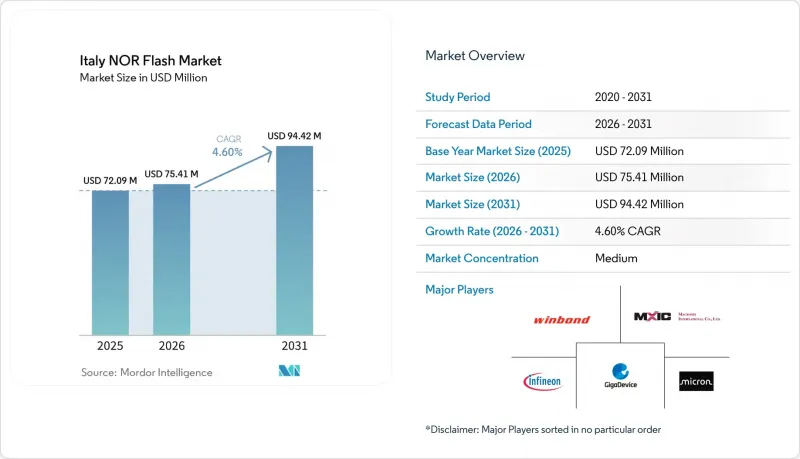
本報告按類型(串行 NOR 快閃記憶體、並行 NOR 快閃記憶體)、介面(SPI 單/雙介面等)、容量(小於 2 兆位元等)、電壓(3V 等級等)、最終用戶應用(通訊、其他)、製程節點(90nm 及更早、其他)、封裝類型(WLCSP/CSP、其他細分)和地區(義大利)進行細分(義大利)進行細分。市場預測以價值(美元)和數量(單位)為單位。
義大利NOR快閃記憶體市場的趨勢與洞察
義大利汽車OEM廠商ADAS與自動駕駛平台的擴展
Stellantis於2026年加入AI4I聯盟,鞏固了其在下一代區域控制器中整合NOR快閃記憶體的合作開發路徑。該聯盟已於2025年底前展示了3級功能,並已撥款100億美元用於2030年前的半導體採購,其中包括用於確定性啟動的256兆位元或更大容量的裝置。法拉利和蘭博基尼也遵循類似的藍圖,整合需要安全、即時啟動儲存的預測性維護堆疊。並行NOR快閃記憶體憑藉其滿足ISO 26262 ASIL-D最壞情況執行目標的固定延遲讀取路徑,正日益受到關注。過渡到200MHz 8位元匯流排將實現400MB/s的吞吐量,將OTA(空中下載)更新的停機時間從數小時縮短至數分鐘,從而提高經銷商業務收益。
義大利電力公司正在擴大智慧型能源電錶的使用範圍。
Enel 的「Open Meter II」計畫由歐洲投資銀行提供的 5 億歐元(5.4 億美元)貸款資助,目標是覆蓋 4,100 萬個終端,並在每個電錶內部整合汽車級串行 NOR 記憶體。 A2A 在米蘭和布雷西亞部署的 130 萬台設備也採用了類似的架構。第二代電錶的工作溫度範圍為 -25 度C至 +70 度C,需要 10 萬次編程擦除循環和 20 年的資料保存,並符合 AEC-Q100 1 級快閃記憶體規格。由於監管機構 ARERA 正在推動剩餘電錶在 2027 年前完成部署,因此市場需求主要集中在Lombardia、Lazio和Emilia-Romagna大區。能夠認證寬溫域、低腳數元件的供應商將獲得持續的競爭優勢。
高額的前端晶圓製造成本和有限的國內晶圓產能
義大利依賴亞洲晶圓代工廠,但其分配規則往往更有利於訂單量大的顧客。歐洲晶圓廠的成本劣勢高達20-30%,且歐盟的NanoIC試點生產線專注於5奈米製程節點,而非NOR快閃記憶體。英特爾取消馬格德堡巨型晶圓廠計畫進一步凸顯了該地區的脆弱性。同時,義法半導體投資50億歐元(約54億美元)建設的碳化矽(SiC)園區專注於功率元件而非記憶體。因此,義大利本土系統整合商面臨更長的前置作業時間和更高的採購成本,削弱了其在出口導向機械行業的競爭力。
細分市場分析
截至2025年,並行NOR閃存在義大利NOR快閃記憶體市場中所佔佔有率雖小,但其7.40%的複合年成長率反映了市場對高級駕駛輔助系統(ADAS)日益成長的需求。汽車網域控制器無法容忍超過100毫秒的啟動延遲,因此確定性讀取效能比減少引腳數量更為重要。英飛凌和華邦電子均已推出符合AEC-Q100 1級標準的平行裝置,可在150 度C的結溫下維持瞬時導通。串行NOR快閃記憶體對於緊湊型車載資訊系統和穿戴式裝置仍然至關重要,但隨著安全關鍵型模組轉向更寬的總線,其市場成長速度正在放緩。
並行 NOR 記憶體也受益於韌體原地韌體,透過省去安全島中的外部 DRAM,從而降低了成本。由於 Stellantis 將 30 多個控制單元整合到分區架構中,每個節點都需要一個雙冗餘並行 NOR 記憶體組來儲存 A/B韌體映像。同時,串行 NOR 記憶體的 SKU 多樣性預計將涵蓋工業感測器和智慧電錶等對低引腳成本和簡化 PCB 佈線要求較高的應用領域,確保其至少佔總出貨量的一半。
目前,四路SPI介面在義大利NOR快閃記憶體市場佔據最大佔有率,但隨著八路和xSPI介面以9.60%的複合年成長率成長,其40.90%的市佔率預計將會下降。行動電話資料通訊流量費用。根據Stellantis的基準測試,在xSPI快閃記憶體上下載2GB韌體包只需不到6分鐘,而在四路SPI快閃記憶體上則需要30分鐘。
標準 SPI 和雙路 SPI 仍然廣泛應用於每年進行代碼修訂的機上盒和工業控制器中。然而,隨著 UN R155 強制要求採用安全更新管線,xSPI 協定的 8 位元 DDR 訊號及其用於認證的邊帶引腳正成為一項極具吸引力的特性。瑞薩電子等微控制器廠商目前正在推出參考設計,將汽車級 MCU 與預裝安全引導程式的板載八進位快閃記憶體結合,從而促進一級供應商的採用。
根據義大利NOR快閃記憶體市場規模數據,32兆位元及以下容量的裝置佔據了大部分出貨量,尤其是在智慧電錶和工業閘道領域。然而,隨著ADAS(先進駕駛輔助系統)協定堆疊的擴展,256兆位元級快閃記憶體市場正以每年7.20%的速度成長。英飛凌的Semper系列快閃記憶體晶片可實現25年的資料保存期或100萬次的晶片級讀寫壽命,從而降低了長期現場使用中的風險。一級供應商目前正為資訊娛樂系統和安全島應用提供雙通路的256兆位元xSPI閃存,從而減輕了認證負擔。
隨著資料傳輸速度從 512 兆位元提升至 1Gigabit,關於 NOR 和 NAND 每位元成本的爭論愈演愈烈。 NOR 技術憑藉其滿足隨機讀取穩定性、原地執行能力等嚴苛要求的能力(這些能力在 ASIL-D 環境中至關重要)的能力,依然保持著領先地位。這些特性使得 NOR 成為安全性和效能不容妥協的應用場景中的可靠選擇。義大利 OEM 廠商正積極採用雙儲存方案。透過將主啟動過程保留在 NOR 上,他們確保了確定性和可靠性的啟動。同時,他們利用 NAND 儲存大量地圖數據,充分發揮其高儲存容量的優勢。這種組合使製造商能夠有效地平衡效能、成本和儲存效率。
其他好處:
- Excel格式的市場預測(ME)表
- 3個月的分析師支持
目錄
第1章:引言
- 研究假設和市場定義
- 調查範圍
第2章:調查方法
第3章執行摘要
第4章 市場狀況
- 市場概覽
- 市場促進因素
- 義大利汽車製造商ADAS和自動駕駛平台的擴展
- 義大利電力公司正在擴大智慧型能源電錶的使用範圍。
- 義大利廣播基礎設施向DVB-T2韌體遷移
- 「工業4.0轉型」框架下的政府對工業IoT的獎勵
- 連網摩托車對安全OTA更新的需求日益成長。
- 義大利醫療設備新創公司正在推動穿戴式裝置的微型化。
- 市場限制因素
- 高額的前端晶圓製造成本和有限的國內晶圓產能
- 遵守歐盟嚴格的 REACH/RoHS 法規正在推高認證成本。
- 義大利中小企業缺乏嵌入式NOR快閃設計人才
- 歐元匯率波動正在影響記憶體元件價格。
- 產業價值與價值鏈分析
- 宏觀經濟因素對市場的影響
- 監管和技術展望
- 波特五力分析
- 價格分析
- 投資分析
第5章 市場規模與成長預測
- 按類型
- 串行 NOR 快閃記憶體
- 並行 NOR 快閃記憶體
- 透過介面
- SPI 單/雙路
- 四路 SPI
- 八進位和xSPI
- 按密度
- 2兆位元或更小的NOR閘
- 對於大於 2Mb 但小於或等於 4Mb 的負載,則採用 NOR 模式。
- 8兆位元或更小以及大於4兆位元的NOR閘
- 16兆位元或以下和8兆位元或以上的NOR閘。
- 32兆位元或更小、16兆位元以上的NOR閘。
- 64兆位元或更小、32兆位元以上的NOR閘。
- 位元深度為 128 兆位元或更低的 NOR 閘和位元深度為 64 兆位元或更高的 NOR 閘。
- 256兆位元或以下的NOR閘,以及128兆位元或以上的NOR閘。
- 超過 256 兆比特
- 透過電壓
- 3 V級
- 1.8 V級
- 寬電壓範圍:1.65V 至 3.6V
- 其他電壓等級:1.2V、2.5V、5V
- 透過最終用戶應用程式
- 家用電子產品
- 溝通
- 車
- 產業
- 其他用途
- 依製程技術節點
- 90奈米及更早
- 65 nm
- 55奈米(包括58奈米)
- 45 nm
- 28奈米或更小
- 按包裝類型
- WLCSP/CSP
- QFN/SOIC
- BGA/FBGA
- 其他包裝類型
第6章 競爭情勢
- 市場集中度
- 策略趨勢
- Vendor Positioning Analysis
- 公司簡介
- Infineon Technologies AG
- Micron Technology Inc.
- GigaDevice Semiconductor Inc.
- Macronix International Co. Ltd
- Winbond Electronics Corp.
- Integrated Silicon Solution Inc.
- Microchip Technology Inc.
- Renesas Electronics Corporation
- Elite Semiconductor Microelectronics Technology Inc.
- Wuhan XMC
- Puya Semiconductor Co. Ltd.
- STMicroelectronics NV
- ISSI Italia Srl
- SK hynix Inc.
- Powerchip Semiconductor Manufacturing Corporation
- AMIC Technology Corporation
- EON Silicon Solution Inc.
- Espressif Systems Shanghai Co. Ltd.
- Elite Memory Systems Srl
- PUFsecurity Corporation
第7章 市場機會與未來展望
According to Mordor Intelligence, the italy nOR flash market size is expected to increase from USD 72.09 million in 2025 to USD 75.41 million in 2026 and reach USD 94.42 million by 2031, growing at a CAGR of 4.60% over 2026-2031.
This report is Segmented by Type (Serial NOR Flash, Parallel NOR Flash), Interface (SPI Single/Dual, and More), Density (2 Megabit and Less, and More), Voltage (3V Class, and More), End-User Application (Communication, and More), Process Node (90nm and Older, and More), Packaging Type (WLCSP/CSP, and More), and Geography (Italy). Market Forecasts are Provided in Terms of Value (USD) and Volume (Units).
Italy NOR Flash Market Trends and Insights
Expansion of ADAS and Autonomous Platforms in Italian Automotive OEMs
Stellantis joined the AI4I consortium in 2026, locking in co-development paths that embed NOR Flash into next-generation zonal controllers. The group already demonstrated Level 3 capabilities in late 2025 and earmarked USD 10 billion in semiconductor sourcing to 2030, including 256 Megabit-plus devices for deterministic boot. Ferrari and Lamborghini follow similar roadmaps, integrating predictive maintenance stacks that also demand secure, instant-on storage. Parallel NOR Flash thus gains favor because its fixed-latency read path satisfies ISO 26262 ASIL-D worst-case execution targets. The shift to octal 200 MHz buses delivers 400 MB/s throughput, reducing OTA downtime from hours to minutes and enhancing dealer service economics.
Growing Deployment of Smart Energy Meters by Italian Utilities
Enel's Open Meter II program, backed by a EUR 500 million (USD 540 million) European Investment Bank loan, targets 41 million endpoints with automotive-grade Serial NOR inside each meter. A2A's 1.3 million-unit rollout in Milan and Brescia follows the same architecture. Second-generation meters operate from -25 °C to +70 °C and require 100,000 program-erase cycles plus 20-year retention, specifications aligned with AEC-Q100 Grade 1 Flash. As the regulator ARERA pushes the remaining meters toward a 2027 deadline, demand concentrates in Lombardy, Lazio, and Emilia-Romagna. Suppliers able to certify wide-temperature, low-pin-count devices gain a durable advantage.
High Front-End Fab Costs Versus Limited Domestic Wafer Capacity
Italy depends on Asian foundries whose allocation rules favor higher-volume customers. European fabs sit at a 20-30% cost disadvantage, and the EU NanoIC pilot line remains focused on 5 nm nodes, not used for NOR Flash. The cancellation of Intel's Magdeburg megafab further underscores regional fragility, while STMicroelectronics' EUR 5 billion (USD 5.40 billion) SiC campus focuses on power devices rather than memory. Consequently, local integrators face longer lead times and higher purchasing costs, eroding competitiveness in export-oriented machinery.
Other drivers and restraints analyzed in the detailed report include:
- Government Incentives for Industrial IoT Under Transizione 4.0
- Rising Demand for Secure OTA Updates in Connected Two-Wheelers
- Stringent EU REACH and RoHS Compliance Raising Qualification Costs
For complete list of drivers and restraints, kindly check the Table Of Contents.
Segment Analysis
Parallel NOR accounted for a smaller share of the Italian NOR Flash market in 2025, yet its 7.40% CAGR underscores rising demand for advanced driver assistance systems. Automotive domain controllers cannot tolerate boot latency above 100 ms, so deterministic read performance takes precedence over pin-count savings. Infineon and Winbond both released AEC-Q100 Grade 1 Parallel devices that sustain instant-on operation at 150 °C junction temperatures. Serial NOR remains indispensable for compact telematics and wearables, but its market growth rate lags because safety-critical modules are moving to wider buses.
Parallel NOR also benefits from execute-in-place firmware execution, reducing cost by eliminating external DRAM in safety islands. As Stellantis consolidates 30-plus control units into zonal architectures, each node requires dual-redundant Parallel NOR banks for A/B firmware images. Conversely, the SKU diversity of Serial NOR ensures it will keep at least half of total unit shipments, covering industrial sensors and smart meters that value low cost per pin and streamlined PCB routing.
Quad SPI owns the largest slice of the Italian NOR Flash market share, yet its 40.90% position is set to erode as Octal and xSPI climb at 9.60% CAGR. GigaDevice's GD25NX line pushes 400 MB/s read speeds at 200 MHz, a fivefold leap over legacy Dual SPI. Italian OEMs adopt these parts to slash OTA update time and cellular data-plan costs. Stellantis benchmarks show a 2 GB firmware package downloading in under six minutes when hosted on xSPI Flash compared with 30 minutes on Quad SPI.
Standard and Dual SPI continue in set-top boxes and industrial controllers with annual code revisions. However, as UN R155 mandates secure update pipelines, the xSPI protocol's 8-bit DDR signaling plus side-band pins for authentication become persuasive features. Microcontroller vendors such as Renesas now ship reference designs pairing automotive MCUs with on-board Octal Flash pre-loaded with secure-boot loaders, smoothing adoption across Tier 1 suppliers.
Italy NOR Flash market size data show 32 Megabit-and-smaller devices dominate volume, especially in smart meters and industrial gateways. Still, the 256 Megabit bracket advances 7.20% per year as ADAS stacks swell. Infineon's Semper family offers 25-year data retention or 1 million cycle endurance on the same die, de-risking long field life. Tier 1 suppliers now dual-source 256 Megabit xSPI Flash for both infotainment and safety islands, reducing qualification overhead.
As data rates rise from 512 Megabits to 1 Gigabit, discussions intensify over the cost-per-bit between NOR and NAND. NOR technology continues to hold its ground due to its ability to meet the stringent requirements of random-read stability and execute-in-place functionalities, which are critical in ASIL-D environments. These features make NOR a reliable choice for applications where safety and performance cannot be compromised. Italian OEMs have strategically adopted a dual-storage approach, securing the primary boot process in NOR to ensure deterministic and reliable start-up. Meanwhile, they utilize NAND for storing bulk map data, capitalizing on its high-capacity storage capabilities. This combination allows manufacturers to balance performance, cost, and storage efficiency effectively.
List of Companies Covered in this Report:
- Infineon Technologies AG
- Micron Technology Inc.
- GigaDevice Semiconductor Inc.
- Macronix International Co. Ltd
- Winbond Electronics Corp.
- Integrated Silicon Solution Inc.
- Microchip Technology Inc.
- Renesas Electronics Corporation
- Elite Semiconductor Microelectronics Technology Inc.
- Wuhan XMC
- Puya Semiconductor Co. Ltd.
- STMicroelectronics N.V.
- ISSI Italia S.r.l.
- SK hynix Inc.
- Powerchip Semiconductor Manufacturing Corporation
- AMIC Technology Corporation
- EON Silicon Solution Inc.
- Espressif Systems Shanghai Co. Ltd.
- Elite Memory Systems S.r.l.
- PUFsecurity Corporation
Additional Benefits:
- The market estimate (ME) sheet in Excel format
- 3 months of analyst support
TABLE OF CONTENTS
1 INTRODUCTION
- 1.1 Study Assumptions and Market Definition
- 1.2 Scope of the Study
2 RESEARCH METHODOLOGY
3 EXECUTIVE SUMMARY
4 MARKET LANDSCAPE
- 4.1 Market Overview
- 4.2 Market Drivers
- 4.2.1 Expansion of ADAS and Autonomous Platforms in Italian Automotive OEMs
- 4.2.2 Growing Deployment of Smart Energy Meters by Italian Utilities
- 4.2.3 Transition of Italian Broadcasting Infrastructure to DVB-T2 Firmware Upgrades
- 4.2.4 Government Incentives for Industrial IoT under Transizione 4.0
- 4.2.5 Rising Demand for Secure OTA Updates in Connected Two-Wheelers
- 4.2.6 Miniaturization Push in Italian Medical Device Start-Ups Wearables
- 4.3 Market Restraints
- 4.3.1 High Front-End Fab Costs vs Limited Domestic Wafer Capacity
- 4.3.2 Stringent EU REACH/RoHS Compliance Raising Qualification Costs
- 4.3.3 Skill Shortages in Embedded NOR Flash Design in Italian SMEs
- 4.3.4 Euro Depreciation Volatility Affecting Memory Component Pricing
- 4.4 Industry Value and Supply-Chain Analysis
- 4.5 Impact of Macroeconomic Factors on the Market
- 4.6 Regulatory and Technological Outlook
- 4.7 Porter's Five Forces Analysis
- 4.7.1 Bargaining Power of Suppliers
- 4.7.2 Bargaining Power of Buyers
- 4.7.3 Threat of New Entrants
- 4.7.4 Threat of Substitute Products
- 4.7.5 Intensity of Competitive Rivalry
- 4.8 Pricing Analysis
- 4.9 Investment Analysis
5 MARKET SIZE AND GROWTH FORECASTS (VALUE, VOLUME)
- 5.1 By Type (Value, Volume)
- 5.1.1 Serial NOR Flash
- 5.1.2 Parallel NOR Flash
- 5.2 By Interface (Value)
- 5.2.1 SPI Single / Dual
- 5.2.2 Quad SPI
- 5.2.3 Octal and xSPI
- 5.3 By Density (Value)
- 5.3.1 2 Megabit and Less NOR
- 5.3.2 4 Megabit and Less NOR greater than 2 Mb
- 5.3.3 8 Megabit and Less NOR greater than 4 Mb
- 5.3.4 16 Megabit and Less NOR greater than 8 Mb
- 5.3.5 32 Megabit and Less NOR greater than 16 Mb
- 5.3.6 64 Megabit and Less NOR greater than 32 Mb
- 5.3.7 128 Megabit and Less NOR greater than 64 Mb
- 5.3.8 256 Megabit and Less NOR greater than 128 Mb
- 5.3.9 Greater than 256 Megabit
- 5.4 By Voltage (Value)
- 5.4.1 3 V Class
- 5.4.2 1.8 V Class
- 5.4.3 Wide-Voltage 1.65 V - 3.6 V
- 5.4.4 Other Voltage Classes 1.2 V 2.5 V 5 V
- 5.5 By End-User Application (Value, Volume)
- 5.5.1 Consumer Electronics
- 5.5.2 Communication
- 5.5.3 Automotive
- 5.5.4 Industrial
- 5.5.5 Other Applications
- 5.6 By Process Technology Node (Value)
- 5.6.1 90 nm and Older
- 5.6.2 65 nm
- 5.6.3 55 nm including 58 nm
- 5.6.4 45 nm
- 5.6.5 28 nm and Below
- 5.7 By Packaging Type (Value)
- 5.7.1 WLCSP / CSP
- 5.7.2 QFN / SOIC
- 5.7.3 BGA / FBGA
- 5.7.4 Other Packaging Types
6 COMPETITIVE LANDSCAPE
- 6.1 Market Concentration
- 6.2 Strategic Moves
- 6.3 Vendor Positioning Analysis
- 6.4 Company Profiles
- 6.4.1 Infineon Technologies AG
- 6.4.2 Micron Technology Inc.
- 6.4.3 GigaDevice Semiconductor Inc.
- 6.4.4 Macronix International Co. Ltd
- 6.4.5 Winbond Electronics Corp.
- 6.4.6 Integrated Silicon Solution Inc.
- 6.4.7 Microchip Technology Inc.
- 6.4.8 Renesas Electronics Corporation
- 6.4.9 Elite Semiconductor Microelectronics Technology Inc.
- 6.4.10 Wuhan XMC
- 6.4.11 Puya Semiconductor Co. Ltd.
- 6.4.12 STMicroelectronics N.V.
- 6.4.13 ISSI Italia S.r.l.
- 6.4.14 SK hynix Inc.
- 6.4.15 Powerchip Semiconductor Manufacturing Corporation
- 6.4.16 AMIC Technology Corporation
- 6.4.17 EON Silicon Solution Inc.
- 6.4.18 Espressif Systems Shanghai Co. Ltd.
- 6.4.19 Elite Memory Systems S.r.l.
- 6.4.20 PUFsecurity Corporation
7 MARKET OPPORTUNITIES AND FUTURE OUTLOOK
- 7.1 White-Space and Unmet-Need Assessment

 人工智慧記憶體:市場佔有率分析、產業趨勢與統計、成長預測(2026-2031)汽車產業NOR快閃記憶體:市場佔有率分析、產業趨勢與統計及成長預測(2026-2031年)AI加速器記憶體:市場佔有率分析、產業趨勢與統計資料、成長預測(2026-2031年)高速LPDDR5X DRAM:市場佔有率分析、產業趨勢與統計數據、成長預測(2026-2031年)德國 NOR Flush:市場佔有率分析、行業趨勢和統計數據、成長預測(2026-2031 年)東南亞NOR快閃記憶體:市場佔有率分析、產業趨勢與統計、成長預測(2026-2031年)NOR Flush(英國):市場佔有率分析、行業趨勢和統計數據、成長預測(2026-2031 年)亞太地區NOR快閃記憶體:市場佔有率分析、產業趨勢與統計、成長預測(2026-2031年)
 2026年全球金屬氧化物半導體(MOS)微處理器市場報告2026年全球金屬氧化物半導體(MOS)標準單元和現場可程式邏輯市場報告