

 |
市場調查報告書
商品編碼
1906877
馬來西亞貨運與物流:市場佔有率分析、產業趨勢、統計數據與成長預測(2026-2031)Malaysia Freight And Logistics - Market Share Analysis, Industry Trends & Statistics, Growth Forecasts (2026 - 2031) |
||||||

※ 本網頁內容可能與最新版本有所差異。詳細情況請與我們聯繫。
馬來西亞貨運和物流市場預計將從 2025 年的 297 億美元成長到 2026 年的 312.3 億美元,到 2031 年達到 401.1 億美元,2026 年至 2031 年的複合年成長率為 5.14%。
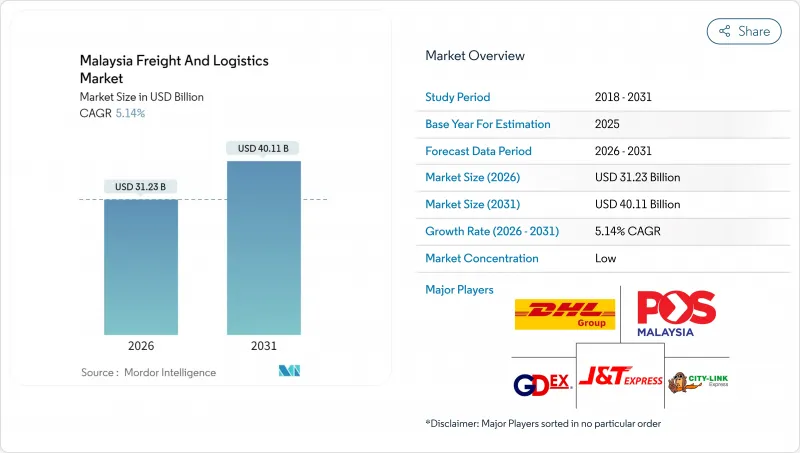
巴生港作為世界第十大貨櫃港口的崛起、政府對鐵路和公路計劃的大規模投資以及電子商務的持續成長勢頭,正推動馬來西亞整個貨運和物流市場重組供應鏈網路、優先發展倉儲自動化並重新評估與承運人的合作關係。預計到2024年,外國直接投資將達到3,785億馬幣(823億美元),創造20.7萬個就業崗位,並帶動跨境貨運、增值配送和專業製造物流的需求。消費者對當日配送的偏好正在加速末端物流網路的完善,而諸如定向柴油補貼和簡化海關手續等監管舉措則緩解了成本壓力和邊境摩擦。全球承運商正在加強與本地企業的合作,以確保空運量、海運配額和溫控運輸能力,從而鞏固馬來西亞作為東協乃至整個亞太貿易網路樞紐的地位。
馬來西亞貨運及物流市場趨勢及展望
B2C電子商務的爆炸性成長推動了最後一公里配送創新
當日配送已成為普遍預期,各大平台上95%的訂單都能在24小時內發出。 64.8%的網路用戶更傾向於免費送貨,這推動了馬來西亞貨運物流市場採用自動化分類系統、微型倉配中心和數據驅動的路線規劃。像MR DIY這樣的零售商在實施機器人系統後效率提升了200%,顯示自動化是競爭優勢的基礎。 UPS與Ninja Van的夥伴關係將全球快遞服務擴展到52家零售店,為出口商提供了更廣泛的貨艙空間和數位追蹤服務。同時,中小企業在區域貿易的參與度也不斷提高。這些累積效應增強了運力彈性和服務多樣性,從而支撐了馬來西亞貨運物流市場近期的成長動能。
外商直接投資主導的製造業生產激增改變了工業物流
2024年核准的馬幣(約823億美元)投資額創歷史新高,這些資金正湧入半導體製造廠、先進汽車零件和可再生能源設備領域。半導體投資帶動了對防靜電包裝、安全機器人和保稅倉庫通道的需求。像MKS Instruments這樣的精密設備製造商正在建造“購物中心”,這需要同步的原料進口和高頻次的運輸。柔佛-新加坡經濟特區內的跨境稅收優惠預計將創造100個計劃和2萬個技術崗位,為馬來西亞貨運和物流市場的新走廊奠定基礎。日益嚴格的ESG(環境、社會和治理)標準也在推動貨物運輸的長期多元化,投資者優先考慮靠近鐵路支線的可再生能源和多式聯運樞紐。
儘管進行了基礎設施投資,港口擁擠仍限制了其吞吐能力。
巴生港船舶平均等待時間為1.3至1.46天,堆場運轉率超過90%,嚴重影響了船期可靠性。儘管馬來西亞海事單一窗口系統於2025年2月推出,已將文件處理週期從五天縮短至數小時,但碼頭擴建規模不太可能跟上近期貨櫃吞吐量的成長。西港控股公司(Westport Holdings)的數十年擴張計劃旨在將總吞吐量大幅提升至遠超目前的水平,但經紅海繞行的航線增加已加劇了到港堵塞和堆場產能過剩。隨著全球航運公司重新分配貨櫃,馬來西亞的貨運和物流市場正面臨短期租船費率飆升和庫存失衡的局面,這可能會侵蝕吞吐量成長帶來的利潤。
細分市場分析
截至2025年,製造業將佔馬來西亞貨運和物流市場的38.98%,主要得益於檳城4,310億馬幣(937億美元)的出口引擎和雪蘭莪的電子產業叢集。跨國公司正在尋求保稅運輸路線、符合靜電放電防護(ESD)標準的倉庫以及貨物護送服務,從而推動服務差異化。電動車零件和可再生能源設備的成長將進一步擴大馬來西亞的貨運和物流市場,對超大型貨櫃裝卸和專業吊裝的需求也將隨之成長。儘管批發和零售貿易的絕對規模小規模,但在2026年至2031年期間,受可支配收入成長和數位支付普及的推動,預計其複合年成長率將達到5.46%。像99 Speedmart這樣的超級市場計劃將其門市數量加倍,這就需要配備多溫區轉運中心和位於消費中心附近的微型倉配中心。
在農業、漁業和林業領域,獲得清真認證的低溫運輸對於開拓中東市場至關重要,這提升了演算法驅動的溫度追蹤平台的商業性價值。建築物流與RTS Link和檳城機場擴建等重大計劃直接相關,需要重型起重機、夜間車隊運輸和準時製材料供應協調。儘管石油、天然氣和採礦業仍具有週期性,但在大宗商品價格波動的情況下,對ISO槽式貨櫃、船舶清潔服務和管道維護零件的穩定需求仍然是馬來西亞貨運和物流業的支柱。
到2025年,貨運將佔馬來西亞貨運和物流市場收入的55.62%,反映了製造業出口和區域分銷的強勁趨勢。受電商企業將當日達服務外包給多模態承運商的推動,馬來西亞宅配、速遞和小包裹解決方案的貨運和物流市場規模預計將在2026年至2031年間以5.86%的複合年成長率快速成長。 UPS和Ninja Van等公司在巴生谷地區的擴張,使得自動化樞紐能夠利用位址驗證軟體和物聯網標籤來降低投遞負載容量,企業正在倉庫安裝傾斜式分類機,並部署電動貨車以避開吉隆坡周邊的擁擠路段。此外,16項貿易協定降低了跨境關稅並統一了標籤標準,使中小企業更容易接觸到海外買家。小包裹密度的持續增加將增強與飛機貨艙供應商的議價能力,但如果柴油補貼的取消速度超過生產力提高的速度,利潤率仍有可能下降。
在小包裹遞送 (CEP) 領域之外,倉儲和貨運代理業者正在引入付費使用制,使微企業能夠按貨櫃而非托盤租用空間。溫控運輸符合馬來西亞的清真認證標準,並為水產品、糖果甜點和生物製藥等高附加價值貨物開闢了優質運輸路線。預計到 2031 年,隨著小包裹和合約物流活動吸收大量資金,貨運代理在馬來西亞貨運和物流市場的佔有率將略有下降。然而,大型計劃貨物(例如太陽能電池板、渦輪機和煉油廠儲槽)的專用卡車運輸將繼續支撐基準貨運量。技術成熟度、監管透明度和勞動力供應將在很大程度上決定現有企業或新進入者能夠獲得增量價值。
其他福利:
- Excel格式的市場預測(ME)表
- 3個月的分析師支持
目錄
第1章 引言
- 研究假設和市場定義
- 調查範圍
第2章調查方法
第3章執行摘要
第4章 市場情勢
- 市場概覽
- 人口統計數據
- 按經濟活動分類的GDP分配
- 按經濟活動分類的GDP成長
- 通貨膨脹
- 經濟表現及概況
- 電子商務產業的趨勢
- 製造業趨勢
- 運輸和倉儲業GDP
- 出口趨勢
- 進口趨勢
- 燃油價格
- 卡車運輸營運成本
- 卡車運輸車隊規模(按類型)
- 主要卡車供應商
- 物流績效
- 透過交通方式分享
- 海運船隊運力
- 班輪運輸連接
- 停靠港口和演出
- 貨運費率趨勢
- 貨物運輸量趨勢
- 基礎設施
- 法規結構(公路和鐵路)
- 法規結構(海事和航空)
- 價值鍊和通路分析
- 市場促進因素
- B2C電子商務交易量爆炸性成長
- 外國直接投資主導製造業產出激增
- 大型政府主導計劃(東海岸鐵路、泛婆羅洲高速公路)
- 透過RCEP進行的跨境貿易流動
- 對清真認證物流的需求不斷成長
- 疫苗和生物製藥低溫運輸發展
- 市場限制
- 港口和最後一公里堵塞
- 長期卡車駕駛人短缺
- 由於國內沿海運輸政策,沿海運輸受到限制
- 更嚴格的排放法規(相當於歐盟6標準)抑制了資本投資
- 市場創新
- 波特五力分析
- 新進入者的威脅
- 買方的議價能力
- 供應商的議價能力
- 替代品的威脅
- 競爭對手之間的競爭
第5章 市場規模與成長預測
- 終端用戶產業
- 農業、漁業、林業
- 建設業
- 製造業
- 石油天然氣、採礦和採石
- 批發和零售
- 其他
- 物流職能
- 宅配、速遞和小包裹(CEP)
- 按目的地
- 國內的
- 國際的
- 按目的地
- 貨運代理
- 透過交通工具
- 航空
- 海路和內河航道
- 其他
- 透過交通工具
- 貨物運輸
- 透過交通工具
- 航空
- 管道
- 鐵路
- 路
- 海路和內河航道
- 透過交通工具
- 倉庫/存儲
- 透過溫度控制
- 非溫控型
- 溫度控制
- 透過溫度控制
- 其他服務
- 宅配、速遞和小包裹(CEP)
第6章 競爭情勢
- 市場集中度
- 重大策略舉措
- 市佔率分析
- 公司簡介
- City-Link Express
- CJ Logistics Corporation
- DHL Group
- DSV A/S(Including DB Schenker)
- FedEx
- FM Global Logistics Holdings Bhd
- GDEX Group
- Hellmann Worldwide Logistics
- Hextar Technologies Solutions Bhd
- J&T Express
- Keretapi Tanah Melayu Bhd
- Kuehne+Nagel
- MMC Corporation Bhd
- NYK(Nippon Yusen Kaisha)Line
- POS Malaysia Bhd
- SF Express(KEX-SF)
- SkyNet Worldwide Express, Inc.
- Taipanco Sdn Bhd
- Tiong Nam Logistics Holdings Bhd
- Transocean Holdings Bhd
- United Parcel Service of America, Inc.(UPS)
- Xin Hwa Holdings Bhd
第7章 市場機會與未來展望
The Malaysia freight and logistics market is expected to grow from USD 29.70 billion in 2025 to USD 31.23 billion in 2026 and is forecast to reach USD 40.11 billion by 2031 at 5.14% CAGR over 2026-2031.
Port Klang's rise to the world's 10th-busiest container port, extensive government funding for rail and highway projects, and sustained e-commerce momentum are reshaping supply-chain networks, warehouse automation priorities, and carrier partnerships across the Malaysia freight and logistics market. Foreign direct investment reached MYR 378.5 billion (USD 82.3 billion) in 2024, creating 207,000 jobs and expanding demand for cross-border forwarding, value-added distribution, and specialized manufacturing logistics. Consumers' preference for same-day delivery is accelerating last-mile network densification, while regulatory moves such as targeted diesel subsidies and simplified customs windows are easing cost pressures and border friction. Global carriers are deepening local ties to secure air-cargo uplift, sea-freight allocations, and temperature-controlled capacity, reinforcing Malaysia's hub role within ASEAN and the broader Asia-Pacific trade lattice.
Malaysia Freight And Logistics Market Trends and Insights
Explosive B2C E-commerce Volumes Drive Last-Mile Innovation
Same-day fulfillment has become a standard expectation, with leading platforms shipping 95% of orders within 24 hours. Free-delivery preferences among 64.8% of internet users are forcing providers in the Malaysia freight and logistics market to adopt automated sortation, micro-fulfillment centers, and data-driven route planning. Retailers such as MR DIY achieved 200% efficiency gains after installing robotic systems, proving that automation now underpins competitive advantage. Partnerships like UPS-Ninja Van extend global express products to 52 retail outlets, offering exporters wider belly-hold access and digital tracking that aligns with rising SME participation in regional trade. The cumulative impact adds capacity resilience and service diversity, supporting the near-term growth trajectory of the Malaysia freight and logistics market.
Surge in FDI-Led Manufacturing Output Transforms Industrial Logistics
Record MYR 378.5 billion (USD 82.3 billion) investment approvals in 2024 are channeling funds toward semiconductor fabs, advanced automotive components, and renewable-energy assemblies. Semiconductor investments are triggering demand for electrostatic-discharge-compliant packaging, secure robotics, and bonded-warehouse clearance lanes. Precision-engineering firms such as MKS Instruments are building "super centers" that require synchronized inbound raw-material flows and high-frequency outbound shipments. Cross-border tax incentives inside the Johor-Singapore Special Economic Zone are expected to add 100 projects and 20,000 skilled jobs, anchoring new corridors for the Malaysia freight and logistics market. As ESG criteria tighten, investors also prioritize multimodal nodes near renewable energy and rail spurs, reinforcing long-term freight diversification.
Port Congestion Constrains Capacity Despite Infrastructure Investment
Average vessel waiting times of 1.3-1.46 days at Port Klang, alongside yard utilization above 90%, undermine schedule dependability. The Malaysia Maritime Single Window, launched in February 2025, has trimmed documentation cycles from five days to mere hours, but physical quay expansions will still lag near-term TEU growth. Westports Holdings' multi-decade expansion blueprint aims to propel total capacity far beyond present limits, yet Red Sea rerouting has already intensified arrival bunching and yard overflow. As global carriers reallocate boxes, the Malaysia freight and logistics market faces short-term charter premium spikes and inventory imbalances that erode margin gains from higher throughput.
Other drivers and restraints analyzed in the detailed report include:
- Government Mega-Projects Unlock Regional Connectivity
- RCEP Integration Accelerates Intra-ASEAN Trade Flows
- Chronic Truck-Driver Shortage Threatens Operational Scalability
For complete list of drivers and restraints, kindly check the Table Of Contents.
Segment Analysis
Manufacturing held 38.98% of Malaysia freight and logistics market share in 2025, supported by Penang's MY 431 billion (USD 93.7 billion) export engine and Selangor's electronics clusters. Multinationals require bonded trucking corridors, ESD-safe warehouses, and secure-freight escorts, driving service differentiation. Growth in electric vehicle components and renewable energy equipment further expands the Malaysia freight and logistics market size for oversized container handling and specialized rigging. Wholesale and retail trade, although smaller in absolute dollars, is on pace for a 5.46% CAGR between 2026-2031 as disposable incomes rise and digital payment adoption widens. Supermarket chains like 99 Speed Mart plan to double store counts, demanding multi-temperature cross-docks and micro-fulfillment centers proximate to consumption hotspots.
Agriculture, fishing, and forestry depend on certified halal cold chains to penetrate Middle-East demand pools, giving algorithm-driven temperature traceability platforms greater commercial pull. Construction logistics ties directly to mega-projects such as the RTS Link and Penang Airport expansion, requiring heavy-lift cranes, night-time convoy escorts, and synchronized just-in-time material sequencing. Oil, gas, and mining remain cyclical but sustain steady demand for ISO tank containers, hull-cleaning services, and pipeline maintenance parts, anchoring a baseline for the Malaysia freight and logistics industry amid commodity swings.
Freight transport generated 55.62% of Malaysia freight and logistics market revenue in 2025, reflecting entrenched manufacturing exports and regional distribution flows. The Malaysia freight and logistics market size linked to courier, express, and parcel solutions is growing faster at a 5.86% CAGR (2026-2031) as e-retailers outsource same-day coverage to multi-modal carriers. Automated hubs, such as UPS-Ninja Van's expanded Klang Valley outlets, harness address-verification software and IoT tags to trim failed-delivery rates. As online orders fill truck bays, operators retrofit depots with tilt-tray sorters and deploy electric vans to navigate congestion nodes near Kuala Lumpur. The segment also benefits from 16 trade pacts that suppress cross-border clearance fees and harmonize labeling, easing SME access to overseas buyers. Continuous parcel-density escalation strengthens bargaining power with airline belly-hold providers, but margin compression remains a risk if diesel subsidies phase down faster than productivity gains materialize.
Beyond CEP, warehousing and forwarding units explore pay-as-you-use charging, allowing micro-enterprises to lease bins rather than full pallet slots. Temperature-controlled shipping aligns with Malaysia's halal-certification standards, opening premium lanes for value-added consolidation of seafood, confectionery, and biologics. The freight transport share of the Malaysia freight and logistics market is expected to decline marginally by 2031 as parcel and contract-logistics activities absorb disproportionate capital. Yet specialized trucking for oversized project cargo-solar panels, turbines, refinery vats-continues to anchor baseline volumes. Technology readiness, regulatory clarity, and workforce availability will largely determine whether incumbents or new entrants capture the incremental value.
The Malaysia Freight and Logistics Market Report is Segmented by End User Industry (Agriculture, Fishing, and Forestry, Construction, Manufacturing, Oil and Gas, Mining and Quarrying, Wholesale and Retail Trade, and Others) and by Logistics Function (Courier, Express, and Parcel (CEP), Freight Forwarding, Freight Transport, Warehousing and Storage, and Other Services). The Market Forecasts are Provided in Terms of Value (USD).
List of Companies Covered in this Report:
- City-Link Express
- CJ Logistics Corporation
- DHL Group
- DSV A/S (Including DB Schenker)
- FedEx
- FM Global Logistics Holdings Bhd
- GDEX Group
- Hellmann Worldwide Logistics
- Hextar Technologies Solutions Bhd
- J&T Express
- Keretapi Tanah Melayu Bhd
- Kuehne+Nagel
- MMC Corporation Bhd
- NYK (Nippon Yusen Kaisha) Line
- POS Malaysia Bhd
- SF Express (KEX-SF)
- SkyNet Worldwide Express, Inc.
- Taipanco Sdn Bhd
- Tiong Nam Logistics Holdings Bhd
- Transocean Holdings Bhd
- United Parcel Service of America, Inc. (UPS)
- Xin Hwa Holdings Bhd
Additional Benefits:
- The market estimate (ME) sheet in Excel format
- 3 months of analyst support
TABLE OF CONTENTS
1 Introduction
- 1.1 Study Assumptions and Market Definition
- 1.2 Scope of the Study
2 Research Methodology
3 Executive Summary
4 Market Landscape
- 4.1 Market Overview
- 4.2 Demographics
- 4.3 GDP Distribution by Economic Activity
- 4.4 GDP Growth by Economic Activity
- 4.5 Inflation
- 4.6 Economic Performance and Profile
- 4.6.1 Trends in E-Commerce Industry
- 4.6.2 Trends in Manufacturing Industry
- 4.7 Transport and Storage Sector GDP
- 4.8 Export Trends
- 4.9 Import Trends
- 4.10 Fuel Price
- 4.11 Trucking Operational Costs
- 4.12 Trucking Fleet Size by Type
- 4.13 Major Truck Suppliers
- 4.14 Logistics Performance
- 4.15 Modal Share
- 4.16 Maritime Fleet Load Carrying Capacity
- 4.17 Liner Shipping Connectivity
- 4.18 Port Calls and Performance
- 4.19 Freight Pricing Trends
- 4.20 Freight Tonnage Trends
- 4.21 Infrastructure
- 4.22 Regulatory Framework (Road and Rail)
- 4.23 Regulatory Framework (Sea and Air)
- 4.24 Value Chain and Distribution Channel Analysis
- 4.25 Market Drivers
- 4.25.1 Explosive B2C E-Commerce Volumes
- 4.25.2 Surge in FDI-led Manufacturing Output
- 4.25.3 Government Mega-Projects (ECRL, Pan-Borneo Highway)
- 4.25.4 RCEP-Driven Cross-Border Trade Flows
- 4.25.5 Rising Demand for Certified Halal Logistics
- 4.25.6 Cold-Chain Build-Out for Vaccines and Biologics
- 4.26 Market Restraints
- 4.26.1 Port and Last-Mile Congestion
- 4.26.2 Chronic Truck-Driver Shortage
- 4.26.3 Domestic Cabotage Policy Limits Coastal Shipping
- 4.26.4 Tightening Euro-VI - Like Emission Rules, Capex Squeeze
- 4.27 Technology Innovations in the Market
- 4.28 Porter's Five Forces Analysis
- 4.28.1 Threat of New Entrants
- 4.28.2 Bargaining Power of Buyers
- 4.28.3 Bargaining Power of Suppliers
- 4.28.4 Threat of Substitutes
- 4.28.5 Competitive Rivalry
5 Market Size and Growth Forecasts (Value, USD)
- 5.1 End User Industry
- 5.1.1 Agriculture, Fishing, and Forestry
- 5.1.2 Construction
- 5.1.3 Manufacturing
- 5.1.4 Oil and Gas, Mining and Quarrying
- 5.1.5 Wholesale and Retail Trade
- 5.1.6 Others
- 5.2 Logistics Function
- 5.2.1 Courier, Express, and Parcel (CEP)
- 5.2.1.1 By Destination Type
- 5.2.1.1.1 Domestic
- 5.2.1.1.2 International
- 5.2.1.1 By Destination Type
- 5.2.2 Freight Forwarding
- 5.2.2.1 By Mode of Transport
- 5.2.2.1.1 Air
- 5.2.2.1.2 Sea and Inland Waterways
- 5.2.2.1.3 Others
- 5.2.2.1 By Mode of Transport
- 5.2.3 Freight Transport
- 5.2.3.1 By Mode of Transport
- 5.2.3.1.1 Air
- 5.2.3.1.2 Pipelines
- 5.2.3.1.3 Rail
- 5.2.3.1.4 Road
- 5.2.3.1.5 Sea and Inland Waterways
- 5.2.3.1 By Mode of Transport
- 5.2.4 Warehousing and Storage
- 5.2.4.1 By Temperature Control
- 5.2.4.1.1 Non-Temperature Controlled
- 5.2.4.1.2 Temperature Controlled
- 5.2.4.1 By Temperature Control
- 5.2.5 Other Services
- 5.2.1 Courier, Express, and Parcel (CEP)
6 Competitive Landscape
- 6.1 Market Concentration
- 6.2 Key Strategic Moves
- 6.3 Market Share Analysis
- 6.4 Company Profiles (Includes Global Level Overview, Market Level Overview, Core Segments, Financials as Available, Strategic Information, Market Rank/Share for Key Companies, Products and Services, and Recent Developments)
- 6.4.1 City-Link Express
- 6.4.2 CJ Logistics Corporation
- 6.4.3 DHL Group
- 6.4.4 DSV A/S (Including DB Schenker)
- 6.4.5 FedEx
- 6.4.6 FM Global Logistics Holdings Bhd
- 6.4.7 GDEX Group
- 6.4.8 Hellmann Worldwide Logistics
- 6.4.9 Hextar Technologies Solutions Bhd
- 6.4.10 J&T Express
- 6.4.11 Keretapi Tanah Melayu Bhd
- 6.4.12 Kuehne+Nagel
- 6.4.13 MMC Corporation Bhd
- 6.4.14 NYK (Nippon Yusen Kaisha) Line
- 6.4.15 POS Malaysia Bhd
- 6.4.16 SF Express (KEX-SF)
- 6.4.17 SkyNet Worldwide Express, Inc.
- 6.4.18 Taipanco Sdn Bhd
- 6.4.19 Tiong Nam Logistics Holdings Bhd
- 6.4.20 Transocean Holdings Bhd
- 6.4.21 United Parcel Service of America, Inc. (UPS)
- 6.4.22 Xin Hwa Holdings Bhd
7 Market Opportunities and Future Outlook
- 7.1 White-Space and Unmet-Need Assessment

 2026-2030年全球貨運物流市場
 中東和非洲貨運物流市場:市場佔有率分析、行業趨勢、統計數據和成長預測(2026-2031 年)北美貨運與物流:市場佔有率分析、產業趨勢與統計、成長預測(2026-2031)印尼貨運與物流:市場佔有率分析、產業趨勢、統計及成長預測(2026-2031)德國貨運和物流市場:市場佔有率分析、行業趨勢、統計數據和成長預測(2026-2031 年)日本貨運物流市場:市場佔有率分析、產業趨勢與統計、成長預測(2026-2031年)歐洲貨運與物流:市場佔有率分析、行業趨勢、統計數據和成長預測(2026-2031 年)法國貨運與物流:市場佔有率分析、產業趨勢、統計數據與成長預測(2026-2031)義大利貨運與物流:市場佔有率分析、產業趨勢、統計數據與成長預測(2026-2031)
 日本貨運物流市場規模、佔有率、趨勢及預測(按類型、最終用戶及地區分類),2026-2034年