


 |
市場調查報告書
商品編碼
2154747
南美金屬包裝:市場佔有率分析、產業趨勢與統計及成長預測(2026-2031 年)South America Metal Packaging - Market Share Analysis, Industry Trends & Statistics, Growth Forecasts (2026 - 2031) |
||||||

※ 本網頁內容可能與最新版本有所差異。詳細情況請與我們聯繫。
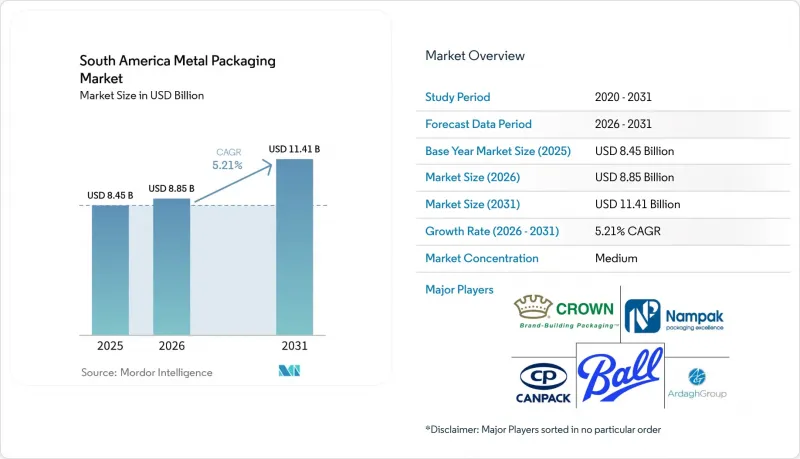
據 Mordor Intelligence 稱,2025 年南美金屬包裝市場價值為 84.5 億美元,2026 年為 88.5 億美元,預計到 2031 年將從 2026 年的 88.5 億美元成長至 114.1 億美元,預測期(2026-2031 年)的複合年成長率為 5.1%。
南美金屬包裝市場趨勢與洞察
罐裝啤酒和即飲飲料的消費量增加
罐裝啤酒和即飲飲料是南美金屬包裝市場需求的最大驅動力。預計到2025年,巴西鋁罐的銷量將達到341億個,其中罐裝水、即飲飲料和罐裝卡沙薩酒將推動銷量成長,而現有飲料品類的成長速度則有所放緩。這些產品通常使用單份鋁罐或鋼罐,而非玻璃罐或PET罐。這意味著新飲料的上市將直接影響罐裝飲料的需求。 Aburatas預測,在FIFA世界盃和整個品類需求成長的推動下,2026年將迎來新的成長週期。隨著需求結構對傳統啤酒銷售的依賴性降低,南美金屬包裝市場將從中受益。
可回收性和向循環經濟邁進的努力
巴西的鋁罐回收系統為南美金屬包裝市場帶來了顯著的成本和採購優勢。 2024年,巴西97.3%的飲料罐已回收,預計到2025年將達到100%。據Abralatas公司稱,巴西製罐所用的鋁板中,超過80%來自回收材料。使用回收材料使生產商能夠降低對原生金屬成本的依賴,並滿足跨國飲料製造商的採購要求。 Ball Beverage Packaging South America和Ardagu Metal Packaging Brazil於2025年獲得了鋁業管理計劃(ASI)V3.1績效舉措認證。這些認證鞏固了它們在南美金屬包裝市場的地位,尤其是在那些要求可追溯性和負責任的材料管理的供應合約中。
鋁、鋼和能源價格波動
大宗商品價格是南美金屬包裝市場面臨的最迫切的成本限制因素。由於中東衝突威脅全球9%的原生鋁提煉產能,預計2026年4月,倫敦金屬交易所(LME)的鋁價將達到每噸3,672美元。許多南美加工商依賴進口鋁卷,因此極易受到此影響。如果合約限制了季中價格上漲,投入成本的上漲速度可能會超過銷售價格。能源成本也可能帶來進一步的壓力,因為鋁的生產和回收依賴穩定的電力供應。因此,企業被迫在自行承擔成本上漲或將其轉嫁給客戶之間做出選擇,這可能會限制利潤率和短期投資。
細分市場分析
到2025年,鋁將佔南美金屬包裝市場銷售額的64.28%。這一地位反映了鋁在飲料罐領域輕盈、可回收和阻隔性能優異的特性。巴西計劃在2025年實現100%的飲料罐回收率,有助於當地取得再生原料。與回收體系較弱的市場相比,該體系減少了對原生鋁錠的依賴。此外,Ball和Ardagu在2025年獲得的ASI認證將有助於滿足跨國飲料製造商的採購要求。
鋼材在食品罐、工業桶和散裝容器中繼續發揮至關重要的作用,因為這些產品的強度和蒸餾處理性能至關重要。在2025年巴西油漆與塗料大獎(Paint & Pintura Awards)中,Greif榮獲桶裝產品類別的「最佳金屬包裝供應商獎」。預計到2031年,鋁材市場將以6.74%的複合年成長率成長,因為生產商正在擴大產能以滿足瓶裝水、即飲雞尾酒和能量飲料的需求。這些飲料包裝正擴大從PET材質轉向鋁材質。因此,南美金屬包裝市場將保持雙材料結構,鋁材在飲料行業佔據主導地位,而鋼材則繼續在食品和工業領域發揮其特殊應用。
到2025年,罐裝飲料佔產品類型總銷售額的41.33%。啤酒、軟性飲料、罐裝水和即飲飲料鞏固了這一領先地位。罐裝水和新興飲料品類在巴西的成長正在降低對傳統啤酒需求的依賴。預計到2031年,氣霧罐的年複合成長率將達到6.89%。其需求主要來自個人保健產品和家居用品,例如除臭劑、髮膠噴霧和清潔產品。
食品罐在常溫下長途運輸中繼續發揮至關重要的作用。散裝容器和桶裝產品則被農產品、化學、塗料和工業領域的客戶廣泛使用。瓶蓋和封蓋受益於對高級啤酒和烈酒容器的需求,這些容器需要更高規格的組件。食品罐和氣霧罐也需要根據當前的監管趨勢進行重新設計的塗層。因此,南美金屬包裝市場既有對大批量飲料的需求,也有對技術要求更高的小規模產品線的需求。
其他好處:
- Excel格式的市場預測(ME)表
- 3個月的分析師支持
目錄
第1章:引言
- 研究假設和市場定義
- 調查範圍
第2章:調查方法
第3章執行摘要
第4章 市場狀況
- 市場概覽
- 市場促進因素
- 罐裝啤酒和即飲飲料消費量成長
- 可回收性和向循環經濟邁進的努力
- 延長食品和飲料的保存期限並保護其阻隔性能。
- 加工食品和簡便食品的消費量增加
- 飲料和個人保健產品的優質化
- 以巴西為首,實現罐裝啤酒供應和區域啤酒分銷的本地化。
- 市場限制因素
- 鋁、鋼和能源價格波動
- 高昂的轉換成本、模具成本和合規成本
- 南美洲區域城市復甦經濟學的差異
- 區域供應有限的塗料合格存在瓶頸
- 宏觀經濟因素對市場的影響
- 產業供應鏈分析
- 科技趨勢
- 監理情勢
- 波特五力分析
第5章 市場規模與成長預測
- 材料類型
- 鋁
- 鋼
- 依產品類型
- 坎
- 食品罐頭
- 飲料罐
- 氣霧罐
- 散裝容器
- 運輸桶和罐
- 蓋子和封口
- 坎
- 按最終用戶行業分類
- 飲料
- 食物
- 化妝品和個人護理
- 家
- 其他終端用戶產業
- 按塗層和襯裡類型分類
- 含雙酚A的環氧樹脂
- BPA-NI環氧樹脂
- 聚酯/PET
- 其他類型的塗層/襯裡
- 按貨櫃容量
- 少於250毫升
- 251~500 ml
- 501~1000 ml
- 超過1000毫升
- 按地區
- 巴西
- 阿根廷
- 哥倫比亞
- 智利
- 其他南美國家
第6章 競爭情勢
- 市場集中度
- 策略趨勢
- 市佔率分析
- 公司簡介
- Ardagh Metal Packaging SA
- Ball Corporation
- Crown Holdings, Inc.
- CANPACK SA
- Silgan Holdings Inc.
- Nampak Limited
- Toyo Seikan Group Holdings, Ltd.
- CPMC Holdings Limited
- Daiwa Can Company
- Hokkan Holdings Limited
- ORG Technology Co., Ltd.
- Baosteel Packaging Co., Ltd.
- Mauser Packaging Solutions
- Greif, Inc.
- TUBEX Holding GmbH
- Colep Packaging
- Envases Group
- Tecnocap SpA
- Massilly Holding SAS
- Pelliconi & CSpA
- Astir Vitogiannis Bros SA
- Trivium Packaging BV
- Jamestrong Packaging Pty Ltd
- Independent Can Company
- United Can Company
第7章 市場機會與未來展望
According to Mordor Intelligence, the South America metal packaging market size was valued at USD 8.45 billion in 2025, USD 8.85 billion in 2026, and is estimated to grow from USD 8.85 billion in 2026 to reach USD 11.41 billion by 2031, at a CAGR of 5.21% during the forecast period (2026-2031).
South America Metal Packaging Market Trends and Insights
Growth in Canned Beer and Ready-to-Drink Beverage Consumption
Canned beer and ready-to-drink beverages are the largest drivers of demand for the South America Metal Packaging Market. Brazil sold 34.1 billion aluminum cans in 2025, with canned water, ready-to-drink beverages, and canned cachaca adding volume as established beverage categories slowed. These formats usually use single-serve aluminum or steel cans rather than glass or PET. This gives new beverage launches a direct effect on can demand. Abralatas expected a new growth cycle in 2026, supported by the FIFA World Cup and broader category demand. The South America Metal Packaging Market benefits as the demand mix becomes less dependent on conventional beer volumes.
Recyclability and Circular-Economy Commitments
Brazil's aluminum can collection system supports a major cost and sourcing advantage for the South America Metal Packaging Market. The country recycled 97.3% of beverage cans in 2024 and reached 100% in 2025. More than 80% of the aluminum sheet used for Brazilian can production came from recycled material, according to Abralatas. Recycled content can reduce producers' exposure to primary metal costs and meet procurement requirements from multinational beverage customers. Ball Beverage Packaging South America and Ardagh Metal Packaging Brasil received Aluminum Stewardship Initiative Performance Standard V3.1 certifications in 2025. These credentials strengthen the South America Metal Packaging Market's position in supply contracts that require traceability and responsible material management.
Aluminum, Steel, and Energy Price Volatility
Commodity prices are the most immediate cost restraint for the South America Metal Packaging Market. LME aluminum reached USD 3,672 per metric ton in April 2026 after conflict in the Middle East threatened 9% of global primary aluminum smelting capacity. South American converters are exposed because many depend on imported aluminum coil. Input costs can rise faster than selling prices when contracts restrict mid-season increases. Energy costs can add further pressure because aluminum production and recycling depend on a reliable power supply. The result is a choice between absorbing higher costs and passing them through to customers, which can constrain margins and near-term investment.
Other drivers and restraints analyzed in the detailed report include:
- Longer Shelf Life and Barrier Protection for Food and Beverages
- Expansion of Processed Food and Convenience Consumption
- High Conversion, Tooling, and Compliance Costs
For complete list of drivers and restraints, kindly check the Table Of Contents.
Segment Analysis
Aluminum held 64.28% of South America Metal Packaging Market revenue in 2025. Its position reflects lightweighting, recyclability, and barrier performance in beverage cans. Brazil's 100% beverage-can recycling rate in 2025 strengthens local access to secondary material. The system reduces dependence on primary ingot compared with markets with weaker collection systems. Ball and Ardagh's 2025 ASI certifications also support sourcing requirements from multinational beverage companies.
Steel remains relevant for food cans, industrial drums, and bulk containers where strength and retort processing matter. Greif received the Best Metal Packaging Supplier award in the drums category at Brazil's 2025 Paint and Pintura Award. Aluminum is forecast to grow at a 6.74% CAGR through 2031 as producers expand capacity to meet demand for canned water, ready-to-drink cocktails, and energy drinks. These beverage formats are increasingly shifting from PET to aluminum. The South America Metal Packaging Market will therefore retain a two-material structure, with aluminum leading in beverages and steel maintaining specialized uses in food and industry.
Beverage cans accounted for 41.33% of product-type revenue in 2025. Beer, soft drinks, canned water, and ready-to-drink beverages underpin this leading position. Brazil's growth in canned water and emerging beverage categories has reduced reliance on traditional beer demand. Aerosol cans are forecast to grow at a 6.89% CAGR through 2031. Demand comes from personal care and household products, including deodorants, hair sprays, and cleaning products.
Food cans remain important because they support ambient distribution over long distances. Bulk containers and drums serve agribusiness, chemicals, paints, and industrial customers. Caps and closures benefit from premium beer and spirits formats that require higher-specification components. Food cans and aerosols also face reformulation requirements for their coatings under the current regulatory direction. The South America Metal Packaging Market, therefore, contains both high-volume beverage demand and smaller product lines with more specialized technical needs.
Complete Report Scope:
- By Material Type
- Aluminum
- Steel
- By Product Type
- Cans
- Food Cans
- Beverage Cans
- Aerosol Cans
- Bulk Containers
- Shipping Barrels and Drums
- Caps and Closures
- Cans
- By End-User Industry
- Beverage
- Food
- Cosmetics and Personal Care
- Household
- Other End-User Industry
- By Coating and Lining Type
- BPA-Based Epoxy
- BPA-NI Epoxy
- Polyester / PET
- Other Coating / Lining Type
- By Container Capacity
- Less than 250 ml
- 251-500 ml
- 501-1000 ml
- More than 1000 ml
- By Geography
- Brazil
- Argentina
- Colombia
- Chile
- Rest of South America
List of Companies Covered in this Report:
- Ardagh Metal Packaging S.A.
- Ball Corporation
- Crown Holdings, Inc.
- CANPACK S.A.
- Silgan Holdings Inc.
- Nampak Limited
- Toyo Seikan Group Holdings, Ltd.
- CPMC Holdings Limited
- Daiwa Can Company
- Hokkan Holdings Limited
- ORG Technology Co., Ltd.
- Baosteel Packaging Co., Ltd.
- Mauser Packaging Solutions
- Greif, Inc.
- TUBEX Holding GmbH
- Colep Packaging
- Envases Group
- Tecnocap S.p.A.
- Massilly Holding S.A.S.
- Pelliconi & C. S.p.A.
- Astir Vitogiannis Bros S.A.
- Trivium Packaging B.V.
- Jamestrong Packaging Pty Ltd
- Independent Can Company
- United Can Company
Additional Benefits:
- The market estimate (ME) sheet in Excel format
- 3 months of analyst support
TABLE OF CONTENTS
1 INTRODUCTION
- 1.1 Study Assumptions and Market Definition
- 1.2 Scope of the Study
2 RESEARCH METHODOLOGY
3 EXECUTIVE SUMMARY
4 MARKET LANDSCAPE
- 4.1 Market Overview
- 4.2 Market Drivers
- 4.2.1 Growth in Canned Beer and Ready-to-Drink Beverage Consumption
- 4.2.2 Recyclability and Circular-Economy Commitments
- 4.2.3 Longer Shelf Life and Barrier Protection for Food and Beverages
- 4.2.4 Expansion of Processed Food and Convenience Consumption
- 4.2.5 Premiumization of Beverage and Personal Care Packaging
- 4.2.6 Brazil-Led Localization of Can Supply and Regional Beer Logistics
- 4.3 Market Restraints
- 4.3.1 Aluminum, Steel, and Energy Price Volatility
- 4.3.2 High Conversion, Tooling, and Compliance Costs
- 4.3.3 Uneven Collection Economics Across Secondary South American Cities
- 4.3.4 Coating Qualification Bottlenecks for Localized Supply
- 4.4 Impact of Macroeconomic Factors on the Market
- 4.5 Industry Supply-Chain Analysis
- 4.6 Technology Outlook
- 4.7 Regulatory Landscape
- 4.8 Porter's Five Forces Analysis
- 4.8.1 Threat of New Entrants
- 4.8.2 Bargaining Power of Suppliers
- 4.8.3 Bargaining Power of Buyers
- 4.8.4 Threat of Substitutes
- 4.8.5 Intensity of Competitive Rivalry
5 MARKET SIZE AND GROWTH FORECASTS (VALUE)
- 5.1 By Material Type
- 5.1.1 Aluminum
- 5.1.2 Steel
- 5.2 By Product Type
- 5.2.1 Cans
- 5.2.1.1 Food Cans
- 5.2.1.2 Beverage Cans
- 5.2.1.3 Aerosol Cans
- 5.2.2 Bulk Containers
- 5.2.3 Shipping Barrels and Drums
- 5.2.4 Caps and Closures
- 5.2.1 Cans
- 5.3 By End-User Industry
- 5.3.1 Beverage
- 5.3.2 Food
- 5.3.3 Cosmetics and Personal Care
- 5.3.4 Household
- 5.3.5 Other End-User Industry
- 5.4 By Coating and Lining Type
- 5.4.1 BPA-Based Epoxy
- 5.4.2 BPA-NI Epoxy
- 5.4.3 Polyester / PET
- 5.4.4 Other Coating / Lining Type
- 5.5 By Container Capacity
- 5.5.1 Less than 250 ml
- 5.5.2 251-500 ml
- 5.5.3 501-1000 ml
- 5.5.4 More than 1000 ml
- 5.6 By Geography
- 5.6.1 Brazil
- 5.6.2 Argentina
- 5.6.3 Colombia
- 5.6.4 Chile
- 5.6.5 Rest of South America
6 COMPETITIVE LANDSCAPE
- 6.1 Market Concentration
- 6.2 Strategic Moves
- 6.3 Market Share Analysis
- 6.4 Company Profiles (includes Global Level Overview, Market Level Overview, Core Segments, Financials as available, Strategic Information, Market Rank/Share, Products and Services, Recent Developments)
- 6.4.1 Ardagh Metal Packaging S.A.
- 6.4.2 Ball Corporation
- 6.4.3 Crown Holdings, Inc.
- 6.4.4 CANPACK S.A.
- 6.4.5 Silgan Holdings Inc.
- 6.4.6 Nampak Limited
- 6.4.7 Toyo Seikan Group Holdings, Ltd.
- 6.4.8 CPMC Holdings Limited
- 6.4.9 Daiwa Can Company
- 6.4.10 Hokkan Holdings Limited
- 6.4.11 ORG Technology Co., Ltd.
- 6.4.12 Baosteel Packaging Co., Ltd.
- 6.4.13 Mauser Packaging Solutions
- 6.4.14 Greif, Inc.
- 6.4.15 TUBEX Holding GmbH
- 6.4.16 Colep Packaging
- 6.4.17 Envases Group
- 6.4.18 Tecnocap S.p.A.
- 6.4.19 Massilly Holding S.A.S.
- 6.4.20 Pelliconi & C. S.p.A.
- 6.4.21 Astir Vitogiannis Bros S.A.
- 6.4.22 Trivium Packaging B.V.
- 6.4.23 Jamestrong Packaging Pty Ltd
- 6.4.24 Independent Can Company
- 6.4.25 United Can Company
7 MARKET OPPORTUNITIES AND FUTURE OUTLOOK
- 7.1 White-Space and Unmet-Need Assessment

 德國金屬包裝市場:市場佔有率分析、產業趨勢與統計及成長預測(2026-2031)泰國金屬包裝市場:市場佔有率分析、產業趨勢與統計、成長預測(2026-2031)義大利金屬包裝市場:市場佔有率分析、產業趨勢與統計及成長預測(2026-2031)越南金屬包裝市場:市場佔有率分析、產業趨勢與統計及成長預測(2026-2031年)印度金屬包裝市場:市場佔有率分析、產業趨勢與統計、成長預測(2026-2031)金屬包裝:市場佔有率分析、產業趨勢及統計、成長預測(2026-2031)
 金屬包裝市場報告:按產品類型、材料、應用和地區分類(2026-2034 年)
 金屬包裝市場機會、成長要素、產業趨勢分析及2026-2035年預測
 金屬包裝市場規模、佔有率、成長及全球產業分析:按類型、應用和地區分類的洞察,2026-2034 年預測
 金屬包裝市場:依材料、產品類型、最終用途產業及地區分類