


 |
市場調查報告書
商品編碼
2125560
泰國金屬包裝市場:市場佔有率分析、產業趨勢與統計、成長預測(2026-2031)Thailand Metal Packaging - Market Share Analysis, Industry Trends & Statistics, Growth Forecasts (2026 - 2031) |
||||||

※ 本網頁內容可能與最新版本有所差異。詳細情況請與我們聯繫。
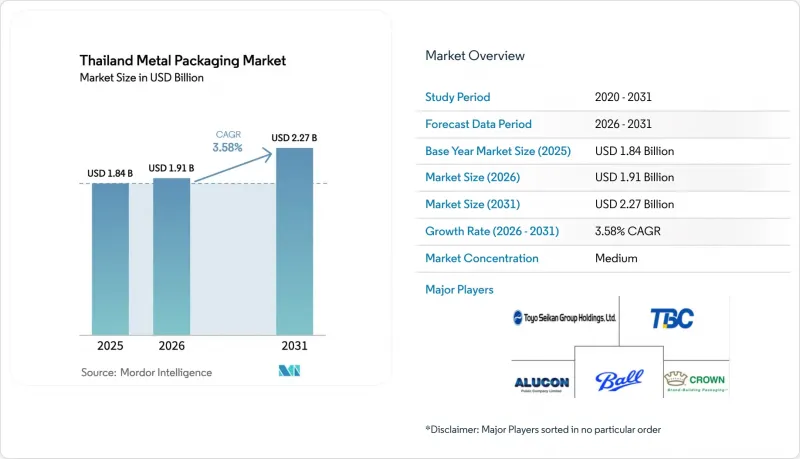
根據 Mordor Intelligence 預測,泰國金屬包裝市場規模預計將在 2025 年達到 18.4 億美元,2026 年達到 19.1 億美元,到 2031 年達到 22.7 億美元,2026 年至 2031 年的複合年成長率為 3.58%。
本報告按材料(鋁、鋼)、產品類型(罐、散裝容器、運輸桶等)、終端用戶行業(飲料、食品、油漆和化工等)以及製罐技術(兩片式DWI、兩片式DRD等)進行細分。市場預測以美元計價。
泰國金屬包裝市場趨勢與洞察
即飲飲料的優質化
精釀啤酒、能量飲料和氣泡茶,採用精緻的250毫升和330毫升罐裝,其成長速度超過了主流飲料,促使加工商投資兩片式拉伸-再拉伸生產線,這種生產線可將單位鋁用量減少近10%。品牌商正在採用360度直接印刷技術來減少冷鏈中的冷凝現象,這項技術已被大型跨國公司的高速生產線所採用。這種優質化趨勢也蔓延到了新型非酒精飲料領域,使用繫繩蓋和穿孔收縮膜有助於滿足便利商店等銷售管道的塑膠法規要求。隨著這些規範對接縫公差和厚度要求的收緊,規模小規模的本地加工商面臨資本投資的挑戰,這可能會加速產業整合。短期來看,優質化正在推動鋁材而非鋼材的需求,推高每罐的平均價格,從而在飲料總銷售量保持平穩的情況下,維持強勁的利潤率。
泰國寵物食品出口基地的成長
泰國計劃在2030年將其寵物食品出口額提升至50億美元,這將對能夠承受121 度C蒸餾高壓滅菌的85克和170克罐頭產生持續需求。出口客戶要求使用能夠抵抗魚蛋白中硫腐蝕的環氧酚塗層,而擁有自動化塗層生產線的加工商最能滿足這項要求。清真認證是一項重大障礙,因為海灣市場已佔罐頭食品出口的三分之一以上。符合美國FDA 21 CFR 113和歐洲過渡期限制是進一步技術檢驗的必要條件,這使得能夠進行批次追溯的供應商更具優勢。這些規範使得阻隔性金屬罐成為保存期限長的寵物濕食的標準包裝,並且在出口通路中逐漸取代軟包裝袋。
軋延鋼捲價格波動加劇
2024年,東協地區熱軋鋼卷價格出現兩位數波動,造成三片式罐生產商壓力。這些生產商以現貨價格購買鋼材,卻以近期平均價格向客戶收取費用。由於鋼材成本佔焊接食品罐總成本的70%之多,短期價格飆升會在轉嫁條款重置前擠壓利潤空間。泰國約60%的扁鋼需求依賴進口,隨著中國出口的擴大,加工商面臨運費波動和貿易救濟措施的風險。範圍3碳排放報告迫使全球品牌轉向低碳包裝,而鋁的循環利用優勢也為鋼材帶來了進一步的挑戰。雖然鋼材在大油漆罐和工業桶中仍然佔據主導地位,但飲料和海鮮加工商已開始轉向更輕的兩片鋁罐。
細分市場分析
預計到2025年,鋁材將佔泰國金屬包裝銷售額的69.03%,反映了其在飲料和水產品罐領域的主導地位。在這些領域,再生材料含量是採購決策的關鍵因素。隨著三大加工商紛紛效法波爾公司(Ball)74%的再生材料含量基準,鋁材在泰國金屬包裝市場的市佔率預計將進一步提升。輕量化措施正幫助啤酒生產商將罐體重量減輕8%至12%。同時,碳排放邊境調節措施將對高碳排放的鋼鐵造成價格壓力。雖然鋼鐵在防盜蓋和20公升油漆罐中仍發揮重要作用,但隨著進口運費飆升和消費者對更高再生材料含量的需求,其在國內的成本優勢正在減弱。
儘管合金成本不斷上漲,泰國金屬包裝市場預計到2031年仍將持續成長。這得歸功於泰國投資促進委員會(BOI)對進口爐渣的關稅豁免以及經濟合作委員會(EEC)回收設施降低的廢料採購成本。鋼鐵工人在氣霧劑罩和工業用桶等細分市場中爭奪領先地位,但持續的捲材價格波動和日益嚴格的揮發性有機化合物(VOC)法規限制了對新建焊接生產線的資金投入。能夠證明符合鋁業管理舉措(ASI)要求的供應商將有機會在飲料行業獲得長期契約,從而進一步鞏固鋁業的成長勢頭。
2025年,飲料罐佔總銷售額的47.37%,而整個罐頭總合(包括飲料、食品和氣霧劑)預計到2031年將以4.26%的複合年成長率成長,成為成長最快的細分市場。泰國金屬包裝市場規模的成長得益於海鮮加工商在2024年出貨630,434噸鮪魚罐頭,以及啤酒廠傾向使用細長罐以提升商店通路的吸引力。此外,隨著潤滑油出口商從鋼桶轉向符合ISO 14001認證的加壓鋁罐,氣霧劑產品也呈現進一步成長的趨勢。
由於化學工業軟性儲罐的淘汰以及軟性飲料行業塑膠蓋的廣泛應用,非罐裝容器(如桶、罐和瓶蓋)的成長速度有所放緩。儘管如此,瓶蓋市場已確立了穩定的市場佔有率,因為防篡改鋼蓋仍然是啤酒和烈酒裝瓶的必備品。在預測期內,隨著品牌所有者優先考慮易裝載性、可回收性和優質圖案(這些是軟包裝袋無法實現的),罐裝產品的市場佔有率預計將繼續成長。
其他好處:
- Excel格式的市場預測(ME)表
- 3個月的分析師支持
目錄
第1章:引言
- 研究假設和市場定義
- 調查範圍
第2章:調查方法
第3章執行摘要
第4章 市場狀況
- 市場概覽
- 宏觀經濟因素的影響
- 市場促進因素
- 為即飲飲料增加高價值
- 泰國寵物食品出口基地的成長
- 擴大清真認證罐裝海鮮的供應
- 政府在循環經濟中推廣鋁材
- 電子商務作為銷售食品雜貨的一種手段迅速發展。
- 啤酒生產商正在向更精緻、更纖細的罐體形狀轉型。
- 市場限制因素
- 軋延捲價格波動範圍擴大
- 源頭領域生物聚合物袋的替代品
- 歐盟以外地區回收基礎設施的普及進展緩慢
- 氣霧劑生產廠的VOC排放標準非常嚴格
- 產業價值鏈分析
- 監理情勢
- 技術展望
- 波特五力分析
第5章 市場規模與成長預測
- 依材料類型
- 鋁
- 鋼
- 依產品類型
- 能
- 食品罐頭
- 飲料罐
- 氣霧罐
- 散裝容器
- 運輸桶和罐
- 蓋子與封口裝置
- 能
- 按行業分類的最終用戶
- 飲料
- 食物
- 油漆/化工產品
- 工業和汽車用油
- 罐頭製造技術
- 兩件式酒後駕車
- 兩件式 DRD
- 三片式焊接型
第6章 競爭情勢
- 市場集中度
- 策略趨勢
- 市佔率分析
- 公司簡介
- Toyo Seikan Group Holdings, Ltd.
- ALUCON Public Company Limited
- Crown Holdings, Inc.
- Ball Corporation
- Thai Beverage Can Co., Ltd.
- Bangkok Can Manufacturing Co., Ltd.
- Swan Industries(Thailand)Co., Ltd.
- Lohakij Rung Charoen Sub Co., Ltd.
- Next Can Innovation Co., Ltd.
- Asian-Pacific Can Co., Ltd.
- Standard Can Co., Ltd.
- Royal Can Industries Co., Ltd.
- Great Siam Metal Packaging Co., Ltd.
- Siam Toppan Packaging Co., Ltd.
- Perfect Can Manufacturing Co., Ltd.
- Can One(Thailand)Co., Ltd.
- Thai Oil Can Manufacturing Co., Ltd.
- Supreme Metal Container Co., Ltd.
- Thien Long Metal Can(Thailand)Co., Ltd.
- WR Will(Thailand)Ltd.
第7章 市場機會與未來展望
According to Mordor Intelligence, the Thailand metal packaging market size is projected to be USD 1.84 billion in 2025, USD 1.91 billion in 2026, and reach USD 2.27 billion by 2031, growing at a CAGR of 3.58% from 2026 to 2031.
This report is Segmented by Material Type (Aluminium, and Steel), Product Type (Cans, Bulk Containers, Shipping Barrels and Drums, and More), End-User Vertical (Beverage, Food, Paints and Chemicals, and More), Can Manufacturing Technology (Two-Piece DWI, Two-Piece DRD, and More). The Market Forecasts are Provided in Terms of Value (USD).
Thailand Metal Packaging Market Trends and Insights
Premiumisation of Ready-to-Drink Beverages
Craft beers, energy drinks, and sparkling teas packaged in sleek 250- and 330-milliliter cans are growing faster than mainstream beverages, prompting converters to invest in two-piece drawn-and-redrawn lines that cut aluminum use by nearly 10% per unit. Brands deploy 360-degree direct printing to mitigate cold-chain condensation, a feature already embedded in the high-speed lines operated by leading multinationals . The premium trend is spilling into nonalcoholic launches, where tethered caps and perforated shrink sleeves help meet plastics regulations in convenience channels . As these specifications tighten seaming tolerances and gauge requirements, smaller local converters face capital hurdles that could accelerate industry consolidation. In the near term, premiumisation keeps aluminum demand ahead of steel and lifts average price per can, supporting margin resilience even as total beverage volumes flatten.
Growth of Thailand's Pet-Food Export Hub
Thailand aims to lift pet-food exports to USD 5 billion by 2030, creating sustained demand for 85-gram and 170-gram cans that withstand retort sterilization at 121 °C. Export customers insist on epoxy-phenolic coatings that resist sulfur corrosion from fish proteins, requirements best met by converters with automated coating lines. Halal certification has become a gating factor because Gulf markets already absorb more than one-third of canned-food exports. Compliance with FDA 21 CFR 113 and European migration limits adds a further layer of technical validation, favoring suppliers capable of batch traceability. These specifications position high-barrier metal cans as the default for long-shelf-life wet pet foods, outpacing flexible pouches in export channels.
Rising Price Volatility of Rolled Steel Coil
ASEAN hot-rolled-coil quotations swung double digits in 2024, squeezing three-piece can producers that buy steel spot yet invoice customers on trailing averages. Steel accounts for as much as 70% of a welded food can's cost, so a short-cycle spike erodes margins before pass-through clauses reset. Thailand imports roughly 60% of its flat-rolled requirements, exposing converters to freight-rate turbulence and trade-remedy risks when China increases exports. Scope 3 carbon reporting is pushing global brands toward low-carbon packaging, making aluminum's circularity advantage an even stronger headwind for steel. While steel remains dominant in large paint cans and industrial drums, beverage and seafood processors have begun migrating to lighter two-piece aluminum alternatives.
Other drivers and restraints analyzed in the detailed report include:
- Expansion of Halal-Certified Canned Seafood
- Government Push for Circular-Economy Aluminum
- Substitution by Bio-Polymer Pouches in Sauce
For complete list of drivers and restraints, kindly check the Table Of Contents.
Segment Analysis
Aluminum claimed 69.03% of 2025 revenue, reflecting its dominant position in beverage and seafood cans, where recycled content underpins procurement decisions. The Thailand metal packaging market share for aluminum is projected to rise further as three leading converters match Ball's 74% recycled-content benchmark. Lightweighting campaigns allow breweries to cut weight by 8-12% per can, while carbon border adjustment rules embed a price on steel's higher carbon footprint. Steel remains relevant for pilfer-proof closures and 20-liter paint tins, but its domestic cost advantage erodes when import freight costs spike or customers demand higher recycled content.
Despite higher alloy costs, the Thailand metal packaging market for aluminum cans is expected to expand through 2031, supported by BOI duty waivers on imported slugs and EEC recycling hubs that lower scrap input costs. Steel converters counter through niche leadership in aerosol domes and industrial drums, yet sustained volatility in coil prices and tighter VOC rules limit capital allocation to new welded lines. Suppliers able to certify Aluminum Stewardship Initiative compliance should lock in long-term beverage contracts, reinforcing aluminum's trajectory.
Beverage cans delivered 47.37% of 2025 sales, but aggregate cans, beverage, food, and aerosol, form the fastest growing cluster at a 4.26% CAGR up to 2031. The Thailand metal packaging market size attached to this cluster benefits from seafood processors shipping 630,434 tonnes of canned tuna in 2024 and from breweries that favor slim cans to enhance shelf presence. Aerosols add incremental upside as lubricant exporters migrate from steel drums to pressurized aluminum formats that meet ISO 14001 audits.
Non-can formats such as barrels, drums, and caps grow more slowly, hampered by flexitank substitution in chemicals and by plastic closures in soft drinks. Nevertheless, closures carve a stable niche because tamper-proof steel caps remain integral to beer and spirits bottling. Over the forecast window, cans will continue to capture incremental share as brand owners prioritize stackability, circularity, and premium graphics that are unattainable in pouches.
Complete Report Scope:
- By Material Type
- Aluminium
- Steel
- By Product Type
- Cans
- Food Cans
- Beverage Cans
- Aerosol Cans
- Bulk Containers
- Shipping Barrels and Drums
- Caps and Closures
- Cans
- By End-User Vertical
- Beverage
- Food
- Paints and Chemicals
- Industrial and Automotive Oils
- By Can Manufacturing Technology
- Two-Piece DWI
- Two-Piece DRD
- Three-Piece Welded
List of Companies Covered in this Report:
- Toyo Seikan Group Holdings, Ltd.
- ALUCON Public Company Limited
- Crown Holdings, Inc.
- Ball Corporation
- Thai Beverage Can Co., Ltd.
- Bangkok Can Manufacturing Co., Ltd.
- Swan Industries (Thailand) Co., Ltd.
- Lohakij Rung Charoen Sub Co., Ltd.
- Next Can Innovation Co., Ltd.
- Asian-Pacific Can Co., Ltd.
- Standard Can Co., Ltd.
- Royal Can Industries Co., Ltd.
- Great Siam Metal Packaging Co., Ltd.
- Siam Toppan Packaging Co., Ltd.
- Perfect Can Manufacturing Co., Ltd.
- Can One (Thailand) Co., Ltd.
- Thai Oil Can Manufacturing Co., Ltd.
- Supreme Metal Container Co., Ltd.
- Thien Long Metal Can (Thailand) Co., Ltd.
- WR Will (Thailand) Ltd.
Additional Benefits:
- The market estimate (ME) sheet in Excel format
- 3 months of analyst support
TABLE OF CONTENTS
1 INTRODUCTION
- 1.1 Study Assumptions and Market Definition
- 1.2 Scope of the Study
2 RESEARCH METHODOLOGY
3 EXECUTIVE SUMMARY
4 MARKET LANDSCAPE
- 4.1 Market Overview
- 4.2 Impact of Macroeconomic Factors
- 4.3 Market Drivers
- 4.3.1 Premiumisation of Ready-to-Drink Beverages
- 4.3.2 Growth of Thailand's Pet-Food Export Hub
- 4.3.3 Expansion of Halal-Certified Canned Seafood
- 4.3.4 Government Push for Circular-Economy Aluminium
- 4.3.5 Rapid Scale-Up of E-Commerce Grocery Formats
- 4.3.6 Brewery Shift to Sleek and Slim Can Formats
- 4.4 Market Restraints
- 4.4.1 Rising Price Volatility of Rolled Steel Coil
- 4.4.2 Substitution by Bio-Polymer Pouches in Sauces
- 4.4.3 Slow Uptake of Recycling Infrastructure Outside EEC
- 4.4.4 Stringent VOC Emission Norms for Aerosol Plants
- 4.5 Industry Value Chain Analysis
- 4.6 Regulatory Landscape
- 4.7 Technological Outlook
- 4.8 Porter's Five Forces Analysis
- 4.8.1 Bargaining Power of Suppliers
- 4.8.2 Bargaining Power of Consumers
- 4.8.3 Threat of New Entrants
- 4.8.4 Threat of Substitutes
- 4.8.5 Intensity of Competitive Rivalry
5 MARKET SIZE AND GROWTH FORECASTS (VALUE)
- 5.1 By Material Type
- 5.1.1 Aluminium
- 5.1.2 Steel
- 5.2 By Product Type
- 5.2.1 Cans
- 5.2.1.1 Food Cans
- 5.2.1.2 Beverage Cans
- 5.2.1.3 Aerosol Cans
- 5.2.2 Bulk Containers
- 5.2.3 Shipping Barrels and Drums
- 5.2.4 Caps and Closures
- 5.2.1 Cans
- 5.3 By End-User Vertical
- 5.3.1 Beverage
- 5.3.2 Food
- 5.3.3 Paints and Chemicals
- 5.3.4 Industrial and Automotive Oils
- 5.4 By Can Manufacturing Technology
- 5.4.1 Two-Piece DWI
- 5.4.2 Two-Piece DRD
- 5.4.3 Three-Piece Welded
6 COMPETITIVE LANDSCAPE
- 6.1 Market Concentration
- 6.2 Strategic Moves
- 6.3 Market Share Analysis
- 6.4 Company Profiles (includes Global Level Overview, Market Level Overview, Core Segments, Financials as available, Strategic Information, Market Rank/Share, Products and Services, Recent Developments)
- 6.4.1 Toyo Seikan Group Holdings, Ltd.
- 6.4.2 ALUCON Public Company Limited
- 6.4.3 Crown Holdings, Inc.
- 6.4.4 Ball Corporation
- 6.4.5 Thai Beverage Can Co., Ltd.
- 6.4.6 Bangkok Can Manufacturing Co., Ltd.
- 6.4.7 Swan Industries (Thailand) Co., Ltd.
- 6.4.8 Lohakij Rung Charoen Sub Co., Ltd.
- 6.4.9 Next Can Innovation Co., Ltd.
- 6.4.10 Asian-Pacific Can Co., Ltd.
- 6.4.11 Standard Can Co., Ltd.
- 6.4.12 Royal Can Industries Co., Ltd.
- 6.4.13 Great Siam Metal Packaging Co., Ltd.
- 6.4.14 Siam Toppan Packaging Co., Ltd.
- 6.4.15 Perfect Can Manufacturing Co., Ltd.
- 6.4.16 Can One (Thailand) Co., Ltd.
- 6.4.17 Thai Oil Can Manufacturing Co., Ltd.
- 6.4.18 Supreme Metal Container Co., Ltd.
- 6.4.19 Thien Long Metal Can (Thailand) Co., Ltd.
- 6.4.20 WR Will (Thailand) Ltd.
7 MARKET OPPORTUNITIES AND FUTURE OUTLOOK
- 7.1 White-Space and Unmet-Need Assessment

 德國金屬包裝市場:市場佔有率分析、產業趨勢與統計及成長預測(2026-2031)義大利金屬包裝市場:市場佔有率分析、產業趨勢與統計及成長預測(2026-2031)越南金屬包裝市場:市場佔有率分析、產業趨勢與統計及成長預測(2026-2031年)印度金屬包裝市場:市場佔有率分析、產業趨勢與統計、成長預測(2026-2031)金屬包裝:市場佔有率分析、產業趨勢及統計、成長預測(2026-2031)
 2034年鋼包裝市場預測-按產品類型、材料類型、產能、終端用戶產業和地區分類的全球分析
 金屬包裝市場報告:按產品類型、材料、應用和地區分類(2026-2034 年)
 金屬包裝市場機會、成長要素、產業趨勢分析及2026-2035年預測
 金屬包裝市場規模、佔有率、成長及全球產業分析:按類型、應用和地區分類的洞察,2026-2034 年預測全球金屬包裝材料市場規模、佔有率、趨勢和成長分析報告(2026-2034年)