


 |
市場調查報告書
商品編碼
2116955
義大利金屬包裝市場:市場佔有率分析、產業趨勢與統計及成長預測(2026-2031)Italy Metal Packaging - Market Share Analysis, Industry Trends & Statistics, Growth Forecasts (2026 - 2031) |
||||||

※ 本網頁內容可能與最新版本有所差異。詳細情況請與我們聯繫。
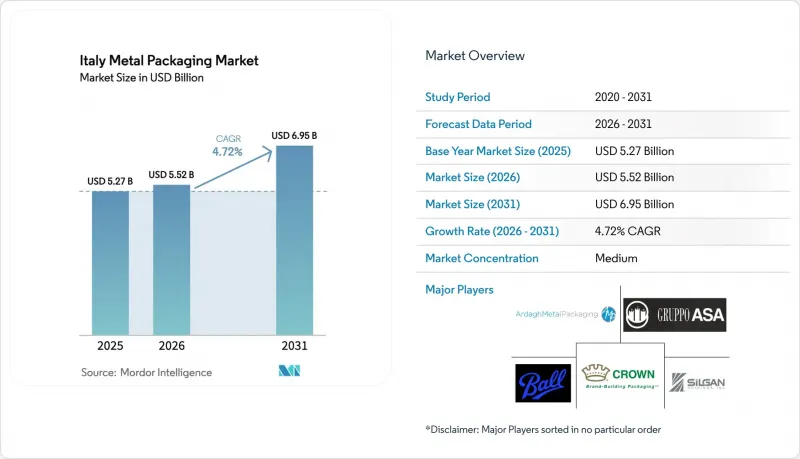
據 Mordor Intelligence 稱,2025 年義大利金屬包裝市場價值為 52.7 億美元,預計到 2031 年將達到 69.5 億美元,而 2026 年為 55.2 億美元,預測期(2026-2031 年)的複合年成長率為 4.72%。
本報告按材料類型(鋁、鋼、錫)、產品類型(罐、散裝容器、桶/罐、瓶蓋/封口等)、終端用戶行業(食品、飲料等)和塗層類型(環氧酚基、丙烯酸基、聚酯基、不含雙酚A的替代品等)進行細分。市場預測以美元計價。
義大利金屬包裝市場趨勢與洞察
即食食品消費量激增
即食食品在注重便利性和份量控制的都市區家庭中仍然很受歡迎。 2024年,冷凍食品銷售達102兆噸,價值58億歐元(64億美元),加工蔬菜出口量增加至25億歐元(27億美元)。金屬罐能夠確保這些高階產品更長的保存期限,從而維護品牌在遠距離市場的聲譽。此外,硬罐比軟包裝膜更耐小包裹搬運,進一步促進了電子商務的發展。隨著義大利生產商將銷售範圍擴展到物流不太可靠的地區,保持產品的阻隔性能對買家來說變得至關重要。這一趨勢也加速了對適合單人家庭的小型金屬容器的需求。
義大利精釀飲料生產的擴張
2024年,全國擁有1,326家精釀酒廠,年產量達1,760萬百公升,市場規模達102億歐元(約112億美元)。精釀啤酒釀造商普遍偏好鋁罐,因為鋁罐具有良好的遮光性和運輸效率。數位印刷技術即使在小批量生產中也能實現色彩鮮豔的圖案,使其非常適合限量版產品的推出。精釀烈酒這一細分市場也呈現出類似的趨勢,小批量生產的杜松子酒和阿瑪羅酒被裝入專為出口而設計的精緻金屬瓶中。北部地區的精釀啤酒中心利用接近性製罐廠的優勢,縮短了前置作業時間。由於品牌故事對獨立啤酒廠至關重要,能夠快速回應設計變更的供應商擁有競爭優勢。
原生鋁供應波動
2024年,受能源衝擊和地緣政治緊張局勢的影響,原生鋁價格波動幅度達15%至20%。義大利約95%的鋁錠依賴進口,使得加工商極易受到外匯風險和運費附加費的影響。儘管海德魯公司投資1,480萬歐元(約1,630萬美元)將阿特薩鋁業的回收產能提高1萬噸/年,但食品級廢鋁仍短缺。生產商透過簽訂長期合約進行避險,但利潤率仍面臨壓力。這種價格波動導致一些買家考慮暫時將非關鍵應用轉向使用鋼材或複合材料,減緩了鋁罐的短期成長。
細分市場分析
到2025年,鋁將佔據義大利金屬包裝市場63.35%的佔有率,這反映了其在飲料和常溫食品領域的強勢地位。同時,受汽車潤滑油、殺蟲劑和潤滑劑等包裝材料(中型散貨箱桶、罐和IBC)需求的推動,鋼鐵預計將以5.63%的複合年成長率成長。預計到2031年,以鋁為主導的義大利金屬包裝市場規模將接近45.5億美元,而鋼鐵市場規模可能超過20.5億美元。精釀啤酒和能量飲料產量的增加支撐了鋁的成長,但其高電力消耗量帶來了成本風險,而閉合迴路回收系統則具有優勢。鋼鐵受益於義大利上游卷材生產能力,這些產能集中在Lombardia,可為工業灌裝商提供較短的前置作業時間。
先進的塗層技術確保兩種金屬均符合歐盟食品接觸法規。不含雙酚A (BPA) 的產品,例如 Accelshield 700,正在擴大鋁在嬰兒配方奶粉罐中的應用,而聚酯-環氧樹脂混合材料則使含溶劑量高的髮膠的鋼製髮膠噴霧罐成為可能。回收目標(到 2030 年鋁容器的回收率達到 75%)正在推動合金最佳化,同時又不影響其成形性。同時,採用微量合金技術的輕質鋼材設計可使板材厚度減少高達 8%,進而幫助工業包裝公司達到環境稅閾值。隨著採購團隊評估整體擁有成本,價值提案的重點正從初始材料成本轉向循環效能。
到2025年,罐裝產品將佔總銷售額的39.65%,仍將是消費品包裝的主力軍。然而,隨著出口導向化工和製藥業的擴張,預計到2031年,散裝容器的年成長率將達到4.86%。在罐裝領域,精緻的250毫升飲料罐正受到精釀啤酒生產商的青睞,他們希望在競爭激烈的零售貨架上脫穎而出。同時,在義大利金屬包裝市場,散裝容器的市場規模到2031年可能達到11.4億美元,反映了工業物流的變化。剛性IBC噸桶、密封桶和大桶正在滿足電動車零件製造中對潤滑油混合物日益成長的需求。
數位印刷技術使得罐裝產品SKU得以擴展,而無需承擔高昂的製版成本。 Ball公司在歐洲、中東和非洲地區重新推出的「Dynamark」平台能夠以商業速度印刷可變圖形,使其成為季節性啤酒產品線的理想之選。同時,散裝容器製造商正專注於符合聯合國認證標準的設計、耐腐蝕內襯以及引入RFID標籤以提高供應鏈透明度。氣霧罐的需求也在成長,這主要得益於義大利南部面向遊客銷售的防曬油噴霧劑實現了兩位數的成長。用於盛裝橄欖油和糖果甜點的裝飾馬口鐵罐則保持著小規模但穩定的利基市場,充分利用了義大利重視送禮的美食文化。
其他好處:
- Excel格式的市場預測(ME)表
- 3個月的分析師支持
目錄
第1章:引言
- 研究假設和市場定義
- 調查範圍
第2章:調查方法
第3章執行摘要
第4章 市場狀況
- 市場概覽
- 市場促進因素
- 即食食品消費量激增
- 義大利精釀飲料生產的擴張
- 歐盟強制規定的金屬回收目標
- 對氣霧劑型個人保健產品的需求日益成長
- 金屬包裝領域的先進數位印刷技術
- 義大利出口型高檔食品的擴張
- 市場限制因素
- 原生鋁供應波動
- 塗料產業消費者對輕質塑膠的偏好正在轉變
- BPA替代品監管方面的不確定性
- 生產金屬罐需要大量的初始投資。
- 產業價值鏈分析
- 監理情勢
- 技術展望
- 宏觀經濟因素的影響
- 波特五力分析
第5章 市場規模與成長預測
- 依材料類型
- 鋁
- 鋼
- 鈴
- 依產品類型
- 能
- 食品罐頭
- 飲料罐
- 氣霧罐
- 裝飾罐
- 散裝容器
- 桶和罐
- 蓋子和封口
- 其他產品類型
- 能
- 按最終用戶行業分類
- 食物
- 飲料
- 油漆、塗料和化學產品
- 藥品和醫療保健
- 產業
- 其他終端用戶產業
- 按塗層類型
- 環氧樹脂和酚醛樹脂
- 丙烯酸纖維
- 聚酯纖維
- 不含雙酚A的替代品
- 其他塗層類型
第6章 競爭情勢
- 市場集中度
- 策略趨勢
- 市佔率分析
- 公司簡介
- Ardagh Metal Packaging Italy Srl
- Ball Beverage Packaging Italia Srl
- Crown Packaging Manufacturing UK Limited-Italian Operations
- Silgan Holdings Inc.
- Gruppo ASA SpA
- Tecnocap SpA
- Nespak SpA
- Trivium Packaging Italy SpA
- Verallia Italia SpA
- Envases Group Italy Srl
- Massilly Italia Srl
- Emballator Metal Group Italy
- Berlin Packaging Italy SpA
- Colep Packaging Italia SpA
- IMCSpA
- Nuova Sansone Srl
- Contital SpA
- CTS Italia Srl
- Metalpack Srl
第7章 市場機會與未來展望
According to Mordor Intelligence, the italy metal packaging market size was valued at USD 5.27 billion in 2025 and estimated to grow from USD 5.52 billion in 2026 to reach USD 6.95 billion by 2031, at a CAGR of 4.72% during the forecast period (2026-2031).
This report is Segmented by Material Type (Aluminum, Steel, and Tin), Product Type (Cans, Bulk Containers, Drums and Barrels, Caps and Closures, and More), End-User Industry (Food, Beverage, and More), and Coating Type (Epoxy Phenolic, Acrylic, Polyester, BPA-Free Alternatives, and More). The Market Forecasts are Provided in Terms of Value (USD).
Italy Metal Packaging Market Trends and Insights
Surge in Ready-to-Eat Food Consumption
Ready-to-eat meals remain popular with urban households that value convenience and portion control. Frozen goods hit 1.02 million t and EUR 5.8 billion (USD 6.4 billion) turnover in 2024, while processed vegetable exports rose to EUR 2.5 billion (USD 2.7 billion). Metal cans ensure a long shelf life for these premium items, thereby protecting the brand's reputation in distant markets. E-commerce adds momentum because rigid cans withstand parcel handling better than flexible films. As Italian producers increasingly sell to regions with less-reliable logistics, barrier integrity becomes a non-negotiable purchase criterion. The trend also accelerates demand for smaller metal formats that suit single-person households.
Growing Craft Beverage Production in Italy
The country counted 1,326 craft breweries with 17.6 million hl output valued at EUR 10.2 billion (USD 11.2 billion) in 2024. Artisanal brewers overwhelmingly favor aluminum cans for light protection and shipping efficiency. Digital printing enables colorful graphics in low volumes, aligning with limited-edition releases. The craft spirits niche follows a similar path, placing small-batch gin or amaro in sleek metal bottles designed for export. Northern clusters benefit from proximity to can makers, shortening lead times. Because brand storytelling matters to independent brewers, suppliers offering rapid design changes gain a competitive edge.
Supply Volatility of Primary Aluminum
Primary aluminum prices swung 15-20% during 2024 amid energy shocks and geopolitical strains. Italy imports roughly 95% of its ingots, exposing converters to exchange-rate risk and freight surcharges. Although Hydro invested EUR 14.8 million (USD 16.3 million) to lift Atessa's recycling capacity by 10,000 t yr-1, food-grade scrap remains scarce. Producers hedge with long-term contracts yet still face margin compression. The volatility briefly prompts some buyers to consider steel or composite solutions for non-critical uses, tempering near-term growth in aluminum cans.
Other drivers and restraints analyzed in the detailed report include:
- Mandatory EU Recycling Targets for Metal
- Rising Demand for Aerosol Personal-Care Products
- Consumer Shift Toward Lightweight Plastics in Paints
For complete list of drivers and restraints, kindly check the Table Of Contents.
Segment Analysis
Aluminum held 63.35% Italy metal packaging market share in 2025, mirroring its entrenched role in beverages and shelf-stable foods. Steel, however, is poised for a 5.63% CAGR on the back of drum, pail, and IBC demand from automotive fluids, agrochemicals, and lubricants. Italy metal packaging market size, attributed to aluminum, is projected to approach USD 4.55 billion by 2031, while steel could surpass USD 2.05 billion. Aluminum's growth stays tethered to increasing craft beer and energy drink production, but its high electricity intensity poses cost risks that favor closed-loop scrap systems. Steel benefits from Italy's upstream coil capacity clustered around Lombardy, offering short lead times for industrial fillers.
Advanced coatings ensure both metals comply with EU food-contact regulations. BPA-free variants such as Accelshield 700 widen aluminum's use in infant formula cans, whereas polyester-epoxy hybrids enable steel aerosol cans for solvent-heavy hair sprays. High recycled content targets-75% by 2030 for aluminum containers-encourage alloy optimization without sacrificing drawability. Simultaneously, lightweight steel designs using micro-alloying technologies lower gauge by up to 8%, helping industrial packers meet eco-tax thresholds. As procurement teams evaluate total cost of ownership, value propositions pivot on circularity credentials rather than upfront material price.
Cans retained 39.65% of the revenue in 2025 and remain the face of consumer-contact applications; yet, bulk containers are forecast to grow at a rate of 4.86% annually through 2031 as the export-heavy chemical and pharmaceutical industries scale. Within cans, sleek 250ml beverage formats are gaining favor among craft brewers seeking differentiation on crowded retail shelves. Meanwhile, Italy metal packaging market size generated by bulk containers could hit USD 1.14 billion by 2031, reflecting shifting industrial logistics. Rigid IBCs, tight-head drums, and large pails cater to the increasing volumes of lubricant blends associated with electric-vehicle part manufacturing.
Digital printing unlocks SKU proliferation for cans without prohibitive plate costs. Ball's Dynamark platform, relaunched across EMEA, prints variable graphics at commercial speed, ideal for seasonal beer lines. Conversely, bulk container manufacturers focus on UN-certified designs, corrosion-resistant linings, and RFID tagging for supply chain transparency. Demand for aerosol cans also advances, buoyed by double-digit growth in sun-care sprays marketed to tourists in Southern Italy. Decorative tins for olive oil and confectionery maintain a small but stable niche, capitalizing on the nation's gift-oriented gourmet culture.
Complete Report Scope:
- By Material Type
- Aluminum
- Steel
- Tin
- By Product Type
- Cans
- Food Cans
- Beverage Cans
- Aerosol Cans
- Decorative Cans
- Bulk Containers
- Drums and Barrels
- Caps and Closures
- Other Product Types
- Cans
- By End-User Industry
- Food
- Beverage
- Paints, Coatings and Chemicals
- Pharmaceuticals and Healthcare
- Industrial
- Other End-user Industries
- By Coating Type
- Epoxy Phenolic
- Acrylic
- Polyester
- BPA-Free Alternatives
- Other Coating Types
List of Companies Covered in this Report:
- Ardagh Metal Packaging Italy S.r.l.
- Ball Beverage Packaging Italia S.r.l.
- Crown Packaging Manufacturing UK Limited - Italian Operations
- Silgan Holdings Inc.
- Gruppo ASA S.p.A.
- Tecnocap S.p.A.
- Nespak S.p.A.
- Trivium Packaging Italy S.p.A.
- Verallia Italia S.p.A.
- Envases Group Italy S.r.l.
- Massilly Italia S.r.l.
- Emballator Metal Group Italy
- Berlin Packaging Italy S.p.A.
- Colep Packaging Italia S.p.A.
- I.M.C. S.p.A.
- Nuova Sansone S.r.l.
- Contital S.p.A.
- C.T.S. Italia S.r.l.
- Metalpack S.r.l.
Additional Benefits:
- The market estimate (ME) sheet in Excel format
- 3 months of analyst support
TABLE OF CONTENTS
1 INTRODUCTION
- 1.1 Study Assumptions and Market Definition
- 1.2 Scope of the Study
2 RESEARCH METHODOLOGY
3 EXECUTIVE SUMMARY
4 MARKET LANDSCAPE
- 4.1 Market Overview
- 4.2 Market Drivers
- 4.2.1 Surge in Ready-to-Eat Food Consumption
- 4.2.2 Growing Craft Beverage Production in Italy
- 4.2.3 Mandatory EU Recycling Targets for Metal
- 4.2.4 Rising Demand for Aerosol Personal-Care Products
- 4.2.5 Advanced Digital Printing on Metal Packaging
- 4.2.6 Expansion of Italian Export-Oriented Gourmet Foods
- 4.3 Market Restraints
- 4.3.1 Supply Volatility of Primary Aluminum
- 4.3.2 Consumer Shift Toward Lightweight Plastics in Paints
- 4.3.3 Regulatory Uncertainty Around BPA Substitutes
- 4.3.4 High Initial Capital for Metal Can Manufacturing
- 4.4 Industry Value Chain Analysis
- 4.5 Regulatory Landscape
- 4.6 Technological Outlook
- 4.7 Impact of Macroeconomic Factors
- 4.8 Porter's Five Forces Analysis
- 4.8.1 Threat of New Entrants
- 4.8.2 Bargaining Power of Buyers
- 4.8.3 Bargaining Power of Suppliers
- 4.8.4 Threat of Substitutes
- 4.8.5 Intensity Competitive Rivalry
5 MARKET SIZE AND GROWTH FORECASTS (VALUE)
- 5.1 By Material Type
- 5.1.1 Aluminum
- 5.1.2 Steel
- 5.1.3 Tin
- 5.2 By Product Type
- 5.2.1 Cans
- 5.2.1.1 Food Cans
- 5.2.1.2 Beverage Cans
- 5.2.1.3 Aerosol Cans
- 5.2.1.4 Decorative Cans
- 5.2.2 Bulk Containers
- 5.2.3 Drums and Barrels
- 5.2.4 Caps and Closures
- 5.2.5 Other Product Types
- 5.2.1 Cans
- 5.3 By End-User Industry
- 5.3.1 Food
- 5.3.2 Beverage
- 5.3.3 Paints, Coatings and Chemicals
- 5.3.4 Pharmaceuticals and Healthcare
- 5.3.5 Industrial
- 5.3.6 Other End-user Industries
- 5.4 By Coating Type
- 5.4.1 Epoxy Phenolic
- 5.4.2 Acrylic
- 5.4.3 Polyester
- 5.4.4 BPA-Free Alternatives
- 5.4.5 Other Coating Types
6 COMPETITIVE LANDSCAPE
- 6.1 Market Concentration
- 6.2 Strategic Moves
- 6.3 Market Share Analysis
- 6.4 Company Profiles (includes Global level Overview, Market level overview, Core Segments, Financials as available, Strategic Information, Market Rank/Share for key companies, Products and Services, and Recent Developments)
- 6.4.1 Ardagh Metal Packaging Italy S.r.l.
- 6.4.2 Ball Beverage Packaging Italia S.r.l.
- 6.4.3 Crown Packaging Manufacturing UK Limited - Italian Operations
- 6.4.4 Silgan Holdings Inc.
- 6.4.5 Gruppo ASA S.p.A.
- 6.4.6 Tecnocap S.p.A.
- 6.4.7 Nespak S.p.A.
- 6.4.8 Trivium Packaging Italy S.p.A.
- 6.4.9 Verallia Italia S.p.A.
- 6.4.10 Envases Group Italy S.r.l.
- 6.4.11 Massilly Italia S.r.l.
- 6.4.12 Emballator Metal Group Italy
- 6.4.13 Berlin Packaging Italy S.p.A.
- 6.4.14 Colep Packaging Italia S.p.A.
- 6.4.15 I.M.C. S.p.A.
- 6.4.16 Nuova Sansone S.r.l.
- 6.4.17 Contital S.p.A.
- 6.4.18 C.T.S. Italia S.r.l.
- 6.4.19 Metalpack S.r.l.
7 MARKET OPPORTUNITIES AND FUTURE OUTLOOK
- 7.1 White-space and unmet-need assessment

 德國金屬包裝市場:市場佔有率分析、產業趨勢與統計及成長預測(2026-2031)泰國金屬包裝市場:市場佔有率分析、產業趨勢與統計、成長預測(2026-2031)越南金屬包裝市場:市場佔有率分析、產業趨勢與統計及成長預測(2026-2031年)印度金屬包裝市場:市場佔有率分析、產業趨勢與統計、成長預測(2026-2031)金屬包裝:市場佔有率分析、產業趨勢及統計、成長預測(2026-2031)
 2034年鋼包裝市場預測-按產品類型、材料類型、產能、終端用戶產業和地區分類的全球分析
 金屬包裝市場報告:按產品類型、材料、應用和地區分類(2026-2034 年)
 金屬包裝市場機會、成長要素、產業趨勢分析及2026-2035年預測
 金屬包裝市場規模、佔有率、成長及全球產業分析:按類型、應用和地區分類的洞察,2026-2034 年預測全球金屬包裝材料市場規模、佔有率、趨勢和成長分析報告(2026-2034年)