


 |
市場調查報告書
商品編碼
2038438
金屬包裝市場機會、成長要素、產業趨勢分析及2026-2035年預測Metal Packaging Market Opportunity, Growth Drivers, Industry Trend Analysis, and Forecast 2026 - 2035 |
||||||

2025年全球金屬包裝市場價值為1,567億美元,預計到2035年將以3.5%的複合年成長率成長至2,189億美元。
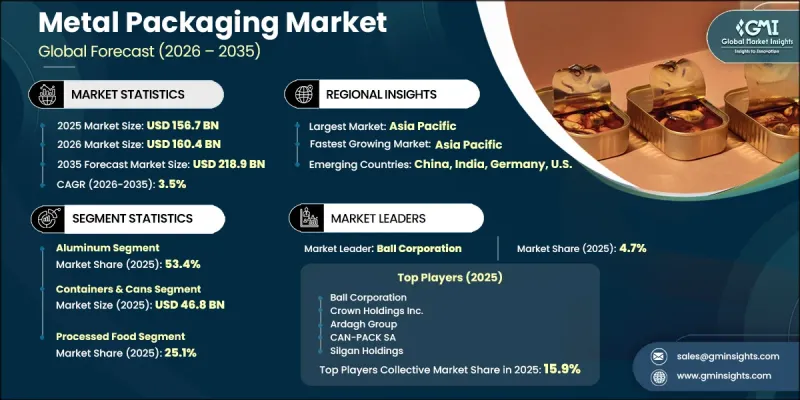
日益嚴格的永續發展法規推動了市場擴張,促使人們從塑膠包裝轉向高度可回收的金屬包裝。快速都市化帶來的生活方式改變,也帶動了包裝食品和飲料消費量的成長,進一步刺激了市場需求。金屬包裝因其延長產品保存期限、同時保持產品品質和安全性的能力而廣受認可,成為眾多行業的首選。製藥、醫療保健和個人護理行業的應用不斷拓展,也促進了市場成長,因為這些行業優先考慮耐用且防污染的包裝解決方案。此外,輕質材料和現代製造技術的進步提高了生產效率,實現了更精細的產品設計,並幫助品牌提升視覺吸引力和差異化優勢。永續性、耐用性和性能仍然是關鍵考慮因素,金屬包裝在全球市場正日益受到關注。
| 市場範圍 | |
|---|---|
| 開始年份 | 2025 |
| 預測期 | 2026-2035 |
| 初始市場規模 | 1567億美元 |
| 預測金額 | 2189億美元 |
| 複合年成長率 | 3.5% |
金屬包裝市場也受益於全球對環保包裝解決方案日益成長的興趣。以回收目標和生產者延伸責任為重點的法律規範正在推動鋁和鋼等材料的普及,這些材料因其高可回收性和對循環經濟的貢獻而備受青睞。金屬包裝的應用範圍正在從傳統的食品飲料產業擴展到醫療保健、個人護理和工業領域,在這些領域,性能、保護和產品穩定性至關重要。製造流程的持續技術創新正在提高效率、降低成本並增強可擴展性,從而擴大金屬包裝在各種終端用戶行業的應用。這些進步增強了金屬包裝相對於其他材料的競爭力。
預計到2035年,鋼鐵業將以3.2%的複合年成長率成長,這主要得益於罐頭食品、家居用品和工業包裝應用領域的穩定需求。鋼鐵因其強度高、耐久性強,且能承受高壓和大批量使用,仍是首選材料。其成本效益進一步推動了鋼鐵在大規模包裝作業中的應用,尤其是在價格敏感市場。隨著各行業持續重視可靠耐用的包裝解決方案,預計鋼鐵將在廣泛的應用領域保持穩定成長。
預計2026年至2035年,瓶罐市場將以5.4%的複合年成長率成長。該細分市場的成長主要得益於個人護理、化妝品、製藥和特色食品行業需求的不斷成長。消費者越來越青睞兼具功能性和視覺吸引力的優質包裝形式,促使金屬瓶罐的普及率不斷提高。金屬瓶罐的可重複使用性、耐用性和維持產品品質的能力是其在高價值和細分應用領域廣受歡迎的關鍵因素。
預計到2025年,北美金屬包裝市佔率將達到35.3%,主要得益於食品、飲料和家居用品領域的強勁需求。該地區擁有完善的零售和餐飲服務基礎設施,從而推動了包裝商品的穩定消費。消費者對便利、即用型產品的強勁需求,以及對衛生耐用包裝的偏好,持續推動金屬容器的廣泛應用。此外,監管機構對回收和永續性的日益重視,以及對國內製造和回收能力的投資,進一步促進了北美市場的成長。
目錄
第1章:調查方法和範圍
第2章執行摘要
第3章業界考察
- 生態系分析
- 供應商情況
- 利潤率
- 成本結構
- 每個階段增加的價值
- 影響價值鏈的因素
- 中斷
- 影響產業的因素
- 促進因素
- 過渡到永續且可無限循環的包裝
- 包裝食品和飲料消費量增加
- 人們越來越關注產品安全性和延長保存期限
- 製藥、個人護理和氣霧劑應用領域的成長
- 金屬包裝的輕量化與技術進步
- 產業潛在風險與挑戰
- 原物料價格波動
- 一種高度資本密集和能源密集型的生產過程。
- 市場機遇
- 從多材料包裝轉向單一材料金屬包裝解決方案
- 智慧功能性金屬包裝解決方案的興起
- 促進因素
- 成長潛力分析
- 監理情勢
- 北美洲
- 歐洲
- 亞太地區
- 拉丁美洲
- 中東和非洲
- 波特五力分析
- PESTEL 分析
- 科技與創新趨勢
- 當前技術趨勢
- 新興技術
- 價格趨勢
- 按地區
- 依產品
- 定價策略
- 新興經營模式
- 合規要求
- 專利和智慧財產權分析
第4章 競爭情勢
- 介紹
- 企業市佔率分析
- 按地區
- 北美洲
- 歐洲
- 亞太地區
- 拉丁美洲
- 中東和非洲
- 市場集中度分析
- 按地區
- 主要公司的競爭標竿分析
- 財務績效比較
- 銷售量
- 利潤率
- 研究與開發
- 產品系列比較
- 產品線寬度
- 科技
- 創新
- 區域擴張比較
- 全球擴張分析
- 服務網路覆蓋
- 按地區分類的市場滲透率
- 競爭定位矩陣
- 領導者
- 挑戰者
- 追蹤者
- 小眾玩家
- 戰略展望矩陣
- 財務績效比較
- 主要進展
- 併購
- 夥伴關係和聯盟
- 技術進步
- 業務拓展與投資策略
- 數位轉型計劃
- 新興/新創競爭對手的發展趨勢
第5章 市場估算與預測:依材料類型分類,2022-2035年
- 鋁
- 鐵
第6章 市場估算與預測:依產品類型分類,2022-2035年
- 容器和罐頭
- 瓶子罐
- 蓋子和閉合部件
- 桶
- 其他
第7章 市場估計與預測:依應用領域分類,2022-2035年
- 加工食品
- 乳製品
- 飲料
- 個人護理和化妝品
- 油漆和清漆
- 衛生保健
- 其他
第8章 市場估計與預測:依地區分類,2022-2035年
- 北美洲
- 美國
- 加拿大
- 歐洲
- 德國
- 英國
- 法國
- 西班牙
- 義大利
- 俄羅斯
- 亞太地區
- 中國
- 印度
- 日本
- 澳洲
- 韓國
- 拉丁美洲
- 巴西
- 墨西哥
- 阿根廷
- 中東和非洲
- 南非
- 沙烏地阿拉伯
- 阿拉伯聯合大公國
第9章:公司簡介
- 全球主要公司
- Ball Corporation
- Crown Holdings Inc.
- Ardagh Group
- CAN-PACK SA
- Silgan Holdings
- 按地區分類的主要公司
- 北美洲
- CPMC Holdings
- DS Containers Inc.
- Greif Incorporated
- Mauser Packaging Solutions
- Sonoco Products Company
- 亞太地區
- Toyo Seikan Group Holdings Inc.
- Visy Industries
- 歐洲
- Tubex GmbH
- CCL Containers
- Middle East &Africa
- Tata Steel
- 北美洲
- 特殊玩家/干擾者
- Amcor Limited
- Novelis Inc.
The Global Metal Packaging Market was valued at USD 156.7 billion in 2025 and is estimated to grow at a CAGR of 3.5% to reach USD 218.9 billion by 2035.
Market expansion is driven by tightening sustainability regulations that are encouraging a transition away from plastic toward highly recyclable metal packaging formats. Increasing consumption of packaged food and beverages, supported by fast-paced urban lifestyles, is further strengthening demand. Metal packaging is widely recognized for its ability to extend product shelf life while preserving quality and safety, making it a preferred choice across multiple industries. Growing applications in pharmaceuticals, healthcare, and personal care sectors are also contributing to market growth, as these industries prioritize durable and contamination-resistant packaging solutions. In addition, advancements in lightweight materials and modern manufacturing technologies are improving production efficiency and enhancing product design, allowing brands to achieve stronger visual appeal and differentiation. As sustainability, durability, and performance remain key priorities, metal packaging continues to gain traction across global markets.
| Market Scope | |
|---|---|
| Start Year | 2025 |
| Forecast Year | 2026-2035 |
| Start Value | $156.7 Billion |
| Forecast Value | $218.9 Billion |
| CAGR | 3.5% |
The metal packaging market is also benefiting from increasing global emphasis on environmentally responsible packaging solutions. Regulatory frameworks focused on recycling targets and extended producer responsibility are encouraging the adoption of materials such as aluminum and steel due to their high recyclability and circular economy benefits. The scope of metal packaging has expanded beyond traditional food and beverage applications, with growing utilization across healthcare, personal care, and industrial sectors where performance, protection, and product stability are critical. Continuous technological advancements in production processes are improving efficiency, reducing costs, and enhancing scalability, which is enabling broader adoption across diverse end-use industries. These developments are strengthening the competitiveness of metal packaging compared to alternative materials.
The steel segment is expected to grow at a CAGR of 3.2% through 2035, supported by consistent demand from canned goods, household products, and industrial packaging applications. Steel remains a preferred material due to its strength, durability, and ability to withstand high-pressure and high-volume usage conditions. Its cost-effectiveness further supports its adoption in large-scale packaging operations, particularly in price-sensitive markets. As industries continue to prioritize reliable and robust packaging solutions, steel is expected to maintain steady growth across a wide range of applications.
The bottles and jars segment is projected to grow at a CAGR of 5.4% during 2026-2035. Growth in this segment is driven by rising demand across personal care, cosmetics, pharmaceutical, and specialty food industries. Consumers are increasingly favoring premium packaging formats that offer both functionality and visual appeal, leading to greater adoption of metal bottles and jars. Their reusability, durability, and ability to preserve product integrity are key factors supporting their popularity in value-added and niche applications.
North America Metal Packaging Market accounted for 35.3% share in 2025, supported by strong demand across food, beverage, and household product segments. The region benefits from a well-established retail and foodservice infrastructure, which drives consistent consumption of packaged goods. High demand for convenient and ready-to-consume products, combined with a preference for hygienic and long-lasting packaging, continues to support the widespread use of metal containers. Increasing regulatory focus on recycling and sustainability, along with investments in domestic manufacturing and recycling capabilities, is further strengthening market growth across North America.
Key companies operating in the Global Metal Packaging Market include Ball Corporation, Crown Holdings Inc., Ardagh Group, Amcor Limited, Silgan Holdings, Sonoco Products Company, CAN-PACK SA, Toyo Seikan Group Holdings Inc., Tata Steel, Novelis Inc, Mauser Packaging Solutions, CCL Containers, DS Containers Inc., Greif Incorporated, Tubex GmbH, CPMC Holdings, and Visy Industries. These companies are actively expanding their capabilities and enhancing product offerings to meet evolving industry requirements. Companies in the metal packaging market are focusing on strategic initiatives aimed at strengthening their competitive position and expanding global reach. A major emphasis is placed on developing lightweight and sustainable packaging solutions that reduce material usage while maintaining durability and performance. Firms are investing in advanced manufacturing technologies to improve production efficiency and lower operational costs. Strategic collaborations with consumer brands and supply chain partners are helping companies secure long-term contracts and expand their customer base. Additionally, organizations are enhancing recycling capabilities and promoting circular economy practices to align with environmental regulations.
Table of Contents
Chapter 1 Methodology and Scope
- 1.1 Market scope and definition
- 1.2 Research design
- 1.2.1 Research approach
- 1.2.2 Data collection methods
- 1.3 Data mining sources
- 1.3.1 Global
- 1.3.2 Regional/Country
- 1.4 Base estimates and calculations
- 1.4.1 Base year calculation
- 1.4.2 Key trends for market estimation
- 1.5 Primary research and validation
- 1.5.1 Primary sources
- 1.6 Forecast model
- 1.7 Research assumptions and limitations
Chapter 2 Executive Summary
- 2.1 Industry 360° synopsis, 2022 - 2035
- 2.2 Key market trends
- 2.2.1 Material type trends
- 2.2.2 Product type trends
- 2.2.3 Application trends
- 2.2.4 Regional trends
- 2.3 TAM Analysis, 2026-2035
- 2.4 CXO perspectives: Strategic imperatives
Chapter 3 Industry Insights
- 3.1 Industry ecosystem analysis
- 3.1.1 Supplier Landscape
- 3.1.2 Profit Margin
- 3.1.3 Cost structure
- 3.1.4 Value addition at each stage
- 3.1.5 Factor affecting the value chain
- 3.1.6 Disruptions
- 3.2 Industry impact forces
- 3.2.1 Growth drivers
- 3.2.1.1 Shift toward sustainable and infinitely recyclable packaging
- 3.2.1.2 Rising consumption of packaged food and beverages
- 3.2.1.3 Increasing focus on product safety and shelf-life extension
- 3.2.1.4 Growth of pharmaceutical, personal care, and aerosol applications
- 3.2.1.5 Lightweight and technological advancements in metal packaging
- 3.2.2 Industry pitfalls and challenges
- 3.2.2.1 Volatility in raw material prices
- 3.2.2.2 High capital intensity and energy-intensive manufacturing processes
- 3.2.3 Market opportunities
- 3.2.3.1 Substitution of multi-material packaging with mono-material metal solutions
- 3.2.3.2 Emergence of smart and functional metal packaging solutions
- 3.2.1 Growth drivers
- 3.3 Growth potential analysis
- 3.4 Regulatory landscape
- 3.4.1 North America
- 3.4.2 Europe
- 3.4.3 Asia Pacific
- 3.4.4 Latin America
- 3.4.5 Middle East & Africa
- 3.5 Porter's analysis
- 3.6 PESTEL analysis
- 3.7 Technology and Innovation landscape
- 3.7.1 Current technological trends
- 3.7.2 Emerging technologies
- 3.8 Price trends
- 3.8.1 By region
- 3.8.2 By product
- 3.9 Pricing Strategies
- 3.10 Emerging Business Models
- 3.11 Compliance Requirements
- 3.12 Patent and IP analysis
Chapter 4 Competitive Landscape, 2025
- 4.1 Introduction
- 4.2 Company market share analysis
- 4.2.1 By region
- 4.2.1.1 North America
- 4.2.1.2 Europe
- 4.2.1.3 Asia Pacific
- 4.2.1.4 Latin America
- 4.2.1.5 Middle East & Africa
- 4.2.2 Market concentration analysis
- 4.2.1 By region
- 4.3 Competitive benchmarking of key players
- 4.3.1 Financial performance comparison
- 4.3.1.1 Revenue
- 4.3.1.2 Profit margin
- 4.3.1.3 R&D
- 4.3.2 Product portfolio comparison
- 4.3.2.1 Product range breadth
- 4.3.2.2 Technology
- 4.3.2.3 Innovation
- 4.3.3 Geographic presence comparison
- 4.3.3.1 Global footprint analysis
- 4.3.3.2 Service network coverage
- 4.3.3.3 Market penetration by region
- 4.3.4 Competitive positioning matrix
- 4.3.4.1 Leaders
- 4.3.4.2 Challengers
- 4.3.4.3 Followers
- 4.3.4.4 Niche players
- 4.3.5 Strategic outlook matrix
- 4.3.1 Financial performance comparison
- 4.4 Key developments
- 4.4.1 Mergers and acquisitions
- 4.4.2 Partnerships and collaborations
- 4.4.3 Technological advancements
- 4.4.4 Expansion and investment strategies
- 4.4.5 Digital transformation initiatives
- 4.5 Emerging/ startup competitors landscape
Chapter 5 Market Estimates and Forecast, By Material Type, 2022 - 2035 (USD Million)
- 5.1 Key trends
- 5.2 Aluminum
- 5.3 Steel
Chapter 6 Market Estimates and Forecast, By Product Type, 2022 - 2035 (USD Million)
- 6.1 Key trends
- 6.2 Containers & cans
- 6.3 Bottles & jars
- 6.4 Caps & closures
- 6.5 Barrels & drums
- 6.6 Others
Chapter 7 Market Estimates and Forecast, By Application, 2022 - 2035 (USD Million)
- 7.1 Key trends
- 7.2 Processed food
- 7.3 Dairy products
- 7.4 Beverages
- 7.5 Personal care & cosmetics
- 7.6 Paints & varnishes
- 7.7 Healthcare
- 7.8 Others
Chapter 8 Market Estimates and Forecast, By Region, 2022 - 2035 (USD Million)
- 8.1 Key trends
- 8.2 North America
- 8.2.1 U.S.
- 8.2.2 Canada
- 8.3 Europe
- 8.3.1 Germany
- 8.3.2 UK
- 8.3.3 France
- 8.3.4 Spain
- 8.3.5 Italy
- 8.3.6 Russia
- 8.4 Asia Pacific
- 8.4.1 China
- 8.4.2 India
- 8.4.3 Japan
- 8.4.4 Australia
- 8.4.5 South Korea
- 8.5 Latin America
- 8.5.1 Brazil
- 8.5.2 Mexico
- 8.5.3 Argentina
- 8.6 Middle East and Africa
- 8.6.1 South Africa
- 8.6.2 Saudi Arabia
- 8.6.3 UAE
Chapter 9 Company Profiles
- 9.1 Global Key Players
- 9.1.1 Ball Corporation
- 9.1.2 Crown Holdings Inc.
- 9.1.3 Ardagh Group
- 9.1.4 CAN-PACK SA
- 9.1.5 Silgan Holdings
- 9.2 Regional key players
- 9.2.1 North America
- 9.2.1.1 CPMC Holdings
- 9.2.1.2 DS Containers Inc.
- 9.2.1.3 Greif Incorporated
- 9.2.1.4 Mauser Packaging Solutions
- 9.2.1.5 Sonoco Products Company
- 9.2.2 Asia Pacific
- 9.2.2.1 Toyo Seikan Group Holdings Inc.
- 9.2.2.2 Visy Industries
- 9.2.3 Europe
- 9.2.3.1 Tubex GmbH
- 9.2.3.2 CCL Containers
- 9.2.4 Middle East & Africa
- 9.2.4.1 Tata Steel
- 9.2.1 North America
- 9.3 Niche Players/Disruptors
- 9.3.1 Amcor Limited
- 9.3.2 Novelis Inc.

 德國金屬包裝市場:市場佔有率分析、產業趨勢與統計及成長預測(2026-2031)泰國金屬包裝市場:市場佔有率分析、產業趨勢與統計、成長預測(2026-2031)義大利金屬包裝市場:市場佔有率分析、產業趨勢與統計及成長預測(2026-2031)越南金屬包裝市場:市場佔有率分析、產業趨勢與統計及成長預測(2026-2031年)印度金屬包裝市場:市場佔有率分析、產業趨勢與統計、成長預測(2026-2031)金屬包裝:市場佔有率分析、產業趨勢及統計、成長預測(2026-2031)
 2034年鋼包裝市場預測-按產品類型、材料類型、產能、終端用戶產業和地區分類的全球分析
 金屬包裝市場報告:按產品類型、材料、應用和地區分類(2026-2034 年)
 金屬包裝市場規模、佔有率、成長及全球產業分析:按類型、應用和地區分類的洞察,2026-2034 年預測全球金屬包裝材料市場規模、佔有率、趨勢和成長分析報告(2026-2034年)