


 |
市場調查報告書
商品編碼
2116922
越南金屬包裝市場:市場佔有率分析、產業趨勢與統計及成長預測(2026-2031年)Vietnam Metal Packaging - Market Share Analysis, Industry Trends & Statistics, Growth Forecasts (2026 - 2031) |
||||||

※ 本網頁內容可能與最新版本有所差異。詳細情況請與我們聯繫。
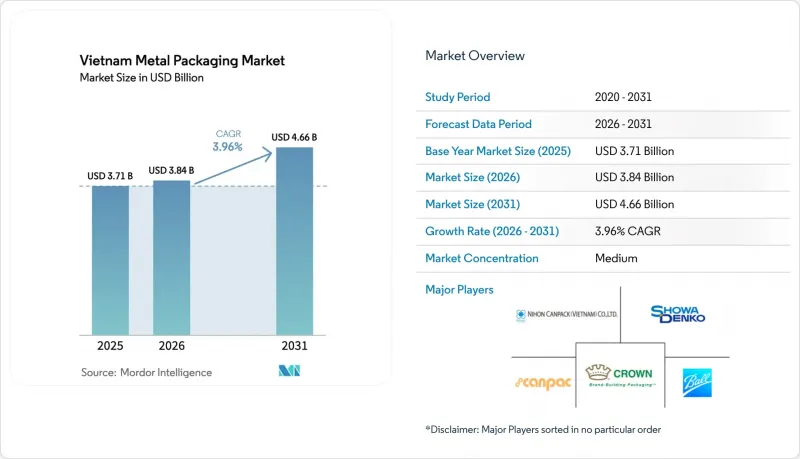
據 Mordor Intelligence 稱,越南金屬包裝市場規模預計將從 2025 年的 37.1 億美元成長到 2026 年的 38.4 億美元,到 2031 年達到 46.6 億美元,2026 年至 2031 年的複合年成長率為 3.96%。
本報告按材質(鋁和鋼)、產品類型(罐、散裝容器、運輸桶、瓶蓋和封蓋等)、容量(1公升以下、1升至25公升、25升至200公升、200公升以上)以及最終用途行業(飲料、食品、油漆和化學品、工業及其他)進行細分。市場預測以美元計價。
越南金屬包裝市場趨勢與洞察
擴大國內飲料罐裝產能
在越南,2024年至2025年間投資超過6億美元用於升級啤酒和軟性飲料生產線,有效提升了罐裝加工總產能,使越南成為東南亞鋁罐生產中心。光是喜力一家就投資5.4億美元用於提升其在平陽省的產能,而三得利百事可樂則將其年產量提高了65%,達到8.25億升。生產線速度的提升,例如Sunrise Packaging於2025年3月推出的每分鐘2000罐的生產線,使單位成本降低了12%,加速了主流啤酒從玻璃瓶向易拉罐的轉變。產能的擴張也帶動了上游工程,例如丸紅株式會社的「NM2鋁回收」項目,該項目旨在每年生產5萬噸鋁卷,從而降低對進口的依賴。因此,供應和成本穩定得到保障,擴大了越南金屬包裝市場的潛在市場規模。
都市區中產階級購買力的增強
到2025年,越南都市區中產階級人口將超過3,600萬,平均年收入超過5,000美元,他們將青睞優質精釀啤酒、即飲咖啡和進口烈酒。金屬包裝容器無需冷藏,可延長保存期限,這在冷鏈基礎設施不完善的越南市場中是一項顯著優勢。 TBC-Ball公司位於平陽省的年產8.5億罐的工廠正在滿足這一高階市場需求,其生產的精美罐體不僅提升了產品的商店形象,還符合鋁業舉措(ASI)的標準。類似的消費群也推動了家用加壓氣霧劑產品的蓬勃發展,預計2024年至2025年間將有47款採用金屬包裝的新產品上市。儘管宏觀經濟存在波動,但這些生活方式的改善正在推動越南金屬包裝市場穩步成長。
進口鋁卷價格波動
2024年,鋁現貨價格一度飆升至每噸2,700美元,隨後在2026年初回落至每噸2,500美元左右。這一價格波動導致簽訂年度供應合約的製罐製造商的EBITDA獲利率下降了8%至12%。昭和鋁業在其2024年證券報告中指出,儘管對2026年40%的需求進行了避險,但卷材成本仍佔銷貨成本的68%,高於2022年的62%。 2024年,越南盾貶值進一步推高了成本,增幅達3.2%。在越南國內冶煉廠運作之前,越南的金屬包裝市場將繼續受到全球大宗商品週期的影響,這可能會嚴重影響盈利。
細分市場分析
到2025年,隨著主要飲料公司年產能達到32億個鋁罐,預計鋁將佔據越南金屬包裝市場61.17%的佔有率。同時,隨著海鮮加工商和油漆製造商從塑膠桶轉向符合危險品法規的鋼桶,預計鋼材將超越鋁材,到2031年將維持4.86%的複合年成長率。鋁材在越南金屬包裝市場佔據主導地位,這得益於其75%的消費後回收率和比鋼材輕18%的重量優勢,隨著「生產者延伸責任制(EPR)」目標的不斷擴大和日益嚴格,這些優勢也促進了跨國公司的業務成長。另一方面,和發集團位於達樂的鋼鐵廠的國內鋼鐵產能正吸引著那些優先考慮供應穩定性的工業買家,因為其能夠提供價格穩定和更短的前置作業時間。
鋁的未來取決於丸紅株式會社的5萬噸回收生產線,該生產線預計將減少95%的碳排放,並將飲料罐的回收率提高到75%以上。電子商務正在推動鋼鐵的崛起。由於軟性塑膠容器在運輸過程中容易因衝擊而破損,而桶裝容器則能承受「最後一公里」配送的衝擊,因此訂單履行商更傾向於選擇金屬容器。隨著這兩種材料的應用範圍不斷擴大,越南的金屬包裝市場並非零和博弈,而是由這兩種主要材料共同驅動的穩健成長。
到2025年,飲料和食品罐將佔據越南金屬包裝市場58.52%的佔有率,鞏固其在該市場的主導地位。在92億美元的水產品出口和450億美元的化學品出貨量的支撐下,運輸桶和罐預計到2031年將以5.33%的複合年成長率成長,超過所有其他產品系列。在越南金屬包裝市場,由於消費者對碳酸飲料的需求以及對金屬保鮮性能的偏好,罐裝產品的市場佔有率並未受到袋裝產品進入市場的影響。同時,受個人護理品牌採用加壓噴霧器的推動,氣霧罐預計到2025年將佔總產量的8%。
由於預計符合歐盟食品接觸法規的魚露出口商對200公升鋼桶的需求增加,Graif位於巴地-頭頓的工廠預計2024年產量將成長18%。這些鋼桶的耐用性也受到尋求符合國際海事組織(IMO)認證的化學品運輸商的青睞。 Crown Holdings推出的壓花精美罐裝產品在上市六個月內就被22%的精釀啤酒廠採用,這顯示為了維持高利潤率,罐裝產品的設計正日益優質化。這兩個趨勢正在推動越南金屬包裝市場整體的多元化成長。
其他好處:
- Excel格式的市場預測(ME)表
- 3個月的分析師支持
目錄
第1章:引言
- 研究假設和市場定義
- 調查範圍
第2章:調查方法
第3章執行摘要
第4章 市場狀況
- 市場概覽
- 市場促進因素
- 方便快速的即食食品需求激增。
- 都市區中產階級購買力的提升
- 政府為實現循環經濟目標所做的努力
- 擴大國內飲料罐裝產能
- 出口導向型海鮮加工業的成長
- 隨著電子商務的興起,對堅固耐用的運輸包裝材料的需求也日益成長。
- 市場限制因素
- 柔軟性塑膠的出現加劇了競爭。
- 進口鋁卷價格波動
- 環保組織反對礬土開採
- 高速罐體製造流程的技能差距
- 產業價值鏈分析
- 宏觀經濟因素對市場的影響
- 監理情勢
- 技術展望
- 波特五力分析
第5章 市場規模與成長預測
- 材料
- 鋁
- 鋼
- 依產品類型
- 坎
- 食品罐頭
- 飲料罐
- 氣霧罐
- 散裝容器
- 運輸桶和罐
- 蓋子和封口
- 其他產品類型
- 坎
- 按產能
- 1公升或更少
- 1升以上至25升
- 25公升以上至200公升
- 200公升或以上
- 按最終用途行業分類
- 飲料
- 食物
- 油漆和化學品
- 產業
- 其他終端用戶產業
第6章 競爭情勢
- 市場集中度
- 策略趨勢
- 市佔率分析
- 公司簡介
- Canpac Vietnam Co., Ltd.
- Nihon Canpack Vietnam Co., Ltd.
- Crown Holdings, Inc.
- Showa Aluminum Can Corporation
- Metal Printing and Packaging Ltd.
- Greif, Inc.
- My Chau Printing and Packaging Corporation
- TMB Corporation
- Superior Multi-Packaging Limited
- Ardagh Group SA
- Toyo Seikan Group Holdings, Ltd.
- Ball Corporation
- Hanacans Vietnam Co., Ltd.
- Silgan Holdings Inc.
- Kian Joo Can Factory Berhad
- Thai Beverage Can Ltd.
- Ton Poh Thai Group
- Sunrise Packaging Vietnam
- Daiwa Can Company
第7章 市場機會與未來展望
According to Mordor Intelligence, the vietnam metal packaging market size is expected to increase from USD 3.71 billion in 2025 to USD 3.84 billion in 2026 and reach USD 4.66 billion by 2031, growing at a CAGR of 3.96% over 2026-2031.
This report is Segmented by Material (Aluminium, and Steel), Product Type (Cans, Bulk Containers, Shipping Barrels and Drums, Caps and Closures, and More), Capacity (Up To 1 L, More Than 1L To 25L, More Than 25L To 200L, and Above 200L), and End-Use Industry (Beverage, Food, Paint and Chemical, Industrial, and More). The Market Forecasts are Provided in Terms of Value (USD).
Vietnam Metal Packaging Market Trends and Insights
Expansion of Domestic Beverage Canning Capacity
Vietnam recorded more than USD 600 million of brewery and soft-drink line upgrades between 2024 and 2025, effectively doubling aggregate canning throughput and positioning the country as Southeast Asia's aluminum-can hub. Heineken alone committed USD 540 million to boosting capacity in Binh Duong, while Suntory PepsiCo increased output by 65% to 825 million liters per year. Faster line speeds, exemplified by Sunrise Packaging's 2,000-cans-per-minute installation in March 2025, have trimmed unit costs by 12% and encouraged a switch from glass to cans for mainstream beers. Capacity additions are cascading upstream as Marubeni's NM2 Aluminum Recycling project targets 50,000 tonnes of coil per year, easing reliance on imports. The resulting supply security and cost stability are expanding the addressable market for Vietnam's metal packaging market.
Rising Urban Middle-Class Consumption Power
Vietnam's urban middle class surpassed 36 million citizens in 2025, each earning more than USD 5,000 annually and favoring premium craft beers, ready-to-drink coffee, and imported spirits. Metal containers offer extended shelf life without refrigeration, a key advantage given the uneven cold-chain infrastructure. TBC-Ball's 850-million-can plant in Binh Duong fulfills this upscale demand, supplying sleek cans that enhance shelf presence and meet Aluminium Stewardship Initiative standards. The same demographic is fueling a boom in pressurized household-care aerosols, with 47 new SKUs arriving in metal formats during 2024-2025. These lifestyle upgrades keep the Vietnam metal packaging market on a steady growth footing despite macro-economic volatility.
Price Volatility of Imported Aluminum Coil
Spot aluminum hovered near USD 2,500 per tonne in early 2026 after peaking at USD 2,700 in 2024, a swing that compressed 8-12% EBITDA margins for can makers locked into annual supply contracts. Showa Aluminum reported coil costs climbing to 68% of cost of goods sold in its 2024 filing, up from 62% in 2022, despite hedging 40% of 2026 needs. Dong depreciation added a further 3.2% cost burden in 2024. Until domestic smelters come online, the Vietnam metal packaging market remains exposed to global commodity cycles that can abruptly erode profitability.
Other drivers and restraints analyzed in the detailed report include:
- Government Push toward Circular Economy Targets
- Surging Demand for Convenient Ready-to-Eat Meals
- Intensifying Competition from Flexible Plastics
For complete list of drivers and restraints, kindly check the Table Of Contents.
Segment Analysis
Aluminum secured 61.17% share of the Vietnam metal packaging market in 2025 as beverage giants installed 3.2 billion cans of annual capacity. In parallel, steel is expected to log a 4.86% CAGR through 2031, surpassing aluminum's pace as seafood processors and paint makers migrate from plastic jerrycans to steel pails compliant with hazardous-goods rules. The Vietnam metal packaging market size for aluminum remains anchored by its 75% post-consumer collection rate and 18% freight-weight advantage versus steel, aiding multinationals under tightening Extended Producer Responsibility targets. Conversely, domestic steel capacity from Hoa Phat's Dak Lak complex offers price stability and shorter lead times, tempting industrial buyers who prize supply security.
Aluminum's future trajectory hinges on Marubeni's 50,000-tonne recycling line, which slashes carbon footprints 95% and could elevate recycled content in beverage cans beyond 75%. Steel's leap is spurred by e-commerce, where pails survive last-mile courier knocks that puncture flexible plastics, driving order-fulfillment providers to favor metal. With both substrates widening their addressable niches, the Vietnam metal packaging market shows healthy dual-material growth rather than a zero-sum battle.
Beverage and food cans contributed 58.52% of market share in 2025, cementing their primacy in the Vietnam metal packaging market. Shipping barrels and drums, buoyed by USD 9.2 billion in seafood exports and USD 45 billion in chemical shipments, are forecast to outpace every other product group at a 5.33% CAGR through 2031. The Vietnam metal packaging market share for cans remains insulated from pouch incursion, thanks to carbonation needs and consumer preference for metal freshness cues. Meanwhile, aerosol cans captured 8% of 2025 output as personal-care brands embraced pressurized dispensers.
Greif's Ba Ria-Vung Tau facility reported 18% volume gains in 2024 as 200-liter steel drums found takers among fish-sauce exporters complying with EU food-contact rules. Drum durability also resonates with chemical shippers seeking IMO-approved barrels. Crown Holdings' embossed sleek can, adopted by 22% of microbreweries within six months, illustrates the ongoing premiumization in can design that sustains higher margins. These dual trends reinforce diversified growth across the Vietnam metal packaging market.
Complete Report Scope:
- By Material
- Aluminium
- Steel
- By Product Type
- Cans
- Food Cans
- Beverage Cans
- Aerosol Cans
- Bulk Containers
- Shipping Barrels and Drums
- Caps and Closures
- Other Product Types
- Cans
- By Capacity
- Upto 1 L
- More than 1L to 25L
- More than 25L to 200L
- Above 200L
- By End-use Industry
- Beverage
- Food
- Paint and Chemical
- Industrial
- Other End-use Industries
List of Companies Covered in this Report:
- Canpac Vietnam Co., Ltd.
- Nihon Canpack Vietnam Co., Ltd.
- Crown Holdings, Inc.
- Showa Aluminum Can Corporation
- Metal Printing and Packaging Ltd.
- Greif, Inc.
- My Chau Printing and Packaging Corporation
- TMB Corporation
- Superior Multi-Packaging Limited
- Ardagh Group S.A.
- Toyo Seikan Group Holdings, Ltd.
- Ball Corporation
- Hanacans Vietnam Co., Ltd.
- Silgan Holdings Inc.
- Kian Joo Can Factory Berhad
- Thai Beverage Can Ltd.
- Ton Poh Thai Group
- Sunrise Packaging Vietnam
- Daiwa Can Company
Additional Benefits:
- The market estimate (ME) sheet in Excel format
- 3 months of analyst support
TABLE OF CONTENTS
1 INTRODUCTION
- 1.1 Study Assumptions and Market Definition
- 1.2 Scope of the Study
2 RESEARCH METHODOLOGY
3 EXECUTIVE SUMMARY
4 MARKET LANDSCAPE
- 4.1 Market Overview
- 4.2 Market Drivers
- 4.2.1 Surging Demand for Convenient, Ready-to-Eat Meals
- 4.2.2 Rising Urban Middle-Class Consumption Power
- 4.2.3 Government Push toward Circular Economy Targets
- 4.2.4 Expansion of Domestic Beverage Canning Capacity
- 4.2.5 Growth of Export-Oriented Seafood Processing
- 4.2.6 E-commerce Adoption Requiring Robust Transit Packaging
- 4.3 Market Restraints
- 4.3.1 Intensifying Competition from Flexible Plastics
- 4.3.2 Price Volatility of Imported Aluminum Coil
- 4.3.3 Environmental Opposition to Bauxite Mining
- 4.3.4 Skill Gaps in High-Speed Can-Making Operations
- 4.4 Industry Value Chain Analysis
- 4.5 Impact of Macroeconomic Factors on the Market
- 4.6 Regulatory Landscape
- 4.7 Technological Outlook
- 4.8 Porter's Five Forces Analysis
- 4.8.1 Bargaining Power of Suppliers
- 4.8.2 Bargaining Power of Consumers
- 4.8.3 Threat of New Entrants
- 4.8.4 Threat of Substitute Products
- 4.8.5 Intensity of Competitive Rivalry
5 MARKET SIZE AND GROWTH FORECASTS (VALUE)
- 5.1 By Material
- 5.1.1 Aluminium
- 5.1.2 Steel
- 5.2 By Product Type
- 5.2.1 Cans
- 5.2.1.1 Food Cans
- 5.2.1.2 Beverage Cans
- 5.2.1.3 Aerosol Cans
- 5.2.2 Bulk Containers
- 5.2.3 Shipping Barrels and Drums
- 5.2.4 Caps and Closures
- 5.2.5 Other Product Types
- 5.2.1 Cans
- 5.3 By Capacity
- 5.3.1 Upto 1 L
- 5.3.2 More than 1L to 25L
- 5.3.3 More than 25L to 200L
- 5.3.4 Above 200L
- 5.4 By End-use Industry
- 5.4.1 Beverage
- 5.4.2 Food
- 5.4.3 Paint and Chemical
- 5.4.4 Industrial
- 5.4.5 Other End-use Industries
6 COMPETITIVE LANDSCAPE
- 6.1 Market Concentration
- 6.2 Strategic Moves
- 6.3 Market Share Analysis
- 6.4 Company Profiles (Includes Global Level Overview, Market Level Overview, Core Segments, Financials as Available, Strategic Information, Market Rank/Share, Products and Services, and Recent Developments)
- 6.4.1 Canpac Vietnam Co., Ltd.
- 6.4.2 Nihon Canpack Vietnam Co., Ltd.
- 6.4.3 Crown Holdings, Inc.
- 6.4.4 Showa Aluminum Can Corporation
- 6.4.5 Metal Printing and Packaging Ltd.
- 6.4.6 Greif, Inc.
- 6.4.7 My Chau Printing and Packaging Corporation
- 6.4.8 TMB Corporation
- 6.4.9 Superior Multi-Packaging Limited
- 6.4.10 Ardagh Group S.A.
- 6.4.11 Toyo Seikan Group Holdings, Ltd.
- 6.4.12 Ball Corporation
- 6.4.13 Hanacans Vietnam Co., Ltd.
- 6.4.14 Silgan Holdings Inc.
- 6.4.15 Kian Joo Can Factory Berhad
- 6.4.16 Thai Beverage Can Ltd.
- 6.4.17 Ton Poh Thai Group
- 6.4.18 Sunrise Packaging Vietnam
- 6.4.19 Daiwa Can Company
7 MARKET OPPORTUNITIES AND FUTURE OUTLOOK
- 7.1 White-Space and Unmet-Need Assessment

 德國金屬包裝市場:市場佔有率分析、產業趨勢與統計及成長預測(2026-2031)泰國金屬包裝市場:市場佔有率分析、產業趨勢與統計、成長預測(2026-2031)義大利金屬包裝市場:市場佔有率分析、產業趨勢與統計及成長預測(2026-2031)印度金屬包裝市場:市場佔有率分析、產業趨勢與統計、成長預測(2026-2031)金屬包裝:市場佔有率分析、產業趨勢及統計、成長預測(2026-2031)
 2034年鋼包裝市場預測-按產品類型、材料類型、產能、終端用戶產業和地區分類的全球分析
 金屬包裝市場報告:按產品類型、材料、應用和地區分類(2026-2034 年)
 金屬包裝市場機會、成長要素、產業趨勢分析及2026-2035年預測
 金屬包裝市場規模、佔有率、成長及全球產業分析:按類型、應用和地區分類的洞察,2026-2034 年預測全球金屬包裝材料市場規模、佔有率、趨勢和成長分析報告(2026-2034年)