


 |
市場調查報告書
商品編碼
2121529
金屬包裝:市場佔有率分析、產業趨勢及統計、成長預測(2026-2031)Metal Packaging - Market Share Analysis, Industry Trends & Statistics, Growth Forecasts (2026 - 2031) |
||||||

※ 本網頁內容可能與最新版本有所差異。詳細情況請與我們聯繫。
根據 Mordor Intelligence 預測,金屬包裝市場規模將從 2025 年的 1,362.2 億美元成長到 2026 年的 1,401.6 億美元,然後在 2031 年達到 1,616.1 億美元,2026 年至 2031 年的複合年成長率為 2.89%。
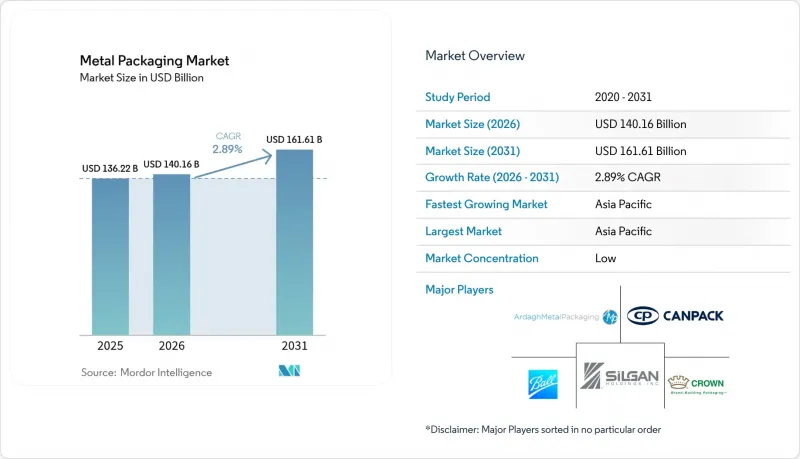
本報告按材料類型(鋁、鋼)、產品類型(散裝容器、運輸桶、蓋子與封口裝置等)、終端用戶行業(飲料、食品等)、塗層/內襯類型(BPA環氧樹脂、BPA-NI環氧樹脂等)、容器容量(小於250毫升、251-500毫升、其他)和地區(北美等)進行細分。市場預測以美元(USD)計價。
全球金屬包裝市場趨勢與洞察
循環經濟法規正在促進「罐到罐」的回收循環。
更嚴格的監管正在重塑價值鏈的經濟結構。鋁罐的回收率已超過最低標準,這使得金屬包裝市場在合規性方面具有競爭優勢。歐盟的《包裝和包裝廢棄物法規》(PPWR) 規定,到2030年,飲料容器中必須使用30%的再生材料,而鋁罐的平均回收率已達71%。押金返還機制正推動回收率在2029年達到90%。這確保了廢料供應的穩定性,並減少了對未使用金屬的依賴。像波爾公司這樣的全球製造商的目標是85%的再生材料回收率,這將增強閉合迴路效率並降低原料成本風險。澳洲制定了與歐盟法規類似的標準,要求到2040年,食品罐中必須含有80%的消費後再生材料。監管的持續推進正在鞏固鋁相對於PET的競爭優勢,尤其是在飲料行業。目前,在飲料業,循環性評分已成為評估供應商競標的考量因素之一。
新興亞洲即飲飲料的優質化
亞太地區高階罐裝飲料需求的激增正在加速金屬包裝市場的成長。在日本,隨著消費者尋求低卡路里、低酒精度的選擇,罐裝酒(一種日本酒精飲料)的市場在2018年至2023年間成長了兩倍。朝日啤酒的「生酒鬼」等品牌展示了包裝創新如何將餐廳般的體驗帶回家。中國和印度可支配收入的成長正在推動高階即飲咖啡、康普茶和功能性代餐飲料進入主流零售市場,而這些產品都依賴罐裝來保持風味和保溫。這波優質化使製造商能夠將不斷上漲的原料成本轉嫁給消費者,並在鋁價波動的情況下維持利潤率。
倫敦金屬交易所鋁和鋼鐵價格波動
能源價格波動導致利潤空間受到擠壓。這是因為金屬包裝市場仍然依賴包含轉嫁條款的契約,這些條款反映現貨價格波動存在滯後。北美徵收的關稅進一步加劇了這種情況,迫使生產商將避險措施與區域採購結合,以保持競爭力。歐洲冶煉廠面臨持續的能源成本壓力,加劇了全球價格波動。雖然大型企業透過廢料供應和多年期合約來抵消價格波動的影響,但小型加工商仍面臨風險,這可能導致其資本投資週期放緩。
細分市場分析
預計到2025年,鋁將佔金屬包裝市場佔有率的42.80%,並將在2031年之前以3.57%的複合年成長率成長,這主要得益於符合PPWR(包裝和包裝廢棄物法規)要求的閉合迴路回收系統。鋼材在大型食品和工業用桶中仍然佔據重要地位,但由於重量和能耗問題,其成長速度正在放緩。諾貝麗斯公司投資9,000萬美元將其易拉罐回收能力翻倍並擴大在英國的業務,凸顯了這種材料的戰略重要性。鋁的輕量特性可以減少物流排放,更符合ESG(環境、社會和治理)評分標準,並增強飲料品牌的顧客忠誠度。市場參與企業持續投資於重熔技術,這正在穩步擴大與再生鋁相關的金屬包裝市場規模。
與新金屬相比,再生鋁的價格優勢有助於品牌控制原物料成本並降低採購風險。印度鋁業(Hindalco)100億美元的產能擴張計畫表明,一體化的冶煉和回收中心將如何縮短供應鏈並協助實現雄心勃勃的再生材料含量目標。雖然鋼材的磁性回收性在混合廢棄物處理中仍是一項優勢,但隨著碳排放稅的日益普及,容器重量的增加推高了運輸成本。總體而言,鋁的成本、循環性和重量優勢鞏固了其主導地位,而鋼材在一些注重機械強度和抗穿刺性的細分市場中仍然佔有一席之地。
到2025年,罐裝產品將佔金屬包裝市場的41.12%,預計複合年成長率將達到6.08%,主要得益於全球便利商店通路即飲咖啡、硬蘇打水和機能飲料的優質化。波爾公司的「Dynamark Advanced Pro」可變圖形系統可實現大規模罐身個性化客製化,幫助行銷人員提升消費者參與度和商店吸引力。食品罐頭市場保持穩定,為番茄醬、湯類和寵物食品的全球貿易提供了高阻隔性。氣霧罐正在推動個人護理市場的成長,後疫情時代的需求不斷積累,新興市場的頭髮造型產品、除臭劑和家用清潔產品等品類也在不斷擴張。
輕量化設計在不影響強度的前提下減少了單位鋁材的使用量,從而降低了成本並減少了範圍 3 的碳排放。瓶蓋和密封蓋憑藉其防篡改功能和便利性,在細分市場中保持領先地位。散裝桶和中型鋼製容器在農藥和食用油等行業仍然很受歡迎,因為這些行業的可重複使用性和聯合國運輸認證至關重要。這些趨勢共同確保了罐裝產品在金屬包裝市場中繼續保持其旗艦地位,而相關細分市場則透過材料科學和設計創新不斷發展。
區域分析
預計到2025年,亞太地區將佔全球金屬包裝市場38.21%的佔有率,並在2031年之前以5.89%的複合年成長率成長,這主要得益於中國即飲飲料行業的快速成長以及印度中產階級的崛起。除了本地供應罐用鋼板外,印度鋁業(Hindalco)斥資數十億美元擴建冶煉廠和回收設施,凸顯了其成本領先優勢和對循環經濟的承諾,使其成為全球品牌所有者的理想選擇。日本在設計方面展現出領先地位,並出口高品質的「chu-hi」罐,影響區域市場的發展趨勢;而東南亞國家則利用旅遊業帶來的飲料需求以及新推出的押金返還計劃試點項目,積極推動市場發展。
北美市場已趨於成熟,國內易拉罐生產線幾乎滿載運作,這得益於與主要啤酒和軟性飲料灌裝商簽訂的長期供應合約。關稅法規迫使易拉罐製造商在國內採購金屬,這反過來又促使他們投資建造自動化鋼坯製造廠和以廢料為原料的倉庫,從而降低單位成本。各州廣泛實施的瓶子回收法使鋁回收率維持在60%以上,確保了二次生產所需原料的穩定供應。
在歐洲,嚴格的包裝回收強制令 (PPWR) 要求和完善的回收網路,正推動塗層技術的創新和數位浮水印技術的試點應用。皇冠啤酒在西班牙和義大利的擴充性工廠近期新增了精釀啤酒出口商的高速生產線,這表明即使在飽和的市場中,也存在持續的發展機會。在南美洲,以巴西為首,啤酒品牌商紛紛轉向罐裝包裝,以提升高階定位和物流效率,從而實現了強勁的銷售量成長。
雖然中東和非洲的基礎設施落後,但人口成長和收入提高為氣霧劑除臭劑和罐頭食品的市場滲透創造了新的機遇,使全部區域成為全球金屬包裝市場成長的必然貢獻者。
其他好處:
- Excel格式的市場預測(ME)表
- 3個月的分析師支持
目錄
第1章:引言
- 市場分析與定義的前提條件
- 分析範圍
第2章 分析方法
第3章執行摘要
第4章 市場狀況
- 市場概覽
- 市場促進因素
- 強制推行循環經濟將促進「罐到罐」的回收循環。
- 亞洲新興市場即飲飲料的優質化
- 零售商承諾以金屬取代塑膠。
- 由於其廢料回收率高,實際成本比PET低。
- 罐體中嵌入的QR碼/NFC技術可實現消費者資料的貨幣化。
- 電子商務和DTC飲料零售的擴張
- 市場限制因素
- 倫敦金屬交易所鋁和鋼鐵價格波動
- 品牌所有者對範圍 3 二氧化碳排放的強烈反對
- 單一材料紙瓶的興起
- 金屬包裝的高成本生產和營運成本
- 供應鏈分析
- 監理情勢
- 技術展望
- 波特五力分析
- 地緣政治環境對市場的影響
- 投資分析
第5章:預測市場規模與成長率
- 依材料類型
- 鋁
- 鋼
- 依產品類型
- 能
- 食品罐頭
- 飲料罐
- 氣霧罐
- 散裝容器
- 運輸桶和罐
- 蓋子與封口裝置
- 能
- 按最終用戶行業分類
- 飲料
- 食物
- 化妝品和個人護理
- 家居用品
- 其他終端用戶產業
- 按塗層/襯裡類型分類
- 含雙酚A的環氧樹脂
- BPA-NI環氧樹脂
- 聚酯/PET
- 其他類型的塗層/襯裡
- 按貨櫃容量
- 少於250毫升
- 251~500 ml
- 501~1000 ml
- 超過1000毫升
- 按地區
- 北美洲
- 美國
- 加拿大
- 墨西哥
- 歐洲
- 德國
- 英國
- 法國
- 義大利
- 西班牙
- 俄羅斯
- 其他歐洲國家
- 亞太地區
- 中國
- 印度
- 日本
- 韓國
- 澳洲和紐西蘭
- 其他亞太國家
- 中東和非洲
- 中東
- 阿拉伯聯合大公國
- 沙烏地阿拉伯
- 土耳其
- 其他中東國家
- 非洲
- 南非
- 奈及利亞
- 埃及
- 其他非洲國家
- 中東
- 南美洲
- 巴西
- 阿根廷
- 其他南美國家
- 北美洲
第6章 競爭情勢
- 市場集中度
- 策略趨勢
- 市佔率分析
- 公司簡介
- Ardagh Metal Packaging SA
- Ball Corporation
- Crown Holdings Inc.
- CANPACK SA
- Silgan Holdings Inc.
- Greif Inc.
- TUBEX Packaging GmbH
- Mauser Packaging Solutions
- Nampak Limited
- Colep Packaging
- CPMC Holdings Ltd.
- Toyo Seikan Group Holdings
- Amcor plc(Metal division)
- AptarGroup Inc.
- Alcoa Corporation
- Sherwin-Williams(Can Coatings)
- Novelis Inc.
- Hindalco Industries Ltd.
- RPC Group plc
- BWAY Corporation
- Berlin Packaging
第7章 市場機會與未來展望
According to Mordor Intelligence, the metal packaging market size is expected to grow from USD 136.22 billion in 2025 to USD 140.16 billion in 2026 and is forecast to reach USD 161.61 billion by 2031 at 2.89% CAGR over 2026-2031.
This report is Segmented by Material Type (Aluminum, Steel), Product Type (Bulk Containers, Shipping Barrels and Drums, Caps and Closures, and More), End-User Industry (Beverage, Food, and More), Coating/Lining Type (BPA-Based Epoxy, BPA-NI Epoxy and More), Container Capacity (less Than 250 Ml, 251-500, and More), Geography (North America, and More). The Market Forecasts are Provided in Terms of Value (USD).
Global Metal Packaging Market Trends and Insights
Circular-Economy Mandates Boost Can-to-Can Recycling Loops
Tighter legislation is reshaping value-chain economics by mandating minimum recycled-content thresholds that aluminium cans already exceed, giving the metal packaging market a compliance edge. The EU's PPWR requires 30% recycled material in beverage containers by 2030, yet aluminium cans average 71% recycled content. Deposit-return schemes are driving collection rates toward 90% by 2029, supporting predictable scrap flows and reducing virgin-metal dependency. Global producers such as Ball target 85% recycled content, reinforcing closed-loop efficiencies that temper raw-material cost risk. Australia mirrors EU rules with an 80% post-consumer threshold for food-grade cans by 2040.Sustained regulatory momentum cements aluminium's moat over PET, particularly in beverages where procurement now factors circularity scores into supplier bids.
Premiumization of RTD Beverages in Emerging Asia
Surging demand for premium canned drinks is accelerating the metal packaging market growth in Asia-Pacific. Japan's canned chuhai segment tripled in the United States between 2018 and 2023 as consumers seek low-calorie, low-alcohol options. Brands like Asahi's Nama Jokki can demonstrate how packaging innovations replicate on-premise experiences in at-home settings. Rising disposable incomes in China and India push premium RTD coffee, kombucha, and functional meal-replacement beverages into mainstream retail, all of which rely on cans for flavor protection and thermal performance. The premiumisation wave enables manufacturers to pass higher material costs through to consumers, sustaining margins despite aluminium volatility.
Price Volatility of LME Aluminium and Steel
Energy-driven price swings strain margins because the metal packaging market still relies on contracts with pass-through clauses that lag spot fluctuations. North American tariffs add complexity, forcing producers to blend hedging tools with regional sourcing to protect competitiveness.European smelters face persistent energy-cost pressure, contributing to global price turbulence. While large players offset volatility through scrap-based feedstocks and multi-year agreements, smaller converters remain exposed, which can slow capital investment cycles.
Other drivers and restraints analyzed in the detailed report include:
- Retailers' Plastic-to-Metal Substitution Pledges
- High Scrap Recovery Rates Lower True Cost vs. PET
- Brand-Owner Push-Back on Scope-3 CO2 Footprint
For complete list of drivers and restraints, kindly check the Table Of Contents.
Segment Analysis
Aluminium generated 42.80% of the metal packaging market share in 2025 and is projected to grow at a 3.57% CAGR through 2031, benefiting from closed-loop recycling systems that meet PPWR mandates. Steel maintains relevance in large-format food and industrial drums but grows more slowly due to weight and energy considerations. Novelis's USD 90 million UK expansion to double can-recycling capacity underscores the material's strategic importance. Aluminium's light weight reduces logistics emissions, aligning with ESG scorecards and deepening customer loyalty among beverage brands. Market participants continue to invest in remelt technology, enabling the metal packaging market size associated with secondary aluminium to expand steadily.
Secondary aluminium pricing advantages help brands manage raw-material costs relative to virgin metal, mitigating procurement risk. Hindalco's USD 10 billion capacity plan illustrates how integrated smelting and recycling hubs shorten supply chains and support aggressive recycled-content targets. Steel's magnetic recoverability remains a plus in mixed-waste streams, yet higher container weight raises transport costs as carbon taxes spread. Altogether, aluminium's cost, circularity, and weight advantages cement its leadership position, even as steel serves resilient niches that prioritize mechanical strength and puncture resistance.
Cans represented 41.12% of the metal packaging market in 2025 and are set to grow at a 6.08% CAGR, propelled by the premiumisation of RTD coffee, hard seltzer, and functional beverages across global convenience channels. Ball's Dynamark Advanced Pro variable-graphics system personalizes cans at scale, allowing marketers to boost engagement and shelf appeal. Food cans hold a stable base, supplying high-barrier protection that underwrites global trade in tomato paste, soups, and pet food. Aerosol cans tap personal-care growth as pent-up post-pandemic demand lifts hair styling, deodorant, and household-cleaning categories in emerging markets.
Light-weighting initiatives reduce aluminium per unit without compromising integrity, helping contain costs and shrink scope-3 footprints. Caps, closures, and lug lids maintain niche relevance by providing tamper evidence and convenience. Bulk drums and intermediate steel containers retain popularity for agrochemicals and edible oils, where reusability and UN transport certifications are critical. Collectively, these dynamics guarantee that cans remain the metal packaging market's flagship product while ancillary segments evolve through material science and design innovation.
Complete Report Scope:
- By Material Type
- Aluminium
- Steel
- By Product Type
- Cans
- Food Cans
- Beverage Cans
- Aerosol Cans
- Bulk Containers
- Shipping Barrels and Drums
- Caps and Closures
- Cans
- By End-user Industry
- Beverage
- Food
- Cosmetics and Personal Care
- Household
- Other End-user Industry
- By Coating / Lining Type
- BPA-Based Epoxy
- BPA-NI Epoxy
- Polyester / PET
- Other Coating / Lining Type
- By Container Capacity
- Less than 250 ml
- 251 - 500 ml
- 501 - 1000 ml
- More than 1000 ml
- By Geography
- North America
- United States
- Canada
- Mexico
- Europe
- Germany
- United Kingdom
- France
- Italy
- Spain
- Russia
- Rest of Europe
- Asia-Pacific
- China
- India
- Japan
- South Korea
- Australia and New Zealand
- Rest of Asia-Pacific
- Middle East and Africa
- Middle East
- United Arab Emirates
- Saudi Arabia
- Turkey
- Rest of Middle East
- Africa
- South Africa
- Nigeria
- Egypt
- Rest of Africa
- Middle East
- South America
- Brazil
- Argentina
- Rest of South America
- North America
Geography Analysis
Asia-Pacific held 38.21% of the metal packaging market in 2025 and is tracking a 5.89% CAGR through 2031, anchored by China's burgeoning RTD sector and India's rising middle class. Localised can-sheet supply, combined with Hindalco's multi-billion-dollar smelter-plus-recycling build-out, underpins cost leadership and circular credentials that appeal to global brand owners. Japan contributes design leadership, exporting high-quality chuhai formats that influence regional adoption patterns, while Southeast Asian nations leverage tourism-driven beverage demand and emerging deposit-return pilots.
North America represents a mature arena where domestic can lines run near full utilisation, cushioned by long-term supply contracts with major beer and soft-drink fillers. Tariff regimes compel canmakers to source metal domestically, spurring investment in scrap-based billet facilities and warehouse automation to drive down per-unit costs. Widespread state-level bottle bills keep aluminium recovery rates above 60%, bolstering feedstock security for secondary production.
Europe combines rigorous PPWR requirements with sophisticated recycling networks, making it a crucible for coating innovations and digital watermark pilots. Crown's scalable plants in Spain and Italy recently added high-speed lines to serve craft-beer exporters, evidencing sustained opportunity even within a saturated market. South America, spearheaded by Brazil, exhibits strong volume growth as beer brand owners convert to cans for premium positioning and logistics efficiency.
The Middle East and Africa trail on infrastructure, yet population expansion and rising incomes provide greenfield prospects for aerosol deodorant and canned-food penetration, ensuring region-wide growth contributions to the global metal packaging market.
- Ardagh Metal Packaging S.A.
- Ball Corporation
- Crown Holdings Inc.
- CANPACK S.A.
- Silgan Holdings Inc.
- Greif Inc.
- TUBEX Packaging GmbH
- Mauser Packaging Solutions
- Nampak Limited
- Colep Packaging
- CPMC Holdings Ltd.
- Toyo Seikan Group Holdings
- Amcor plc (Metal division)
- AptarGroup Inc.
- Alcoa Corporation
- Sherwin-Williams (Can Coatings)
- Novelis Inc.
- Hindalco Industries Ltd.
- RPC Group plc
- BWAY Corporation
- Berlin Packaging
Additional Benefits:
- The market estimate (ME) sheet in Excel format
- 3 months of analyst support
TABLE OF CONTENTS
1 INTRODUCTION
- 1.1 Study Assumptions and Market Definition
- 1.2 Scope of the Study
2 RESEARCH METHODOLOGY
3 EXECUTIVE SUMMARY
4 MARKET LANDSCAPE
- 4.1 Market Overview
- 4.2 Market Drivers
- 4.2.1 Circular-economy mandates boost can-to-can recycling loops
- 4.2.2 Premiumisation of RTD beverages in emerging Asia
- 4.2.3 Retailers' plastic-to-metal substitution pledges
- 4.2.4 High scrap recovery rates lower true cost vs. PET
- 4.2.5 In-can QR/NFC tech unlocking consumer-data monetisation
- 4.2.6 Expansion of e-commerce and DTC beverage retailing
- 4.3 Market Restraints
- 4.3.1 Price volatility of LME aluminium and steel
- 4.3.2 Brand-owner push-back on scope-3 CO? footprint
- 4.3.3 Rise of mono-material paper bottles
- 4.3.4 High production and operational costs of metal packaging
- 4.4 Supply-Chain Analysis
- 4.5 Regulatory Landscape
- 4.6 Technological Outlook
- 4.7 Porter's Five Forces Analysis
- 4.7.1 Bargaining Power of Suppliers
- 4.7.2 Bargaining Power of Buyers
- 4.7.3 Threat of New Entrants
- 4.7.4 Threat of Substitutes
- 4.7.5 Intensity of Competitive Rivalry
- 4.8 Impact of Geopolitical Scenario on the Market
- 4.9 Investment Analysis
5 MARKET SIZE AND GROWTH FORECASTS (VALUE)
- 5.1 By Material Type
- 5.1.1 Aluminium
- 5.1.2 Steel
- 5.2 By Product Type
- 5.2.1 Cans
- 5.2.1.1 Food Cans
- 5.2.1.2 Beverage Cans
- 5.2.1.3 Aerosol Cans
- 5.2.2 Bulk Containers
- 5.2.3 Shipping Barrels and Drums
- 5.2.4 Caps and Closures
- 5.2.1 Cans
- 5.3 By End-user Industry
- 5.3.1 Beverage
- 5.3.2 Food
- 5.3.3 Cosmetics and Personal Care
- 5.3.4 Household
- 5.3.5 Other End-user Industry
- 5.4 By Coating / Lining Type
- 5.4.1 BPA-Based Epoxy
- 5.4.2 BPA-NI Epoxy
- 5.4.3 Polyester / PET
- 5.4.4 Other Coating / Lining Type
- 5.5 By Container Capacity
- 5.5.1 Less than 250 ml
- 5.5.2 251 - 500 ml
- 5.5.3 501 - 1000 ml
- 5.5.4 More than 1000 ml
- 5.6 By Geography
- 5.6.1 North America
- 5.6.1.1 United States
- 5.6.1.2 Canada
- 5.6.1.3 Mexico
- 5.6.2 Europe
- 5.6.2.1 Germany
- 5.6.2.2 United Kingdom
- 5.6.2.3 France
- 5.6.2.4 Italy
- 5.6.2.5 Spain
- 5.6.2.6 Russia
- 5.6.2.7 Rest of Europe
- 5.6.3 Asia-Pacific
- 5.6.3.1 China
- 5.6.3.2 India
- 5.6.3.3 Japan
- 5.6.3.4 South Korea
- 5.6.3.5 Australia and New Zealand
- 5.6.3.6 Rest of Asia-Pacific
- 5.6.4 Middle East and Africa
- 5.6.4.1 Middle East
- 5.6.4.1.1 United Arab Emirates
- 5.6.4.1.2 Saudi Arabia
- 5.6.4.1.3 Turkey
- 5.6.4.1.4 Rest of Middle East
- 5.6.4.2 Africa
- 5.6.4.2.1 South Africa
- 5.6.4.2.2 Nigeria
- 5.6.4.2.3 Egypt
- 5.6.4.2.4 Rest of Africa
- 5.6.4.1 Middle East
- 5.6.5 South America
- 5.6.5.1 Brazil
- 5.6.5.2 Argentina
- 5.6.5.3 Rest of South America
- 5.6.1 North America
6 COMPETITIVE LANDSCAPE
- 6.1 Market Concentration
- 6.2 Strategic Moves
- 6.3 Market Share Analysis
- 6.4 Company Profiles (includes Global level Overview, Market level overview, Core Segments, Financials as available, Strategic Information, Market Rank/Share for key companies, Products and Services, and Recent Developments)
- 6.4.1 Ardagh Metal Packaging S.A.
- 6.4.2 Ball Corporation
- 6.4.3 Crown Holdings Inc.
- 6.4.4 CANPACK S.A.
- 6.4.5 Silgan Holdings Inc.
- 6.4.6 Greif Inc.
- 6.4.7 TUBEX Packaging GmbH
- 6.4.8 Mauser Packaging Solutions
- 6.4.9 Nampak Limited
- 6.4.10 Colep Packaging
- 6.4.11 CPMC Holdings Ltd.
- 6.4.12 Toyo Seikan Group Holdings
- 6.4.13 Amcor plc (Metal division)
- 6.4.14 AptarGroup Inc.
- 6.4.15 Alcoa Corporation
- 6.4.16 Sherwin-Williams (Can Coatings)
- 6.4.17 Novelis Inc.
- 6.4.18 Hindalco Industries Ltd.
- 6.4.19 RPC Group plc
- 6.4.20 BWAY Corporation
- 6.4.21 Berlin Packaging
7 MARKET OPPORTUNITIES AND FUTURE OUTLOOK
- 7.1 White-space and Unmet-need Assessment

 德國金屬包裝市場:市場佔有率分析、產業趨勢與統計及成長預測(2026-2031)泰國金屬包裝市場:市場佔有率分析、產業趨勢與統計、成長預測(2026-2031)義大利金屬包裝市場:市場佔有率分析、產業趨勢與統計及成長預測(2026-2031)越南金屬包裝市場:市場佔有率分析、產業趨勢與統計及成長預測(2026-2031年)印度金屬包裝市場:市場佔有率分析、產業趨勢與統計、成長預測(2026-2031)
 2034年鋼包裝市場預測-按產品類型、材料類型、產能、終端用戶產業和地區分類的全球分析
 金屬包裝市場報告:按產品類型、材料、應用和地區分類(2026-2034 年)
 金屬包裝市場機會、成長要素、產業趨勢分析及2026-2035年預測
 金屬包裝市場規模、佔有率、成長及全球產業分析:按類型、應用和地區分類的洞察,2026-2034 年預測全球金屬包裝材料市場規模、佔有率、趨勢和成長分析報告(2026-2034年)