


 |
市場調查報告書
商品編碼
2124495
印度金屬包裝市場:市場佔有率分析、產業趨勢與統計、成長預測(2026-2031)India Metal Packaging - Market Share Analysis, Industry Trends & Statistics, Growth Forecasts (2026 - 2031) |
||||||

※ 本網頁內容可能與最新版本有所差異。詳細情況請與我們聯繫。
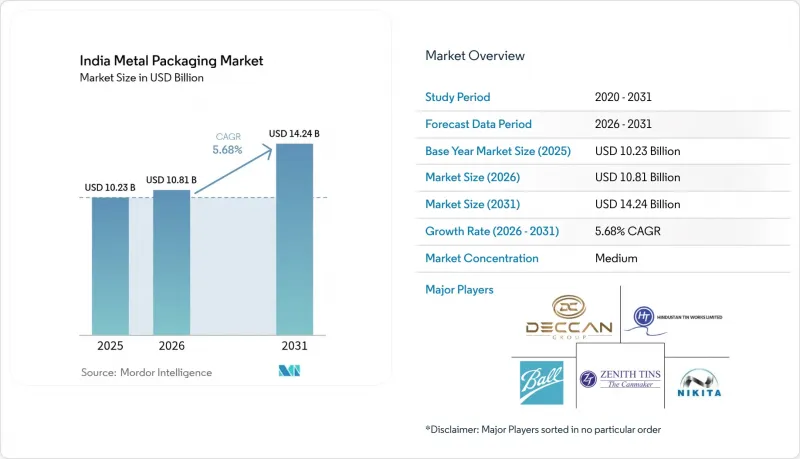
印度金屬包裝市場預計將從 2025 年的 102.3 億美元成長到 2026 年的 108.1 億美元,然後在 2031 年達到 142.4 億美元,2026 年至 2031 年的複合年成長率為 5.68%。
本報告按材料(鋁、鋼、錫)、產品類型(罐、散裝容器、桶/罐等)、終端用戶行業(食品、飲料、油漆/塗料、化學等)和塗料類型(環氧酚基、丙烯酸基、聚酯基、不含雙酚A的替代品等)進行分類。市場預測以美元計價。
印度金屬包裝市場趨勢與洞察
金屬包裝回收率高
金屬的無限循環利用與生產者延伸責任制(EPR)政策的目標相契合,該政策旨在加強對回收和可追溯性的監管。回收鋁罐可節省95%的初級提煉能源,而鋼的磁性使其能夠在市政設施中高效回收。印度標準局(BIS)的IS 15410:2024標準規定了最低再生材料含量,從而為再生金屬創造了穩定的終端市場。同時,國家氣候變遷行動計畫的目標是到2030年將排放強度降低40%。由中央污染控制委員會主導的消費者意識宣傳活動強調了金屬在其整個生命週期中對環境的低影響,而各大飲料品牌也正在調整其產品組合,增加可回收罐的使用。這些因素共同推動了印度金屬包裝市場的長期發展。
即飲飲料品牌需求增加
2024年,印度多個邦將含酒精即飲飲料合法化,加之能量飲料銷量激增23%,推動了印度炎熱氣候下兩片式鋁罐的使用量成長,這種鋁罐能夠更好地保持飲料的風味和碳酸氣。可口可樂在其薩南德工廠引入新的輕型罐裝生產線,以及紅牛致力於擴大分銷管道,都清楚地表明了優質化,而非玻璃和塑膠包裝。印度食品安全標準局(FSSAI)正在收緊碳酸飲料的阻隔性能要求,間接地引導了包裝材料向金屬方向發展。對於加工商而言,即飲飲料的蓬勃發展帶來了穩定的銷售量,也使其有理由投資高速罐裝生產線,從而進一步促進了印度金屬包裝市場的成長。
存在其他柔軟性和硬質塑膠解決方案。
在價格敏感的食品類別中,立式袋和硬質PET罐的材料成本比金屬包裝便宜30-40%。現代多層薄膜的氧氣和水蒸氣阻隔性能如今已能與曾經只有金屬包裝才具備的性能相媲美,這正在逐漸削弱金屬包裝在通用領域的技術優勢。零售商更傾向於使用軟袋包裝以節省展示空間,而品牌商則可享有比罐裝包裝低15-20%的運輸成本。隨著《塑膠廢棄物管理條例》允許使用可回收的單一材料複合材料,塑膠包裝正從永續性的角度受到越來越多的關注。因此,軟包裝正在蠶食入門級食品和家居護理產品的銷售量,阻礙印度金屬包裝市場的成長。
細分市場分析
預計到2025年,鋁將佔據印度金屬包裝市場62.24%的佔有率,並將繼續保持主導地位,因為下游加工領域的投資將解決供應瓶頸問題。印度鋁業(Hindalco)投資100億美元的項目將新增線圈塗布和罐體材料的生產線,使加工商能夠在不依賴進口的情況下滿足日益成長的飲料需求。隨著工業塗料和潤滑劑需求的成長,對更堅固耐用的散裝容器的需求也隨之增加,鋼鐵市場正以7.32%的複合年成長率加速擴張,直至2031年。因此,預計鋼鐵包裝在印度金屬包裝市場的市場規模成長速度將位居所有材料之首。馬口鐵目前仍是一個小眾市場,但在高階糖果甜點和美食領域盈利豐厚,因為消費者認為馬口鐵上的圖案設計具有「禮品級品質」。
越來越多的代工罐製造商採用輕量化的兩件式罐體設計,在保持層壓強度的同時,可將板材厚度減少高達 12%。以鋁材為例,這可以降低運輸成本,並減少每公升產品的 EPR(生產者責任回收)費用,有助於維持整體成本競爭力。鋼材的復興取決於油漆製造商是否改用符合全球危險品法規的聯合國認證桶,這些法規優先考慮高強度合金而非塑膠。鋁材的無限可回收性與品牌的永續性相輔相成,而冶煉廠層面的脫碳努力可能會進一步鞏固其在印度金屬包裝市場的主導地位。
預計到2025年,罐裝產品將佔總銷售量的41.02%,主要成長動力來自軟性飲料、啤酒和加工食品。儘管印度金屬包裝市場的罐裝產品市場預計將持續擴張,但受工業生產成長的推動,桶裝和罐裝等散裝容器預計到2031年將以7.65%的複合年成長率成長。化學和塗料製造商更傾向於使用金屬桶,因為金屬桶擁有聯合國認證和抗穿刺性能,隨著出口轉向使用一次性桶裝產品,預計金屬桶的需求將進一步成長。隨著飲料和製藥廠升級灌裝生產線,瓶蓋和封口的需求也在成長,而裝飾性罐裝產品在高檔禮品市場蓬勃發展。
在政府的生產關聯獎勵計畫(PLI)下,對石化和特種化學品產業的資本投入增加,催生了對200公升鋼桶的新需求。同時,隨著個人護理品牌推出除臭劑和消毒噴霧等產品,氣霧罐的需求也日益成長。新型罐頭生產線整合了基於攝影機的接縫檢測功能,可將缺陷率控制在0.5%以下,這在品管標準日益嚴格的印度金屬包裝市場至關重要。散裝容器製造商正在採用機器人焊接技術來提高產能,而自動化帶來的好處正惠及所有產品類型。
其他好處:
- Excel格式的市場預測(ME)表
- 3個月的分析師支持
目錄
第1章:引言
- 研究假設和市場定義
- 調查範圍
第2章:調查方法
第3章執行摘要
第4章 市場狀況
- 市場概覽
- 市場促進因素
- 金屬包裝回收率高
- 即飲飲料品牌需求增加
- 政府推廣生產者延伸責任制(EPR)
- 印度精釀啤酒和能量飲料市場快速成長
- 加工食品冷鏈物流的擴展
- 投資興建輕型兩片式鋁罐生產線
- 市場限制因素
- 存在兼具柔軟性和剛性的替代塑膠解決方案。
- 鋁和鋼價格波動
- 罐頭內襯含雙酚A引發的健康問題
- 區域馬口鐵板供應中的物流瓶頸
- 產業價值鏈分析
- 監理情勢
- 技術展望
- 波特五力分析
- 宏觀經濟因素對市場的影響
第5章 市場規模與成長預測
- 材料類型
- 鋁
- 鋼
- 鈴
- 依產品類型
- 坎
- 食品罐頭
- 飲料罐
- 氣霧罐
- 裝飾罐
- 散裝容器
- 桶和罐
- 蓋子和封口
- 其他產品類型
- 坎
- 按最終用戶行業分類
- 食物
- 飲料
- 油漆、塗料和化學產品
- 藥品和醫療保健
- 產業
- 其他終端用戶產業
- 按塗層類型
- 環氧樹脂和酚醛樹脂
- 丙烯酸纖維
- 聚酯纖維
- 不含雙酚A的替代品
- 其他塗層類型
第6章 競爭情勢
- 市場集中度
- 策略趨勢
- 市佔率分析
- 公司簡介
- Hindustan Tin Works Ltd
- Kaira Can Company Limited
- Ball Corporation
- Oricon Enterprises Ltd
- Crown Holdings Inc
- Can-Pack India Pvt Ltd
- Ardagh Group SA
- The Tinplate Company of India Limited
- Manaksia Ltd
- Ess Dee Aluminium Ltd
- Bharat Tin Works Pvt Ltd
- Casablanca Industries Pvt Ltd
- Deccan Cans and Printers Pvt Ltd
- Petrox Packaging India Pvt Ltd
- Hi-Can Industries Pvt Ltd
- AJ Packaging Limited
- Nikita Containers Pvt Ltd
- Zenith Tins Pvt Ltd
- SC Packagings Pvt Ltd
第7章 市場機會與未來展望
According to Mordor Intelligence, the India metal packaging market size is expected to grow from USD 10.23 billion in 2025 to USD 10.81 billion in 2026 and is forecast to reach USD 14.24 billion by 2031 at 5.68% CAGR over 2026-2031.
This report is Segmented by Material Type (Aluminum, Steel, Tin), Product Type (Cans, Bulk Containers, Drums and Barrels, and More), End-User Industry (Food, Beverage, Paints, Coatings, and Chemicals, and More), Coating Type (Epoxy Phenolic, Acrylic, Polyester, BPA-Free Alternatives, and More). The Market Forecasts are Provided in Terms of Value (USD).
India Metal Packaging Market Trends and Insights
High Recyclability Rates of Metal Packaging
Metal's infinite recycling loop aligns with EPR policy targets that are tightening collection and traceability rules. Aluminium can recycling saves 95% of the energy used in primary smelting, and steel's magnetic properties allow efficient recovery in municipal facilities. BIS specification IS 15410:2024 now mandates minimum recycled content, creating a stable end-market for secondary metal, while the National Action Plan on Climate Change seeks a 40% cut in emission intensity by 2030. Consumer education campaigns led by the Central Pollution Control Board emphasize metal's lower life-cycle footprint, prompting large beverage brands to shift SKU mixes toward recyclable cans. Together, these factors add long-run momentum to the India metal packaging market.
Rising Demand from Ready-to-Drink Beverage Brands
Legalization of alcoholic RTDs in multiple states during 2024 and a 23% surge in energy-drink sales have expanded use of two-piece aluminium cans that protect flavor and carbonation across India's hot climate zones. Coca-Cola's new lightweight can line in Sanand and Red Bull's distribution push illustrate the premiumization trend that favors metal over glass or plastic. The Food Safety and Standards Authority of India has tightened barrier-performance requirements for carbonated drinks, indirectly steering packaging decisions toward metal. For converters, the RTD boom supplies volume certainty that underwrites capital spending on high-speed can lines, reinforcing growth in the India metal packaging market.
Presence of Alternate Flexible and Rigid Plastic Solutions
Stand-up pouches and rigid PET jars undercut metal on material cost by 30-40% in value-focused food categories . Modern multilayer films now match oxygen and moisture barrier levels once exclusive to metal, eroding the latter's technical edge in commodity segments. Retailers favor pouches for shelf-space efficiency, and brand owners benefit from a 15-20% freight-cost reduction relative to cans or tins. The Plastic Waste Management Rules permit recyclable mono-material laminates, letting plastics occupy the sustainability narrative. As a result, flexible packaging is siphoning volumes from entry-price foods and home-care SKUs, restraining top-line expansion of the India metal packaging market.
Other drivers and restraints analyzed in the detailed report include:
- Government Push for Extended Producer Responsibility
- Rapid Growth of India's Craft Beer and Energy-Drink Segments
- Volatility in Aluminium and Steel Prices
For complete list of drivers and restraints, kindly check the Table Of Contents.
Segment Analysis
Aluminium held 62.24% of the India metal packaging market share in 2025 and is forecast to sustain leadership as downstream processing investments remove supply bottlenecks. Hindalco's USD 10 billion program will add coil-coating and can-body stock lines, enabling converters to capture rising beverage volumes without imports. Steel is accelerating at a 7.32% CAGR through 2031 as industrial paints and lubricants demand stronger bulk containers. The India metal packaging market size for steel-based formats is therefore poised to climb at the fastest pace among materials. Tin remains niche but lucrative in premium confectionery and gourmet foods, where consumers associate tin-plate graphics with giftable quality.
Growing numbers of contract canners are adopting lightweight two-piece body designs that trim gauge thickness by up to 12% while preserving stacking strength. For aluminium this translates to freight savings and lower EPR fees per liter of product, supporting overall cost leadership. Steel's resurgence hinges on paint manufacturers upgrading to UN-rated pails that meet global hazardous-goods rules, which favor high-strength alloys over plastics. Aluminium's infinite recycling potential complements brand sustainability pledges, and smelter-level decarbonization efforts could further cement its advantage in the India metal packaging market.
Cans controlled 41.02% of 2025 revenue, underpinned by soft drinks, beer, and processed foods. The India metal packaging market size for cans will keep expanding, yet bulk containers such as barrels and drums are projected to climb at an 7.65% CAGR to 2031, fueled by industrial output growth. Chemical formulators and paint makers favor metal drums for UN certification and puncture resistance, and the shift to one-way export barrels widens volume potential. Caps and closures piggyback on fill-line upgrades in beverage and pharmaceutical plants, while decorative cans occupy a premium gift segment.
Higher capital allocations in petrochemicals and specialty chemicals under the government's PLI scheme are triggering fresh demand for 200-liter steel drums. In contrast, aerosol cans add consumer-oriented upside as personal-care brands roll out deodorants and disinfectant sprays. New can lines integrate camera-based seam inspection that cuts rejection rates below 0.5%, a capability essential for the India metal packaging market where QC norms are tightening. Bulk container manufacturers are adopting robotic welding to boost throughput, spreading automation benefits across the product-type mix.
Complete Report Scope:
- By Material Type
- Aluminium
- Steel
- Tin
- By Product Type
- Cans
- Food Cans
- Beverage Cans
- Aerosol Cans
- Decorative Cans
- Bulk Containers
- Drums and Barrels
- Caps and Closures
- Other Product Types
- Cans
- By End-User Industry
- Food
- Beverage
- Paints, Coatings and Chemicals
- Pharmaceuticals and Healthcare
- Industrial
- Other End-user Industries
- By Coating Type
- Epoxy Phenolic
- Acrylic
- Polyester
- BPA-Free Alternatives
- Other Coating Types
List of Companies Covered in this Report:
- Hindustan Tin Works Ltd
- Kaira Can Company Limited
- Ball Corporation
- Oricon Enterprises Ltd
- Crown Holdings Inc
- Can-Pack India Pvt Ltd
- Ardagh Group S.A.
- The Tinplate Company of India Limited
- Manaksia Ltd
- Ess Dee Aluminium Ltd
- Bharat Tin Works Pvt Ltd
- Casablanca Industries Pvt Ltd
- Deccan Cans and Printers Pvt Ltd
- Petrox Packaging India Pvt Ltd
- Hi-Can Industries Pvt Ltd
- AJ Packaging Limited
- Nikita Containers Pvt Ltd
- Zenith Tins Pvt Ltd
- S C Packagings Pvt Ltd
Additional Benefits:
- The market estimate (ME) sheet in Excel format
- 3 months of analyst support
TABLE OF CONTENTS
1 INTRODUCTION
- 1.1 Study Assumptions and Market Definition
- 1.2 Scope of the Study
2 RESEARCH METHODOLOGY
3 EXECUTIVE SUMMARY
4 MARKET LANDSCAPE
- 4.1 Market Overview
- 4.2 Market Drivers
- 4.2.1 High Recyclability Rates of Metal Packaging
- 4.2.2 Rising Demand from Ready-to-Drink Beverage Brands
- 4.2.3 Government Push for Extended Producer Responsibility (EPR)
- 4.2.4 Rapid Growth of India's Craft Beer and Energy-Drink Segments
- 4.2.5 Expansion of Cold-Chain Logistics for Processed Foods
- 4.2.6 Investments in Lightweight Two-Piece Aluminium Can Lines
- 4.3 Market Restraints
- 4.3.1 Presence of Alternate Flexible and Rigid Plastic Solutions
- 4.3.2 Volatility in Aluminium and Steel Prices
- 4.3.3 Health Concerns Around BPA-Based Can Liners
- 4.3.4 Logistics Bottlenecks in Regional Supply of Tinplate
- 4.4 Industry Value Chain Analysis
- 4.5 Regulatory Landscape
- 4.6 Technological Outlook
- 4.7 Porter's Five Forces Analysis
- 4.7.1 Bargaining Power of Suppliers
- 4.7.2 Bargaining Power of Consumers
- 4.7.3 Threat of New Entrants
- 4.7.4 Threat of Substitute Products
- 4.7.5 Intensity of Competitive Rivalry
- 4.8 Impact of Macroeconomic Factors on the Market
5 MARKET SIZE AND GROWTH FORECASTS (VALUE)
- 5.1 By Material Type
- 5.1.1 Aluminium
- 5.1.2 Steel
- 5.1.3 Tin
- 5.2 By Product Type
- 5.2.1 Cans
- 5.2.1.1 Food Cans
- 5.2.1.2 Beverage Cans
- 5.2.1.3 Aerosol Cans
- 5.2.1.4 Decorative Cans
- 5.2.2 Bulk Containers
- 5.2.3 Drums and Barrels
- 5.2.4 Caps and Closures
- 5.2.5 Other Product Types
- 5.2.1 Cans
- 5.3 By End-User Industry
- 5.3.1 Food
- 5.3.2 Beverage
- 5.3.3 Paints, Coatings and Chemicals
- 5.3.4 Pharmaceuticals and Healthcare
- 5.3.5 Industrial
- 5.3.6 Other End-user Industries
- 5.4 By Coating Type
- 5.4.1 Epoxy Phenolic
- 5.4.2 Acrylic
- 5.4.3 Polyester
- 5.4.4 BPA-Free Alternatives
- 5.4.5 Other Coating Types
6 COMPETITIVE LANDSCAPE
- 6.1 Market Concentration
- 6.2 Strategic Moves
- 6.3 Market Share Analysis
- 6.4 Company Profiles (includes Global level Overview, Market level overview, Core Segments, Financials as available, Strategic Information, Market Rank/Share for key companies, Products and Services, and Recent Developments)
- 6.4.1 Hindustan Tin Works Ltd
- 6.4.2 Kaira Can Company Limited
- 6.4.3 Ball Corporation
- 6.4.4 Oricon Enterprises Ltd
- 6.4.5 Crown Holdings Inc
- 6.4.6 Can-Pack India Pvt Ltd
- 6.4.7 Ardagh Group S.A.
- 6.4.8 The Tinplate Company of India Limited
- 6.4.9 Manaksia Ltd
- 6.4.10 Ess Dee Aluminium Ltd
- 6.4.11 Bharat Tin Works Pvt Ltd
- 6.4.12 Casablanca Industries Pvt Ltd
- 6.4.13 Deccan Cans and Printers Pvt Ltd
- 6.4.14 Petrox Packaging India Pvt Ltd
- 6.4.15 Hi-Can Industries Pvt Ltd
- 6.4.16 AJ Packaging Limited
- 6.4.17 Nikita Containers Pvt Ltd
- 6.4.18 Zenith Tins Pvt Ltd
- 6.4.19 S C Packagings Pvt Ltd
7 MARKET OPPORTUNITIES AND FUTURE OUTLOOK
- 7.1 White-space and Unmet-Need Assessment

 德國金屬包裝市場:市場佔有率分析、產業趨勢與統計及成長預測(2026-2031)泰國金屬包裝市場:市場佔有率分析、產業趨勢與統計、成長預測(2026-2031)義大利金屬包裝市場:市場佔有率分析、產業趨勢與統計及成長預測(2026-2031)越南金屬包裝市場:市場佔有率分析、產業趨勢與統計及成長預測(2026-2031年)金屬包裝:市場佔有率分析、產業趨勢及統計、成長預測(2026-2031)
 2034年鋼包裝市場預測-按產品類型、材料類型、產能、終端用戶產業和地區分類的全球分析
 金屬包裝市場報告:按產品類型、材料、應用和地區分類(2026-2034 年)
 金屬包裝市場機會、成長要素、產業趨勢分析及2026-2035年預測
 金屬包裝市場規模、佔有率、成長及全球產業分析:按類型、應用和地區分類的洞察,2026-2034 年預測全球金屬包裝材料市場規模、佔有率、趨勢和成長分析報告(2026-2034年)