


 |
市場調查報告書
商品編碼
2117239
德國金屬包裝市場:市場佔有率分析、產業趨勢與統計及成長預測(2026-2031)Germany Metal Packaging - Market Share Analysis, Industry Trends & Statistics, Growth Forecasts (2026 - 2031) |
||||||

※ 本網頁內容可能與最新版本有所差異。詳細情況請與我們聯繫。
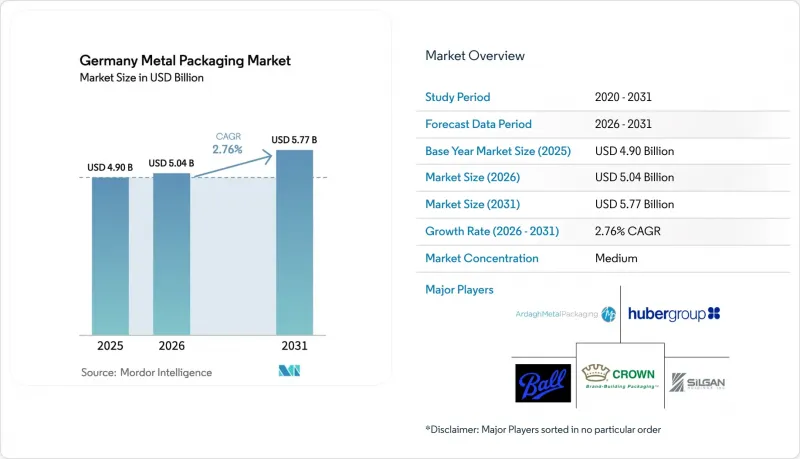
據 Mordor Intelligence 稱,2025 年德國金屬包裝市場價值 49 億美元,預計到 2031 年將從 2026 年的 50.4 億美元成長至 57.7 億美元,預測期(2026-2031 年)複合年成長率為 2.76%。
本報告按材料類型(鋁、鋼、錫)、產品類型(罐、散裝容器、桶/罐、瓶蓋/封口等)、終端用戶行業(食品、飲料等)和塗層類型(環氧酚、丙烯酸、聚酯、不含雙酚A的替代品等)進行分類。市場預測以美元計價。
德國金屬包裝市場的趨勢與洞察
德國快速消費品品牌的永續發展目標
德國食品飲料跨國公司承諾在2027年實現100%回收利用,並正果斷轉向金屬包裝。金屬包裝的回收率高達83%,且具有閉合迴路的潛力。品牌所有者正從複合材料包裝轉向符合德國包裝法規(VerpackG)生態調節費要求的鋁或鋼製容器,這些容器也簡化了使用後的分類流程。飲料填充商尤其積極主動,將高階即飲飲料(RTD)產品換成印有醒目圖案的鋁罐,以強調其無限循環利用的特性。零售商透過優先貨架空間獎勵這種轉變,而押金返還的收入則有助於將廢料回收至冶煉廠,從而完善材料循環,並減少對廢棄金屬的依賴。
金屬罐生產線的自動化
在德國各地工廠的「工業4.0」維修中,利用數位孿生技術同步卷材送料、杯型成型和頸部成型工藝,已證實可減少25%的廢料,並節省約10千瓦時/噸的能源。整合在壓平機中的感測器可偵測高頻振動模式,並將這些資料輸入人工智慧模型,以便在產生廢棄物之前識別模具錯位。透過預測性維護延長維護週期可提高機器運作,而基於雲端的SPC儀表板則允許操作員將板材厚度公差微調至±3微米範圍內。 「Manufacturing-X」框架促進了原始設備製造商 (OEM)、清漆供應商和填料供應商之間安全、標準化的資料交換,從而減少了批次放行延遲,並實現了批次級可追溯性。
基底金屬價格波動
地緣政治動盪導致倫敦金屬交易所 (LME) 的鋁溢價在 2025 年初飆升 27%,直接推高了每千張鋁罐材料的成本。大型加工商透過簽訂 12 個月的合約進行避險,而小型公司缺乏足夠的信貸能力來延長供貨期限,導致利潤率承壓,設備升級也因此延誤。價格波動使品牌客戶的定價更加複雜,而隨著一些客戶探索混合包裝和更薄鋁板等替代方案,鋁罐的整體需求正在下降。使用再生材料進行替代可以緩解部分成本壓力,但回收率的限制和熔化損耗抑制了價格上漲,使其居高不下。
細分市場分析
到2025年,鋁將佔據德國金屬包裝市場63.48%的佔有率,主要得益於其輕質、耐腐蝕和閉合迴路可回收等優勢。這種主導地位轉化為有利的運輸成本和減少範圍3排放,從而提升了鋁出口商在德國碳邊境調節機制(CBAM)下的競爭力。同時,鋼鐵市場正以3.55%的複合年成長率成長,顯示工業散裝容器使用者更注重單位體積成本而非單位重量成本。主要鋼廠正在採用符合即將實施的REACH法規的無鉻馬口鐵,從而減輕了填充商的合規負擔。
鋼鐵業的崛起使德國密集的電弧爐網路受益匪淺,這些電弧爐的廢鋼回收率超過85%。製造商認為,當罐體厚度小於0.18毫米時,尤其是對於熱填充食品應用而言,鋼鐵和鋁的生命週期成本基本上相當。此外,鋼鐵的磁性簡化了市政垃圾處理廠的自動化分類流程,從而提高了回收的經濟效益。雖然鋁在高階飲料市場仍具有一定的“光環效應”,但鋼鐵強大的機械強度已使其在氣霧劑和化學品桶領域佔據穩固地位,從而增強了德國金屬包裝市場的收入來源的多樣性。
到2025年,罐裝產品將佔德國金屬包裝市場42.25%的佔有率。這主要得益於飲料、食品和個人保健產品等SKU的需求,這些產品優先考慮密封性和品牌曝光度,將其作為廣告空間。隨著能量飲料細長罐的種類日益增多以及SKU的擴展,市場對能夠快速換型、將停機時間控制在5分鐘內的裝飾性包裝製造商的需求也隨之成長,從而提高了訂單的盈利。散裝容器,特別是500公升和1000公升的IBC內襯,預計將以3.95%的複合年成長率成長,這反映了化學和製藥行業對高價值液體無污染運輸的依賴。 Ringmetal SE收購內襯業務旨在掌握此一成長機遇,也反映了德國金屬包裝市場轉型為專業化、高利潤細分市場的趨勢。
隨著電子商務中托盤貨物的增加,對帶有防滑輪胎邊緣紋路的可堆疊金屬桶的需求日益成長,這種金屬桶能夠減少運輸過程中的損壞和保險索賠。同時,由於推進劑監管更加嚴格,氣霧罐的出貨量趨於穩定,但品牌商正透過採用壓縮型氣霧罐來降低材料成本風險,這種氣霧罐在保持相同噴塗時間的同時,可減少20%的金屬用量。季節性糖果甜點罐利用微影術技術的進步,透過實現逼真的印刷效果,凸顯德國的設計和工藝,從而提升了其作為禮品的吸引力。
其他好處:
- Excel格式的市場預測(ME)表
- 三個月的分析師支持
目錄
第1章:引言
- 研究假設和市場定義
- 調查範圍
第2章:調查方法
第3章執行摘要
第4章 市場狀況
- 市場概覽
- 市場促進因素
- 德國快速消費品品牌的永續發展目標
- 過渡到輕質、可回收包裝
- 即飲飲料市場的成長
- 德國精釀啤酒出口擴張
- 金屬罐生產線的自動化
- 原始設備製造商 (OEM) 更傾向於使用單一材料包裝
- 市場限制因素
- 基底金屬價格波動
- 擴大阻隔性塑膠的使用
- 對含雙酚A塗料的監管
- 先進塗佈設備需要高額資本投入。
- 產業價值鏈分析
- 宏觀經濟因素的影響
- 監理情勢
- 技術展望
- 波特五力分析
第5章 市場規模與成長預測
- 依材料類型
- 鋁
- 鋼
- 鈴
- 依產品類型
- 能
- 食品罐頭
- 飲料罐
- 氣霧罐
- 裝飾罐
- 散裝容器
- 桶和罐
- 蓋子和封口
- 其他產品類型
- 能
- 按最終用戶行業分類
- 食物
- 飲料
- 油漆、塗料和化學產品
- 藥品和醫療保健
- 產業
- 其他終端用戶產業
- 按塗層類型
- 環氧樹脂和酚醛樹脂
- 丙烯酸纖維
- 聚酯纖維
- 不含雙酚A的替代品
- 其他塗層類型
第6章 競爭情勢
- 市場集中度
- 策略趨勢
- 市佔率分析
- 公司簡介
- Ardagh Metal Packaging SA
- Ball Corporation
- Crown Holdings Inc.
- Silgan Holdings Inc.
- HUBER Packaging Group GmbH
- Trivium Packaging BV
- Greif Inc.
- Mauser Packaging Solutions Holding Company
- Sonoco Products Company
- Envases Europe A/S
- Nussbaum Matzingen AG
- Sarten Ambalaj Sanayi ve Ticaret AS
- Colep Packaging SA
- Emballator Metal Group AB
- P. Wilkinson Containers Ltd.
- Nefab AB
- Toyo Seikan Group Holdings Ltd.
- Can One Berhad
- Kian Joo Can Factory Berhad
- Crown Van Gelder NV
第7章 市場機會與未來展望
According to Mordor Intelligence, the Germany metal packaging market size was valued at USD 4.90 billion in 2025 and estimated to grow from USD 5.04 billion in 2026 to reach USD 5.77 billion by 2031, at a CAGR of 2.76% during the forecast period (2026-2031).
This report is Segmented by Material Type (Aluminum, Steel, and Tin), Product Type (Cans, Bulk Containers, Drums and Barrels, Caps and Closures, and More), End-User Industry (Food, Beverage, and More), Coating Type (Epoxy Phenolic, Acrylic, Polyester, BPA-Free Alternatives, and More). The Market Forecasts are Provided in Terms of Value (USD).
Germany Metal Packaging Market Trends and Insights
Sustainability Targets of German FMCG Brands
German food and beverage multinationals have pledged to achieve 100% recyclability rates by 2027, prompting a decisive shift toward metal packaging due to its 83% recycling rate and closed-loop potential. Brand owners are replacing composite laminates with Aluminum or steel containers that meet VerpackG eco-modulation fees and simplify end-of-life sorting. Beverage fillers are particularly aggressive, switching premium ready-to-drink SKUs into brightly printed Aluminum cans that underscore infinite recyclability. Retailers reward this shift by granting shelf-space premiums, while deposit-return gains help reclaim scrap for smelters, closing material loops, and offsetting reliance on virgin metal.
Automation in Metal Can Production Lines
Industry 4.0 retrofits across German facilities have demonstrated scrap declines of 25% and energy savings of nearly 10 kWh per ton when digital twins synchronize coil feed, cupping, and necking stations. Sensors embedded in presses capture high-frequency vibration patterns, feeding AI models that identify die misalignment before it generates waste. Predictive maintenance intervals lengthen machine uptime, and cloud-based SPC dashboards let operators fine-tune sheet-thickness tolerances within +-3 µm. The Manufacturing-X framework promotes secure, standardized data exchange among OEMs, varnish suppliers, and fillers, reducing batch-release delays and enabling lot-level traceability.
Price Volatility of Base Metals
London Metal Exchange Aluminum premiums spiked 27% in early 2025 following geopolitical disruptions, directly increasing the cost per thousand units of can sheet. Large converters hedge by locking 12-month contracts, yet SMEs lack credit headroom, leading to squeezed margins and deferred machine upgrades. Volatility complicates quoted pricing to brand clients, some of whom experiment with hybrid packaging or down-gauging options, reducing overall can demand. Recycled-content substitution offers partial relief but is capped by collection yield and melt-loss limits, keeping price pressure elevated.
Other drivers and restraints analyzed in the detailed report include:
- Growth of Ready-to-Drink Beverage Segment
- Expansion of Germany's Craft-Beer Exports
- Rising Adoption of High-Barrier Plastics
For complete list of drivers and restraints, kindly check the Table Of Contents.
Segment Analysis
Aluminum commanded 63.48% of Germany metal packaging market share in 2025, buoyed by its lightweight profile, corrosion resistance, and closed-loop recyclability advantages. This supremacy translates into favorable freight economics and reduced scope-3 emissions, positioning Aluminum exporters competitively under Germany's Carbon Border Adjustment Mechanism. Steel, however, is pacing at a 3.55% CAGR, signaling demand from industrial bulk-container users who weigh cost per volume over grams per unit. Major mills have introduced chrome-free tinplate that meets upcoming REACH mandates, lowering compliance overhead for fillers.
Steel's ascent benefits Germany's dense network of electric-arc furnaces supplied by scrap streams exhibiting >85% recovery rates. Producers tout life-cycle cost parity with Aluminum when can-body thickness drops below 0.18 mm, especially for hot-fill food applications. Furthermore, steel's magnetic properties simplify automated sorting in municipal plants, reinforcing collection economics. Although Aluminum retains halo effects in premium beverage marketing, steel's robust mechanical strength secures its foothold in aerosols and chemical drums, diversifying revenue resilience for the Germany metal packaging market.
Cans retained 42.25% of Germany metal packaging market size in 2025, propelled by beverage, food, and personal-care SKUs that value hermetic sealing and billboard branding real estate. Sleek-can variants for energy drinks multiply SKUs, demanding fast-changeover decorators capable of <5 min downtime to push order profitability. Bulk containers, notably 500 L and 1,000 L IBC liners, are forecast to log a 3.95% CAGR, reflecting chemical and pharma sector reliance on contamination-free transport of high-value liquids. Ringmetall SE's liner acquisitions aim to exploit this pocket of momentum, mirroring the Germany metal packaging market's tilt toward specialized, higher-margin niches.
Growing e-commerce palletization calls for stackable metal drum designs with anti-slip bead geometry, reducing transit damage and insurance claims. Meanwhile, aerosol can volumes stabilize amidst regulatory scrutiny of propellants, but brand owners counter with compressed formats that achieve equal spray duration using 20% less metal, alleviating material cost exposure. Decorative tins for seasonal confectionery leverage lithographic advances to deliver photo-realistic prints, extending gifting appeal and showcasing German design craftsmanship.
Complete Report Scope:
- By Material Type
- Aluminium
- Steel
- Tin
- By Product Type
- Cans
- Food Cans
- Beverage Cans
- Aerosol Cans
- Decorative Cans
- Bulk Containers
- Drums and Barrels
- Caps and Closures
- Other Product Types
- Cans
- By End-User Industry
- Food
- Beverage
- Paints, Coatings and Chemicals
- Pharmaceuticals and Healthcare
- Industrial
- Other End-user Industries
- By Coating Type
- Epoxy Phenolic
- Acrylic
- Polyester
- BPA-Free Alternatives
- Other Coating Types
List of Companies Covered in this Report:
- Ardagh Metal Packaging S.A.
- Ball Corporation
- Crown Holdings Inc.
- Silgan Holdings Inc.
- HUBER Packaging Group GmbH
- Trivium Packaging B.V.
- Greif Inc.
- Mauser Packaging Solutions Holding Company
- Sonoco Products Company
- Envases Europe A/S
- Nussbaum Matzingen AG
- Sarten Ambalaj Sanayi ve Ticaret A.S.
- Colep Packaging S.A.
- Emballator Metal Group AB
- P. Wilkinson Containers Ltd.
- Nefab AB
- Toyo Seikan Group Holdings Ltd.
- Can One Berhad
- Kian Joo Can Factory Berhad
- Crown Van Gelder N.V.
Additional Benefits:
- The market estimate (ME) sheet in Excel format
- 3 months of analyst support
TABLE OF CONTENTS
1 INTRODUCTION
- 1.1 Study Assumptions and Market Definition
- 1.2 Scope of the Study
2 RESEARCH METHODOLOGY
3 EXECUTIVE SUMMARY
4 MARKET LANDSCAPE
- 4.1 Market Overview
- 4.2 Market Drivers
- 4.2.1 Sustainability Targets of German FMCG Brands
- 4.2.2 Shift Toward Lightweight Recyclable Packaging
- 4.2.3 Growth of Ready-to-Drink Beverage Segment
- 4.2.4 Expansion of Germany's Craft Beer Exports
- 4.2.5 Automation in Metal Can Production Lines
- 4.2.6 OEM Preference for Monomaterial Packaging
- 4.3 Market Restraints
- 4.3.1 Price Volatility of Base Metals
- 4.3.2 Rising Adoption of High-Barrier Plastics
- 4.3.3 Regulatory Scrutiny of BPA-Based Coatings
- 4.3.4 High Capex for Advanced Coating Equipment
- 4.4 Industry Value Chain Analysis
- 4.5 Impact of Macroeconomic Factors
- 4.6 Regulatory Landscape
- 4.7 Technological Outlook
- 4.8 Porter's Five Forces Analysis
- 4.8.1 Threat of New Entrants
- 4.8.2 Bargaining Power of Suppliers
- 4.8.3 Bargaining Power of Buyers
- 4.8.4 Threat of Substitutes
- 4.8.5 Intensity Competitive Rivalry
5 MARKET SIZE AND GROWTH FORECASTS (VALUE)
- 5.1 By Material Type
- 5.1.1 Aluminium
- 5.1.2 Steel
- 5.1.3 Tin
- 5.2 By Product Type
- 5.2.1 Cans
- 5.2.1.1 Food Cans
- 5.2.1.2 Beverage Cans
- 5.2.1.3 Aerosol Cans
- 5.2.1.4 Decorative Cans
- 5.2.2 Bulk Containers
- 5.2.3 Drums and Barrels
- 5.2.4 Caps and Closures
- 5.2.5 Other Product Types
- 5.2.1 Cans
- 5.3 By End-User Industry
- 5.3.1 Food
- 5.3.2 Beverage
- 5.3.3 Paints, Coatings and Chemicals
- 5.3.4 Pharmaceuticals and Healthcare
- 5.3.5 Industrial
- 5.3.6 Other End-user Industries
- 5.4 By Coating Type
- 5.4.1 Epoxy Phenolic
- 5.4.2 Acrylic
- 5.4.3 Polyester
- 5.4.4 BPA-Free Alternatives
- 5.4.5 Other Coating Types
6 COMPETITIVE LANDSCAPE
- 6.1 Market Concentration
- 6.2 Strategic Moves
- 6.3 Market Share Analysis
- 6.4 Company Profiles (includes Global Level Overview, Market Level Overview, Core Segments, Financials as Available, Strategic Information, Market Rank/Share for Key Companies, Products and Services, and Recent Developments)
- 6.4.1 Ardagh Metal Packaging S.A.
- 6.4.2 Ball Corporation
- 6.4.3 Crown Holdings Inc.
- 6.4.4 Silgan Holdings Inc.
- 6.4.5 HUBER Packaging Group GmbH
- 6.4.6 Trivium Packaging B.V.
- 6.4.7 Greif Inc.
- 6.4.8 Mauser Packaging Solutions Holding Company
- 6.4.9 Sonoco Products Company
- 6.4.10 Envases Europe A/S
- 6.4.11 Nussbaum Matzingen AG
- 6.4.12 Sarten Ambalaj Sanayi ve Ticaret A.S.
- 6.4.13 Colep Packaging S.A.
- 6.4.14 Emballator Metal Group AB
- 6.4.15 P. Wilkinson Containers Ltd.
- 6.4.16 Nefab AB
- 6.4.17 Toyo Seikan Group Holdings Ltd.
- 6.4.18 Can One Berhad
- 6.4.19 Kian Joo Can Factory Berhad
- 6.4.20 Crown Van Gelder N.V.
7 MARKET OPPORTUNITIES AND FUTURE OUTLOOK
- 7.1 White-Space and Unmet-Need Assessment

 泰國金屬包裝市場:市場佔有率分析、產業趨勢與統計、成長預測(2026-2031)義大利金屬包裝市場:市場佔有率分析、產業趨勢與統計及成長預測(2026-2031)越南金屬包裝市場:市場佔有率分析、產業趨勢與統計及成長預測(2026-2031年)印度金屬包裝市場:市場佔有率分析、產業趨勢與統計、成長預測(2026-2031)金屬包裝:市場佔有率分析、產業趨勢及統計、成長預測(2026-2031)
 2034年鋼包裝市場預測-按產品類型、材料類型、產能、終端用戶產業和地區分類的全球分析
 金屬包裝市場報告:按產品類型、材料、應用和地區分類(2026-2034 年)
 金屬包裝市場機會、成長要素、產業趨勢分析及2026-2035年預測
 金屬包裝市場規模、佔有率、成長及全球產業分析:按類型、應用和地區分類的洞察,2026-2034 年預測全球金屬包裝材料市場規模、佔有率、趨勢和成長分析報告(2026-2034年)