


 |
市場調查報告書
商品編碼
2154233
南美洲農業灌溉機械:市場佔有率分析、產業趨勢與統計及成長預測(2026-2031 年)South America Agricultural Irrigation Machinery - Market Share Analysis, Industry Trends & Statistics, Growth Forecasts (2026 - 2031) |
||||||

※ 本網頁內容可能與最新版本有所差異。詳細情況請與我們聯繫。
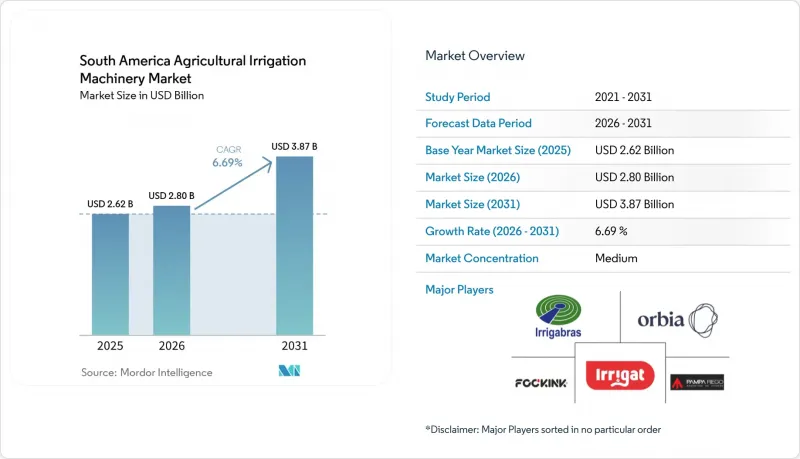
根據 Mordor Intelligence 預測,南美洲農業灌溉機械市場規模預計在 2025 年達到 26.2 億美元,2026 年達到 28 億美元,到 2031 年達到 38.7 億美元,在 2026 年至 2031 年的預測期內,複合年成長率將達到 6.69%。
南美洲農業灌溉機械市場趨勢與洞察
透過灌溉擴大高價值作物的種植面積
多年生作物和出口作物能夠支撐持續的灌溉需求,因為其生產的穩定性與農場的獲利能力和投資能力密切相關。在巴西,耐特菲姆有限公司(Netafim Ltd.)2025年的業績較2024年成長了20%,柑橘、咖啡和園藝產品表現強勁。該公司也設定了2026年12-15%的成長目標,並宣布投資約1億雷亞爾(約1,750萬美元)擴建其位於裡貝朗普雷圖的工廠。在秘魯,農業發展和灌溉部(MIDAGRI)報告稱,2024年農產品出口將達到創紀錄的127億美元,其中包括藍莓22.7億美元、葡萄17.1億美元和酪梨12.5億美元。這些高價值、出口導向作物的持續擴張,為精準灌溉技術創造了有利的需求基礎,有助於確保可靠的供水並維持作物品質的穩定性。
政府和發展資金對節水灌溉的支持
政府支持的基礎建設項目正在南美洲各地建構灌溉投資管道。在秘魯,政府已宣布22個灌溉項目,總投資額達241億美元。這些項目將涵蓋新增100萬公頃農田,其中85%的投資將透過官民合作關係(PPP)模式實現。在巴西,政府支持的「灌溉農業中心」和推廣更有效率灌溉技術的計畫也不斷擴大灌溉基礎設施。這些措施正在增強灌溉設備計畫的儲備,為商業農業和家庭農場的節水系統供應商拓展商機,並促進南美洲農業灌溉機械市場的成長。
農業貸款初始成本高,且取得管道有限。
高昂的初始投資和有限的農業融資管道會阻礙灌溉技術的推廣應用,尤其對於中小農戶而言。現代灌溉系統通常需要在水泵、配水基礎設施、控制設備和安裝工程方面投入大量資金,與傳統的雨養農業相比,這增加了其准入門檻。聯合國糧食及農業組織(糧農組織)在2024年指出,取得資金是農民投資生產資產的關鍵因素,資金籌措會限制農業投資,特別是在農民和中小農業相關企業。這些資金籌措限制會延長投資回收期,並使小規模生產者難以獲得先進的灌溉技術。因此,對於缺乏抵押品、良好信用記錄或適合其農業現金流的金融產品的農場而言,市場滲透速度可能會很慢。因此,確保獲得農業融資和公共資金籌措機制對於灌溉系統的更廣泛應用至關重要。
細分市場分析
2025年,滴灌系統在南美洲農業灌溉機械市場中佔45.0%。滴灌廣泛應用於咖啡、柑橘、甘蔗、藍莓和酪梨等作物的種植,透過精準供水支持高價值作物的生產。巴西和秘魯出口導向作物種植面積的擴大,尤其是那些受益於精準供水的高價值作物,推動了對滴灌系統的需求。大規模大豆和玉米農場採用中心支軸式和滾筒式噴灌系統來覆蓋大片田地。 2026年3月,巴西Irrigabras Irrigacao do Brasil Ltda.公司發布了「Irrigabras Conecta」數位平台,使用者可透過QR碼存取設備使用手冊。此次發布表明,這家巴西中心支軸式噴灌系統供應商正在將其產品和服務範圍擴展到機械設備之外。
預計2026年至2031年間,噴水灌溉將以8.1%的複合年成長率成長。在馬托格羅索州和戈亞斯州等糧食種植面積廣闊的州,中心支軸式噴灌仍十分重要。同時,投資能力相對有限的農場仍採用漫灌和溝灌。巴西農業研究公司(Embrapa)的低碳大豆(SBC)計畫為參與農場提供用水量和灌溉方法的記錄指南。因此,對於供應認證出口鏈的農場而言,計量指標和水資源管理控制功能可能會影響設備的選擇。整體而言,南美洲農業灌溉機械市場受到本地灌溉系統和機械化灌溉系統在經濟和農藝需求上差異的影響。
其他好處:
- Excel格式的市場預測(ME)表
- 3個月的分析師支持
目錄
第1章:引言
- 研究假設和市場定義
- 調查範圍
第2章:調查方法
第3章執行摘要
第4章 市場狀況
- 市場概覽
- 市場促進因素
- 透過灌溉擴大高價值作物的種植面積
- 政府和發展資金支持節水灌溉
- 穩定降雨量波動地區作物種植區的氣候相關產量。
- 擴大機械化灌溉在大豆、玉米、甘蔗和水果大規模種植的應用。
- 由於電力和抽水成本最佳化,灌溉設施維修需求增加。
- 已實施可追溯用水管理的出口型農場。
- 市場限制因素
- 前期投入成本高,且農業貸款管道有限。
- 承壓系統中電網可靠性不穩定且能源成本高。
- 小規模農戶擁有的農地零散,以及該地區服務供給不足。
- 進口貨幣風險和更換零件的前置作業時間
- 監理情勢
- 技術展望
- 波特五力分析
第5章 市場規模與成長預測
- 透過灌溉法
- 噴水灌溉
- 滴灌
- 中心支線灌溉
- 其他灌溉方法
- 按應用程式類型
- 穀物和穀類
- 豆類和油籽
- 水果和蔬菜
- 其他用途
- 按地區
- 巴西
- 阿根廷
- 秘魯
- 其他南美國家
第6章 競爭情勢
- 市場集中度
- 策略趨勢
- 市佔率分析
- 公司簡介
- Fockink Industrias Eletricas Ltda.
- Irrigabras Irrigacao do Brasil Ltda.
- Turbom Argentina Industrial y Comercial SA
- Torvil Riegos SA
- Irrigat Agricola Ltda.
- Evandro de Castro Silva Fundicao e Solucoes para Irrigacao Ltda.
- Hidro Solo Industria e Comercio Ltda.
- Quiver Plast EIRL
- Netafim Ltd.(Orbia Advance Corporation, SAB de CV)
- Pampa Riego SA
- Irrigamais Sistemas de Irrigacao Ltda.
- Bauer do Brasil Irrigacao Ltda.
- Rain Bird Corporation
第7章 市場機會與未來展望
According to Mordor Intelligence, the South America agricultural irrigation machinery market was valued at USD 2.62 billion in 2025 and is forecasted to reach USD 2.80 billion in 2026 and USD 3.87 billion by 2031, registering a CAGR of 6.69% during the forecast period 2026-2031.
South America Agricultural Irrigation Machinery Market Trends and Insights
Expansion of Irrigated High-Value Crops
Perennial and export-oriented crops can support sustained demand for irrigation because production reliability is closely linked to farm revenue and investment capacity. In Brazil, Netafim Ltd. reported 20% growth in 2025 compared with 2024, with strong performance in citrus, coffee, and horticulture, and announced an investment of approximately BRL 100 million (USD 17.5 million) to expand its Ribeirao Preto facility while targeting 12%-15% growth in 2026. In Peru, the Ministry of Agrarian Development and Irrigation (MIDAGRI) reported record agricultural exports of USD 12.7 billion in 2024, including USD 2.27 billion from blueberries, USD 1.71 billion from grapes, and USD 1.25 billion from avocados. The continued expansion of these high-value, export-oriented crops creates a favorable demand base for precision irrigation technologies that provide reliable water delivery and help maintain consistent crop quality.
Government and Development-Finance Support for Water-Efficient Irrigation
Government-backed infrastructure programs are creating a pipeline of irrigation investment across South America. In Peru, the government announced 22 irrigation projects requiring USD 24.1 billion, targeting an additional 1 million hectares of agricultural land, with 85% of investment promotion structured through public-private partnerships (PPPs). Brazil is also expanding irrigation infrastructure through government-supported Irrigated Agriculture Hubs and programs promoting more efficient irrigation technologies. These initiatives are strengthening the project pipeline for irrigation equipment and improving opportunities for suppliers of water-efficient systems across commercial agriculture and family farming, supporting growth in the South America agricultural irrigation machinery market.
High Upfront Cost and Limited Farm-Finance Access
High upfront capital requirements and limited access to suitable agricultural finance can constrain irrigation adoption, particularly among small and mid-sized farms. Modern irrigation systems often require significant investment in pumps, distribution infrastructure, controls, and installation, creating a higher entry barrier than conventional rainfed production. The Food and Agriculture Organization (FAO) highlighted in 2024 that access to finance is an important determinant of farmers' ability to invest in productive assets and that financing constraints can limit agricultural investment, particularly for farmers and small and medium-sized agribusinesses. These financing constraints can extend investment payback periods and make sophisticated irrigation technologies less accessible to smaller producers. As a result, the market may face slower adoption among farms that lack collateral, adequate credit history, or financing products suited to agricultural cash flows, making accessible agricultural credit and public financing mechanisms important for broader irrigation-equipment adoption.
Other drivers and restraints analyzed in the detailed report include:
- Climate-Driven Yield Stabilization in Rainfall-Variable Cropping Regions
- Irrigation Retrofit Demand from Electricity and Pumping-Cost Optimization
- Fragmented Smallholder Plots and Weak Local Service Coverage
For complete list of drivers and restraints, kindly check the Table Of Contents.
Segment Analysis
Drip irrigation held 45.0% of the South America agricultural irrigation machinery market size in 2025. It is widely used in coffee, citrus, sugarcane, blueberries, and avocados, where controlled water delivery supports high-value crop production. Demand for drip irrigation equipment is supported by the expansion of export-oriented crop cultivation in Brazil and Peru, particularly for high-value crops that benefit from precise water application. Large soybean and corn operations use pivots and reels because these systems can cover broad field areas. Irrigabras Irrigacao do Brasil Ltda. launched Irrigabras Conecta in March 2026, a digital platform that allows field users to access equipment documentation through QR codes. The launch indicates that Brazilian pivot suppliers are extending their offering beyond mechanical equipment.
Sprinkler irrigation is forecast to expand at an 8.1% CAGR between 2026 and 2031. Pivot irrigation remains important in Mato Grosso and Goias, where grain farms operate across large areas. Flood and furrow irrigation continue to serve farms where investment capacity remains more limited. The Brazilian Agricultural Research Corporation (Embrapa) Low-Carbon Soybean (SBC) Program provides guidance on documenting water use and irrigation practices for participating farms. As a result, metering and water-management controls can influence equipment selection among farms supplying certified export chains. Overall, the South America agricultural irrigation machinery market is shaped by the differing economic and agronomic requirements of localized and mechanized irrigation systems.
Complete Report Scope:
- By Irrigation Type
- Sprinkler Irrigation
- Drip Irrigation
- Pivot Irrigation
- Other Irrigation Types
- By Application Type
- Grains and Cereals
- Pulses and Oilseeds
- Fruits and Vegetables
- Other Applications
- By Geography
- Brazil
- Argentina
- Peru
- Rest of South America
List of Companies Covered in this Report:
- Fockink Industrias Eletricas Ltda.
- Irrigabras Irrigacao do Brasil Ltda.
- Turbom Argentina Industrial y Comercial S.A.
- Torvil Riegos S.A.
- Irrigat Agricola Ltda.
- Evandro de Castro Silva Fundicao e Solucoes para Irrigacao Ltda.
- Hidro Solo Industria e Comercio Ltda.
- Quiver Plast E.I.R.L.
- Netafim Ltd. (Orbia Advance Corporation, S.A.B. de C.V.)
- Pampa Riego S.A.
- Irrigamais Sistemas de Irrigacao Ltda.
- Bauer do Brasil Irrigacao Ltda.
- Rain Bird Corporation
Additional Benefits:
- The market estimate (ME) sheet in Excel format
- 3 months of analyst support
TABLE OF CONTENTS
1 INTRODUCTION
- 1.1 Study Assumptions and Market Definition
- 1.2 Scope of the Study
2 RESEARCH METHODOLOGY
3 EXECUTIVE SUMMARY
4 MARKET LANDSCAPE
- 4.1 Market Overview
- 4.2 Market Drivers
- 4.2.1 Expansion of irrigated high-value crops
- 4.2.2 Government and development-finance support for water-efficient irrigation
- 4.2.3 Climate-driven yield stabilization in rainfall-variable cropping regions
- 4.2.4 Expansion of mechanized irrigation in large-scale soybean, corn, sugarcane, and fruit operations
- 4.2.5 Irrigation retrofit demand from electricity and pumping-cost optimization
- 4.2.6 Export-oriented farms adopting traceable water-use controls
- 4.3 Market Restraints
- 4.3.1 High upfront cost and limited farm-finance access
- 4.3.2 Uneven grid reliability and high energy cost for pressurized systems
- 4.3.3 Fragmented smallholder plots and weak local service coverage
- 4.3.4 Import-currency exposure and replacement-part lead times
- 4.4 Regulatory Landscape
- 4.5 Technological Outlook
- 4.6 Porter's Five Forces Analysis
- 4.6.1 Bargaining Power of Suppliers
- 4.6.2 Bargaining Power of Buyers
- 4.6.3 Threat of Substitute Products
- 4.6.4 Threat of New Entrants
- 4.6.5 Intensity of Competitive Rivalry
5 MARKET SIZE AND GROWTH FORECASTS (VALUE)
- 5.1 By Irrigation Type
- 5.1.1 Sprinkler Irrigation
- 5.1.2 Drip Irrigation
- 5.1.3 Pivot Irrigation
- 5.1.4 Other Irrigation Types
- 5.2 By Application Type
- 5.2.1 Grains and Cereals
- 5.2.2 Pulses and Oilseeds
- 5.2.3 Fruits and Vegetables
- 5.2.4 Other Applications
- 5.3 By Geography
- 5.3.1 Brazil
- 5.3.2 Argentina
- 5.3.3 Peru
- 5.3.4 Rest of South America
6 COMPETITIVE LANDSCAPE
- 6.1 Market Concentration
- 6.2 Strategic Moves
- 6.3 Market Share Analysis
- 6.4 Company Profiles (Includes Global Level Overview, Market Level Overview, Core Segments, Financials as Available, Strategic Information, Market Rank/Share, Products and Services, Recent Developments)
- 6.4.1 Fockink Industrias Eletricas Ltda.
- 6.4.2 Irrigabras Irrigacao do Brasil Ltda.
- 6.4.3 Turbom Argentina Industrial y Comercial S.A.
- 6.4.4 Torvil Riegos S.A.
- 6.4.5 Irrigat Agricola Ltda.
- 6.4.6 Evandro de Castro Silva Fundicao e Solucoes para Irrigacao Ltda.
- 6.4.7 Hidro Solo Industria e Comercio Ltda.
- 6.4.8 Quiver Plast E.I.R.L.
- 6.4.9 Netafim Ltd. (Orbia Advance Corporation, S.A.B. de C.V.)
- 6.4.10 Pampa Riego S.A.
- 6.4.11 Irrigamais Sistemas de Irrigacao Ltda.
- 6.4.12 Bauer do Brasil Irrigacao Ltda.
- 6.4.13 Rain Bird Corporation
7 MARKET OPPORTUNITIES AND FUTURE OUTLOOK

 2026年全球農業灌溉機械市場報告
 自走式噴水灌溉系統市場:全球市場預測(2026-2032年)
 2026-2030年全球自動化灌溉系統市場
 人工智慧驅動的灌溉控制系統市場預測至2034年-全球分析(按感測器類型、灌溉系統、農場類型、應用、最終用戶和地區分類)
 噴水灌溉系統市場機會、成長要素、產業趨勢分析及2026-2035年預測。
 美國農業灌溉機械:市場佔有率分析、產業趨勢與統計、成長預測(2026-2031)農業灌溉機械:市場佔有率分析、產業趨勢與統計、成長預測(2026-2031)非洲農業灌溉機械:市場佔有率分析、產業趨勢與統計及成長預測(2026-2031 年)德國農業灌溉機械:市場佔有率分析、產業趨勢與統計及成長預測(2026-2031)北美農業灌溉機械:市場佔有率分析、產業趨勢與統計、成長預測(2026-2031)