


 |
市場調查報告書
商品編碼
2109265
噴水灌溉系統市場機會、成長要素、產業趨勢分析及2026-2035年預測。Sprinkler Irrigation System Market Opportunity, Growth Drivers, Industry Trend Analysis, and Forecast 2026 - 2035 |
||||||

全球噴水灌溉系統市場預計到 2025 年將價值 39 億美元,預計到 2035 年將以 7.4% 的複合年成長率成長至 78 億美元。
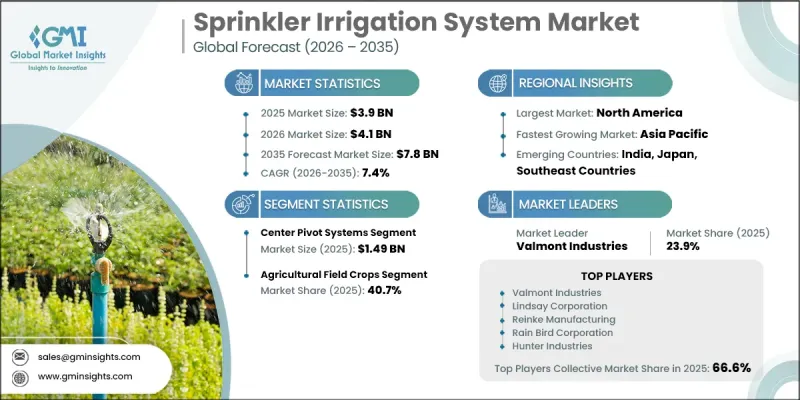
由於水資源日益短缺、氣候變遷、地下水資源枯竭以及灌溉農田面積不斷擴大,傳統灌溉方式正逐漸被更有效率的噴水灌溉系統所取代,市場因此不斷擴張。節水意識的增強和提高農業生產力的需求進一步加速了市場對噴灌系統的接受度。同時,精密農業的日益普及推動了對先進灌溉技術的需求,這些技術能夠實現精準配水並支援高效的資源管理。農民加大對數位化農業基礎設施的投資,推動了智慧灌溉控制器、連網監控解決方案和雲端灌溉管理平台的應用。因此,噴水灌溉系統正在超越傳統灌溉設備,成為互聯農業生態系統不可或缺的一部分。目前,消費者的購買決策不僅取決於灌溉性能,還取決於其與各種農場管理軟體和數位化農業平台的兼容性,這有助於生產者提高營運效率、最佳化用水並加強長期作物管理。
| 市場範圍 | |
|---|---|
| 開始年份 | 2025 |
| 預測期 | 2026-2035 |
| 初始市場規模 | 39億美元 |
| 預測金額 | 78億美元 |
| 複合年成長率 | 7.4% |
預計到 2025 年,中心樞軸灌溉系統業務的銷售額將達到 14.9 億美元,並在 2026 年至 2035 年期間以 6.9% 的複合年成長率成長。對高效大規模灌溉解決方案的持續需求,以及在商業農業運營中不斷擴大的應用,正在推動該業務在整個預測期內穩步成長。
預計到 2025 年,園藝、草坪和非農業領域將佔市場佔有率的 34.5%,到 2035 年將達到 37.3%。這一成長反映了噴水灌溉系統市場在傳統農業應用之外的多元化發展,其驅動力是商業、市政和其他非農業環境對高效可靠灌溉解決方案的持續高需求。
預計2025年,北美噴水灌溉系統市場規模將達12.3億美元。該地區憑藉著廣袤的灌溉農田、對高效水資源管理技術的持續投資以及噴水灌溉基礎設施在大規模農業生產中的廣泛應用,繼續保持主導地位。農業灌溉技術的不斷現代化和先進灌溉設備的採用,正在推動全部區域市場的成長。
目錄
第1章:調查方法和範圍
第2章執行摘要
第3章 行業洞察
- 產業生態系分析
- 供應鏈分析
- 關鍵原料和零件的採購
- 供應鏈脆弱性與集中風險
- 系統製造商近岸外包和垂直整合的趨勢
- 影響產業的因素
- 市場促進因素
- 全球水資源短缺日益嚴重,亟需高效灌溉
- 政府補貼和灌溉現代化計劃
- 新興經濟體耕地面積的擴張
- 擴大精密農業和智慧農業實踐的應用
- 市場限制因素
- 較大的初始資本投資和安裝成本
- 農村地區技術知識和熟練勞動力短缺
- 易受風力條件所引起的不均勻水流的影響
- 市場機遇
- 撒哈拉以南非洲和南亞地區尚未開發的灌溉潛力
- 物聯網與遙感探測的整合應用於自動化水資源管理
- 在非農業領域(高爾夫、運動、溫室)的應用不斷擴展
- 老舊灌溉基礎設施的維修和升級需求
- 市場促進因素
- 成長潛力分析
- 技術與創新展望
- 智慧灌溉和物聯網控制系統
- 精密噴灌和壓力調節技術的進步
- 太陽能發電和高效能水泵技術
- 變數灌溉(VRI)與GPS的整合
- 監理框架
- 區域用水效率義務和灌溉法規
- 政府補貼和獎勵計畫(PMKSY、USDA EQIP、歐盟共同農業政策)
- 環境合規和節水標準
- 未來市場趨勢
- 價格分析
- 對過去價格趨勢的分析
- 依球員類型分類的定價策略(高級球員、超值球員、成本加成球員)
- 貿易數據分析
- 按系統類型和組件分類的進出口量和出口額趨勢
- 關稅對主要貿易路線和灌溉設備的影響
- 人工智慧和生成式人工智慧對市場的影響
- 人工智慧正在改變傳統的灌溉管理模式。
- 按細分領域(田間作物、園林綠化、溫室)分類的人工智慧生成用例和實施藍圖
- 人工智慧在灌溉領域的風險、限制與監管考量
- 波特的分析
- PESTLE分析
第4章 競爭情勢
- 介紹
- 企業市佔率分析
- 按地區
- 企業矩陣分析
- 主要市場公司的競爭分析
- 競爭定位矩陣
- 主要進展
- 併購
- 夥伴關係和聯盟
- 新產品發布
- 業務拓展計劃
第5章 市場估計與預測:依系統類型分類,2022-2035年
- 主要趨勢
- 中心樞軸系統
- 單跨
- 多跨距
- 角臂式系統
- 橫向(線性)系統
- 硬塑膠管式橫向移動系統
- 軟管式橫向移動
- 固定式噴灌系統
- 地面安裝式固定型
- 地下(彈出式)固定式
- 可攜式和旅行系統
- 大型噴淋/雨槍系統
- 手動管道系統
- 側滾式系統
- 其他
第6章 市場估計與預測:依組件分類,2022-2035年
- 主要趨勢
- 噴灌
- 旋轉/衝擊頭
- 彈出式噴頭
- 微噴霧擺動頭
- 管道和配件
- 鋁管
- PVC管
- HDPE管
- 配件和接頭
- 泵浦
- 電動幫浦
- 柴油/引擎驅動泵
- 太陽能水泵
- 控制單元和自動化
- 機械控制器和定時器
- 智慧/物聯網相容控制器
- 天氣資訊和感測器驅動控制器
- 閥門
- 電磁閥
- 壓力調節閥
- 止回閥和閘閥
- 其他物品(過濾器、肥料注入器、配件)
第7章 市場估計與預測:依應用領域分類,2022-2035年
- 主要趨勢
- 農作物
- 穀類和穀類食品
- 油籽/豆類
- 糖料作物
- 農產品(水果和蔬菜)
- 水果和果樹
- 蔬菜和綠葉蔬菜
- 景觀美化和草坪
- 商業景觀設計
- 公共公園和市立綠地
- 高爾夫球場和體育設施
- 私人高爾夫球場
- 公共高爾夫球場
- 運動場/賽馬場
- 溫室和可控制環境農業(CEA)
- 開花植物和觀賞植物的栽培
- 溫室種植蔬菜和特色作物
- 住宅草坪和花園
- 其他
第8章 市場估算與預測:依行程類型分類,2022-2035年
- 主要趨勢
- 靜止系統
- 永久性地下安裝系統
- 半永久性地面系統
- 可拖曳/移動系統
- 牽引式中心樞軸與線性系統
- 可攜式捲軸和移動式槍系統
第9章 市場估計與預測:依田地規模分類,2022-2035年
- 主要趨勢
- 小規模農地(不到5公頃)
- 中型農場(5-25公頃)
- 大型農場(25公頃或以上)
第10章 市場估價與預測:依最終用戶分類,2022-2035年
- 主要趨勢
- 個體農戶及小規模農戶
- 商業農場和農產品
- 農業合作社
- 政府和公共機構(灌溉局、地方政府)
- 園林綠化公司及設施管理公司
- 其他
第11章 市場估價與預測:按地區分類,2022-2035年
- 北美洲
- 美國
- 加拿大
- 歐洲
- 德國
- 英國
- 法國
- 義大利
- 西班牙
- 亞太地區
- 中國
- 印度
- 日本
- 韓國
- 澳洲
- 拉丁美洲
- 巴西
- 墨西哥
- 阿根廷
- 中東和非洲
- UAE
- 沙烏地阿拉伯
- 南非
第12章:公司簡介
- Global Leader
- Valmont Industries, Inc.
- Lindsay Corporation
- Rain Bird Corporation
- The Toro Company
- Hunter Industries
- Reinke Manufacturing Co., Inc.
- TL Irrigation Company
- 當地公司
- Alkhorayef Industries/Pierce Corporation
- RAESA
- Bauer GmbH
- Grupo Fockink
- Irrifrance Groupe
- Ocmis Irrigazione SpA
- Rainfine(Dalian)Irrigation Co., Ltd.
- 新興企業
- Irrigreen
- Deem Irrigation Systems
- IDEM Irrigation
- FarmHQ
The Global Sprinkle Irrigation System Market was valued at USD 3.9 billion in 2025 and is estimated to grow at a CAGR of 7.4% to reach USD 7.8 billion by 2035.
The market is expanding as growing water scarcity, changing climate conditions, depletion of groundwater resources, and the continuous increase in irrigated farmland encourage the transition from conventional irrigation methods to more efficient sprinkler irrigation systems. Rising awareness of water conservation and the need to improve agricultural productivity are further accelerating market adoption. At the same time, the growing implementation of precision agriculture is increasing demand for advanced irrigation technologies capable of delivering accurate water distribution while supporting efficient resource management. Farmers are increasingly investing in digital farm infrastructure, which is driving the adoption of intelligent irrigation controllers, connected monitoring solutions, and cloud-based irrigation management platforms. As a result, sprinkler irrigation systems are evolving beyond traditional irrigation equipment and becoming an integral part of connected agricultural ecosystems. Purchasing decisions are now influenced not only by irrigation performance but also by compatibility with broader farm management software and digital agriculture platforms, enabling growers to improve operational efficiency, optimize water usage, and enhance long-term crop management.
| Market Scope | |
|---|---|
| Start Year | 2025 |
| Forecast Year | 2026-2035 |
| Start Value | $3.9 Billion |
| Forecast Value | $7.8 Billion |
| CAGR | 7.4% |
The center pivot systems segment generated USD 1.49 billion in 2025 and is expected to grow at a CAGR of 6.9% between 2026 and 2035. Continued demand for efficient large-scale irrigation solutions, along with increasing adoption across commercial farming operations, is supporting the steady growth of this segment throughout the forecast period.
The landscape, turf, and non-agricultural segment held a 34.5% share in 2025 and is forecast to reach 37.3% by 2035. This growth reflects the increasing diversification of the Sprinkle Irrigation System Market beyond traditional agricultural applications, as demand continues to rise across commercial, municipal, and other non-farming environments that require efficient and reliable irrigation solutions.
North America Sprinkle Irrigation System Market captured USD 1.23 billion in 2025. The region continues to maintain its leadership position due to the extensive deployment of sprinkler irrigation infrastructure across large agricultural operations, supported by significant irrigated farmland and continued investment in efficient water management technologies. Ongoing modernization of agricultural irrigation practices and the adoption of advanced irrigation equipment continue to reinforce market growth throughout the region.
Key companies operating in the global sprinkle irrigation system market include Valmont Industries, Inc., Lindsay Corporation, Rain Bird Corporation, The Toro Company, Hunter Industries, Reinke Manufacturing Co., Inc., T-L Irrigation Company, Alkhorayef Industries / Pierce Corporation, RAESA, Bauer GmbH, Grupo Fockink, Irrifrance Groupe, Ocmis Irrigazione S.p.A., Rainfine (Dalian) Irrigation Co., Ltd., Irrigreen, Deem Irrigation Systems, IDEM Irrigation, and FarmHQ. Companies participating in the global sprinkle irrigation system market are strengthening their market presence by expanding product portfolios, investing in advanced irrigation technologies, and enhancing smart irrigation capabilities. Manufacturers are focusing on developing connected irrigation systems with improved automation, remote monitoring, and efficient water management features to meet evolving customer requirements. Strategic partnerships with distributors, agricultural technology providers, and channel partners are helping companies expand their geographic reach and strengthen customer engagement. Businesses are also increasing investments in research and development to improve system efficiency, durability, and operational performance. In addition, companies are expanding manufacturing capacity, improving after-sales support, and strengthening service networks to enhance customer satisfaction.
Table of Contents
Chapter 1 Methodology & Scope
- 1.1 Research approach
- 1.2 Quality Commitments
- 1.2.1 GMI AI policy & data integrity commitment
- 1.2.1.1 Source consistency protocol
- 1.2.1 GMI AI policy & data integrity commitment
- 1.3 Research Trail & Confidence Scoring
- 1.3.1 Research Trail Components
- 1.3.2 Scoring Components
- 1.4 Data Collection
- 1.4.1 Partial list of primary sources
- 1.5 Data mining sources
- 1.5.1 Paid sources
- 1.5.1.1 Sources, by region
- 1.5.1 Paid sources
- 1.6 Base estimates and calculations
- 1.6.1 Base year calculation for any one approach
- 1.7 Forecast model
- 1.7.1 Quantified market impact analysis
- 1.7.1.1 Mathematical impact of growth parameters on forecast
- 1.7.1 Quantified market impact analysis
- 1.8 Research transparency addendum
- 1.8.1 Source attribution framework
- 1.8.2 Quality assurance metrics
- 1.8.2.1 Our commitment to trust
Chapter 2 Executive Summary
- 2.1 Industry 360° synopsis, 2022 – 2035
- 2.2 Key market trends
- 2.2.1 Region
- 2.2.2 System Type
- 2.2.3 Component
- 2.2.4 Application
- 2.2.5 Mobility
- 2.2.6 Field Size
- 2.2.7 End-user
Chapter 3 Industry Insights
- 3.1 Industry ecosystem analysis
- 3.2 Supply chain analysis
- 3.2.1 Key Raw Materials & Component Sourcing
- 3.2.2 Supply Chain Vulnerabilities & Concentration Risks
- 3.2.3 Nearshoring & Vertical Integration Trends Among System Manufacturers
- 3.3 Industry Impact Forces
- 3.3.1 Market drivers
- 3.3.1.1 Rising Global Water Scarcity & Need for Efficient Irrigation
- 3.3.1.2 Government Subsidies & Irrigation Modernization Programs
- 3.3.1.3 Expansion of Agricultural Land Under Cultivation in Emerging Economies
- 3.3.1.4 Growing Adoption of Precision Agriculture & Smart Farming Practices
- 3.3.2 Market restraints
- 3.3.2.1 High Initial Capital Investment & Installation Costs
- 3.3.2.2 Lack of Technical Knowledge & Skilled Workforce in Rural Areas
- 3.3.2.3 Vulnerability to Uneven Water Distribution in Wind Conditions
- 3.3.3 Market opportunities
- 3.3.3.1 Untapped Irrigation Potential in Sub-Saharan Africa & South Asia
- 3.3.3.2 Integration of IoT & Remote Sensing for Automated Water Management
- 3.3.3.3 Expansion in Non-Agricultural Applications (Golf, Sports, Greenhouses)
- 3.3.3.4 Retrofit & Upgrade Demand in Aging Irrigation Infrastructure
- 3.3.1 Market drivers
- 3.4 Growth potential analysis
- 3.5 Technology & innovation landscape
- 3.5.1 Smart Irrigation & IoT-Enabled Control Systems
- 3.5.2 Precision Sprinkler Nozzle & Pressure Regulation Advances
- 3.5.3 Solar-Powered & Energy-Efficient Pump Technologies
- 3.5.4 Variable Rate Irrigation (VRI) & GPS Integration
- 3.6 Regulatory framework
- 3.6.1 Water Use Efficiency Mandates & Irrigation Regulations by Region
- 3.6.2 Government Subsidy & Incentive Programs (PMKSY, USDA EQIP, EU CAP)
- 3.6.3 Environmental Compliance & Water Conservation Standards
- 3.7 Future market trends
- 3.8 Pricing analysis (driven by primary research)
- 3.8.1 Historical Price Trend Analysis (Driven by Primary Research)
- 3.8.2 Pricing Strategy by Player Type (Premium / Value / Cost-plus) (Driven by Primary Research)
- 3.9 Trade data analysis (HS Code - 84249000) (driven by primary research)
- 3.9.1 Import/Export Volume & Value Trends by System Type & Component (Driven by Primary Research)
- 3.9.2 Key Trade Corridors & Tariff Impact on Irrigation Equipment (Driven by Primary Research)
- 3.10 Impact of AI & generative AI on the market
- 3.10.1 AI-Driven Disruption of Traditional Irrigation Management Models
- 3.10.2 GenAI Use Cases & Adoption Roadmap by Segment (Field Crops, Landscape, Greenhouse)
- 3.10.3 Risks, Limitations & Regulatory Considerations for AI in Irrigation
- 3.11 Porter’s analysis
- 3.12 PESTEL analysis
Chapter 4 Competitive Landscape, 2025
- 4.1 Introduction
- 4.2 Company market share analysis
- 4.2.1 By Region
- 4.2.1.1 North America
- 4.2.1.2 Europe
- 4.2.1.3 Asia Pacific
- 4.2.1.4 Latin America
- 4.2.1.5 Middle East and Africa
- 4.2.1 By Region
- 4.3 Company matrix analysis
- 4.4 Competitive analysis of major market players
- 4.5 Competitive positioning matrix
- 4.6 Key developments
- 4.6.1 Mergers & acquisitions
- 4.6.2 Partnerships & collaborations
- 4.6.3 New product launches
- 4.6.4 Expansion plans
Chapter 5 Market Estimates and Forecast, By System Type, 2022 - 2035 (USD Billion) (thousand Units)
- 5.1 Key Trends
- 5.2 Center Pivot Systems
- 5.2.1 Single-Span
- 5.2.2 Multi-Span
- 5.2.3 Corner Arm Systems
- 5.3 Lateral Move (Linear) Systems
- 5.3.1 Hard Hose Lateral Move
- 5.3.2 Soft Hose Lateral Move
- 5.4 Solid Set Sprinkler Systems
- 5.4.1 Above-Ground Solid Set
- 5.4.2 Under-Ground (Pop-Up) Solid Set
- 5.5 Portable & Traveling Systems
- 5.5.1 Big Gun / Rain Gun Systems
- 5.5.2 Hand-Move Pipe Systems
- 5.5.3 Side-Roll Systems
- 5.6 Others
Chapter 6 Market Estimates and Forecast, By Component, 2022 - 2035 (USD Billion) (thousand Units)
- 6.1 Key Trends
- 6.2 Sprinkler Heads
- 6.2.1 Rotary/Impact Heads
- 6.2.2 Pop-Up Spray Heads
- 6.2.3 Micro-Spray & Wobbler Heads
- 6.3 Pipes & Fittings
- 6.3.1 Aluminum Pipes
- 6.3.2 PVC Pipes
- 6.3.3 HDPE Pipes
- 6.3.4 Fittings & Couplers
- 6.4 Pumps
- 6.4.1 Electric Pumps
- 6.4.2 Diesel/Engine-Driven Pumps
- 6.4.3 Solar-Powered Pumps
- 6.5 Control Units & Automation
- 6.5.1 Mechanical Controllers & Timers
- 6.5.2 Smart/IoT-Enabled Controllers
- 6.5.3 Weather-Based & Sensor-Driven Controllers
- 6.6 Valves
- 6.6.1 Solenoid Valves
- 6.6.2 Pressure Regulating Valves
- 6.6.3 Check Valves & Gate Valves
- 6.7 Others (Filters, Fertigation Injectors, Accessories)
Chapter 7 Market Estimates and Forecast, By Application, 2022 - 2035 (USD Billion) (thousand Units)
- 7.1 Key Trends
- 7.2 Agricultural Crop
- 7.2.1 Cereals & Grains
- 7.2.2 Oilseeds & Pulses
- 7.2.3 Sugar Crops
- 7.3 Agricultural Fruit and Vegetable
- 7.3.1 Fruits & Orchard Crops
- 7.3.2 Vegetables & Leafy Greens
- 7.4 Landscape & Turf
- 7.4.1 Commercial Landscaping
- 7.4.2 Public Parks & Municipal Green Spaces
- 7.5 Golf Courses & Sports Grounds
- 7.5.1 Private Golf Courses
- 7.5.2 Public Golf Courses
- 7.5.3 Athletic Fields & Race Courses
- 7.6 Greenhouse & Controlled Environment Agriculture (CEA)
- 7.6.1 Flower & Ornamental Cultivation
- 7.6.2 Vegetable & Specialty Crop Greenhouse
- 7.7 Residential Lawns & Gardens
- 7.8 Others
Chapter 8 Market Estimates and Forecast, By Mobility, 2022 - 2035 (USD Billion) (thousand Units)
- 8.1 Key Trends
- 8.2 Stationary Systems
- 8.2.1 Permanent In-Ground Installations
- 8.2.2 Semi-Permanent Above-Ground Installations
- 8.3 Towable/Mobile Systems
- 8.3.1 Towable Center Pivot & Linear Systems
- 8.3.2 Portable Reel & Traveling Gun Systems
Chapter 9 Market Estimates and Forecast, By Field Size, 2022 - 2035 (USD Billion) (thousand Units)
- 9.1 Key Trends
- 9.2 Small Fields (Below 5 Hectares)
- 9.3 Medium Fields (5–25 Hectares)
- 9.4 Large Fields (Above 25 Hectares)
Chapter 10 Market Estimates and Forecast, By End-user, 2022 - 2035 (USD Billion) (thousand Units)
- 10.1 Key Trends
- 10.2 Individual Farmers & Smallholders
- 10.3 Commercial Farms & Agribusinesses
- 10.4 Agricultural Cooperatives
- 10.5 Government & Institutional (Irrigation Departments, Municipalities)
- 10.6 Landscape Contractors & Facility Management Companies
- 10.7 Others
Chapter 11 Market Estimates & Forecast, By Region, 2022 – 2035, (USD Billion) (thousand Units)
- 11.1 Key trends
- 11.2 North America
- 11.2.1 U.S.
- 11.2.2 Canada
- 11.3 Europe
- 11.3.1 Germany
- 11.3.2 U.K.
- 11.3.3 France
- 11.3.4 Italy
- 11.3.5 Spain
- 11.4 Asia Pacific
- 11.4.1 China
- 11.4.2 India
- 11.4.3 Japan
- 11.4.4 South Korea
- 11.4.5 Australia
- 11.5 Latin America
- 11.5.1 Brazil
- 11.5.2 Mexico
- 11.5.3 Argentina
- 11.6 MEA
- 11.6.1 UAE
- 11.6.2 Saudi Arabia
- 11.6.3 South Africa
Chapter 12 Company Profiles
- 12.1 Global Leader
- 12.1.1 Valmont Industries, Inc.
- 12.1.2 Lindsay Corporation
- 12.1.3 Rain Bird Corporation
- 12.1.4 The Toro Company
- 12.1.5 Hunter Industries
- 12.1.6 Reinke Manufacturing Co., Inc.
- 12.1.7 T-L Irrigation Company
- 12.2 Regional Players
- 12.2.1 Alkhorayef Industries / Pierce Corporation
- 12.2.2 RAESA
- 12.2.3 Bauer GmbH
- 12.2.4 Grupo Fockink
- 12.2.5 Irrifrance Groupe
- 12.2.6 Ocmis Irrigazione S.p.A.
- 12.2.7 Rainfine (Dalian) Irrigation Co., Ltd.
- 12.3 Emerging Players
- 12.3.1 Irrigreen
- 12.3.2 Deem Irrigation Systems
- 12.3.3 IDEM Irrigation
- 12.3.4 FarmHQ

 2026年全球農業灌溉機械市場報告
 自走式噴水灌溉系統市場:全球市場預測(2026-2032年)
 2026-2030年全球自動化灌溉系統市場
 人工智慧驅動的灌溉控制系統市場預測至2034年-全球分析(按感測器類型、灌溉系統、農場類型、應用、最終用戶和地區分類)
 美國農業灌溉機械:市場佔有率分析、產業趨勢與統計、成長預測(2026-2031)農業灌溉機械:市場佔有率分析、產業趨勢與統計、成長預測(2026-2031)非洲農業灌溉機械:市場佔有率分析、產業趨勢與統計及成長預測(2026-2031 年)德國農業灌溉機械:市場佔有率分析、產業趨勢與統計及成長預測(2026-2031)北美農業灌溉機械:市場佔有率分析、產業趨勢與統計、成長預測(2026-2031)噴水灌溉系統市場:按類型、組件、移動性、作物類型、自動化程度、水源、最終用戶和分銷管道分類-2026-2032年全球市場預測