


 |
市場調查報告書
商品編碼
2113198
北美農業灌溉機械:市場佔有率分析、產業趨勢與統計、成長預測(2026-2031)North America Agricultural Irrigation Machinery - Market Share Analysis, Industry Trends & Statistics, Growth Forecasts (2026 - 2031) |
||||||

※ 本網頁內容可能與最新版本有所差異。詳細情況請與我們聯繫。
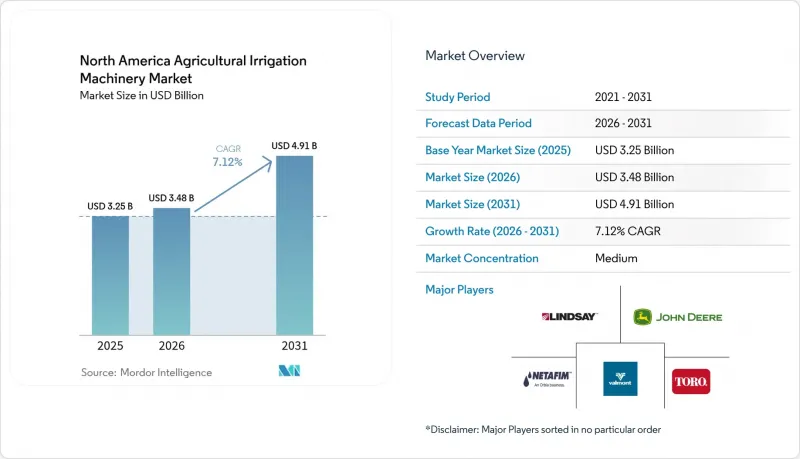
據 Mordor Intelligence 稱,北美農業灌溉機械市場預計到 2026 年價值 34.8 億美元,高於 2025 年的 32.5 億美元,預計到 2031 年將達到 49.1 億美元。
預計從 2026 年到 2031 年,其複合年成長率將達到 7.12%。
本報告依灌溉方式(噴水灌溉、滴灌、中心支軸式噴灌等)、應用領域(穀物、水果和蔬菜、豆類和油籽等)以及地區(美國、加拿大、墨西哥等)進行分類。市場預測以美元(USD)計價。
北美農業灌溉機械市場趨勢及洞察
利用數位孿生進行設計最佳化
虛擬建模平台可以將中心支軸式噴灌系統維修的規劃時間從數週縮短至數天,並將工程成本降低高達 18%。在 2024 年獲得大量資金支持的 CropTwin 專案中,土壤圖、天氣預報和作物係數被用於在訂購硬體之前模擬噴嘴位置。據內布拉斯加州和堪薩斯州的種植者反映,該軟體能夠揭示手動設計尺寸時經常被忽略的水壓瓶頸和跨度不匹配問題,從而防止因灌溉不均造成的產量損失。由於合理的區域分類對於節水至關重要,因此維修為可變灌溉系統將受益最大。透過將這些模擬器整合到客戶入口網站中,製造商可以使即使是技術人員有限的中型農場也能負擔得起先進的設計功能。
擴大灌溉面積
根據美國農業部的數據,大平原和密西西比Delta地區的灌溉面積正在逐步擴大;而在加拿大,亞伯達和薩斯喀徹爾省為新建灌溉區提供高達50%的補貼。在墨西哥北部各州,隨著墨西哥國家水務委員會(Conagua)補貼的加壓灌溉系統的引入,漫灌正在逐步被淘汰,儘管初期成本高昂,但對灌溉設備的需求仍在成長。生產者將灌溉基礎設施視為應對降雨不確定性的保障。儘管利率不斷上升,但由於穩定的產量能夠支撐長期盈利,許多農場仍在延長貸款償還期限。
高昂的投資和維護成本
最新的滴灌系統每英畝造價在1000美元到3000美元之間,而中心支軸式噴灌系統則根據噴灌跨度和自動化功能的不同,造價在5萬美元到15萬美元之間。每年的維護成本平均佔資本價值的4%,對利潤率低的農場來說是一筆不小的負擔。墨西哥國家糧食安全委員會(Conagua)的補貼降低了墨西哥小規模農戶的初始投資成本,但不涵蓋過濾器清潔和電力等持續性費用。糧食價格下跌延長了投資回收期,阻礙了設備的升級換代。
細分市場分析
2025年,中心支軸式噴灌系統將佔據北美農業灌溉機械市場38.72%的佔有率,反映出其適用於大規模行栽作物灌溉。可變灌溉量的改進,例如用區域控制噴頭取代固定噴嘴,正日益普及。滴灌感測器解決方案仍然是成長最快的細分市場,年複合成長率達12.05%,這主要得益於加州關於灌溉均勻性的法規以及多年生作物的推廣。在零件銷售方面,管道、過濾器和調壓閥佔據主導地位,而壓力補償式發送器則縮短了維護週期。移動式噴槍和固定式系統則滿足了草坪和苗圃種植的剩餘需求。
Valmont旗下「Valley」品牌的支軸式噴灌系統在2024年第三季銷量有所下滑,但該公司正大力投資擴大可變灌溉率支軸式噴灌系統的生產,展現出對長期發展的信心。流量計和遙測模組現已成為標準配置,以滿足奧加拉拉含水層各縣的用水量報告規定。太陽能混合幫浦和變頻驅動裝置降低了運作電力成本,而改裝套件則延長了舊支軸式噴灌系統的使用壽命。邊緣運算面板記錄運作,使生產者能夠透過節能獲得排碳權。
其他好處:
- Excel格式的市場預測(ME)表
- 3個月的分析師支持
目錄
第1章:引言
- 研究假設和市場定義
- 調查範圍
第2章:調查方法
第3章執行摘要
第4章 市場狀況
- 市場概覽
- 市場促進因素
- 利用數位孿生進行設計最佳化
- 擴大灌溉面積
- 政府支持推廣機械化灌溉
- 為增強應對氣候變遷的能力而提供的資金與智慧灌溉相關
- 引進採用新技術的灌溉方法
- 利用邊緣人工智慧進行預測性維護,降低營運成本。
- 市場限制因素
- 高昂的投資和維護成本
- 高科技系統的複雜功能
- 熟練灌溉技術人員短缺
- 網路灌溉系統的網路安全風險
- 監理情勢
- 技術展望
- 波特五力分析
第5章 市場規模與成長預測
- 透過灌溉法
- 噴水灌溉
- 水泵設備
- 注射器
- 感應器
- 控制器
- 配件和附件
- 噴頭/噴灌噴頭
- 管道
- 耦合器
- 流量計
- 其他噴水灌溉
- 滴灌
- 管道
- 回流防止裝置
- 壓力調節器
- 發送器
- 閥門
- 篩選
- 其他滴灌
- 中心支線灌溉
- 其他灌溉方法
- 噴水灌溉
- 按應用程式類型
- 穀物和穀類
- 水果和蔬菜
- 豆類和油籽
- 其他應用程式類型
- 按地區
- 美國
- 加拿大
- 墨西哥
- 其他北美國家
第6章 競爭情勢
- 市場集中度
- 策略趨勢
- 市佔率分析
- 公司簡介
- Netafim Ltd.
- TL Irrigation Co.
- Jain Irrigation Systems Ltd.
- Lindsay Corporation
- Nelson Irrigation Corporation
- Deere & Company
- The Toro Company
- Rain Bird Corporation
- Hunter Industries, Inc.
- Valmont Industries, Inc.
- Rivulis Irrigation Ltd.
- Reinke Manufacturing Co., Inc.
- Irritec SpA
- AquaSpy, Inc.
- CropX Technologies Ltd.
- Trimble Inc.
- Hunter Industries Inc.
- Pessl Instruments GmbH
- Hosur Plastics
第7章 市場機會與未來展望
According to Mordor Intelligence, North America agricultural irrigation machinery market size in 2026 is estimated at USD 3.48 billion, growing from 2025 value of USD 3.25 billion with 2031 projections showing USD 4.91 billion, growing at 7.12% CAGR over 2026-2031.
This report is Segmented by Irrigation Type (Sprinkler Irrigation, Drip Irrigation, Pivot Irrigation, and More), by Application Type (Grains and Cereals, Fruits and Vegetables, Pulses and Oilseeds, and More), and by Geography (United States, Canada, Mexico, and More). The Market Forecasts are Provided in Terms of Value (USD).
North America Agricultural Irrigation Machinery Market Trends and Insights
Digital-Twin Enabled Design Optimization
Virtual modeling platforms shorten center-pivot retrofit planning from weeks to days, trimming engineering outlays by as much as 18%. The CropTwin project, with heavy funding in 2024, uses soil maps, weather forecasts, and crop coefficients to simulate nozzle packages before hardware is ordered. Growers in Nebraska and Kansas report that the software highlights pressure bottlenecks and span mismatches overlooked during manual sizing, preventing yield loss tied to uneven distribution. Variable-rate retrofits benefit most because correct zone mapping is critical for water savings. As manufacturers embed these simulators into customer portals, mid-sized farms with limited technical staff gain affordable access to advanced design capability.
Increasing Area Under Irrigation
The United States Department of Agriculture (USDA) data show a gradual expansion of irrigated acreage in the High Plains and Mississippi Delta, while Canadian programs subsidize up to 50% of new irrigation districts in Alberta and Saskatchewan . Mexico's northern states are phasing out flood irrigation in favor of pressurized systems eligible for Conagua subsidies, boosting equipment demand despite higher upfront costs. Producers view irrigation infrastructure as insurance against erratic rainfall. Even with elevated interest rates, many operations stretch repayment schedules because stabilized yields support long-term profitability.
High Investment and Maintenance Costs
Modern drip systems cost USD 1,000 to USD 3,000 per acre, while pivots can range from USD 50,000 to USD 150,000 depending on span length and automation features. Annual upkeep averages 4% of capital value, a heavy burden for farms operating on slim margins. Conagua subsidies reduce acquisition costs for Mexican smallholders but do not offset recurring expenses such as filter cleaning and electricity bills. When grain prices soften, payback timelines lengthen, deterring upgrades.
Other drivers and restraints analyzed in the detailed report include:
- Government Support to Enhance Mechanized Irrigation
- Climate-Resilience Funding Tied to Smart Irrigation
- Scarcity of Skilled Irrigation Technologists
For complete list of drivers and restraints, kindly check the Table Of Contents.
Segment Analysis
Pivot irrigation held a 38.72% share of the North America agricultural irrigation machinery market in 2025, reflecting its fit with large-scale row-crop geometry. Variable-rate retrofits, which swap fixed nozzles for zone-controlled heads, are adding momentum. Drip-sensor solutions remain the fastest rising subsegment at a 12.05% CAGR, buoyed by California distribution uniformity mandates and permanent-crop adoption. Tubing, filters, and pressure regulators dominate component sales, while pressure-compensating emitters cut maintenance intervals. Traveling guns and solid-set systems capture the balance of niche demand in sod and nursery operations.
Valmont's Valley brand saw the pivot revenue decline in the third quarter of 2024, but the firm invested significantly to expand variable-rate pivot production, signaling long-term confidence. Flow meters and telemetry modules are now standard to satisfy water-reporting rules in Ogallala Aquifer counties. Solar-hybrid pumps and variable-frequency drives lower operating electricity costs, while retrofit kits extend service life for aging pivots. Edge-computing panels record run-time data, enabling growers to claim carbon credits for energy savings.
Complete Report Scope:
- By Irrigation type
- Sprinkler Irrigation
- Pumping Unit
- Injectors
- Sensors
- Controllers
- Fittings and Accessories
- Spray/Sprinklers Heads
- Tubing
- Couplers
- Flow Meters
- Other Sprinkler Irrigations
- Drip Irrigation
- Tubing
- Backflow Preventers
- Pressure Regulators
- Emitters
- Valves
- Filters
- Other Drip Irrigations
- Pivot Irrigation
- Other Irrigation Types
- Sprinkler Irrigation
- By Application Type
- Grains and Cereals
- Fruits and Vegetables
- Pulses and Oilseeds
- Other Application Types
- By Geography
- United States
- Canada
- Mexico
- Rest of North America
List of Companies Covered in this Report:
- Netafim Ltd.
- T-L Irrigation Co.
- Jain Irrigation Systems Ltd.
- Lindsay Corporation
- Nelson Irrigation Corporation
- Deere & Company
- The Toro Company
- Rain Bird Corporation
- Hunter Industries, Inc.
- Valmont Industries, Inc.
- Rivulis Irrigation Ltd.
- Reinke Manufacturing Co., Inc.
- Irritec S.p.A.
- AquaSpy, Inc.
- CropX Technologies Ltd.
- Trimble Inc.
- Hunter Industries Inc.
- Pessl Instruments GmbH
- Hosur Plastics
Additional Benefits:
- The market estimate (ME) sheet in Excel format
- 3 months of analyst support
TABLE OF CONTENTS
1 INTRODUCTION
- 1.1 Study Assumptions and Market Definition
- 1.2 Scope of the Study
2 RESEARCH METHODOLOGY
3 EXECUTIVE SUMMARY
4 MARKET LANDSCAPE
- 4.1 Market Overview
- 4.2 Market Drivers
- 4.2.1 Digital-Twin Enabled Design Optimization
- 4.2.2 Increasing Area Under Irrigation
- 4.2.3 Government Support to Enhance Mechanized Irrigation
- 4.2.4 Climate-Resilience Funding Tied to Smart Irrigation
- 4.2.5 Adoption of New Technological Irrigation Methods
- 4.2.6 Edge-Artificial Intelligence (AI) Based Predictive Maintenance Lowers OPEX
- 4.3 Market Restraints
- 4.3.1 High Investment and Maintenance Costs
- 4.3.2 Complex Functioning of High-Tech Systems
- 4.3.3 Scarcity of Skilled Irrigation Technologists
- 4.3.4 Cyber-Security Risks in Connected Irrigation Assets
- 4.4 Regulatory Landscape
- 4.5 Technological Outlook
- 4.6 Porter's Five Forces Analysis
- 4.6.1 Threat of New Entrants
- 4.6.2 Bargaining Power of Buyers/Consumers
- 4.6.3 Bargaining Power of Suppliers
- 4.6.4 Threat of Substitute Products
- 4.6.5 Intensity of Competitive Rivalry
5 MARKET SIZE AND GROWTH FORECASTS (VALUE)
- 5.1 By Irrigation type
- 5.1.1 Sprinkler Irrigation
- 5.1.1.1 Pumping Unit
- 5.1.1.2 Injectors
- 5.1.1.3 Sensors
- 5.1.1.4 Controllers
- 5.1.1.5 Fittings and Accessories
- 5.1.1.6 Spray/Sprinklers Heads
- 5.1.1.7 Tubing
- 5.1.1.8 Couplers
- 5.1.1.9 Flow Meters
- 5.1.1.10 Other Sprinkler Irrigations
- 5.1.2 Drip Irrigation
- 5.1.2.1 Tubing
- 5.1.2.2 Backflow Preventers
- 5.1.2.3 Pressure Regulators
- 5.1.2.4 Emitters
- 5.1.2.5 Valves
- 5.1.2.6 Filters
- 5.1.2.7 Other Drip Irrigations
- 5.1.3 Pivot Irrigation
- 5.1.4 Other Irrigation Types
- 5.1.1 Sprinkler Irrigation
- 5.2 By Application Type
- 5.2.1 Grains and Cereals
- 5.2.2 Fruits and Vegetables
- 5.2.3 Pulses and Oilseeds
- 5.2.4 Other Application Types
- 5.3 By Geography
- 5.3.1 United States
- 5.3.2 Canada
- 5.3.3 Mexico
- 5.3.4 Rest of North America
6 COMPETITIVE LANDSCAPE
- 6.1 Market Concentration
- 6.2 Strategic Moves
- 6.3 Market Share Analysis
- 6.4 Company Profiles (Includes Global Level Overview, Market Level Overview, Core Segments, Financials as Available, Strategic Information, Market Rank/Share for Key Companies, Products and Services, and Recent Developments)
- 6.4.1 Netafim Ltd.
- 6.4.2 T-L Irrigation Co.
- 6.4.3 Jain Irrigation Systems Ltd.
- 6.4.4 Lindsay Corporation
- 6.4.5 Nelson Irrigation Corporation
- 6.4.6 Deere & Company
- 6.4.7 The Toro Company
- 6.4.8 Rain Bird Corporation
- 6.4.9 Hunter Industries, Inc.
- 6.4.10 Valmont Industries, Inc.
- 6.4.11 Rivulis Irrigation Ltd.
- 6.4.12 Reinke Manufacturing Co., Inc.
- 6.4.13 Irritec S.p.A.
- 6.4.14 AquaSpy, Inc.
- 6.4.15 CropX Technologies Ltd.
- 6.4.16 Trimble Inc.
- 6.4.17 Hunter Industries Inc.
- 6.4.18 Pessl Instruments GmbH
- 6.4.19 Hosur Plastics
7 MARKET OPPORTUNITIES AND FUTURE OUTLOOK

 2026年全球農業灌溉機械市場報告
 自走式噴水灌溉系統市場:全球市場預測(2026-2032年)
 2026-2030年全球自動化灌溉系統市場
 人工智慧驅動的灌溉控制系統市場預測至2034年-全球分析(按感測器類型、灌溉系統、農場類型、應用、最終用戶和地區分類)
 噴水灌溉系統市場機會、成長要素、產業趨勢分析及2026-2035年預測。
 美國農業灌溉機械:市場佔有率分析、產業趨勢與統計、成長預測(2026-2031)農業灌溉機械:市場佔有率分析、產業趨勢與統計、成長預測(2026-2031)非洲農業灌溉機械:市場佔有率分析、產業趨勢與統計及成長預測(2026-2031 年)德國農業灌溉機械:市場佔有率分析、產業趨勢與統計及成長預測(2026-2031)噴水灌溉系統市場:按類型、組件、移動性、作物類型、自動化程度、水源、最終用戶和分銷管道分類-2026-2032年全球市場預測