


 |
市場調查報告書
商品編碼
2113415
德國農業灌溉機械:市場佔有率分析、產業趨勢與統計及成長預測(2026-2031)Germany Agricultural Irrigation Machinery - Market Share Analysis, Industry Trends & Statistics, Growth Forecasts (2026 - 2031) |
||||||

※ 本網頁內容可能與最新版本有所差異。詳細情況請與我們聯繫。
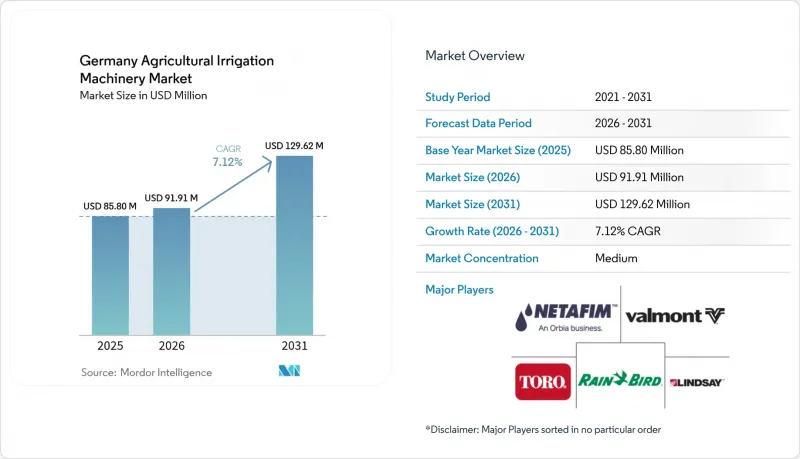
據 Mordor Intelligence 稱,德國農業灌溉機械市場預計到 2026 年價值 9,191 萬美元,高於 2025 年的 8,580 萬美元,預計到 2031 年將達到 1.2962 億美元。
預計 2026 年至 2031 年的複合年成長率為 7.12%。
本報告按灌溉方式(噴水灌溉和滴灌)、作物類型(田間作物、果園和葡萄園等)、動力來源(電力、柴油、太陽能)和自動化程度(手動、半自動等)進行細分。市場預測以美元計價。
德國農業灌溉機械市場趨勢與洞察
氣候智慧型資助計劃
2027年,聯邦和各州通用農業政策(CAP)每年將撥款約62億歐元(67億美元)用於資源高效型設備,2028年至2032年也提案類似數額的資金。在「農業環境與氣候行動」(Agrarumwelt und Klimamaßnahmen)框架下,滴灌系統的安裝被列為優先項目,導致噴灌升級的批准率較低。目前,獲得補貼的前提是安裝能夠傳輸用水資料的農場遠端資訊處理系統,這促使人們採用與Netafim GrowSphere和John Deere Operations Center等系統相容的物聯網控制器。在巴伐利亞州和北萊茵-威斯特法倫州,高達60%的共同資金籌措率使得核准的氣候適應計畫數量是全國平均水準的三倍多。相比之下,薩克森州的獲批率很少超過35%。此外,補助金結轉條款允許生產者將補助金與德國復興信貸銀行(KfW)的低利率貸款結合使用,從而將投資回收期縮短至四年以內。由於許多農業繼承者將數位化合規視為標準業務實踐,預計補助金機制將繼續以績效為基礎,而非以面積為基礎。
溫室園藝叢集的擴張
在德國,國內番茄產量佔總產量的12.5%,黃瓜產量佔10.4%,甜椒產量佔3.9%,但國內需求仍超過進口量。為了因應這項需求,投資者正在北萊茵-威斯特法倫州和巴伐利亞州的物流樞紐附近建造佔地數公頃的溫室。這些設施採用先進技術,例如閉迴路水耕系統、滴灌以及感測器控制的施肥和灌溉,以提高勞動力和水的利用效率。德國農業協會的一項研究表明,將滴灌與太陽能水泵結合,可以在連續五個生長季節保持產量穩定的情況下,減少35%的用水量。建築公司透過安裝用於暖氣、通風和空調(HVAC)的熱回收系統,並將冷凝水用於灌溉,進一步減少了8-10%的淡水消耗。由於溫室灌溉是一個資本密集系統,營運商通常依靠基於訂閱的服務合約來確保系統運作,從而成為 OEM(目的地設備製造商)公司軟體更新的穩定客戶。
在農場上打井需要很長時間才能獲得許可。
在巴登-符騰堡州,農業用水量超過每年5000立方公尺需要環境影響評估。該過程包括含水層建模、水位下降預測和生態學調查。評估週期可能長達6至18個月,這會延誤資本投資,迫使生產者考慮其他方案,例如租賃水權或使用昂貴的市政供水。雖然灌溉活動免繳該州每立方公尺0.051歐元(0.055美元)的地下水使用費,但小規模生產者通常需要聘請顧問來處理相關手續,增加工程成本約10%。萊茵蘭-普法爾茨州也面臨類似的挑戰,該州的地下水使用費為每立方公尺0.06歐元(0.065美元)。透過節水等抵消措施,該費用可以減半。諸如「庫倫塔」(Külenta)和「諾斯海德」(Northeide)等案件的判決促使政府制定了更嚴格的法規來保護生態系統水流。因此,獲得油井許可證預計將變得越來越嚴格。
細分市場分析
預計到2025年,滴灌將佔據德國農業灌溉機械市場54.12%的佔有率,並預計在2031年之前以11.68%的複合年成長率成長。這一成長預計將超過噴灌系統,主要得益於北萊茵-威斯特法倫州和巴伐利亞州溫室園藝叢集現有基礎設施的維修,以及缺水地區農戶為遵守地下水開採限制而採用地下滴灌系統。此外,優先發展節水技術的、以應對氣候變遷為導向的補貼計畫也為此細分市場的擴張提供了支持。在2024年國際農工園藝機械展覽會(EIMA)上發布的Netafim「GrowSphere」作業系統,將施肥和灌溉控制、土壤濕度反饋以及農業決策支援功能整合到滴灌硬體中,凸顯了產業向整合解決方案的轉變,這種轉變促使生產商簽訂多年服務合約。
噴水灌溉,包括移動式捲筒噴灌系統和中心支軸式噴灌系統,仍廣泛用於馬鈴薯、甜菜和穀物等田間作物。在下薩克森州,噴灌面積佔德國56萬公頃灌溉土地的48%,該州主要採用噴灌,因為其初始成本低,且易於在租賃農地之間遷移。然而,噴灌系統的推廣應用也面臨許多挑戰,例如工業用戶電費上漲(2024年4月達到每千瓦時20.16歐分),以及旨在減少因噴灌系統過度噴灑而加劇的硝酸鹽淋溶的監管措施。
蔬菜和保護性作物佔德國農業灌溉機械市場的37.74%,預計到2031年將以11.26%的複合年成長率成長。這一成長反映了德國蔬菜的結構性短缺,以及溫室叢集集中在北萊茵-威斯特法倫州和巴伐利亞州,在這些地區,滴灌是氣候控制生產的強制性要求。溫室經營者面臨嚴重的勞動力短缺,預計2024年,農業工人數將減少7%,降至87.6萬人。因此,整合養分供應、pH值調節和土壤濕度回饋的全自動施肥和灌溉平台對於企業的永續性至關重要。保護性作物的灌溉需求主要集中在番茄、黃瓜和辣椒上,其自給率分別為12.5%、10.4%和3.9%。低自給率造成了擴大國內生產能力的結構性獎勵,使 Netafim、Rivulis 和 Irritec 等高階滴灌系統供應商受益。
在巴登-符騰堡州、萊茵蘭-普法爾茨州和巴伐利亞州等地的果園和葡萄園中,滴灌和微噴灌系統的應用日益普及。這些系統因其防霜凍、精準施肥灌溉以及高效節水而備受青睞。迪爾公司基於雷射雷達的感測技術「智慧施肥」(Smart Apply)在索諾瑪縣的初步試驗中,農藥和用水量減少了28%,引起了德國其他葡萄園產區的關注。
草坪和觀賞植物市場是一個小眾市場,主要由市政景觀美化、體育設施和苗圃企業驅動,需求集中在都市區。在這個市場中,旋轉噴灌和滴灌帶因其澆水範圍精準、維護成本低等優點而被廣泛使用。
其他好處:
- Excel格式的市場預測(ME)表
- 3個月的分析師支持
目錄
第1章:引言
- 研究假設和市場定義
- 調查範圍
第2章:調查方法
第3章執行摘要
第4章 市場狀況
- 市場概覽
- 市場促進因素
- 具有氣候意識的補貼計劃
- 北德平原地下水鹽度增加
- 溫室園藝叢集的擴張
- 對太陽能發電泵進行維修
- 農業勞動力老化正在推動自動化。
- 利用排碳權資助擴大灌溉項目
- 市場限制因素
- 在農場上打井需要獲得許可,這需要時間。
- 租賃機器設備還是購買機器設備更可取?
- 電費波動
- 供應鏈中對進口微晶片的依賴
- 監理情勢
- 技術展望
- 波特五力分析
第5章 市場規模與成長預測
- 透過灌溉法
- 噴水灌溉
- 水泵設備
- 管道
- 耦合器
- 噴頭/噴灌噴頭
- 其他規則
- 滴灌
- 閥門
- 回流防止裝置
- 壓力調節閥
- 配件和附件
- 篩選
- 發送器
- 主要的
- 支線
- 其他規則
- 噴水灌溉
- 按作物類型
- 田間作物
- 果園和葡萄園
- 蔬菜和保護性作物
- 草坪和觀賞植物
- 透過電源
- 電的
- 柴油引擎
- 太陽的
- 按自動化級別
- 手動的
- 半自動
- 全自動/智慧
第6章 競爭情勢
- 市場集中度
- 策略趨勢
- 市佔率分析
- 公司簡介
- Netafim Limited(An Orbia Business)
- Valmont Industries, Inc.
- Rain Bird Corporation
- The Toro Company
- Nelson Irrigation Corporation
- Irritec SpA
- Ocmis Irrigazione SpA(Farmfront Group)
- Jain Irrigation Systems Ltd.(Rivulis Irrigation Ltd.)
- Bauer GmbH
- Lindsay Corporation
- Deere & Company
- TECO Electric & Machinery Co., Ltd.
第7章 市場機會與未來展望
According to Mordor Intelligence, Germany agricultural irrigation machinery market size in 2026 is estimated at USD 91.91 million, growing from 2025 value of USD 85.80 million with 2031 projections showing USD 129.62 million, growing at 7.12% CAGR over 2026-2031.
This report is Segmented by Irrigation Type (Sprinkler Irrigation and Drip Irrigation), by Crop Type (Field Crops, Fruits and Vineyards, and More), by Power Source (Electric, Diesel, and Solar), and by Automation Level (Manual, Semi-Automatic, and More). The Market Forecasts are Provided in Terms of Value (USD).
Germany Agricultural Irrigation Machinery Market Trends and Insights
Climate-Smart Subsidy Programs
Approximately EUR 6.2 billion (USD 6.7 billion) in federal and state Common Agricultural Policy funding is allocated annually to resource-efficient equipment through 2027, with similar allocations proposed for 2028-2032. Under the Agrarumwelt und KlimamaBnahmen framework, drip installations receive priority scoring, leading to a decline in approval rates for sprinkler upgrades. Subsidies now require on-farm telematics capable of transmitting water-use data, driving the adoption of IoT-ready controllers that are compatible with systems such as Netafim GrowSphere and the John Deere Operations Center. Bavaria and North Rhine-Westphalia approve over three times the national average of climate-adaptation applications due to co-financing rates of up to 60%, compared to Saxony, where rates rarely exceed 35%. Subsidy rollover provisions also allow growers to combine grants with low-interest KfW loans, reducing payback periods to less than four years. As many farm successors consider digital compliance a standard business practice, subsidy structures are projected to remain performance-linked rather than area-based.
Expansion of Greenhouse Horticulture Clusters
Germany produces 12.5% of its tomatoes, 10.4% of its cucumbers, and 3.9% of its peppers, while domestic demand continues to outpace imports. In response, investors are constructing multi-hectare greenhouses near logistics hubs in North Rhine-Westphalia and Bavaria. These facilities utilize advanced technologies, including closed hydroponic systems, subsurface drip laterals, and sensor-guided fertigation, to enhance labor and water efficiency. Research conducted by the German Agricultural Society has demonstrated that combining underground drip irrigation with solar-powered pumps reduces water usage by 35% while maintaining consistent yields over five consecutive growing seasons. Builders incorporate heating, ventilation, and air conditioning (HVAC) heat-recovery systems to recycle condensation for irrigation, further reducing freshwater consumption by 8-10%. Given the capital-intensive nature of greenhouse irrigation, operators often rely on subscription-based service contracts to ensure system uptime, making them consistent customers for original equipment manufacturer (OEM) software updates.
Lengthy Permitting for On-Farm Wells
In Baden-Wurttemberg, agricultural water extraction exceeding 5,000 cubic meters annually requires an environmental impact assessment. This process involves aquifer modeling, drawdown projections, and ecological studies. The processing time ranges from six to eighteen months, delaying capital investments and leading growers to explore alternatives such as rented water rights or costly municipal supplies. While irrigation activities are exempt from the state's EUR 0.051 (USD 0.055) per cubic meter groundwater fee, small growers often incur additional costs by hiring consultants to manage the paperwork, increasing project expenses by approximately 10%. Similar challenges are observed in Rhineland-Palatinate, where groundwater usage is charged at EUR 0.06 (USD 0.065) per cubic meter. Conservation offsets can reduce this fee by half. Legal rulings, such as the Currenta and Nordheide cases, have established stricter regulations to protect ecological flows. As a result, obtaining well approvals is projected to become increasingly stringent.
Other drivers and restraints analyzed in the detailed report include:
- Aging Farm Labor Force Driving Automation
- Rising Groundwater Salinity in North German Plains
- Supply Chain Dependence on Imported Microchips
For complete list of drivers and restraints, kindly check the Table Of Contents.
Segment Analysis
Drip irrigation accounted for 54.12% of the Germany agricultural irrigation machinery market share in 2025 and is projected to grow at a CAGR of 11.68% through 2031. This growth is set to surpass that of sprinkler systems, driven by the retrofitting of legacy infrastructure in greenhouse horticulture clusters in North Rhine-Westphalia and Bavaria, as well as the adoption of subsurface drip systems by field-crop growers in water-stressed regions to comply with groundwater extraction limits. The segment's expansion is supported by climate-smart subsidy programs that prioritize water-efficient technologies. Netafim's GrowSphere operating system, introduced at the International Exposition of Machinery for Agriculture and Gardening (EIMA) 2024, integrates drip hardware with fertigation control, soil-moisture feedback, and agronomic decision support, highlighting the industry's shift toward bundled solutions that secure growers into multi-year service agreements.
Sprinkler irrigation, including mobile reel-mounted systems and center-pivot installations, remains widely used for field crops such as potatoes, sugar beets, and cereals. Lower Saxony, which accounts for 48% of Germany's 560,000 hectares of irrigated land, predominantly utilizes sprinklers due to their lower initial costs and ease of relocation across rental parcels. The adoption of sprinkler systems faces challenges from increasing electricity tariffs, which reached 20.16 cents per kilowatt-hour for industrial users in April 2024, and regulatory measures aimed at reducing nitrate leaching, a problem exacerbated by over-application associated with sprinkler systems.
Vegetables and protected crops accounted for 37.74% of the German agricultural irrigation machinery market size and are projected to grow at a CAGR of 11.26% through 2031. This growth reflects Germany's structural vegetable deficit and the concentration of greenhouse clusters in North Rhine-Westphalia and Bavaria, where the use of drip irrigation is mandatory for climate-controlled production. Greenhouse operators are facing significant labor shortages, with agricultural employment projected to decline by 7% to 876,000 workers in 2024. As a result, fully automated fertigation platforms that integrate nutrient dosing, pH adjustment, and soil-moisture feedback have become essential for operational sustainability. Tomatoes, cucumbers, and peppers dominate the demand for protected-crop irrigation, with self-sufficiency rates of 12.5%, 10.4%, and 3.9%, respectively. These low self-sufficiency rates create a structural incentive for domestic capacity expansion, benefiting premium drip irrigation suppliers such as Netafim, Rivulis, and Irritec.
Fruits and vineyards, primarily located in Baden-Wurttemberg, Rhineland-Palatinate, and Bavaria, are increasingly adopting drip and micro-sprinkler systems. These systems are valued for their frost protection, fertigation precision, and water-use efficiency. Deere's Smart Apply LiDAR-based sensing technology has demonstrated a 28% reduction in chemical and water usage during pilot trials in Sonoma County, a result that has garnered interest from German viticulture regions.
The turf and ornamentals segment represents a niche market driven by municipal landscaping, sports facilities, and nursery operations, with demand concentrated in urban centers. This segment predominantly utilizes rotator sprinklers and drip tape, which offer precise coverage and low maintenance requirements.
Complete Report Scope:
- By Irrigation Type
- Sprinkler Irrigation
- Pumping Unit
- Tubing
- Coupler
- Spray / Sprinkler Heads
- Other Components
- Drip Irrigation
- Valves
- Back-flow Preventers
- Pressure Regulators
- Fittings and Accessories
- Filters
- Emitters
- Mainline
- Sub-main
- Other Components
- Sprinkler Irrigation
- By Crop Type
- Field Crops
- Fruits and Vineyards
- Vegetables and Protected Crops
- Turf and Ornamentals
- By Power Source
- Electric
- Diesel
- Solar
- By Automation Level
- Manual
- Semi-automatic
- Fully Automatic / Smart
List of Companies Covered in this Report:
- Netafim Limited (An Orbia Business)
- Valmont Industries, Inc.
- Rain Bird Corporation
- The Toro Company
- Nelson Irrigation Corporation
- Irritec S.p.A.
- Ocmis Irrigazione S.p.A. (Farmfront Group)
- Jain Irrigation Systems Ltd. (Rivulis Irrigation Ltd.)
- Bauer GmbH
- Lindsay Corporation
- Deere & Company
- TECO Electric & Machinery Co., Ltd.
Additional Benefits:
- The market estimate (ME) sheet in Excel format
- 3 months of analyst support
TABLE OF CONTENTS
1 Introduction
- 1.1 Study Assumptions and Market Definition
- 1.2 Scope of the Study
2 Research Methodology
3 Executive Summary
4 Market Landscape
- 4.1 Market Overview
- 4.2 Market Drivers
- 4.2.1 Climate-smart subsidy programs
- 4.2.2 Rising groundwater salinity in North German plains
- 4.2.3 Expansion of greenhouse horticulture clusters
- 4.2.4 Adoption of solar-powered pump retrofits
- 4.2.5 Aging farm labor force driving automation
- 4.2.6 Growth of carbon-credit funded irrigation projects
- 4.3 Market Restraints
- 4.3.1 Lengthy permitting for on-farm wells
- 4.3.2 Preference for leased versus owned machinery
- 4.3.3 Volatility of electricity tariffs
- 4.3.4 Supply chain dependence on imported microchips
- 4.4 Regulatory Landscape
- 4.5 Technological Outlook
- 4.6 Porter's Five Forces Analysis
- 4.6.1 Threat of New Entrants
- 4.6.2 Bargaining Power of Buyers
- 4.6.3 Bargaining Power of Suppliers
- 4.6.4 Threat of Substitutes
- 4.6.5 Intensity of Competitive Rivalry
5 Market Size and Growth Forecasts (Value)
- 5.1 By Irrigation Type
- 5.1.1 Sprinkler Irrigation
- 5.1.1.1 Pumping Unit
- 5.1.1.2 Tubing
- 5.1.1.3 Coupler
- 5.1.1.4 Spray / Sprinkler Heads
- 5.1.1.5 Other Components
- 5.1.2 Drip Irrigation
- 5.1.2.1 Valves
- 5.1.2.2 Back-flow Preventers
- 5.1.2.3 Pressure Regulators
- 5.1.2.4 Fittings and Accessories
- 5.1.2.5 Filters
- 5.1.2.6 Emitters
- 5.1.2.7 Mainline
- 5.1.2.8 Sub-main
- 5.1.2.9 Other Components
- 5.1.1 Sprinkler Irrigation
- 5.2 By Crop Type
- 5.2.1 Field Crops
- 5.2.2 Fruits and Vineyards
- 5.2.3 Vegetables and Protected Crops
- 5.2.4 Turf and Ornamentals
- 5.3 By Power Source
- 5.3.1 Electric
- 5.3.2 Diesel
- 5.3.3 Solar
- 5.4 By Automation Level
- 5.4.1 Manual
- 5.4.2 Semi-automatic
- 5.4.3 Fully Automatic / Smart
6 Competitive Landscape
- 6.1 Market Concentration
- 6.2 Strategic Moves
- 6.3 Market Share Analysis
- 6.4 Company Profiles (Includes Global-Level Overview, Market-Level Overview, Core Segments, Financials as Available, Strategic Information, Market Rank/Share for Key Companies, Products and Services, and Recent Developments)
- 6.4.1 Netafim Limited (An Orbia Business)
- 6.4.2 Valmont Industries, Inc.
- 6.4.3 Rain Bird Corporation
- 6.4.4 The Toro Company
- 6.4.5 Nelson Irrigation Corporation
- 6.4.6 Irritec S.p.A.
- 6.4.7 Ocmis Irrigazione S.p.A. (Farmfront Group)
- 6.4.8 Jain Irrigation Systems Ltd. (Rivulis Irrigation Ltd.)
- 6.4.9 Bauer GmbH
- 6.4.10 Lindsay Corporation
- 6.4.11 Deere & Company
- 6.4.12 TECO Electric & Machinery Co., Ltd.
7 Market Opportunities and Future Outlook

 2026-2030年全球自動化灌溉系統市場
 人工智慧驅動的灌溉控制系統市場預測至2034年-全球分析(按感測器類型、灌溉系統、農場類型、應用、最終用戶和地區分類)
 噴水灌溉系統市場機會、成長要素、產業趨勢分析及2026-2035年預測。
 美國農業灌溉機械:市場佔有率分析、產業趨勢與統計、成長預測(2026-2031)農業灌溉機械:市場佔有率分析、產業趨勢與統計、成長預測(2026-2031)非洲農業灌溉機械:市場佔有率分析、產業趨勢與統計及成長預測(2026-2031 年)北美農業灌溉機械:市場佔有率分析、產業趨勢與統計、成長預測(2026-2031)
 噴水灌溉系統市場:按類型、組件、移動性、作物類型、自動化程度、水源、最終用戶和分銷管道分類-2026-2032年全球市場預測自主灌溉控制系統市場預測至2034年:全球分析(按組件、灌溉方式、農場類型、技術、應用、最終用戶和地區分類)
 灌溉機械市場:按類型、應用和地區分類