


 |
市場調查報告書
商品編碼
2113566
非洲農業灌溉機械:市場佔有率分析、產業趨勢與統計及成長預測(2026-2031 年)Africa Agricultural Irrigation Machinery - Market Share Analysis, Industry Trends & Statistics, Growth Forecasts (2026 - 2031) |
||||||

※ 本網頁內容可能與最新版本有所差異。詳細情況請與我們聯繫。
據 Mordor Intelligence 稱,2025 年非洲農業灌溉機械市場價值 14.5 億美元,預計到 2031 年將從 2026 年的 15.9 億美元成長至 25.1 億美元,預測期(2026-2031 年)複合年成長率為 9.54%。
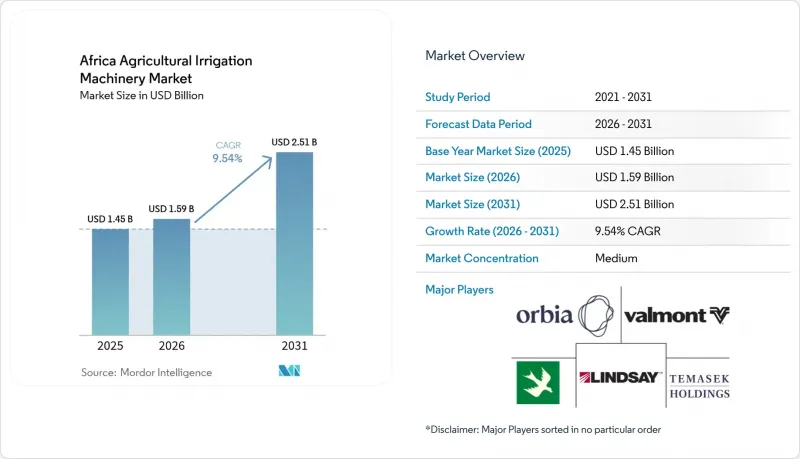
本報告按應用領域(作物相關和非作物相關)、灌溉方式(噴水灌溉、滴灌等)和地區(南非、埃及及非洲其他地區)進行細分。市場預測以美元計價。
非洲農業灌溉機械市場趨勢與洞察
水資源短缺日益嚴重,糧食安全需求也日益迫切。
儘管非洲只有一小部分耕地得到灌溉,但亞洲的灌溉比例要高得多。同時,非洲人口正在快速成長,預計糧食需求將翻倍。在薩赫勒地區,雨季降雨量持續低於平均水平,導致布吉納法索、尼日和馬利共和國等國實施了針對水稻和蔬菜田的緊急滴灌計畫。南部非洲近期遭受了數十年來最嚴重的乾旱,促使玉米和大豆農場引入了精準灌溉系統。由於尼羅河向埃及輸送的水量減少,現在對於超過一定規模的新農業項目,使用滴灌或噴水灌溉系統已成為強制性要求。預計北非的水資源供應將進一步減少,凸顯了提高灌溉效率以確保糧食安全的重要性。
擴大政府的微灌補貼計劃
埃及的「國家管道襯砌和現代化灌溉轉型計畫」著重津貼小規模農戶的大部分設備成本。摩洛哥的「綠色世代2020-2030」計畫透過承擔大部分滴灌成本來支持小規模農戶,並計劃在更大範圍內推廣微灌。南非正致力於透過引進太陽能滴灌設備來改造小規模農戶的灌溉系統。肯亞的「瓜拉納庫拉爾」計畫正在擴大覆蓋範圍,透過整合中心支軸式噴灌和滴灌管線,並採用包括津貼在內的資金籌措框架。這些措施顯著降低了農民的投資成本,使現代化灌溉系統更加經濟實惠。
初始投資成本高,與傳統漫灌相比
與溝灌基礎設施相比,精準灌溉系統對小規模農戶而言成本高得多,絕大多數生產者都難以負擔。在奈及利亞,儘管滴灌系統能顯著提高產量,但高昂的貸款利率延長了投資回收期。在加納,許多農民沒有正式的土地所有權,這限制了他們獲得充足的小額貸款,導致普通面積的農場缺乏足夠的資金來實施滴灌。在坦尚尼亞,儘管有補貼,但初始成本仍然是一大障礙,導致許多小規模農戶的灌溉計畫仍依賴重力灌溉系統。此外,區域關稅也推高了對進口零件的依賴。
細分市場分析
在非洲農業灌溉機械市場,預計到2025年,作物灌溉將佔銷售額的38.60%,主要用於南非Free State省和Mpumalanga省28萬公頃農田的玉米、小麥和大豆種植,這些農田配備了中心支軸式和滴灌系統。非作物灌溉領域,例如草坪、觀賞植物和苗圃灌溉,預計將以12.17%的複合年成長率成長,這主要得益於拉各斯、內羅畢和約翰內斯堡等城市綠化面積的擴大,以及肯尼亞和埃塞俄比亞出口花卉種植業的成長。 2024年,由於高爾夫球場通過實施天氣控制型噴灌控制設備以遵守市政用水限制,用水量減少了35%,草坪灌溉需求較去年同期增加14%。
在作物應用領域,成長最快的細分市場是蔬果產業,這主要得益於滴灌技術在埃及的推廣應用。 2024年至2025年間,埃及的番茄、辣椒和柑橘類水果滴灌面積將達8.5萬公頃。預計到2031年,非洲蔬果灌溉機械市場將以12.04%的複合年成長率成長,這得益於政府提供的津貼,補貼金額最高可達滴灌成本的60%。中心支軸式噴灌系統已應用於9.5萬公頃的油籽作物,但由於每公頃盈利較低,其推廣速度較為緩慢。同時,符合全球良好農業規範(GlobalGAP)節水標準的微型噴灌目前已安裝在1.2萬公頃的育苗作物上。肯亞2016年《水法》下的監管審計正進一步加速精準灌溉技術在作物和非作物領域的應用。
其他好處:
- Excel格式的市場預測(ME)表
- 3個月的分析師支持
目錄
第1章:引言
- 研究假設和市場定義
- 調查範圍
第2章:調查方法
第3章執行摘要
第4章 市場狀況
- 市場概覽
- 市場促進因素
- 為應對日益嚴重的水資源短缺和糧食安全問題所做的努力
- 擴大政府的微灌補貼計劃
- 迅速轉向為注重氣候的農業資金籌措
- 對中心樞軸式灌溉系統進行改造正成為大型農場的主流方法。
- 面向高階園藝細分市場的地下滴灌系統
- 利用農業技術的付費計量收費模式。
- 市場限制因素
- 與傳統漫灌相比,初始設備投資較高。
- 缺乏維護精密系統所需的技術技能。
- 外匯波動對進口零件的影響
- 土地所有權的分散化阻礙了規模經濟的實現。
- 監理情勢
- 技術展望
- 波特五力模型
第5章 市場規模與成長預測
- 透過使用
- 由糧食作物製成
- 穀類和穀類食品
- 油籽
- 水果和蔬菜
- 由非食用作物製成
- 草坪和觀賞植物
- 幼苗作物
- 由糧食作物製成
- 透過灌溉法
- 噴水灌溉
- 滴灌
- 中心支線灌溉
- 其他灌溉方法
- 按地區
- 南非
- 埃及
- 其他非洲國家
第6章 競爭情勢
- 市場集中度
- 策略趨勢
- 市佔率分析
- 公司簡介
- Netafim Limited(Orbia Advance Corporation)
- Valmont Industries
- Lindsay Corporation
- Rain Bird Corporation
- Rivulis(Temasek Holdings)
- Jain Irrigation Systems
- Nelson Irrigation Corporation
- Hunter Industries
- Toro Company
- Reinke Manufacturing
- TL Irrigation
- Agrico
- Metzer
- Amiad Water Systems
- Rainfine Irrigation
第7章 市場機會與未來展望
According to Mordor Intelligence, the Africa agricultural irrigation machinery market size was valued at USD 1.45 billion in 2025 and estimated to grow from USD 1.59 billion in 2026 to reach USD 2.51 billion by 2031, at a CAGR of 9.54% during the forecast period (2026-2031).
This report is Segmented by Application (Crop Based and Non-Crop Based), Irrigation Type (Sprinkler Irrigation, Drip Irrigation, and More), and Geography (South Africa, Egypt, and Rest of Africa). The Market Forecasts are Provided in Terms of Value (USD).
Africa Agricultural Irrigation Machinery Market Trends and Insights
Intensifying Water Scarcity and Food Security Mandates
Only a small percentage of Africa's cultivated land is irrigated compared to a significantly higher proportion in Asia, even as the continent's population is anticipated to grow substantially, doubling food demand. Consecutive below-average rainy seasons in the Sahel have led to emergency drip-irrigation programs for rice and vegetable plots in countries such as Burkina Faso, Niger, and Mali. Southern Africa recently faced its most severe drought in decades, prompting efforts to retrofit precision irrigation systems on maize and soybean farmland. Water allocations from the Nile to Egypt have decreased, resulting in mandatory use of drip or sprinkler irrigation systems for new agricultural projects of a certain size. Projections indicate that water availability in North Africa will decline further, highlighting the importance of improving irrigation efficiency to ensure food security.
Expansion of Government Micro-Irrigation Subsidy Schemes
Egypt's National Program for Lining Canals and Conversion to Modern Irrigation focuses on subsidizing a significant portion of equipment costs for small farms. Morocco's Green Generation 2020-2030 program supports smallholder farmers by covering a large share of drip irrigation costs, with plans to expand micro-irrigation across a substantial area. In South Africa, efforts are underway to upgrade smallholder schemes with solar-powered drip irrigation kits. Kenya's Galana-Kulalu project is expanding its coverage, integrating pivots and drip lines under a financial arrangement that includes a grant component. These initiatives significantly lower the capital expenditure for farmers, making modern irrigation systems more affordable.
High Upfront Capex versus Traditional Flood Irrigation
Precision irrigation systems are significantly more expensive for smallholders compared to furrow infrastructure, making them inaccessible for the majority of growers. High interest rates for loans in Nigeria extend the payback period for drip irrigation systems, even though they result in notable yield improvements. In Ghana, the lack of formal land titles among many farmers limits their access to adequate microfinance loans, which are insufficient for implementing drip irrigation on typical farm sizes. In Tanzania, most smallholder irrigation schemes continue to rely on gravity-fed systems, as the upfront costs remain a major obstacle despite subsidies. Furthermore, dependence on imported parts increases costs due to regional tariff duties.
Other drivers and restraints analyzed in the detailed report include:
- Rapid Pivot toward Climate-Smart Agriculture Financing
- Mainstream Adoption of Center-Pivot Retrofits on Large Estates
- Limited Technical Skills for Precision-System Maintenance
For complete list of drivers and restraints, kindly check the Table Of Contents.
Segment Analysis
Crop-based uses generated 38.60% of 2025 revenue in the African agricultural irrigation machinery market, led by maize, wheat, and soybean production on 280,000 hectares of center-pivot and drip-equipped estates in South Africa's Free State and Mpumalanga regions. Non-crop segments turf, ornamental, and nursery irrigation are set to outpace with a 12.17% CAGR as urban landscaping proliferates in Lagos, Nairobi, and Johannesburg, and export floriculture expands in Kenya and Ethiopia. Turf applications logged a 14% year-on-year rise in 2024, due to weather-based sprinkler controllers that cut water use by 35% on golf courses, aligning with municipal restrictions.
The fruits and vegetables sub-segment is the fastest-growing within crop-based uses, driven by Egypt's 85,000-hectare drip expansion for tomatoes, peppers, and citrus between 2024 and 2025. Africa agricultural irrigation machinery market size for fruits and vegetables is projected to advance at a 12.04% CAGR through 2031, aided by subsidies that defray up to 60% of drip costs. Oilseeds use pivots on 95,000 hectares yet lag due to lower per-hectare returns, while nursery crops now cover 12,000 hectares under micro-sprinklers that satisfy GlobalGAP water-efficiency rules for exports. Regulatory audits under Kenya's Water Act 2016 further propel precision adoption across both crop and non-crop categories.
Complete Report Scope:
- By Application
- Food Crop Based
- Cereals and Grains
- Oilseeds
- Fruits and Vegetables
- Non-Food Crop Based
- Turf and Ornamental
- Nursery Crops
- Food Crop Based
- By Irrigation Type
- Sprinkler Irrigation
- Drip Irrigation
- Pivot Irrigation
- Other Irrigation Types
- By Geography
- South Africa
- Egypt
- Rest of Africa
List of Companies Covered in this Report:
- Netafim Limited (Orbia Advance Corporation)
- Valmont Industries
- Lindsay Corporation
- Rain Bird Corporation
- Rivulis (Temasek Holdings)
- Jain Irrigation Systems
- Nelson Irrigation Corporation
- Hunter Industries
- Toro Company
- Reinke Manufacturing
- T-L Irrigation
- Agrico
- Metzer
- Amiad Water Systems
- Rainfine Irrigation
Additional Benefits:
- The market estimate (ME) sheet in Excel format
- 3 months of analyst support
TABLE OF CONTENTS
1 Introduction
- 1.1 Study Assumptions and Market Definition
- 1.2 Scope of the Study
2 Research Methodology
3 Executive Summary
4 Market Landscape
- 4.1 Market Overview
- 4.2 Market Drivers
- 4.2.1 Intensifying water scarcity and food-security mandates
- 4.2.2 Expansion of government micro-irrigation subsidy schemes
- 4.2.3 Rapid pivot toward climate-smart agriculture financing
- 4.2.4 Mainstream adoption of center-pivot retrofits on large estates
- 4.2.5 Underground drip systems for high-value horticulture niches
- 4.2.6 Agritech-enabled pay-per-use irrigation-as-a-service models
- 4.3 Market Restraints
- 4.3.1 High upfront capex versus traditional flood irrigation
- 4.3.2 Limited technical skills for precision-system maintenance
- 4.3.3 Foreign-exchange volatility affecting imported components
- 4.3.4 Fragmented land holdings limiting economies of scale
- 4.4 Regulatory Landscape
- 4.5 Technological Outlook
- 4.6 Porter's Five Forces
- 4.6.1 Threat of New Entrants
- 4.6.2 Bargaining Power of Buyers
- 4.6.3 Bargaining Power of Suppliers
- 4.6.4 Threat of Substitute Products
- 4.6.5 Intensity of Competitive Rivalry
5 Market Size and Growth Forecasts (Value)
- 5.1 By Application
- 5.1.1 Food Crop Based
- 5.1.1.1 Cereals and Grains
- 5.1.1.2 Oilseeds
- 5.1.1.3 Fruits and Vegetables
- 5.1.2 Non-Food Crop Based
- 5.1.2.1 Turf and Ornamental
- 5.1.2.2 Nursery Crops
- 5.1.1 Food Crop Based
- 5.2 By Irrigation Type
- 5.2.1 Sprinkler Irrigation
- 5.2.2 Drip Irrigation
- 5.2.3 Pivot Irrigation
- 5.2.4 Other Irrigation Types
- 5.3 By Geography
- 5.3.1 South Africa
- 5.3.2 Egypt
- 5.3.3 Rest of Africa
6 Competitive Landscape
- 6.1 Market Concentration
- 6.2 Strategic Moves
- 6.3 Market Share Analysis
- 6.4 Company Profiles (Includes Global level Overview, Market level overview, Core Segments, Financials as available, Strategic Information, Market Rank/Share for key companies, Products and Services, and Recent Developments)
- 6.4.1 Netafim Limited (Orbia Advance Corporation)
- 6.4.2 Valmont Industries
- 6.4.3 Lindsay Corporation
- 6.4.4 Rain Bird Corporation
- 6.4.5 Rivulis (Temasek Holdings)
- 6.4.6 Jain Irrigation Systems
- 6.4.7 Nelson Irrigation Corporation
- 6.4.8 Hunter Industries
- 6.4.9 Toro Company
- 6.4.10 Reinke Manufacturing
- 6.4.11 T-L Irrigation
- 6.4.12 Agrico
- 6.4.13 Metzer
- 6.4.14 Amiad Water Systems
- 6.4.15 Rainfine Irrigation
7 Market Opportunities and Future Outlook

 2026-2030年全球自動化灌溉系統市場
 人工智慧驅動的灌溉控制系統市場預測至2034年-全球分析(按感測器類型、灌溉系統、農場類型、應用、最終用戶和地區分類)
 噴水灌溉系統市場機會、成長要素、產業趨勢分析及2026-2035年預測。
 美國農業灌溉機械:市場佔有率分析、產業趨勢與統計、成長預測(2026-2031)農業灌溉機械:市場佔有率分析、產業趨勢與統計、成長預測(2026-2031)德國農業灌溉機械:市場佔有率分析、產業趨勢與統計及成長預測(2026-2031)北美農業灌溉機械:市場佔有率分析、產業趨勢與統計、成長預測(2026-2031)
 噴水灌溉系統市場:按類型、組件、移動性、作物類型、自動化程度、水源、最終用戶和分銷管道分類-2026-2032年全球市場預測自主灌溉控制系統市場預測至2034年:全球分析(按組件、灌溉方式、農場類型、技術、應用、最終用戶和地區分類)
 灌溉機械市場:按類型、應用和地區分類