

 |
市場調查報告書
商品編碼
2125640
中國半導體裝置:市場佔有率分析、產業趨勢與統計及成長預測(2026-2031)China Semiconductor Device - Market Share Analysis, Industry Trends & Statistics, Growth Forecasts (2026 - 2031) |
||||||

※ 本網頁內容可能與最新版本有所差異。詳細情況請與我們聯繫。
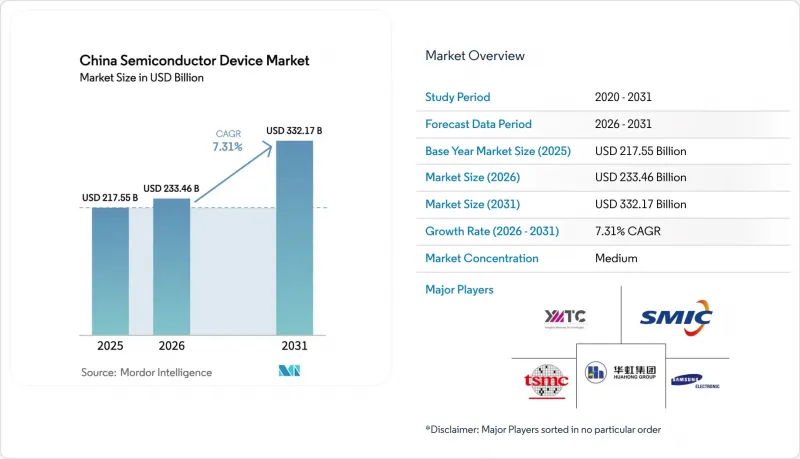
2025年中國半導體裝置市場價值為2,175.5億美元,預計到2031年將達到3,321.7億美元,而2026年為2,334.6億美元,預測期內(2026-2031年)複合年成長率為7.31%。
本報告按裝置類型(離散半導體[二極體、電晶體等]、光電子元件[LED、雷射二極體等]、感測器和MEMS[壓力感測器、執行器等]、積體電路)、經營模式(IDM、設計/無晶圓廠供應商)和最終用戶產業(汽車、通訊、消費、工業、計算/資料儲存、產業、計算/政府)。
中國半導體裝置市場趨勢與洞察
基於「中國製造2025」策略,加速積體電路產能擴張計劃
中國計劃在2024年將晶圓代工產能擴大15%,並計劃在2025年進一步增產14%,屆時中芯國際、華虹半導體和Nexchip等公司將全面運作其成熟節點的生產線。國產化進程目前已從製造流程擴展到光阻劑剝離和濕式清洗設備等領域,國內供應商在這些領域的採用率很高。預計到2027年,中國28nm晶圓產能將佔全球總產能的31%,將改變成熟節點的價格格局。該計劃的成功取決於穩定的電力供應、程式工程人才以及能夠緩解出口限制影響的備用設備生產線。總而言之,這項發展將鞏固國內消費電子、工業電子和汽車電子的供應鏈體系,進而提升整個生態系統的運轉率和獲利能力。
中國一級雲端服務供應商對以人工智慧為中心的邊緣運算的需求
阿里巴巴承諾2025年至2027年間投資3,800億元人民幣(約529億美元)發展人工智慧雲端基礎設施,騰訊和百度也宣布了類似的投資計畫。市場需求也延伸至GPU、高頻寬記憶體和網路交換器專用積體電路(ASIC),訂單正源源不斷地湧向本土半導體晶圓廠和記憶體製造商。 DeepSeek的基礎模式展現了中國軟硬體整合的能力,從而降低了對海外加速器的依賴。邊緣人工智慧工作負載傾向於低延遲的本地運算,這促使買家轉向符合國家資料主權法規的國產SoC。因此,超大規模資料中心業者資料中心資本投資與晶片級創新之間的良性循環將成為中期成長的主要驅動力。
美國出口管制實體清單中關於EUV和EDA工具的規定
美國政府於2024年10月和12月頒布的法規禁止向中國半導體製造廠出口極紫外光刻機、先進沉積設備和高階EDA許可證。國內製造商的大規模生產仍受限於28奈米工藝,必須在不使用ASML極紫外光刻技術的情況下,利用7奈米概念驗證(PoC)晶圓進行創新。替代方案包括正在測試的1奈米閘極長度的2D材料電晶體和先進的深紫外線多重圖形化,但商業性良率仍需數年時間才能實現。設備交付週期延長、軟體授權的不確定性以及合規性審計等問題都減緩了製程節點轉換的步伐。
細分市場分析
預計到2025年,積體電路將佔半導體銷售額的86.02%,並且由於人工智慧、5G和伺服器需求推動了對更大晶片尺寸和堆疊式V-cache解決方案的需求,其佔有率預計將進一步小幅成長。在中國半導體市場,積體電路正以8.02%的複合年成長率成長,預計到2031年新增產量將超過692億美元。長江儲存的232層3D NAND快閃記憶體和長江儲存的DDR5 80%良率凸顯了記憶體產業的強勁發展勢頭,而中芯國際的12吋晶片生產線運作運轉率已達89.6%,這得益於強勁的消費和工業需求。
分離式功率裝置、光電子裝置和感測器合計佔據剩餘的13.98%市場佔有率,受益於新能源汽車的電氣化以及5G對光元件日益成長的需求。國內碳化矽二極體產能每18個月加倍,用於智慧型手機3D感測的垂直腔面發射雷射(VCSEL)的出貨量也正轉向國內晶圓廠。儘管這些類別在以金額為準小規模,但它們在汽車安全、智慧工廠實施和擴增實境/虛擬實境(AR/VR)硬體領域卻是關鍵的差異化因素,有助於提升多個產業的韌性。
其他好處:
- Excel格式的市場預測(ME)表
- 3個月的分析師支持
目錄
第1章:引言
- 研究假設和市場定義
- 調查範圍
第2章:調查方法
第3章執行摘要
第4章 市場狀況
- 市場概覽
- 市場促進因素
- 基於「中國製造2025」策略,加速IC在亞太地區的產能擴張計劃
- 中國一級雲端服務供應商對以人工智慧為中心的邊緣運算的需求
- 汽車級SiC/GaN在新能源汽車動力傳動系統中的應用
- 日本 5G 基地台的發展正在推動射頻前端積體電路的普及。
- 工業4.0:從先進工業化到智慧工廠
- 疫情後AIoT賦能消費性設備(智慧穿戴設備、AR/VR)的復甦
- 市場限制因素
- 美國出口管制清單中關於EUV和EDA工具的規定
- 人才流向海外設計公司
- 高電力消耗量半導體製造廠面臨較低的碳排放配額限制。
- 300mm優質晶圓的價格持續波動。
- 產業價值鏈分析
- 監理展望
- 科技趨勢
- 波特五力分析
- 宏觀經濟因素影響評估
- 半導體代工廠的發展趨勢
- 主要公司的代工廠收入和市場佔有率
- IDM 和無晶圓廠銷售
- 亞太地區晶圓部署現狀(以晶圓廠位置分類)
第5章 市場規模與成長預測
- 依設備類型分類(依設備類型分類的出貨量資料為補充資料)
- 法令半導體
- 二極體
- 電晶體
- 功率電晶體
- 整流器和閘流體
- 其他分立元件
- 光電子學
- 發光二極體(LED)
- 雷射二極體
- 影像感測器
- 歐普託卡普拉
- 其他設備類型
- 感測器和微機電系統
- 壓力
- 磁場
- 執行器
- 加速度和偏航率
- 溫度和其他
- 積體電路
- 依積體電路類型
- 模擬
- 微
- 微處理器(MPU)
- 微控制器(MCU)
- 數位訊號處理器
- 邏輯
- 記憶
- 依技術節點分類(出貨量不適用)
- 小於3奈米
- 3nm
- 5nm
- 7nm
- 16nm
- 28nm
- 大於28奈米
- 依積體電路類型
- 法令半導體
- 按經營模式
- IDM
- 設計/無晶圓廠供應商
- 按最終用戶行業分類
- 車
- 通訊(有線和無線)
- 一般消費者
- 產業
- 計算/數據存儲
- 資料中心
- AI
第6章 競爭情勢
- 市場集中度
- 策略趨勢
- 市佔率分析
- 公司簡介
- Semiconductor Manufacturing International Corp(SMIC)
- Taiwan Semiconductor Manufacturing Co(TSMC)
- Hua Hong Group
- Intel Corp
- Samsung Electronics Co Ltd
- SK Hynix Inc
- Micron Technology Inc
- Yangtze Memory Technologies Co(YMTC)
- JCET Group Co Ltd
- Advanced Micro Devices Inc
- Qualcomm Inc
- Broadcom Inc
- Nvidia Corp
- NXP Semiconductors NV
- Infineon Technologies AG
- STMicroelectronics NV
- Texas Instruments Inc
- Will Semiconductor Co Ltd
- Goodix Technology
- ASE Technology Holding Co
- Renesas Electronics Corp
- Rohm Co Ltd
第7章 市場機會與未來展望
According to Mordor Intelligence, the China semiconductor device market size was valued at USD 217.55 billion in 2025 and estimated to grow from USD 233.46 billion in 2026 to reach USD 332.17 billion by 2031, at a CAGR of 7.31% during the forecast period (2026-2031).
This report is Segmented by Device Type (Discrete Semiconductors [Diodes, Transistors, and More], Optoelectronics [LEDs, Laser Diodes, and More], Sensors and MEMS [Pressure, Actuators, and More], and Integrated Circuits), Business Model (IDM, and Design/ Fabless Vendor), and End-Use Industry (Automotive, Communication, Consumer, Industrial, Computing/Data Storage, Data Center, AI, and Government).
China Semiconductor Device Market Trends and Insights
Accelerated "Made-in-China 2025" IC Capacity Expansion Programs
China expanded foundry capacity by 15% in 2024 and is scheduled to add another 14% in 2025 as SMIC, Huahong, and Nexchip ramp mature-node lines. Localization now stretches beyond fabrication to photoresist stripping and wet-clean tools, where domestic suppliers have achieved high usage rates. By 2027, China is projected to hold 31% of global 28 nm capacity, reshaping pricing at mature nodes. The program's success hinges on stable power, process-engineering talent, and second-source equipment lines that mitigate export-control exposure. Taken together, the rollout cements domestic supply for consumer, industrial, and automotive electronics, lifting utilization rates and margins across the ecosystem.
AI-Centric Edge-Computing Demand from Tier-1 Chinese Cloud Providers
Alibaba pledged CNY 380 billion (USD 52.9 billion) over 2025-2027 for AI-ready cloud infrastructure, while Tencent and Baidu announced comparable outlays. Demand spans GPUs, high-bandwidth memory, and network switch ASICs, channeling orders to local fabs and memory houses. DeepSeek's foundation model showcases China's ability to align software and hardware, easing reliance on foreign accelerators. Edge-AI workloads favor low-latency, on-premise compute, steering buyers toward domestically designed SOCs that comply with national data-sovereignty rules. The virtuous loop between hyperscaler capex and chip-level innovation is therefore a prime mid-term growth catalyst.
US Export-Control Entity-List Restrictions on EUV and EDA Tools
Washington's October 2024 and December 2024 rules bar shipment of EUV scanners, advanced deposition gear, and high-end EDA licenses to Chinese fabs. Domestic producers remain confined to 28 nm for mass production and must innovate around 7 nm proof-of-concept wafers without ASML EUV. Work-arounds include 2D-material transistors piloted at 1 nm gate length and advanced DUV multiple-patterning, but commercial yields are years away. Longer equipment lead-times, software license uncertainty, and compliance audits dampen the pace of node migration.
Other drivers and restraints analyzed in the detailed report include:
- Automotive-Grade SiC/GaN Adoption in NEV Powertrains
- National 5G Base-Station Build-Out Driving RF Front-End IC Uptake
- Talent Drain to Overseas Design Houses
For complete list of drivers and restraints, kindly check the Table Of Contents.
Segment Analysis
Integrated circuits accounted for 86.02% revenue in 2025, and their share is forecast to edge higher as AI, 5G, and server demand require larger die sizes and stacked V-cache solutions. Within the Chinese semiconductor market, integrated circuits are expected to expand at an 8.02% CAGR, adding more than USD 69.2 billion in new output by 2031. YMTC's 232-layer 3D NAND and CXMT's 80% DDR5 yield underscore momentum in memory, while SMIC's 12-inch lines run at 89.6% utilization on robust consumer and industrial demand.
Discrete power devices, optoelectronics, and sensors together occupy the remaining 13.98% share but are benefiting from NEV electrification and 5G optical-component pull. Domestic SiC diode capacity is doubling every 18 months, and VCSEL shipments for 3D sensing in smartphones are moving to local fabs. Although smaller in value, these categories contribute critical differentiation in automotive safety, smart-factory deployments, and AR/VR hardware, sustaining multi-segment resilience.
Complete Report Scope:
- By Device Type (Shipment Volume for Device Type is Complementary)
- Discrete Semiconductors
- Diodes
- Transistors
- Power Transistors
- Rectifier and Thyristor
- Other Discrete Devices
- Optoelectronics
- Light-Emitting Diodes (LEDs)
- Laser Diodes
- Image Sensors
- Optocouplers
- Other Device Types
- Sensors and MEMS
- Pressure
- Magnetic Field
- Actuators
- Acceleration and Yaw Rate
- Temperature and Others
- Integrated Circuits
- By Integrated Circuit Type
- Analog
- Micro
- Microprocessors (MPU)
- Microcontrollers (MCU)
- Digital Signal Processors
- Logic
- Memory
- By Technology Node (Shipment Volume Not Applicable)
- < 3nm
- 3nm
- 5nm
- 7nm
- 16nm
- 28nm
- > 28nm
- By Integrated Circuit Type
- Discrete Semiconductors
- By Business Model
- IDM
- Design/ Fabless Vendor
- By End-user Industry
- Automotive
- Communication (Wired and Wireless)
- Consumer
- Industrial
- Computing/Data Storage
- Data Center
- AI
List of Companies Covered in this Report:
- Semiconductor Manufacturing International Corp (SMIC)
- Taiwan Semiconductor Manufacturing Co (TSMC)
- Hua Hong Group
- Intel Corp
- Samsung Electronics Co Ltd
- SK Hynix Inc
- Micron Technology Inc
- Yangtze Memory Technologies Co (YMTC)
- JCET Group Co Ltd
- Advanced Micro Devices Inc
- Qualcomm Inc
- Broadcom Inc
- Nvidia Corp
- NXP Semiconductors NV
- Infineon Technologies AG
- STMicroelectronics NV
- Texas Instruments Inc
- Will Semiconductor Co Ltd
- Goodix Technology
- ASE Technology Holding Co
- Renesas Electronics Corp
- Rohm Co Ltd
Additional Benefits:
- The market estimate (ME) sheet in Excel format
- 3 months of analyst support
TABLE OF CONTENTS
1 INTRODUCTION
- 1.1 Study Assumptions and Market Definition
- 1.2 Scope of the Study
2 RESEARCH METHODOLOGY
3 EXECUTIVE SUMMARY
4 MARKET LANDSCAPE
- 4.1 Market Overview
- 4.2 Market Drivers
- 4.2.1 Accelerated "Made-in-China 2025" IC Asia-Pacificity Expansion Programs
- 4.2.2 AI-centric Edge-Computing Demand from Tier-1 Chinese Cloud Providers
- 4.2.3 Automotive-grade SiC/GaN Adoption in NEV Powertrains
- 4.2.4 National 5G Base-station Build-out Driving RF-Front-End IC Uptake
- 4.2.5 Industrial Upgrade to "Industry 4.0" Smart-Factories
- 4.2.6 Post-pandemic rebound of AIoT-enabled consumer devices (smart wearables, AR/VR)
- 4.3 Market Restraints
- 4.3.1 US Export-control Entity-List Restrictions on EUV and EDA Tools
- 4.3.2 Talent Drain to Overseas Design Houses
- 4.3.3 Electricity-Intensive Fabs Facing Provincial Carbon-Quota Caps
- 4.3.4 Persistent Price Volatility of 300 mm Prime Wafers
- 4.4 Industry Value Chain Analysis
- 4.5 Regulatory Outlook
- 4.6 Technological Trends
- 4.7 Porter's Five Forces Analysis
- 4.7.1 Threat of New Entrants
- 4.7.2 Bargaining Power of Buyers
- 4.7.3 Bargaining Power of Suppliers
- 4.7.4 Threat of Substitutes
- 4.7.5 Intensity of Rivalry
- 4.8 Impact Assessment of Macroeconomic Factors
- 4.9 Semiconductor Foundry Landscape
- 4.9.1 Foundry Revenue and Share by Players
- 4.9.2 IDM vs Fabless Sales
- 4.9.3 Installed Wafer Asia-Pacificity (by Fab Location)
5 MARKET SIZE AND GROWTH FORECASTS (VALUE)
- 5.1 By Device Type (Shipment Volume for Device Type is Complementary)
- 5.1.1 Discrete Semiconductors
- 5.1.1.1 Diodes
- 5.1.1.2 Transistors
- 5.1.1.3 Power Transistors
- 5.1.1.4 Rectifier and Thyristor
- 5.1.1.5 Other Discrete Devices
- 5.1.2 Optoelectronics
- 5.1.2.1 Light-Emitting Diodes (LEDs)
- 5.1.2.2 Laser Diodes
- 5.1.2.3 Image Sensors
- 5.1.2.4 Optocouplers
- 5.1.2.5 Other Device Types
- 5.1.3 Sensors and MEMS
- 5.1.3.1 Pressure
- 5.1.3.2 Magnetic Field
- 5.1.3.3 Actuators
- 5.1.3.4 Acceleration and Yaw Rate
- 5.1.3.5 Temperature and Others
- 5.1.4 Integrated Circuits
- 5.1.4.1 By Integrated Circuit Type
- 5.1.4.1.1 Analog
- 5.1.4.1.2 Micro
- 5.1.4.1.2.1 Microprocessors (MPU)
- 5.1.4.1.2.2 Microcontrollers (MCU)
- 5.1.4.1.2.3 Digital Signal Processors
- 5.1.4.1.3 Logic
- 5.1.4.1.4 Memory
- 5.1.4.2 By Technology Node (Shipment Volume Not Applicable)
- 5.1.4.2.1 < 3nm
- 5.1.4.2.2 3nm
- 5.1.4.2.3 5nm
- 5.1.4.2.4 7nm
- 5.1.4.2.5 16nm
- 5.1.4.2.6 28nm
- 5.1.4.2.7 > 28nm
- 5.1.4.1 By Integrated Circuit Type
- 5.1.1 Discrete Semiconductors
- 5.2 By Business Model
- 5.2.1 IDM
- 5.2.2 Design/ Fabless Vendor
- 5.3 By End-user Industry
- 5.3.1 Automotive
- 5.3.2 Communication (Wired and Wireless)
- 5.3.3 Consumer
- 5.3.4 Industrial
- 5.3.5 Computing/Data Storage
- 5.3.6 Data Center
- 5.3.7 AI
6 COMPETITIVE LANDSCAPE
- 6.1 Market Concentration
- 6.2 Strategic Moves
- 6.3 Market Share Analysis
- 6.4 Company Profiles (includes Global level Overview, Market level overview, Core Segments, Financials as available, Strategic Information, Market Rank/Share for key companies, Products and Services, and Recent Developments)
- 6.4.1 Semiconductor Manufacturing International Corp (SMIC)
- 6.4.2 Taiwan Semiconductor Manufacturing Co (TSMC)
- 6.4.3 Hua Hong Group
- 6.4.4 Intel Corp
- 6.4.5 Samsung Electronics Co Ltd
- 6.4.6 SK Hynix Inc
- 6.4.7 Micron Technology Inc
- 6.4.8 Yangtze Memory Technologies Co (YMTC)
- 6.4.9 JCET Group Co Ltd
- 6.4.10 Advanced Micro Devices Inc
- 6.4.11 Qualcomm Inc
- 6.4.12 Broadcom Inc
- 6.4.13 Nvidia Corp
- 6.4.14 NXP Semiconductors NV
- 6.4.15 Infineon Technologies AG
- 6.4.16 STMicroelectronics NV
- 6.4.17 Texas Instruments Inc
- 6.4.18 Will Semiconductor Co Ltd
- 6.4.19 Goodix Technology
- 6.4.20 ASE Technology Holding Co
- 6.4.21 Renesas Electronics Corp
- 6.4.22 Rohm Co Ltd
7 MARKET OPPORTUNITIES AND FUTURE OUTLOOK
- 7.1 White-space and Unmet-Need Assessment

 亞太地區半導體元件:市場佔有率分析、產業趨勢與統計及成長預測(2026-2031)北美和南美半導體裝置市場:市場佔有率分析、行業趨勢和統計數據以及成長預測(2026-2031 年)日本半導體裝置:市場佔有率分析、產業趨勢與統計、成長預測(2026-2031)歐洲半導體裝置:市場佔有率分析、產業趨勢與統計數據、成長預測(2026-2031)光敏半導體元件:市場佔有率分析、產業趨勢與統計、成長預測(2026-2031)
 2034年工業半導體市場預測-全球分析(依元件類型、材料、封裝類型、功率等級、晶圓尺寸、應用、終端用戶產業、製造模式、銷售管道和地區分類)
 半導體拆解服務市場:全球市場預測,2026-2032年用於加工應用的半導體裝置:市場佔有率分析、行業趨勢和統計數據以及成長預測(2026-2031 年)
 光敏半導體元件市場:依元件、材料、應用、工作模式、最終用戶、國家及地區分類-全球產業分析、市場規模、市場佔有率及2026年至2033年預測半導體裝置:市場佔有率分析、產業趨勢與統計、成長預測(2025-2030)