


 |
市場調查報告書
商品編碼
2119575
亞太地區半導體元件:市場佔有率分析、產業趨勢與統計及成長預測(2026-2031)Asia-Pacific Semiconductor Device - Market Share Analysis, Industry Trends & Statistics, Growth Forecasts (2026 - 2031) |
||||||

※ 本網頁內容可能與最新版本有所差異。詳細情況請與我們聯繫。
據 Mordor Intelligence 稱,亞太地區半導體裝置市場預計到 2026 年價值 4,671.5 億美元,高於 2025 年的 4,321.1 億美元,預計到 2031 年將達到 6,899 億美元。
預計 2026 年至 2031 年的複合年成長率為 8.11%。
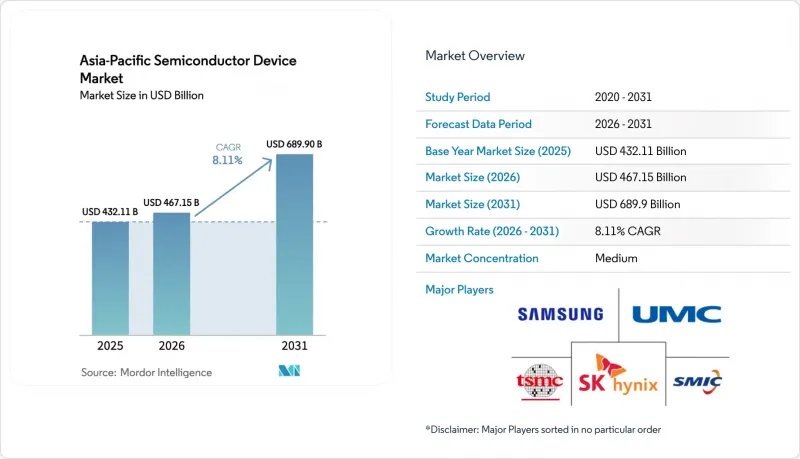
本報告按元件類型(離散半導體、光電子元件、感測器和微機電系統、積體電路)、經營模式(整合元件製造商和設計/無晶圓廠供應商)、終端用戶產業(汽車、通訊、消費性電子、工業、計算/資料儲存、資料中心、人工智慧等)以及國家/地區進行細分。市場預測以美元計價。
亞太地區半導體裝置市場趨勢及洞察。
對人工智慧驅動運算的需求正在激增。
用於生成式人工智慧和邊緣推理工作負載的人工智慧加速器持續對晶圓代工廠的產能帶來壓力,台積電的先進製程(7奈米及更精細製程)預計在2024年將佔其晶圓銷量的74%。 SK海力士的高頻寬記憶體(HBM)銷量較去年同期成長四倍,使其季度營業利潤創下8.08兆韓元的歷史新高。三星投入47.5兆韓元用於記憶體擴張,重點發展HBM3E和3奈米環柵(GAA)邏輯,以滿足人工智慧伺服器的需求。晶圓代工廠正在擴大其2.5D和3D晶片封裝生產線,但基板供應的限制預計將使前置作業時間延長至2026年。儘管由於神經網路架構(包括稀疏運算和記憶體內處理)的不斷最佳化,每TOPS的晶片尺寸預計將會減小,但隨著人工智慧滲透到個人電腦、智慧型手機和工業邊緣節點,晶圓開工總數預計將會增加。
汽車電氣化和高級駕駛輔助系統
為了降低對進口的依賴,中國正計劃在2025年前製定30多種關鍵汽車半導體的國內標準,並加速碳化矽(SiC)和微控制器(MCU)的在地採購。該地區電動車的普及推動了半導體需求的成長,東南亞汽車生產正轉向電池式電動車平台,與內燃機汽車相比,純電動車每輛車所需的功率裝置數量高達2.5倍。三星馬達預測,用於汽車應用的多層陶瓷電容器(MLCC)出貨量將以每年11%的速度成長,並計劃在2025年生產其首款支援雷射雷達(LiDAR)的電容器。意法半導體(STMicroelectronics)在全球碳化矽功率市場佔據32.6%的佔有率,並正在擴大其位於卡塔尼亞和無錫的產能,以支持到2030年實現兩位數的複合年成長率。諸如ISO 26262等關鍵功能安全標準持續推動對推進、感測和區域控制等領域高可靠性汽車積體電路的需求。
先進光刻和EDA的出口限制
自2022年以來,美國工業與安全局(BIS)的一系列決定限制了向中國晶圓廠銷售極紫外線(EUV)掃描器、直射電子束系統和先進EDA軟體。荷蘭和日本於2024年調整了政策,擴大了授權範圍,將深紫外線(DUV)多重圖形化和等離子體增強化學氣相沉積(PECVD)設備納入其中。作為回應,中國將部分美國製造的處理器排除在政府採購之外,並擴大了國內晶圓廠的授權範圍,總額達460億美元。跨國積體電路製造(IDM)公司被迫適應不同的合規體系,這增加了其法律和物流成本。然而,隨著28奈米及成熟節點的持續發展,地方政府的補貼和二線EDA供應商的支持正在緩解這些政策對亞太地區整體半導體裝置市場的短期負面影響。
細分市場分析
預計到2025年,積體電路(IC)將佔亞太地區半導體裝置市場銷售額的84.62%,並隨著先進邏輯晶片、HBM和LPDDR6出貨量的增加,保持其主導地位直至2031年。製程節點向3nm的轉變以及Rapidus公司建設計畫,進一步提升了該地區邏輯晶片的高價值密度。受人工智慧伺服器需求的支撐,記憶體市場週期性復甦帶動晶圓平均售價(ASP)上漲;同時,汽車MCU對基於28nm製程的嵌入式MRAM功能的需求也在成長,尤其是在日本和中國。
預計感測器和微機電系統(MEMS)產業將以9.54%的複合年成長率成長,在亞太地區超越整體半導體裝置市場,這主要得益於汽車雷達、雷射雷達以及智慧工廠環境感測技術的日益普及。到2031年,亞太地區用於擴增實境/虛擬實境(AR/ VR頭戴裝置的MEMS動作感測器的半導體裝置市場規模可能超過43.2億美元。光學元件和分立功率元件預計將保持中等個位數的成長率,這主要得益於對LED微顯示器的需求以及碳化矽(SiC)動力傳動系統的日益普及。
其他好處:
- Excel格式的市場預測(ME)表
- 3個月的分析師支持
目錄
第1章:引言
- 研究假設和市場定義
- 調查範圍
第2章:調查方法
第3章執行摘要
第4章 市場狀況
- 市場概覽
- 市場促進因素
- 對人工智慧驅動運算的需求正在激增。
- 汽車電氣化和高級駕駛輔助系統
- 5G/6G網路部署
- 區域補貼適用於7牛頓米以下的製造流程。
- 光伏/儲能系統的蓬勃發展正在推動對寬能隙功率裝置的需求。
- 由超大規模雲端服務供應商自主研發的晶片
- 市場限制因素
- 先進微影術和EDA的出口限制
- 設計和工程人員嚴重短缺。
- 製造實驗室中水和能源永續性的限制
- 記憶體市場的低迷抑制了資本投資。
- 產業價值鏈分析
- 監理情勢
- 技術展望
- 波特五力分析
- 宏觀經濟因素對市場的影響
第5章 市場規模與成長預測
- 依設備類型
- 法令半導體
- 二極體
- 電晶體
- 功率電晶體
- 整流器和閘流體
- 其他設備類型
- 光電子學
- 發光二極體(LED)
- 雷射二極體
- 影像感測器
- 光耦合器
- 其他光電子裝置
- 感測器和微機電系統
- 壓力
- 磁場
- 執行器
- 加速度和偏航率
- 溫度感測器和其他感測器/MEMS
- 積體電路
- 依積體電路類型
- 模擬
- 微
- 微處理器(MPU)
- 微控制器(MCU)
- 數位訊號處理器
- 邏輯
- 記憶
- 依技術節點
- 小於3奈米
- 3 nm
- 5 nm
- 7 nm
- 16 nm
- 28 nm
- 28奈米或更大
- 依積體電路類型
- 法令半導體
- 按經營模式
- IDM
- 設計/無晶圓廠供應商
- 按最終用戶行業分類
- 車
- 通訊(有線和無線)
- 一般消費者
- 產業
- 計算/數據存儲
- 資料中心
- 人工智慧
- 政府(航太/國防)
- 其他終端用戶產業
- 國家
- 中國
- 日本
- 韓國
- 台灣
- 印度
- 新加坡
- 馬來西亞
- 澳洲
- 印尼
- 其他亞太國家
第6章 競爭情勢
- 市場集中度
- 策略趨勢
- 市佔率分析
- 公司簡介
- Taiwan Semiconductor Manufacturing Company Limited(TSMC)
- Samsung Electronics Co., Ltd.
- SK hynix Inc.
- Semiconductor Manufacturing International Corporation
- United Microelectronics Corporation
- Hua Hong Semiconductor Limited
- Powerchip Semiconductor Manufacturing Corp.
- Tower Semiconductor Ltd.
- Renesas Electronics Corporation
- Rohm Co., Ltd.
- MediaTek Inc.
- Novatek Microelectronics Corp.
- Realtek Semiconductor Corp.
- Nuvoton Technology Corporation
- Winbond Electronics Corporation
- GigaDevice Semiconductor Inc.
- Shanghai Fudan Microelectronics Group Co., Ltd.(Unisoc)
- Silicon Motion Technology Corp.
- JCET Group Co., Ltd.
- Advanced Semiconductor Engineering Inc.
- Magnachip Semiconductor Corp.
- Macronix International Co., Ltd.
第7章 市場機會與未來展望
According to Mordor Intelligence, Asia-Pacific semiconductor device market size in 2026 is estimated at USD 467.15 billion, growing from 2025 value of USD 432.11 billion with 2031 projections showing USD 689.9 billion, growing at 8.11% CAGR over 2026-2031.
This report is Segmented by Device Type (Discrete Semiconductors, Optoelectronics, Sensors and MEMS, and Integrated Circuits), Business Model (IDM and Design/Fabless Vendor), End-User Industry (Automotive, Communication, Consumer, Industrial, Computing/Data Storage, Data Centre, Artificial Intelligence, and More), and Country. The Market Forecasts are Provided in Terms of Value (USD).
Asia-Pacific Semiconductor Device Market Trends and Insights
AI-centric compute demand surge
AI accelerators for generative and edge inference workloads continue to strain foundry capacity, with TSMC's advanced nodes (7 nm and finer) representing 74% of the company's wafer revenue in 2024. SK hynix lifted quarterly operating profit to a record KRW 8.08 trillion on high-bandwidth memory (HBM) sales that quadrupled year over year. Samsung has earmarked KRW 47.5 trillion for memory expansion focused on HBM3E and 3-nm gate-all-around logic to meet AI server demand. Foundries are scaling 2.5-D and 3-D chiplet packaging lines, yet substrate constraints keep lead times elevated into 2026. Continuous optimization of neural network architectures, including sparse computation and in-memory processing, is expected to reduce die size per TOPS but raise total wafer starts as AI permeates PCs, smartphones, and industrial edge nodes.
Electrification and ADAS in vehicles
China established domestic standards for more than 30 critical automotive semiconductors by 2025 to curb import dependence, accelerating local SiC and MCU sourcing. Regional EV adoption fuels incremental silicon content, with Southeast Asian vehicle output shifting toward battery electric platforms that require up to 2.5 times more power devices per unit than internal-combustion equivalents. Samsung Electro-Mechanics forecasts 11% annual growth in automotive MLCC shipments and plans production of the first LiDAR-grade capacitors in 2025. STMicroelectronics retains 32.6% share of the global SiC power market and is adding capacity in Catania and Wuxi to support double-digit CAGR through 2030. Mandatory functional-safety standards such as ISO 26262 continue to drive demand for high-reliability, automotive-grade ICs across propulsion, sensing, and zonal control domains.
Export controls on advanced lithography and EDA
Successive U.S. Bureau of Industry and Security rulings since 2022 restrict EUV scanners, direct-write e-beam tools, and advanced EDA software sales to Chinese fabs. The Netherlands and Japan aligned policies in 2024, extending licensing to deep-UV multipatterning and PECVD equipment. China retaliated by excluding certain U.S. processors from government procurement and boosting domestic fab approvals worth USD 46 billion. Multinational IDMs must navigate divergent compliance frameworks, elevating legal and logistical expenses. Yet, provincial subsidies and tier-two EDA vendors support ongoing 28 nm and mature-node expansions, tempering the near-term drag on the broader Asia-Pacific semiconductor device market.
Other drivers and restraints analyzed in the detailed report include:
- 5G/6G network roll-outs
- Regional subsidies for sub-7 nm fabs
- Acute design-engineering talent shortage
For complete list of drivers and restraints, kindly check the Table Of Contents.
Segment Analysis
Integrated circuits generated 84.62% of the Asia-Pacific semiconductor device market revenue in 2025 and are projected to retain leadership through 2031 as leading-edge logic, HBM, and LPDDR6 volumes scale. Node transitions to 3 nm and the planned 2 nm pilot line at Rapidus reinforce the high value density of logic die produced in the region. Memory's cyclical rebound, anchored by AI server demand, lifts blended wafer ASPs, while automotive-grade MCUs call for embedded MRAM features on 28 nm processes in Japan and China.
The sensors and MEMS category is forecast to outpace the broader Asia-Pacific semiconductor device market at a 9.54% CAGR on rising automotive radar, lidar, and environmental sensing adoption in smart factories. The Asia-Pacific semiconductor device market size for MEMS motion sensors used in AR/VR headsets could exceed USD 4.32 billion by 2031. Optical and discrete power devices register mid-single-digit growth, buoyed by LED micro-display demand and SiC powertrain rollouts.
Complete Report Scope:
- By Device Type
- Discrete Semiconductors
- Diodes
- Transistors
- Power Transistors
- Rectifier and Thyristor
- Other Device Type
- Optoelectronics
- Light-Emitting Diodes (LEDs)
- Laser Diodes
- Image Sensors
- Optocouplers
- Other Optoelectronics
- Sensors and MEMS
- Pressure
- Magnetic Field
- Actuators
- Acceleration and Yaw Rate
- Temperature and Other Sensors and MEMS
- Integrated Circuits
- By IC Type
- Analog
- Micro
- Microprocessors (MPU)
- Microcontrollers (MCU)
- Digital Signal Processors
- Logic
- Memory
- By Technology Node
- less than 3 nm
- 3 nm
- 5 nm
- 7 nm
- 16 nm
- 28 nm
- Above 28 nm
- By IC Type
- Discrete Semiconductors
- By Business Model
- IDM
- Design/Fabless Vendor
- By End-user Industry
- Automotive
- Communication (Wired and Wireless)
- Consumer
- Industrial
- Computing/Data Storage
- Data Centre
- Artificial Intelligence
- Government (Aerospace and Defence)
- Other End-user Industry
- By Country
- China
- Japan
- South Korea
- Taiwan
- India
- Singapore
- Malaysia
- Australia
- Indonesia
- Rest of Asia-Pacific
List of Companies Covered in this Report:
- Taiwan Semiconductor Manufacturing Company Limited (TSMC)
- Samsung Electronics Co., Ltd.
- SK hynix Inc.
- Semiconductor Manufacturing International Corporation
- United Microelectronics Corporation
- Hua Hong Semiconductor Limited
- Powerchip Semiconductor Manufacturing Corp.
- Tower Semiconductor Ltd.
- Renesas Electronics Corporation
- Rohm Co., Ltd.
- MediaTek Inc.
- Novatek Microelectronics Corp.
- Realtek Semiconductor Corp.
- Nuvoton Technology Corporation
- Winbond Electronics Corporation
- GigaDevice Semiconductor Inc.
- Shanghai Fudan Microelectronics Group Co., Ltd. (Unisoc)
- Silicon Motion Technology Corp.
- JCET Group Co., Ltd.
- Advanced Semiconductor Engineering Inc.
- Magnachip Semiconductor Corp.
- Macronix International Co., Ltd.
Additional Benefits:
- The market estimate (ME) sheet in Excel format
- 3 months of analyst support
TABLE OF CONTENTS
1 INTRODUCTION
- 1.1 Study Assumptions and Market Definition
- 1.2 Scope of the Study
2 RESEARCH METHODOLOGY
3 EXECUTIVE SUMMARY
4 MARKET LANDSCAPE
- 4.1 Market Overview
- 4.2 Market Drivers
- 4.2.1 AI-Centric Compute Demand Surge
- 4.2.2 Electrification and ADAS in Vehicles
- 4.2.3 5G/6G Network Rollouts
- 4.2.4 Regional Subsidies for Sub-7 Nm Fabs
- 4.2.5 PV/ESS Boom Boosting Wide-Band-Gap Power Devices
- 4.2.6 In-House Silicon by Hyperscale Cloud Providers
- 4.3 Market Restraints
- 4.3.1 Export Controls on Advanced Lithography and EDA
- 4.3.2 Acute Design-Engineering Talent Shortage
- 4.3.3 Water-Energy Sustainability Constraints on Fabs
- 4.3.4 Memory Down-Cycles Throttling CAPEX
- 4.4 Industry Value Chain Analysis
- 4.5 Regulatory Landscape
- 4.6 Technological Outlook
- 4.7 Porter's Five Forces Analysis
- 4.7.1 Threat of New Entrants
- 4.7.2 Bargaining Power of Suppliers
- 4.7.3 Bargaining Power of Buyers
- 4.7.4 Threat of Substitutes
- 4.7.5 Intensity of Competitive Rivalry
- 4.8 Impact of Macroeconomic Factors on the Market
5 MARKET SIZE AND GROWTH FORECASTS (VALUE)
- 5.1 By Device Type
- 5.1.1 Discrete Semiconductors
- 5.1.1.1 Diodes
- 5.1.1.2 Transistors
- 5.1.1.3 Power Transistors
- 5.1.1.4 Rectifier and Thyristor
- 5.1.1.5 Other Device Type
- 5.1.2 Optoelectronics
- 5.1.2.1 Light-Emitting Diodes (LEDs)
- 5.1.2.2 Laser Diodes
- 5.1.2.3 Image Sensors
- 5.1.2.4 Optocouplers
- 5.1.2.5 Other Optoelectronics
- 5.1.3 Sensors and MEMS
- 5.1.3.1 Pressure
- 5.1.3.2 Magnetic Field
- 5.1.3.3 Actuators
- 5.1.3.4 Acceleration and Yaw Rate
- 5.1.3.5 Temperature and Other Sensors and MEMS
- 5.1.4 Integrated Circuits
- 5.1.4.1 By IC Type
- 5.1.4.1.1 Analog
- 5.1.4.1.2 Micro
- 5.1.4.1.2.1 Microprocessors (MPU)
- 5.1.4.1.2.2 Microcontrollers (MCU)
- 5.1.4.1.2.3 Digital Signal Processors
- 5.1.4.1.3 Logic
- 5.1.4.1.4 Memory
- 5.1.4.2 By Technology Node
- 5.1.4.2.1 less than 3 nm
- 5.1.4.2.2 3 nm
- 5.1.4.2.3 5 nm
- 5.1.4.2.4 7 nm
- 5.1.4.2.5 16 nm
- 5.1.4.2.6 28 nm
- 5.1.4.2.7 Above 28 nm
- 5.1.4.1 By IC Type
- 5.1.1 Discrete Semiconductors
- 5.2 By Business Model
- 5.2.1 IDM
- 5.2.2 Design/Fabless Vendor
- 5.3 By End-user Industry
- 5.3.1 Automotive
- 5.3.2 Communication (Wired and Wireless)
- 5.3.3 Consumer
- 5.3.4 Industrial
- 5.3.5 Computing/Data Storage
- 5.3.6 Data Centre
- 5.3.7 Artificial Intelligence
- 5.3.8 Government (Aerospace and Defence)
- 5.3.9 Other End-user Industry
- 5.4 By Country
- 5.4.1 China
- 5.4.2 Japan
- 5.4.3 South Korea
- 5.4.4 Taiwan
- 5.4.5 India
- 5.4.6 Singapore
- 5.4.7 Malaysia
- 5.4.8 Australia
- 5.4.9 Indonesia
- 5.4.10 Rest of Asia-Pacific
6 COMPETITIVE LANDSCAPE
- 6.1 Market Concentration
- 6.2 Strategic Moves
- 6.3 Market Share Analysis
- 6.4 Company Profiles (includes Global level Overview, Market level overview, Core Segments, Financials as available, Strategic Information, Market Rank/Share, Products and Services, and Recent Developments)
- 6.4.1 Taiwan Semiconductor Manufacturing Company Limited (TSMC)
- 6.4.2 Samsung Electronics Co., Ltd.
- 6.4.3 SK hynix Inc.
- 6.4.4 Semiconductor Manufacturing International Corporation
- 6.4.5 United Microelectronics Corporation
- 6.4.6 Hua Hong Semiconductor Limited
- 6.4.7 Powerchip Semiconductor Manufacturing Corp.
- 6.4.8 Tower Semiconductor Ltd.
- 6.4.9 Renesas Electronics Corporation
- 6.4.10 Rohm Co., Ltd.
- 6.4.11 MediaTek Inc.
- 6.4.12 Novatek Microelectronics Corp.
- 6.4.13 Realtek Semiconductor Corp.
- 6.4.14 Nuvoton Technology Corporation
- 6.4.15 Winbond Electronics Corporation
- 6.4.16 GigaDevice Semiconductor Inc.
- 6.4.17 Shanghai Fudan Microelectronics Group Co., Ltd. (Unisoc)
- 6.4.18 Silicon Motion Technology Corp.
- 6.4.19 JCET Group Co., Ltd.
- 6.4.20 Advanced Semiconductor Engineering Inc.
- 6.4.21 Magnachip Semiconductor Corp.
- 6.4.22 Macronix International Co., Ltd.
7 MARKET OPPORTUNITIES AND FUTURE OUTLOOK
- 7.1 White-space and Unmet-need Assessment

 北美和南美半導體裝置市場:市場佔有率分析、行業趨勢和統計數據以及成長預測(2026-2031 年)日本半導體裝置:市場佔有率分析、產業趨勢與統計、成長預測(2026-2031)歐洲半導體裝置:市場佔有率分析、產業趨勢與統計數據、成長預測(2026-2031)光敏半導體元件:市場佔有率分析、產業趨勢與統計、成長預測(2026-2031)
 2034年工業半導體市場預測-全球分析(依元件類型、材料、封裝類型、功率等級、晶圓尺寸、應用、終端用戶產業、製造模式、銷售管道和地區分類)
 半導體拆解服務市場:全球市場預測,2026-2032年用於加工應用的半導體裝置:市場佔有率分析、行業趨勢和統計數據以及成長預測(2026-2031 年)
 光敏半導體元件市場:依元件、材料、應用、工作模式、最終用戶、國家及地區分類-全球產業分析、市場規模、市場佔有率及2026年至2033年預測半導體裝置:市場佔有率分析、產業趨勢與統計、成長預測(2025-2030)
 半導體環境感測器市場分析與預測(至2035年):類型、產品類型、技術、組件、應用、材料類型、最終用戶、功能、安裝方式、解決方案